Blog

  • Crypto Whales Accumulate as Bear Market Nears End

    Crypto Whales Accumulate as Bear Market Nears End

    Large Holders Accumulate Bitcoin, Ether, and XRP Amid Market Weakness

    Large holders of Bitcoin, Ether, and XRP have continued to increase their positions during the recent period of market weakness, according to analytics firm CryptoQuant.

    In its weekly report, titled “Buying the Bear: A Signal of the Bear Market’s Final Stage,” the firm analyzed the recent accumulation patterns among the largest wallets. CryptoQuant stated that this steady buying behavior is often observed during the closing stages of a bear market.

    For Bitcoin, wallets associated with major holders, excluding exchanges and miners, have expanded their collective balance to approximately 3.06 million BTC this year. The pace of buying accelerated after Bitcoin dipped below $60,000 in June, although current holdings remain below the peak reached in the 2025 cycle.

    Ethereum has demonstrated an even more pronounced accumulation trend among its largest holders. Wallets holding between 10,000 and 100,000 ETH have reached a record high of 19.6 million ETH. Meanwhile, addresses with over 100,000 ETH have added roughly 1.8 million ETH since mid-2025, marking an increase of approximately 70% in their holdings.

    This accumulation trend among large holders stands in contrast to the activity seen among smaller Ethereum holders. CryptoQuant noted that wallets outside these major groups have reduced their combined balance by about 2.7 million ETH since January, indicating a widening divergence between large and small-scale holders.

    A similar pattern has also been observed in XRP, where significant holders have continued to bolster their positions despite prevailing fears and liquidation events.

    The recent accumulation by these large holders occurs as all three assets are trading near key realized price levels. Realized price, which estimates the average acquisition cost for holders, is a widely used metric for assessing market cycles.

    Bitcoin was trading around $65,000, compared to its realized price of approximately $52,900. Ether changed hands near $1,920 against a realized price of about $2,450. XRP was trading near $1.04, with a realized price of approximately $0.75. CryptoQuant described these levels as consistent with conditions typically seen in the late stages of a bear market.

    According to CryptoQuant, the combination of whale accumulation and prices trading near realized values aligns with the closing phase of a bear market. The firm cautioned, however, that further downside is still possible before a definitive market bottom is confirmed.

  • Wall Street Dominates Crypto Spot Market, Driving 72% of Flow

    Wall Street Dominates Crypto Spot Market, Driving 72% of Flow

    Institutional Investors Dominate Crypto Markets, Shifting Trading Dynamics

    Institutional investors now represent a significant majority of cryptocurrency trading activity, reshaping market dynamics and reducing volatility, according to a new report from digital asset trading firm Wintermute. In the first half of 2026, institutional investors accounted for 72% of Wintermute’s spot over-the-counter (OTC) crypto flow, a notable increase from 59% a year prior.

    Concentration and Derivatives Drive Institutional Strategy

    The firm’s analysis indicates that professional investors are fundamentally altering the crypto landscape by focusing on a narrower selection of assets and increasingly utilizing derivatives. This strategic shift is contributing to a dampening of the extreme price swings that were once characteristic of retail-driven trading.

    Wintermute’s “1H26 OTC Report” revealed that institutional counterparties, encompassing hedge funds, digital asset treasuries, asset managers, and family offices, constituted 72% of the spot flow on its desk between January and June. This figure marks a substantial rise from 61% in the latter half of 2025 and 59% in the first half of 2025.

    The report highlights that institutional activity has reached a scale capable of influencing market direction and token performance. “Institutions are now the clear drivers of Wintermute’s OTC flow,” the firm stated, adding that their trading habits are actively reshaping how liquidity is distributed across the cryptocurrency ecosystem.

    A Narrower Focus on Key Assets

    One of the most pronounced changes observed is the institutional tendency to concentrate their trading on a more limited set of tokens. Between the first half of 2024 and the first half of 2026, the number of unique tokens traded by institutional counterparties saw a modest increase of just 24%. In contrast, retail traders expanded their engagement across 76% more unique tokens during the same period.

    Wintermute noted that this trend has led to a market where liquidity is increasingly consolidated within a smaller group of assets. Furthermore, institutional investors have demonstrably shifted more of their exposure into derivatives. The notional volume of altcoin options on Wintermute’s desk surged by 3.4 times between the second half of 2025 and the first half of 2026, as investors employed options strategies to generate yield.

    Reduced Volatility Linked to Institutional Influx

    The report also draws a correlation between increased institutional participation and a reduction in market volatility. Bitcoin’s realized volatility, for instance, has reportedly fallen from nearly 70% in 2025 to approximately 45% currently.

    Evgeny Gaevoy, CEO of Wintermute, commented to Bloomberg Crypto that institutions are fundamentally altering the behavior of the cryptocurrency market as they become a more dominant force in trading activity. The firm observed, “As the patient cohort grows, it is draining crypto of the volatility that once made the asset class so compelling to retail.”

    Bitcoin’s Steady Decline Amidst Institutional Shift

    Despite a prolonged downturn that has seen Bitcoin drop roughly 49% from its October peak above $126,000 last year, this decline has been characterized by relative steadiness, with fewer sudden and extreme price plunges compared to previous crypto winters. At the time of reporting, the flagship cryptocurrency was trading near $65,000, with minimal movement in the preceding 24 hours and a modest 1% increase over the past seven days, according to data from CoinGecko.

    These findings align with a broader trend of traditional financial institutions building out their cryptocurrency infrastructure this year. Notably, Morgan Stanley announced earlier this year its intention to introduce crypto trading on its E*Trade Platform, and the asset management firm also recently launched some of the most cost-effective ETH and SOL ETFs in the market.

  • وال‌استریت کنترل رمزارزها را تشدید کرد: نهادها ۷۲ درصد جریان اسپات را هدایت می‌کنند

    وال‌استریت کنترل رمزارزها را تشدید کرد: نهادها ۷۲ درصد جریان اسپات را هدایت می‌کنند

    نهادهای مالی بزرگ، هدایت‌کننده ۷۲ درصد جریان معاملاتی اسپات در بازار ارزهای دیجیتال

    تهران – شرکت Wintermute در گزارشی اعلام کرد که سرمایه‌گذاران نهادی در نیمه اول سال ۲۰۲۶، ۷۲ درصد از جریان معاملاتی اسپات (OTC) این شرکت را به خود اختصاص داده‌اند که این رقم در مقایسه با سال گذشته که ۵۹ درصد بود، افزایش قابل توجهی را نشان می‌دهد.

    به گفته این شرکت، سرمایه‌گذاران حرفه‌ای با تمرکز بر تعداد کمتری از دارایی‌ها، استفاده از ابزارهای مشتقه و کاهش نوسانات شدید قیمتی که پیش از این با معاملات خرد مرتبط بود، در حال تغییر چهره بازارهای ارزهای دیجیتال هستند.

    گزارش نیمه اول سال ۲۰۲۶ Wintermute نشان می‌دهد که طرف‌های مقابل نهادی، شامل صندوق‌های پوشش ریسک، خزانه‌داری دارایی‌های دیجیتال، مدیران دارایی و دفاتر خانوادگی، ۷۲ درصد از جریان اسپات در میز معاملات این شرکت را بین ماه‌های ژانویه تا ژوئن به خود اختصاص داده‌اند. این رقم در مقایسه با ۶۱ درصد در نیمه دوم سال ۲۰۲۵ و ۵۹ درصد در نیمه اول سال ۲۰۲۵، روند صعودی داشته است.

    این شرکت تاکید کرده است که فعالیت نهادی به اندازه‌ای بزرگ شده است که می‌تواند جهت بازار و عملکرد توکن‌ها را تحت تاثیر قرار دهد. Wintermute در گزارش خود آورده است: «نهادها اکنون محرکان اصلی جریان معاملاتی OTC ما هستند» و افزوده‌اند که عادات معاملاتی آن‌ها در حال تغییر نحوه توزیع نقدینگی در بازار ارزهای دیجیتال است.

    یکی از تغییرات عمده، تمرکز نهادها بر گروه کوچکتری از توکن‌ها است. بین نیمه اول سال ۲۰۲۴ و نیمه اول سال ۲۰۲۶، تعداد توکن‌های منحصربه‌فرد معامله شده توسط طرف‌های مقابل نهادی تنها ۲۴ درصد افزایش یافته است، در حالی که این رقم در میان معامله‌گران خرد در همین دوره ۷۶ درصد رشد داشته است.

    Wintermute اعلام کرد که این افزایش منجر به بازاری شده است که نقدینگی به طور فزاینده‌ای در دارایی‌های کمتری متمرکز می‌شود. سرمایه‌گذاران نهادی همچنین بخش بیشتری از سرمایه‌گذاری خود را به سمت ابزارهای مشتقه سوق داده‌اند. حجم اسمی اختیار معامله آلت‌کوین‌ها در میز معاملات Wintermute بین نیمه دوم سال ۲۰۲۵ و نیمه اول سال ۲۰۲۶، ۳.۴ برابر افزایش یافته است، زیرا سرمایه‌گذاران از استراتژی‌های اختیار معامله برای کسب بازده استفاده کرده‌اند.

    این گزارش همچنین مشارکت نهادی را با کاهش نوسانات مرتبط دانسته است؛ به طوری که نوسانات تحقق‌یافته بیت‌کوین از نزدیک به ۷۰ درصد در سال ۲۰۲۵ به حدود ۴۵ درصد در حال حاضر کاهش یافته است.

    اوگنی گائوووی، مدیرعامل Wintermute، در مصاحبه با Bloomberg Crypto اظهار داشت که با افزایش سهم نهادها در فعالیت‌های معاملاتی، آن‌ها در حال تغییر رفتار بازار ارزهای دیجیتال هستند. این شرکت نوشت: «با رشد این گروه صبور، نوسانات بازار ارزهای دیجیتال که زمانی این کلاس دارایی را برای سرمایه‌گذاران خرد جذاب می‌کرد، در حال کاهش است.»

    اگرچه رکود طولانی‌مدت بیت‌کوین شاهد افت تقریباً ۴۹ درصدی آن از اوج اکتبر سال گذشته در بالای ۱۲۶,۰۰۰ دلار بوده است، اما برخلاف زمستان‌های گذشته بازار ارزهای دیجیتال، این کاهش نسبتاً پایدار بوده و شاهد افت‌های ناگهانی و شدید قیمتی کمتری بوده‌ایم. در زمان نگارش این گزارش، این ارز دیجیتال اصلی با قیمت نزدیک به ۶۵,۰۰۰ دلار معامله می‌شد و داده‌های CoinGecko نشان می‌دهد که در ۲۴ ساعت گذشته تغییر چندانی نداشته و در طول هفت روز تنها ۱ درصد افزایش یافته است.

    یافته‌های این گزارش با الگوی گسترده‌تری از تلاش بانک‌ها برای توسعه زیرساخت‌های ارزهای دیجیتال در سال جاری مطابقت دارد. از جمله این تلاش‌ها، اعلام مورگان استنلی در اوایل سال جاری مبنی بر راه‌اندازی معاملات ارزهای دیجیتال در پلتفرم E*Trade خود بود. این شرکت مدیریت دارایی همچنین اخیراً ارزان‌ترین ETFهای اتریوم و سولانا را در آمریکا راه‌اندازی کرده است.

  • Bitcoin Price Outlook: Next Week’s Chart Signals

    Bitcoin Price Outlook: Next Week’s Chart Signals

    Bitcoin Consolidates as Bullish Momentum Falters Near Key Resistance

    Bitcoin remains entrenched in a broad consolidation pattern, with recent price recoveries failing to ignite convincing bullish momentum. The cryptocurrency is once again approaching overhead supply levels, but buyers have yet to demonstrate the breakout strength necessary to signal a significant structural shift.

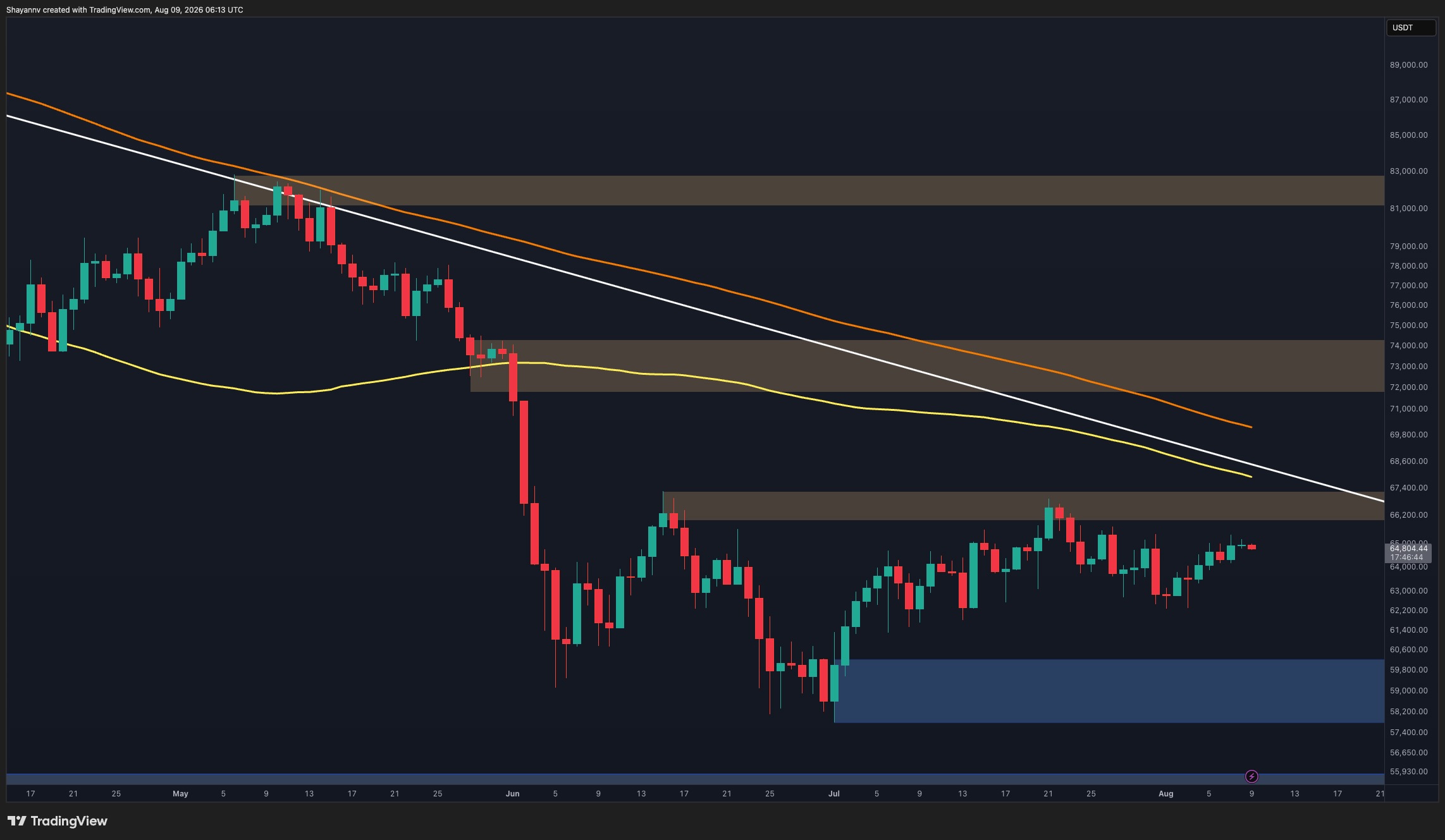
    On the daily chart, Bitcoin is trading around the $65,000 mark after rebounding from late June lows. However, this recovery continues to lack robust bullish conviction. Recent price action has shown compressed candles as the price nears the $65,800 to $66,800 resistance zone.

    This area has previously capped recovery attempts and is now further reinforced by a descending trendline approaching from above. Crucially, Bitcoin is trading below its declining moving averages, indicating that the broader market structure remains tilted towards bearish sentiment despite recent stabilization.

    Consequently, the current advance appears more indicative of consolidation beneath resistance rather than the commencement of a confirmed bullish reversal. A decisive daily breakout above the $65,800 to $66,800 zone and the descending trendline would improve the outlook. Conversely, another rejection could redirect attention back to the significant demand region between $57,800 and $60,000.

    The hesitant price action also suggests a market awaiting greater clarity on macroeconomic and geopolitical fronts. Developments concerning US-Iran tensions and the Strait of Hormuz, alongside upcoming US inflation data this month, could serve as catalysts for increased volatility. Until a decisive move materializes, Bitcoin may remain susceptible to sharp, liquidity-driven fluctuations within its current range.

    Immediate Challenges for Buyers

    The 4-hour chart highlights the immediate challenges facing buyers. Bitcoin has recovered substantially from the $61,800 to $62,300 support zone, but the rally has repeatedly struggled to reclaim the orange resistance box situated between $64,800 and $65,400.

    Recent price action shows consolidation around the lower boundary of this supply zone, rather than a decisive breach. This inability to retake resistance, despite the recovery from $62,000, suggests that bullish momentum is waning as it approaches a critical threshold.

    As long as Bitcoin remains below the $64,800 to $65,400 region, another rejection remains a significant possibility. Such a scenario could lead to a unwinding of the latest recovery and potentially expose the $61,800 to $62,300 support box once again.

    Conversely, a clean breakout and sustained acceptance above $65,400 would weaken this bearish outlook and could empower buyers to challenge the larger resistance area between $65,800 and $66,800.

    Realized Price Analysis Reveals Overhead Pressure

    The Realized Price UTXO Age Bands offer additional context for Bitcoin’s current market structure. This metric reveals the realized prices of holder cohorts aged 1-3 months and 3-6 months, which are currently positioned above the spot price at approximately $67,000 and $72,000, respectively.

    With Bitcoin trading near $65,000, both of these groups are holding coins at an aggregate unrealized loss. This creates a significant overhead cost-basis structure. Notably, the 1-3 month cohort’s realized price around $67,000 is relatively close to the current market and could act as resistance if Bitcoin continues to recover, as recently underwater holders may seek to exit their positions as they approach their cost basis.

    The 3-6 month cohort’s realized price around $72,000 represents another higher threshold. Reclaiming these realized-price bands would signify that the market is absorbing potential supply from recent buyers and would bolster the recovery narrative. Until then, their position above the spot price reinforces the technical picture, where Bitcoin continues to face substantial overhead resistance.

  • مایکل سیلر از حرکت بعدی بیت‌کوین خبر داد؛ تحلیلگران منتظر فروش دیگرند

    مایکل سیلر از حرکت بعدی بیت‌کوین خبر داد؛ تحلیلگران منتظر فروش دیگرند

    مایکل سیلر به حرکت بعدی MicroStrategy در حوزه بیت‌کوین اشاره کرد: تحلیلگران انتظار فروش دیگری را دارند

    رئیس هیئت مدیره و مدیرعامل سابق MicroStrategy در اقدامی که به سبک روزهای یکشنبه بود، اظهارنظرهای جالبی را در پلتفرم X (توییتر سابق) در خصوص آخرین تحرکات این شرکت در حوزه بیت‌کوین مطرح کرد.

    پیام امروز او با عبارت «Doing ₿usiness» (کسب و کار کردن) منتشر شد که در آن از لوگوی ارز دیجیتال بیت‌کوین به جای حرف اول کلمه دوم استفاده شده است. در حالی که بسیاری از تحلیلگران محبوب ارزهای دیجیتال و ناظران بازار این پست را بازنشر کرده و گمانه‌زنی کردند که این به معنای از سرگیری خرید بیت‌کوین توسط MicroStrategy است، نگاهی به رویدادهای هفته گذشته ممکن است داستانی متفاوت را روایت کند.

    مایکل سیلر هفته گذشته نیز پیش از اعلام سومین فروش بیت‌کوین سال توسط MicroStrategy، پیامی مبهم در X منتشر کرده بود. در آن فروش، این شرکت ۱۶۳۸ واحد بیت‌کوین را به ارزش کمی بیش از ۱۰۰ میلیون دلار واگذار کرد.

    تحلیلگران Lookonchain حتی پیش از اعلام رسمی این فروش، آن را رصد کرده بودند، زیرا کل دارایی‌های بیت‌کوین این شرکت به ۸۴۲,۱۳۸ واحد کاهش یافته بود.

    چند روز پیش، آن‌ها از احتمال فروش دیگری خبر دادند، زیرا کیف پولی مرتبط با بزرگترین دارنده شرکتی بیت‌کوین در جهان، بیش از ۱۰۰۰ واحد را منتقل کرده بود.

    این شرکت بخشی از عواید حاصل از فروش را برای خرید سهام خود، یعنی STRC، اختصاص داد. قیمت اسمی این سهام ۱۰۰ دلار تعیین شده است. با این حال، این سهم چند هفته پیش به زیر ۸۰ دلار سقوط کرد و MicroStrategy در واکنش به این وضعیت، خرید بیت‌کوین را در اواخر ژوئن متوقف کرد تا بر بازسازی ذخایر دلاری خود تمرکز کند. سهام STRC واکنش مثبتی نشان داده و از پایین‌ترین سطح خود ۲۰ دلار افزایش یافته و هفته را با قیمت ۹۵ دلار به پایان رساند.

  • XRP ETFs Shine Again Amidst New Worries

    XRP ETFs Shine Again Amidst New Worries

    XRP ETFs Maintain Upward Trend Amidst Emerging Concerns

    Spot exchange-traded funds tracking XRP, the sixth-largest cryptocurrency by market capitalization, have achieved their fourth consecutive week of gains. However, several warning signs are emerging that warrant attention.

    Meanwhile, the price of XRP’s native token has approached a critical support level that has, for now, held firm. Analysts are offering their perspectives on the asset’s future potential and what lies ahead.

    During May and June, periods marked by significant outflows from spot Bitcoin and Ethereum ETFs, often in the billions of dollars, XRP’s spot counterparts managed to buck the broader market slump. As previously reported, these ETFs experienced an impressive nine-week streak of positive performance. Even the single week that ended in the red in early May saw only a modest net outflow of $35,210.

    July began with a setback, as the first full week recorded over $7 million in net withdrawals. However, bullish sentiment returned in the subsequent three weeks, with inflows of $6.78 million, $8.15 million, and $14.86 million, respectively. This brought the month to a close with net inflows totaling $27.29 million.

    While this appears to be a positive outcome on the surface, a closer examination reveals the first warning sign: July represented the second-weakest month for net inflows since January of this year. The beginning of August has also seen positive net inflows, but another cautionary signal is the modest figure of just $1 million. In comparison, XRP ETFs attracted over $1 billion combined during the same period as BTC and ETH ETFs.

    Over the first five trading days of August, two days reported no significant activity ($0.00). Investors withdrew $3.58 million on Wednesday. Net inflows of $1.15 million on Monday and $3.45 million on Thursday were just enough to offset these outflows.

    The subdued ETF performance did little to support XRP’s price action during the week. The asset felt the negative impact of the delayed vote on the CLARITY Act in the U.S. Senate. As reported on Friday, the token dipped to $1.02, coming perilously close to falling below the key $1.00 support level.

    Despite these headwinds, analysts remain optimistic about XRP’s future price trajectory. Some anticipate a “strongest price reversal” if the asset can maintain its current support and reclaim the $1.05 level in the near term. Others have projected ambitious targets of up to $50 for the next bull run, though these figures are admittedly considered far-fetched at present.

  • رشد هفتگی ریپل (XRP) ادامه دارد؛ نگرانی‌های تازه پدیدار شد

    رشد هفتگی ریپل (XRP) ادامه دارد؛ نگرانی‌های تازه پدیدار شد

    صندوق‌های قابل معامله در بورس اسپات که ششمین ارز دیجیتال بزرگ از نظر ارزش بازار را دنبال می‌کنند، چهارمین هفته متوالی را در محدوده مثبت ثبت کرده‌اند. با این حال، نشانه‌های هشداردهنده‌ای وجود دارند که نمی‌توان آن‌ها را نادیده گرفت.

    در همین حال، قیمت توکن بومی به سمت سطح حمایتی کلیدی که تا کنون توانسته آن را حفظ کند، کاهش یافت. تحلیلگران در مورد پتانسیل این دارایی در آینده و آنچه ممکن است رخ دهد، اظهار نظر کرده‌اند.

    در طول ماه‌های می و ژوئن، زمانی که صندوق‌های اسپات بیت‌کوین و اتریوم به شدت با خروج سرمایه مواجه بودند، اغلب در حد میلیاردها دلار، طرف‌های مقابل صندوق اسپات ریپل (XRP) توانستند در برابر رکود کلی مقاومت کنند. همانطور که به طور مداوم گزارش کردیم، آن‌ها یک روند چشمگیر ۹ هفته‌ای متوالی را در محدوده مثبت ثبت کردند و حتی هفته‌ای که در اوایل ماه می در محدوده منفی قرار گرفت و این روند را متوقف کرد، تنها شاهد خروج خالص بسیار ناچیزی به مبلغ ۳۵,۲۱۰ دلار بود.

    ماه جولای با شروعی ناامیدکننده آغاز شد، زیرا در هفته اول بیش از ۷ میلیون دلار خروج خالص ثبت شد. با این حال، در سه هفته بعدی، گاوها بازگشتند و به ترتیب ۶.۷۸ میلیون دلار، ۸.۱۵ میلیون دلار و ۱۴.۸۶ میلیون دلار سرمایه وارد کردند. بنابراین، ماه با ورود خالص ۲۷.۲۹ میلیون دلاری به پایان رسید.

    در حالی که در ظاهر این یک پیروزی بزرگ به نظر می‌رسد، نگاهی عمیق‌تر اولین نشانه هشدار را نشان می‌دهد: این ماه از نظر ورود خالص از ژانویه امسال، دومین ماه ضعیف بوده است. آغاز ماه آگوست نیز در محدوده مثبت است، اما یک هشدار دیگر وجود دارد – ورود خالص واقعی تنها ۱ میلیون دلار است. در عین حال، صندوق‌های ETF بیت‌کوین و اتریوم در مجموع بیش از ۱ میلیارد دلار جذب کرده‌اند.

    در دو روز از پنج روز معاملاتی، هیچ رقم قابل گزارشی (۰.۰۰ دلار) ثبت نشد، در حالی که سرمایه‌گذاران در روز چهارشنبه ۳.۵۸ میلیون دلار برداشت کردند. ورود خالص ۱.۱۵ میلیون دلاری در روز دوشنبه و ۳.۴۵ میلیون دلاری در روز پنجشنبه به سختی توانست زیان‌ها را جبران کند.

    داده‌های ضعیف ETF نتوانست به XRP در طول هفته از نظر عملکرد قیمتی کمک کند و این دارایی پیامدهای منفی رأی‌گیری به تعویق افتاده قانون CLARITY در سنای ایالات متحده را احساس کرد. همانطور که در روز جمعه گزارش شد، این توکن به ۱.۰۲ دلار سقوط کرد و تنها چند اینچ با عبور از سطح حمایتی کلیدی ۱.۰۰ دلاری فاصله داشت.

    با این حال، تحلیلگران نسبت به عملکرد قیمتی آینده آن خوش‌بین باقی مانده‌اند. برخی انتظار “قوی‌ترین بازگشت قیمتی” را دارند، اگر این دارایی بتواند این حمایت را حفظ کرده و به زودی سطح ۱.۰۵ دلار را بازپس گیرد. برخی دیگر اهداف عظیمی را برای رالی صعودی بعدی تا ۵۰ دلار ترسیم کرده‌اند که البته در حال حاضر کمی دور از دسترس به نظر می‌رسد.

  • Altcoin Surges 50% Amid Bitcoin’s Drop Below $65K

    Altcoin Surges 50% Amid Bitcoin’s Drop Below $65K

    Bitcoin’s Price Action Remains Sluggish Over the Weekend

    Bitcoin’s price action has continued its dull trajectory over the weekend, with the cryptocurrency barely budging from the $65,000 range and currently trading just below that mark. Most larger-cap altcoins have also experienced sideways movement, though BNB has managed to reclaim the psychologically significant $600 level, while SOL and ZEC have seen gains of just over 2%.

    The business week began on a negative note for the primary cryptocurrency. After recovering some ground the previous weekend following former President Trump’s decision to cancel planned attacks against Iran, Bitcoin had settled near $64,000. However, it faced a swift rejection on Monday morning, slipping to $62,200.

    Bulls Intervene, Price Recovers

    Despite the downturn, bulls quickly intervened, helping Bitcoin rebound to $64,000 by Tuesday morning. The subsequent days saw gradual price increases, with BTC managing to touch $65,000. This upward momentum was halted, however, after the CLARITY Act encountered another setback in the U.S. Senate. A weak jobs report released on Friday then triggered a minor rally, pushing the asset to $65,400.

    Sideways Movement Persists

    Bitcoin was unable to sustain its climb and retreated to $65,000, a level it held throughout Saturday. The cryptocurrency remained range-bound on Sunday as well, currently trading a few hundred dollars below that threshold. Its market capitalization remains around $1.3 trillion, with its dominance over altcoins exceeding 57% according to CoinGecko.

    Altcoin Market Sees Mixed Performance

    The day’s standout performer in terms of gains is Audiera’s BEAT, a highly volatile token that has surged by 50% in the past 24 hours, reaching $3.30. PUMP and CC have followed suit with increases of 8-10%, while CRO has recovered some of its previous day’s losses, nearing $0.05 again.

    Solana has reclaimed the $76 level after a 2% increase, and ZEC is trading close to $220 following a nearly 3% jump. BNB is now above $600, while XRP, HYPE, DOGE, and RAIN have registered minor losses. Ethereum continues to trade above $1,900.

    The total market capitalization of all crypto assets has decreased by approximately $25 billion, now standing at $2.275 trillion, according to CoinGecko.

  • Amodei’s AI Forecasts Bitcoin’s 2026 Trajectory

    Amodei’s AI Forecasts Bitcoin’s 2026 Trajectory

    Bitcoin’s Tight Range Hints at Volatility Ahead as AI Predicts $150,000 Price

    With only 1.32 million coins remaining unmined and an estimated 4 million permanently lost, the dwindling supply of Bitcoin is poised to become a dominant narrative in the second half of the year, according to AI predictions. Claude Fable 5 forecasts a potential surge to $150,000 by December, a significant leap from its current trading price of $64,600.

    A Multifaceted Catalyst List

    The outlook is bolstered by an unusually extensive list of potential catalysts. Regulatory clarity, spearheaded by the CLARITY Act and closely followed by the GENIUS Act stablecoin framework, is leading the charge. Federal Reserve rate cuts are also expected to play a crucial role, particularly a widely anticipated dovish pivot once Jerome Powell’s term concludes in May. Persistent demand is further fueled by ETF holdings, which have already surpassed 1.5 million BTC.

    Behind the scenes, corporate treasuries are continuing their accumulation of Bitcoin. This is complemented by a burgeoning Bitcoin-backed lending market, which analysts project will exceed $100 billion this year. The historical pattern of post-halving cycles provides another layer of support, with demand for Bitcoin as a safe-haven asset during periods of macroeconomic stress serving as the final contributing factor.

    A Sobering Counterpoint

    However, the bullish outlook is tempered by recent market performance. June 2026 saw the worst monthly ETF outflow on record, amounting to approximately $4 billion. Bitcoin concluded the first half of the year down nearly 33%, a stark contrast to the rally experienced by tech stocks. Claude Fable 5 interprets this as a crypto-specific unwinding rather than a broader risk-off sentiment.

    The market is currently trading within a narrow band, oscillating between $63,900 and $65,000. Should the Federal Open Market Committee (FOMC) decision prove disappointing and outflows persist, the bearish scenario anticipates Bitcoin breaking key support levels and potentially falling towards $45,000.

    Charting the Recent Price Action

    The daily chart illustrates a complete price cycle. Bitcoin experienced a significant run from $75,000 last April to a peak near $126,000 in October. The subsequent unwind began in November, with prices falling to roughly $80,000 by December, followed by a brief recovery attempt.

    February marked a decisive downturn, with prices plummeting from $90,000 to $60,000. The spring saw a rebound, reaching $82,000 by May, only for June to erase these gains and return Bitcoin to $58,000. Since then, the price structure has consolidated into a tight base with incrementally higher lows.

    The latest closing price was $64,809, marking a 0.86% increase and a gain of $553 for the session. The daily trading range spanned from $64,103 to $64,910. Immediate support is identified at $63,900, followed by $60,000 and $58,000. Resistance levels are situated at $68,000, $72,000, and $76,000.

    The Relative Strength Index (RSI) stands at 54.15, with the signal line at 49.64. This gap of approximately 4.5 points suggests a mild bullish leaning, albeit without strong conviction. Both indicators are hovering near the midpoint of their range, indicating a flattening momentum and a state of indecision.

    Claude Fable 5 characterizes the current price range as a “coiled spring,” with the FOMC outcome expected to dictate the direction of the next significant price movement.

  • Top 5 Global Payment Platforms for Businesses

    Top 5 Global Payment Platforms for Businesses

    Global Businesses Grapple with Complex Payment Challenges

    Companies operating across multiple countries and serving a diverse international customer base often encounter payment hurdles that traditional banking systems are ill-equipped to handle. These challenges can manifest as lengthy wire transfer clearing times, fees levied by correspondent banks at each stage, and significant delays for contractors in locations like Buenos Aires, Singapore, or Lagos, who may wait longer for payment than the duration of their work. While stablecoins offer some improvements by streamlining certain payment routes, they are not a universally perfect solution.

    This guide explores some of the leading payment platforms available to businesses today, detailing their fees, supported destinations, and regulatory oversight. Our evaluation considered published pricing, regulatory standing, the range of currencies and countries each platform serves, and the ease with which businesses could verify this information without needing to schedule a sales call. This last criterion proved to be a significant differentiator, with several established providers offering only a contact form, a fact we have noted where applicable.

    Here are five platforms and their primary use cases:

    Performa: Digital Asset Payment Infrastructure

    Performa provides payment infrastructure for companies that manage digital assets and require bidirectional movement of these funds. The platform enables businesses to accept payments via links and invoices, execute bulk payouts from CSV files, convert between cryptocurrency and fiat through vetted over-the-counter (OTC) partners, and monitor all wallet activity from a centralized treasury dashboard.

    For payroll, finance teams can upload a contractor list and process all payments in a single run, eliminating the per-transfer bank charges that can make small international payments uneconomical. Onboarding is offered in two tiers: simplified verification for basic account access, and full Know Your Business (KYB) verification to lift limits and unlock additional benefits. The platform supports both custodial and self-custodial wallets, allowing companies to retain control of their private keys if desired.

    In a nutshell:

    • Pros: Facilitates digital asset management and cross-border payments, streamlines payroll, offers flexible wallet options.
    • Cons: Specific details on fees and limitations require direct inquiry.

    BVNK: Global Stablecoin and Fiat Solutions

    BVNK, a London-based company, specializes in accepting stablecoins, holding balances, and converting them to fiat, with the added capability of API integration. The company processes approximately $30 billion annually across more than 200 markets. Mastercard acquired BVNK earlier in 2026 for $1.5 billion, with an additional $300 million tied to performance milestones, a deal that closed on August 3, ahead of its original December target. This acquisition was one of the largest stablecoin deals on record, following earlier acquisition talks by Coinbase valued at around $2 billion.

    BVNK boasts an extensive regulatory footprint, holding over 40 licenses and registrations across the UK, EU, and US, including an electronic money institution authorization from the Financial Conduct Authority. The platform operates on enterprise terms, with one significant restriction: [details not provided in source text].

    In a nutshell:

    • Pros: Extensive global reach, strong regulatory compliance, significant transaction volume, Mastercard backing.
    • Cons: Primarily enterprise-focused, specific restrictions apply.

    NOWPayments: Versatile Crypto Payment Gateway

    Launched by ChangeNOW in 2019, NOWPayments is a cryptocurrency payment gateway that supports over 300 cryptocurrencies and 75 fiat currencies, settling funds to a merchant-controlled wallet. Payments are routed through a one-time deposit address. Merchants can opt to convert received assets into different cryptocurrencies, with payouts automatically sent to their designated wallet. An optional Custody product allows for pooling funds within the platform, enabling merchants to make a single withdrawal rather than incurring network fees for each individual payment.

    The platform supports mass payouts of up to 1,000 transactions at a time, suitable for contractor payroll, refunds, and affiliate payments. The service fee is 0.5% for mono-currency payments (where the customer and merchant use the same coin). This fee increases to 1% for payments involving currency conversion, or when a fixed exchange rate or the fee-paid-by-user option is activated. Network fees are additional, with the company’s documentation indicating three per payment: one paid by the customer and two deducted from the deposit.

    In a nutshell:

    • Pros: Wide range of supported cryptocurrencies and fiat currencies, flexible settlement options, mass payout capabilities.
    • Cons: Network fees are additional to service fees, potential for multiple network fees per transaction.

    BitPay: Established Crypto Payment Processor

    BitPay has been processing cryptocurrency payments since 2011 and is recognized as one of the leading payment service providers and digital wallet applications. The New York Department of Financial Services licenses BitPay for virtual currency business activity under NMLS ID 1496848.

    The platform supports a broad array of assets, including BTC, BCH, ETH, XRP, LTC, DOGE, USDC, DAI, and EURC, among others. Fiat settlement is available in seven currencies, including the US dollar, euro, and British pound. Merchants can choose to receive payments in fiat, crypto, or a combination of both, with fiat funds typically arriving in their bank account daily. Fee structures are tiered: 2% plus 25 cents for transactions below $500,000; 1.5% plus 25 cents for transactions between $500,000 and $999,999; and 1% plus 25 cents for transactions of $1 million or more.

    In a nutshell:

    • Pros: Long-standing reputation, broad asset support, flexible settlement options, tiered fee structure.
    • Cons: Fiat settlement limited to seven currencies, transaction fees can be significant for smaller amounts.

    Revolut: European Payment Giant with Crypto Integration

    Revolut stands as Europe’s largest payment processor, offering multi-currency balances, local account details, cards, expense management, and API access across markets including the UK, US, EEA, Singapore, Australia, and the UAE. Cryptocurrency is integrated as an investable asset within the Revolut Business app, allowing businesses to buy, hold, and sell over 220 tokens. The majority of funds are kept in cold storage, with permissions governing team member trading activities.

    However, it is crucial to understand Revolut’s limitations: businesses cannot receive cryptocurrencies from external accounts, nor can they send cryptocurrencies from their Revolut Business account. Funds originating from crypto dealing or trading are also prohibited under the terms. The crypto functionality primarily serves as treasury exposure, with payments still processed through traditional banking rails.

    Published pricing is available in a legal fee schedule: UK plans include Basic at £10 per month, Grow at £35 per month or £360 annually, Scale at £125 per month or £1,080 annually, and Enterprise with custom pricing.

    In a nutshell:

    • Pros: Comprehensive financial services, extensive market reach, integrated crypto investment for treasury.
    • Cons: Crypto functionality is limited to holding and trading within the platform; cannot send or receive crypto externally.

    Key Considerations for Choosing a Payment Platform

    When selecting a payment platform, businesses should consider the following steps:

    Step 1: Define Your Needs: Prioritize providers based on your primary requirements, whether it’s collecting payments, making payouts, holding balances, or currency conversion. Few platforms excel in all four areas.

    Step 2: Scrutinize Fees: Look beyond advertised transaction fees to include subscription, payout, and foreign exchange (FX) costs. Compare exchange rates against the mid-market rate, as FX spreads are often a significant hidden expense.

    Step 3: Verify Recipient Payouts: Confirm that recipients can receive local currency in local bank accounts if necessary, and assess whether bank transfers or stablecoin payouts are more suitable for your target markets.

    Step 4: Inquire About Settlement Times: Understand real-world settlement times, accounting for weekends, holidays, and compliance reviews, not just the best-case scenarios.

    Step 5: Assess Regulatory Status: Verify the provider’s registration and licensing. Different levels of oversight and protection are offered by various licenses and banking arrangements; confirm what applies and request license numbers.

    Step 6: Ensure Business Compatibility: Many providers impose restrictions on crypto-related activities. Thoroughly review the terms and conditions before integration to ensure your business operations are fully supported.

    Additional Factors for Payment Platform Evaluation

    Several factors warrant careful consideration when evaluating payment platforms:

    • Stablecoin Risk: A dollar held in USDC represents a claim on Circle’s reserves, while USDT is a claim on Tether’s. Neither is a bank deposit with insurance. This risk is amplified as two issuers dominate business stablecoin flows, meaning issues at either could impact most platforms in this guide, excluding those that do not accept stablecoins.
    • Key Management: Determine whether the platform holds your private keys or if you do, and understand the implications for your balance in the event of the company’s failure.
    • Irreversible Crypto Payments: While crypto payments shield merchants from chargeback fraud, they leave buyers without recourse. This characteristic shapes the types of businesses that can sensibly accept them.
    • Regulatory Landscape: Licensing regimes for digital asset payments vary significantly across jurisdictions like Singapore, the EU, and the US. A platform available in one market this year may not be in another next year.
    • Destination Matters: For well-served corridors like SEPA, a mid-market rate transfer through services like Wise may be more cost-effective than a stablecoin payout when conversion costs at both ends are factored in. Conversely, for markets with slow banking or restricted dollar access, USDC or USDT payouts are typically cheaper and faster.
    • Problem Solved: The value of crypto payments is highest when they address a specific problem. Businesses with customers paying by card and staff in well-banked countries may see little benefit. However, companies paying contributors across numerous countries or those whose customers prefer settling in stablecoins stand to gain significantly.
    • Tax Implications: In most jurisdictions, crypto is treated as property for tax purposes, meaning a transaction can result in a gain or loss between receipt and spending. Platforms that produce audit-grade records, such as Request Finance, are therefore more valuable than their feature lists might suggest. Seek local tax advice before running payroll this way.
    • Recipient Value: The recipient may end up with less value than the sender intended due to fees. Platforms that settle merchants in fiat absorb this risk in exchange for their fee. Those paying out in stablecoins pass this risk to the recipient, making it crucial for contracts to specify who bears this responsibility.