Tag: DeFi

  • Premu Launches User-Created Prediction Markets for 2026 World Cup

    Premu Launches User-Created Prediction Markets for 2026 World Cup

    Decentralized Platform Empowers Users to Launch World Cup Prediction Markets

    Stockholm, Sweden – June 4th, 2026 – As the 2026 FIFA World Cup approaches, Premu, a decentralized prediction market platform, is highlighting its unique ability to allow any participant to create and trade markets on World Cup outcomes. This feature sets it apart from traditional, centrally operated venues, offering users the power to define the market landscape and profit from its activity.

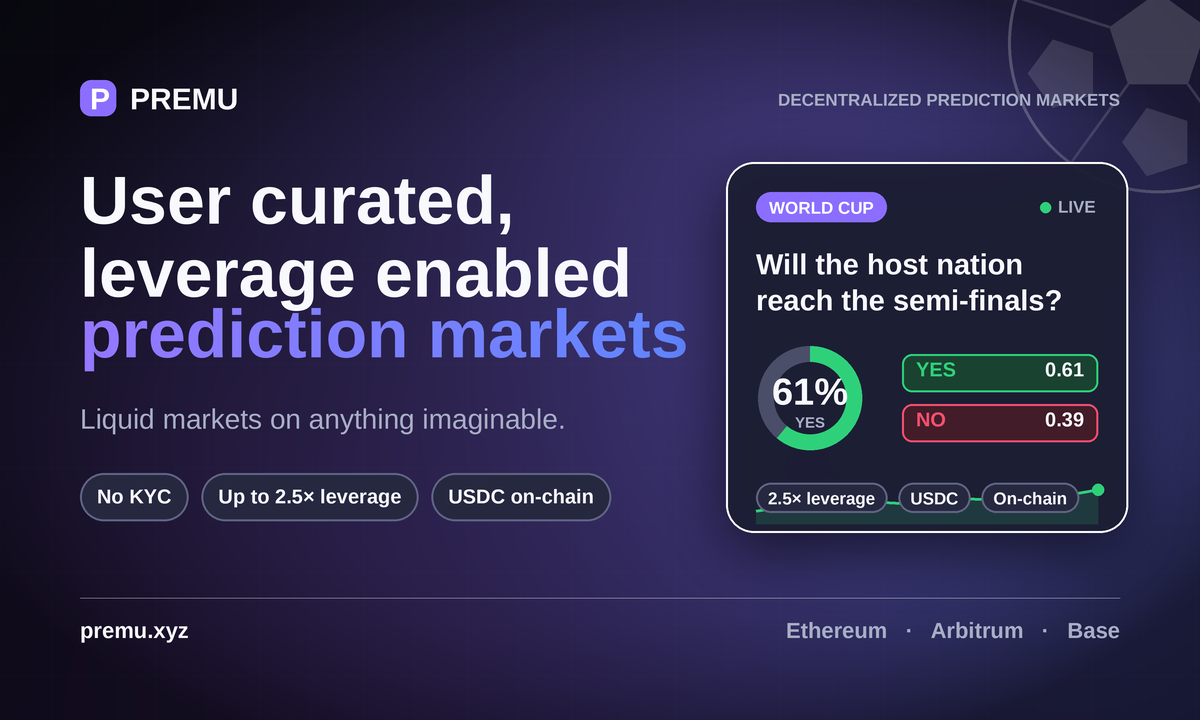
    Unlike conventional platforms where users must wait for contracts to be listed, Premu enables participants to launch permissionless yes-or-no markets on a wide array of World Cup-related questions. These can range from which team will advance from a specific group to predicting the finalists or the outcome of individual matches. Market creators are required to post a bond in USDC, and in return, they earn a fee on every trade executed within their created market.

    Traders on Premu can utilize leverage of up to 2.5 times, employing either isolated or cross margin. All trading activity is settled on-chain in USDC across the Ethereum, Arbitrum, and Base networks, ensuring transparency and security.

    The platform’s announcement coincides with a surge in interest surrounding prediction markets. Over the past year, these markets have transitioned from a niche tool to a more mainstream method for forecasting and information gathering, particularly for event-based scenarios. Major sporting events have historically been a significant driver of trading volume on such platforms, and the 2026 World Cup, a 104-match tournament concluding on July 19th, is poised to be one of the year’s most prominent events.

    “Sporting events like the World Cup tend to generate questions faster than any central team can list them,” stated Chadi Farhat, Chief Technology Officer at Premu. “By empowering participants to create their own markets and earn from the activity they generate, the platform can effectively keep pace with each unfolding stage of a tournament.”

    Discussions within the industry often draw comparisons between platforms like Polymarket and Kalshi, highlighting differences in market structure, regulatory approaches, and listing mechanisms between centralized and decentralized models. Premu positions itself as a decentralized prediction market where the market list is determined by its users, a model the company believes is particularly well-suited for fast-paced events where demand can fluctuate rapidly between different fixtures.

    Beyond sports, Premu supports markets across a broad spectrum of categories, including cryptocurrency, politics, culture, technology, economics, and global events. The platform also offers rapid, five-minute markets on the price direction of assets such as Bitcoin, Ethereum, and Solana. User balances are secured in independently verifiable on-chain vault contracts, with deposits and withdrawals recorded as on-chain events rather than being processed through a custodial intermediary.

    The Premu platform is accessible globally via its web application at https://premu.xyz.

    About Premu
    Premu is a decentralized prediction market platform that empowers participants to create and trade markets based on real-world events. The platform integrates permissionless, user-generated markets with leveraged event trading and on-chain settlement in USDC across the Ethereum, Arbitrum, and Base networks, supporting a diverse range of event categories.


  • Cardano Sees 61% Surge in Stablecoin Liquidity

    Cardano Sees 61% Surge in Stablecoin Liquidity

    Cardano Stablecoin Market Cap Surges

    Cardano’s total stablecoin market capitalization has reached approximately $54.88 million, a 15% increase since early March 2024, reflecting the rapid growth of liquidity on the network in recent weeks.

    USDCx Leads the Charge

    Circle’s USDCx currently dominates Cardano’s stablecoin market, holding a 45.20% share. USDM holds 26.90%, USDA 15.45%, and DJED approximately 5.90%. Data from Cexplorer indicates that nearly 8 million USDCx were minted in the final two days of the reporting period.

    According to Messari data, Cardano experienced a 61% rise in stablecoin market capitalization over the past seven days, the highest among major blockchain networks tracked during that period. Polygon followed with 36%, World Chain with 10.3%, HyperEVM with 7.4%, and XDC Network with 3.5%.

    Net stablecoin flow for the current epoch on Cardano has reached approximately $8.55 million. Approximately $9.57 million worth of stablecoins were minted during this period, while roughly $1 million were burned.

    Infrastructure Gap Persists

    The surge in minting has been primarily driven by USDCx, Circle’s on-chain representation of USDC on the Cardano blockchain. This product has seen consistent minting activity throughout the week, with an acceleration in the final two days.

    Despite this momentum, Cardano has yet to secure a direct integration of a Tier-1 stablecoin such as Circle’s native USDC or Tether’s USDT. Cardano founder Charles Hoskinson has repeatedly emphasized that such an integration would significantly strengthen the network’s DeFi activity and liquidity.

    Market Implications

    These figures indicate increasing on-chain activity within the Cardano ecosystem, even as the network continues to develop its stablecoin infrastructure. Analysts generally view stablecoin inflows as a sign of expanding financial activity and broader DeFi adoption on a given chain. Cardano’s performance over the past week places it well ahead of other networks in Messari’s rankings for stablecoin market cap growth. The sustainability of this pace will likely depend on the speed of new stablecoin integrations and ongoing minting activity within the ecosystem.

  • Crypto Trade Yielded 638% APY Last Month

    Crypto Trade Yielded 638% APY Last Month

    Hyperliquid Vaults Deliver Impressive Returns

    Hyperliquid, known for its on-chain perpetuals exchange, also offers vaults where users can deposit funds and follow specific trading strategies. One of these vaults recently achieved a remarkable 638% APY last month, attracting significant attention.

    Understanding Hyperliquid Vaults

    Hyperliquid vaults are a notable feature of the decentralized derivatives exchange, enabling traders to participate in shared strategies. These vaults function like pooled trading accounts. A vault leader executes a specific strategy, and other users can deposit funds to gain exposure to the results. Profits are shared among depositors, as are losses.

    What distinguishes these vaults is their direct integration with HyperCore. This allows vault strategies to leverage the exchange’s infrastructure, including leverage, liquidations, perpetuals, and high-throughput execution. While offering potentially high returns for passive investors, vaults also carry significant risk. Returns can fluctuate dramatically, particularly when leverage is used or concentrated directional bets are made.

    Essentially, vaults can be viewed as on-chain copy trading with pooled capital. The strategy is fully transparent, performance is trackable, and users can assess whether the risk profile aligns with their portfolios.

    The “Long HYPE & BTC, Short Garbage” Vault

    One particular vault on Hyperliquid has gained attention after generating a 638% APY over the past month. Named “Long HYPE & BTC, Short Garbage,” the vault currently manages approximately $3.03 million in total value locked.

    The strategy involves a 70% long position in HYPE and a 30% long position in BTC. It also maintains short positions in a basket of at least 10 high-FDV and high-emission coins, with the short side representing about 60% of notional exposure.

    The vault’s performance chart indicates a substantial increase in profit and loss (PnL) over the past 30 days, approaching $1.2 million.

    It’s important to note that this performance should not be interpreted as a low-risk yield. The vault’s success reflects an aggressive, leveraged long-short crypto trade heavily reliant on HYPE’s price performance.

  • Grayscale: Hyperliquid a Breakout Success, Report Says

    Grayscale: Hyperliquid a Breakout Success, Report Says

    Grayscale Report Highlights Hyperliquid’s Rise

    A new research report from Grayscale Investments is spotlighting Hyperliquid, characterizing it as a significant success story in the evolving cryptocurrency market. The report analyzes how the platform has rapidly gained momentum by combining high-performance trading infrastructure with a fully on-chain model, establishing itself as a major player in the derivatives space.

    Hyperliquid’s Integrated Ecosystem Gains Industry Recognition

    Grayscale Investments has significantly elevated Hyperliquid’s institutional profile with the release of its detailed research report, titled “Hyperliquid Breaks the Mold.” An analyst known as Crypto Banter on X revealed that Grayscale describes Hyperliquid as one of the breakout success stories in the modern digital asset industry.

    The report attributes Hyperliquid’s growth to several factors, including its projected $800 million in annualized revenue for 2025, which would position it among the largest crypto assets by market capitalization and a dominant force in the perpetuals trading market. Grayscale highlighted Hyperliquid’s open architecture, which supports spot trading, commodities, and outcome-based markets. This versatility is combined with self-custody principles and centralized exchange-level performance.

    In a notable development, Grayscale has filed and recently amended an S-1 registration for a proposed Hyperliquid ETF, although approval from the US Securities and Exchange Commission (SEC) is still pending. Crypto Banter noted that this represents meaningful institutional recognition for a project that has generated real revenue, demonstrated strong product-market fit, and delivered technical innovation.

    Despite its rapid growth, the report emphasizes that Hyperliquid’s revenue is small compared to the massive traditional global derivatives industry, suggesting significant potential for further growth if it continues to gain market share.

    Hyperliquid’s Unique Position

    Hyperliquid distinguishes itself from both traditional finance and existing crypto projects, offering a distinct and forward-looking model for blockchain-based financial systems. The platform is described as breaking the mold rather than fitting into established categories. An investor known as Gustavo Am on X explained that Hyperliquid is offering a compelling vision for the future of blockchain-based finance.

    At its core, Hyperliquid operates on an open architecture platform that encourages permissionless innovation, allowing it to adhere to foundational DeFi principles such as transparency and self-custody. Simultaneously, it is structured around a highly optimized core application that has already proven its ability to attract and retain users. This dual approach positions Hyperliquid as more than just another protocol. If it continues to execute effectively, retain and grow its dedicated community, and benefits from favorable regulatory developments, it could potentially achieve broader adoption and become a financial services leader.

  • Hyperliquid Launches Prediction Markets, Eyes Polymarket Competition.

    Hyperliquid Launches Prediction Markets, Eyes Polymarket Competition.

    Hyperliquid has expanded its trading offerings with the launch of canonical prediction markets for off-chain events, a move that few decentralized exchanges (DEXs) have attempted at scale. The first contract, tied to the U.S. May CPI year-over-year figure, went live on May 25 at 20:00 UTC.

    Market Response

    The initial response from traders was positive, with $12,800 in open interest and $10,300 in 12-hour trading volume recorded on the first day. While modest in absolute terms, the figures signal immediate interest. Validators utilize automated newsfeed software to manage market publication and settlement voting, eliminating the manual bottlenecks that often plague traditional prediction platforms.

    Technical Details

    The markets are built on Hyperliquid’s HIP-4 standard and settle in Circle’s USDC. The second contract focuses on the June federal funds rate decision, indicating a focus on macro traders. When Hyperliquid initially announced the prediction market concept in February, the HYPE token surged 20%.

    Competitive Landscape and Market Implications

    This launch positions Hyperliquid in direct competition with Polymarket. The timing of the launch, coinciding with heightened macro uncertainty surrounding Federal Reserve policy, appears deliberate. The broader market implications are still developing.

    HYPE Token Performance

    The 20% surge in HYPE following the February announcement set a high expectation for the actual launch. Whether the live product triggers a similar move depends on liquidity depth and contract expansion over the next 72 hours. The data suggests a market that is closely monitoring the situation rather than reacting impulsively.

    Broader Market Context

    Delphi Digital, in a December research report, noted that the infrastructure is now mature enough for true crypto superapps to exist beyond the wallet form factor. Hyperliquid is currently at an all-time high, and many traders anticipate the rally to continue towards $100. However, the broader market conditions will ultimately determine the outcome.

    Infrastructure Development

    Hyperliquid’s prediction market launch underscores the growing interest and capital flowing into on-chain financial infrastructure. This trend is also benefiting earlier-stage infrastructure projects.

    LiquidChain

    LiquidChain ($LIQUID), a Layer 3 infrastructure project, is building what it calls the Cross-Chain Liquidity Layer, a single execution environment combining Bitcoin, Ethereum, and Solana liquidity. The project’s Unified Liquidity Layer enables single-step execution across all three ecosystems, while its Deploy-Once Architecture allows developers to write one contract and access the full stack.

    The presale is currently live at $0.01463 per $LIQUID, with $807,965.95 raised to date, approaching the $1 million milestone. Verifiable settlement and cross-chain composability are key differentiators. Presale assets carry significant risks, including illiquidity and no guarantee of exchange listing.

  • NOW Wallet Adds Perpetuals and Prediction Markets

    NOW Wallet Adds Perpetuals and Prediction Markets

    NOW Wallet Integrates Perpetual Futures and Prediction Markets

    Kingstown, Saint Vincent and the Grenadines, May 21st, 2026 – NOW Wallet, a non-custodial crypto wallet focused on security, multi-chain access, and a seamless DeFi experience, has integrated direct access to perpetual futures and prediction markets within its app. This integration provides users with direct access to platforms such as Hyperliquid, Aster, Lighter, GMX, and dYdX for perpetuals trading, and Polymarket and PancakeSwap for prediction markets, all without leaving the wallet.

    Perpetual Futures and Prediction Markets Explained

    Perpetual futures (“perps”) enable users to speculate on cryptocurrency price movements without owning the underlying asset. These instruments offer features like leverage, short selling, and continuous trading, contributing to their popularity in digital asset markets.

    Prediction markets operate differently, reflecting the perceived likelihood of specific outcomes rather than tracking asset prices. Participants bet on whether an event will occur, such as a cryptocurrency reaching a certain price level or a macroeconomic development. Market prices adjust based on changing expectations, and positions are settled once the outcome is determined.

    Both perpetual futures and prediction markets have experienced significant growth within decentralized finance (DeFi) in recent years.

    Streamlined In-Wallet Access

    Previously, accessing advanced DeFi trading tools required a fragmented workflow, involving separate accounts on different platforms, funds spread across multiple locations, and constant switching between apps and browser tabs.

    This update consolidates access within the NOW Wallet. Users can now connect to supported protocols directly through their wallet, fund trading balances, sign transactions, and manage positions, all while maintaining self-custody of their assets. Centralized exchange accounts are no longer required.

    The goal is to make on-chain trading more direct, less fragmented, and more user-friendly on mobile devices.

    Part of a Broader UX Shift

    Wallets are evolving beyond simple storage tools. As users increasingly engage with swaps, staking, trading, and prediction markets simultaneously, the expectation has shifted. A wallet should serve as the primary access point for all these activities, not just a place to store funds.

    The addition of perpetual futures and prediction markets is a step in this direction for NOW Wallet.

    About NOW Wallet

    NOW Wallet is a non-custodial multi-chain crypto wallet supporting storage, swaps, staking, fiat purchases, and dApp access across over 70 blockchain networks.

    The new feature is available now in the latest version of NOW Wallet.

    Users can download NOW Wallet at: https://walletnow.app/

  • XRP Gains Native DeFi Access with Flare Wallet Integration

    XRP Gains Native DeFi Access with Flare Wallet Integration

    Flare Network Integrates XRP Support

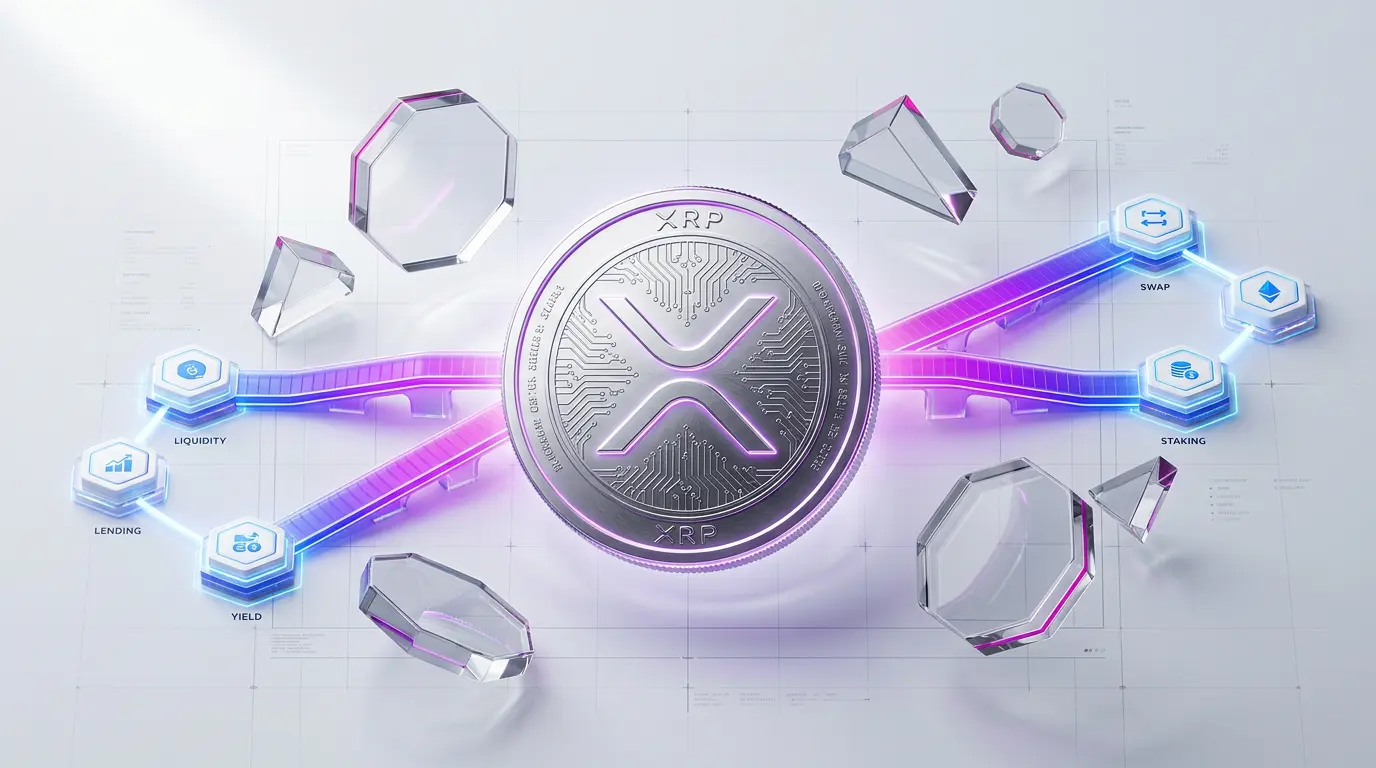
    Flare Network has completed a significant infrastructure milestone by integrating native XRP support directly into its wallet architecture. This integration allows XRP holders to access a full suite of decentralized finance (DeFi) applications, including lending, borrowing, liquidity provision, and yield farming, without relying on centralized custodians or permissioned bridges.

    The mechanism enabling this functionality is Flare’s FAssets protocol, which utilizes the network’s State Connector to verify transactions on the XRP Ledger. This allows XRP to be minted as FXRP on Flare in a trustless, overcollateralized format.

    Flare Smart Accounts are now live in D’CENT wallets. The process involves two signatures on XRPL, followed by FXRP minting, and then access to the Monarq XRP Yield Vault. A $55,000 campaign reward pool is available for D’CENT users and early depositors.

    Addressing XRP’s Utility Gap

    This development directly addresses a long-standing utility gap for XRP, a token with significant liquidity and institutional reach that has historically been excluded from the smart-contract DeFi ecosystem.

    On-chain data indicates a 20% increase in Flare’s Total Value Locked (TVL) following the integration announcement, with large wallets holding more than 10 million XRP as the primary drivers.

    The key question is whether this initial inflow represents a sustained capital migration or opportunistic positioning in anticipation of future developments.

    The Risk-Reward Trade-Off

    XRP holders who move their assets from the XRP Ledger onto Flare accept smart-contract risk and bridging complexity in exchange for yield exposure that the native ledger currently cannot provide. The market is now assessing whether the yield rates justify this trade-off and if crypto liquidity will deepen quickly enough to sustain the ecosystem.

    How the System Works

    Flare’s State Connector protocol monitors the XRP Ledger for confirmed transactions and relays cryptographic proof of those transactions to Flare’s EVM-compatible execution layer.

    When an XRP holder initiates a mint, agents on the Flare side provide overcollateralized backing, denominated in FLR, and FXRP is issued on a 1:1 basis against the locked XRP. Agents earn minting and redemption fees, and the overcollateral provides a liquidation buffer if FLR prices decline.

    This structure, as outlined in Flare’s introduction to XRP DeFi, distinguishes FXRP from custodial wrapped-token approaches. There is no single bridge operator to compromise, and the collateral backstop is enforced by Flare’s proof-of-stake consensus, where 98% of the stake is community-held and no single data provider can exceed 3.3% of the total stake.

    The network achieves an average block time of 1.2 seconds with single-slot finality, which is crucial for DeFi protocols where price feeds and liquidation triggers operate in near-real time.

    FXRP’s DeFi Applications

    Once minted, FXRP becomes a composable DeFi asset. Holders can deploy it across lending protocols, supply it to automated market maker pools on SparkDex (Flare’s native DEX), or route it into yield optimizers developed under Flare’s developer incentive program.

    The Firelight protocol, currently being rolled out, further expands this functionality by introducing Economically Secured Services. FXRP stakers underwrite security for third-party applications and earn a share of the fees those applications generate.

    Liquid staking tokens issued through Firelight act as receipts that can be redeployed in additional XRP DeFi strategies, creating compounding yield loops without sacrificing the base staking position.

    Structural Shift in DeFi

    What was previously impossible for XRP holders—accessing a full-stack DeFi environment with native collateral, decentralized price feeds via Flare’s FTSO, and programmable yield—is now accessible through a single wallet integration. This structural shift is reflected in the TVL data.

    XRP Market Performance

    XRP is currently trading near $1.36, consolidating after a sharp rally following the passage of the Clarity Act through the Senate Banking Committee. The token has maintained its position above the $1.30 support level for 11 consecutive sessions, a level the market views as a near-term structural floor.

  • XRP Holders to Earn Yield with Flare-D’CENT Partnership

    XRP Holders to Earn Yield with Flare-D’CENT Partnership

    Flare and D’CENT Wallet Integrate to Expand XRPFi Access

    Flare, a decentralized finance (DeFi) applications network, has taken another step toward making XRP Finance (XRPFi) accessible to XRP holders. The blockchain announced an integration with D’CENT Wallet, a crypto wallet provider, offering direct access to institutional-grade yield vaults.

    According to a press release, the integration between Flare and D’CENT Wallet is part of a new coalition called the XRP Alliance. The Alliance includes other crypto platforms such as Doppler, Banxa, and Squid, and aims to facilitate the development of XRPFi.

    The integration into D’CENT Wallet does not require a new chain, wallet, or gas token. XRP holders can access the vaults directly from their hardware wallets using two signatures on the XRP Ledger (XRPL). This process is enabled by Flare Smart Accounts.

    The vaults in question are the Monarq XRP Yield Vault (MXRPY) and earnXRP, curated by on-chain strategy curator Clearstar. Monarq launched MXRPY last week in partnership with Flare and vault infrastructure provider Upshift. The vault offers both on-chain and off-chain yield sources. Users can access both vaults directly from D’CENT.

    As a hardware wallet provider, D’CENT serves at least 720,000 users across the U.S., UK, Canada, Japan, and South Korea, accounting for billions of XRP in storage. This development makes the wallet one of the first to offer a native path from XRP custody to DeFi yield.

    As the programmable layer for XRP within the Alliance, Flare Smart Accounts convert XRPL signatures into minted FXRP, which is then deposited into vaults in a single flow. FXRP is the Flare representation of XRP. When depositing from D’CENT Wallet, each XRPL transaction includes encoded instructions in its memo field, and the Flare Data Connector relays a proof of that transaction to the Smart Account system.

    The process requires two XRPL signatures from the D’CENT device. The first reserves collateral on Flare and identifies the desired vault, while the second sends XRP to the Core Vault on XRPL. The second signature also triggers the minting of FXRP and its automatic deposit into the chosen vault. This process is fully non-custodial and requires no intermediary taking custody.

    “D’CENT is one of the most widely used hardware wallets in Asia, particularly in Korea. For XRP holders using it, security has always come first — and yield has meant going elsewhere. This integration changes that. D’CENT users can now earn on their XRP without moving it off the device they already trust. That’s what production-grade XRPFi looks like,” said Hugo Philion, co-founder of Flare.

  • Hyperliquid Thrives Amid Market Uncertainty, Anticipating Major IPOs

    Hyperliquid Thrives Amid Market Uncertainty, Anticipating Major IPOs

    Hyperliquid’s HYPE Token Outperforms Crypto Market Amid Pre-IPO Futures Momentum

    Hyperliquid’s native token, HYPE, is bucking the broader cryptocurrency market downturn as its pre-IPO perpetual futures ecosystem gains traction ahead of a wave of technology listings.

    According to CoinGecko data, HYPE was trading at $45.17 on Monday, up approximately 5% in the last 24 hours and 69% over the past year.

    This divergence is linked to Hyperliquid’s HIP-3 marketplace, where traders are speculating on pre-IPO shares of companies like SpaceX, Anthropic, and OpenAI. This represents a $120 billion volume opportunity that traditional finance currently does not offer.

    Since its launch, the HIP-3 framework, which allows third-party teams to launch their own perpetual futures markets, has processed over $120 billion in total volume, according to Dune Analytics data. On April 8, HIP-3 deployers accounted for 48.1% of Hyperliquid’s total platform volume, nearing parity with the platform’s native markets.

    This parity allows retail traders to access pre-IPO price exposure previously limited to institutional investors through secondary venues.

    TradeXYZ, a leading HIP-3 deployer, demonstrated the model’s effectiveness by pricing Cerebras perpetuals within 3% of the AI chipmaker’s Nasdaq debut, while traditional secondary platforms were 35% off.

    This discrepancy highlighted that on-chain pre-IPO markets achieved faster and more accurate price discovery than off-chain alternatives.

    “For years, retail investors often entered once companies were already public and much of the upside had already played out,” Diego Martin, CEO of Yellow Capital, told Decrypt. “This feels like the beginning of a much bigger shift in who gets to participate.”

    The next wave of test cases is already forming, with several high-profile IPOs scheduled for 2026.

    According to Reuters, SpaceX is targeting a June IPO that could raise between $75 and $80 billion, roughly double the total raised across all 2025 IPOs combined, at a valuation of up to $1.75 trillion to $2 trillion. Anthropic and OpenAI are each considering listings that could raise $60 billion at valuations exceeding $1 trillion.

    A SpaceX pre-IPO perpetual contract, SPCX, is already live on TradeXYZ with a $150 reference price, implying a valuation of approximately $1.78 trillion. The token is currently trading at $207, down roughly 10% from Monday’s $230 local peak.

    Market expectations are already factoring in the scale of these listings.

    On prediction market Myriad, owned by Decrypt’s parent company Dastan, users assign a 91% chance that SpaceX’s closing market cap will exceed $1.3 trillion and give Anthropic a 67% chance of going public before OpenAI.

    Matthew Pinnock, COO of Altura DeFi, told Decrypt that the Cerebras market demonstrated how on-chain infrastructure can outperform traditional secondary markets in price formation. “24/7 crypto rails, leveraged positioning, and global participation can create faster consensus formation around late-stage private assets, particularly for sectors like AI where demand is heavily retail-driven and information moves quickly,” he said.

    Pinnock added that the category carries significant regulatory risk and anticipates regulators will eventually scrutinize whether pre-IPO perpetual products function as unregistered securities exposure for retail traders. OpenAI and Anthropic have already cautioned investors against trading in securities tied to companies they have not authorized.

    The platform’s ambitions have garnered early attention from Wall Street: Intercontinental Exchange and CME Group have reportedly urged the CFTC to address potential market integrity risks associated with Hyperliquid’s pseudonymous trading environment. The Hyperliquid Policy Center responded, arguing that the platform’s transparency is “hostile” to insider trading.

    “Instead of being focused purely on digital assets, crypto infrastructure starts becoming a way for people to participate in broader financial opportunities,” Martin said. “That is a story a much larger audience can understand.”