Tag: DeFi

  • Institutional Coalition on Hashi Welcomes Cumberland, Fluid, SwissBorg Ahead of July Testnet

    Institutional Coalition on Hashi Welcomes Cumberland, Fluid, SwissBorg Ahead of July Testnet

    Sui Ecosystem Welcomes Major Players as Bitcoin Finance Primitive Nears Launch

    Grand Cayman, Cayman Islands – June 23rd, 2026 – Sui, a blockchain platform designed for seamless financial transactions, announced today that Cumberland, Fluid, and SwissBorg have joined the Hashi ecosystem. Hashi, Sui’s native Bitcoin finance primitive, aims to unlock the productive potential of Bitcoin’s substantial market capitalization, estimated at $1.2 trillion, by transforming it into verifiable on-chain financial products. This expansion of institutional support comes just weeks before the scheduled launch of Hashi’s global testnet in July.

    The growing coalition addresses a significant challenge in the cryptocurrency space: capital inefficiency. By enabling the safe integration of over a trillion dollars of Bitcoin into decentralized finance (DeFi), Hashi seeks to overcome this persistent issue. Previous market cycles highlighted the risks associated with relying on opaque, centralized credit intermediaries like Celsius, Voyager, and Genesis for generating utility from dormant assets. Hashi offers an alternative by replacing centralized balance-sheet trust with verifiable smart contract logic.

    Crucially, Bitcoin will remain securely on its native blockchain, with Sui smart contracts managing the cryptographic and programmatic rights necessary for its use as financial collateral.

    “Hashi was built to unlock the productive use of Bitcoin at a scale the industry hasn’t seen before,” said Adeniyi Abiodun, Co-Founder and Chief Product Officer of Mysten Labs, the original contributor to Sui. “We believe Bitcoin will become one of the largest sources of collateral in finance as the world moves onchain, and Hashi provides the foundation to make that possible on Sui.”

    Built for Institutional Bitcoin Finance

    Hashi is designed to set a new standard for creating bespoke, Bitcoin-backed financial products. Builders will be able to define risk parameters and loan terms that are fully verifiable on-chain. In the coming weeks, institutions, custodians, wallet providers, and developers will have the opportunity to test the infrastructure that will support Bitcoin-backed lending, borrowing, and credit origination on Sui.

    Expanded Institutional Support

    The addition of Cumberland, Fluid, and SwissBorg significantly broadens support for institutional liquidity providers, market makers, and digital asset platforms within the Hashi ecosystem. These new participants join a robust group of infrastructure providers, custodians, and DeFi protocols already collaborating to build a native Bitcoin financial ecosystem on Sui.

    “Bitcoin is the world’s most liquid digital asset, but without native utility, it remains an off-chain asset,” stated Paul Kremsky, Global Head of Business Development at Cumberland. “Hashi is exciting because it introduces a transparent, institutional-grade framework for BTC-backed credit that will replace synthetic workarounds with a product we are excited to use ourselves.”

    Cyrus Fazel, Founder & CEO at SwissBorg, commented, “Our community has consistently sought native ways to lend and borrow against their Bitcoin. We’re thrilled to see Hashi delivering innovative solutions that make this a reality.”

    Samyak Jain, Co-Founder & CEO at Fluid, added, “The next phase of the industry’s growth will come from bringing larger pools of capital onchain through infrastructure institutions can actually trust. Hashi gets this right: Bitcoin stays on its native chain while verifiable contracts make it productive as collateral. Fluid’s lending infrastructure is built to turn that into deep, capital-efficient Bitcoin-backed credit markets on Sui.”

    These new partnerships reinforce the growing consensus that Sui, through Hashi, is poised to become a central hub for Bitcoin finance. The ecosystem already includes partners focused on custody and wallet access, lending, trading, liquidity provision, DeFi applications, vaults, asset management, and oracle and security auditing services.

    The upcoming global testnet in July will serve as a comprehensive rehearsal for the transformation of Bitcoin finance. This sandbox environment is intended for institutional engineers, Sui protocols, developers, and custody partners to refine integration parameters, stress-test the code under simulated market volatility, and verify cryptographic integrity before the mainnet release.

    Technical documentation and testnet access configurations will be available at https://www.sui.io/hashi.

    About Sui

    Sui is a next-generation Layer 1 blockchain engineered for scalable finance and global payments. Developed by the core team behind Meta’s stablecoin initiative, Sui utilizes an object-centric model to make assets, permissions, and user data programmable and ownable. The platform provides builders with essential primitives for creating high-performance payment and financial applications, including instant agentic payments. Further information can be found at sui.io.

  • Grayscale Sees AAVE Reaching $175

    Grayscale Sees AAVE Reaching $175

    Grayscale Predicts AAVE Could Reach $175 Amidst Regulatory Clarity and RWA Adoption

    New York, NY – Grayscale Research has projected that AAVE, the native token of the Aave decentralized finance (DeFi) protocol, could see its value surge to approximately $175 within the next year. This optimistic outlook hinges on the potential for clearer regulations to accelerate the adoption of tokenized real-world assets (RWAs).

    The firm estimates AAVE’s current fair value to be between $80 and $100, a significant premium compared to its current trading price hovering around $73.

    Grayscale highlighted Aave’s established position as the leading decentralized lending protocol, coupled with increasing stablecoin usage and the burgeoning tokenization of traditional financial assets, as key drivers for future growth. Aave functions as a digital lending platform, enabling users to deposit cryptocurrency, earn yield, and borrow against collateral via smart contracts, bypassing traditional financial intermediaries.

    The broader DeFi ecosystem currently holds over $59 billion in deposits and $25 billion in outstanding loans, with Aave commanding a substantial portion of this activity. The protocol boasts nearly 200,000 monthly users and generates revenue primarily through lending spreads, treasury earnings, and income from GHO, its native overcollateralized stablecoin.

    Grayscale noted a considerable strengthening of Aave’s financial performance in recent years. Between 2023 and 2025, the protocol’s revenue saw a more than sixfold increase, while maintaining a robust profitability rate of approximately 50%. The report also pointed out that Aave’s DAO treasury has, at times, held over $360 million, providing a substantial capital reserve for expansion initiatives and other community-approved projects.

    A significant factor in Grayscale’s bullish forecast is Aave’s strategic push into institutional markets, particularly through its Horizon initiative. This dedicated market aims to enable institutions to leverage tokenized real-world assets as collateral for accessing DeFi liquidity. Grayscale believes that regulatory clarity surrounding digital assets and tokenized securities will be instrumental in driving the adoption of these products, consequently boosting loan growth and protocol revenues.

    Further catalysts identified by Grayscale include the continued development of GHO, the implementation of the Umbrella safety module, the forthcoming V4 protocol architecture, and the launch of a simplified Aave App designed to attract a broader, mainstream user base. Grayscale’s valuation model suggests that AAVE’s current market price reflects relatively modest long-term earnings growth, despite strong sector tailwinds. Regulatory uncertainty remains a primary reason for AAVE trading at a discount when compared to fintech companies with similar lending and revenue-generating profiles.

    In a significant development last month, Aave Labs announced that its UK-based subsidiaries, Push Labs Ltd. and Push Virtual Assets Ltd., secured registration from the UK Financial Conduct Authority (FCA) to operate as crypto asset exchange providers. This approval also permits the companies to issue electronic money under the UK’s Electronic Money Regulations 2011.

    According to Aave Labs, these registrations are crucial for establishing regulated crypto services and payment infrastructure, including solutions for on- and off-ramping stablecoins. Founder Stani Kulechov stated that these approvals will facilitate the direct integration of traditional fiat currency into the Aave ecosystem through a zero-fee on-ramp. He further indicated that these FCA approvals are part of Aave’s broader regulatory engagement across Europe, which includes pursuing a MiCA license in Ireland.

  • Uniswap Whale Activity Surges to 7-Month High on $100 Price Forecast

    Uniswap Whale Activity Surges to 7-Month High on $100 Price Forecast

    Uniswap Network Activity Surges on $100 Price Forecast

    Uniswap experienced a significant increase in network activity this week, fueled by new institutional price expectations for its UNI token that circulated across markets and social media.

    According to a report by Santiment, transactions involving “whale” accounts on the network reached a seven-month high, while the number of active whale addresses climbed to a four-month peak.

    This uptick coincided with traders reacting to a long-term forecast from Standard Chartered’s research team, led by Geoff Kendrick. The team projected UNI could reach $100 by 2030, linking this outlook to an anticipated surge in tokenized assets moving on-chain in the coming years. They estimate the value of these assets could grow to approximately $4 trillion by the end of 2028, a substantial increase from the current $340 billion.

    The researchers further noted that tokenized assets active within decentralized finance (DeFi) are expected to multiply at least 37 times over the next four years. This growth trajectory implies a similar expansion could be mirrored in Uniswap’s liquidity pools.

    Standard Chartered believes Uniswap is strategically positioned to capitalize on this growth, citing its role as a general-purpose trading infrastructure, its established brand recognition, and its current dominance as the largest decentralized exchange (DEX) in the market, particularly in trading highly correlated asset pairs.

    In line with this, Uniswap confirmed last weekend that tokenized equities from companies like Apple, Tesla, and NVIDIA are now accessible via its app and API. Earlier this year, the protocol also facilitated trading access for BlackRock’s BUIDL tokenized fund through UniswapX, an development that contributed to a 40% rise in its token’s value.

    The bank’s price prediction for UNI is detailed: $6.50 by the end of this year, $20 by 2027, and $40 by the end of 2028. Looking further ahead, Kendrick and his team foresee the cryptocurrency reaching $65 by 2029 and $100 before the close of 2030.

    This projected trajectory represents a 40-fold increase from UNI’s trading level at the time the note was published. The bank also anticipates that the token, currently ranked #45 by market capitalization, could outperform both Bitcoin and Ethereum over the same period.

    “Uniswap shocked traders with a +24% surge and massive whale activity and volume,” Santiment reported on X.

    This surge occurred on June 17. The following day, the on-chain analytics platform provided further details, confirming that active addresses had reached a four-month high and whale transactions had increased to levels not seen in seven months.

    As of this report, UNI was trading near $3.10, according to CoinGecko data. It had touched $3.65 in the preceding 24 hours, its highest point since mid-May.

    The token has seen a gain of nearly 24% over the past week and over 16% in the last 14 days. However, it remains down by nearly 12% over the past month and is down 58% year-on-year.

  • Standard Chartered Predicts UNI to Hit $100 by 2030

    Standard Chartered Predicts UNI to Hit $100 by 2030

    UNI, the governance token for the decentralized exchange Uniswap, has seen a significant surge, climbing by double digits over the past 24 hours to reach a local high of $3.70, its strongest performance in over a month.

    As of this report, Uniswap is trading at $3.63, marking a 19.8% increase on the day and a substantial 48.4% gain over the past week, according to data from CoinGecko. This performance has outpaced both Bitcoin and Ethereum. The upward trend has boosted Uniswap’s market capitalization to approximately $2.26 billion, with daily trading volumes nearing $864 million, reflecting a wave of institutional optimism within the decentralized finance (DeFi) sector.

    A primary driver for this rally appears to be a research note published Monday by Geoff Kendrick, Standard Chartered’s global head of digital assets. Kendrick projected a target of $100 for UNI by 2030, representing a nearly fortyfold increase, and set a year-end target of $6.50. He argued that traditional finance (TradFi) should perceive Uniswap not merely as a retail decentralized exchange (DEX) application but as essential market infrastructure, drawing a parallel between Uniswap and YouTube, and Coinbase and Netflix.

    Kendrick further posited that Uniswap is “uniquely positioned to scale” amidst the burgeoning growth of tokenized assets in DeFi. Its neutral, rules-based automated market maker (AMM) model is expected to become the foundational liquidity layer for institutional adoption. Standard Chartered forecasts that DeFi will manage $2.7 trillion in assets by 2030, potentially increasing the trading volume within Uniswap pools by 37 times. Additionally, a planned “UNIfication” fee-switch upgrade in late 2025 is expected to burn approximately 1% of the token supply annually, reducing the total supply from 1 billion to around 895 million.

    The recent surge also follows Uniswap’s launch of tokenized securities on June 12. This development allows for the trading of tokenized stocks, including those of major companies like SpaceX, Apple, Tesla, and NVIDIA, across its app, wallet, and API. Uniswap Labs described the launch as “a small fraction of what’s coming,” highlighting that over $9.1 billion had already been swapped in real-world-asset pools prior to the debut of tokenized securities on the platform.

    Fundamental analysis also supports the token’s momentum. Lorenzo Valente of ARK Invest noted that Uniswap achieved a record monthly trading volume of $125 billion in October 2025. The platform has since reclaimed its leading position among DEXs, accounting for 25-30% of total volume, and generates “close to half of all gross spot trading fees in the space.” Valente also pointed out that over the past 30 days, on an annualized basis, the protocol is on track to burn roughly 2% of its total supply, suggesting the token is now “fully aligned with the protocol as the single source of value accrual.”

    Risks and Future Outlook

    Despite the positive momentum, UNI is trading near multi-year lows and remains significantly below its all-time high of $44.92, which was set in May 2021. Kendrick also identified potential risks, including competition from niche players and the eventual standardization of compliance rules as traditional finance participants increasingly enter the tokenization space.

    The token’s current upward trend is further bolstered by BlackRock’s February decision to make its BUIDL tokenized money market fund accessible through Uniswap X. At the time, Uniswap Labs indicated that the asset manager had made a “strategic investment within the Uniswap ecosystem.”

  • Standard Chartered: Wall Street Could Drive Uniswap Token Up 40x by 2030

    Standard Chartered: Wall Street Could Drive Uniswap Token Up 40x by 2030

    Standard Chartered Predicts Uniswap Token to Soar Fortyfold as Wall Street Embraces On-Chain Finance

    London, UK – Uniswap’s native token, UNI, is projected to experience a nearly fortyfold increase in value over the coming years, potentially outperforming both Bitcoin and Ethereum as Wall Street firms increasingly migrate to on-chain operations, according to Geoff Kendrick, global head of digital assets at Standard Chartered.

    Kendrick, in a note released Monday, posited that Uniswap, a leading decentralized exchange (DEX) and a cornerstone of decentralized finance (DeFi), is strategically positioned to capitalize on an anticipated surge of digital assets representing traditional investments. He has set a price target of $100 for UNI by 2030.

    This optimistic outlook is underpinned by Uniswap’s inherent structural neutrality, which allows financial institutions to build on its platform with assurance that the underlying rules will remain consistent as tokenized assets gain traction. Kendrick drew a parallel, likening Uniswap’s role to that of YouTube and Coinbase to Netflix in their respective industries.

    “For TradFi institutions, Uniswap should be viewed less as a retail DEX app and more as market infrastructure that TradFi can integrate with once tokenized assets scale and TradFi operators want to plug them into DeFi,” Kendrick elaborated.

    On Monday, UNI was trading around $2.72, marking a 9.8% gain over the preceding 24 hours, according to data from CoinGecko. While Uniswap’s platform has long been a dominant force in the DEX landscape, its associated token’s price reached a high of approximately $45 five years ago.

    Since its inception in 2018, Uniswap has facilitated over $3.7 trillion in trading volume and generated $5.6 billion in fees, as reported by DeFiLlama.

    Standard Chartered forecasts that by the end of the decade, the total value of digital assets deposited or staked in DeFi protocols will reach $2.7 trillion. Consequently, Kendrick anticipates that liquidity pools on Uniswap could hold 37 times more assets for on-chain trading.

    He further noted a direct correlation between Uniswap’s protocol fees and trading volumes. As tokenized assets become more prevalent on-chain, the platform’s “UNIfication” upgrade, slated for late 2025, is expected to trigger programmatic token burns, thereby reducing supply.

    Kendrick pointed out that UNI’s total supply has already decreased from 1 trillion to approximately 895 million since the activation of protocol fees in December. This supply reduction has been further amplified by a significant retroactive token burn and an ongoing annualized burn rate of roughly 1%.

    Despite its established position in the DeFi ecosystem, Kendrick acknowledged that Uniswap faces potential risks from smaller competitors capable of developing more specialized and competitive solutions. Additionally, he highlighted the possibility of regulatory headwinds stemming from the establishment of compliance frameworks for tokenization.

    Nevertheless, Kendrick observed that a viable pathway for tokenized assets to utilize decentralized settlement mechanisms is beginning to materialize. In February, BlackRock announced that its tokenized money market fund, BUIDL, would be accessible through UniswapX, an auction-based swapping protocol, with the assets being issued via the tokenization platform Securitize.

    At the time of that announcement, the world’s largest asset manager intended to acquire UNI tokens, according to a person familiar with the matter who spoke to Decrypt. Kendrick’s immediate price projection for UNI is $6.50 by the end of the current year.

  • CoinFello Launches Fello 1 for General DeFi

    CoinFello Launches Fello 1 for General DeFi

    CoinFello Launches Fello 1, Expanding AI Agent Capabilities for DeFi

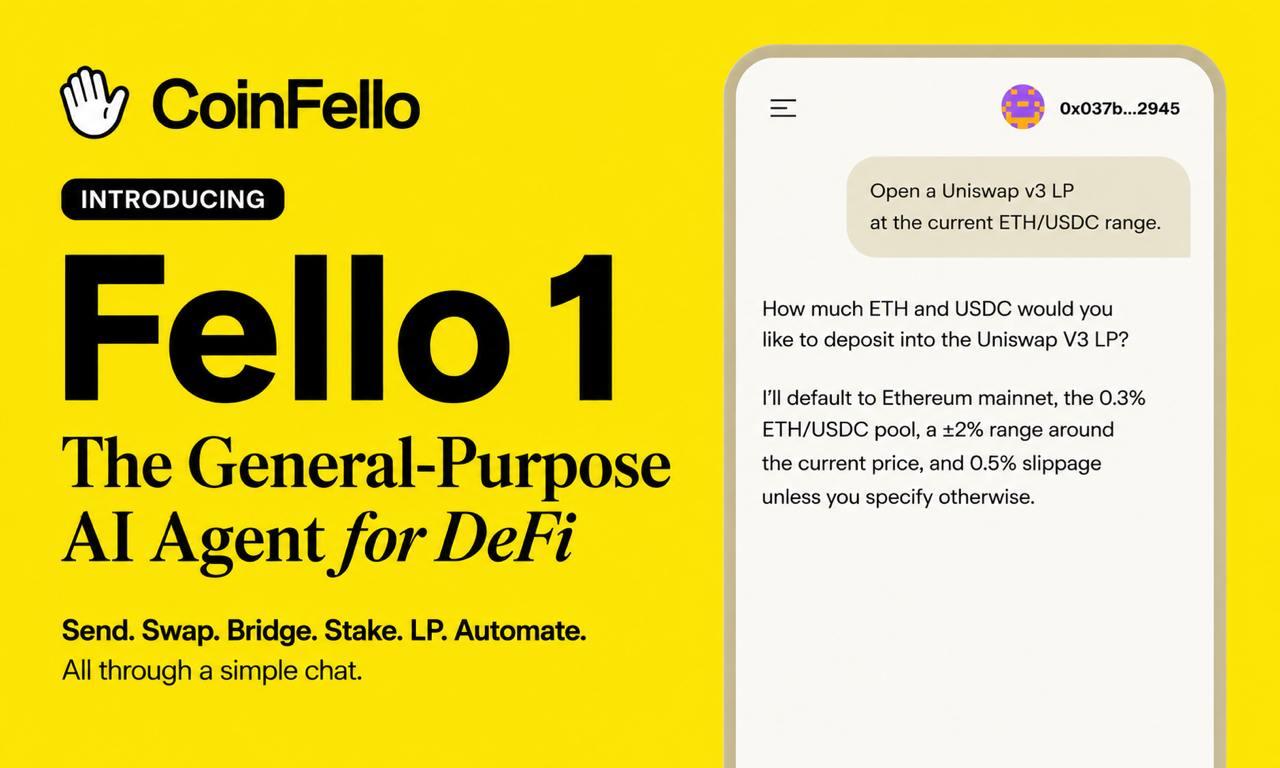
    Fort Worth, Texas, June 11, 2026 – CoinFello, a pioneer in self-sovereign AI agents for decentralized finance (DeFi), today announced the release of Fello 1. This significant upgrade transforms the company’s agent into a general-purpose AI crypto tool, enabling users to interact with any EVM-compatible smart contract and introducing new functionalities without requiring code updates. The launch broadens CoinFello’s scope from a specialized application to a comprehensive AI agent focused on simplifying the process of providing liquidity (LP) in DeFi.

    Beyond its foundational capabilities in sending, swapping, bridging, and staking, Fello 1 can now assist users in opening LP positions on Uniswap V2, V3, and V4. It also facilitates multi-step DeFi transactions, eliminating the need for protocol-specific interfaces or pre-built integrations. The system operates on a self-custodial delegation model, ensuring users retain control over their wallets and private keys while granting agents limited, user-defined permissions.

    This latest release builds upon CoinFello’s previous innovations, including Fello 0 and the CoinFello agent skill, a framework for secure agent delegation. Fello 1 is developed in accordance with MetaMask Smart Accounts standards, incorporating ERC-7710 and ERC-7715 delegation capabilities.

    Fello 1 not only offers general-purpose functionality but also enhances the LP experience for DeFi users. The agent handles all necessary calculations, monitors live positions, and clearly presents information on in/out-of-range status, recommendations, and impermanent loss, providing users with a transparent view of their actual returns.

    “Concentrated liquidity has been a significant yield opportunity in DeFi for years, but its complexity has been a barrier for many,” said jacobc.eth, Co-Founder & CEO of CoinFello. “Managing tick math, fee tiers, position monitoring, and impermanent loss requires considerable effort to do effectively. Fello 1 directly addresses these challenges, allowing users to capture yield without the burden of managing the underlying mechanics, all while maintaining full control of their private keys.”

    In contrast to narrowly integrated DeFi assistants, Fello 1 is engineered to interact directly with EVM smart contracts through generalized execution capabilities. This approach, according to the company, allows for broader protocol coverage and faster expansion of supported features without the need for dedicated integrations for each new application.

    Current functionalities include the management of liquidity positions, execution of multi-step transactions, interaction with ERC-4626 vaults, and integrations with protocols such as Aave, Uniswap V2, Uniswap V3, and Uniswap V4. CoinFello anticipates further enhancements for protocols like Pancakeswap and Aerodrome in upcoming updates.

    The launch coincides with a surge in interest in AI-powered crypto infrastructure and conversational blockchain interfaces. CoinFello positions Fello 1 as an execution layer designed to provide users with simplified access to decentralized finance while preserving their direct control over transaction approvals and wallet permissions.

    “Many AI agents in the crypto space today either operate on custodial systems or are confined to limited workflows,” stated MinChi, Co-Founder & COO of CoinFello. “We believe the next evolution of onchain AI will necessitate systems capable of operating across the full spectrum of EVM applications, while ensuring users remain actively involved in every transaction decision.”

    CoinFello has stressed that Fello 1 is not designed as an autonomous trading bot. Users are required to review and approve each transaction before execution, and delegation permissions can be modified or revoked at any time.

    The Fello 1 launch campaign is now active. Existing CoinFello users can access Fello 1 immediately, while new users can create accounts via the CoinFello application.

    About CoinFello
    CoinFello is an AI agent platform that facilitates the research, execution, and automation of onchain actions. Through plain language commands, users can perform actions such as sending, swapping, bridging, staking, creating LPs, and automating various crypto activities across EVM-compatible networks, all while maintaining full custody of their wallets and private keys. CoinFello employs a delegation model that grants AI agents only the specific permissions users choose to authorize.

  • Shotgun.fun Debuts as First Trading Terminal Offering 100% Cashback

    Shotgun.fun Debuts as First Trading Terminal Offering 100% Cashback

    Shotgun.fun Launches as the First Trading Terminal With 100% Cashback

    New York, United States – June 10th, 2026 – Shotgun.fun, a new trading terminal, has officially launched today with a novel business model designed to return all fees to traders, challenging an industry practice that has historically siphoned billions from market participants.

    For years, every trade executed has generated revenue for intermediaries, not for the market itself or the underlying protocols, but for the trading terminals positioned between users and execution. The fees associated with every buy, sell, and limit order have become the established norm. Shotgun.fun aims to fundamentally alter this paradigm.

    The high-performance trading terminal promises to return up to 100% of trading fees to its users. Its cashback program begins at 50%, a rate already exceeding that of other trading terminals, and increases with trading volume. The tiered structure is designed for rapid progression, with 100% cashback presented not as an aspirational target but as an achievable goal.

    Shotgun.fun operates on a fully non-custodial basis, utilizing Turnkey for enhanced security, which ensures that user keys are encrypted and accessible solely by the individual trader.

    The platform arrives equipped with several key features:

    The terminal addresses concerns about insider trading, a practice that has seen insiders profit from hundreds of millions across recent token launches. Shotgun.fun intends to level the playing field by providing transparency into insider wallets, enabling users to monitor their trades and replicate their strategies in real-time.

    Additionally, Shotgun.fun incorporates a referral program offering up to a 50% revenue share across five referral tiers. This structure allows users to earn rewards when their referred users engage in trading activities.

    The company is spearheaded by Miguel Loures and Pedro Maurício, the founding team previously behind Pulsar Finance. Pulsar Finance, a portfolio manager supported by Delphi Ventures, amassed over one million users before its acquisition by Terraform Labs. The team has been actively developing within the cryptocurrency space since 2020.

    “Until now, traders have been treated as the product, not as users,” stated Miguel Loures, founder of Shotgun.fun. “We built Shotgun to give the power back to the people.”

    Shotgun.fun is launching with support for the Solana blockchain, with plans to integrate additional blockchains and introduce agentic trading capabilities in the near future.

    About Shotgun.fun
    Shotgun.fun is a non-custodial trading terminal developed with the needs of traders at its core. It offers up to 100% cashback, enterprise-grade execution, and a comprehensive suite of tools engineered for speed, instinct, and market advantage.

  • Morpho Secures $175M for Wall Street’s DeFi Expansion

    Morpho Secures $175M for Wall Street’s DeFi Expansion

    Decentralized lending protocol Morpho has secured $175 million in new funding, underscoring persistent demand for DeFi infrastructure despite a series of recent setbacks for the sector.

    A Landmark Funding Round

    The platform, which enables users to create isolated lending markets, announced Tuesday that the raise represents one of the largest funding rounds ever for a DeFi platform. Prior to this, Morpho had raised $68 million across two previous financing rounds, according to Crunchbase data.

    With $11 billion in user deposits, the protocol has played a significant role in popularizing curated lending vaults. These vaults function similarly to investment funds, allowing risk managers to define parameters for the automatic allocation of user capital across various crypto-backed markets.

    Strategic Backing and Key Partnerships

    Morpho announced that the funding round was co-led by Paradigm and Andreessen Horowitz (a16z), two of the most prominent venture capital firms in the cryptocurrency space, alongside Ribbit Capital. The raise also attracted strategic investment from Apollo Funds, Circle Ventures, and VanEck, with participation from over a dozen other firms.

    Leading exchanges such as Coinbase and Binance have adopted the protocol, allowing their customers to earn interest on stablecoins like Circle’s USDC or Tether’s USDT, and to take out loans using digital assets like Bitcoin and Ethereum as collateral.

    Navigating Sector Challenges

    Morpho’s funding comes at a time when the DeFi sector has faced increased scrutiny due to a rise in exploits this year. Notable incidents include Aave’s liquidity crisis, triggered by an exploit affecting KelpDAO, and the suspected theft of $285 million from Drift by a hacking group linked to North Korea.

    In its announcement, Morpho highlighted that French banking giant Société Générale is already building on its platform. The protocol also expressed ambitions to become “a shared credit layer that lets banks, asset managers, and fintechs” develop programmable lending products.

    “The true value of finance has always been held back by dated infrastructure,” said Morpho co-founder Paul Frambot in a statement. “We’re building the open credit network for the world, connecting those with excess capital to those who need financing, globally.”

    Future Development and Borrower Risks

    Morpho stated that the newly acquired funds will be allocated towards infrastructure development and commercial integrations with strategic partners. Before this latest round, Morpho had received backing from Coinbase, which utilized the platform to revive its Bitcoin-backed lending program early last year.

    Similar to other lending protocols, borrowers on Morpho face liquidation if their collateral value drops below a certain threshold. This allows third-party buyers to acquire the collateral at a discount. Recently, Coinbase’s platform has experienced an increase in user losses.

    Amid Bitcoin’s recent plunge to a 19-month low, approximately 2,900 Coinbase customers have been liquidated over the past week, according to Dune analytics. When liquidations surged to record levels in February, the exchange informed Decrypt that users are frequently notified about their loan risks, with alerts sent “up to every 30 minutes.”

  • DeFi Giant Raises $175M, Issues Bold Challenge to Wall Street

    DeFi Giant Raises $175M, Issues Bold Challenge to Wall Street

    Morpho Secures $175 Million to Bridge Wall Street and DeFi

    New York, NY – Morpho, a prominent decentralized lending protocol operating across Ethereum, HyperEVM, and other blockchains, has successfully raised $175 million in a significant funding round. The investment, led by major players Paradigm, Ribbit Capital, and Andreessen Horowitz’s digital assets arm, a16z crypto, values the protocol at up to $2 billion. This substantial capital infusion positions Morpho for a potential future public offering as its founders aim to integrate traditional Wall Street institutions into the decentralized finance (DeFi) ecosystem.

    A Coalition of Diverse Investors

    The funding round saw participation from a broad spectrum of investors, including Apollo Funds, Circle’s venture unit, and VanEck. This diverse group represents a powerful convergence of crypto-native venture capital, established asset management firms, and institutional finance, underscoring the growing mainstream appeal of DeFi infrastructure.

    According to Fortune’s report, the investment was structured in cryptocurrency and priced based on the token’s average monthly price, with the final cost varying depending on when each participant contributed.

    The 25-Year-Old Disruptor

    Paul Frambot, the 25-year-old co-founder of Morpho, established the protocol at the age of 20 alongside three fellow French co-founders: Merlin Egalite, Julien Thomas, and Mathis Gontier Delaunay. Frambot articulated his vision for the future of finance in a candid conversation with Fortune, suggesting that “TradFi is going to have to wear shorts,” a metaphorical nod to bridging the cultural divide between the crypto community and the more formal world of traditional finance.

    Morpho’s core offering allows any user to establish their own blockchain-based lending markets with customizable risk parameters. This functionality effectively enables users to create their own versions of established DeFi lenders like Aave, which currently holds approximately $12.5 billion in total value locked (TVL). With $6.6 billion in TVL, Morpho has solidified its position as the second-largest player in the decentralized lending sector. This gap has reportedly narrowed following Aave’s exposure to a significant hack in April 2026.

    Institutional Adoption Underway

    Evidence of Morpho’s institutional crossover is already apparent in its existing user base. Major financial entities such as Coinbase, Kraken, Anchorage Digital, and Galaxy Digital leverage Morpho’s infrastructure, according to Fortune’s reporting.

    Guy Wuollet, a general partner at a16z crypto, commented on the evolving landscape, suggesting that traditional finance professionals may soon embrace more casual attire, mirroring the slight shift towards formality within the DeFi development community. He views this convergence as a natural progression for an industry increasingly aligning with institutional capital. Frambot himself recently attended an event at the New York Stock Exchange, notably opting for trousers.

    This latest funding round, backed by prominent names across both the crypto and traditional investment worlds, signals a pivotal moment for DeFi. The substantial investment targeting Wall Street institutions, which have cautiously explored DeFi for the past two years, indicates that decentralized lending is transitioning from a niche crypto experiment to a foundational infrastructure that institutional capital is poised to utilize.

  • Flare Secures $4M XRP Liquidity Milestone

    Flare Secures $4M XRP Liquidity Milestone

    Flare Network Achieves Milestone with $4 Million XRP Liquidity Rollover

    The decentralized finance ecosystem on Flare Network has reached a significant milestone with an automated liquidity rollover, successfully moving over $4 million in capital between fixed-term yield markets without disrupting trading activity.

    Seamless Transition for Yield Markets

    The rollover, which occurred on June 4, 2026, involved the largest stXRP fixed-term pool on Spectra Finance reaching its maturity date. Managed by GamiLabs’ FXRP MetaVault, the process automatically transferred liquidity into successor pools scheduled to expire on August 27 and November 26, 2026.

    MetaVaults Streamline DeFi Operations

    Introduced in February 2026, MetaVaults were designed to address operational challenges inherent in fixed-term yield tokenization. The system utilizes a single smart contract to monitor market expiries, identify new investment opportunities, and route liquidity according to predefined on-chain rules.

    Under this model, liquidity providers deposit assets once and receive a vault token representing their stake. The vault then autonomously manages subsequent rollovers, eliminating the need for users to manually withdraw and reallocate funds each time a market expires.

    Overcoming the “Expiry Cliff”

    This automated transition directly tackles a persistent issue in fixed-term DeFi markets known as the “expiry cliff.” Historically, maturing pools have often led to fragmented liquidity and diminished market activity as participants scramble to move capital into new opportunities.

    In the case of the June rollover, liquidity was already established in the replacement markets prior to the original pool’s maturity. This proactive approach ensured the maintenance of continuous market depth, thereby avoiding the typical disruptions associated with fixed-term expiries.

    Significant Market Activity Precedes Rollover

    The importance of this rollover was underscored by the substantial scale of the maturing market. The stXRP pool had recorded over $25 million in lifetime trading volume during its four-month tenure. By May, it was offering double-digit fixed rates, a testament to sustained activity leading up to its expiry.

    Spectra Finance continues to be a prominent yield trading platform on Flare, facilitating structured yield products through FXRP. FXRP itself functions as a trustless and overcollateralized representation of XRP within Flare’s FAssets framework.

    Collaborative Ecosystem Drives Growth

    GamiLabs manages the FXRP MetaVault, while Firelight is responsible for issuing the stXRP utilized within the ecosystem. In conjunction with Spectra’s protocol infrastructure, these elements collectively support a burgeoning market for XRP-denominated yield strategies.

    The operational advantages of this structure were highlighted by Spectra Finance co-founder Gaspard Peduzzi. He stated that the MetaVault framework transforms expiry events into seamless market transitions. Peduzzi further suggested that this methodology could foster deeper and more efficient XRP yield markets by mitigating the operational friction associated with fixed-term maturities.