Tag: Market Trends

  • Hyperliquid Surges: Bulls Eye Triple-Digit Prices

    Hyperliquid Surges: Bulls Eye Triple-Digit Prices

    Hyperliquid’s HYPE Token Surges to Record High Amidst Growing Trader Optimism

    Hyperliquid’s native token, HYPE, recently reached a new all-time high, surpassing $73, as investor interest and optimism surrounding the project continue to escalate.

    Data from analytics firm Santiment indicates a significant surge in social activity and positive sentiment for HYPE across platforms including X, Reddit, and Telegram. The firm reported that HYPE’s social dominance has climbed to its highest level of 2026, with positive commentary increasing in tandem with the token’s price. This trend reflects growing confidence among traders, positioning Hyperliquid as one of the market’s top-performing projects.

    Several factors are fueling this momentum. The project has seen a rise in perpetual futures trading volume, alongside the ongoing expansion of its decentralized trading infrastructure. Hyperliquid is increasingly being recognized as a formidable competitor to centralized derivatives exchanges.

    Additional initiatives contributing to investor confidence include the introduction of new trading products, an increase in protocol revenues, and speculation about future ecosystem growth. These developments have captured market attention, accelerating discussions around HYPE and making it one of the most talked-about crypto assets.

    From a technical standpoint, crypto analyst Ali Martinez suggests that HYPE’s rally may have further room to grow. He noted that previous sell signals have been invalidated and identified potential upside targets of $97 and $163, should the current momentum persist.

    Echoing this bullish outlook, Bitwise Chief Investment Officer Matt Hougan recently lauded Hyperliquid as one of the most significant crypto projects to emerge in recent years. Hougan described the platform as a financial “super-app” that provides access to a diverse range of asset classes beyond just cryptocurrencies.

    He further highlighted Hyperliquid’s innovative tokenomics, particularly its buyback-driven model, which he believes is designed to accrue value from inception. Based on these factors, Hougan asserted that HYPE remains substantially undervalued despite its robust performance.

    Investor demand for HYPE is also evident in the exchange-traded fund (ETF) market. Following the launch of the first U.S. spot Hyperliquid ETF by 21Shares under the ticker THYP, Bitwise introduced its own ETF, BHYP. According to data from SoSoValue, these two funds have collectively attracted over $57 million and nearly $80 million in inflows since their respective launches.

  • Strategy Shares Drop Again as Bitcoin Giant Sells $56 Billion

    Strategy Shares Drop Again as Bitcoin Giant Sells $56 Billion

    Shares of Bitcoin-focused software company MicroStrategy (MSTR) tumbled more than 9% on Tuesday, extending a recent decline following the firm’s disclosure of a $2.5 million Bitcoin sale on Monday.

    The company’s stock closed at $136.08, marking a nearly 15% drop over the past five trading days and a more than 23% fall for the month.

    This sharp downturn in MicroStrategy’s stock price coincides with a significant slump in Bitcoin’s value. The cryptocurrency has fallen approximately 5.8% in the last 24 hours, recently trading around $67,288. This represents a more than 46% decrease from its all-time high of $126,080.

    Although MicroStrategy CEO Michael Saylor had previously signaled the company’s intention to sell Bitcoin, the amount—32 BTC, valued at roughly $2.5 million—represented a small fraction of its extensive Bitcoin holdings, which exceed $56 billion. Despite this, shareholders have reacted negatively to the sale.

    Analysts at TD Cowen, however, remain optimistic, maintaining a $400 price target for MSTR shares. This target suggests a potential gain of nearly 200% from the current trading level. MicroStrategy’s stock has not reached such heights since August of last year, shortly before Bitcoin’s most recent all-time high.

    Currently, MicroStrategy’s stock is trading more than 70% below its 52-week high of $457.22.

    The pressure on MicroStrategy’s stock is not an isolated incident within the crypto-related equities market as major digital assets experience a downturn.

    Shares of leading U.S. cryptocurrency exchange Coinbase (COIN) also declined, falling more than 4.5% on Tuesday to close at $173.99. Coinbase’s stock has faced challenges this year, mirroring the broader crypto market’s struggles and dropping over 23% year-to-date.

    Coinbase is now trading nearly 61% below its 52-week high. Analysts at Compass Point have set an even lower price target, reiterating a forecast of $140 this week, which implies a further 19% drop from its current trading price.

    Other publicly traded companies with significant exposure to the cryptocurrency market have also seen their stock prices fall in recent trading sessions. Bitmine Immersion Technologies (BMNR) and Sharplink (SBET), firms involved with Ethereum treasuries, saw their shares drop 4.62% and 6.14% respectively on Tuesday. BMNR closed at $17.98, while SBET finished the day at $5.81.

    Additional notable decliners among crypto-related stocks on Tuesday included Bitcoin miner CleanSpark (CLSK) and BTC services firm Fold (FLD). CleanSpark lost 6.5% to close at $17.58, while Fold dropped 8.4% to end the day at $0.87.

  • RLUSD’s Impact on XRP Value Explained

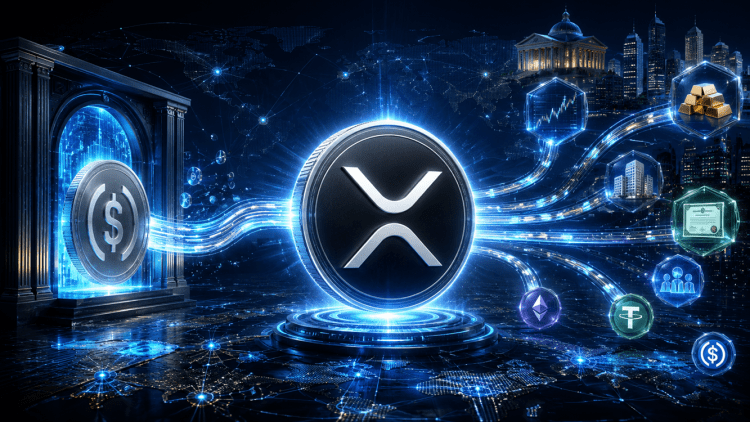
    RLUSD’s Impact on XRP Value Explained

    XRP Advocate Argues New Stablecoin Bolsters, Not Undermines, XRP’s Role

    Jake Claver, a prominent proponent of XRP, contends that Ripple’s forthcoming RLUSD stablecoin will not diminish the case for XRP but could, in fact, strengthen it by introducing more institution-friendly dollar liquidity to the XRP Ledger.

    In a recent X thread, Claver articulated that XRP and RLUSD are designed for distinct purposes. RLUSD is envisioned as a compliant digital dollar, while XRP serves as a neutral bridge asset, facilitating value transfer across otherwise disparate markets. This perspective addresses a persistent question within the XRP community: if RLUSD can move funds instantaneously, what is XRP’s continued necessity?

    Claver posits that this framing overlooks the fundamental difference between a settlement asset and a routing asset. “RLUSD is not the finish line. It is the front door,” Claver wrote. “Institutions come for a compliant digital dollar. Once they are on the ledger they start asking bigger questions. Can we tokenize securities here? Settle trades instantly? Drop the 3 day wait.”

    XRP as the Ledger’s “Money Changer”

    To illustrate his point, Claver employed an analogy of a historical trading port. Merchants arrive with various commodities like silk, spices, wool, salt, and gold, but rarely possess precisely what another trader desires. A silk merchant seeking pepper might first need to exchange their silk for wool before acquiring the desired spice. Claver noted that with ten goods, this creates 45 potential trading pairs; with a hundred goods, the number escalates to nearly 5,000.

    His conclusion is that markets require a neutral intermediary asset to reduce friction. On the XRP Ledger, Claver asserts, XRP fulfills this role. “On the surface that looks like one trade. Underneath it is two. He buys your silk and sells you silver, both at once. Remove that money changer and the whole port slows to a crawl. On the XRP Ledger, XRP plays that exact role,” he explained.

    Claver provided an example of an individual swapping a tokenized Treasury bill for a euro stablecoin. In his model, the user might perceive a single transaction—one asset entering and another exiting. However, the underlying routing path can, and often does, involve XRP. “The trader never sees the XRP step. Asset goes in, the one they want comes out. XRP sits quietly in the middle making it work,” he stated.

    Why RLUSD Does Not Replace XRP

    Claver described RLUSD as a digital dollar engineered to maintain a stable value of one dollar, backed by tangible reserves held in a bank. This makes it advantageous when both parties in a transaction seek dollar exposure. However, he argued that numerous future use cases on the XRP Ledger may not conclude in dollars, including the exchange of tokenized Treasuries for euro funds, lending in non-dollar currencies, or other asset-to-asset transactions.

    “RLUSD is perfect anytime both sides of a trade want dollars at the end. Plenty of trades do,” Claver wrote. “But plenty do not. Tokenized Treasuries swapping into euro funds. Lending in other currencies. Any trade where neither side is USD. There, a dollar coin cannot sit in the middle.”

    He then outlined three limitations that, in his view, preclude RLUSD from becoming the ledger’s universal bridge asset. Firstly, RLUSD has an issuer, introducing issuer-specific risk. Should the entity behind it encounter legal, banking, or operational challenges, the stablecoin could be impacted. XRP, in contrast, is not minted by a single issuer and cannot be deactivated by one company, he argued.

    Secondly, Claver contended that a global routing asset must be neutral. Regulated stablecoins are compelled to adhere to sanctions, blacklists, and regional regulations, potentially allowing them to freeze tokens or block specific users. While this may be suitable for a regulated dollar product, Claver suggested it is less appropriate for a foundational bridge asset.

    Thirdly, liquidity pools necessitate two distinct assets. RLUSD can be paired with euro stablecoins, tokenized Treasuries, or other instruments, but it cannot simultaneously represent both sides of a market. Claver concluded that the asset most likely to emerge as the primary routing layer is one that is liquid, neutral, free from issuer risk, and has a proven track record. His assertion is that XRP fits this description.

    At press time, XRP was trading at $1.2628.

  • Microsoft’s Copilot AI Forecasts Major XRP Surge by June 2026

    Microsoft’s Copilot AI Forecasts Major XRP Surge by June 2026

    Microsoft Copilot AI Forecasts Significant XRP Price Surge by Mid-2026

    Microsoft’s Copilot AI has presented a direct and optimistic forecast for XRP, projecting a rise to between $3 and $4 by mid-2026, a substantial increase from its current price of $1.26. This prediction hinges on two key catalysts that are already in motion and do not require further developments to influence the market.

    The straightforward nature of Copilot’s bullish outlook is considered its primary strength, contrasting with other XRP predictions that often rely on multiple variables. Copilot has distilled its forecast to two core factors: the return of ETF inflows as institutional investors re-enter cryptocurrency markets, and the CLARITY Act, which is expected to provide the long-awaited regulatory certainty for the U.S. market. Both of these are active developments, not speculative future events.

    Exchange-Traded Fund (ETF) products have already received approval and have demonstrated their potential to impact prices positively when inflows are strong.

    The CLARITY Act advanced through the Senate Banking Committee with a 15-9 vote in May, and a White House target of July 4th indicates that legislative progress is on a clear timeline, providing a definitive deadline for this prediction.

    Copilot’s framing of payment adoption and renewed investor confidence serves as the crucial link between these institutional catalysts and the retail investor segment.

    Regulatory clarity not only opens doors for institutional investment but also instills confidence in retail investors, enabling them to position themselves without the persistent overhang of legal risks that have historically suppressed participation.

    This dual-layered demand response, with institutions leading and retail investors following, is the mechanism Copilot anticipates will drive XRP from its current $1.26 to the projected $3 within the specified timeframe.

    Bearish Outlook Remains Limited

    The bearish scenario outlined by Copilot is notably contained. Should ETF demand fall short of expectations or regulatory clarity prove less impactful than currently priced into the market, XRP is predicted to consolidate between $1.00 and $1.50 without a significant breakout.

    This scenario is characterized as a period of stagnation rather than a collapse. Copilot views this as the less probable outcome, given the current balance of probabilities surrounding the passage of the CLARITY Act.

    Technical Analysis and Key Levels

    XRP concluded the week at $1.2588, marking a 5.42% decline over the past seven days. This weekly candle is a significant indicator, representing one of the most crucial pieces of information the chart has provided in months.

    The current closing price is falling below a support zone that has held since February. The wick structure of this week’s candle suggests that sellers maintained control from the opening to the closing bell, with no substantial buyer resistance observed throughout the week.

    The weekly chart structure dating back to November 2024 tells a complete story: a rapid ascent from $0.60 to $3.70 in under eight weeks, followed by a distribution phase characterized by a series of lower highs. XRP’s current position at $1.2588 is perilously close to the pre-CLARITY breakout zone that was first factored into pricing in late 2024.

    A sustained weekly close below this zone would signify the complete unwinding of the post-settlement premium, fundamentally altering the market narrative.

    The $1.20 level represents the final significant weekly support before the chart potentially opens up towards the $0.80 to $1.00 range. This level has acted as a floor through the February downturn and multiple subsequent tests. However, the current weekly close at $1.2588 is the closest the price has come to threatening this level since February.

    A weekly close below $1.20 in the upcoming week would constitute a structural break, invalidating the consolidation base and necessitating a complete re-evaluation of the current investment thesis.

    Upside Potential and Necessary Steps

    For Copilot’s $3 price target to materialize, a clear sequence of events must unfold on the upside. First, XRP needs to reclaim the $1.40 level, which currently acts as resistance, having previously served as support indicated by a dotted line on the chart.

    Following this, clearing the $1.60 level is crucial. This price point has rejected every recovery attempt since February. Achieving a weekly close above $1.60 would signal a fundamental shift in the chart’s character, moving from a pattern of declining steps to one building towards a breakout.

    Shifting Focus to Early-Stage Infrastructure

    When market leaders experience stagnation, astute investors begin to explore alternative opportunities. Bitcoin, Ethereum, and XRP are currently facing resistance. The catalysts required for the next upward movement—macroeconomic relief and sustained institutional inflows—have yet to materialize, meaning investors are waiting on factors beyond their control.

    Early-stage infrastructure projects operate in a distinct market environment where upside potential is not yet fully priced in. A relatively modest capital injection can significantly influence their trajectory, presenting an attractive asymmetry.

    LiquidChain is developing a solution that addresses a critical need in the current multi-chain ecosystem. Liquidity across Bitcoin, Ethereum, and Solana is currently fragmented, leading to costly, time-consuming, and user-unfriendly cross-chain transactions. LiquidChain aims to consolidate these three into a single execution layer, allowing developers to deploy applications once and users to interact across all three ecosystems seamlessly.

    The presale is priced at $0.01454, with over $700,000 raised, indicating an opportunity to invest at the ground floor rather than a late entry.

    The inherent risks associated with early-stage projects, including post-launch adoption, liquidity depth, and execution capabilities, are significant and acknowledged. However, the question remains whether the potential rewards justify these uncertainties.

    While established assets offer a more predictable path to a visible ceiling, LiquidChain presents an opportunity to participate in the foundational stages of a project with substantial future potential.


  • Cobie Denies $6.58M LDO Dump, Blames Wintermute

    Cobie Denies $6.58M LDO Dump, Blames Wintermute

    Cobie Denies $6.58 Million LDO Token Sale, Blames Market Maker Misattribution

    Crypto personality Cobie has publicly refuted claims that he sold $6.58 million worth of LDO tokens, attributing the flagged transactions to Wintermute, a prominent cryptocurrency market maker. The incident highlights how on-chain data can be misinterpreted, leading to the rapid spread of false narratives.

    On-Chain Misattribution and Viral Narratives

    The issue arose when on-chain tracking platform Lookonchain flagged a large transaction of LDO tokens, initially linking it to Cobie. The post, shared widely on social media, quickly gained traction, embedding a mistaken identity into the public feed before any correction could be issued. This is not the first instance where Wintermute’s operational activities have been misidentified as a celebrity or insider dump.

    Cobie directly addressed the misattribution, stating, “You’re looking at Wintermute’s wallets and reporting them as mine. Why would I be using 5 exchanges simultaneously? Why would I be using Gate? Please use your brain.”

    Lookonchain’s initial post stated, “It seems that Cobie dumped 20M $LDO ($6.58M)! Wallets linked to Cobie collected 20M $LDO from multiple wallets 6 hours ago and deposited it all into Binance, Kraken, OKX, Bybit, and Gate 1 hour ago.” The phrasing suggested a deliberate sell-off by an insider, but the underlying on-chain data pointed to a different scenario.

    Market Maker Operations vs. Individual Exits

    The simultaneous deposit of tokens across five centralized exchanges – Binance, Kraken, OKX, Bybit, and Gate – is characteristic of a market maker rebalancing inventory. Such actions are taken to manage spreads, fulfill over-the-counter (OTC) commitments, and maintain order book liquidity, rather than an individual investor exiting a position.

    Wintermute operates by routing significant token flows across multiple centralized and decentralized exchanges within a short timeframe. Analytics platforms like Arkham Intelligence and Nansen can sometimes misinterpret these movements as directional selling, particularly if wallet labels are outdated or incomplete.

    The Root of the Misattribution

    The misattribution appears to stem from a documented prior transaction. In July 2024, Cobie transferred 3.64 million LDO tokens to a Wintermute OTC wallet, a transaction that Lookonchain itself had previously reported. This earlier connection between Cobie’s addresses and Wintermute’s operational footprint seems to have led to the incorrect wallet labeling that triggered the recent false alarm.

    The structural flaw lies in how on-chain attribution tools often tag wallets based on historical transaction patterns. When a market maker’s OTC desk handles a sale on behalf of a client, subsequent transactions through related infrastructure can be mistakenly attributed to the original seller.

    LDO Token Performance and Market Context

    LDO is currently trading significantly below its all-time high. However, investors who participated in the DAO’s presale may still be in profit.

    The article also briefly mentions LiquidChain ($LIQUID), a Layer 3 infrastructure project in its presale phase, aiming to create a unified liquidity layer across Bitcoin, Ethereum, and Solana. The project’s presale price is $0.01465, with $820,000 raised to date.

  • Outpoll: Revolutionizing Prediction Markets

    Outpoll: Revolutionizing Prediction Markets

    Outpoll Launches Global Prediction Market Platform with Professional Trading Tools

    Outpoll has unveiled a new global prediction market platform designed to allow users to trade on the outcomes of real-world events. The platform encompasses a wide array of categories, including politics, sports, cryptocurrency, culture, and more. It features a product layer centered on professional trading tools, public API access, an integrated news feed, a native mobile experience, and creator-led markets.

    Prediction markets have significantly grown in prominence over the past two years, transitioning from a niche interest to a mainstream phenomenon. Trading volumes have reached billions, institutional capital has entered the space, and the prices generated by these markets are now cited alongside traditional polls and expert forecasts. However, the trading infrastructure itself has lagged behind the user experience of entering, managing, and exiting positions.

    The Outpoll prediction market platform aims to bridge this gap. At its core, Outpoll offers a prediction market in the established structural sense. Users can trade on the likelihood of specific events occurring, with positions resolving based on predefined outcomes. The underlying mechanics are intentionally familiar to those who have used similar platforms.

    What Outpoll innovates is the layer above these core mechanics. Historically, most prediction markets have offered a limited interaction model: users select a side, execute a trade, hold the position, and monitor charts until resolution. Outpoll operates on the premise that active traders expect more sophisticated tools.

    Experienced traders will immediately notice the enhanced order ticket. Both limit and market orders are available, and crucially, take-profit and stop-loss orders can be set on open positions. These are standard features in most trading venues, and Outpoll ensures their execution adheres to published rules. This functionality allows users to set a position, protect it, and then disengage, with the platform managing execution. For anyone who has experienced the volatility of prediction markets triggered by late-night news, the value of this robust infrastructure is clear.

    For traders who prefer programmatic access over a graphical user interface, Outpoll will provide a full public REST and WebSocket API. This is essential for active strategies, enabling automation of take-profit and stop-loss orders across multiple positions, real-time monitoring of price movements across different markets, and integration with existing trading stacks. The platform’s help center includes comprehensive API guides and technical reference materials, complete with practical Python examples. Programmatic access is a key indicator of a platform’s sophistication and its appeal to institutional capital.

    Creator-Led Markets

    A distinctive structural choice by Outpoll is its creator-led markets platform. This feature empowers approved community leaders, subject-matter experts, and channel owners to launch and curate their own prediction markets for their respective audiences. While most prediction markets are centrally managed, with the platform dictating available markets, Outpoll democratizes this process. Creators can extend their existing audience engagement into interactive markets, with Outpoll maintaining oversight on resolution and quality. This approach allows for a market list that reflects real-world attention and niche interests, often curated by individuals with deep domain expertise, leading to broader topical coverage than a centralized catalog can typically provide.

    Integrated News Layer

    Prediction markets are inherently news-driven, with events priced based on political developments, geopolitical shifts, economic data, and cultural moments. The friction for traders often lies in the gap between consuming relevant news and acting on it. Outpoll addresses this by integrating a dedicated news section directly within the trading interface. This aggregates relevant world news, allowing traders to see developments impacting a market immediately and act with a single click. This streamlined workflow eliminates the need for tab switching and fragmented context, reducing the gap between information consumption and trading action.

    Native Mobile Experience

    A significant portion of prediction market trading occurs on mobile devices, often in direct response to news consumed on the same platforms. Outpoll launches with a native Android application available on Google Play, with an iOS app slated for release in the autumn. The mobile experience is designed to be intuitive, with the order ticket, position management, charting, and notifications functioning as expected on a mobile device. This attention to mobile usability is crucial for traders who may need to act on market movements while away from their desks.

    Funding and Collateralization

    Outpoll supports deposits in multiple currencies with in-app conversion. Users can fund their accounts using their preferred cryptocurrency, which the platform converts to USDC, the primary settlement asset for trading, without requiring an additional swap. All markets are fully collateralized at the contract level, with resolution rules and authoritative sources published prior to market launch. Trading fees are set at approximately 0.1% per trade, aligning with industry standards.

  • NEAR, Worldcoin Surge Amid $714M Liquidation Event

    NEAR, Worldcoin Surge Amid $714M Liquidation Event

    The cryptocurrency market remains firmly in risk-off territory, with Bitcoin slipping below $70,000 for the first time in eight weeks. However, a select few altcoins have defied this downturn, notching double-digit gains.

    Altcoin Surge Amidst Bitcoin Slump

    NEAR Protocol has surged 15% over the past 24 hours, according to CoinGecko data. Worldcoin (WLD) and Internet Computer (ICP) have also seen significant gains, hovering near 12% and 11% respectively.

    Hyperliquid is trading near $73, a slight 0.7% dip on the day and approximately 3% below its record high of $75.46 set on Tuesday. Despite this minor pullback, the token has experienced an impressive 125% increase over the past year, highlighting its strong momentum.

    Factors Driving Divergence

    This robust performance from select altcoins occurs even as Bitcoin has fallen below the crucial $70,000 psychological level, reaching a local low of $69,034. Bitcoin is down more than 4% in the last 24 hours, leading to the liquidation of $728 million in leveraged positions, according to CoinGlass data.

    “Geopolitics lit the fuse for a sharp risk-off move, triggering the ~$650M+ liquidation cascade on June 1,” Andri Fauzan Adziima, research lead at Bitrue Research Institute, told Decrypt. “ETF outflows amplified it, with spot Bitcoin products bleeding billions in recent weeks as institutions rotated or de-risked.”

    Experts suggest that Bitcoin is facing pressure from multiple headwinds, including geopolitical tensions, macroeconomic factors, and significant capital outflows from exchange-traded funds.

    Tim Sun, senior researcher at HashKey Group, attributes Bitcoin’s decline to rising U.S. Treasury yields, which have dampened market risk appetite, and the booming AI market, which is siphoning capital away from cryptocurrencies. “This has left the crypto market relatively weak due to a lack of new narratives and strong capital inflows,” Sun told Decrypt. The sale of 32 Bitcoin by Strategy has further amplified this bearish sentiment.

    Ecosystem-Specific Catalysts

    In contrast, altcoin gains “seem to be independently driven by their respective ecosystems,” according to Sun.

    NEAR Protocol’s recent gains are linked to developments in privacy and AI, Decrypt reported. Injective is also benefiting from a similar AI trend, Adziima noted. Worldcoin’s price appreciation, meanwhile, can be attributed to “whale buying, derivatives interest, and adoption wins like live music ticketing via World ID,” he added.

    Nearly 97% to 99% of Hyperliquid’s revenue is being reinvested into token buybacks through its Assistance Fund, which has positively impacted the ecosystem and token holders. While the token’s price has reached multiple record highs over the past week, its market capitalization only hit a new all-time high on Tuesday, underscoring the deflationary effect of these buybacks. Furthermore, the HYPE token has seen growing institutional popularity over the past month, reflected in sustained inflows into HYPE ETFs.

    Concentrated Capital Flows

    Beyond individual fundamental developments, there is a “shared commonality,” according to Sun. He explained that “capital within the crypto industry is increasingly concentrating on assets with clear narratives, real cash flow growth, and healthy supply structures.”

    “These aren’t random pumps, they’re conviction plays with real catalysts in a sea of beta,” Adziima stated. “Capital is rotating hard into narratives with actual utility, yield, or tech edge, exactly what I’d expect in this phase.”

    With capital exiting ETF products and worsening macroeconomic conditions driven by factors such as the U.S.-Iran conflict and rising energy costs, the risk appetite for the crypto market remains virtually non-existent.

    “Even if a rebound occurs, we believe a relatively weak, range-bound consolidation is the most probable scenario,” Sun concluded. He added that a bear case scenario for crypto markets would involve a potential correction in U.S. equities, which remain elevated, noting that “These factors will all impact crypto assets, making it even harder for the crypto market to fully enter a phase of expanding risk appetite.”

  • Cardano Active Addresses Surge 14% Amid CME 24/7 Trading Launch

    Cardano Active Addresses Surge 14% Amid CME 24/7 Trading Launch

    Cardano Price Prediction: ADA Active Addresses Grow 14% as CME Launches 24/7 Trading

    Despite bearish price predictions for Cardano (ADA), on-chain data reveals that its largest holders are quietly accumulating the cryptocurrency, even as retail sentiment remains cautious. This activity coincides with CME Group’s rollout of 24/7 cryptocurrency futures and options trading, effective May 29.

    Institutional Access Expands

    This significant upgrade to the trading infrastructure extends institutional access to cryptocurrency markets around the clock, with only a brief weekly maintenance window. CME had already introduced ADA futures in both standard and micro sizes in February, establishing a direct derivatives pipeline for Cardano into regulated institutional markets.

    Following this development, active addresses on the Cardano network climbed by 14%, even as the price softened. Concurrently, the cohort of “whale” investors holding between 10 million and 100 million ADA increased their supply share from 36.48% to 37.23% over a three-week period. Currently, ADA is consolidating within a market structure influenced by these derivatives-driven upgrades.

    Whale Accumulation Amidst Governance Setback

    Data indicates that the accumulation by ADA whales, specifically the 10 million to 100 million ADA cohort, has reached 37.23% of the total supply. Active addresses have seen a 14% increase, reaching 17,500. Notably, whale buying activity commenced 18 days prior to a crucial summit vote that ultimately failed.

    Technical Outlook and Potential Scenarios

    Cardano is currently trading within a technically indecisive range, suggesting a potential for further price declines, though a reversal is possible at any time. Immediate resistance is observed at $0.28, with meaningful support found at the current price level.

    The technical setup presents three plausible scenarios. If the 24/7 CME trading volume leads to incremental derivatives volume in ADA-linked contracts, potentially followed by spot market activity, the price could surpass $0.25 ahead of the August spot ETF eligibility window.

    Alternatively, ADA might trade sideways between $0.22 and $0.24 as the market processes the recent failed governance vote. The Cardano Foundation’s request for 7.8 million ADA in summit funding garnered only 65.21% support, falling short of the required 66.67% supermajority.

    The final scenario involves a breakdown below $0.2, which would re-open the $0.18 price area and signal that whale accumulation was insufficient to absorb sustained selling pressure.

    Network Utility Growth

    The 14% growth in active addresses is a positive indicator, suggesting that network utility is expanding even as the price remains stagnant.

    Maxi Doge: A Different Proposition

    While ADA is experiencing a decline and faces a challenging path to reclaiming its all-time high above $3, Maxi Doge ($MAXI) presents a structurally different investment opportunity. Unlike assets still in their price discovery phase, Maxi Doge, a meme token built on Ethereum, focuses on the leverage-trading and high-energy dynamics of crypto bull cycles. Its ethos is captured by the tagline: “never skip leg day, never skip a pump.”

    The presale for Maxi Doge has raised $4.7 million, with the token currently priced at $0.00028. Holders can benefit from a substantial 66% staking Annual Percentage Yield (APY). The ecosystem includes exclusive trading competitions for holders, a Maxi Fund treasury for liquidity and partnerships, and meme-centric viral marketing strategies.

    The rotation of capital into meme-sector plays has been accelerating, even as large-cap altcoins consolidate.

  • XRP Price Holds Steady Amidst Rally Signals and Large Inflows

    XRP Price Holds Steady Amidst Rally Signals and Large Inflows

    Santiment has identified a significant surge in XRP’s Exchange Flow Balance, with 22.80 million tokens — the largest daily net inflow of 2026 — landing on centralized exchanges as the price dipped to $1.27. This wave of deposits, likely indicative of panic selling, was quickly followed by a net withdrawal of 25.24 million XRP, reversing the flow into negative territory.

    Bullish Implications of Exchange Flows

    The significance of this shift lies in the typical interpretation of exchange flows. When outflows exceed inflows, it generally signals that holders are moving their coins off exchanges for safekeeping, a behavior often associated with institutional-grade positioning.

    A tweet from Santiment highlighted the sequence: “22.80M XRP hit exchanges on May 28… then 25.24M XRP walked right back off exchanges on May 29-30 someone used that dip to load up heavy.”

    XRP’s Current Market Position

    XRP appears to be trading within a defined range. After reaching a weekly high near $1.36, the asset has retreated to the $1.26 area, marking a 6% pullback this week. While this decline is notable, XRP has outperformed Bitcoin, which saw a dip exceeding 10%. This resilience suggests a degree of strength among major altcoins like XRP.

    Key support levels are identified within the $1.13 to $1.21 band. Analysts on TradingView widely regard this zone as a demand floor that has previously absorbed selling pressure. Conversely, local resistance is concentrated between $1.40 and $1.50, an area where XRP has repeatedly struggled to sustain a breakout.

    The exchange flow data, indicating 25.24 million XRP being withdrawn from exchanges, suggests a reduction in selling pressure at current price levels.

    The prospect of an XRP ETF continues to be a positive factor, potentially representing the most significant variable for the asset’s future. If this narrative gains traction, the existing support levels are likely to hold.

    The XRP Investment Landscape

    The current setup for XRP presents a notable tension. Even a bullish scenario, projecting a move to its all-time high, would represent a 2.3x increase from current prices, a substantial gain. However, for traders who may have missed earlier opportunities with XRP at $0.01 or Bitcoin at $200, the question arises whether early-stage infrastructure projects offer a different risk-reward profile.

    LiquidChain ($LIQUID) is one such project, a Layer 3 infrastructure initiative currently in its presale phase. It aims to establish itself as a cross-chain liquidity layer, consolidating liquidity from Bitcoin, Ethereum, and Solana into a unified execution environment.

    The project’s core proposition is to enable “deploy once, access all three ecosystems,” addressing the fragmentation that has hindered capital efficiency across different blockchains. Its features include a Unified Liquidity Layer, Single-Step Execution, Verifiable Settlement, and a Deploy-Once Architecture.

    The presale price for LiquidChain is set at $0.01465, with $820,000 raised to date. At this entry point, the potential upside to any significant exchange listing offers an asymmetry that is rarely found in the consolidations of large-cap assets. Investors are encouraged to research LiquidChain before the presale concludes.

  • Binance Opens Trading for 7,000+ US Stocks, ETFs, Unveils Tokenization Plan

    Binance Opens Trading for 7,000+ US Stocks, ETFs, Unveils Tokenization Plan

    Binance is intensifying its efforts to bridge the gap between digital assets and traditional financial markets, announcing plans to allow users to trade over 7,000 U.S. stocks and exchange-traded funds (ETFs). The cryptocurrency exchange also unveiled a strategy to enable customers to convert their stock holdings into tokenized, crypto-style digital assets, positioning the move as part of a broader ambition to become a “multi-asset financial super app.”

    Targeting ‘Friction-Free’ Stock Trading

    Binance co-CEO Richard Teng explained that the initiative is primarily aimed at international customers. He noted that while U.S. stocks represent a significant portion of the global equity market, many overseas investors face high costs and complexities when attempting to access them.

    To address this, Binance will offer zero-commission stock trading for non-U.S. users. The platform will also facilitate fractional share purchases starting at $5, aiming to reduce both financial barriers and the operational hurdles for participation.

    Operational Framework

    Operationally, Binance’s new stock trading service will be supported by broker-dealer Nest Trading. Custody and settlement functions, including dividend payments and corporate actions, will be managed by Alpaca, a New York-based firm.

    Customers will have the option to fund their stock purchases using stablecoins such as Circle’s USDC or Tether’s USDT, alongside other digital currencies including Binance’s native BNB token.

    Introducing ‘bStocks’

    Beyond the trading program, Binance introduced a more innovative concept called “bStocks.” The company intends for bStocks to allow users to tokenize equities they acquire.

    According to Teng, this process involves creating a synthetic digital token representation of specific stocks by converting them into tokens on Binance’s BNB blockchain. This tokenization functionality is anticipated to be rolled out in the coming weeks.

    While other major platforms have explored similar models, Binance asserts that its approach could differentiate itself by empowering customers to initiate the tokenization process independently, rather than being limited to pre-defined conversion pathways offered by the platform.

    Market Reactions and BNB Performance

    The exchange’s announcement has already drawn attention. Analyst Zero Kyle suggested on X (formerly Twitter) that the development could pose a challenge to decentralized exchange Hyperliquid (HYPE). Kyle posited that while Binance’s offering might not replicate the continuous trading availability of venues like Hyperliquid, it is likely to intensify competition and potentially lead to a direct contest for market share. The analyst clarified that while this might not be detrimental to the HYPE token itself, it could negatively impact Hyperliquid as an exchange due to increased competitive pressure.

    Meanwhile, Binance’s native token, BNB, was trading at $692 at the time of reporting. This movement aligns with a broader retracement observed in the cryptocurrency market on Monday, which saw a 2.3% decline.