Tag: Negative

  • Republicans Launch Probe of Kalshi, Polymarket for Insider Trading

    Republicans Launch Probe of Kalshi, Polymarket for Insider Trading

    House Oversight Committee Launches Investigation into Prediction Market Platforms

    Investigation Focus

    The chairman of the House Oversight Committee announced Friday the launch of an investigation into the prediction market platforms Kalshi and Polymarket. The investigation will center on potential insider trading by users on both platforms, specifically concerning wagers that leverage non-public information, according to Committee Chair James Comer (R-KY).

    Congressional Action Considered

    “This growing pattern of insider trading activity on prediction market platforms indicates that Congressional action may be necessary,” Congressman Comer stated.

    Document Requests

    Comer sent letters to Kalshi CEO Tarek Mansour and Polymarket CEO Shayne Coplan on Friday, requesting a range of documents related to the companies’ internal operations. The requested information includes documentation and communications pertaining to know-your-customer (KYC) standards, policies and procedures for detecting suspicious trades, analysis of the impact of insider trading scandals on the companies’ reputations, and deliberations regarding wagers tied to armed conflicts.

    Specific Wager Scrutiny

    Comer has also requested that Kalshi and Polymarket provide internal communications and documents related to wagers on the Iran war and the U.S. attack on Venezuela earlier this year.

    Recent Events Prompting Inquiry

    The investigation follows the recent arrest of a U.S. soldier for allegedly placing Polymarket bets on the timing of American military actions using classified information. Additionally, Kalshi fined multiple U.S. politicians for betting on the outcomes of their own elections. Comer’s actions also appear to be influenced by a New York Times investigation that identified over 80 instances of potential insider trading on Polymarket.

    Growing Scrutiny of Prediction Markets

    In recent months, Kalshi and Polymarket have faced increased scrutiny from lawmakers concerned about the potential for widespread insider trading within the prediction market sector. Last month, the Senate unanimously passed a resolution banning its members and staff from trading on prediction markets.

    Platforms’ Response and Potential Risks

    In response to the growing pressure, both companies have taken steps to assure regulators that they are actively working to identify and eliminate insider traders on their platforms. However, this assurance could present challenges.

    “If they can catch this guy, why can’t you catch another?” said Dan Boyle, a partner at Boies Schiller Flexner and a former federal prosecutor focused on gambling-related fraud, referring to lawmakers’ potential concerns. Boyle added, “If their position was ‘We just don’t have the ability to catch some of these issues,’ that would be one position. But they’re making a push to show they have the [detection] technology, and they are able and willing to use it.”

    Republican-Led Investigation

    Unlike previous requests from Democratic lawmakers to investigate crypto firms, the House’s prediction market investigation is supported by Republican committee leadership. As the majority party in the House, the GOP leadership on the House Oversight Committee likely has the votes to issue legally binding subpoenas.


  • Polymarket Suffers $700K Loss in Wallet Exploit

    Polymarket Suffers $700K Loss in Wallet Exploit

    On-chain investigator ZachXBT flagged a suspected drain tied to Polymarket on Friday, reporting that over $520,000 had been taken from addresses linked to the prediction market’s Polygon infrastructure.

    Polymarket Acknowledges Breach

    Polymarket developers later acknowledged the incident, stating that it involved an internal rewards wallet and did not affect user funds or market outcomes.

    “Findings point to a private key compromise of a wallet used for internal top-up operations, not contracts or core infrastructure,” the Polymarket Developers account tweeted.

    Over an hour after the initial disclosure, the on-chain analytics platform Bubblemaps estimated the loss at approximately $700,000. Bubblemaps indicated that the funds were split across 16 addresses and routed through centralized exchanges and other services.

    Prediction markets on Polymarket utilize contracts that record bets and pay winners after an external service confirms the result. The wallet involved in Friday’s incident appears to have been used for rewards payments, separate from the contracts that handle user funds and market outcomes.

    Experts Weigh In

    Andy Yajin Zhou, associate professor at the Chinese University of Hong Kong and co-founder of on-chain security firm BlockSec, told Decrypt that their initial review aligned with the Polymarket developers’ account, suggesting a private key compromise rather than a flaw in the platform’s core systems.

    “Based on our initial analysis, this does not appear to be a flaw in the adapter contract logic or prediction market infrastructure itself,” Zhou said. “At this stage, we have not identified evidence suggesting a protocol-level exploit, oracle manipulation, or a generalized vulnerability in adapter-based market infrastructure.”

    Zhou explained that incidents like this highlight operational security risks, including key management, access control, signing policies, monitoring, and other safeguards surrounding wallets used for routine operations.

    Blockchain security firm Cyvers reached a similar conclusion, stating that the incident appeared to affect operational or admin wallets instead of Polymarket’s core contracts or its system used for settling markets, pointing to a broader industry risk around privileged wallets.

    “Even when prediction market protocols are secure at the smart contract level, privileged adapter or admin wallets remain a critical attack surface if key management or operational security is compromised,” Hakan Unal, senior security operation lead at Cyvers, told Decrypt.

    Dan Dadybayo, strategy lead at crypto infrastructure developer Horizontal Systems, told Decrypt that the incident fits a broader shift in how attackers are targeting crypto projects.

    “This increasingly looks like a key management failure rather than a smart contract exploit,” Dadybayo said. “The interesting shift across crypto is that attackers are no longer primarily breaking protocols. They’re targeting the operational layers around them: admin wallets, permissions, and infrastructure.”

    Decrypt has reached out to Polymarket for comment and will update this article should they respond. This is a developing story.

  • Nakamoto Moves to Stabilize Stock Price

    Nakamoto Moves to Stabilize Stock Price

    Nakamoto Sells Bitcoin to Cover Costs Amidst Financial Struggles

    Nakamoto sold 284 Bitcoin on the last day of March to cover operational expenses, according to the company’s first-quarter financial results. This detail highlights the current situation of one of the country’s Bitcoin treasury companies.

    Mounting Losses and Shifting Strategy

    The Bitcoin accumulation strategy that once propelled Nakamoto’s stock above $25 per share has been replaced by selling Bitcoin to manage operating costs. The company reported a net loss of $238 million for the first quarter. Over $102 million of this loss stemmed from a 20% decline in the value of its Bitcoin holdings during the quarter. Despite a 500% increase in revenue quarter-over-quarter, the losses overshadowed these gains.

    Nakamoto currently holds 5,058 Bitcoin, making it the 20th largest corporate Bitcoin holder globally, just behind ProCap Financial. Michael Saylor’s strategy leads the list, holding over 843,000 Bitcoin.

    Reverse Stock Split to Maintain Nasdaq Listing

    The company is now focused on maintaining its listing on the Nasdaq. Last December, Nasdaq issued a warning to Nakamoto after its stock price fell below $1 for 30 consecutive trading days. The deadline to rectify this is June 8. The company’s chosen solution is a 1-for-40 reverse stock split, scheduled to take effect on Friday. Shareholders approved the move at a special meeting earlier this month.

    The reverse stock split will consolidate every 40 shares into one, reducing the total share count from 696 million to 17.4 million. The stock closed at 16 cents on Wednesday, down 7.5% for the day and more than 99% below its price a year ago. A reverse split does not affect a company’s overall market value; it is a structural adjustment designed to increase the price per share above the listing threshold.

    Broader Sector Downturn

    Nakamoto’s challenges are not isolated. Reports suggest that crypto treasury companies have generally experienced a downturn since 2025, with many trading below the value of their assets. Some companies have begun selling their Bitcoin holdings to address debt. For example, Genius Group liquidated its entire 84 Bitcoin reserve in February.

  • Bitcoin Worth Nearly $500B Vulnerable to Quantum Computing: Glassnode

    Bitcoin Worth Nearly $500B Vulnerable to Quantum Computing: Glassnode

    Bitcoin Vulnerable to Quantum Computing Threat

    Nearly one-third of all Bitcoin in circulation, representing over 6 million coins and valued at over $469 billion at the time of writing, is potentially vulnerable to theft if powerful quantum computers become a reality, according to a report published Wednesday by blockchain analytics firm Glassnode.

    The analysis examined the Bitcoin blockchain to identify coins with exposed public cryptographic keys. It found that 6.04 million BTC, or 30.2% of the total supply, is susceptible to quantum risk, while the remaining 13.99 million BTC shows no public-key exposure. This estimate of exposed coins is lower than some previous figures, which have been closer to 7 million BTC.

    The concern stems from the architecture of Bitcoin’s security. Each coin is controlled by a private key, which corresponds to a public key visible on the blockchain under specific circumstances. The potential threat is that a sufficiently advanced quantum computer, using an algorithm known as Shor’s algorithm, could theoretically recover a private key from a known public key.

    In such a scenario, any coin whose public key has already been revealed on-chain would be immediately vulnerable, requiring no transaction to be initiated.

    Categories of Exposure

    Glassnode divides the exposed supply into two categories. Structural exposure accounts for 1.92 million BTC, or 9.6% of the issued supply. These coins are locked in script formats that inherently reveal the public key, including early “pay-to-public-key” outputs associated with Bitcoin’s pseudonymous founder, Satoshi Nakamoto, legacy multisignature structures, and more recent Taproot outputs. Many of these coins may be effectively unrecoverable, such as those in lost wallets or dormant holdings that cannot be moved to safer address formats.

    The larger and more actionable category is what Glassnode terms operational exposure. This category totals 4.12 million BTC, or 20.6% of the issued supply. These coins were not initially vulnerable but became so through address reuse, a practice where a wallet receives multiple transactions at the same address, eventually broadcasting the public key during a spend and leaving any remaining balance exposed.

    Exchange Vulnerabilities

    Exchanges are significantly represented in this category. Within the operationally unsafe category, 1.66 million BTC, or 8.3% of the total supply, is exchange-related, accounting for approximately 40% of all operationally unsafe Bitcoin. The exposure varies significantly across platforms. Among the largest exchanges, Coinbase’s labeled balances appear largely concentrated in non-exposed structures, with only 5% exposed, while Binance and Bitfinex show comparatively high susceptible balances—85% and 100%, respectively.

    Glassnode emphasized that its findings should not be interpreted as a risk ranking or a signal of solvency for any particular firm, stressing that the data reflects custody design choices rather than imminent danger. Sovereign Bitcoin holdings fared considerably better, with the United States, United Kingdom, and El Salvador all showing zero quantum exposure.

    Mitigation Strategies and Future Developments

    The report does not predict when, or if, a quantum computer capable of cracking Bitcoin’s encryption will exist. Instead, it presents its analysis as a baseline, noting that for exchanges and custodians, address hygiene, reserve management, reduced key reuse, and migration planning are practical measures to reduce visible exposure.

    These findings come as quantum computing advances globally and as the Bitcoin developer community discusses protocol-level responses, including a proposed update known as BIP-360, which would introduce more quantum-resistant transaction formats. Another official proposal suggests freezing coins that are not migrated by a set deadline.

    Estimates for “Q-Day”—when a quantum computer becomes powerful enough to crack the cryptography securing blockchains like Bitcoin and Ethereum—range from 2030 to 2032 and beyond. On Thursday, the United States government announced that it will invest over $2 billion in quantum startups and planned foundries to fuel American industry.

  • Syndicate Labs Shuts Down, Citing Rollup Ecosystem Decline

    Syndicate Labs Shuts Down, Citing Rollup Ecosystem Decline

    Syndicate Labs, an on-chain development startup backed by Andreessen Horowitz (a16z), announced it is winding down operations after five years of building infrastructure for on-chain developers.

    Rollup Market Shifts Cited

    The company cited significant shifts in the rollup market as the primary reason for the decision. In a statement on X, Syndicate Labs said its main focus had been providing developers with better tools to build and scale on-chain applications. However, according to the company, the rollup market has changed dramatically in recent years. It noted that fewer new rollups are entering the space, while several older projects have slowly disappeared.

    The company stated that the market had moved away from the type of technology it was building, adding that EVM rollups are no longer considered the industry standard. Instead, developers are increasingly choosing to build custom chains from scratch through consulting teams, which has resulted in less reusable infrastructure and reduced network effects across the ecosystem.

    Syndicate Labs said it had spent years trying to support the growth of on-chain applications and wished the outcome had been different. Despite the shutdown of the development company, the group stressed that the broader Syndicate ecosystem will continue to exist separately through the Syndicate Network Collective, a Wyoming-based DUNA that holds governance authority over SYND tokens.

    The company also clarified that the collective operates independently from Syndicate Labs, meaning governance over the SYND token is not immediately impacted. It explained that a successor organization could continue maintaining the DUNA structure, though it also outlined plans for an orderly wind-down if no successor emerges.

    Bridge Compromise and Token Lockups

    The Syndicate Commons Bridge on Base was compromised in late April after attackers gained access through a leaked private key, which eventually drained 18.5 million SYND tokens worth nearly $330,000. However, Syndicate Labs stated that the shutdown decision was unrelated to the incident.

    The affected customer and all SYND holders on Commons Chain have already been reimbursed using treasury reserves specifically set aside for such events. The company further stated that team members and investors remain subject to token lockups and that no affiliated individual has been able to access allocations for short-term benefit. Syndicate Labs said its vesting structure was designed around long-term incentives.

    Broader Industry Trends

    Syndicate Labs is not the only crypto project to struggle after security incidents and changing market conditions this year. Two DeFi projects moved toward shutdowns after struggling with the fallout from major security and financial problems. In February, Solana-based DeFi aggregator Step Finance, along with SolanaFloor and Remora Markets, ceased operations after a wallet compromise led to roughly $30 million in losses. The teams said fundraising and acquisition talks failed to produce a recovery plan.

    A month later, Balancer Labs proposed restructuring the Balancer protocol after months of financial strain, declining TVL, and a November exploit that accelerated liquidity outflows across the platform.

  • XRP Faces Further Downside After 100-Day MA Rejection

    XRP Faces Further Downside After 100-Day MA Rejection

    XRP Price Analysis: Where’s XRP Going Next After Latest Rejection at the 100-Day MA?

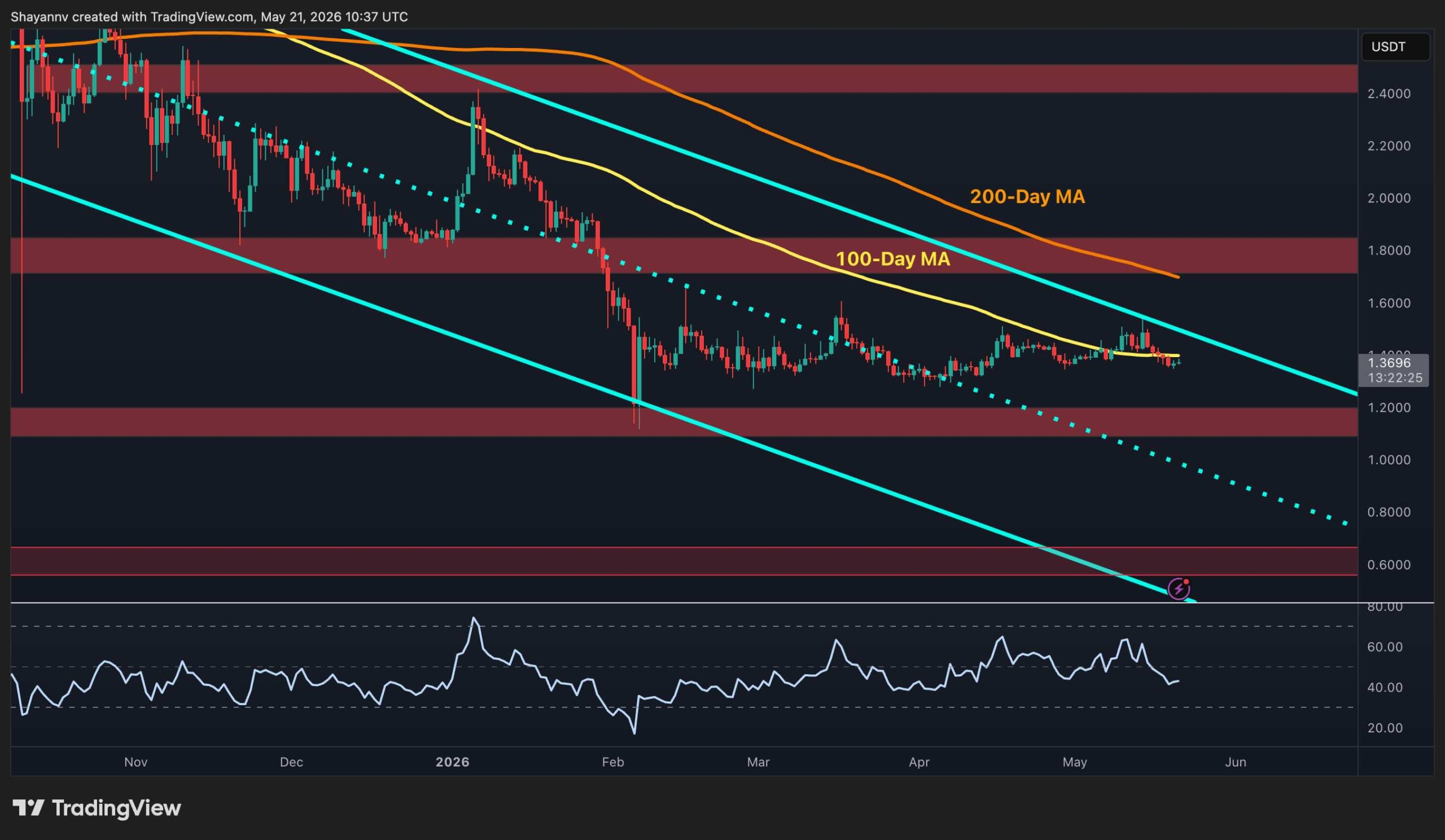
    XRP is trading at $1.37 as May nears its end, having reversed all gains from what briefly appeared to be the most promising technical setup of the corrective cycle. The breakout above the 100-day moving average on the USDT chart has failed to hold, and a lower high has formed on the BTC pair. The levels that looked like support last week are now the targets bulls need to reclaim to return to their starting point.

    USDT Pair Analysis

    The USDT pair’s daily timeframe setup appeared compelling last week. The asset was testing the upper boundary of the long-term descending channel and holding above the 100-day moving average at approximately $1.45, with the Relative Strength Index (RSI) climbing toward 65.

    However, this move has played out as a textbook rejection. XRP failed to close a single candle above the channel, and the subsequent sell-off has brought the price back to $1.37. The 100-day moving average, which was considered dynamic support just days ago, is now nearby overhead resistance at $1.40, just below the descending channel ceiling.

    The RSI has fallen from 65 back to the 40s, eliminating the momentum that made the setup optimistic. The $1.20 demand zone below should now be monitored as a potential floor, while a recovery above $1.45 and the 100-day moving average remains the minimum requirement to rebuild any constructive case. Yet, with the broader altcoin market declining, the path of least resistance points toward another test of support rather than another attempt at resistance.

    BTC Pair Analysis

    The brief breakout above 1,800 sats that appeared on the BTC pair last week has proven to be a fakeout. XRP/BTC has slipped back to around 1,770 sats, creating a lower high at approximately 1,800-1,900 sats. The RSI, which had recovered from an extreme low of roughly 25 to above 50 while demonstrating a bullish divergence, has also faded back toward 40. The relief bounce is losing energy before it accomplishes anything structurally meaningful.

    The failed reclaim of 1,800 sats is the defining development on this pair. It confirms that the oversold bounce was corrective rather than structural, and that the broader downtrend in the ratio remains intact. The 100-day moving average at approximately 1,900 sats and the 200-day moving average at approximately 2,100 sats continue to decline well above, offering no nearby reference for a recovery.

    Below, the lower channel boundary near 1,550 sats and the 1,500 sat horizontal support band remain the next downside targets if the current level gives way. With altcoin sentiment deteriorating across the board, there is little in the near-term macro picture to suggest that pressure is about to ease.

  • Peirce to Leave SEC, Raising Questions

    Peirce to Leave SEC, Raising Questions

    The departure of Hester Peirce, a staunch advocate for innovation and cryptocurrency within the Securities and Exchange Commission (SEC), leaves behind a significant unfinished regulatory agenda. This agenda includes unwritten stablecoin rules, tokenization frameworks still in the discussion phase, and the absence of clear statutory guidelines for digital asset exchange registration.

    Unresolved Regulatory Landscape

    The SEC, now without Commissioner Peirce, faces the task of addressing these issues. Peirce, known in the industry as “Crypto Mom,” is set to join Regent University School of Law as an associate professor in November 2026, concluding her tenure at the SEC that began in January 2018. Regent University, based in Virginia, announced her appointment on May 19, alongside the hiring of former Solicitor of Labor Gregory F. Jacob.

    Peirce had previously indicated in March 2025 that she would not seek another nomination after her second five-year term expired in June 2025, and has since been serving in a holdover capacity. Her start date at Regent aligns with her planned departure from the SEC.

    Impact of Peirce’s Approach

    Under former chair Gary Gensler, the SEC focused on enforcement actions rather than publishing comprehensive rules for token offerings, DeFi protocols, and crypto exchange registration. Peirce consistently criticized this approach, labeling it “regulation by enforcement” in her dissenting opinions since 2020. She argued that enforcement actions lead to case-specific legal outcomes, lacking the broad guidance necessary for industry-wide compliance.

    Peirce dissented in several high-profile crypto enforcement cases, including the 2021 DeFi Money Market settlement, where she argued that some projects were “failed experiments” rather than fraudulent schemes, and that the commission’s approach created uncertainty.

    She also championed a token safe harbor proposal, which would have given development teams up to three years to achieve network decentralization before securities registration was required. Although the full commission did not adopt this proposal, market lawyers used it as a reference for structuring token launches.

    Legacy and Future Implications

    Peirce’s dissenting record on spot Bitcoin ETFs is arguably her most significant legacy. She consistently criticized the SEC’s repeated rejections, calling the agency’s stance “a paternalistic and lazy approach to innovation.” The 2024 approvals, which she viewed as “long overdue,” are partially attributed to the legal and political pressure generated by her sustained dissents. Her consistent, documented record provided a roadmap for outside counsel and courts.

    Most recently, Peirce led the SEC’s Crypto Task Force, launched in January 2025. The task force has held public roundtables, rescinded prior bank custody guidance, and incorporated industry experts to advise on tokenization frameworks and exchange rules. This task force, representing the institutional framework she established during her final period, will now continue its work without her.

  • XRP Sees Inflows in April, Outflows in May: Data

    XRP Sees Inflows in April, Outflows in May: Data

    XRP Struggles Amidst Institutional Hesitation

    XRP is facing resistance, with selling pressure weighing on its price, which has retreated from the $1.45 level that briefly offered hope for a sustained recovery. Market sentiment is cautious, and a report by Arab Chain, which tracks institutional accumulation behavior, has identified a shift in large investor activity. This provides an on-chain explanation for the current weakness.

    Institutional Accumulation Declines

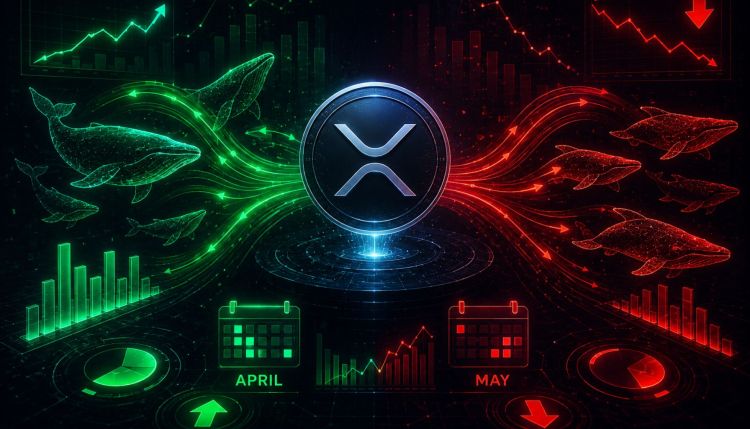
    The institutional accumulation indicator for XRP on Binance has fallen to approximately -0.0059, returning to negative territory after a period of improvement throughout April. This regression is significant due to the preceding trends. From late March onward, the indicator had been gradually increasing, reflecting growing institutional buying interest as XRP’s price recovered towards $1.45. While the positive readings were not dramatic, they were consistent, indicating that large investors were cautiously rebuilding their exposure.

    This constructive dynamic has reversed. The same institutional accumulation that supported the April recovery has cooled in May, coinciding with the price decline back towards $1.38. This sequence – institutional buying improving alongside price advances, then fading alongside price declines – is not coincidental. It highlights the specific category of participants whose presence or absence directly influences whether XRP’s recovery has structural support or is simply driven by momentum.

    Institutions Step Back

    The Arab Chain report clarifies that the current indicator decline should not be interpreted as a distribution signal. The institutional accumulation index has returned to negative territory, but the reading of -0.0059 is close to neutral, rather than at deeply negative levels that would indicate widespread institutional exit or active selling by large holders.

    According to the analysis, the negative reading likely reflects a phase of caution and reassessment rather than a conviction in a bearish direction. Institutional participants who were gradually rebuilding XRP exposure through April have paused, not reversed their positions. The momentum that was building has stabilized rather than collapsed, and the liquidity conditions that supported the April improvement have softened without triggering aggressive outflows.

    The report identifies a specific and actionable forward signal: a return of the institutional accumulation indicator to positive territory, even marginally, would represent early confirmation that large investors are resuming the buying behavior seen during the April price improvement. This signal would not guarantee a recovery, but it would restore the structural support that underpinned the previous advance. Until this return appears, XRP is navigating a market where potential buyers have stepped back to reassess, rather than stepped away entirely.

    Consolidation and Technical Outlook

    XRP is trading near $1.37 after another failed attempt to reclaim the $1.45 resistance region, reinforcing the broader consolidation structure that has dominated price action since the February capitulation event. The daily chart reflects a market trapped between weakening bullish momentum and the absence of aggressive selling pressure, creating an environment defined more by exhaustion than conviction.

    Following the sharp collapse towards the $1.15 region in February, XRP stabilized and entered a prolonged sideways range between approximately $1.30 and $1.50. Buyers have repeatedly attempted to push the price higher, but every breakout effort has faded once XRP approached the descending 100-day moving average. Meanwhile, the 200-day moving average remains significantly higher near the $1.70 region, confirming that the broader trend structure still favors sellers.

    Volume has steadily declined throughout the consolidation period, aligning with the recent deterioration in institutional accumulation metrics on Binance. The fading participation suggests large investors are no longer supporting the market with the same consistency seen during April’s recovery phase. Technically, the $1.30 support zone remains the most important level for bulls to defend. A breakdown below this region could trigger another leg lower towards the February lows, while reclaiming the $1.45-$1.50 resistance area would likely be required to restore bullish momentum and attract renewed institutional participation.

  • Malware Targets Software Pipelines: Understanding Shai-Hulud

    Malware Targets Software Pipelines: Understanding Shai-Hulud

    Malware Campaign Targets Software Supply Chains

    A malware campaign dubbed “Shai-Hulud” is spreading through the software pipelines used by developers to build and distribute code, raising concerns about the reliance on automated systems with minimal human oversight.

    Researchers have linked the Shai-Hulud malware campaign to approximately 320 package entries across Node Package Manager (NPM) and PyPI, two major online repositories used by developers to download and share JavaScript and Python software packages. These affected packages collectively account for over 518 million monthly downloads.

    “Shai-Hulud is significant because it exposes a problem we cannot fully patch away: modern software is built by running other people’s code,” said Jeff Williams, CTO of the California-based security firm Contrast Security. “Developers do not merely ‘download’ libraries. They install them, build with them, test with them, deploy with them, and eventually execute them. And if you run a malicious library, it can do almost anything you can do.”

    Williams added that advances in artificial intelligence complicate the threat, comparing Shai-Hulud to making a computer a double-agent.

    “The scary part is the leverage. If an attacker compromises one obscure package, they do not just get that package,” Williams said. “They get a path into every downstream project that trusts it. Then they can steal more tokens, publish more poisoned packages, and repeat the cycle. The software supply chain is not a chain anymore—it’s a propagation network.”

    Recent Incidents and Impact

    Earlier this month, Microsoft Threat Intelligence disclosed that attackers inserted malicious code into a Mistral AI software package distributed through PyPI. The malware downloaded an additional file designed to resemble Hugging Face’s widely used Transformers library to blend into machine-learning development environments. Mistral later stated that an affected developer device was involved but that there was “no indication that Mistral infrastructure was compromised.”

    Two days later, OpenAI confirmed that malware tied to the same campaign infected two employee devices, giving attackers access to a limited number of internal code repositories. The company found no evidence that customer data, production systems, or intellectual property were compromised.

    Named after the giant sandworms in Frank Herbert’s “Dune,” researchers traced earlier versions of the malware back to September 2023 and cybercriminals known as TeamPCP. However, the campaign gained wider attention after a major May 11 attack targeting TanStack, a widely used open-source JavaScript framework used in web and cloud applications.

    Growing Threat to Software Supply Chains

    Shai-Hulud is part of a growing trend of supply-chain attacks where hackers compromise trusted software tools or services used by other companies. Instead of directly targeting victims, attackers use these trusted systems to spread malicious code or gain access to developer environments.

    Researchers say the attacks poison shared build caches, causing future software releases to quietly incorporate the malicious code. To a developer downloading the packages, everything appears normal because the software comes from trusted sources, carries valid signatures, and passes security checks. This is what makes the attack so concerning.

    On Sunday, cybersecurity firm OX Security reported that new malicious packages mimicking the original malware were already stealing cloud and crypto wallet credentials, SSH keys, and environment variables. Some variants also attempted to turn infected machines into DDoS botnets.

    “One incriminating evidence that this is a different actor from TeamPCP is that the Shai-Hulud malware code is an almost exact copy of the leaked source code, with no obfuscation techniques, which make the final version visually different from the original,” OX Security wrote. “In our breakdown, we show the side by side comparison of the chalk-template Shai-Hulud version with the original source code leak, showing that they are the same.”

    Broader Implications

    The emergence of Shai-Hulud coincides with the increasing reliance of modern software developers on automated platforms like GitHub Actions. Simultaneously, supply-chain attacks targeting open-source infrastructure have become more common as attackers focus on developer tooling and automated publishing systems rather than end-user systems directly.

    “[Shai-Hulud] is a reminder that [systems, applications, and products] attack surface now extends well beyond traditional application layers and into the open-source packages that power modern development and deployment workflows,” said Joris Van De Vis, Director of Security Research at the Netherlands-based cybersecurity firm SecurityBridge.

    On Tuesday, GitHub announced it was investigating unauthorized access to its internal repositories after TeamPCP claimed responsibility for stealing roughly 4,000 private repos and offering the data for sale on a cybercrime forum for at least $50,000.

    According to Van De Vis, Shai-Hulud also demonstrates how attacks targeting trusted software automation can quickly spread from developer tools into enterprise systems that companies rely on for critical operations.

    “When trusted npm dependencies can be weaponized to steal credentials from [Cloud Application Programming] and [Multi-Target Application] environments, the risk is no longer just a developer laptop issue, it becomes a direct path toward productive SAP systems, which is why organizations need tighter dependency controls, exact version pinning, and stronger publishing safeguards,” Van De Vis said.

  • GitHub Internal Repos Breached; Binance CEO Calls for Immediate Key Rotation

    GitHub Internal Repos Breached; Binance CEO Calls for Immediate Key Rotation

    GitHub Repositories Breached, Prompting Security Concerns

    Hackers gained access to GitHub’s internal repositories earlier today by exploiting an employee’s computer through a compromised VS Code extension.

    Following the incident, reports surfaced that a threat actor using the alias TeamPCP is allegedly selling approximately 4,000 of GitHub’s private repositories on a cybercriminal forum, with a minimum asking price of $50,000.

    GitHub confirmed the breach via posts on its X account, detailing the information available at the time. According to the platform, the attacker gained access to its internal repository through a malicious VS Code extension loaded onto an employee’s device.

    GitHub stated that it promptly removed the malicious software from the infected machine upon discovering the attack. Crucially, the company emphasized that there is currently no evidence that customer data held outside its internal systems, including individual users’ enterprises, organizations, or repositories, was accessed.

    The hosting service also confirmed it quickly rotated credentials, prioritizing the most critical secrets. It will also examine logs to identify any additional activity and will provide further details after the investigation concludes.

    Alleged Sale of Stolen Data

    Meanwhile, French researcher Sébastien Latombe highlighted a listing on a criminal message board by the threat actor TeamPCP, claiming responsibility for the hack. The listing mentions repositories related to GitHub Actions, GitHub Enterprise, GitHub Copilot, Azure, CodeQL, billing, and authentication services.

    TeamPCP is reportedly seeking a single buyer for the stolen data, rather than a ransom from GitHub, with a minimum asking price of $50,000.

    However, neither GitHub nor Microsoft has officially confirmed the content of the forum listing. Claims made on cybercriminal sites should be treated with caution, as the data provided may be outdated or exaggerated to inflate its perceived value.

    Industry Response and Broader Security Concerns

    The online reaction to the breach was swift. Binance co-founder Changpeng Zhao (CZ) urged crypto developers to review and change their API keys if they are present in their code, even in private repositories.

    Responses highlighted a widespread industry problem. Topaz DEX founder Aaron Shames called it “bad practice to have API keys in any repo, private or not,” while acknowledging the warning.

    Others pointed out that managing hundreds of keys across projects is not a simple task for developers.

    Digital artist Tuteth_ wrote, “This entire practice of key storage needs an update.”

    Security commentator Dhanush Nehru added, “No one knows what all permissions each VS Code extension owns. The cybersecurity threat landscape is scary.”

    The timing of this incident has heightened existing concerns about crypto security, following multiple high-profile hacks this month, including an attack on Echo Protocol, where hackers minted $76.7 million worth of eBTC.

    That incident followed multimillion-dollar attacks on THORChain and the Verus-Ethereum Bridge.

    These events have reignited discussions about code verification and software supply chain vulnerabilities, with Vitalik Buterin suggesting that formal verification, aided by AI, can enhance software security by mathematically proving its behavior.