Tag: Neutral

  • Bitcoin Rally Hits Major Hurdle

    Bitcoin Rally Hits Major Hurdle

    Bitcoin Recovers Sharply, Nearing Key Resistance Zone

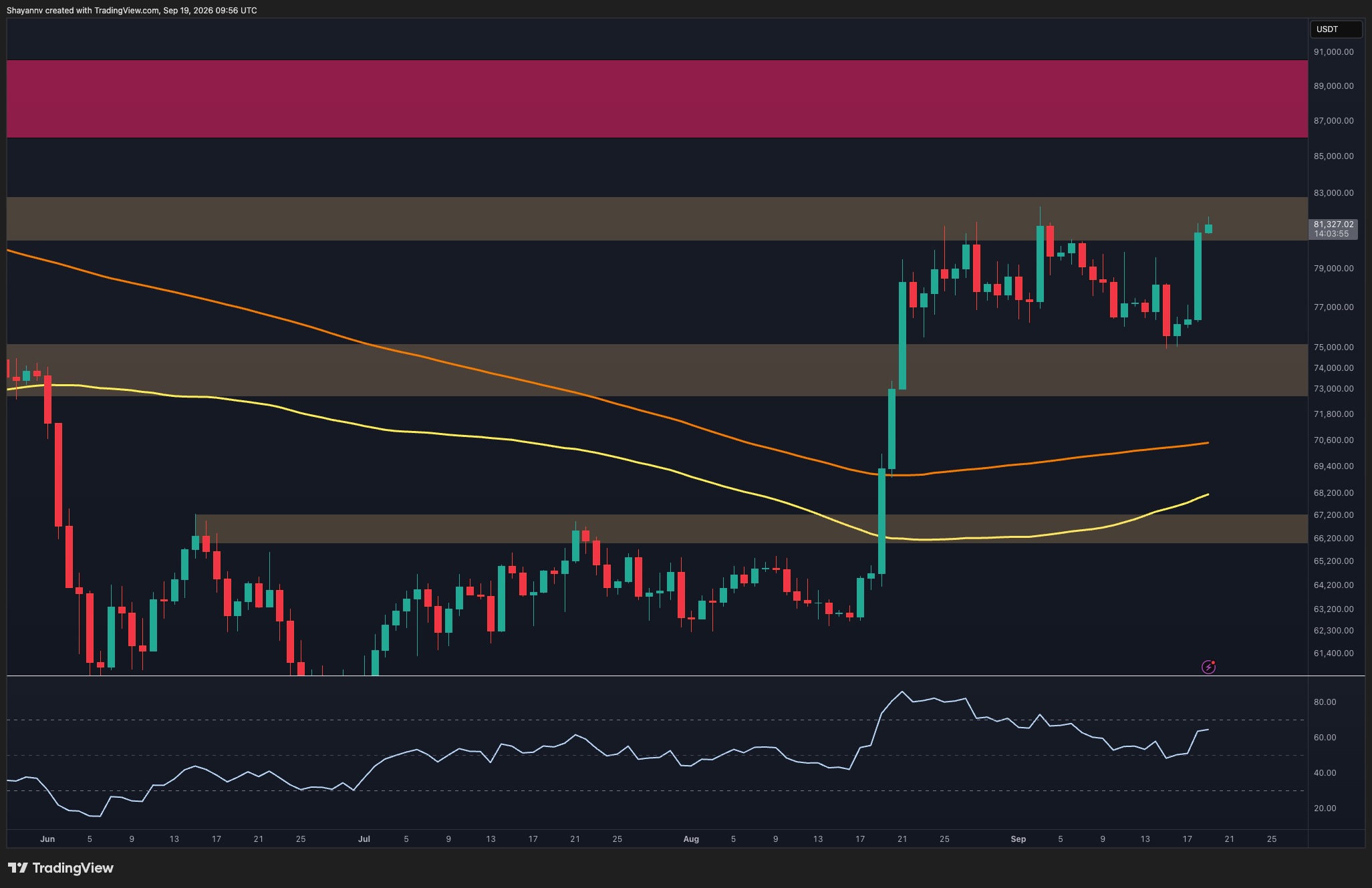
    Bitcoin has staged a strong recovery from its latest pullback, once again testing the upper boundary of its current consolidation range. With BTC trading around $81,500, the market is approaching a critical juncture where a confirmed bullish breakout could propel prices higher.

    Daily Chart Consolidation

    The daily chart indicates that Bitcoin has been consolidating following a significant breakout in August. The recent rebound from the $75,000 level has been particularly robust, with buyers swiftly pushing the price back towards the major resistance zone between $80,500 and $82,500.

    This area has consistently capped upward price movements and remains the primary hurdle for another bullish advance. Bitcoin is currently retesting this zone around $81,500, while the broader market structure remains constructive as long as the support area between $72,500 and $75,000 holds.

    Momentum indicators have also shown improvement. The daily Relative Strength Index (RSI) has moved back above the neutral 50 level and is approaching the mid-60s, signaling renewed buying interest without yet entering overbought territory.

    A sustained daily breakout above the $82,500 resistance level would represent a significant structural development and could open the path towards the next major supply zone, estimated between $86,000 and $90,000. Conversely, another rejection at this resistance could keep Bitcoin trading within its current range, with $75,000 and the broader $72,500-$75,000 region serving as the key support.

    Four-Hour Timeframe Insights

    The four-hour timeframe offers a clearer view of the range-bound structure. Bitcoin recently experienced an aggressive rebound from the lower boundary of its range, near $74,500-$75,000, and has now returned directly to the $81,000-$82,000 resistance region.

    This recovery has been impulsive, particularly the latest move from approximately $76,000 to $81,000. However, the price has yet to achieve a convincing breakout above the upper boundary. Consequently, the market remains within the broader range despite increasingly bullish short-term momentum.

    A clean break and sustained hold above the $81,000-$82,000 zone would likely shift the market structure decisively in favor of buyers. Such a move could trigger another price surge, initially targeting the rising upper trendline around $84,000-$85,000.

    Until this breakout occurs, rejection remains a plausible scenario. Failure to overcome the $82,000 level could send BTC back towards the middle of the range, with the $72,500-$75,000 zone continuing to act as critical support and the broader invalidation area for the current bullish setup.

    Liquidation Heatmap Analysis

    The two-week Binance BTC/USDT liquidation heatmap provides additional context for the recent rally. Liquidation heatmaps illustrate areas of concentrated leveraged positions, with brighter regions indicating larger potential liquidation clusters.

    Bitcoin’s surge above $80,000 has pushed the price into a significant concentration of liquidity within the $80,000-$82,000 region. This aligns closely with the technical resistance observed on price charts, making the current area particularly pivotal.

    Some liquidity remains immediately above the current market price, suggesting that a decisive breakout could trigger additional short liquidations and potentially accelerate the upward movement. This supports the possibility of another sharp spike if BTC successfully breaks through the $81,000-$82,000 resistance zone.

    Simultaneously, a liquidity concentration persists below the current price, around $74,000-$75,000. Therefore, as long as Bitcoin remains capped below resistance, volatility in either direction cannot be ruled out. For now, the combination of improving momentum and price pressing against the range high places the focus squarely on whether buyers can convert the current test into a confirmed breakout.


  • US Senate Vote on CLARITY Act Preserves Regulatory Patchwork; Bitcoin Recovers from Initial Dip

    US Senate Vote on CLARITY Act Preserves Regulatory Patchwork; Bitcoin Recovers from Initial Dip

    The US Senate’s decision not to advance the CLARITY Act on September 15 has maintained the existing regulatory framework for digital assets in the United States, leading to a temporary price drop for Bitcoin followed by a recovery. The bill’s core aim was to establish clearer boundaries between the Securities and Exchange Commission (SEC) and the Commodity Futures Trading Commission (CFTC) and create federal rules for crypto markets.

    Following the vote, Bitcoin’s price declined to a multi-week low of $75,000. However, the cryptocurrency subsequently recovered, surpassing $81,000 by Friday. Experts suggest this market reaction indicates the outcome was largely anticipated and ‘priced in’ by traders, who had treated a failed vote as the likely scenario for weeks.

    Regulatory Patchwork Persists

    Alvin Kan, COO at Bitget Wallet, noted that the failure of the CLARITY Act preserves the current US regulatory patchwork. He explained that the vote did not introduce new restrictions on self-custody or self-hosted wallets. However, Kan cautioned that protections that might have been included in the proposed legislation, such as those covering users controlling their own assets and developers providing non-custodial software, remain without a stronger statutory foundation.

    This continued regulatory uncertainty could disproportionately affect smaller companies within the crypto space. Recent data from Electric Capital indicates a decline in the US share of global crypto developers, dropping from 38% in 2015 to 19%. Similarly, the US share of centralized-exchange volume growth between 2024 and 2025 is estimated to be between 2% and 5%.

    Incremental Regulatory Development Continues

    The CLARITY Act is not definitively dead, as a procedural vote by Senator Thom Tillis allows for the possibility of reconsideration. However, the legislative calendar makes passage this year increasingly difficult. In the interim, the SEC and CFTC are expected to continue utilizing their existing authorities to regulate the digital asset industry.

    This ongoing regulatory development was demonstrated by the SEC’s recent introduction of a five-week exemption for certain tokenized-stock trading, illustrating that regulatory progress can occur even without comprehensive congressional legislation, a scenario previously predicted by Bitwise’s CIO.

    Iliya Kalchev, a Nexo Dispatch analyst, commented on Bitcoin’s price movement, suggesting that the initial $3,000 drop to $75,000 should not be overlooked. However, he echoed the sentiment that the subsequent rebound pointed to the market having already factored in the vote’s outcome, viewing it more as a confirmation than a surprise. Kalchev concluded that the US is likely to continue legislating crypto incrementally as political conditions allow, with market structure unlikely to remain an exception.

    The failure of the CLARITY Act leaves the US crypto regulatory landscape with continued uncertainty. While the market has shown resilience, the lack of clear federal rules may continue to impact developer activity and market share, with existing regulatory bodies expected to fill the void through their current powers.

    Why This Matters

    The materials describe a narrow update: The US Senate failed to advance the CLARITY Act, which aimed to establish clearer regulatory boundaries for crypto markets. The long-term impact of the CLARITY Act’s failure on the US regulatory landscape for crypto.

    Broader Context

    Source materials place the factual news in this context: The CLARITY Act’s failure to advance has preserved the current US regulatory patchwork.

  • SEC Receives Amended Filing for 21Shares Injective ETF, Highlighting Procedural Status and Unresolved Custody Arrangements

    SEC Receives Amended Filing for 21Shares Injective ETF, Highlighting Procedural Status and Unresolved Custody Arrangements

    The U.S. Securities and Exchange Commission (SEC) has received an amended registration statement for the proposed 21Shares Injective ETF. This filing serves as a procedural update to a prior submission and is part of the SEC’s ongoing review process for the potential cryptocurrency-backed investment product. Crucially, this amended filing does not signify approval, and critical operational details, such as custody arrangements, remain unfinalized, according to the filing.

    The amended S-1/A filing updates the original submission made in October 2025. Should it receive approval, the 21Shares Injective ETF aims to offer traditional investors regulated access to the INJ token, the native cryptocurrency of the Injective Network. The proposed ETF is slated to list on the Nasdaq under the ticker symbol TINJ and is structured as a Delaware statutory trust, sponsored by 21Shares US LLC.

    ETF Strategy and Potential Yield

    The ETF’s investment strategy is designed to passively track the performance of the INJ token via the FTSE Injective Index. A key component of this strategy involves the discretionary staking of a portion of the fund’s INJ holdings, a move intended to potentially enhance returns beyond simple price tracking. Historical data from 2025 indicates that annual staking rewards for INJ ranged between 9.3% and 13.62%, providing a yield component not typically found in traditional equity-focused exchange-traded funds.

    Outstanding Uncertainties and Regulatory Hurdles

    Despite this procedural step, significant regulatory hurdles remain. According to the filing, custody arrangements for the ETF’s assets are still unfinalized. This is a critical detail that the SEC will likely require to be resolved before considering any approval. The preliminary prospectus also states that shares have not yet traded publicly, and financial statements are not included at this stage.

    Market Context and 21Shares’ Experience

    The Injective Network is a layer-1 blockchain built on the Cosmos SDK, specifically engineered for decentralized finance (DeFi) applications, including decentralized exchanges and derivatives platforms. As of September 1, 2026, the circulating supply of INJ was approximately 92.8 million tokens, with a market capitalization near $488 million. This market capitalization is considerably smaller than major cryptocurrencies like Bitcoin or Ethereum, suggesting that even modest inflows into an INJ ETF could represent a significant percentage of the token’s total available supply.

    21Shares has prior experience in bringing digital asset investment products to market. The firm currently offers a 21Shares Injective Staking ETP for European investors and was involved in the launch of the ARK 21Shares Bitcoin ETF in the U.S. The current filing for the Injective ETF aligns with a broader trend of asset managers seeking to launch ETFs for various layer-1 and DeFi tokens, following the introduction of spot Bitcoin and Ethereum ETFs in the U.S. in 2024.

    The amended filing keeps the registration active and updated as the SEC continues its review. This process involves assessing the ETF’s structure, strategy, and operational readiness, including the finalization of custody arrangements. Whether the 21Shares Injective ETF will be approved by the SEC remains uncertain, as key details are still pending.

    Why This Matters

    The materials describe a narrow update: The SEC has received an amended registration statement (S-1/A) for the 21Shares Injective ETF, which aims to provide traditional investors with regulated access to the INJ token. Whether the 21Shares Injective ETF will be approved by the SEC.

  • Canada-EU Trade Deal Odds: Prediction Markets Weigh In

    Canada-EU Trade Deal Odds: Prediction Markets Weigh In

    Canada-EU Ties: From Internet Curiosity to Geopolitical Discussion

    Speculation that Canada might one day join the European Union has evolved from an online novelty into a serious geopolitical conversation in recent months. This shift is reflected in the growing traction of Canada-EU odds on prediction market platforms like Kalshi and Polymarket.

    The idea gained momentum as Canada sought to lessen its reliance on the United States amid escalating trade tensions. A Canadian poll conducted in April revealed that 58% of respondents believed EU membership was worth exploring, with an additional 25% deeming it a good idea.

    “Associate Member” Proposal Sparks Closer Cooperation

    Speculation intensified this week following an invitation from European Commission President Ursula von der Leyen for Canada to become the EU’s first “associate member.” The proposal aims to foster closer cooperation in critical areas such as defense, critical minerals, energy, and artificial intelligence. Canadian Prime Minister Mark Carney welcomed the concept but emphasized that Canada is pursuing a “unique alliance” rather than full EU membership.

    This distinction is significant, as current EU treaties do not accommodate associate membership and are structured for accession by European states only. Some EU diplomats have already voiced skepticism regarding the proposal’s feasibility and the potential for member state support.

    Prediction Markets Weigh In on EU Membership Prospects

    On Polymarket, a market assessing the likelihood of Canada being admitted as a full EU member by the end of 2026 or 2027 currently places the probability at approximately 2% for 2026 and 9% for 2027. This market, which opened on September 17, has generated only about $1,250 in volume, suggesting the figures should be viewed with caution rather than as a definitive consensus.

    A separate Polymarket market focuses on whether Canada will formally apply for full EU membership. Traders are assigning an 8% probability to an application by December 31, 2027, compared to 2% for an application by the end of 2026.

    Meanwhile, Kalshi offers a broader market inquiring whether the EU will gain a new member before 2030. Currently, 75.8% of bettors favor a “yes” outcome, though with only $8,000 in trading volume. Crucially, this market does not specifically identify Canada as the potential new member, thus limiting its ability to provide a Canada-specific probability.

    The overall picture from prediction markets indicates a stronger leaning towards closer Canada-EU integration rather than full membership. The proposed “associate member” status could pave the way for significantly deeper economic, security, and political ties, but transforming this into full EU membership would necessitate overcoming substantial legal and political hurdles.

    For the time being, the clearest market signal suggests that Canada’s full accession to the EU remains a low-probability scenario, while a new form of privileged association between Canada and the EU is garnering considerably more attention.

    Bitcoin Hyper Aims to Enhance Network Visibility and Performance

    Bitcoin Hyper is working to improve network visibility, enabling better performance tracking, understanding of transaction flows, earlier issue identification, and ecosystem refinement as it expands.

    A modest 1.37% increase from a $1.54 trillion base is characteristic of the current market dynamics. At this scale, Bitcoin is not expected to experience dramatic surges from interest rate relief rallies, as the underlying mathematics no longer support such rapid growth.

    This reality is prompting some traders to explore early-stage infrastructure projects built directly on Bitcoin, rather than solely anticipating diminishing percentage gains from Bitcoin itself.

    Bitcoin Hyper ($HYPER) is positioning itself as the first Bitcoin Layer 2 solution to integrate a Solana Virtual Machine (SVM). Its objective is to surpass Solana’s transaction throughput while reinforcing security by anchoring to Bitcoin’s base layer.

    The presale token is currently trading at $0.0136864, with $33,144,078.90 raised to date. This figure has grown in tandem with capital rotations driven by interest rate hikes into Bitcoin-adjacent investment opportunities.

    Bitcoin Hyper proposes to address Bitcoin’s slow settlement times and limited programmability through low-latency Layer 2 processing. It also offers a decentralized canonical bridge for BTC transfers and provides staking rewards with a high annual percentage yield (APY).

  • AI Cooling Shifts to ‘Forever Chemicals’ Over Water

    AI Cooling Shifts to ‘Forever Chemicals’ Over Water

    The burgeoning artificial intelligence sector is grappling with a significant heat problem. The sophisticated chips that power large language models and generative AI systems operate at such high temperatures that conventional air and water-based cooling methods are proving insufficient. In response, data center operators are increasingly turning to an unconventional solution: submerging servers in synthetic fluorocarbon liquids, substances known for their environmental persistence.

    Immersion Cooling’s Promise

    This advanced cooling technique is known as two-phase immersion cooling. Server components are immersed in a specially formulated dielectric fluid, a liquid that does not conduct electricity. As the chips generate heat, the fluid boils at a low temperature, absorbing the thermal energy. It then rises as vapor, condenses back into a liquid, and drips down to resume the cooling cycle.

    Chemours, a prominent manufacturer in this field, markets its Opteon 2P50 fluid with compelling claims. The company asserts that its system can reduce cooling energy consumption by over 90% and slash water usage to virtually zero. Furthermore, data center footprints could potentially shrink by up to 60%, as the need for large cooling towers and air handling units, which occupy significant space, is eliminated.

    Nvidia has reported efficiency gains of up to 300 times with advanced cooling solutions. For an industry that has faced considerable scrutiny over its water consumption, particularly in drought-stricken regions, the appeal of such technologies is undeniable.

    Environmental Concerns Emerge

    Per- and polyfluoroalkyl substances (PFAS), often dubbed “forever chemicals,” derive their name from the exceptionally strong carbon-fluorine bonds that resist degradation in the environment. While this chemical stability makes them ideal for cooling fluids, capable of withstanding extreme temperatures, it also raises significant concerns among environmental advocates.

    Environmental assessments indicate an annual evaporative loss rate of 0.7% from these cooling systems. Communities in North Carolina and Virginia have already voiced alarm regarding potential PFAS contamination risks near existing chemical manufacturing plants and data center facilities. Earthjustice has formally challenged the Environmental Protection Agency’s expedited review process for these cooling chemicals, arguing that fast-tracking approval for persistent, potentially toxic substances violates fundamental precautionary principles.

    Microsoft has publicly pledged to reduce water consumption at its data centers by 31-52%, with some facilities aiming for near-zero on-site water usage. Nvidia highlights its advancements in cooling efficiency, while Amazon is actively exploring low- or zero-water cooling alternatives.

    Traditional air cooling systems are no longer adequate for the escalating power densities within server racks, which have surged from 10-15 kilowatts a few years ago to 100 kilowatts or more per rack today.

    A September 2026 report from ChemSec, an organization that monitors chemical industry sustainability, revealed that nearly all major PFAS producers, including Arkema and Daikin, are planning capacity expansions directly linked to the demand from AI data centers. 3M, a historical leader in PFAS dielectric fluids, has completely exited the market, redirecting its business to companies like Chemours.

    As of mid-2026, no major commercial deployments of the latest generation of PFAS cooling fluids have been officially confirmed. This apparent gap between announced capabilities and actual implementation suggests that regulatory uncertainty, community opposition, or a combination of both factors may be contributing to delays in the rollout.

    The regulatory landscape presents a dual-edged risk. Should environmental challenges succeed in imposing stricter oversight on PFAS, or if a contamination incident at a data center sparks public outcry, the entire product category could face significant restrictions. This potential outcome is already prompting some operators to diversify their strategies by investing in alternative cooling approaches that entirely bypass PFAS.

  • JPMorgan Analysts: Bitcoin’s Price Support May Depend More on Easing ETF Hedging Than Gold’s

    JPMorgan Analysts: Bitcoin’s Price Support May Depend More on Easing ETF Hedging Than Gold’s

    JPMorgan analysts suggest that Bitcoin could receive more price support than gold if hedging demand within the exchange-traded fund (ETF) market begins to ease. This comparative analysis, based on current positioning and hedging metrics, indicates Bitcoin faces a more skeptical backdrop.

    Bitcoin’s Hedging Landscape
    The analysts, led by Nikolaos Panigirtzoglou, highlighted that Bitcoin appears to face a more skeptical positioning backdrop compared to gold, despite recent inflows into Bitcoin funds. They pointed to higher short interest in BlackRock’s iShares Bitcoin Trust (IBIT) and a greater put-to-call open interest ratio for IBIT relative to the SPDR Gold Shares ETF (GLD) as indicators of more significant hedging activity around Bitcoin.

    According to data from the August 31 settlement date, short interest in IBIT stood at 45.9 million shares, marking its highest level of the year. This figure represents a 23.8% increase from the 37.1 million shares recorded two weeks prior. The current short position equates to 3.53% of IBIT’s float and would take approximately 0.6 days of average trading volume, estimated at 53 million shares, to cover. This contrasts with the end of March, when IBIT’s short base was near 13 million shares.

    Gold’s Contrasting Position
    In contrast, JPMorgan analysts observed that short interest in the SPDR Gold Shares ETF (GLD) remains below its historical average. This difference in hedging intensity suggests that investors may be more actively seeking to protect against potential downside in Bitcoin compared to gold.

    Flows and Sentiment Shifts
    Both Bitcoin and gold funds experienced inflows following the Federal Reserve’s late-July meeting, a period when the “debasement trade” saw a resurgence. Investors appeared to rotate into scarce assets amid concerns over US fiscal policy, which contributed to Bitcoin trading near $80,000 and gold approaching $4,600 per ounce at one point. However, this momentum has since faded as inflation-adjusted bond yields have risen and legislative efforts, such as the CLARITY Act, have stalled.

    Recent ETF flow data further illustrates the differing recovery paths. Gold ETFs have fully recovered all outflows experienced earlier in the year. Bitcoin funds, while seeing significant inflows, have only recaptured about half of their earlier outflows. For instance, on September 1, US spot Bitcoin ETFs experienced outflows totaling $236 million, followed by inflows of $731 million on September 3, with IBIT accounting for approximately $454 million of those inflows. As of early September, net assets across Bitcoin ETFs stood at $103.3 billion, representing about 6% of Bitcoin’s market capitalization.

    The JPMorgan note also referenced a previous analysis from February, where analysts estimated a volatility-adjusted comparison for Bitcoin to gold at $266,000 per Bitcoin. While deemed an unrealistic target for the current year, it was presented as indicative of Bitcoin’s long-term upside potential once negative sentiment reverses.

    Outlook and Uncertainty
    The analysts interpret the current data as Bitcoin facing a more skeptical positioning backdrop than gold. The extent to which hedging demand in the ETF market may ease remains a key uncertainty, influencing the potential future price support for Bitcoin relative to gold.

    Why This Matters

    The materials describe a narrow update: JPMorgan analysts noted that Bitcoin could see more price support than gold if hedging demand in the ETF market eases. The extent to which hedging demand in the ETF market may ease.

    Broader Context

    Source materials place the market analysis in this context: JPMorgan analysts led by Nikolaos Panigirtzoglou.

  • UK Lords Committee Proposes Gambling Ad Restrictions, Halting Sector Growth

    UK Lords Committee Proposes Gambling Ad Restrictions, Halting Sector Growth

    A cross-party House of Lords committee in the UK has put forward recommendations for the government to ban most gambling advertisements and to abandon its objectives for expanding the gambling sector. The committee advised that any advertising ban should be implemented as soon as it is “practicable”.

    According to the House of Lords committee, the government should also cease pursuing goals aimed at growing the gambling industry. These recommendations signal a potential shift in the UK’s regulatory approach to gambling.

    The Betting and Gaming Council has reacted to the report, stating that it is “deeply misguided.”

    Significant uncertainties remain regarding the precise timeline for implementing any potential ban on gambling advertising and the UK government’s ultimate response to the committee’s proposals. The committee’s report underscores an ongoing debate surrounding the regulation of the gambling sector in the UK.

    Why This Matters

    The materials describe a narrow update: A cross-party House of Lords committee has advised the UK government to implement a ban on nearly all gambling advertisements at the earliest feasible opportunity. The exact timeline for implementing the ban on gambling advertising.

    Broader Context

    Source materials place the factual news in this context: The article is about recommendations made by a UK House of Lords committee regarding gambling advertising and sector growth.

  • Anthropic’s Claude AI Forecasts Explosive XRP Finish to 2026

    Anthropic’s Claude AI Forecasts Explosive XRP Finish to 2026

    AI Forecasts Significant XRP Surge by 2026

    New York, NY – In a development that has energized the XRP community, artificial intelligence model Claude, developed by Anthropic, has predicted that XRP could reach $11 by the end of 2026, contingent on specific market conditions. This forecast emerges as CoinGecko data indicates XRP is trading at $1.30, a modest 0.4% increase over the past 24 hours. However, the digital asset has seen a 6.6% decline over the past week, following a notable downturn after the Senate blocked the CLARITY Act.

    Despite recent headwinds, XRP has experienced a substantial rally of approximately 30% in the last month and 57% over the past year, with its all-time high standing at $3.65. The cryptocurrency’s market capitalization is currently around $81.4 billion. Positive indicators include consistent inflows into spot XRP Exchange-Traded Funds (ETFs) and Ripple’s assertion that XRP functions as a digital commodity.

    Bullish Price Targets and Market Dynamics

    Analysts have set bullish price targets for XRP by January 1, 2027, ranging from $5.50 to $7.50, with an ambitious stretch target of $9 to $11. These projections are predicated on the assumption that the setback with the CLARITY Act is temporary and that the market will revert to bull-market conditions.

    Under such a scenario, XRP could potentially reclaim its all-time high and enter a phase of price discovery. A more optimistic outlook, or “stretch case,” would necessitate a flourishing retail-driven market coupled with significant institutional accumulation.

    Technical analysis of XRP’s chart reveals a sharp, news-induced decline this week, pushing the price down to approximately $1.28 before a slight recovery. This pattern of high volatility surrounding binary regulatory events has been a consistent feature of XRP’s price action throughout the year.

    The critical downside support level is identified at the $1.25 area, representing this week’s low. Holding this level is crucial for maintaining the broader uptrend structure. A breach below $1.25 could pave the way for a decline toward the psychologically significant $1.00 level.

    On the upside, immediate resistance is observed in the $1.50 zone, which previously capped price increases before the recent drop. The next significant hurdle is expected in the $2.00 to $2.70 range, corresponding to 2025 highs.

    The most pivotal level remains the all-time high of $3.65. XRP has historically struggled to sustain trading above this mark, suggesting that a decisive breakout could propel the price into uncharted territory, free from historical overhead resistance. Such conditions have historically been catalysts for XRP’s most rapid price movements.

    ETF Flows and Regulatory Uncertainty

    Volume and ETF flow data are considered key indicators. The continuation of ETF inflows, even amidst this week’s regulatory-driven selloff, presents a mildly bullish divergence. This suggests that selling pressure originated from spot and leveraged traders reacting to news, rather than from the ETF investor base.

    Furthermore, a resurgence of strong net inflows, combined with expanding spot trading volume, would serve as the clearest signal that the bullish outlook for XRP is regaining momentum.

    It is important to acknowledge the significant caveat: the failure of the CLARITY Act this week represents a tangible, immediate headwind. This development directly heightens regulatory uncertainty for the very institutional adoption upon which the bullish scenario depends. Further legislative delays or an unfavorable outcome could substantially undermine this forecast.

    The projected price range of $5.50 and above is contingent on the CLARITY Act setback being resolved constructively, either through a re-vote or an alternative legislative path, alongside the return of broader bull-market conditions.

    Shift in Trader Focus to Bitcoin Layer 2 Solutions

    The recent weekly drop of nearly 7%, coupled with $10 million in liquidations, confirms observations from weeks of range-bound trading: market conviction is currently thin. XRP, at its current market capitalization, requires a genuinely new catalyst for meaningful upward movement, beyond mere relief bounces.

    For traders seeking asymmetric upside potential while XRP navigates sideways price action, attention is increasingly shifting towards earlier-stage infrastructure projects built on the Bitcoin base layer.

    Bitcoin Hyper (HYPER) is developing what it claims to be the first Bitcoin Layer 2 solution with SVM integration. The project aims to achieve faster transaction processing than Solana while inheriting the security of the Bitcoin base layer. The presale has reportedly raised over $33 million, with tokens priced at $0.0136863. Early participants are being offered a substantial 35% staking reward at launch.

    The project’s Decentralized Canonical Bridge is designed to facilitate low-cost, low-latency Bitcoin transfers, addressing the long-standing issues of slow transaction speeds and limited programmability that have characterized the Bitcoin network for over a decade.

  • North Korea Fuels Onchain Malware Surge; CoinEx Halts Operations

    North Korea Fuels Onchain Malware Surge; CoinEx Halts Operations

    North Korea and Iran are the primary sources of on-chain malware, while Malaysia has been identified as one of the most crypto-curious Islamic nations.

    Hackers linked to North Korea and Iran were responsible for the majority of a 420% surge in malware on public blockchains this year, according to a report by Chainalysis. State-affiliated hackers accounted for approximately two-thirds of new activity where attackers stored malware instructions or infrastructure details on public blockchains.

    Chainalysis also identified UNC5342, a group associated with North Korea, for previously unattributed activity across the Tron, Aptos, and BNB Smart Chain networks. The firm stated that utilizing public blockchains enhances the longevity of malware campaigns, as the stored information remains accessible even after domains, servers, or code repositories are taken down. In 2025, North Korean hackers employed a similar technique known as EtherHiding to embed cryptocurrency-stealing code within smart contracts.

    North Korea (DPRK) is now reportedly using remote workers from third countries, including Iran and Lebanon, to navigate job interviews. These positions are subsequently taken over by North Korean operatives with the objective of infiltrating U.S. companies and acquiring funds to finance their weapons programs, according to NBC.

    KOREA

    South Korean police have forwarded 18 Polymarket users to prosecutors as part of an illegal gambling investigation. The inquiry, which analyzed publicly available blockchain data, identified a total of 26 users. These individuals collectively wagered approximately 17.6 billion won (equivalent to $12.7 million) on Polymarket, a platform that does not collect users’ real names or verify their identities. Authorities contend that Polymarket transactions constitute illegal gambling under South Korea’s Criminal Act, as users stake assets on outcomes that cannot be predicted with certainty.

    HONG KONG

    Following last week’s controversy surrounding a proposal to allocate up to 20% of its fully diluted shares to executives, Metaplanet has significantly reduced its Series 10 stock pool. The company will decrease the number of potential shares underlying the rights from 319.464 million to 188.19 million and will reset the conversion ratio to its pre-September 2025 international share offering level. This adjustment is expected to extinguish over $220 million in warrant value and increase the company’s Bitcoin per fully diluted share by approximately 8.8%, according to Metaplanet.

    The South China Morning Post reports that cryptocurrency industry insiders are urging Hong Kong policymakers to capitalize on the opportunity presented by the failure of the CLARITY vote in the United States. Allen Ding, director of Bitfire Research, stated that the delay has provided Hong Kong with a “critical strategic window.” Shawn Yan, founder of Cregis Technology, advised the city to concentrate on “building infrastructure that can operate across regulatory boundaries, rather than waiting for any single jurisdiction to define the market for everyone.”

    The Hong Kong-founded exchange announced that declining trading volumes and liquidity during the bear market, coupled with rising regulatory and compliance costs, led to its decision to cease operations. Withdrawals will remain accessible until December 22.

    INDIA

    India’s securities regulator and central bank have initiated a pilot program for tokenized corporate bonds, with three companies issuing a combined 10.25 billion rupees (approximately $107 million) through the new market infrastructure. The Securities and Exchange Board of India (SEBI) stated that Demat 2.0 enables corporate bonds to be issued and held as digital tokens on a distributed ledger managed by the country’s statutory depositories. This system is integrated with the Reserve Bank of India’s (RBI) wholesale central bank digital currency (CBDC) via its Unified Market Interface.

    India’s Parliamentary Standing Committee on Finance has concluded its hearings on cryptocurrency policy. The government is expected to provide its response next week before the committee prepares and submits its report. India’s Enforcement Directorate aims to finalize economic crime investigations within 18 months and is enhancing its capabilities to track crimes involving cryptocurrencies.

    VIETNAM

    Bitcoin Suisse plans to relocate up to half of its Swiss workforce to Bratislava and Vietnam. Founded in Zug in 2013, the company offers cryptocurrency trading, custody, staking, and lending services. It will establish a new center in Vietnam to manage many of its back-office and administrative functions. Vietnamese regulators are developing a supervisory framework for crypto asset service providers and investor transactions, drawing on recommendations from the Financial Action Task Force (FATF). Binance, the world’s largest exchange, has signed an agreement to assist in the development of the Vietnam International Finance Center in Ho Chi Minh City.

    SINGAPORE

    Singapore Exchange has become the first major Asian TradFi exchange to receive approval from the Commodities Futures Trading Commission (CFTC) to offer Bitcoin and Ethereum perpetual futures to U.S. institutions. A recent court decision has set a precedent for valuing crypto assets in claims, departing from traditional breach-date damage assessment principles, according to the law firm Reed Smith. The firm noted, “The court is unlikely to allow claimants to delay mitigation for years and then seek damages at a higher present-day market price.”

    Six Malaysian men have been sentenced in Singapore to lengthy prison terms, ranging up to 12 years and 11 months, along with 24 strokes of the cane, for an armed robbery in 2024 involving cryptocurrency, cash, and luxury items.

    THAILAND

    Thailand’s Securities and Exchange Commission (SEC) has proposed new stablecoin regulations that would limit users to transferring no more than 5 million baht per day, equivalent to approximately $151,000.

    MALAYSIA

    According to Fitch Ratings, Malaysia is among the most crypto-curious Muslim-majority nations, with its local Securities Commission having declared Bitcoin, Ethereum, Ripple, and Stellar as Sharia-compliant.

  • XRP Price Holds Steady Near $1.30 Amid Futures Leverage Reset and Strong ETF Demand

    XRP Price Holds Steady Near $1.30 Amid Futures Leverage Reset and Strong ETF Demand

    XRP’s price is currently trading near the $1.30 mark, demonstrating resilience even as open interest in its derivatives market has seen a significant decrease. This divergence between a stable spot price and a shrinking futures market has prompted analysis into whether this indicates a genuine shift in trader conviction or a deleveraging event.

    Deleveraging in Futures Market
    According to the data, XRP’s open interest in derivatives markets has fallen from $1.128 billion in August to $871.22 million. This reduction of over $250 million in under a month suggests traders are closing futures positions, facing liquidations, or repositioning. However, the analysis indicates that this decline does not automatically signal a bearish sentiment for XRP, but may instead reflect traders cutting exposure rather than making a firm directional bet.

    The contraction in open interest appears to be broad-based, with major exchanges like Binance seeing a drop from $558 million to $423 million, and Bybit from $379 million to $291 million. This suggests it is not an isolated incident on a single platform.

    Trader Positioning and Sentiment
    Further insights into market sentiment come from trader positioning and funding rates. Binance’s OI-weighted funding rate remains positive, indicating that long exposure still outweighs short exposure among the remaining open contracts. While the overall 24-hour long/short ratio is close to balanced at 0.9904, account-level data from Binance and OKX shows traders leaning long by a factor of roughly 2.5 to 3. Even top traders on Binance remain net long by both account count and position size.

    Liquidations over the past 24 hours totaled $9.67 million, split almost evenly between $4.87 million in longs and $4.80 million in shorts. This near-even split does not point to a one-sided liquidation event. However, a closer look at the 12-hour window reveals $500.96K in long liquidations compared to $148.49K in shorts, aligning with a period of price weakness that preceded the recent bounce. This short-term imbalance is noted for its timing implications but is considered secondary to the broader 24-hour positioning picture.

    Resilient Spot Demand via ETFs
    Adding to the complex market picture is the continued strength in spot demand, particularly through XRP Exchange-Traded Funds (ETFs). On September 16, XRP ETFs saw inflows of $3.5 million, driven by Franklin Templeton’s XRPZ fund. This marks a ten-day inflow streak for XRP ETFs, a performance that stands in contrast to other major cryptocurrencies. On the same day, Bitcoin ETFs experienced outflows of $295 million, and Ethereum ETFs lost $224 million, positioning XRP ETFs as one of the few crypto ETF categories still attracting net buyers.

    Technical Outlook
    Technically, XRP is currently trading within an 8-hour parallel channel, situated mid-range between descending resistance and support lines. Key technical levels are closely watched. The 20-week Exponential Moving Average (EMA) provides support near $1.29, a level that also aligns with the 0.382 Fibonacci retracement. A daily or weekly close below $1.29 would challenge both these indicators and potentially bring the psychological $1 support zone back into play. On the upside, clearing the descending channel resistance around $1.40 could open a path towards $1.60–$1.70, approaching the 50-week EMA resistance at $1.52.

    Conclusion: Navigating Mixed Signals
    In summary, XRP’s market presents a mixed signal. The deleveraging in the futures market, coupled with resilient spot demand evidenced by ETF inflows, suggests a complex environment. It remains unclear whether the current stability represents a genuine retreat of bullish conviction or a leverage reset occurring alongside steady spot demand. Continued observation of these divergent signals is advised.

    Why This Matters

    The materials describe a narrow update: XRP’s price has remained stable around $1. Whether the current situation represents a genuine retreat of bullish conviction or a leverage reset alongside steady spot demand.

    Broader Context

    Source materials place the market analysis in this context: XRP price trades near $1.30, going up by as little as 1%, even as open interest across its derivatives market has fallen from $1.128 billion in August to $871.22 million now, a decline of more than $250 million in under a month.