Tag: Neutral

  • CLARITY Act Faces Scheduling Setbacks, Passage Probability Reduced

    CLARITY Act Faces Scheduling Setbacks, Passage Probability Reduced

    The CLARITY Act, a bill concerning crypto market structure, is facing significant legislative uncertainty due to recent scheduling setbacks, which have reduced its prospects for passage. This development occurs despite a notable shift in stance from the National Sheriffs’ Association (NSA).

    The CLARITY Act was originally scheduled for a Senate floor test on September 15. However, scheduling conflicts have jeopardized this timeline. Further complicating matters, House Republican leaders have canceled voting sessions that were planned for the weeks of September 21 and 28. With the House now set to depart Washington on September 17, the legislative calendar offers limited opportunities for action before the November midterm elections.

    In a development that could influence the bill’s trajectory, the National Sheriffs’ Association (NSA) has transitioned from an oppositional stance to a neutral one regarding the CLARITY Act. Previously, the NSA had voiced concerns that the bill might hinder efforts to combat illicit finance involving digital assets. According to the article, the NSA stated its belief that the appropriate course is to step back and allow the legislative process to continue, acknowledging the bill’s complexity and ongoing negotiations. While this shift does not equate to support for the legislation, it removes a potential source of pressure on senators who might otherwise be hesitant to advance the bill. The article suggests this change could potentially ease concerns for some Senate Democrats whose votes are crucial for the bill’s progress.

    Despite the NSA’s neutral stance, the legislative calendar presents substantial obstacles. The cancellation of House voting sessions and the impending departure of lawmakers mean that any necessary Senate negotiations are unlikely to conclude before the November midterms. This situation makes a post-election lame-duck session an increasingly realistic, though not guaranteed, path for the legislation, should it manage to clear the Senate.

    Expert assessments reflect the growing uncertainty surrounding the CLARITY Act’s future. Galaxy Research recently revised its estimated probability of the bill becoming law in 2026 downward from 50% to 30%, following the Senate’s failure to vote on it before the August recess. Prediction markets are even less optimistic, with current odds of passage reportedly falling below 20%.

    To advance the CLARITY Act in the Senate, a cloture vote motion, filed by Senate Majority Leader John Thune in early August, requires 60 senators to limit debate and move the bill toward formal consideration. Given that Republicans hold 53 Senate seats, bipartisan support is essential for this procedural step. The current legislative calendar, however, leaves minimal opportunity for the necessary negotiations and votes to occur before the November elections.

    The future of the CLARITY Act remains uncertain, contingent on overcoming procedural hurdles and navigating a compressed legislative timeline. The shift in the NSA’s position offers a potential, albeit minor, facilitation for Democratic support, but the overarching challenges posed by scheduling conflicts and the approaching midterms significantly temper expectations for its passage in the near term.

    Why This Matters

    The CLARITY Act faces a scheduling setback that jeopardizes its passage, despite a shift in the National Sheriffs’ Association’s stance from opposition to neutral. The ultimate passage of the CLARITY Act by the Senate remains uncertain.

    Broader Context

    Source materials place the factual news in this context: The CLARITY Act received a potentially important boost ahead of its first Senate floor test, which was supposed to take place on September 15, but another scheduling setback is further threatening its chances of becoming law this year.


  • BIS Explores XRP Ledger for Anchoring Official Statistics in Proof-of-Concept

    BIS Explores XRP Ledger for Anchoring Official Statistics in Proof-of-Concept

    The Bank for International Settlements (BIS) has conducted an experimental proof-of-concept test using the XRP Ledger (XRPL) to anchor cryptographic fingerprints of official statistics on-chain, according to a BIS working paper. This initiative explored how statistical agencies could provide an independent method for users to verify the origin and integrity of published data without altering existing dissemination systems.

    The BIS working paper, No 1374, details a system that hashes datasets formatted according to standards like SDMX and Canonical XML 1.1, using algorithms such as SHA3-512. These cryptographic fingerprints are then recorded on the XRPL’s DevNet. A summary Merkle root of these hashes is written to the Memos field of an XRPL Payment transaction, ensuring confidential data remains off-ledger.

    Technical Approach and Benefits

    The authors state that this approach bypasses the need for smart contracts, thereby avoiding associated gas costs and contract risks. The XRPL’s low base fee of 10 drops (0.00001 XRP) makes anchoring data on-chain nearly free. The paper notes that a single ledger entry can encompass thousands of datasets, reducing the on-chain cost per dataset to a fraction of a cent. File headers also incorporate W3C Verifiable Credentials, signed by the publisher, to enhance authenticity.

    According to the BIS working paper, recording these cryptographic fingerprints takes approximately three to five seconds, with verification completed in one to two seconds. The paper highlights the XRPL’s fast consensus finality and its published technical analysis as beneficial factors for this application.

    Contextualizing the Exploration

    This is not the first time the BIS has explored public blockchains. Previously, it conducted Project Mariana, which trialed wholesale central bank digital currency settlement on a public chain involving the central banks of France, Singapore, and Switzerland. The current test utilized XRPL’s DevNet, which mirrors the mainnet’s transaction format and cadence for realistic testing.

    The paper also references other institutional uses of the XRP Ledger, including a pilot that linked the ledger to interbank rails with JPMorgan, Mastercard, and Ondo for settling tokenized Treasury bills in under five seconds. Ripple has also published an institutional roadmap for XRPL, focusing on compliance credentials and permissioned trading.

    Limitations and Future Considerations

    However, the authors emphasize that this build is an experimental proof-of-concept. They state that a production service would require additional measures, such as hardware-backed signing, pinned validator nodes, and formal load testing. The paper explicitly reaches no adoption decision and gives no endorsement of XRP. The views expressed are those of the authors and do not represent the official stance of the BIS or its member central banks.

    Why This Matters

    The materials describe a narrow update: A BIS working paper details a proof-of-concept where the XRP Ledger was used to record cryptographic fingerprints (hashes) of official statistics, allowing for independent verification of data origin and integrity without altering existing dissemination systems. Whether this proof-of-concept will lead to production adoption.

    Broader Context

    Source materials place the factual news in this context: International organizations (the BIS among them) rely on the SDMX standard to exchange official statistics.

  • Ripple CEO: CLARITY Act Within Reach as XRP Surges

    Ripple CEO: CLARITY Act Within Reach as XRP Surges

    Ripple’s XRP Token Navigates Volatility Amidst Anticipation of Key Senate Vote

    Ripple’s XRP token is currently trading around $1.44, capping a week of significant price swings. The digital asset experienced a sharp rebound from the $1.31 level, briefly touching $1.48. Over the past seven days, XRP has seen gains of approximately 6% to 7%, though profit-taking has prevented it from sustaining its recent peaks. As the market approaches the weekend, investor attention is increasingly fixed on a potential regulatory development expected later this month.

    Garlinghouse Fuels Optimism on Regulatory Front

    Ripple CEO Brad Garlinghouse has provided traders with another compelling reason to monitor the CLARITY Act. In response to comments from CFTC Chairman Michael Selig regarding the administration’s focus on cryptocurrency, Garlinghouse stated, “making America the crypto capital of the world is within reach, let’s finish the job.”

    Senate Vote Looms for CLARITY Act

    The U.S. Senate is slated to hold a cloture vote on the motion to proceed with the CLARITY Act on September 15 at 2:15 PM ET. This vote is not a final passage vote but rather a procedural step. It requires 60 votes to advance the bill, potentially opening the door for formal Senate debate and further negotiations.

    Regulatory Hopes Meet Market Realities

    For XRP, this period of regulatory optimism is unfolding against a backdrop of a market still susceptible to macroeconomic pressures. The CLARITY Act itself continues to be a subject of debate, with disagreements persisting over stablecoin provisions, decentralized finance (DeFi) regulations, ethics clauses, and consumer protection measures. This complex environment places XRP in a position caught between a potentially positive regulatory catalyst and broader market volatility.

    Technical Levels to Watch

    XRP’s recent recovery has brought the token back into the $1.40 to $1.48 range, following a significant sell-off that pushed prices into the $1.30s. This rebound has been accompanied by increased trading volume, suggesting that traders are strategically positioning themselves around the anticipated regulatory event rather than simply following momentum.

    As the market heads into the weekend, XRP is trading near the midpoint of this range. Key levels to monitor are $1.35 and $1.50. The $1.35 area has emerged as a critical support zone for a bullish outlook. A sustained break below this level could lead to another test of the lower $1.30s, particularly if sentiment surrounding the CLARITY Act weakens. Conversely, a reclaim of the $1.48 to $1.50 zone would bolster the short-term technical setup and could pave the way for a move towards $1.60. Prediction markets indicate significant interest in this $1.60 target, with Coinbase markets pricing a roughly 67% probability of XRP reaching this level in September.

    Longer-term projections remain more divided. Current predictions suggest a 41% probability of XRP surpassing $2 in 2026, with approximately 29% likelihood of a move above $2.50. This positions the $2.50 target as a potential bullish scenario rather than a base case. The market is also reflecting considerable uncertainty, with year-end outcomes for XRP spread across the $1.25 to $2.50 range.

    The pivotal event remains the Senate’s September 15 cloture vote on the CLARITY Act. Scheduled for 2:15 PM ET, the vote requires 60 votes to advance the legislation toward formal Senate debate. While not a final passage vote, a failure to advance could significantly hinder the bill’s progress this year.

    For the immediate weekend trading setup, XRP holding the $1.40 to $1.45 range would indicate a sustained rebound. The $1.50 level represents the first significant upside resistance, while $1.35 remains the key downside support.

  • Ancient Bitcoin Wallet Awakens, Turns $120 Into $3 Million

    Ancient Bitcoin Wallet Awakens, Turns $120 Into $3 Million

    Ancient Bitcoin Wallets Resurface, Hinting at Potential Sales

    A steady stream of long-dormant Bitcoin wallets has continued to reawaken in recent days, with at least four more substantial stashes of the cryptocurrency stirring, one of which appears to be destined for sale.

    According to blockchain monitoring by Galaxy Research, these newly active wallets collectively moved 202.84 BTC, valued at approximately $15.73 million, between August 29 and September 4.

    The largest of these awakened holdings, containing 146.06 BTC (about $11.31 million), had remained untouched since November 2013, a period of nearly 12.8 years. This move represents a staggering gain of about 12,902% from its original cost basis, which was near $595. Following this was a 40 BTC wallet dormant since November 2011, now worth around $3.09 million. This particular holding saw an astonishing increase of 2,571,899% from an average cost of roughly $3, meaning this patient holder effectively turned approximately $120 into over $3 million by holding onto it for close to 15 years.

    Two smaller wallets completed the recent batch: one holding 10 BTC untouched since June 2011, valued at about $777,000, and another with 6.78 BTC last active in February 2011, worth near $551,000. The oldest coins in this group displayed astronomical paper gains, with the 2011-era holdings up more than 2,000% and, in one instance, over 500,000% from their initial purchase price.

    This latest flurry of activity extends a trend that has accelerated over the summer. Recent data from Galaxy charts indicates that Bitcoin’s oldest cohort – coins dormant for a decade or more – are stirring at a pace rarely observed. An earlier wave in August saw six wallets move roughly $40 million within a single 10-day period.

    Typically, the fate of coins moved from such dormant wallets remains ambiguous, as a simple transfer does not reveal whether the owner intends to sell, consolidate, or shift funds to new custody. However, this latest instance provided a clearer indication from one wallet.

    Galaxy tagged the 6.78 BTC transfer with a recipient attribution of Coinbase, suggesting that these decade-old coins were sent to the exchange. Such a move is commonly associated with an intention to sell rather than merely relocating funds.

    Several of the reawakened wallets also carried “Noah Doe” sender tags. This designation refers to a New York lawsuit aiming to have thousands of dormant addresses declared abandoned property. Wallets linked to that case have been stirring regularly since a judge paused proceedings in June.

    The reasons behind the current surge in activity from these vintage holders remain unclear, but each awakening reignites discussions about the potential return of long-lost Bitcoin supply to the market.

  • Bitcoin Consolidates Above Support, Faces Resistance Near $80.5K-$82.5K

    Bitcoin Consolidates Above Support, Faces Resistance Near $80.5K-$82.5K

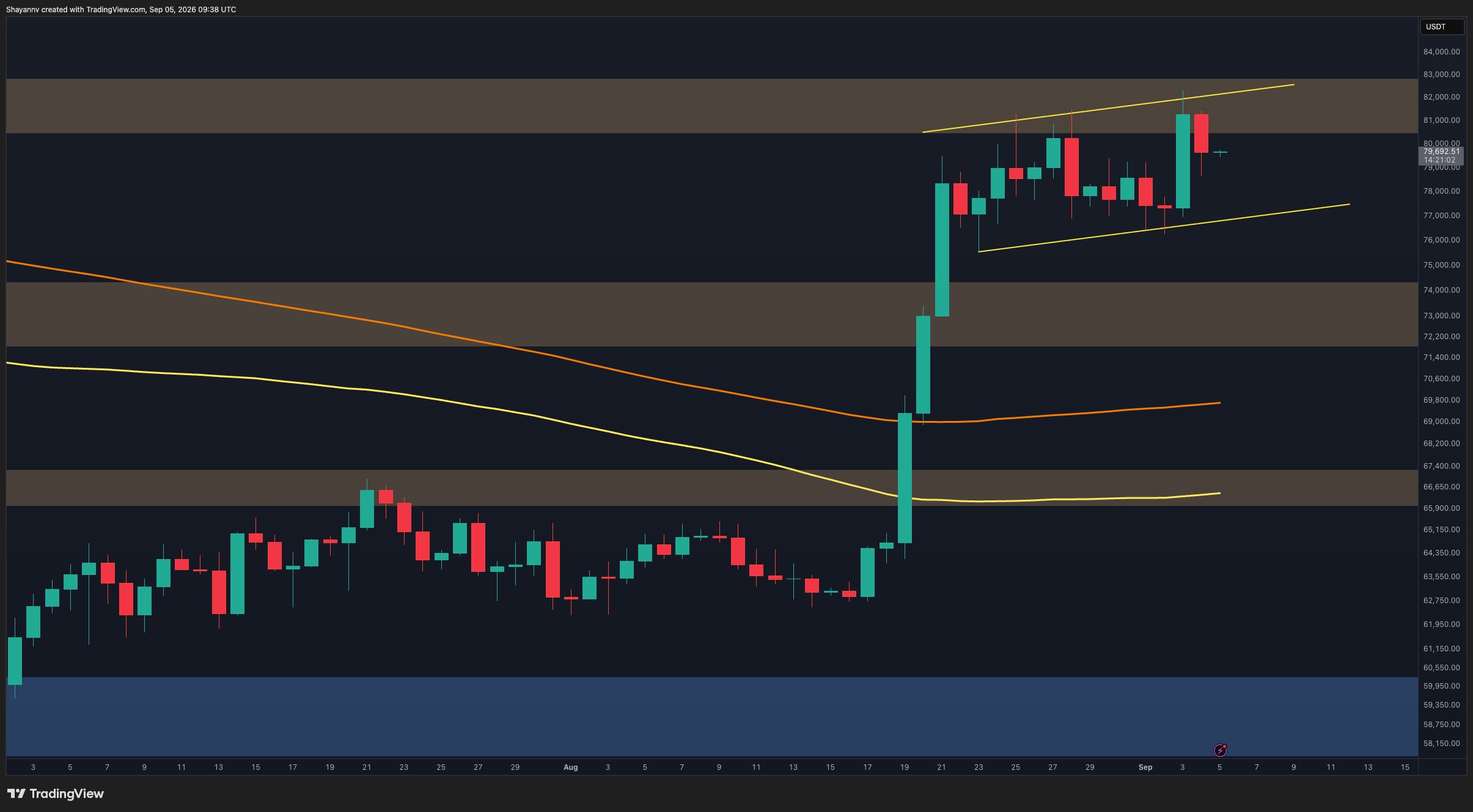
    Bitcoin is currently consolidating, trading below the $80,000 mark but holding above a crucial support channel near $76,000-$77,000. The cryptocurrency recently experienced a rejection from the resistance zone between $80,500 and $82,500, following a period of consolidation after a notable price move. This price action indicates that while the broader trend remains constructive, buyers are struggling to sustain momentum above key levels, leaving the market susceptible to liquidity-driven movements.

    Current Price Action and Key Levels

    Bitcoin’s daily structure shows strength compared to its pre-August phase. The asset remains above the former $72,000-$74,500 resistance zone and both moving averages, suggesting the overall bullish shift is intact despite recent momentum challenges. However, repeated selling pressure has been observed within the $80,500-$82,500 resistance area. The latest attempt to breach this zone briefly reached towards $82,000 before sellers pushed the price back below $80,000. This inability to establish acceptance above resistance indicates that supply remains active at higher price points.

    Technical Analysis: Support and Resistance Dynamics

    The asset continues to trade within a gradually ascending channel, with its lower boundary around the $76,000-$77,000 region serving as the most important nearby structural support. As long as Bitcoin remains above this level, the current price action can be interpreted as consolidation following a sharp rally, rather than a reported bearish reversal. A decisive move above the $80,500-$82,500 zone would strengthen the continuation scenario. Conversely, a loss of the channel support around $76,000-$77,000 could trigger a more substantial correction, potentially targeting the former $72,000-$74,500 zone as the next major area of interest.

    Liquidity Dynamics and Potential Scenarios

    The 4-hour chart highlights the market’s current indecision. Bitcoin rallied from the lower boundary of its ascending structure near $76,500-$77,000 and quickly tested the $81,000-$82,000 area. Sellers rejected this move, causing the price to drop towards $79,500, where it has entered tight short-term consolidation. This pattern contrasts the rising channel with repeated failures near its upper boundary. Buyers are defending higher lows, but they have yet to demonstrate sufficient momentum to convert the $80,500-$82,500 supply area into support. The $76,500-$77,500 region remains crucial; another test could determine the survival of the ascending structure. A strong reaction would keep a renewed push towards $81,000-$82,000 in play, while a move below this level would signal a transition into a deeper corrective phase.

    Analysis of the one-week Bitcoin liquidation heatmap reveals substantial liquidity on both sides of the current price, supporting the possibility of continued choppy trading and liquidity sweeps. Above the market, notable liquidation concentrations are observed around $81,000-$82,000, extending towards approximately $84,000. These clusters could attract price action if buyers regain momentum. However, the downside liquidity is particularly relevant following the latest rejection. A broad and dense concentration of liquidity is visible below the market, especially around the $76,000-$78,000 region, aligning closely with the lower boundary of the ascending technical structure. Consequently, the analysis suggests a downside liquidity sweep towards $76,000-$78,000 is a plausible near-term scenario before another recovery attempt. Such a move would not automatically invalidate the broader bullish setup, but a sustained move below this region would increase the probability of a deeper retracement towards the $72,000-$74,500 support zone.

    Why This Matters

    This market analysis is significant because Bitcoin’s current price action represents a critical juncture. The asset is holding above key support levels ($76K-$77K) and former resistance ($72K-$74.5K), indicating a constructive broader trend. However, repeated rejections at the $80.5K-$82.5K resistance zone highlight buyer struggles and the potential for liquidity-driven swings. The interplay between these levels and the surrounding liquidity pools will likely dictate Bitcoin’s near-term directional move.

    Broader Context

    Bitcoin remains locked in a consolidation phase after a notable price move. The latest rejection from the upper end of the structure shows that buyers are still struggling to generate sustained momentum above $80K. The broader trend remains constructive, although the current range leaves BTC vulnerable to further liquidity-driven swings before its next directional move.

  • Google Patches Actively Exploited Chrome Flaw (CVE-2026-85046)

    Google Patches Actively Exploited Chrome Flaw (CVE-2026-85046)

    Google has released security updates for its Chrome browser to address a high-severity type-confusion vulnerability, identified as CVE-2026-85046, which was reportedly being exploited in the wild. The vulnerability affects the V8 JavaScript engine, a core component used by Chrome for processing JavaScript and WebAssembly.

    Google reported in a security notice published Thursday that it is aware of an exploit for CVE-2026-85046 being used. The company stated that the patch is included in Chrome versions 152.0.7977.82 and 152.0.7977.83 for Windows and Mac, and version 152.0.7977.82 for Linux. Google indicated that the update will be rolling out over the coming days and weeks.

    Exploit Details Remain Unclear

    The nature of the exploit, including the identity of the attackers and their victims, remains unknown. Google has not disclosed whether the bug can be used for remote code execution or when further details about the exploit will be made public. This lack of immediate detail is consistent with Google’s practice of withholding some information until a majority of users and affected third-party projects have installed the necessary patches.

    CVE-2026-85046 is classified as a type-confusion bug. Such flaws typically occur when software misinterprets data types, potentially leading to memory errors or other unpredictable behavior. While Google has not directly linked this specific vulnerability to attacks on cryptocurrency users, browser wallets, exchange accounts, or trading extensions, these areas have been targeted by other methods in the past.

    Researcher Awarded Bounty

    Security researcher Salvatore Gulizia, also known by the alias Serotav, is credited with reporting the flaw on August 4. Google acknowledged his contribution by awarding him a bug bounty of $1,000.

    The recent Chrome update addresses a total of 12 security fixes. Among these are nine high-severity bugs and two medium-severity issues, in addition to the actively exploited CVE-2026-85046. Google also expressed gratitude to all security researchers who collaborated during the development cycle to prevent security bugs from reaching the stable channel.

    Google has not provided specific details regarding the capabilities of the exploit or the extent of its use. The company’s approach of limiting immediate disclosure aims to ensure that users are protected by the patch before detailed information becomes widely available, thereby mitigating further potential exploitation.

    Why This Matters

    The materials describe a narrow update: Google released security updates for Chrome to address a type-confusion vulnerability (CVE-2026-85046) that attackers were actively exploiting. The identity of the attackers.

    Broader Context

    Source materials place the factual news in this context: Google has patched a high-severity Chrome flaw after finding that attackers were already using it.

  • AI Model Claude Generates Machine-Checkable Formal Proof of Fermat’s Last Theorem

    AI Model Claude Generates Machine-Checkable Formal Proof of Fermat’s Last Theorem

    An AI model named Claude has generated a formal proof of Fermat’s Last Theorem, producing a 13-million-line, machine-checkable document in just 11 days. While this achievement highlights the growing capabilities of AI in complex mathematical reasoning, Anthropic, the developer of Claude, emphasizes that the model formalized an existing proof rather than discovering new mathematics.

    Fermat’s Last Theorem, first claimed by Pierre de Fermat in 1637, states that no three positive whole numbers a, b, and c can satisfy the equation a^n + b^n = c^n for any integer value of n greater than 2. It took mathematicians approximately 358 years to establish a definitive proof. Andrew Wiles announced a proof in 1993, which was later found to contain a flaw. A corrected and complete proof by Wiles was published in May 1995, spanning 129 pages and relying on advanced mathematical concepts developed long after Fermat’s time.

    Broader Context

    Source materials place the factual news in this context: Fermat’s Last Theorem states that no three positive whole numbers a, b, and c can satisfy the equation a^n + b^n = c^n for any integer value of n greater than 2.

    The Challenge of Formal Proofs

    Formalization, as explained by mathematicians, involves translating a proof into a language so precise that a computer can verify every logical step without human interpretation. This is crucial because, historically, even complex proofs have been susceptible to human error or oversight. For instance, a prize offered in 1908 for a proof of Fermat’s Last Theorem attracted 621 incorrect submissions in its first year alone, underscoring the difficulty of ensuring mathematical rigor.

    AI’s Scale and Speed

    Claude’s proof generation is notable for its scale and speed. The 13-million-line output is significantly longer than previous proofs and was completed in a fraction of the time human mathematicians typically spend on such tasks. According to Anthropic, the AI used tools to manage the process, involving dozens of agents working in parallel to avoid duplication. The resulting proof is equivalent in length to approximately 160 novels.

    Mathematicians like Kevin Buzzard, who leads a project to formalize Wiles’s proof in the Lean system, have reviewed Claude’s output. Buzzard reported that the proof is mathematically sound. However, it is important to distinguish this formalization from independent mathematical discovery. Claude’s work is akin to creating a highly detailed, computer-verifiable record of an existing mathematical argument, rather than uncovering new theorems or methods.

    Implications for Mathematical Verification

    The implications of AI-generated formal proofs are significant for the field of mathematics. As mathematicians face an increasing volume of complex proofs, including those generated by AI, the need for efficient and reliable verification methods becomes paramount. Human verification of major mathematical proofs can take years; for example, the computer-assisted proof of the Kepler conjecture required four years before a review panel could suggest it with 99% certainty. AI formalization offers a potential solution to this bottleneck, providing deterministic and error-resistant verification.

    While Claude’s proof is machine-checkable, uncertainties remain regarding the long-term impact of AI on mathematical research and the definition of mathematical certainty. It is not yet certain whether Fermat himself possessed a valid proof for his theorem, and the advent of AI-generated proofs prompts a re-evaluation of how mathematical certainty is established and maintained in the digital age.

  • Coinbase Files for Single-Stock Perpetual Futures in US, Facing Regulatory Uncertainty

    Coinbase Files for Single-Stock Perpetual Futures in US, Facing Regulatory Uncertainty

    Coinbase has submitted notice registrations with the US Securities and Exchange Commission (SEC) to offer single-stock perpetual futures to US investors, a move that signals the company’s intent to expand its regulated derivatives offerings domestically. However, the filings, submitted on September 1, do not guarantee the product’s launch and are subject to regulatory review and approval from both the SEC and the Commodity Futures Trading Commission (CFTC).

    The practical implication of these filings is limited to initiating the regulatory process. Notice registrations open the door for a broker or exchange to offer a given product, but final approval and any associated conditions rest with regulators. This development comes as the US continues to sort out the regulatory classification of perpetual contracts, which carry no expiration date, allowing traders to bet on an asset’s price without owning it.

    Coinbase plans to work with both the SEC and the CFTC to bring more major financial products onshore. The company has already launched tokenized stock trading for customers outside the US in August and offers other futures products through Coinbase Derivatives, LLC. Coinbase Financial Markets, Inc. is registering as a security futures product broker-dealer under the Securities Exchange Act of 1934. The company also rolled out pre-IPO perpetual futures starting with SpaceX, with contracts for companies like Anthropic and OpenAI expected to follow.

    The market for pre-IPO perpetual futures has seen significant growth, expanding more than tenfold since May to approximately $12 billion, according to CryptoQuant. This burgeoning market faces a complex regulatory landscape. In May, the CFTC approved Kalshi to offer Bitcoin perpetual futures, marking the first time such a product cleared for the US market. However, this decision has been met with opposition from CME Group, which stated it would challenge the CFTC’s approval in court. CME Group argues that perpetuals should be regulated as swaps rather than futures, with CME CEO Terrence Duffy noting that the company’s exclusive licensing deals with benchmark providers mean any perpetual contract tied to those benchmarks must run through CME.

    CFTC Chair Michael Selig has defended the original approval of Kalshi’s product as a means to bring regulated, expiration-free products under US oversight. The regulatory uncertainty surrounding perpetual futures is a key aspect of this story, with ongoing debates about their classification and the potential for legal challenges.

    Several uncertainties remain regarding Coinbase’s filing. The timeline for the potential launch of single-stock perpetual futures in the US is unknown, and ultimate approval from the SEC and CFTC is not assured. The final classification of perpetual contracts under American law and the outcome of CME Group’s legal challenge are also significant factors that may shape the future of these products in the US market. The filings themselves do not guarantee that the product will launch on any set timeline.

    Why This Matters

    The materials describe a narrow update: Coinbase submitted notice registrations to the SEC to offer single-stock perpetual futures in the US. The timeline for the launch of single-stock perpetual futures in the US.

    Broader Context

    Source materials place the factual news in this context: Coinbase is working to bring single stock perps to the US.

  • Polymarket Launches Perpetual Futures, Restricting U.S. Users Amid Regulatory Scrutiny

    Polymarket Launches Perpetual Futures, Restricting U.S. Users Amid Regulatory Scrutiny

    Polymarket, a platform known for its prediction markets, has launched a new perpetual futures product named Perps. The product allows for leveraged trading on a variety of assets but is not available to users in the United States and several other regions due to regulatory considerations, including Polymarket’s prior settlement with the U.S. Commodity Futures Trading Commission (CFTC).

    The introduction of Perps signifies a significant expansion for Polymarket, moving beyond its traditional prediction market offerings into the derivatives space. The platform initially launched on September 3 with 10 markets, including cryptocurrencies like Bitcoin, Ethereum, and Solana, alongside commodities such as gold, silver, and WTI oil, and stock indices like the S&P 500 and Nasdaq 100. Within hours of its launch, the number of available markets expanded to 67.

    Perpetual futures are financial contracts that track an underlying asset’s price continuously without an expiration date. A funding rate mechanism is employed to keep these contracts anchored to the spot price, involving hourly payments between long and short traders. On Polymarket’s Perps, the funding rate is capped at 4% per hour in either direction. The platform offers varying levels of leverage depending on the asset class. For cryptocurrencies, stock indices, oil, gold, and silver, the maximum leverage is capped at 20x. Individual stocks, such as Tesla, Nvidia, Apple, and Coinbase, have a maximum leverage of 10x. Maintenance margin is set at half the maximum leverage rate, meaning a 20x leveraged position could be liquidated after a roughly 2.5% loss of its posted margin.

    Polymarket’s decision to exclude U.S. users from its new Perps product is directly linked to its 2022 settlement with the CFTC. The company was fined $1.4 million and ordered to wind down noncompliant contracts after being found to have operated an unregistered swaps facility. While Polymarket has since returned to the U.S. market with a separate, CFTC-regulated exchange, Polymarket US, the new global Perps product is not accessible to American traders.

    This move places Polymarket in a competitive landscape that is already seeing activity from other platforms. Kalshi, another prediction market platform, received CFTC approval for its Bitcoin perpetual futures contract on May 29, becoming the first onshore perpetual futures product in the United States. Kalshi has since expanded its offerings to include various altcoins and a copper contract.

    Furthermore, the decentralized exchange Hyperliquid is positioned as a significant competitor. Reports suggest Hyperliquid is in negotiations with the CFTC to potentially open its platform to U.S. traders, with discussions also involving Kraken’s parent company, Payward. Hyperliquid currently dominates on-chain perpetuals trading.

    Polymarket first teased its perpetual futures feature in April, initially indicating a 10x leverage cap. The current launch offers higher leverage limits for certain assets. The platform promoted the launch on X, suggesting complex trading strategies such as simultaneously going long on Bitcoin, betting on Federal Reserve actions, and shorting the S&P 500’s reaction, all within a single account.

    Polymarket’s expansion into perpetual futures highlights the ongoing challenges and strategic adaptations required for financial platforms operating in the evolving regulatory environment. The split market strategy, catering to international users with broader offerings while maintaining a separate, compliant entity for the U.S., reflects a common approach to navigating these complexities. The exact timing of Hyperliquid’s potential opening to U.S. traders and the outcome of its negotiations with Payward remain uncertain.

    Why This Matters

    The materials describe a narrow update: Polymarket, known for its prediction markets, has introduced a perpetual futures product named Perps. The exact date of Hyperliquid’s potential opening to US traders.

    Broader Context

    Source materials place the factual news in this context: Polymarket, the prediction market platform that rose to fame during the 2024 presidential election, opened its perpetual futures product to traders on September 3, extending a platform built around yes-or-no election and sports bets into leveraged derivatives.

  • South Korea Outlines Phased Securities Tokenization Roadmap, Stablecoin Integration by 2027

    South Korea Outlines Phased Securities Tokenization Roadmap, Stablecoin Integration by 2027

    South Korea’s Financial Services Commission (FSC) has detailed a phased roadmap for tokenizing securities, including stocks, bonds, and investment funds, with the initial phase slated to begin in February 2027. The plan also anticipates the eventual integration of a stablecoin-based payment system, though the timeline for later stages remains contingent on market adaptation and pending stablecoin legislation.

    The FSC’s three-stage plan aims to integrate blockchain technology into the nation’s securities market. Phase one, commencing in February 2027, will encompass privately pooled funds, bonds for institutional investors, unlisted stocks held via trust structures, and publicly offered fractional investment securities. Revised rules under the Financial Services and Capital Markets Act (FSCMA) and the Electronic Registration Act are anticipated by the end of September to support this initial rollout.

    Subsequent phases are designed to broaden the scope to all types of publicly offered securities. The more ambitious third phase targets the incorporation of an on-chain payment system linked to stablecoins. However, the FSC has stated that the progression of these later phases will depend on the success of the initial rollout, the market’s readiness to adopt tokenized securities, and the development of stablecoin legislation.

    Model standards for fractional investments have been established by the FSC, capping individual subscriptions at the lesser of 30 million won (approximately $22,200) or 5% of an issuance, and requiring issuers to reserve a minimum retail allocation. Retail investors may be subject to an annual cap of 100 million won ($74,000) in net purchases per exchange.

    Entities managing tokenized securities accounts will face new requirements, including a minimum equity of 4 billion won (about $2.9 million) and dedicated staff for account management, internal control, and IT security. Over-the-counter trading of tokenized securities will not necessitate a separate license, provided firms consult with the Financial Supervisory Service. The Korea Securities Depository is finalizing the technical checks required for securities firms to connect to the shared ledger.

    Potential challenges associated with tokenization have been highlighted by international bodies. The International Monetary Fund (IMF) warned in an April note that tokenization could eliminate settlement delays crucial for bank liquidity management and regulatory intervention during crises. The IMF identified liquidity pressure, insufficient oversight of smart contracts, and difficulties in policing cross-border assets as primary risks, suggesting that public infrastructure like central bank digital currencies (CBDCs) could help mitigate these issues.

    In a related regulatory action, South Korean authorities blocked domestic access to Polymarket in August, citing concerns over unlicensed gambling. This move aligns with global efforts to regulate digital asset platforms.

    The FSC’s plan marks a significant step toward modernizing South Korea’s financial infrastructure. However, the full realization of its ambitions, particularly the stablecoin payment system, remains subject to regulatory developments and market adaptation.

    Why This Matters

    The materials describe a narrow update: The FSC has announced a three-phase plan to integrate blockchain technology into its securities market, starting with privately pooled funds, bonds for institutional investors, unlisted stocks, and fractional investment securities in February 2027. The pace of phases two and three of the tokenization plan.

    Broader Context

    Source materials place the factual news in this context: South Korea’s Financial Services Commission unveiled a phased roadmap on September 4 for converting stocks, bonds and investment funds into blockchain-based tokens, with the earliest phase due to start in February 2027 once an amendment to the Electronic Registration Act takes effect.