Tag: Positive

  • Durov to Offer Crypto Wallets to Billion Telegram Users

    Durov to Offer Crypto Wallets to Billion Telegram Users

    Telegram to Launch Native Non-Custodial Crypto Wallet for Over a Billion Users

    Pavel Durov, the founder of Telegram, has made a significant promise: by the end of summer, the popular messaging app will introduce a native non-custodial cryptocurrency wallet across all its versions. This move aims to provide instant, zero-fee crypto transactions to its user base, which exceeds one billion monthly active users.

    A New Era for Crypto Transactions

    The forthcoming wallet is designed to support Telegram’s native cryptocurrency, Gram, formerly known as Toncoin. A non-custodial wallet empowers users by giving them direct control over their private keys, meaning they hold the ultimate authority over their funds. This contrasts with custodial wallets, where a third party manages the keys. Durov likened this to carrying cash, emphasizing that no entity can freeze or block transactions without the user’s explicit consent.

    This initiative represents a substantial upgrade from Telegram’s existing @wallet bot. While the @wallet bot, with over 150 million registered users, currently operates partly in a custodial mode where a company holds the keys, Durov’s new wallet will be fully non-custodial from its inception.

    Native Integration vs.

    Bot Functionality

    A key distinction lies in the integration of the new wallet. Unlike the current @wallet bot, which is developed and managed by The Open Platform, a separate entity, the new wallet will be natively built into every version of the Telegram application. This means it will be an integral feature, readily accessible to all users, rather than an add-on that requires separate activation.

    Durov himself heralded the development on social media, stating, “This summer will see the largest rollout of a non-custodial crypto wallet in human history. Instant zero-fee crypto transactions for over a billion users are about to become reality. We’re bringing a native non-custodial Gram wallet to every Telegram app!”

    Unanswered Questions and Market Reaction

    While the announcement is a major step, several details remain undisclosed. It is unclear whether the new wallet will replace or coexist with the existing @wallet bot, which cryptocurrencies beyond Gram will be supported, and how key management will be handled for users new to cryptocurrency.

    Durov’s assertion of it being “the largest rollout of a non-custodial crypto wallet in human history” appears mathematically sound, considering that MetaMask, a leading self-custody wallet, has tens of millions of users. No cryptocurrency project has ever launched with the potential to reach a billion users on day one.

    Following the announcement, Gram, the native token of The Open Network (TON), saw a surge of approximately 7%, climbing back above $1.52 and reaching a market capitalization of $4.18 billion. This recovery partially offset a significant 25% decline the token experienced throughout July, though it remained well below its previous highs.

    The Backstory of Gram and TON

    The journey to this point began in 2018 when Telegram initially developed a network and raised $1.7 billion for a token intended to be called Gram. However, the U.S. Securities and Exchange Commission (SEC) intervened, alleging the tokens were unregistered securities. Telegram settled the case in 2020, returning $1.2 billion to investors, paying an $18.5 million penalty, and withdrawing from the project.

    Despite Telegram’s departure, community developers continued to maintain the blockchain, rebranding it as Toncoin. Durov re-engaged with the project in 2026. In June of the same year, a community vote overwhelmingly approved the rebranding of Toncoin back to Gram, restoring Durov’s original vision. The recent wallet announcement is seen as a pivotal move in Durov’s stated goal to “Make TON Great Again.”

    Earlier this year, Durov also highlighted significant upgrades to the TON blockchain, stating, “The TON blockchain just got upgraded and is now 10× faster. Block rate increased 6×. Transactions are now instant, subsecond. This was step 1 of 7 to Make TON Great Again (MTONGA). Next step: cut the already low transaction fees by 6×.”

    Implications for Users and Businesses

    The integration of a built-in wallet could revolutionize how average Telegram users interact with cryptocurrency, enabling them to send digital assets as easily as sending text messages, without the need for exchange accounts, bank transfers, or intermediaries. For small businesses and retailers, this presents a new payment channel with a vast reach and zero transaction fees, a proposition unmatched by traditional card networks.

    Investment Outlook

    For investors, the situation is more complex. While the announcement may prompt some to “buy the news,” a longer-term perspective is advised. Gram’s 200-day exponential moving average, a key indicator of long-term trends, currently sits above the prevailing price, suggesting a bearish market sentiment.

    The all-time high of $8.25, set in June 2024 during a period of high engagement with Telegram’s tap-to-earn gaming features, remains a distant target. A more immediate milestone, the $2.89 peak from May 2026, when Telegram first announced its acquisition of the network, would require an 88% rally from current prices.

    As of now, no specific launch date beyond “this summer” has been provided for the new wallet.

  • Augustus Secures $180M for Global Dollar Bank

    Augustus Secures $180M for Global Dollar Bank

    Augustus Secures $180 Million in Series B Funding, Valued at $1 Billion

    Augustus, a startup developing a federally chartered clearing bank focused on stablecoins and programmable money, announced Tuesday it has raised $180 million in a Series B funding round, valuing the company at $1 billion.

    The funding round was spearheaded by Tiger Global, with contributions from Hummingbird, QED, and notable figures including the founders of Nubank, Ramp, Circle, and Deel. The investment also saw backing from a range of fintech and crypto industry leaders, such as Circle co-founder Sean Neville, former Coinbase Chief Technology Officer Balaji Srinivasan, and Rain’s Farooq Malik. Augustus has now raised a total of $210 million to date.

    The company is targeting the correspondent banking sector, the essential infrastructure that facilitates cross-border money transfers between financial institutions. Instead of issuing its own stablecoin, Augustus is building the underlying technology that will enable banks and fintech companies to conduct transactions across both traditional financial networks and blockchain platforms.

    Augustus’ API-first platform supports operating and FBO (For Benefit Of) accounts, with settlements processed via SWIFT, ACH, SEPA, and stablecoins. The system operates on a proprietary core banking system named Marble, which the firm claims enhances settlement speed and offers 24/7 availability through the deployment of artificial intelligence in its back-office operations.

    The significance of this funding for financial markets lies in its focus on stablecoins. These digital tokens are designed to maintain a stable value, typically pegged one-to-one with the U.S. dollar, allowing market participants to enter and exit trades without direct access to dollars.

    Dollar-pegged stablecoins have emerged as a multibillion-dollar settlement layer, expanding the reach of the U.S. dollar and presenting a challenge to the slow, weekday-dependent correspondent banking system that currently underpins international payments. By integrating stablecoin rails directly into a chartered bank, Augustus is positioning this emerging crypto infrastructure as an upgrade for mainstream financial institutions, rather than merely an alternative.

    This financing follows Augustus’ conditional approval in May for a U.S. national bank charter from the Office of the Comptroller of the Currency. The company stated it is the eighth institution to receive conditional approval since 2010. The startup already lists cryptocurrency exchange Kraken as a client.

    “We founded Augustus with a straightforward premise: the Dollar is the world’s most powerful product, but its distribution is fundamentally flawed,” said Ferdinand Dabitz, CEO and co-founder. “This funding allows us to advance our mission of providing high-quality dollar access to international fintechs and banks. It’s time to globalize dollar access.”

    Augustus has framed its initiative partly as a geopolitical strategy, citing China’s digital yuan and Russia’s proposed BRICS Pay as potential challenges to Western currency dominance. The company plans to utilize the capital to expand its operations in Latin America, Southeast Asia, the Middle East, and Africa, regions where access to dollars is currently limited.

  • DCENT S vs. Tangem: Comparing Card-Shaped Hardware Wallets and Their Backup Strategies

    DCENT S vs. Tangem: Comparing Card-Shaped Hardware Wallets and Their Backup Strategies

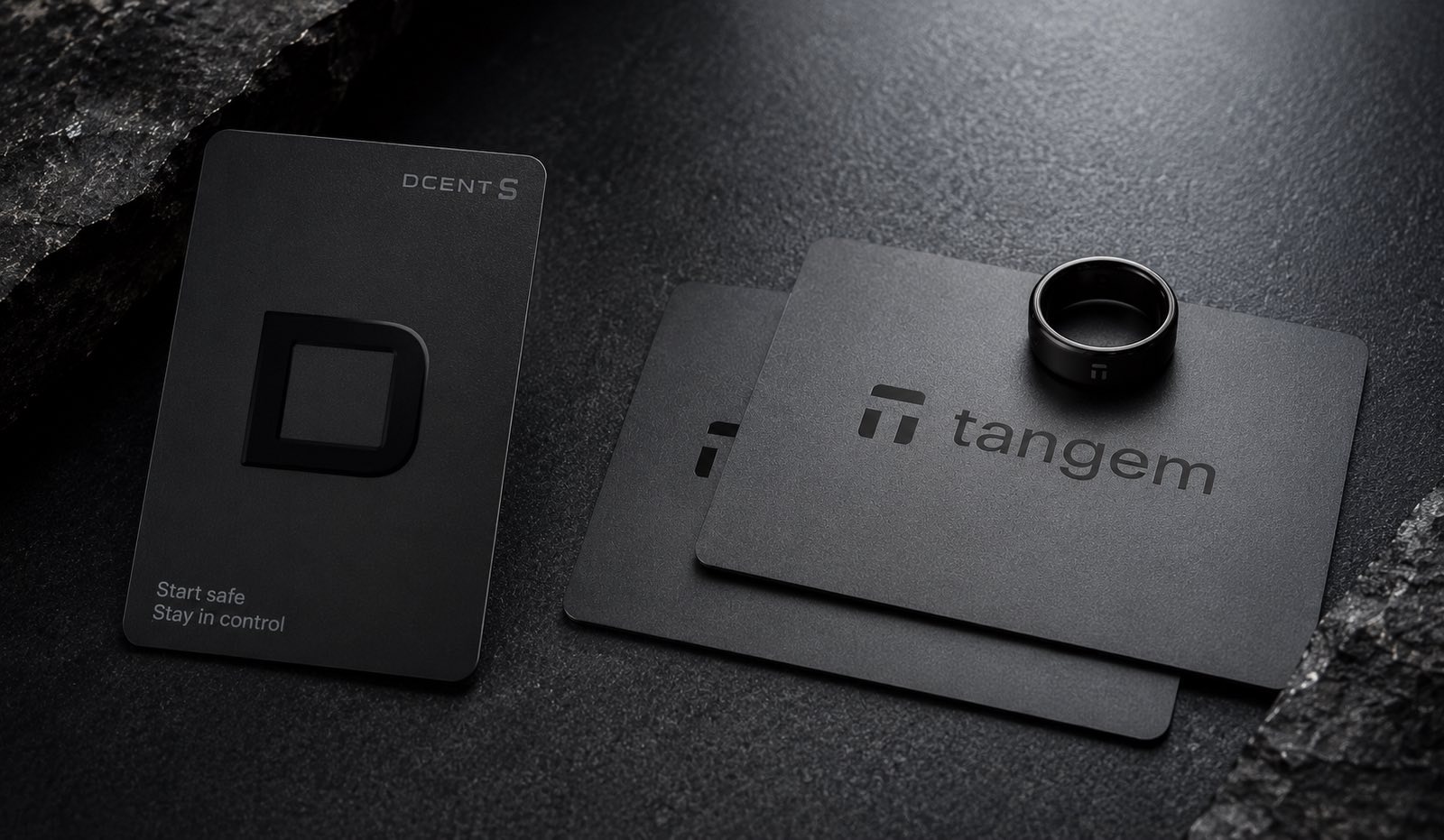
    The hardware wallet market is seeing a shift towards innovative form factors, with card-shaped devices like the DCENT S and Tangem emerging as key players. While both wallets share a convenient credit-card size and utilize NFC technology for secure transaction signing, their approaches to backup and recovery present a critical distinction for users, according to the article.

    Shared Foundations: Design and Security

    Both DCENT S and Tangem wallets are designed to be battery-free and powered by NFC during transaction signing. They employ EAL6+ certified secure elements, a robust security standard also used in government IDs and payment cards. This ensures that private keys are generated on-device within the secure chip and never leave it, significantly reducing the attack surface. A notable trade-off for this compact form factor is the absence of a display on either wallet, requiring users to rely on their paired mobile application to verify transaction details before signing.

    The Crucial Difference: Backup and Recovery

    The primary divergence lies in how these wallets handle backup and recovery. The DCENT S features a dedicated ‘R3covery Card.’ This card is exclusively for restoring wallet access if the main DCENT S card is lost and cannot sign transactions itself. The backup data is stored securely on another chip, eliminating the need for users to write down recovery phrases. The article notes that while this design prevents direct fund theft from a stolen recovery card alone, it is recommended to store the primary and recovery cards in separate physical locations.

    Tangem takes a different approach by selling wallets in sets of two or three identical cards. The private key is copied to all cards in the set during setup, meaning any card can function as the primary wallet and sign transactions. This provides immediate redundancy; if one card is lost, another from the set can be used. However, the article points out that this convenience comes with a security consideration: if a backup card is compromised along with the user’s PIN, access to funds is at risk. This highlights a trade-off between DCENT S’s segregated, recovery-focused backup and Tangem’s multi-card accessibility.

    Features and Usability

    In terms of supported assets, DCENT S supports over 100 blockchain networks and more than 4,900 tokens, with a strong emphasis on full XRP Ledger (XRPL) functionality. Tangem supports over 90 blockchain networks and more than 14,000 tokens, covering major cryptocurrencies like Bitcoin, Ethereum, and XRP. The article suggests that the difference in token counts is largely due to counting methodologies rather than significant functional disparities for most users.

    Usability is streamlined for both, requiring an NFC-enabled smartphone. Setup is quick, with Tangem estimating two minutes and DCENT S estimating three. Daily use involves tapping the wallet against the phone to sign transactions, a process described as seamless and akin to contactless payments. Both come with companion mobile apps for Android and iOS for asset management and transaction handling. Tangem’s app is noted for its more mature feature set, including built-in swapping and staking, while DCENT’s app covers essential functions effectively.

    Durability and Value

    DCENT S offers IP69 dust and water resistance, while Tangem provides IP69K resistance and additional advertised protection against X-rays and electromagnetic pulses. Both have similar operating temperature ranges. Tangem provides a 25-year warranty, whereas DCENT S offers a limited lifetime warranty.

    Conclusion: Which Wallet for You?

    The article suggests that while both wallets advance accessible self-custody, the DCENT S may appeal more to security-conscious users due to its segregated backup system and robust XRP Ledger support. The author leans towards the DCENT S, citing its thoughtful security design and IOTRUST’s longer experience in hardware wallet engineering since 2017. Tangem, conversely, offers immediate convenience through its multi-card redundancy. The choice ultimately depends on individual user priorities regarding security versus immediate backup availability.

    Why This Matters

    The materials describe a narrow update: The article compares two card-shaped hardware cryptocurrency wallets, DCENT S and Tangem, detailing their features, strengths, and weaknesses across various categories including design, security, backup and recovery, supported cryptocurrencies, daily usability, mobile apps, and overall value. The exact launch date of DCENT S is stated as July 2026, which is in the future.

    Broader Context

    Source materials place the factual news in this context: The hardware wallet market has seen a quiet revolution over the past few years.

  • All-Party Parliamentary Group Probes UK Banks’ Crypto Debanking Ahead of FCA Deadline

    All-Party Parliamentary Group Probes UK Banks’ Crypto Debanking Ahead of FCA Deadline

    UK Parliament Launches Inquiry into Crypto Banking Access

    London, UK – The UK Parliament’s Crypto and Digital Assets All-Party Parliamentary Group (APPG) has initiated a formal investigation into the persistent refusal by banks to open accounts and process payments for cryptocurrency businesses. The inquiry seeks written evidence until August 31, with the group aiming to release recommendations before the Financial Conduct Authority’s (FCA) mandatory crypto regime takes effect in October 2027. This move will test the viability of the UK’s ambition to become a global digital asset hub amidst significant banking restrictions.

    Scope of the Inquiry

    The inquiry, announced Tuesday by co-chairs Lord Vaizey of Didcot and Labour MP Gurinder Singh Josan CBE, will examine the difficulties crypto firms encounter in opening and maintaining business accounts, as well as issues related to transfer limits, payment blocks, and the proportionality of banking restrictions. It will also draw comparisons with the approaches taken by the United States, Hong Kong, Australia, and the European Union.

    The APPG articulated its concerns, stating that crypto and digital asset firms have consistently reported challenges in accessing UK banking services. The group emphasized that banking access is crucial for legitimate businesses, and that unnecessary barriers risk hindering investment, innovation, and long-term growth.

    Scale of the Problem

    The issue’s magnitude is considerable. Research published in January 2026 by the UK Cryptoasset Business Council revealed that approximately 40% of payments directed to crypto exchanges were blocked or delayed by UK banks. One platform reported nearly £1 billion in rejected transactions during 2025. Furthermore, 80% of exchanges experienced an increase in customer friction, and 70% described banking conditions as more hostile than the previous year.

    Government Stance vs.

    Reality

    These findings appear to contradict the government’s stated position. In March 2026, HM Treasury Economic Secretary Lucy Rigby informed Parliament that licensed crypto firms should not face restrictions solely due to their sector of operation. Consequently, the inquiry will investigate why FCA-registered businesses continue to encounter banking hurdles despite regulatory advancements.

    The inquiry also follows the finalization of the UK’s FCA crypto framework. The authorization window is set to open in September 2026, with full compliance becoming mandatory on October 25, 2027. If licensed firms continue to struggle with securing banking services, confidence in the new regulatory framework could be undermined.

    International Comparisons

    Comparisons with overseas markets are also being drawn. In the United States, crypto companies have likened banking restrictions to “Operation Chokepoint 2.0.” Kraken recently secured a $22 million settlement from an auditor it claimed abandoned the exchange during that period. In Australia, Coinbase has also voiced criticism against banks regarding restrictions on crypto-related services. The APPG will assess how other jurisdictions have managed similar challenges.

    Political Context and Industry Expectations

    The inquiry arrives amidst a period of political transition, with Andy Burnham having recently become Prime Minister and John Healey appointed Chancellor of the Exchequer. Legal experts suggest that global financial firms will be closely observing whether the new government establishes a stable regulatory environment for digital assets and financial services.

    Written submissions will be accepted from July 21 through August 31, encompassing the banking, payments, fintech, and crypto sectors. The APPG plans to publish its recommendations before the October 2027 deadline. Industry participants are expected to advocate for case-by-case risk assessments rather than blanket restrictions on FCA-registered crypto firms.

  • Bitcoin Surges Past $66K on ETF Demand, LiquidChain Presale Nears $1M

    Bitcoin Surges Past $66K on ETF Demand, LiquidChain Presale Nears $1M

    Bitcoin Recovers Above $66,000 Amid Strong ETF Inflows

    July 21, 2026 – Institutional capital has demonstrated sustained momentum, propelling Bitcoin (BTC) back above the $66,000 mark on Tuesday. This recovery, bolstered by five consecutive days of net inflows into U.S. spot ETFs, has helped stabilize the market following a period of volatility near the $60,000 support level. As capital flows return to the primary digital asset, market attention is increasingly focusing on infrastructure projects designed to bridge Bitcoin’s liquidity with other major blockchain ecosystems.

    U.

    S. Spot Bitcoin ETFs See Significant Inflows

    On Monday, U.S. spot Bitcoin ETFs recorded a net inflow of approximately $227 million, reversing the net outflows observed in May and June. BlackRock’s IBIT was a leading contributor, with $116 million in net inflows, bringing the total net assets across all U.S. spot Bitcoin products to nearly $79 billion. This consistent buying pressure drove Bitcoin’s price past $66,000, with 24-hour trading volume exceeding $31 billion.

    Analyst Ted Pillows noted that clearing the $65,000 resistance level opens the door for a near-term target of $68,000, with potential for further upward movement.

    “BTC has reclaimed the $65,000 level. The next key resistance is $67,500-$68,000, which means Bitcoin has some room to pump. If BTC manages to reclaim the $68,000 resistance too, it could rally another 5%-6% very quickly,” Pillows stated.

    Focus Shifts to Bitcoin Infrastructure and Utility

    While spot exposure remains the primary avenue for institutional investment, Bitcoin’s price stabilization is also sparking interest in decentralized applications and infrastructure that aim to enhance the utility of dormant BTC.

    LiquidChain Aims to Bridge Blockchain Ecosystems

    To address capital fragmentation across major networks, LiquidChain (LIQUID) is developing a Layer 3 execution environment. The network intends to connect Bitcoin’s liquidity with Ethereum’s decentralized finance (DeFi) ecosystem and Solana’s high execution speeds. By employing a Solana-class virtual machine, trust-minimized state verification, and cross-chain proofs, the protocol facilitates atomic settlements without relying on traditional wrapped assets.

    LiquidChain Presale Nears $1 Million Milestone

    The native LIQUID token will serve as the network’s utility asset, powering transaction fees, staking, and governance. The total supply of LIQUID is capped at 11.8 billion tokens.

    The ongoing presale has successfully raised over $914,000, with the current token price set at $0.01482. The next price increase is scheduled in two days.

    Investors can participate in the presale by connecting a compatible Web3 wallet to the official LiquidChain website. The presale is also accessible through the Best Wallet mobile application, available on the Apple App Store and Google Play, under its “Upcoming Tokens” section.

    The presale accepts various payment methods, including BTC, ETH, SOL, BNB, USDT, USDC, and direct credit/debit card purchases. Participants have the option to immediately stake their acquired LIQUID tokens to earn a dynamic staking yield of 1,231% APY, which will be adjusted as the staking pool grows.

    For real-time development updates and presale milestones, interested parties can follow LiquidChain on X and join its Telegram community.

  • Bernstein Boosts Robinhood Price Target to $160, Highlighting Blockchain Infrastructure’s Long-Term Value

    Bernstein Boosts Robinhood Price Target to $160, Highlighting Blockchain Infrastructure’s Long-Term Value

    Bernstein has raised its price target for Robinhood (HOOD) stock to $160, with the firm emphasizing the long-term value of the company’s blockchain infrastructure over its cryptocurrency trading volume. This revised outlook, released ahead of Robinhood’s second-quarter earnings on July 29, is underpinned by a projected 2028 earnings per share (EPS) of $4.56, based on a 35x forward price-to-earnings (P/E) multiple.

    The primary driver for Bernstein’s increased target is the anticipated contribution from Robinhood’s blockchain initiatives, including Robinhood Chain, prediction markets, and perpetual futures. According to Bernstein analysts, these ventures are expected to account for 18% of total revenue by 2027, growing to 23% by 2028. The firm estimates that prediction markets alone could generate $1.7 billion in revenue by 2028.

    Supporting this optimistic view, Robinhood Chain is demonstrating steady network activity. Robinhood Wrapped ETH on the chain has seen a 2% gain in the past week, with daily trading volume currently near $44 million. These metrics suggest sustained user engagement, reflecting a broader market trend where investors are increasingly valuing companies that build foundational digital asset infrastructure over those primarily benefiting from speculative token rallies.

    Bernstein suggests that developing the underlying infrastructure can yield more sustainable returns than simply collecting transaction fees. The firm views Robinhood Chain as a potential contributor to the broader crypto ecosystem, enhancing Ethereum’s scalability through additional Layer 2 infrastructure, which could lead to cheaper transactions and faster settlement times. Increased adoption of such networks may also improve accessibility to on-chain activity for retail users.

    This strategic emphasis on infrastructure development aligns with a growing investor preference for foundational projects. The Robinhood Chain narrative illustrates how chain-level infrastructure can capture value independently of native token price movements, attracting investors who are shifting focus from speculative assets to execution layer projects. Bernstein anticipates that future infrastructure will be increasingly interconnected.

    Despite the positive outlook, uncertainties persist regarding the long-term sustainability of Robinhood Chain’s growth and the precise future revenue contributions from its blockchain ventures. The competitive landscape also presents a factor that could influence Robinhood Chain’s adoption and revenue generation. Nevertheless, Bernstein’s updated price target signals a potential shift in market valuation for crypto-related companies, highlighting the significance of underlying blockchain technology.

    Broader Context

    Source materials place the factual news in this context: Robinhood’s second-quarter earnings arrive on July 29.

  • UK Lawmakers Launch Inquiry into Crypto Banking Access, Potentially Impacting Digital Asset Ambitions

    UK Lawmakers Launch Inquiry into Crypto Banking Access, Potentially Impacting Digital Asset Ambitions

    A cross-party group of UK lawmakers has launched a parliamentary inquiry to investigate the significant challenges cryptocurrency firms face in accessing banking services. The investigation, led by the Crypto and Digital Assets All-Party Parliamentary Group (APPG), aims to understand why banks restrict crypto-related payments and why firms struggle to open and maintain accounts. This move comes as the UK finalizes its new regulatory framework for digital assets, raising questions about whether existing banking barriers could impede the nation’s ambition to become a global leader in the sector.

    The inquiry, initiated on July 21, 2026, will collect written evidence until August 31. A report is expected before October 2027, coinciding with the mandatory implementation of the UK’s new crypto regime. Co-chaired by Lord Vaizey of Didcot and Labour MP Gurinder Singh Josan, the APPG seeks to assess if these banking hurdles are proportionate and how they affect consumers, competition, and innovation.

    Industry Faces Persistent Banking Hurdles

    UK crypto businesses have reported persistent difficulties with banking for years. Research from January indicated that banks were blocking or delaying approximately 40% of attempted transfers to crypto exchanges. Furthermore, a survey found that 70% of crypto exchanges reported that these restrictions were negatively impacting their investment, expansion, or hiring efforts within the UK. Several major UK banks, including HSBC, Nationwide, NatWest, Santander, and Starling Bank, have reportedly restricted crypto-related payments.

    The APPG’s inquiry will examine various aspects of banking access, including account services, payment blocks, transfer limits, and insurance availability. This investigation follows a similar inquiry by the APPG in 2023, which also highlighted friction in the crypto sector and called for urgent action.

    Government Acknowledges Issues

    HM Treasury has acknowledged the problem. Economic Secretary Lucy Rigby stated in March that FCA-licensed crypto firms should not face banking restrictions solely due to their sector. The government’s position, as outlined in the upcoming regulatory framework, is that regulated firms should not be shut out of banking services simply for operating in the crypto space.

    International Context

    Internationally, similar banking access issues have been reported. In the United States, crypto firms have attributed banking difficulties to a pressure campaign they refer to as ‘Operation Chokepoint 2.0.’ Kraken, for instance, recently won $22 million from an auditor it claimed abandoned it during this period. In Australia, Coinbase has accused banks of imposing what it describes as an ‘unlawful’ regulatory ban on crypto.

    The APPG will consider these international approaches from jurisdictions such as the United States, Hong Kong, Australia, and the European Union as part of its investigation. The outcome of this inquiry remains uncertain, but it is expected to shed light on the challenges facing the UK’s burgeoning digital asset industry and its potential impact on the country’s regulatory goals.

    Why This Matters

    The materials describe a narrow update: A cross-party group of UK lawmakers has initiated a parliamentary inquiry to examine why cryptocurrency firms face difficulties in opening bank accounts and why banks restrict crypto-related payments. Whether banking barriers could undermine the Government’s goal of making the UK a global leader in digital assets.

    Broader Context

    Source materials place the factual news in this context: The APPG is Westminster’s leading cross-party group on crypto and digital assets.

  • Worldcoin Surges 8% After Grayscale ETF Filing

    Worldcoin Surges 8% After Grayscale ETF Filing

    Grayscale Files for Worldcoin ETF, Signaling Wall Street Interest

    New York, NY – The price of Worldcoin’s WLD token saw a significant surge following asset manager Grayscale’s announcement of its intention to launch the first U.S. exchange-traded fund (ETF) linked to the controversial biometric cryptocurrency project. This move brings Sam Altman’s eye-scanning venture a notable step closer to mainstream Wall Street adoption.

    The WLD token climbed approximately 8% over a 24-hour period after the filing, reaching an intraday high of $0.387. Despite this uptick, the token remains down around 5.5% over the past seven days, according to data from CoinGecko.

    On Monday, Grayscale submitted an S-1 registration statement for the Grayscale Worldcoin ETF. This “passive” investment vehicle is designed to hold WLD, the native token of the World Network, and track its price using the CoinDesk Worldcoin Benchmark Rate, as detailed in the filing.

    Should the ETF receive approval, it is slated to list on Nasdaq under the ticker GWLD. The fund would utilize the exchange’s standard listing requirements for commodity-based trusts, potentially allowing it to launch without requiring a specific rule change from the Securities and Exchange Commission (SEC), provided WLD meets Nasdaq’s eligibility criteria. The filing indicates that BitGo Bank & Trust would serve as the custodian for the tokens, with the Bank of New York Mellon acting as the transfer agent and administrator. Currently, WLD ranks as the 55th-largest cryptocurrency, boasting a market capitalization of approximately $1.4 billion, according to CoinGecko.

    Worldcoin, which rebranded to simply “World” in 2024, was co-founded by OpenAI CEO Sam Altman with the aim of establishing a global “proof of personhood” system. The project employs a spherical device known as the Orb to scan individuals’ irises, generating a unique “World ID” intended to verify a person’s identity and distinguish them from AI bots. Verified users are then rewarded with WLD tokens. The initiative has faced considerable regulatory scrutiny concerning its collection of biometric data, particularly in the European Union and countries such as Brazil and Kenya.

    The ETF filing represents the latest indication of institutional interest in the WLD token. Last year, Nasdaq-listed Eightco established the first corporate treasury backed by WLD, accumulating one of the largest publicly disclosed holdings in the cryptocurrency.

    This filing underscores Grayscale’s ongoing strategy to expand its cryptocurrency ETF offerings. The firm successfully converted its prominent Bitcoin trust into an ETF following a landmark legal victory against the SEC. Subsequently, Grayscale launched an Ethereum fund and has filed for or introduced products tied to other cryptocurrencies, including Dogecoin, Solana, XRP, Litecoin, and Chainlink.

    For the time being, the filing marks only an initial step. The ETF cannot commence trading until the registration statement becomes effective and WLD satisfies Nasdaq’s listing requirements. However, if these conditions are met, it would provide retail investors with their first opportunity to invest in Worldcoin through a U.S. brokerage account.

  • XRP Surges 5% as Analysts Declare Ripple’s Moment Arrived

    XRP Surges 5% as Analysts Declare Ripple’s Moment Arrived

    Bitcoin Surges Past $66,000, Altcoins Follow as XRP Shows Signs of Life

    The cryptocurrency market experienced a notable uptick on Tuesday morning, with Bitcoin reaching a multi-week high above $66,000. A wave of altcoins followed suit, including the widely watched cross-border payment token.

    Analysts, who have frequently commented on the token’s performance, were quick to point to a resurgence of optimism, with some offering exceptionally bullish price predictions.

    Crypto analytics platform CW was among the first to signal positive momentum for XRP, indicating it was “breaking through the sell walls.” According to their analysis, significant resistance levels were identified at $1.13-$1.14, which the token was testing, followed by another hurdle at approximately $1.16, and a final major barrier at $1.20.

    Ali Martinez also emphasized the importance of the $1.13 resistance, noting it had previously capped the token’s breakout attempts over the past month. The analyst predicted that a decisive move above this level “could confirm the bullish breakout and open the door for further upside.” Martinez’s chart suggested potential short-term targets reaching up to $1.30.

    EGRAG CRYPTO presented the most optimistic outlook, focusing on the asset’s long-term potential. Based on a “triple-bottom roadmap,” EGRAG projected ambitious targets of $9, $15, and $31. While these figures appear distant given the token’s recent movement from below $1.10 to $1.13, EGRAG highlighted a “three-bottom sequence of rising cyclical lows, supported by XRP’s long-term exponential moving averages.” He added that the current bottom is forming with “strong confluence around $0.90-$1.00.”

    In contrast, ChartNerd cautioned that XRP has yet to break free from a downtrend that commenced over a year ago, shortly after it achieved its all-time high of $3.65. “We remain inside the wedge structure and below the current descending resistance,” ChartNerd stated. According to ChartNerd’s analysis, XRP would need to surpass $1.20 to demonstrate significant strength and a potential to reverse the trend.

    However, analyst Bird expressed a more immediate positive sentiment, believing XRP has already taken a crucial step to exit its year-long period of consolidation. Bird suggested that “it’s time” for an “explosive candle” that could emerge imminently and propel the asset towards new local highs.

  • Binance Boosts VIP Program: Lower Threshold, OTC Volume Now Counts

    Binance Boosts VIP Program: Lower Threshold, OTC Volume Now Counts

    Binance Adjusts VIP Program to Enhance Accessibility and Reward Trading Activity

    Binance is implementing further enhancements to its VIP Program, aiming to better recognize and reward its most valued users. Following adjustments to the VIP program criteria in March 2026, two new updates are being introduced to make VIP status more attainable and to ensure all forms of trading activity are fairly considered for VIP qualification.

    VIP 3 Asset Holding Threshold Lowered

    The asset holding threshold for VIP 3 has been reduced from $3,000,000 to $1,000,000. This change is designed to make the VIP fee rate for VIP 3 holders more competitive and to facilitate a smoother progression for users advancing through the VIP tiers.

    OTC Spot Trading Volume Now Multiplied

    Over-the-Counter (OTC) Spot Trading Volume will now count at a 4x multiplier towards the Spot Trading Volume metric for VIP qualification. This means that $1 in OTC Spot Trading Volume will be recognized as $4 towards the Spot Trading Volume threshold. The previous cap on OTC VIP qualification at VIP 4 has been lifted to VIP 9, aligning it with the full range of Spot and Futures trading pathways. The legacy OTC-only trading path has been retired.

    These updates are effective from July 21, 2026, at 08:00 (UTC).

    Binance Affiliate Program Transition

    To ensure a seamless transition and protect the existing interests of affiliates, Binance will offer a three-month grace period following the VIP program adjustments. During this period, affiliate commissions will continue to be calculated based on the previous VIP 3 Holder threshold. Commission distributions under this arrangement will be made at the end of the three-month grace period.

    This transition arrangement applies only to existing referrals. New referrals invited after July 21, 2026, at 08:00 (UTC) will not be eligible for coverage under this arrangement.

    From October 21, 2026, at 08:00 (UTC) onward, commission distributions will be calculated in accordance with the standard VIP-level rules.

    Expanded Eligibility and VIP Tiers

    The adjustment to the OTC VIP cap means that more users actively participating in both Spot and OTC trading will be able to qualify for VIP status sooner. OTC traders can now upgrade beyond VIP 4, up to VIP 9.

    To qualify for any VIP tier, users must meet the BNB Balance requirement and satisfy at least one of the following criteria: Spot Trading Volume, Derivatives Trading Volume, Wallet Assets, or 30-Day Average Net Borrowing.

    The updated VIP tier requirements are as follows:

    | VIP Level | BNB Balance | 30-Day Spot Trade Volume (USD) (OTC 4x Multiplier) | 30-Day Futures Trade Volume (USD) | Asset Holdings (inc. Earn and BNB Holdings) | 30-Day Net Borrowing (USD) |
    |—|—|—|—|—|—|
    | VIP 1 | ≥ 5 | ≥ 1,000,000 | ≥ 5,000,000 | ≥ 100,000 | ≥ 100,000 |
    | VIP 2 | ≥ 25 | ≥ 5,000,000 | ≥ 10,000,000 | ≥ 200,000 | ≥ 500,000 |
    | VIP 3 | ≥ 100 | ≥ 20,000,000 | ≥ 50,000,000 | ≥ 1,000,000 | ≥ 2,000,000 |
    | VIP 4 | ≥ 500 | ≥ 75,000,000 | ≥ 600,000,000 | ≥ 6,000,000 | ≥ 10,000,000 |
    | VIP 5 | ≥ 1,000 | ≥ 150,000,000 | ≥ 1,000,000,000 | ≥ 50,000,000 | ≥ 20,000,000 |
    | VIP 6 | ≥ 1,750 | ≥ 400,000,000 | ≥ 2,500,000,000 | ≥ 100,000,000 | ≥ 40,000,000 |
    | VIP 7 | ≥ 3,000 | ≥ 800,000,000 | ≥ 5,000,000,000 | ≥ 200,000,000 | ≥ 65,000,000 |
    | VIP 8 | ≥ 4,500 | ≥ 2,000,000,000 | ≥ 12,000,000,000 | ≥ 500,000,000 | ≥ 120,000,000 |
    | VIP 9 | ≥ 5,500 | ≥ 4,000,000,000 | ≥ 25,000,000,000 | ≥ 1,000,000,000 | ≥ 160,000,000 |

    Notes:

    • There are no changes to VIP trading fees.
    • Spot Trading Volume encompasses Spot, Margin, Convert, Copy Trading, Trading Bots, Stocks, and bStocks trading volume.
    • Wallet Assets refer to the total USD value of assets held in a user’s Binance Wallet.
    • 30-Day Average Net Borrowing refers to the daily average net borrowing volume on Binance Loans over the trailing 30-day period.
    • Sub-account volume is combined with the master account for VIP qualification.

    These updates will take effect on July 21, 2026, at 08:00 (UTC). Users who qualify under the new criteria will be automatically upgraded daily at 08:00 (UTC) to the corresponding VIP tier. If a user qualifies under multiple criteria, their VIP level will reflect the highest level they meet. Users can view their latest VIP level in the My VIP Mobile Hub.