Tag: Positive

  • XRP Poised for Rebound as Selling Pressure Eases

    XRP Poised for Rebound as Selling Pressure Eases

    Ripple’s XRP Shows Signs of Stabilization Amidst Downtrend

    XRP, the cryptocurrency associated with Ripple, is exhibiting signs of stabilization following an extended period of decline. Buyers have successfully defended a critical support level, leading to a short-term shift in market structure. While the overall trend remains bearish, recent price action suggests a weakening of selling pressure and a potential prelude to a more significant recovery attempt, provided current support levels hold firm.

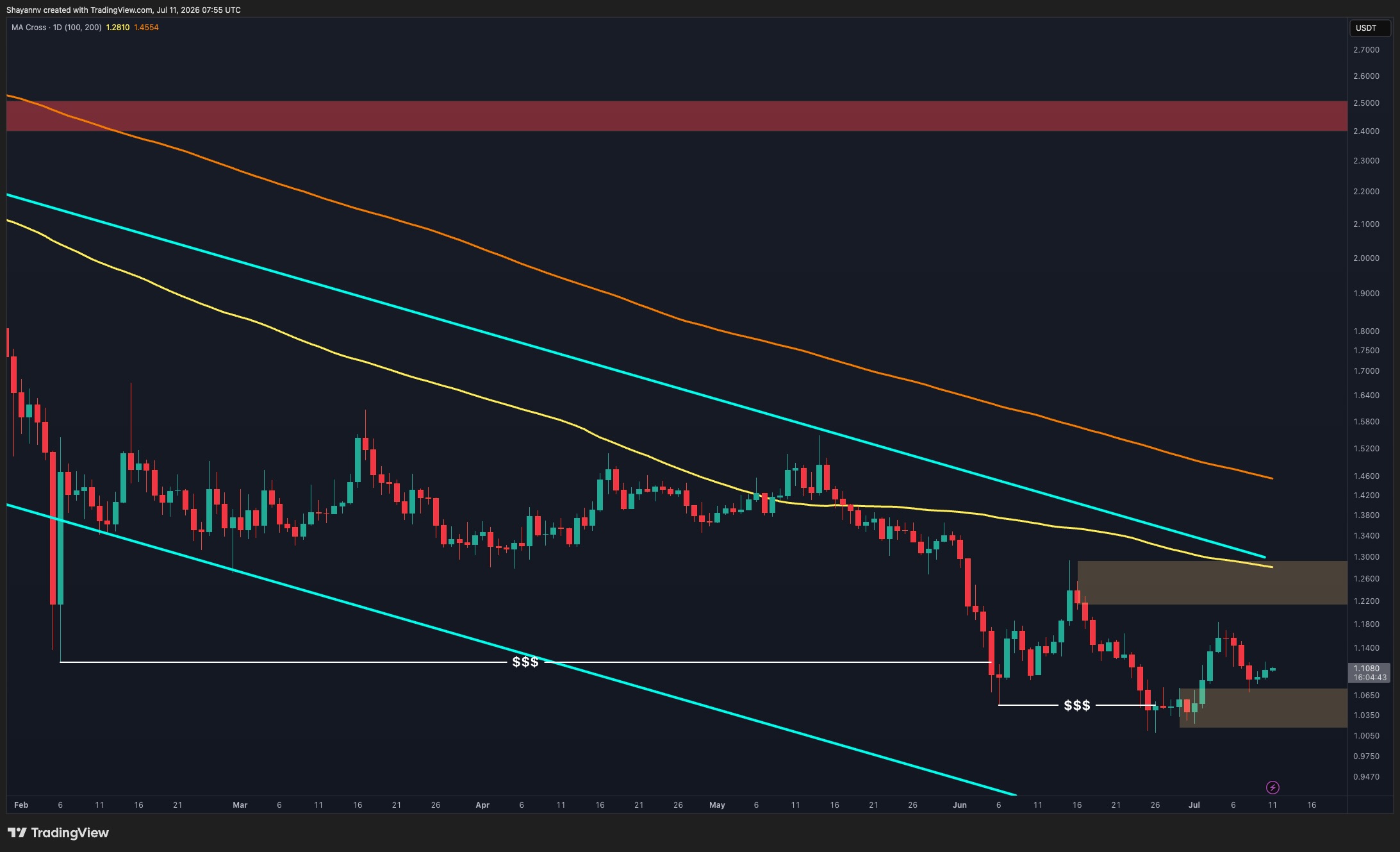
    On the daily chart, XRP continues to trade within a broader descending channel and remains below its 100-day and 200-day moving averages. Both averages are trending downwards, reinforcing the long-term bearish outlook.

    However, the recent dip towards the $1.02-$1.06 support zone appears to have spurred considerable demand. This area coincides with a previous sweep of liquidity below April’s lows, where the market briefly traded below support before a swift rebound. Since then, XRP has established a higher low and is building a base above this demand area.

    The price has recently bounced from this support zone and is now attempting to re-establish itself above the horizontal resistance region between $1.22 and $1.28. This zone is particularly significant as it also aligns with the descending 100-day moving average and the upper boundary of the prevailing bearish structure.

    A successful reclaim of the $1.22-$1.28 resistance zone would bolster the recovery narrative and could pave the way towards the major supply area situated near $1.55. Until such a breakout occurs, the broader trend is expected to remain corrective within the larger downtrend.

    Constructive Outlook on Shorter Timeframes

    The 4-hour chart presents a more optimistic perspective. Following the liquidity sweep below the $1.02-$1.06 support region, XRP experienced a market structure shift (MSS), signaling the first indication that sellers were losing their grip on the short-term trend.

    The subsequent rally resulted in a change of character (ChoCh), as the price broke above a previous lower high and challenged the descending trendline that has capped rallies since mid-June. Although the token initially faced resistance near the trendline around $1.16-$1.18, the pullback has been relatively shallow, with buyers continuing to defend the former breakout zone.

    Crucially, the market has not retreated to its previous lows despite the rejection, suggesting that demand remains active at current price levels. As long as XRP holds above the $1.03-$1.06 support area, the bullish structure established after the liquidity sweep remains intact.

    The key levels to watch are the descending trendline and the $1.15-$1.18 resistance area. A decisive breakout above this region would confirm a higher-high formation and could accelerate momentum towards the larger daily resistance zone between $1.22 and $1.28.

    Conversely, a failure to break the trendline could lead to further consolidation between support and resistance before a more significant directional move materializes.

    In summary, recent price action suggests a gradual recovery for XRP. However, the cryptocurrency still needs to reclaim the trendline resistance and the $1.22-$1.28 supply zone before a broader bullish reversal can be definitively confirmed.


  • Bitcoin and Ethereum ETFs See Net Inflows, Breaking Eight-Week Outflow Streak

    Bitcoin and Ethereum ETFs See Net Inflows, Breaking Eight-Week Outflow Streak

    Spot Bitcoin and Ethereum Exchange-Traded Funds (ETFs) have recorded net inflows in the past week, signaling a potential shift after an eight-week period of consistent net outflows. This development, reported by CryptoPotato, coincides with recent price rebounds for both cryptocurrencies.

    In the week ending around July 2, 2024, spot Bitcoin ETFs saw nearly $200 million in net inflows, marking the first positive flow week in two months. Spot Ethereum ETFs also reported net inflows totaling $84.42 million during the same period. This contrasts sharply with the preceding weeks, during which investors withdrew substantial amounts from these crypto-backed investment vehicles.

    Previous Outflow Trend

    Before this recent positive turn, both Bitcoin and Ethereum ETFs experienced eight consecutive weeks of net outflows. According to CryptoPotato, the outflow streak for Bitcoin ETFs began around the week ending May 15. Over this eight-week span, total withdrawals exceeded $8 billion. The last full week of June saw particularly significant outflows, with Bitcoin ETFs losing $1.79 billion, followed by an additional $526 million in the week ending July 2.

    The Ethereum ETF market followed a similar pattern, with cumulative net flows decreasing from $12.09 billion to $10.89 billion during its eight-week streak of net withdrawals. The $84.42 million in net inflows for Ethereum ETFs in the past week represents their highest weekly inflow since the week ending April 24.

    Daily Flows and Price Movements

    While the past week concluded with net inflows, the daily performance for Bitcoin ETFs showed some variability. Net outflows were recorded on Wednesday ($84.86 million) and Thursday ($95.30 million) of that week. However, these were offset by inflows on other days, including $265.69 million on Monday and $90.44 million on Friday, contributing to the overall weekly net inflow.

    Ethereum ETFs also experienced daily fluctuations. On July 9, these ETFs saw net outflows of $52.08 million. Nevertheless, other days registered positive flows, such as $20.66 million on Monday, $27 million on Tuesday, $70.48 million on Wednesday, and $18.43 million on Friday.

    In parallel with these ETF flow changes, the prices of Bitcoin and Ethereum have shown upward movement. Bitcoin is currently trading above $64,000, reflecting a weekly increase of approximately 3%. Ethereum is challenging the $1,800 mark, with a weekly gain of about 2.7%.

    Uncertainties and Outlook

    It is important to note that while the past week’s data indicates a break in the outflow streak, the long-term trend remains subject to market dynamics. Points of uncertainty include the exact end date of the “past week” for reporting and the precise duration of the “eight weeks” of outflows. Additionally, a mention of “February 2025” in relation to past outflows appears to be a typographical error, and specific date ranges for Ethereum ETFs’ “past few months” and “eight consecutive weeks” of performance are not detailed. These inflows may suggest renewed investor interest, but whether this marks a sustained reversal of the previous outflow trend requires further observation. The data is reported as of CryptoPotato’s analysis.

    Why This Matters

    The materials describe a narrow update: Spot Bitcoin ETFs recorded nearly $200 million in net inflows in the past week, breaking an eight-week streak of net outflows. The exact end date of the “past week” for reporting inflows/outflows.

    Broader Context

    Source materials place the factual news in this context: The article is from CryptoPotato.

  • Euro Coin (EURC) Activity Surges, Signaling Growing Demand for Regulated Stablecoins in Europe

    Euro Coin (EURC) Activity Surges, Signaling Growing Demand for Regulated Stablecoins in Europe

    Euro Coin (EURC) has recently achieved record levels of on-chain activity, including daily active addresses and new wallet creation. According to analytics firm Santiment, this surge may signal increasing demand for regulated, euro-denominated stablecoins within Europe’s evolving digital asset market.

    The heightened engagement with EURC occurs against the backdrop of the European Union’s Markets in Crypto-Assets (MiCA) framework. MiCA aims to establish a clear regulatory pathway for crypto assets, encouraging compliant digital assets among exchanges, payment providers, and applications. This regulatory clarity is anticipated to foster the adoption of stablecoins that meet European standards.

    Santiment indicates that the latest on-chain data suggests euro liquidity is becoming increasingly important across blockchain networks. The firm also attributed the rise in activity to developments within Circle’s ecosystem, the broader cross-chain expansion of stablecoins, and a renewed interest in compliant payment infrastructure. While stablecoins typically do not experience price rallies, the elevated activity around EURC points to growing underlying demand within Europe’s blockchain-based payment ecosystem.

    Circle’s EURC, issued by Circle SAS, is a prominent euro-backed stablecoin available on networks including Ethereum and Cronos. The market for MiCA-compliant euro stablecoins now comprises eight fully authorized tokens, offering regulated options for various users. EURC leads this group in market capitalization, joined by other MiCA-compliant stablecoins such as Société Générale’s EURCV, Monerium’s EURE, Schuman Financial’s EUROP, StablR’s EURR, Quantoz Payments’ EURQ, Banking Circle’s EURI, and AllUnity’s EURAU.

    In the past year, the combined market capitalization of these eight euro stablecoins has grown significantly, from approximately $295 million to $669 million, marking a 126% increase. This expansion in the broader market for regulated euro stablecoins provides context for the increased on-chain activity observed for EURC.

    Despite these positive indicators, uncertainties remain regarding the precise drivers behind EURC’s on-chain activity surge beyond the general influence of MiCA. It is also unclear whether this trend represents a sustained shift in market behavior or a temporary fluctuation. The growing importance of euro liquidity and the adoption of regulated stablecoins are key signals to monitor as the European digital asset landscape matures under the MiCA framework.

    Why This Matters

    The materials describe a narrow update: On-chain activity for Euro Coin (EURC), including daily active addresses and new wallet creation, reached all-time highs. The exact reasons for the surge in EURC’s on-chain activity beyond the general influence of MiCA.

    Broader Context

    Source materials place the factual news in this context: The EU’s Markets in Crypto-Assets (MiCA) framework encourages exchanges, payment providers, and crypto applications to adopt compliant digital assets.

  • STC, SATA Reach $10B Monthly Trading Milestone Amidst Below-Par Prices

    STC, SATA Reach $10B Monthly Trading Milestone Amidst Below-Par Prices

    STRC, SATA Hit Record $10 Billion Monthly Trading Volume Amid Bitcoin Sell-Off

    Bitcoin-backed preferred shares STRC and SATA achieved their highest combined monthly trading volume on record in June, exceeding $10 billion. This surge occurred even as a sell-off in Bitcoin (BTC) pushed both securities below their $100 par value.

    According to data from BitcoinTreasuries.net (BTN), Strategy’s STRC generated $8.7 billion in trading volume last month, while Strive’s SATA recorded $1.5 billion. This activity took place as the price of BTC declined, approaching the $57,000 level.

    The latest corporate adoption report from BitcoinTreasuries indicates that the $8.7 billion volume for STRC represented a 20.8% increase from May’s $7.2 billion and was 11.5% higher than April’s $7.8 billion. This figure also marked a more than 52% jump compared to the shares’ performance in March, following a more subdued start to the year.

    Strategy’s perpetual preferred stock volumes had reached $2.2 billion in February, before climbing 159.1% in March. January saw $2.4 billion in volume, following $1.2 billion in December 2025.

    The BTC treasuries market aggregator identified June as the first significant stress test for these digital credit products. Both STRC and SATA dropped well below their $100 par value starting June 18. The firm noted that margin calls compelled leveraged traders of STRC and SATA to liquidate their positions after an extended period of trading near par.

    Following Bitcoin’s drop below the $60,000 mark, STRC recovered to approximately $87 by July 2, after having fallen as low as $75. SATA, meanwhile, traded near $97. A survey conducted by BTN revealed that investors remained largely resolute despite the volatility. More than half of the respondents indicated that the price decline was not a significant concern. Furthermore, 84% of investors did not sell either stock during the decline, and 52% purchased one or both after June 18.

    “The instinct after June 18 is to ask whether STRC and SATA are safe,” the survey stated. “That is the wrong question. Strategy holds 847,363 BTC acquired at an average cost of approximately $75,651. The dividend obligation is a cash flow question, not a solvency question.”

    The report also highlighted that none of the issuers had missed a payment, and their credit quality remained unchanged since mid-June.

    In the investor confidence segment of the BTN study, respondents projected the strongest issuance potential for Strategy. The most common expectation was for new digital credit issuance between $10 billion and $30 billion for the Michael Saylor-led firm by the end of 2027.

    Strive secured second place with a forecast of $2 billion to $5 billion in additional issuance. Metaplanet, Smarter Web Company, and Bitmine followed, respectively.

    When asked which digital credit issuers appeared most promising, 78.4% of poll participants ranked Strategy first, 74.5% selected Strive as second, and Metaplanet took third place with 49%.

  • Housing Bill With CBDC Ban Likely to Become Law Despite Presidential Objection

    Housing Bill With CBDC Ban Likely to Become Law Despite Presidential Objection

    A significant housing bill that includes a ban on the issuance of a U.S. central bank digital currency (CBDC) through the end of 2030 is poised to become law, even though President Donald Trump has stated he will not sign it. This development is due to the bill having passed both the House of Representatives and the Senate with veto-proof majorities, meaning it can automatically become law if the president does not actively veto it by the end of Friday.

    President Trump announced on Thursday that he would not sign the 21st Century ROAD to Housing Act, citing the Senate’s failure to pass the SAVE America Act as one reason for his refusal. However, under the U.S. Constitution, a bill passed by Congress automatically becomes law after 10 days if the president does not sign or veto it, provided Congress remains in session. This deadline for the housing bill expires at the end of Friday.

    The legislation previously cleared the Senate with a vote of 85-5 and the House with a vote of 358-32. These margins indicate that Congress could potentially override a presidential veto if one were issued. A White House spokesperson, reached by Decrypt, declined to comment on whether Trump intends to issue a formal veto before the deadline, directing inquiries to the president’s Truth Social post.

    The 21st Century ROAD to Housing Act is primarily designed to stimulate U.S. housing construction by reducing regulations and limiting the ability of institutional investors to purchase residential properties. A key provision added to the bill prohibits the Federal Reserve from issuing a central bank digital currency until the end of 2030. Privacy advocates have expressed concerns that a government-issued digital dollar could enable federal surveillance of Americans’ financial transactions, and this CBDC ban was reportedly welcomed by such groups.

    The Federal Reserve has been researching CBDC technology but has previously stated that it would not issue such a currency without explicit authorization from Congress.

    Despite President Trump’s stated intention not to sign, the bill’s strong bipartisan support in Congress suggests it is likely to become law. The primary uncertainty remains whether the president will formally veto the legislation before the Friday deadline. If a veto is issued, Congress would need to muster a two-thirds majority in both chambers to override it, a threshold they have already demonstrated they can meet.

    Why This Matters

    The materials describe a narrow update: President Trump announced he would not sign the 21st Century ROAD to Housing Act because it included a ban on a U.S. central bank digital currency (CBDC). The bill is expected to automatically become law if the President does not veto it by midnight Friday, as it previously passed both chambers of Congress with veto-proof majorities. Whether President Trump intends to formally veto the legislation before midnight Friday remains uncertain.

    Broader Context

    Source materials place the factual news in this context: President Donald Trump said Thursday he will not sign a bipartisan housing bill that includes a multi-year ban on the issuance of a U.S. central bank digital currency, or CBDC. The bill is expected to automatically become law if the President does not veto it by midnight Friday, as it previously passed both chambers of Congress with veto-proof majorities.

  • Circle Receives OCC Approval for National Trust Bank, Navigating Regulatory Landscape

    Circle Receives OCC Approval for National Trust Bank, Navigating Regulatory Landscape

    Circle, the issuer of the stablecoin USDC, has received final approval from the U.S. Office of the Comptroller of the Currency (OCC) to establish a national trust bank. This development signifies a transition for the company from state-specific regulations to a federal banking framework.

    Circle has stated that this transition is intended to enhance its capabilities in safeguarding customer assets and managing reserves. The company indicated that the OCC approval integrates the infrastructure supporting its $73.2 billion stablecoin, USDC, into a federal banking system designed for safety, soundness, and transparency. Circle has described this move as a step toward building a new fundamental money layer for the internet.

    On Friday, the day of the announcement, Circle’s stock price reportedly increased by 8.4%, reaching as high as $73.80 during pre-market trading. The stablecoin USDC currently holds a valuation of $73.2 billion.

    This approval aligns with a broader trend of increased banking access for crypto firms under the current administration. In December, entities such as Ripple, BitGo, Fidelity Digital Assets, and Paxos received similar approvals from the OCC. More recently, Sony Bank indicated it had received conditional OCC approval for a national trust bank.

    Market Competition and Industry Dynamics

    The stablecoin market is also experiencing increased competition. Late last month, over 140 financial and technology firms, including Mastercard and BlackRock, backed a new initiative called Open USD. This development suggests a growing landscape of potential alternatives and challenges to existing stablecoin models.

    Circle’s relationship with Coinbase is also noteworthy. Coinbase has a revenue-sharing agreement with Circle concerning the interest income generated from USDC reserves, which are largely held in U.S. Treasuries. Coinbase CEO Brian Armstrong has previously praised such developments.

    Regulatory Scrutiny and Uncertainties

    However, these approvals have faced scrutiny. Some lawmakers, including Sen. Elizabeth Warren, have raised concerns regarding the process by which these charters were granted. Trade groups like the Digital Chamber have defended the OCC’s actions.

    While Circle’s move into a federal banking framework is reported, uncertainties remain regarding the long-term impact of the OCC’s approach to digital assets, the extent to which other crypto firms will pursue national charters, and the competitive response to initiatives like Open USD. It is important to note that Circle’s approval does not constitute a formal endorsement of all stablecoins by the OCC, nor does it may provide the future success or stability of any specific crypto firm.

    Why This Matters

    Circle’s OCC approval signifies a significant regulatory step, moving it into a federal banking framework. This could have implications for its operations and the broader stablecoin market, which is facing increasing competition and ongoing regulatory debate.

    Broader Context

    Under President Donald Trump’s second administration, financial regulators have shifted their stance toward digital assets, leading to increased banking access for crypto firms. This trend has coincided with both opportunities for digital asset companies and scrutiny from lawmakers.

  • TrueDAO Secures $10 Million for AI-Powered Decentralized Financial Infrastructure Development

    TrueDAO Secures $10 Million for AI-Powered Decentralized Financial Infrastructure Development

    TrueDAO has announced the completion of a $10 million strategic funding round, led by Brevan Howard Digital with participation from Zee Prime Capital and Jump Capital. This funding is designated for advancing the company’s AI-powered decentralized financial infrastructure.

    According to TrueDAO, the capital infusion will primarily support core AI protocol development, enhance AI-driven risk control mechanisms, fund security audits, bolster global compliance efforts, and expand ecosystem partnerships. The company’s objective is to construct a decentralized financial infrastructure that integrates smart contracts, on-chain reserves, dynamic adjustment mechanisms, and community governance. This infrastructure is designed to be modular, offering services such as liquidity management, reserve management, risk alerts, yield distribution, and governance support to a wide array of blockchain projects.

    The initiative aims to address persistent challenges in the traditional crypto industry, including yield sustainability, risk response, reserve transparency, and governance efficiency. Specific areas of focus for the funding include refining smart contracts and protocol modules, developing AI-driven risk monitoring and stress-testing systems, implementing independent security audits and bug bounty programs, advancing legal and compliance assessments across various jurisdictions, and releasing comprehensive developer documentation while expanding ecosystem partnerships.

    SoLee, Head of Marketing at TrueDAO, stated that while the $10 million funding is a significant milestone, “capital accelerates development, it cannot replace security, transparent governance, and genuine value creation.” TrueDAO remains committed to building an on-chain financial infrastructure that is auditable, verifiable, and governable.

    Looking ahead, TrueDAO plans to advance its testnet launch, security audits, developer tools, and ecosystem integration initiatives. The company intends to disclose protocol operations and reserve data in phases. However, specific launch dates, token arrangements, and incentive mechanisms are subject to official announcements and applicable laws.

    Why This Matters

    The materials describe a narrow update: TrueDAO announced it has completed a $10 million strategic funding round led by Brevan Howard Digital, with participation from Zee Prime Capital and Jump Capital. Specific launch dates, token arrangements, and incentive mechanisms are subject to official announcements and applicable laws.

    Broader Context

    Source materials place the announcement in this context: TrueDAO is an AI-driven decentralized autonomous financial infrastructure project.

  • Charles Hoskinson Denies Cardano Retirement Rumors

    Charles Hoskinson Denies Cardano Retirement Rumors

    Charles Hoskinson has directly refuted rumors suggesting his retirement from Cardano, labeling the claims as “categorically untrue” and “a complete fabrication.” The widespread speculation appears to have originated from decontextualized video clips and social media posts that circulated widely.

    Hoskinson clarified that the rumors were fueled by statements taken out of context. One such instance involved a New Year 2026 stream where he mentioned having “outgrown X” (referring to the social media platform), a comment that was later shared without the full context of the session. Additionally, a post on X stating, “I’m taking a break. TTYL,” was screenshotted and disseminated without the accompanying video, contributing to the narrative of his departure.

    The denial comes against a backdrop of significant structural changes and ongoing discussions within Cardano’s governance framework. In a reform video, Hoskinson had previously criticized elements of the Cardano Foundation’s governance structure, calling them the “biggest mistake of his career.” These statements, also subject to decontextualization, have added layers to the perception of his involvement.

    It is important to note that Hoskinson’s executive control over Cardano is limited. He holds no governance keys, cannot initiate hard forks or protocol parameter changes, and has no access to the Cardano treasury or ownership of the Cardano trademark. Key governance powers were transferred to ADA holders via DReps following the Plomin hard fork in January 2025.

    Further contributing to the complex ecosystem dynamics, EMURGO has exited Cardano’s Pentad governance body. Separately, investor Justin Bons has publicly called for Hoskinson’s removal. An active funding standoff also exists between DReps and Input Output’s research budget, with Hoskinson warning that the ecosystem could lose scientists if research funding falters.

    These underlying factors, including the governance shifts and funding disputes, may have contributed to the plausibility of retirement rumors among some observers. However, Hoskinson’s explicit denial addresses the core speculation directly. The incident underscores the challenges in communication within complex decentralized ecosystems and the potential for decontextualized information to create significant noise.

    While Hoskinson has denied the retirement rumors, uncertainties remain regarding the specifics of a proposed governance overhaul and the resolution of the funding standoff between DReps and Input Output’s research budget. The exact timing of past statements, such as the “I’m taking a break. TTYL” post, also remains unspecified.

    Why This Matters

    The materials describe a narrow update: Charles Hoskinson issued a direct denial of rumors suggesting his retirement from Cardano, stating the claims were untrue and fabricated. The specific content of the ‘reform video’ beyond Hoskinson’s criticism of governance.

    Broader Context

    Source materials place the factual news in this context: Cardano News.

  • SWIFT Pilots Blockchain Ledger with 17 Banks for 24/7 Cross-Border Settlement

    SWIFT Pilots Blockchain Ledger with 17 Banks for 24/7 Cross-Border Settlement

    SWIFT has launched a pilot for its blockchain-based shared ledger, designed to facilitate cross-border payments using tokenized deposits and enable 24/7 settlement. The initiative involves 17 major banks from six continents and is built on Hyperledger Besu, with the pilot ready for initial use after a nine-month implementation period.

    How the Ledger Works and Integrates
    The core of the pilot involves using tokenized deposits, which are backed one-to-one by commercial bank deposits. This approach aims to leverage the benefits of blockchain technology while maintaining the regulated status of traditional bank accounts. The shared ledger operates above existing payment rails, coordinating funding commitments between participating banks and providing a real-time view of payment status. Crucially, final settlement continues through existing RTGS systems and SWIFT’s established messaging network, rather than being replaced.

    Enabling 24/7 Settlement
    According to SWIFT, the primary objective of this new ledger is to remove the constraint of overlapping business hours between sender and receiver, thereby enabling 24/7 settlement availability. This includes facilitating transactions during nights, weekends, and across different time zones, which current infrastructure struggles to support efficiently.

    Upgrading Existing Infrastructure
    SWIFT’s strategy emphasizes upgrading existing infrastructure rather than replacing it. The platform is designed to allow tokenized value to move across borders with speed, while maintaining the resilience, security, and compliance expected by global financial institutions. Thierry Chilosi, SWIFT’s Chief Business Officer, stated that the platform enables tokenized value to move across borders with the speed modern commerce demands while maintaining the resilience, security, and compliance expected by global financial institutions.

    Maintaining Compliance and Encouraging Adoption
    The pilot maintains existing compliance, credit, risk, and control standards, a move intended to reduce barriers to institutional adoption. By keeping established safeguards in place, SWIFT is pitching blockchain as an enhancement to its current infrastructure. This approach is seen as critical, as regulators and major banks have shown reluctance towards tokenized payment systems that might weaken oversight.

    Global Participation and Industry Context
    The 17 participating banks include HSBC, Citi, UBS, BNP Paribas, DBS, ANZ, Standard Chartered, BNY Mellon, First Abu Dhabi Bank (FAB), FirstRand, Itaú Unibanco, Lloyds Banking Group, Mashreq, MUFG, OCBC, UOB, and Wells Fargo. Their involvement from six continents provides the project with a broad international footprint from its outset, potentially serving as an early test of blockchain-based settlement at a global banking scale.

    SWIFT is not alone in exploring tokenized finance. A separate consortium, including JPMorgan Chase, Bank of America, Barclays, and BNY Mellon, is developing a US-focused tokenized deposit network targeting a first-half 2027 launch. Additionally, Intercontinental Exchange has outlined a 24/7 settlement venue for tokenized securities, and NYSE partnered with Securitize to build blockchain infrastructure for tokenized stocks and ETFs.

    Future Outlook and Next Steps
    SWIFT’s existing network connects over 11,500 financial institutions across more than 200 countries, offering the shared ledger a potential user base that few blockchain payment networks can match. If the pilot succeeds across these 17 major banks and multiple currency corridors, it could pave the way for easier adoption by other institutions.

    Future upgrades are anticipated to support foreign exchange payment versus payment, programmable corporate payments, and cash movements tied to securities transactions. However, the current rollout is an early milestone, and the next test will be whether this global network can translate initial interest into meaningful transaction volume. The success of the pilot hinges on its ability to demonstrate tangible improvements in cross-border payment efficiency while adhering to established financial regulations and controls.

    Why This Matters

    The materials describe a narrow update: SWIFT has launched a pilot for its blockchain-based shared ledger, built on Hyperledger Besu, involving 17 major banks. Whether the global network can translate interest into meaningful transaction volume.

  • Circle Obtains Final OCC Authorization for National Trust Bank

    Circle Obtains Final OCC Authorization for National Trust Bank

    Circle has obtained the final authorization from the US Office of the Comptroller of the Currency (OCC) to establish and operate Circle National Trust, a national trust bank. This development places the company’s trust bank under direct federal oversight, a move Circle executives described as a significant milestone.

    The national trust bank charter will enable Circle to provide fiduciary cryptocurrency custody services, including for its own USDC reserves. The company may also extend these services to institutional clients, though this may depend on demand.

    Circle applied for this charter a year ago and received conditional approval later in 2025. As reported at the end of 2025, Circle was among the companies that received initial conditional approval from the US OCC. This final authorization suggests the establishment of Circle National Trust.

    According to Circle, federal oversight of the trust bank is intended to set a new standard for transparency and governance for its infrastructure. This is seen as unlocking a new phase for adoption, where financial institutions can build on public blockchains with greater clarity and confidence.

    This development follows similar approvals for other entities, such as Ripple, which secured approval to establish Ripple National Trust Bank. These actions are viewed as steps toward integrating blockchain technology into the US financial system. Other cryptocurrency-focused companies like BitGo, Digital Assets, and Paxos were also mentioned in the context of earlier approvals.

    “OCC approval to establish Circle National Trust marks a defining step in bringing blockchain technology and digital assets into the core of the U.S. financial system,” commented Jeremy Allaire, Co-Founder, Chairman, and CEO of Circle. He added that federal oversight sets a new standard for transparency, governance, and scale for Circle’s infrastructure.

    The company stated that it continues to build on its long-standing regulatory strategy. The extent to which Circle will extend custody services to institutional clients remains dependent on demand.

    Why This Matters

    The materials describe a narrow update: Circle has obtained the final license from the OCC to launch its national trust bank, Circle National Trust. Whether Circle will extend custody services to a limited number of institutional clients depends on demand.

    Broader Context

    Source materials place the factual news in this context: The entity behind the second-largest stablecoin announced earlier today that it has secured the necessary license from the US Office of the Comptroller of the Currency (OCC) to launch First National Digital Currency Bank, N.A., which will operate as Circle National Trust.