Tag: Positive

  • FLEXUSDT Perpetual Contract Lists with 20x Leverage

    FLEXUSDT Perpetual Contract Lists with 20x Leverage

    Bybit Lists FLEXUSDT Perpetual Contract, Offering Up to 20x Leverage

    Cryptocurrency exchange Bybit has announced the listing of the FLEXUSDT Perpetual Contract, with trading now live and offering users leverage of up to 20x.

    The new contract is also accessible through Bybit’s suite of Futures bots, including Futures Grid, Futures Martingale, and Futures Combo.

    FLEXUSDT Perpetual Contract Details:

    • Underlying Asset: Flex Ltd (FLEX)
    • Settlement Asset: USDT
    • Tick Size: 0.01
    • Maximum Leverage: 20x
    • Capped Funding Rate: 2.5%
    • Funding Fee Settlement Interval: Every 8 hours
    • Trading Hours: 24/7
  • Binance Expands Collateral Options with 15 Tokenized Stocks

    Binance Expands Collateral Options with 15 Tokenized Stocks

    Binance Expands Margin Trading Options with New bStocks Collateral Assets

    Binance has announced the addition of fifteen new bStocks tokens as eligible collateral assets for its Cross Margin, Portfolio Margin, and Portfolio Margin Pro services. This move significantly broadens the collateral options available to eligible users for margin trading.

    The newly added bStocks tokens represent a diverse range of companies and investment vehicles, including Circle (CRCLB), Micron (MUB), NVIDIA (NVDAB), Sandisk (SNDKB), Tesla (TSLAB), SpaceX (SPCXB), Advanced Micro Devices (AMDB), iShares MSCI South Korea ETF (EWYB), Intel (INTCB), Strategy (MSTRB), Lumentum (LITEB), Meta (METAB), Microsoft (MSFTB), Palantir (PLTRB), and Invesco QQQ Trust (QQQB). Corresponding bStocks trading pairs are now also available for margin trading.

    Eligibility and Risk Management

    This feature is exclusively available to VIP 3 and above users in permitted jurisdictions. Users in restricted regions will not have access to these new collateral options.

    Binance strongly encourages users to implement robust risk management strategies and to continuously monitor their margin levels when utilizing bStocks tokens as collateral. Further details on marginable assets and related information can be found in the Margin Data section.

    For a comprehensive understanding of the index price methodology for bStocks as collateral assets, users are directed to the bStocks Tokenized Securities Collateral Index Price Methodology.

    Understanding Binance bStocks

    Binance bStocks are tokenized securities that represent underlying equities. The platform offers resources such as Frequently Asked Questions on Binance bStocks as Collateral Assets, Margin Trading Overview, and a Binance Cross Margin Trading Guide to help users navigate these products.

    Binance reserves the right to amend or cancel this announcement at any time and for any reason without prior notice.

    It is important to note that information regarding Tokenized Securities is not intended as an offer, solicitation, promotion, recommendation, or invitation to buy or sell securities in any jurisdiction. Tokenized Securities are not offered, sold, distributed, made available, or accessible in the United States or to U.S. persons. They have not been registered under the U.S. Securities Act of 1933 or any U.S. state securities laws, and a public offering of bStocks will not be conducted in the United States or any other jurisdiction, with the exception of the ADGM. By accessing this product, users represent and warrant that they are not U.S. persons, are not located in the United States, are not acting for the account or benefit of any U.S. person, and will not access, purchase, sell, transfer, redeem, or otherwise transact in Tokenized Securities from within the United States.

  • Bitcoin Options Expiry: Will Markets Move?

    Bitcoin Options Expiry: Will Markets Move?

    Bitcoin Options Expiry Amid Market Uptick

    Approximately 31,000 Bitcoin options contracts, with a notional value of around $1.9 billion, are set to expire on Friday, July 3. This expiration is significantly smaller than the substantial end-of-quarter event last week, suggesting a minimal impact on spot markets.

    Crypto markets, which experienced a flat trend for most of the week, saw a resurgence on Friday. Since Monday, the sector has attracted $70 billion as losses from last month’s downturn have decelerated.

    This week’s Bitcoin options contracts exhibit a put/call ratio of 0.7, indicating a slight dominance of sellers of long (call) contracts over sellers of short (put) contracts. The maximum pain point is situated near $61,000, close to current spot prices, meaning some contracts are likely to expire in the money.

    Open interest (OI), representing the value or number of Bitcoin options contracts yet to expire, remains highest on Deribit at the $80,000 strike price, totaling $1.1 billion. However, short sellers maintain $900 million in OI at the $60,000 strike.

    According to Coinglass, total BTC options OI across all exchanges has decreased to a 16-month low of $26 billion following last week’s significant expiry.

    Derivatives provider Greeks Live noted this week that “Short-dated skew continues to account for the majority of downside premium embedded in BTC options pricing.” They added, “Options positioning remains primarily driven by near-term risk management rather than a broad repricing of longer-term expectations.”

    Ethereum Contracts Also Expire

    In addition to Bitcoin options, approximately 134,000 Ethereum contracts are expiring today, with a notional value of $228 million. These contracts have a maximum pain point of $1,650 and a put/call ratio of 1.3.

    Total ETH options OI across all exchanges is currently low, standing at around $3.6 billion, its lowest level since January 2023. This brings the total notional value of crypto options expirations to approximately $1.8 billion.

    Market Sees Broad Gains

    Crypto markets are experiencing a broad rally this Friday, with total capitalization rising to $2.2 trillion.

    Bitcoin led the gains, reaching an intraday high of $62,000 on Thursday following weaker-than-expected U.S. jobs data. It was trading at $61,500 on Friday morning in Asia. Ether performed slightly better, reclaiming the $1,700 level with a 6% daily gain and maintaining that momentum over the past 12 hours.

    The upcoming long weekend in the United States is expected to lead to subdued market activity.

    A recent social media post indicated that Bitcoin had reclaimed $62,000 after June jobs data came in below expectations, reducing the likelihood of a Federal Reserve rate hike. The post also stated that over $69 billion had been added to the crypto market in the preceding six hours, with Bitcoin up 3.5% and Ethereum also showing gains.

  • Standard Chartered Launches Direct Stablecoin Services

    Standard Chartered Launches Direct Stablecoin Services

    Standard Chartered Pioneers Direct Stablecoin Access for Institutional Clients

    Standard Chartered has achieved a significant milestone, becoming the first Global Systemically Important Bank (G-SIB) to enable institutional clients to mint and redeem USDC directly via its banking platform, the lender announced.

    This new service eliminates the necessity for eligible clients to establish separate accounts with Circle, the issuer of USDC. Instead, it offers a streamlined, single onboarding process for both traditional banking services and access to stablecoins.

    The offering, unveiled on July 2, was developed in partnership with Circle. It will permit qualifying institutional clients to mint and redeem USDC through Standard Chartered’s operations in the Dubai International Financial Center (DIFC). The bank stated that clients will gain access to banking, custody, and digital asset services through a unified platform, facilitating on-chain settlement and treasury management using USDC.

    Initially, the service will be exclusively available through the bank’s DIFC operations. However, Standard Chartered indicated plans to extend the offering to additional markets, pending regulatory approvals.

    “Digital assets are increasingly becoming a crucial component of global financial infrastructure, and institutional clients are seeking the same levels of trust and governance that underpin traditional markets,” said Roberto Hoornweg, Standard Chartered’s chief of corporate and investment banking.

    He further emphasized that the launch aims to foster broader institutional engagement in crypto markets by leveraging established compliance and risk management frameworks.

    Industry observers have interpreted the announcement as a further indication of stablecoin infrastructure’s integration into regulated finance. Hupzy of Spot On Chain commented on X that enabling a G-SIB to directly participate in the USDC minting process removes a substantial operational barrier for institutions that previously relied on exchanges or over-the-counter desks for stablecoin acquisition. The analyst suggested that this arrangement could boost USDC adoption among institutions, thereby enhancing on-chain liquidity.

    Standard Chartered’s announcement follows closely on the heels of the introduction of OpenUSD, a new stablecoin backed by a consortium of over 140 companies, including major players like Visa, Mastercard, Stripe, Coinbase, Ripple, and BlackRock. This initiative, built on principles of collaborative governance and revenue sharing, introduces another competitor to the landscape of institutional stablecoin infrastructure development.

    The bank has been actively expanding its footprint in regulated digital assets. In April of this year, Standard Chartered was among the first entities to secure a Hong Kong stablecoin issuer license, empowering it to mint Hong Kong dollar-backed stablecoins for cross-border payment purposes.

  • XRP Bullish Divergence Signals Defense of $1 Support

    XRP Bullish Divergence Signals Defense of $1 Support

    XRP Consolidates as Technical Signals Hint at Shifting Momentum

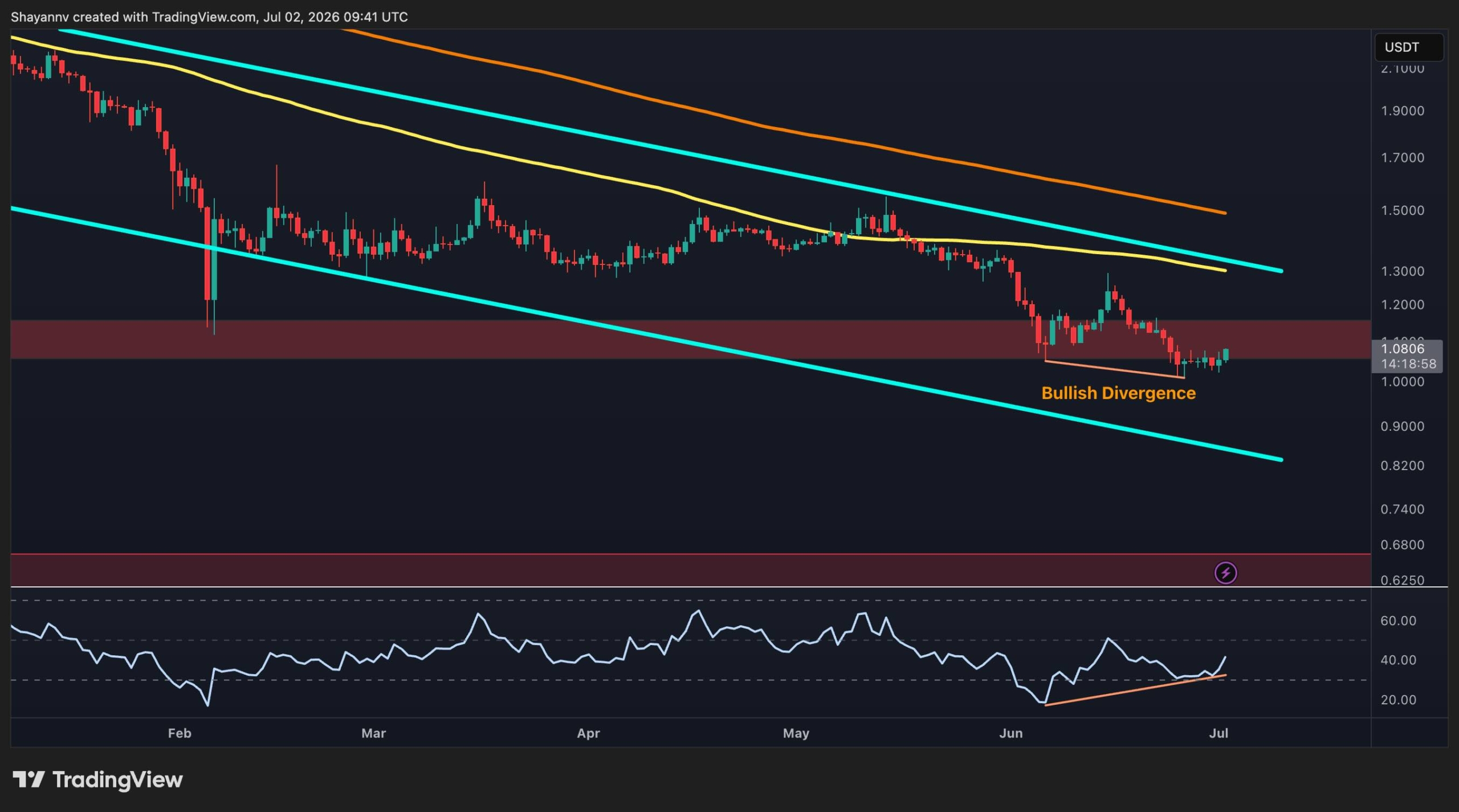
    XRP is currently trading within a tight range against both USDT and Bitcoin, with the overall trend still leaning towards sellers. However, recent technical indicators suggest that the downward momentum may be waning as the market defends key support levels and early signs of bullish divergence emerge.

    XRP/USDT Analysis

    Against USDT, XRP is confined within a descending channel, trading below its 100-day and 200-day moving averages. This positioning maintains a bearish outlook on higher time frames, despite recent price stabilization. The asset is holding firm around the $1.08 support area, which aligns with a significant horizontal demand zone. Following a sharp sell-off in June, sellers have been unable to push XRP lower, allowing it to establish a short-term base above this support.

    The Relative Strength Index (RSI) has formed a clear bullish divergence, showing higher lows while the price has registered lower lows. This pattern typically signals a weakening bearish trend and increases the likelihood of a relief rally if buyers can regain higher price levels. Immediate resistance is observed around the $1.15 supply zone, with stronger resistance located near the 100-day moving average, approximately at $1.25. A sustained move above these levels would improve the broader outlook. Conversely, a break below the $1 support could expose the lower boundary of the channel, potentially leading to a decline towards $0.80.

    XRP/BTC Analysis

    Against Bitcoin, XRP is also trading within a long-term descending channel, indicating persistent relative weakness. The pair remains below key moving averages, suggesting that the broader trend has not yet shifted in XRP’s favor.

    Recently, XRP experienced a brief dip below the critical 1,700 satoshi level before quickly recovering, suggesting a potential fake breakdown. This rejection below support implies that sellers failed to maintain control and may have triggered a liquidity sweep before the price returned to its previous range. Despite this recovery, the pair faces immediate resistance around 1,850 satoshis. A more significant supply zone is situated near 2,000 satoshis, where horizontal resistance converges with the declining 200-day moving average. A decisive move above these resistance levels would strengthen the case for a broader recovery towards the upper boundary of the channel.

    As long as XRP maintains its position above 1,700 satoshis, the fake breakout scenario remains plausible and could support further upside movement. However, a confirmed daily close below this level would invalidate the bullish setup and likely pave the way for another downward move towards the critical 1,500 satoshi support area.

  • Peirce: Senate CLARITY Act Vote Expected Before August Recess

    Peirce: Senate CLARITY Act Vote Expected Before August Recess

    Peirce Optimistic CLARITY Act Will Pass Senate This Summer

    SEC Commissioner Hester Peirce expressed optimism on the “Searching for Mana” podcast, stating she anticipates the CLARITY Act will pass the full Senate this summer. Her remarks lend significant weight to a timeline the market has viewed as ambitious, though not entirely out of reach.

    The bill previously cleared the House with bipartisan support in July 2025, a 294–134 vote, and advanced from the Senate Banking Committee in May 2026 by a 15–9 margin. While these represent substantial procedural milestones, the legislation still requires a floor vote, a merged text from differing House and Senate versions, and a presidential signature to become law.

    Peirce’s position as a sitting SEC commissioner and former Senate Banking Committee staffer means her public statements carry considerable authority, offering insight into the remaining procedural hurdles. Her assertion suggests that the agency’s leadership views the summer timeline not as an aspirational goal, but as a tangible expectation.

    The path forward involves merging the text approved by the Senate Banking Committee with a parallel bill from the Agriculture Committee, which focuses on commodities and derivatives. Following this consolidation, the merged text must secure 60 votes to overcome a cloture motion, a threshold that necessitates sustained bipartisan cooperation.

    Bipartisan Support and Industry Urgency

    While Democrats Ruben Gallego of Arizona and Angela Alsobrooks of Maryland joined all 13 Republicans on the committee, a positive indicator, committee votes do not always translate directly to floor support.

    The urgency surrounding the CLARITY Act is palpable. Over 100 cryptocurrency firms and trade associations have publicly urged Senate leadership to advance the bill. Furthermore, Treasury Secretary Scott Bessent has emphasized its passage as crucial for maintaining U.S. financial leadership and the dollar’s reserve status.

    Unlike agency guidance, which can be reversed by future administrations through no-action letters and staff bulletins, statutory clarity provided by legislation is permanent. This distinction makes the current legislative window particularly significant for the digital assets market, extending beyond immediate news cycles.

    Key Provisions of the CLARITY Act

    Peirce detailed the bill’s core components, which aim to delineate jurisdiction over crypto assets between the SEC and the Commodity Futures Trading Commission (CFTC). This division would be based on a three-tiered classification system.

    “Digital commodities,” such as Bitcoin and Ethereum, and likely Solana, would fall under CFTC oversight for spot market regulation, a framework currently absent in existing statutes. Assets deemed “investment contracts” would remain under SEC jurisdiction, while “permitted payment stablecoins” would be jointly supervised.

    A critical element of the CLARITY Act is the clarification of the Howey Test. Under current law, determining whether a token constitutes an investment contract involves a fact-intensive analysis that the SEC has applied inconsistently, leaving issuers and secondary market participants vulnerable to retroactive enforcement. The bill seeks to codify a clearer standard for applying this test, addressing the ambiguity that has hindered the listing of major Layer 1 tokens on U.S. exchanges.

    Peirce has long advocated that the previous enforcement-first approach blurred the lines between legitimate builders and bad actors. This provision would offer developers a statutory framework, replacing a landscape of contradictory staff positions.

    The CLARITY Act also includes over 16 safeguards against illicit finance, not loopholes, such as applying the Bank Secrecy Act and Anti-Money Laundering rules to crypto, introducing new sanctions against Iran, and enabling exchanges to freeze illicit funds.

    Developer Liability and a “Rare Window”

    The bill also addresses developer liability, a distinct but related concern. Under previous SEC policies, software developers faced potential repercussions when their protocols were used by third parties in ways regulators later deemed unlawful. The CLARITY Act would shield developers from such liability in cases where a decentralized network lacks a centralized intermediary exercising control, a provision that directly impacts DeFi protocol builders and open-source contributors operating under significant legal uncertainty.

    Peirce characterized the current moment as a “rare window” with substantial “regulatory goodwill,” urging stakeholders to “use that to build things that last, things that matter.”

    SEC Chair Paul Atkins has echoed this sentiment, signaling a unified direction from the agency’s leadership. In remarks to the Economic Club of New York and in a Fox News interview, Atkins stated that President Trump has challenged the agency to position the U.S. as the global crypto capital and criticized the previous administration’s approach to digital assets. Atkins pledged to attract innovators back to the U.S. to build under American law, a commitment that aligns with Peirce’s comments and suggests a shared understanding of the bill’s importance. The Trump administration’s significant financial ties to the crypto sector lend considerable political weight to this commitment.

  • Robinhood Launches Blockchain Network

    Robinhood Launches Blockchain Network

    Robinhood Launches ‘AI-Native’ Ethereum Layer-2 with Tokenized Stocks

    Robinhood has officially launched the public mainnet of Robinhood Chain, an Ethereum layer-2 solution powered by Arbitrum. The company is positioning its new chain as “AI-native,” designed to facilitate direct trading by AI agents on-chain.

    The network has debuted with integrations from BitGo and Chainlink, alongside partnerships with Uniswap and Pleiades for market-making. Its core purpose is to bridge Robinhood’s established brokerage services with its cryptocurrency offerings.

    A key feature of Robinhood Chain is its “Stock Tokens,” which are on-chain representations of shares in companies such as Nvidia and Apple. These tokenized shares can be deposited into lending pools and utilized as collateral within decentralized finance (DeFi) applications. This innovation transforms traditional stock holdings into composable on-chain capital, a capability not available through conventional brokerages. Additionally, Robinhood has enabled perpetuals trading directly within its wallet via the decentralized perpetuals decentralized exchange (DEX) Lighter. Eligible U.S. users can also now access Robinhood Earn, allowing them to lend the USDG stablecoin and earn approximately 7% APY.

    Following the announcement, HOOD shares closed up more than 8% to $108.65, marking a nearly 20% increase for the month, though still below their peak values. Lighter’s LIT token saw a 15% surge to $2.14, reaching fresh local highs on the news of its integration.

    Venice AI Achieves $1 Billion Valuation as Voorhees Invests in Private AI

    Erik Voorhees’ privacy-focused artificial intelligence platform, Venice AI, has successfully raised $65 million in its first external funding round, achieving a $1 billion valuation and earning unicorn status just over two years after its inception. The funding round was spearheaded by crypto venture capital firm Dragonfly, with participation from Coinbase Ventures and North Island Ventures.

    Voorhees stated that this funding validates Venice’s objective to develop a private, uncensored alternative to mainstream AI services like ChatGPT. For those unfamiliar with the platform, Venice provides users access to over 200 open and closed AI models across text, image, video, and code generation, while ensuring no data is stored on its own servers. User prompts are encrypted client-side and routed through an external proxy.

    The platform has surpassed 3 million users and processes 1.7 million API calls daily. It is already profitable, generating approximately $70 million in annualized revenue, a notable achievement for an AI startup at this stage. The newly acquired capital will be allocated towards purchasing Graphics Processing Units (GPUs) and constructing its own data centers, aiming to reduce reliance on leased computing power and improve profit margins.

    The VVV token experienced a 10% increase on the day, reaching $13.50 and a fully diluted valuation (FDV) of $1 billion, mirroring the company’s valuation. The distinction between VVV token and company equity is a topic for future discussion.

  • Binance Convert Adds Smart DCA for Flexible Investing

    Binance Convert Adds Smart DCA for Flexible Investing

    Binance Introduces Smart DCA for Dynamic Recurring Investments

    Binance has launched Smart DCA, an optional advanced feature for its Convert Recurring service, allowing users to automatically adjust their investment amounts based on market sentiment. This new tool leverages the Fear & Greed Index, a market sentiment indicator developed by CoinMarketCap, to offer a more flexible automated purchasing strategy.

    Market Sentiment-Based Automation

    Smart DCA enables users to customize their recurring investment plans. When market sentiment, as indicated by the Fear & Greed Index, enters predefined “oversold” (0-40) or “overbought” (60-100) regions, the system can automatically increase or decrease the recurring purchase amount according to user-set parameters. This functionality aims to enhance the convenience of Binance Convert Recurring by introducing dynamic adjustments.

    The Fear & Greed Index is assessed at the time of each recurring transaction to determine if an adjustment is necessary.

    Optional Advanced Setting

    Smart DCA is an optional feature. Users can continue to utilize the standard Convert Recurring plans or opt to enable Smart DCA for eligible plans.

    Clear Execution Records

    The platform will provide clear records of executed transactions. The recurring history will display the actual investment amount utilized for each execution under Smart DCA. The plan details page will continue to show the original recurring amount as the baseline for reference.

    For instance, a user might set an original recurring amount of 100 USDC. If the “Market Dips” setting is configured at 150%, the plan will invest 150 USDC when the Fear & Greed Index falls between 0 and 40. Conversely, if the “Market Rallies” setting is configured at 50%, the plan will invest 50 USDC when the Fear & Greed Index is between 60 and 100. If the current Fear & Greed Index region has not been configured by the user, the plan will proceed with the original recurring amount of 100 USDC.

    In cases where the Fear & Greed Index is unavailable at the time of execution, the system will default to using the original recurring amount for that specific transaction.

    How to Enable Smart DCA

    Users can access the Smart DCA feature through both the Binance website and the Binance App. The steps to set up a plan are as follows:

    1. Navigate to the “Trade” section, then select either “Buy/Sell” or “Convert.”
    2. Choose the “Recurring” order type.
    3. Select an eligible cryptocurrency token and configure your desired recurring purchase amount and schedule.
    4. Open “Advanced Options” and enable “Smart DCA.”
    5. Set your preferred adjustment percentages for the “Market Dips” and/or “Market Rallies” market regions.
    6. Select “Create a Plan” and then “Confirm” after reviewing your setup.

    Binance emphasizes that Smart DCA operates solely based on user-selected parameters. The exchange does not recommend any specific investment strategy, threshold, multiplier, or configuration, nor does it assess the suitability of any configuration for individual users. Users are solely responsible for determining whether and how to utilize this feature.

  • XRP Surges Past Resistance Despite Billion-Token Unlock

    XRP Surges Past Resistance Despite Billion-Token Unlock

    Ripple’s latest release of 1 billion XRP from its escrow account this week has done little to dampen the cryptocurrency’s price, which is currently trading around $1.06. The digital asset has seen a modest 2% increase over the past 24 hours and, more significantly, continues to hold a crucial support level. This resilience has left traders contemplating whether buyers are quietly accumulating the asset or simply unfazed by the regular unlock.

    The monthly escrow release is a predictable event, as Ripple has adhered to the same schedule for years, making it an expected occurrence for most market participants. Nevertheless, the unlocking of 1 billion XRP always garnishes attention. This time, however, the price remained firm rather than declining, suggesting that sellers were unable to capitalize on the event.

    On-chain data confirmed the release of 1 billion XRP, valued at approximately $1.05 billion at current prices, in two distinct 500 million XRP tranches. The key question now is how much of this will be relocked versus how much will enter the market during this cycle.

    Technically, XRP maintains a constructive outlook as long as its support levels hold. Recent resistance points have now transitioned into support, preserving the short-term trend. However, derivatives data indicates a significant concentration of long positions. While this can be advantageous during periods of strong momentum, it could prove problematic if buyers lose control of the market.

    The broader market environment remains favorable for risk assets. U.S. stocks concluded a strong quarter, with technology shares continuing to lead the advance, which has contributed to an upbeat sentiment in the cryptocurrency market. Coupled with consistent institutional interest in Ripple’s ecosystem, XRP continues to be a focal point for traders.

    XRP is currently trading in the $1.05 range, with 24-hour trading volume around $1.5 billion. Liquidity remains robust, even with slight price variations across different exchanges. Buyers have demonstrated a consistent willingness to step in during pullbacks rather than chasing rallies, thereby maintaining short-term momentum.

    The $1.05-$1.06 area is now the primary support to monitor, while the $1.10-$1.13 zone represents key resistance. XRP is currently testing this ceiling again, suggesting that the upcoming trading sessions could be pivotal in determining whether buyers can break through or if the price will retreat to consolidate.

    Should XRP maintain its position above $1.05 and surpass $1.13 with substantial volume, the next target could be the $1.20-$1.22 region. Conversely, a decline to $1.03 would not necessarily signal a significant downturn, as this area has previously attracted buying interest.

    The bullish narrative would weaken if XRP closes below $1.01, shifting focus to the $0.99 support zone and prompting traders to reassess the current market setup. Even so, XRP is still trading approximately 72% below its all-time high, indicating considerable room for growth should momentum return.

    While XRP at the dollar level is attractive, it is also a cryptocurrency with a market capitalization exceeding $60 billion that is now encountering resistance after a substantial rally. The potential for asymmetric upside that initially drew traders to XRP at lower price points is now diminished. This is a mathematical observation rather than a bearish prediction. Traders seeking opportunities in early-stage infrastructure projects are evaluating a different risk-reward profile.

    Bitcoin Hyper ($HYPER) is presented as a structurally interesting presale in the current market cycle. It aims to be the first Bitcoin Layer 2 solution integrating the Solana Virtual Machine (SVM), enabling fast, low-cost smart contract execution directly within the Bitcoin ecosystem without compromising BTC’s inherent security. The project’s proposition focuses on addressing Bitcoin’s core limitations: slow transaction throughput, high fees, and a lack of native programmability. The presale has reportedly raised $32.9 million, with the current price at $0.01368, and offers staking opportunities for early participants. For those who invested in XRP at earlier stages and are now seeking their next asymmetric investment, Bitcoin Hyper is highlighted as a project worth researching before its next price adjustment.

  • USD1 Airdrop Campaign Update

    USD1 Airdrop Campaign Update

    Binance to Launch World Liberty Financial (WLFI) Airdrop Campaign

    Binance will update its airdrop campaign rules starting July 3, 2026, at 00:00 (UTC), to reward eligible users who hold World Liberty Financial USD (USD1) on its platform. Participants stand to share rewards from a prize pool of 178 million World Liberty Financial (WLFI) tokens.

    Bonus Multiplier for Futures and Margin Users

    Users holding USD1 in Binance Futures or Margin accounts from July 3, 2026, at 00:00 (UTC), can qualify for a 1.2x bonus multiplier on their rewards. This bonus is contingent upon maintaining a minimum daily open interest of 300 USD1 on USD1 Futures pairs.

    Binance will conduct hourly snapshots of each user’s open interest daily. The lowest recorded amount will determine if the daily open interest meets the minimum requirement for the 1.2x bonus multiplier.

    It is important to note that if a user’s daily open interest on USD1 Futures pairs falls below 300 USD1 on certain days, they will still receive 1x rewards for those days, provided they hold more than 0.01 USD1 in their Margin or Futures Accounts. The 1.2x bonus rewards will not apply on such days.

    Reward Calculation Examples

    User A maintained a daily open interest of 1,500 USD1 on USD1 Futures pairs for the first six days of the campaign, with 100 USD1 on the seventh day. Throughout the seven days, User A held 10,000 USD1 in Spot and 20,000 USD1 as collateral in Margin. With an effective base APR of 20% and a boosted APR of 24%, User A’s estimated rewards at the end of seven days are calculated as follows:

    [(10,000 20% 7) / 365] + [(20,000 24% 6) / 365] + [(20,000 20% 1) / 365] = 128.21 USD worth of WLFI

    User B maintained a daily open interest of 1,500 USD1 on the USD1 Futures pair throughout the first week. The user borrowed 5,000 USD1 from a VIP loan or Margin account. Of this borrowed amount, 4,000 USD1 was used as collateral in Margin, with the remaining 1,000 USD1 held in their Spot Account. With an effective base APR of 20% and a boosted APR of 24%, User B’s estimated rewards at the end of week 1 are calculated as:

    Qualifying Balance = 0
    [(0 20% 7) / 365] + [(0 24% 7) / 365] = 0 USD worth of WLFI

    User C maintained a daily open interest of 100 USD1 throughout the first week. The user had 1,000 USD1 in their Margin Account, which was used as collateral to borrow 4,000 USDT through Margin. This USDT was then converted to USD1, resulting in User C holding 5,000 USD1 in their Margin account. As User C’s daily open interest was below 300 USD1, they did not qualify for the 1.2x bonus rewards. With an effective base APR of 20% and a boosted APR of 24%, User C’s estimated rewards at the end of week 1 are calculated as:

    Qualifying Balance = MAX [5,000 – 4,000, 0] + {5,000 – MAX[5,000 – 4,000, 0] } = 1,000 + (5,000 – 1,000) * (1 – 70%) = 2,200
    [(2,200 20% 7) / 365] = 8.43 USD worth of WLFI

    Snapshot Methodology and Eligibility

    Hourly snapshots of user open interest will be taken at any point during each hour. The lowest USD1 open interest captured during these snapshots on any given day will be considered the user’s Daily Open Interest. If this amount falls below 300 USD1, the user will not receive the 1.2x bonus rewards for that day.

    Users with active account restrictions may not be eligible for rewards. The value of WLFI tokens for airdrop distribution will be determined by Binance’s official market closing price one day prior to the distribution.

    Hourly snapshots of user balances and total pool balances will also be taken to determine hourly balances in specified account categories. The lowest USD1 balance captured during these snapshots on each day will constitute the user’s Qualifying Balance for reward calculations.

    Broker accounts are ineligible for this campaign. Binance reserves the right to update campaign rules periodically to comply with legal, regulatory, or other factors.

    Participation Requirements and Exclusions

    To participate, users must complete account verification (KYC) and reside in an eligible jurisdiction. Users in the following countries or regions are currently excluded from the USD1 campaign, regardless of whether they hold USD1:

    Åland Islands (Finland), Austria, Belgium, Bulgaria, Canada, Crimea (Ukraine – disputed territory), Croatia, Cyprus, Czech Republic, Denmark, Democratic People’s Republic of Korea, Donetsk People’s Republic, Estonia, Faroe Islands, Finland, France, French Guiana, Germany, Gibraltar, Greece, Guadeloupe, Guernsey, Hungary, Ireland, Isle of Man, Islamic Republic of Iran, Italy, Japan, Latvia, Lithuania, Luhansk People’s Republic, Luxembourg, Malta, Martinique, Mayotte, Netherlands, Poland, Portugal, Republic of Cuba, Réunion, Romania, Russian Federation, Saint Martin (French part), Slovakia, Slovenia, Spain, Sweden, United Kingdom, United States of America and its territories.

    Binance notes that this list of excluded countries is not exhaustive and may be updated due to evolving local rules and regulations.

    For clarity, references to “USD1” in this announcement do not necessarily refer to the United States Dollar fiat currency unless explicitly stated.

    Binance reserves the right to disqualify users for dishonest behavior, including wash trading, illegal bulk account registrations, self-dealing, or market manipulation. Participants who tamper with Binance program code or interfere with its operation will also be disqualified.

    Binance may suspend any user’s Margin borrowing at any time without prior notice if abnormal or suspicious activity is detected.

    Binance reserves the right to amend or cancel this announcement at any time and for any reason without prior notice.