Tag: Positive

  • XRP Poised for Significant Upside Surge

    XRP Poised for Significant Upside Surge

    XRP Price Eyes Further Gains Above $1.20 as Momentum Builds

    XRP has begun a steady ascent, surpassing the $1.1650 mark. The cryptocurrency is currently consolidating its gains and appears poised for further upward movement, potentially targeting levels above $1.20.

    XRP Price Aims for Fresh Increase

    Following a pattern seen in Bitcoin and Ethereum, XRP initiated a fresh upward trajectory, breaking through the $1.1450 and $1.150 thresholds. The digital asset then accelerated, achieving a decisive move above the $1.1680 resistance level. Bulls pushed the price towards the $1.1880 zone, establishing a high of $1.1926. XRP has since entered a consolidation phase, trading above the 23.6% Fibonacci retracement level of its recent climb from a swing low of $1.0879 to the $1.1926 peak.

    Currently, XRP is trading above $1.180 and the 100-hourly Simple Moving Average. A bullish trend line has formed on the hourly chart of the XRP/USD pair, with support identified at $0.140. Should XRP experience another upward surge, it may encounter resistance near the $1.1920 level. The first significant resistance lies around $1.1950, a break above which could propel the price to test the $1.20 zone. A clear breach of the $1.20 resistance could see XRP advance towards the $1.2150 resistance, with further gains potentially pushing it towards $1.2220. The next major hurdle for buyers is anticipated near $1.2250.

    Downside Correction?

    Conversely, if XRP fails to overcome the $1.20 resistance zone, a fresh decline could be initiated. Initial support on the downside is observed near the $1.1680 level. The subsequent major support is situated around $1.1550. A downside break and a close below $1.1550 could lead to a continued decline towards $1.1400, the trend line, and the 50% Fibonacci retracement level of the move from $1.0879 to $1.1926. Further down, the next significant support is located near the $1.1280 zone, below which the price could extend its losses towards $1.1120. The primary support level is seen at $1.080.

    Technical Indicators

    • Hourly MACD: The MACD for XRP/USD is currently gaining momentum in the bullish territory.
    • Hourly RSI (Relative Strength Index): The RSI for XRP/USD is trading above the 50 level.

    Major Support Levels: $1.1680 and $1.1400
    Major Resistance Levels: $1.1920 and $1.2000

  • XRP Funds Outperform Crypto ETF Downtrend

    XRP Funds Outperform Crypto ETF Downtrend

    XRP Funds Outperform Crypto ETF Market Amidst Broader Downturn

    In a market where most cryptocurrency exchange-traded funds are experiencing significant losses, spot XRP funds have consistently bucked the trend, attracting substantial new capital. This resilience stands in contrast to the underlying asset, XRP, which continues to trade below key support levels, though it has managed to remain above the crucial $1.00 psychological mark.

    Data compiled by SoSoValue reveals that XRP-tracking financial vehicles saw inflows of $7.44 million on Tuesday, followed by $1.19 million on Wednesday and $2.04 million on Friday. While Monday and Thursday registered no reported flows, the week concluded with over $10 million in net inflows. Notably, not a single day saw outflows, extending a positive streak that began on June 3, when the funds experienced a net outflow of $5.34 million.

    Consequently, cumulative net inflows for spot XRP ETFs have reached an all-time high exceeding $1.44 billion. While these figures do not match the peak enthusiasm seen following the funds’ launch last November, they represent a significant achievement in a challenging environment for other ETFs.

    In stark contrast, spot Bitcoin ETFs have endured a five-week losing streak, with investors withdrawing $315 million in the past week alone. Ethereum funds have faced a similar situation, with nearly $15 million pulled out despite a strong Monday performance. Even Solana ETFs have been in negative territory for two consecutive weeks.

    While spot HYPE funds have maintained a positive inflow streak, their $5.87 million in net inflows this past week fell short of XRP’s performance.

    Ripple’s native token, XRP, experienced a sharp decline to $1.05 on June 4-5 during a broader market crash. It came perilously close to falling below $1.00 for the first time in nearly two years but managed to hold the level. As of press time, XRP has recovered to $1.15.

    However, analysts remain cautious about the token’s immediate future. Ali Martinez recently projected potential price bottoms for Bitcoin, Ethereum, and XRP, suggesting that XRP could fall to a new low between $0.70 and $0.90.

    Despite these bearish forecasts, such a potential dip could present a significant buying opportunity. Both Martinez and EGRAG CRYPTO anticipate a substantial rebound, with projections pointing towards new peaks of $7.00-$8.00 or even higher.

  • XRP Shows Seller Exhaustion, Eyes Recovery

    XRP Shows Seller Exhaustion, Eyes Recovery

    XRP Shows Signs of Seller Exhaustion, Poised for Potential Recovery

    XRP is currently trading near a critical support level, exhibiting early indications of stabilization. While the broader market trend remains under pressure, recent price movements and momentum indicators suggest that selling pressure may be waning, opening the door for a more substantial recovery in the near future.

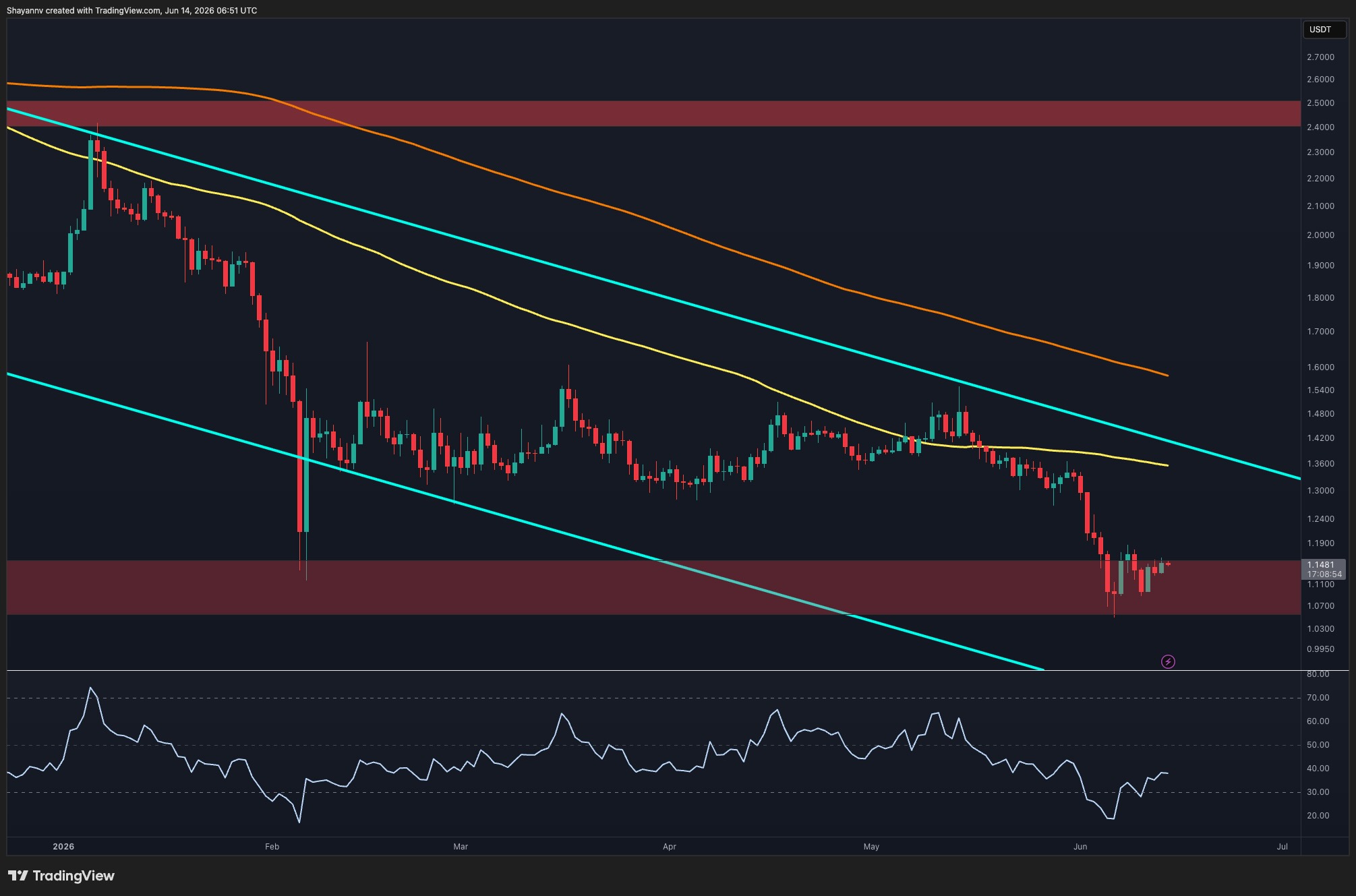
    On the daily chart, XRP has consolidated above a key support zone situated between $1.05 and $1.15. This consolidation follows the asset finding demand near the lower boundary of its descending channel.

    A significant development has been the emergence of bullish divergence between XRP’s price and the Relative Strength Index (RSI). As XRP revisited the $1.05 support area, the RSI registered a higher low. This suggests a weakening of downward momentum, even as the price remained near its recent lows. Such divergences are often observed at potential turning points and can signal a fading of selling pressure.

    For bullish investors, the immediate hurdle remains the resistance presented by the descending channel, which currently aligns with a cluster of moving averages between $1.35 and $1.55. A sustained move into this region would likely improve market sentiment and could indicate a broader trend reversal. Until then, XRP is considered to be in a corrective phase within its prevailing downtrend.

    Short-Term Momentum Builds

    The 4-hour chart reveals XRP gradually constructing a recovery pattern from the $1.05 support zone. The asset has been charting higher lows while respecting an ascending trendline, pointing to improving short-term momentum.

    Immediate resistance is observed in the $1.18 to $1.21 range, which corresponds with the 0.5 Fibonacci retracement level. A successful breach of this resistance could pave the way for XRP to advance towards the 0.618 Fibonacci retracement level at $1.25.

    Beyond this, the primary resistance area lies between $1.27 and $1.30, encompassing the 0.702 and 0.786 Fibonacci levels. This zone previously served as significant support and could now act as a formidable barrier to the ongoing recovery.

    As long as XRP maintains its position above the rising trendline and the $1.05 support zone, the short-term outlook favors continued upward attempts. However, a decisive reclamation of the $1.21 to $1.30 region is necessary to confirm a broader bullish reversal. The daily RSI divergence lends credence to this recovery scenario, indicating a gradual shift in momentum towards buyers.

  • Gemini AI Forecasts Massive XRP Surge

    Gemini AI Forecasts Massive XRP Surge

    Gemini AI Forecasts Significant XRP Surge

    Google’s Gemini AI has placed XRP back in the spotlight, predicting a substantial breakout for the cryptocurrency, with potential gains of 42% to 59% over the next 90 days, targeting a price range of $1.60 to $1.80. Currently trading at $1.13, this forecast hinges on a key catalyst: the impending Senate vote on the CLARITY Act.

    The Bull Case: Legislative Clarity and Institutional Interest

    The optimistic outlook for XRP is largely driven by the potential passage of the CLARITY Act. If enacted, this landmark legislation would officially reclassify XRP as a digital commodity under the purview of the CFTC, thereby removing a significant legal hurdle that has historically suppressed its value.

    This anticipated legislative clarity, coupled with substantial whale accumulation absorbing supply, is seen as a potent combination. Furthermore, recent disclosures of Morgan Stanley ETF holdings indicate rising institutional interest, which could fuel a powerful short squeeze. Gemini AI suggests these factors will drive XRP’s price toward the $1.60 to $1.80 target by the end of the third quarter.

    The Bear Case: Technical Weakness and Macro Pressures

    Conversely, the bearish scenario for XRP is framed as a near-term technical challenge rather than a fundamental collapse. The cryptocurrency is currently testing a head and shoulders neckline, a pattern that typically signals a potential temporary decline if breached.

    A break below the critical support level of $1.09 could see XRP retrace to the $0.94 to $0.96 range. Such a move would likely be triggered by broader macroeconomic pressures or an unexpected delay in legislative progress, derailing the CLARITY Act’s timeline.

    Technical Analysis: A Coiled Spring

    On the 4-hour chart, XRP has experienced a prolonged downturn from its mid-May high of $1.55, currently sitting at $1.13. The prevailing trend on this timeframe is a series of lower highs and lower lows, which found a bottom near $1.05 before the current rebound attempt.

    The identified head and shoulders pattern places the neckline support at approximately $1.09. A decisive break below this level would confirm a bearish outlook. Key support levels are identified at $1.09, followed by $1.05, with deeper demand expected around $0.95. Resistance is noted at $1.20, $1.35, and a more significant zone at $1.45.

    The Relative Strength Index (RSI) is currently at 49.52, with its signal line at 45.22. This positioning near the midline, with the RSI trending upwards, suggests that buying momentum is beginning to reassert itself after a period of selling pressure. A sustained move above 50 and into the 60s would further solidify a bullish shift in momentum. The current chart configuration mirrors the Gemini AI thesis: a coiled spring balanced on the neckline, awaiting a decisive trigger.

    Holding the $1.09 support and reclaiming $1.20 could pave the way for the projected $1.60 to $1.80 price target. However, a failure to maintain the neckline support would bring the $0.95 level into play.

    Beyond XRP: Emerging Opportunities in Early-Stage Infrastructure

    While major cryptocurrencies like Bitcoin, Ethereum, and XRP have been consolidating against resistance levels, the search for the next significant breakout continues. The narrative of institutional inflows and predictable market movements is contrasted with the potential for outsized returns in early-stage infrastructure projects.

    Copilot AI highlights that capital that might be negligible in larger markets can significantly impact smaller, undiscovered projects. The true asymmetric return, it suggests, lies in the gap between a project’s intrinsic value and its current market perception, a gap that often exists due to a lack of market awareness.

    LiquidChain: Addressing Cross-Chain Fragmentation

    The persistent issue of cross-chain fragmentation has been a drain on DeFi participants, with existing solutions like bridges often becoming mechanisms for extracting fees rather than solving the problem. Bitcoin, Ethereum, and Solana, designed as independent systems, incur costs in fees, slippage, and execution failures for every transaction that crosses their boundaries.

    LiquidChain aims to eliminate these cross-chain fees by operating three networks within a single execution layer. This architecture allows for a single deployment to reach all networks without incurring a “cross-chain tax” on any interaction.

    Copilot AI has flagged LiquidChain as a project to watch. Its presale is currently priced at $0.01454, having raised over $835,000. While its execution and adoption remain unproven, LiquidChain represents a potential entry point into a market that could disappear once it gains wider recognition, offering a different proposition compared to the more predictable, ceiling-bound trajectory of established assets.

  • Japan’s Top Banks to Launch Yen Stablecoin by March 2027

    Japan’s Top Banks to Launch Yen Stablecoin by March 2027

    Japan’s Three Megabanks to Launch Joint Yen Stablecoin by March 2027

    MUFG Bank, Mizuho Bank, and Sumitomo Mitsui Banking Corporation have formalized a joint council with the ambitious goal of developing and co-issuing a yen-backed cryptocurrency stablecoin by the end of Japan’s fiscal year 2026, which concludes in March 2027.

    The stablecoin will operate under a trust agreement, with all three banking giants serving as joint settlors. A designated trust bank or a similar institution will act as the trustee. This initiative is not a pilot program; rather, it represents a significant commitment from three systemically important financial institutions to share infrastructure for this endeavor.

    This move signals a substantial step toward stablecoin adoption by Japan’s largest banks. The three leading financial groups in Japan – MUFG, Sumitomo Mitsui Financial Group, and Mizuho – are collectively planning to issue stablecoins by the March 2027 deadline.

    The initiative is being conducted under the Financial Services Agency’s (FSA) Payment Innovation Project. It follows a pilot program conducted in late 2025, which assessed the feasibility of multi-bank stablecoin co-issuance, examining whether it could be executed “legally and appropriately,” according to the banks. The successful outcome of this pilot has evidently paved the way for the current joint venture.

    Collectively, MUFG, Mizuho, and SMBC manage assets exceeding $7 trillion, positioning this as the most significant institutional stablecoin initiative in Asia to date.

    Japan’s regulatory framework for stablecoins solidified in June 2023 with amendments to the Payment Services Act. These amendments introduced a formal licensing regime for fiat-pegged stablecoins, classifying them as electronic payment instruments.

    Current legislation restricts the domestic issuance of stablecoins to three categories of entities: licensed banks, trust companies or trust banks, and registered fund transfer service providers. This regulatory structure provides the established megabanks with a clear pathway to enter the market.

    The FSA’s Payment Innovation Project, part of the FinTech Proof-of-Concept Hub that has been operational since 2017, served as the formal channel for the late-2025 pilot.

    Updated amendments to the Payment Services Act, which took full effect on June 13, 2026, have strengthened travel-rule obligations for cross-border transactions and reinforced the FSA’s enforcement capabilities. Furthermore, from June 1, 2026, foreign trust-type stablecoins are permitted to operate in Japan as electronic payment instruments under a revised Cabinet Office Ordinance, provided they meet the FSA’s licensing, collateral management, and audit standards.

    Specific reserve rules allow trust stablecoin issuers to invest up to 50% of their reserves in short-term Japanese government bonds. The megabank yen stablecoin is expected to be fully reserved, with assets comprising cash and Japanese government bonds held in trust, adhering strictly to the FSA’s requirements for asset segregation and redemption at par.

    The megabanks are entering a yen stablecoin market that has seen rapid development since regulatory clarity emerged in 2023. JPYC Inc. launched Japan’s first legally recognized yen-denominated stablecoin, JPYC, in October 2025. The FSA subsequently classified it under the same regulated payment services framework as popular payment services like PayPay and Rakuten Pay in April 2026, indicating the growing mainstream acceptance of such products.

    In February 2026, SBI Holdings and Startale Group introduced JPYSC, a yen stablecoin backed by a trust bank and issued by SBI Shinsei Trust Bank, targeting institutional and cross-border use cases. The Japan Blockchain Foundation announced EJPY in May 2026, which is slated to be issued on the Japan Open Chain and Ethereum networks.

    On the dollar side, major financial institutions are actively pursuing bank-issued crypto ventures. USDC became the first dollar-pegged stablecoin approved in Japan in March 2025, issued by SBI. Additionally, Ripple and SBI Holdings have announced plans to launch RLUSD in Japan.

    The key differentiator of the megabank co-issuance model lies in its regulatory weight rather than technological innovation. While existing stablecoins like JPYC and JPYSC are compliant products, a jointly branded yen stablecoin from all three of Japan’s dominant banking groups carries a distinct level of institutional credibility and the potential for significantly larger settlement volumes.

  • Pi Network Gains Momentum as Bitcoin Hits 10-Day Peak

    Pi Network Gains Momentum as Bitcoin Hits 10-Day Peak

    Bitcoin Surges to Near $64,800, Fueled by Geopolitical Developments

    Bitcoin’s price experienced a significant jump, reaching nearly $64,800 in recent hours, marking its highest point since June 4. This surge appears to be influenced by a combination of geopolitical tensions and a recent statement from former President Donald Trump regarding a potential deal with Iran.

    Market Overview

    The broader cryptocurrency market is showing signs of recovery, with most larger-cap altcoins trading in positive territory. Binance Coin (BNB) has climbed to $610, and Solana (SOL) is approaching the $70 mark. Notably, TAO has seen a substantial increase of over 15%.

    Bitcoin’s Volatility and Recovery

    The primary cryptocurrency experienced a sharp decline at the beginning of the month, plummeting from over $73,000 to a 19-month low of $59,100 within a four-to-five-day period. After shedding $14,000 in less than a week, Bitcoin found support and managed to reclaim the $60,000 level. The following week saw the digital asset trade sideways between $61,000 and $64,000, with its movements closely mirroring developments on the war front involving the US, Iran, and other Middle Eastern nations.

    Trump’s Deal Announcement and Market Reaction

    Former President Donald Trump announced yesterday that a permanent deal with Iran is slated for signing today, June 14. The initial reaction from Bitcoin has been somewhat muted, with a brief ascent to $64,800 followed by a slight decline. However, conflicting reports emerging from Iran suggest that a deal may not be finalized today.

    Currently, Bitcoin’s market capitalization is approaching $1.3 trillion, and its dominance over altcoins has risen to 56.6%.

    Altcoin Performance

    Ethereum is trading near $1,700, while Binance Coin has reached $610 and XRP is hovering around $1.15. Solana is nearing $70, with Tron (TRX) and Dogecoin (DOGE) showing minor gains. HYPE has touched $60 after a 2% increase, and Zcash (ZEC) has added 3% to its value, reaching $427.

    Among the larger-cap cryptocurrencies, TAO has shown the most significant gains, while BEAT has experienced a 20% daily decline. Humanity (H) has entered the top 100 altcoins by market capitalization, driven by an impressive daily surge of over 90%.

    Pi Network’s Revival

    The native token of Pi Network has finally demonstrated signs of recovery following a recent downturn. The token had fallen to an all-time low of under $0.12 last week but has since rebounded to trade well above $0.13, representing an increase of more than 10% from its lowest point.

    The total cryptocurrency market capitalization has increased by $20 billion in the past day, reaching $2.280 trillion, according to CoinGecko.

  • Musk’s SpaceX AI Forecasts Massive Bitcoin Surge

    Musk’s SpaceX AI Forecasts Massive Bitcoin Surge

    Bitcoin’s Rocky Road: AI Predicts a Rebound Amidst Market Uncertainty

    The pronouncements of capitulation are often only validated in hindsight. Currently, with Bitcoin hovering in the low $60,000s, a forecast of a surge to the mid-$70,000s might seem overly optimistic. Yet, Elon Musk’s AI, xAI, is venturing such predictions, setting a 30-day target of $72,000 to $78,000 for a cryptocurrency that has recently seen its value nearly halved.

    This projected rebound, representing a 14% to 24% increase from the $63,000 mark, hinges on the assumption that current sellers are those who consistently exit at market bottoms. This is the core of the bullish argument. With over 50% of Bitcoin’s supply now held at a loss, xAI interprets this not as a sign of weakness, but as a classic capitulation event that has historically marked the floor in previous market cycles.

    The narrative suggests that long-term holders are quietly accumulating during this period of fear, ETF outflows are diminishing, and historically, June has often seen positive price action for Bitcoin. The addition of even a slight easing of macroeconomic liquidity or greater regulatory clarity could ignite a sharp rally driven by short-covering.

    A more confident projection sees Bitcoin breaking through the $65,000 resistance level and accelerating towards the mid-$70,000s by mid-July as market sentiment shifts.

    xAI Acknowledges Downside Risks

    However, xAI is candid about the potential for a downturn. Should Bitcoin decisively fall below $60,000, with capital continuing to flow into AI and equities, and a persistently challenging macroeconomic environment, the cryptocurrency could slide towards the $55,000 to $58,000 range.

    Intriguingly, this potential decline is framed as a higher-probability buying zone rather than the onset of a severe crash. In essence, even the bearish scenario is presented as an opportunity for a discount, not a disaster.

    Chart Analysis Supports Key Levels

    The current chart patterns offer some backing to these projections. A review of the daily chart reveals the extent of the damage, with Bitcoin trading at $63,024 after a significant decline from its October peak of $126,000, a drop that has effectively erased more than half of that gain.

    The prevailing trend is undeniably downward, characterized by a series of lower highs. The most recent leg of this slide pushed the price into the low $60,000s, with a brief dip near $60,000 preceding the current modest bounce.

    This specific price zone, between $60,000 and $62,000, is crucial. It served as a strong support level where buyers entered aggressively in February, and it is the floor upon which xAI’s bullish outlook rests.

    A decisive daily close below this level could quickly open the door to $58,000, with $55,000 as a further potential downside target. Conversely, holding this support could lead to a test of the $65,000 resistance, a level that must be breached for momentum to build, paving the way for targets at $72,000 and the more significant $76,000 ceiling.

    RSI Signals Potential Selling Exhaustion

    The Relative Strength Index (RSI) offers a point of agreement with the bulls. Currently at 31.95 with its signal line at 25.74, the RSI indicates that price momentum has entered deeply oversold territory but has already begun to turn upward, crossing above its average.

    This approximately 6-point divergence, with the RSI leading the signal higher, suggests early signs of selling exhaustion rather than continued downward pressure. While not a standalone buy signal, it aligns with xAI’s assessment that capitulation among weaker hands may be nearing its end. A reclaim of $65,000 with this underlying momentum could shift the mid-$70,000s target from wishful thinking to a more probable trajectory.

    The Waiting Game for Large Caps

    Major cryptocurrencies like Bitcoin, Ethereum, and XRP have been consolidating within familiar ranges for weeks, failing to break through key resistance levels. Each potential macro catalyst or institutional adoption wave seems to be perpetually pushed back to a later date. Holding assets whose next move is entirely dependent on external decisions can feel less like trading and more like waiting in a room.

    The capital that truly drives market cycles often moves discreetly, reallocating before destinations become obvious.

    Small-Cap Infrastructure Plays Offer Different Dynamics

    Smaller market capitalization infrastructure projects operate on principles that large-cap assets cannot replicate. A rotation that would be negligible for Bitcoin could significantly reprice an undiscovered project. The opportunity lies in the gap between a project’s intrinsic value and its current market valuation, a gap that can be fully captured before market discovery closes it.

    The Challenge of Multi-Chain Fragmentation

    The persistent issue of multi-chain fragmentation in Decentralized Finance (DeFi) has remained largely unsolved. Bitcoin, Ethereum, and Solana, for instance, operate as isolated ecosystems with no native interoperability or shared architecture. Every transfer of value between these networks incurs costs through fees, slippage, and failed transactions.

    LiquidChain aims to address this by creating a unified execution environment for these networks, enabling single deployments and complete ecosystem access without transaction fees.

    The project’s presale is currently priced at $0.01454, having raised over $830,000, positioning it as an early-stage, undiscovered opportunity.

    However, its execution remains unproven, and adoption is uncertain. Established assets offer predictability within known market parameters. LiquidChain, conversely, represents an entry point that may cease to exist once the market recognizes its potential.
  • XRPL Update Fuels AI Economy with XRP and RLUSD

    XRPL Update Fuels AI Economy with XRP and RLUSD

    AI Agents Take On Complex Transactions, Ripple Aims for Central Role

    Artificial intelligence agents are rapidly evolving beyond generating text, images, or simple code, now capable of undertaking complex tasks, including autonomous transactions for services and computing power. In a move to capitalize on this shift, Ripple has unveiled an update to its XRP Ledger (XRPL) ecosystem, positioning its native tokens, XRP and RLUSD, at the forefront of this emerging machine-to-machine economy.

    AI Starter Kit Aims to Fuel Autonomous Payments

    The latest update, dubbed the AI Starter Kit, introduces a suite of tools designed to empower developers in building autonomous payment applications powered by Ripple’s tokens. According to the announcement, this new product line will enable AI agents to initiate and receive payments directly on the XRPL. It incorporates support for X402-powered payments, allowing these agents to procure API access, AI model inference, cloud computing resources, and other digital services using either XRP or RLUSD.

    Ripple seeks to distinguish itself from other blockchain networks that often contend with variable transaction fees and complex smart contract execution. The XRPL, in contrast, offers settlement finality within a rapid 3-5 seconds, predictable transaction costs, and integrated payment functionalities. This allows developers to ascertain transaction expenses in advance, while AI agents can execute transfers without the complexities of gas fee auctions or unpredictable settlement durations.

    Decentralized Exchange and Security as Key Advantages

    The XRPL’s native decentralized exchange is also highlighted as a significant draw for developers. The protocol facilitates a single transaction where an AI agent can send RLUSD and the recipient receives XRP, or vice versa, with the conversion handled directly by the protocol.

    Ripple further emphasizes its enhanced security features as a major selling point. The XRP Ledger has maintained uninterrupted operation for 14 years without transaction rollbacks. Moreover, its protocol-level payment system mitigates many of the smart contract risks that have historically led to billions of dollars in cryptocurrency exploits across various projects.

    The initial phase of the AI Starter Kit will provide access to documentation via AI assistants like Claude, along with wallet and payment tools tailored for agent-based applications. It will also include support for the X402 protocol, following a collaboration with t54.

  • SEC’s Rule 611 Repeal Could Unlock Tokenized US Stocks

    SEC’s Rule 611 Repeal Could Unlock Tokenized US Stocks

    SEC Proposes Scrapping Key Rule, Paving Way for Tokenized Stocks in DeFi

    The U.S. Securities and Exchange Commission (SEC) has taken a significant step that could fundamentally alter the landscape for tokenized stocks and decentralized finance (DeFi) by proposing to rescind Rule 611 of Regulation NMS. This move, announced on June 11, targets the trade-through prohibition that has dictated stock order routing since 2005, alongside Rule 610(e), which prohibits locked and crossed quotations.

    The implications for tokenized equities are immediate and profound. Alex Thorn, head of research at Galaxy Digital, described the proposal as “one of the biggest unlocks yet for tokenized stocks,” removing what he characterized as “one of the biggest structural barriers to tokenized US equities trading in DeFi.”

    The proposal is now subject to a 60-day public comment period before the SEC considers a final rule.

    The SEC stated that the proposed rescission of Rules 611 and 610(e) aims to reduce costs for market participants and foster competition and innovation, allowing market forces to shape the evolution of U.S. equity markets.

    This action is part of the SEC’s broader Project Crypto initiative, launched in August 2025 to modernize the regulatory framework for digital assets and blockchain technology in U.S. markets. If finalized, the repeal of Rule 611 would represent the most impactful development within this initiative to date.

    Rule 611, known as the Order Protection Rule, was a cornerstone of Regulation NMS when adopted in 2005. It prevents trades from being executed at a price inferior to the best protected quote available on any other registered exchange, effectively embedding the National Best Bid and Offer (NBBO) into every equity transaction across all trading venues.

    However, this rule presents a structural challenge for tokenized equities within the current framework. DeFi’s Automated Market Makers (AMMs) price trades algorithmically based on the pool price at the moment of execution, typically using a constant-product formula, rather than routing to the NBBO. Thorn explained that any AMM pool offering tokenized U.S. stocks would “commit trade-throughs constantly and arguably be an illegal trading center.” Rule 610(e) exacerbates this issue, as AMMs cannot halt trades when a better quote exists elsewhere, leading to continuous violations.

    The SEC’s proposed alternative is a principles-based best execution framework applied at the broker-dealer level, rather than on each individual trade across venues. This shift would enable AMM-based tokenized equities by requiring brokers interacting with DeFi pools to demonstrate policies reasonably designed to achieve best execution for clients overall, without mandating NBBO compliance on every atomic swap.

    Commissioner Hester Peirce, in her supporting statement, argued that the existing Order Protection Rule had “helped fuel disorder” by encouraging exchange proliferation and stifling innovation, rather than genuinely protecting investors.

    Tokenized equities are a rapidly growing segment within the broader real-world asset (RWA) category, attracting institutional capital focused on creating on-chain versions of traditional financial instruments. Companies like Robinhood and Kraken have been developing tokenized stock capabilities. The SEC had reportedly prepared a separate innovation exemption for authentic tokenized versions of exchange-listed U.S. equities, backed 1:1 by underlying shares held by a qualified custodian, but postponed its release last month following concerns raised by traditional exchange officials regarding execution.

    The rescission of Rule 611 addresses the fundamental incompatibility that made such an exemption legally precarious. Policy analysts at TD Cowen’s Washington Research Group anticipate a final SEC vote on the rescission by the first quarter of 2027, assuming a standard comment and reproposal cycle. This timeline aligns with other market structure reforms under the broader Regulation NMS modernization.

    International regulatory developments are also increasing pressure. Japan’s recent reclassification of crypto assets as financial instruments indicates that other jurisdictions are not waiting for Washington to act.

    The competitive landscape is shifting rapidly. Wall Street is actively building the infrastructure for tokenization, with institutions like Citi and DTCC, along with a growing number of prime brokers, already engaged in on-chain settlement infrastructure. The removal of Rule 611 effectively clears the last major regulatory hurdle for AMM-based tokenized U.S. equity trading to operate at scale.

  • Binance Convert: Stocks from 0.01 USDC

    Binance Launches Tokenized US Stocks, Offering Fractional Ownership

    Binance, the global cryptocurrency exchange, has introduced “bStocks,” a new offering that allows users to trade tokenized securities representing fractional ownership of US shares. These bStocks are issued by BTech Holdings Limited, an affiliate of Binance.

    Understanding bStocks

    bStocks are classified as certificates that represent an interest in underlying financial instruments held by the issuer. Crucially, they do not grant holders direct ownership of the actual shares in the listed companies. Instead, each bStock is backed 1:1 by a US share held by a regulated custodian.

    This new product marks a significant development as bStocks are the first tokenized securities to be admitted to the Financial Services Regulatory Authority (FSRA) Official List. They are issued under an FSRA-approved prospectus and are traded on a Recognised Investment Exchange.

    Access and Trading Features

    Eligible Binance users can now access bStocks through the “Convert” feature on the Binance platform, with entry points starting as low as the equivalent of 0.01 USDC. This allows for fractional exposure to US stocks.

    Key features of bStocks include:

    • Low Entry Point: Access fractional US stock exposure from just 0.01 USDC equivalent.
    • 24/7 Trading: Trade on the spot market without being restricted by traditional market hours.
    • Full Backing and Verifiability: bStocks are fully backed by real shares held at a regulated custodian and are publicly verifiable.

    The availability of bStocks may vary depending on a user’s country or region of residence and their verification status.

    How to Access bStocks

    For users KYC-verified in eligible countries and regions, bStocks can be accessed via the “Convert” function on the Binance App. The process involves tapping “Convert,” searching for the desired bStock, entering the amount, and confirming the purchase.

    For users verified in other eligible regions, bStocks can be accessed via “Convert” on the Binance Web platform. The bStocks feature will be integrated into upcoming app upgrades (iOS version 3.16.0 and Android version 3.16.3). On the Binance Web, users can navigate to “Trade,” select “Convert & Block Trade,” search for their preferred bStock, enter the amount, and confirm the trade.

    Binance encourages users to start building their bStocks portfolio today, joining millions of other users on the platform.

    Binance reserves the right to amend or cancel this announcement at any time and for any reason without prior notice. The information provided is not intended as an offer, solicitation, promotion, recommendation, or invitation to buy or sell securities. Tokenized Securities are not offered, sold, distributed, made available, or accessible in the United States or to U.S. persons. They have not been registered under U.S. securities laws, and no public offering will be conducted in the United States or other jurisdictions outside the ADGM. By accessing this product, users represent and warrant that they are not U.S. persons, are not located in the United States, are not acting for the account or benefit of any U.S. person, and will not transact in Tokenized Securities from within the United States.