Tag: Positive

  • LG Electronics Partners with Arbitrum for Blockchain Ad Platform

    LG Electronics Partners with Arbitrum for Blockchain Ad Platform

    LG Electronics has developed its own layer-2 blockchain network in collaboration with Arbitrum, aiming to revolutionize its digital advertising platform. The South Korean consumer electronics giant revealed to Fortune that this Arbitrum-based network will function as a comprehensive platform for the placement, purchase, sale, and management of digital advertisements, thereby cutting out traditional intermediaries within the advertising supply chain. LG has already completed a pilot program with a Japanese advertising agency and is currently assessing the feasibility of launching the product to market later this year.

    LG Electronics Building with Arbitrum

    LG’s dedicated blockchain team, operating within the company’s research and development division, is currently piloting an on-chain advertising network built on Arbitrum.

    “We are evaluating whether this approach can deliver meaningful value to advertisers, publishers, and audiences,” stated Samuel Byungsun Park, head of LG Electronics’ blockchain research department.

    Steven Goldfeder, a co-founder of Arbitrum, highlighted that the blockchain approach eliminates the necessity for manual interventions in ad transactions. “You don’t need manual interventions,” Goldfeder explained, elaborating that the technology facilitates automated market operations through software.

    Following the announcement of the partnership with LG Electronics, Arbitrum’s native token, ARB, saw a 5% increase, according to data from CoinGecko.

    This advertising blockchain initiative marks LG’s latest engagement with distributed ledger technology. The company’s IT services division, LG CNS, previously introduced the Monachain enterprise blockchain platform in 2018, although LG discontinued its Art Lab NFT marketplace last year. The current endeavor leverages LG Ad Solutions, the company’s advertising arm which oversees a global smart TV installed base of 216 million units, including 49 million in the United States.

    LG’s move aligns with a broader trend of major corporations developing custom blockchain infrastructure for business applications. Notable examples include Samsung’s supply chain ledger, J.P. Morgan’s JPM Coin deposit token, and Mastercard’s stablecoin settlement infrastructure. These initiatives are increasingly being deployed on public or Layer-2 chains rather than private, permissioned ledgers.

    This trend suggests a growing enterprise adoption of crypto infrastructure, even as blockchain received limited attention at CES 2026, where artificial intelligence dominated technology discussions.

  • LBank Sponsors VIP Matchday for Argentina vs. Austria at AT&T Stadium During FIFA World Cup 2026

    LBank Sponsors VIP Matchday for Argentina vs. Austria at AT&T Stadium During FIFA World Cup 2026

    LBank to Host Exclusive VIP Matchday Experience at AT&T Stadium During FIFA World Cup 2026

    Singapore, Singapore – June 12, 2026 – LBank, a prominent global cryptocurrency exchange, is set to host an exclusive Matchday Experience on June 22 at AT&T Stadium in Dallas, coinciding with the FIFA World Cup 2026. The event will bring together international partners, VIP guests, and key representatives from the Argentine Football Association (AFA) for a full-day celebration centered around the Argentina versus Austria match. The occasion aims to blend top-tier football with strategic networking and community engagement.

    Attendees can anticipate exceptional stadium access, premium hospitality, and a range of immersive activities designed to underscore the growing collaboration between LBank and the AFA. A significant highlight of the day will be a special partnership ceremony and jersey exchange involving Leandro Petersen, Chief Marketing Officer of the AFA, and LBank executives. This event reinforces LBank’s role as an Official Regional Sponsor of the Argentina National Team, strengthening an alliance that merges football enthusiasm with the innovation of digital assets.

    “The synergy between LBank and the AFA continues to unlock exciting opportunities for global communities through the universal language of football,” stated Karen, Business VP of LBank. “The World Cup provides the ideal platform to connect our partners, users, and supporters while celebrating the shared values of competition, teamwork, and global connection that are fundamental to both football and the cryptocurrency space.”

    Kaia, VP Commercial & Partnership at LBank, added, “This event is about more than just watching a game; it’s about creating enduring memories, fostering stronger partnerships, and building connections that extend far beyond the football pitch.”

    This Matchday Experience is a key component of LBank’s broader World Cup 2026 campaign, which includes the recently launched World Cup Super League Campaign offering a substantial $5 million prize pool. With a user base exceeding 25 million registered individuals across more than 160 countries and regions, LBank is committed to driving global expansion through strategic sports sponsorships, localized initiatives, and continuous product development.

    Looking forward, LBank remains focused on developing dynamic and engaging experiences that seamlessly integrate sports, technology, and digital assets, aiming to empower communities both online and offline on the world’s most significant stages.

    About LBank
    Established in 2015, LBank is a leading global cryptocurrency exchange serving over 25 million registered users in 160 countries and regions. With a daily trading volume surpassing $10.5 billion and a decade of operational safety with no security incidents, LBank is dedicated to delivering a comprehensive and user-friendly trading experience. The platform’s innovative trading solutions have enabled users to achieve average returns exceeding 130% on newly listed assets. LBank has listed over 300 mainstream cryptocurrencies and more than 50 promising altcoins. Recognized as a leader in categories such as 100x Gems, Highest Gains, and Meme Share, LBank distinguishes itself with rapid altcoin listings, exceptional liquidity, and industry-first trading guarantees, positioning it as a preferred platform for cryptocurrency investors globally.

  • XRP Price: Three-Part Impulse Signals Next Move

    XRP Price: Three-Part Impulse Signals Next Move

    XRP Bulls Eye Larger Recovery Beyond Mere Bounce

    XRP bulls are attempting to transform a sharp selloff into a significant recovery, with technical analysis suggesting a potential three-part impulse wave from recent lows. However, the success of this scenario hinges on buyers’ ability to push the price past key resistance levels that crumbled during the recent downturn.

    XRP Chart Suggests Three-Part Impulse Formation

    A notable technical outlook for XRP’s price centers on a potential three-leg recovery structure, originating from the cryptocurrency’s most recent low near $1.07. This projection outlines an initial impulsive move towards the $1.94 mark, followed by a pullback to the $1.46 zone, and subsequently a more substantial advance into the upper resistance band between $2.39 and $3.11.

    This intriguing chart pattern, shared on X by RWA_Investor, illustrates a broader corrective sequence unfolding since XRP’s peaks above $3 last year. This pattern is characterized as a classic W-X-Y double zigzag, which has spanned several months of price action. The initial leg, Wave W, concluded a full ABC decline, finding a significant bottom labeled (C)/(W) on the chart in early February. A linking wave, X, then spurred a counter-rally that propelled XRP above $1.50 in mid-May, exhibiting its own internal (X)-(A)-(B) sequence before reversing. This reversal initiated the final Y leg, which has since driven XRP’s price back to the $1.12 range as of this report.

    Impulse Setup Targets Return Above $3

    With the (C)/(Y) wave currently playing out at lows around $1.12, the prevailing technical setup anticipates a shift from correction to a bullish impulse wave. The projected move involves a three-wave ABC recovery, targeting a price zone between $2.39 and $3.11.

    Wave A is expected to aim for the $2.12 level. However, this projection is not without its challenges. XRP faces immediate resistance from a support/resistance trendline around $1.46, which will serve as the initial test. A further potential rejection point is anticipated around $2.12. Wave B would then see a retracement back to approximately $1.46, but this pullback should not be interpreted as a bearish signal. Wave C, the final and most potent leg of this sequence, is projected to drive the price into a target zone ranging from $2.70 to $3.10.

    A decisive break above $3.10 would suggest that XRP has established its macro bottom at $1.05. In such a scenario, the three-part structure would begin to resemble the nascent stages of a broader trend reversal, potentially leading to new all-time highs. Conversely, if XRP falters below the upper band and loses momentum following the anticipated rebound, it could eventually revisit the $0.75 to $1 range to complete a corrective macro wave 2. Notably, several analysts have identified the $0.87 to $0.92 region as a potential bottom target for XRP under a corrective macro wave scenario.

  • Grok AI Predicts Bitcoin Surge: Traders Risk Missing Out

    Grok AI Predicts Bitcoin Surge: Traders Risk Missing Out

    Elon Musk’s Grok AI has analyzed a Bitcoin chart showing a decline of over 50%, identifying it as a classic accumulation zone and projecting a price target of $150,000 to $225,000 by the end of 2026.

    Accumulation Zone Prediction

    With Bitcoin (BTC) currently trading around $62,800, this forecast represents a potential 2.5x to 3.5x increase, predicated on the principle that significant downturns often present the greatest opportunities. The core argument hinges on the convergence of structural scarcity and persistent demand. Grok AI suggests that Bitcoin is not merely experiencing a dip but is poised for a supply and demand supercycle.

    The post-halving reduction in new Bitcoin issuance, coupled with sustained demand from spot ETFs, corporate treasuries, and potential momentum for a Strategic Bitcoin Reserve, is expected to constrict the available supply. When supply tightens concurrently with intensifying demand, prices typically experience sharp upward movements, forming the basis of this optimistic outlook.

    Bull Case Catalysts

    The bull case is bolstered by several key catalysts. Post-halving scarcity, relentless institutional demand via spot ETFs, increasing adoption by corporate treasuries, and supportive regulatory tailwinds are anticipated to drive a robust recovery and new all-time highs. The projected target of $150,000 to $225,000 by the end of 2026, a 2.5x to 3.5x surge, assumes improving liquidity and escalating buying pressure from nation-states and corporations. This scenario positions the current dip as the last opportunity for entry at a historically low price before Bitcoin matures.

    Bear Case Scenario

    In contrast, the bear case is comparatively mild. Prolonged macroeconomic headwinds could potentially confine BTC to a range between $50,000 and $75,000 through late 2026. However, the established institutional support and recurring cyclical patterns make a prolonged bear market unlikely. The key distinction is that the current situation appears to be a correction within a larger uptrend, rather than the onset of a multi-year downturn. Overall, the market setup strongly favors bullish sentiment, with the current dip presenting a prime buying opportunity.

    Chart Analysis

    Examining the Bitcoin chart on a weekly timeframe, the price is currently at $62,857, following a significant drop from its all-time high of $126,000 reached in October 2025. The current structure represents a deep correction, exceeding 50% from its peak, with the price now entering a major previous accumulation zone. Pattern analysis indicates a return to the $55,000 to $70,000 range, which served as a launchpad for the previous significant upward movement.

    Key support levels are identified at $60,000, with the next floor near $55,000 and deeper demand anticipated around $50,000. Resistance is observed at $70,000, followed by $80,000, and a more substantial ceiling at $90,000.

    The Relative Strength Index (RSI) is currently at 33.97, with its signal line at 40.40. This indicates that momentum is well below its average and approaching oversold territory on the higher timeframe. The notable gap of approximately 6.4 points between the RSI and its signal line suggests significant short-term selling pressure. However, historically, such stretches on the weekly chart have often marked major cycle lows. A return of the RSI above the 40.40 signal line would re-establish a long-term bullish outlook. When these factors are considered together, the chart suggests Bitcoin is positioned within a key accumulation zone that has historically preceded significant upward price movements. Maintaining the $55,000 to $70,000 band could pave the way back toward six-figure prices, aligning with the projected $150,000 to $225,000 target.

    Infrastructure Plays and Interoperability

    While large-cap cryptocurrencies like Bitcoin, Ethereum, and XRP have been testing resistance levels for weeks without significant breakthroughs, the focus is shifting towards infrastructure plays. The current market dynamic, where the next major move for established assets depends on external decisions, is characterized as a “waiting room” rather than a strategic trade.

    The capital that drives market cycles often moves preemptively, before the ultimate destination is widely recognized. Smaller market cap infrastructure projects operate on different principles, where a relatively small rotation of capital can lead to substantial repricing of undiscovered projects. The opportunity lies in the discrepancy between a project’s intrinsic value and its current market valuation, a gap that closes upon market discovery.

    The fragmentation across multiple blockchains, including Bitcoin, Ethereum, and Solana, presents a persistent and costly challenge in decentralized finance (DeFi). These networks operate as isolated systems with no native interoperability, leading to significant costs in fees, slippage, and failed transactions whenever value is transferred between them.

    LiquidChain aims to address this issue by enabling free cross-chain transactions within a single execution environment. This approach offers unified deployment, complete ecosystem access, and eliminates transaction taxes. The project’s presale is currently at $0.01454, having raised over $830,000, positioning it as an early and undiscovered opportunity.

    However, the execution and adoption of LiquidChain remain unproven. Established assets offer predictability within a known market ceiling. LiquidChain represents an entry point that may cease to exist once it gains market recognition.

  • Crypto Trading Dives to 2-Year Low Amid Market Exhaustion

    Crypto Trading Dives to 2-Year Low Amid Market Exhaustion

    Crypto Trading Volumes Plunge to Two-Year Lows as Market Fatigue Sets In

    New data from on-chain analytics firm Santiment indicates that trading activity across cryptocurrency’s largest non-stablecoin assets has fallen to levels not seen since 2024. According to the firm, this slowdown suggests a market where traders have largely retreated, a condition that has historically preceded relief rallies as confidence gradually returns.

    Santiment’s analysis, shared on X on June 11, highlighted that top-cap assets are experiencing two-year lows in trading volumes. The firm framed this as a potential capitulation signal rather than an indicator of another downward trend.

    “Traders appear reluctant to aggressively buy or sell as macro uncertainty, geopolitical tensions, and recent liquidations keep participants on the sidelines,” Santiment stated.

    While low activity can often be interpreted as bearish, Santiment pointed out that periods of weak participation have historically preceded some of crypto’s strongest recoveries. The firm noted that markets rarely see significant upward reversals when investors are actively chasing prices, and that turning points often emerge when traders become disengaged and anticipate little movement.

    Supporting Santiment’s observations on trading flow, data from CoinGecko showed that Bitcoin’s 24-hour trading volume stood at approximately $30 billion, a nearly 20% decrease from the previous day. Ethereum’s volume saw a more modest decline of 1.40%, while Tron (TRX) and BNB experienced dips of 4% and 10%, respectively.

    Despite the general trend, some altcoins registered upticks. Solana (SOL), for instance, saw a 23% increase in its 24-hour trading volume, and Ripple’s XRP experienced an 11% rise.

    Santiment suggests that this market environment, characterized by idle capital despite ongoing industry development and institutional involvement, is increasingly searching for a catalyst for renewed movement.

    “If confidence begins returning, just a small amount of inflows could be enough to spark a much-needed relief rally as sidelined capital re-enters the sector,” the firm concluded.

    The lack of participation from crypto investors is not occurring in isolation, as the on-chain landscape has become more challenging recently. Data published earlier this week by CryptoQuant contributor Axel Adler Jr. revealed that Bitcoin’s realized cap 30-day change had fallen to -1.1%, marking the deepest level of capital outflows since mid-March, with approximately $12 billion exiting the network since a May peak.

    Meanwhile, Bitcoin’s adjusted SOPR, a metric that measures whether coins are being sold at a profit or loss, has remained below 1.0 for 13 consecutive days. This reading indicates that BTC moved on-chain is being sold at an average loss, which Adler associated with weaker holders exiting the market.

  • Crypto Platforms Open SpaceX Access Ahead of $1.75 Trillion IPO

    Crypto Platforms Open SpaceX Access Ahead of $1.75 Trillion IPO

    Crypto Fuels Speculation Ahead of SpaceX IPO

    As Wall Street braces for SpaceX’s highly anticipated initial public offering, the cryptocurrency industry is providing investors with a range of avenues to speculate on the rocket-maker’s debut, which is valued at an estimated $1.75 trillion. With traditional brokerage accounts heavily oversubscribed, digital asset markets are enabling a broader spectrum of participation.

    These alternative investment options include wagers placed on prediction markets, bets executed through perpetual futures contracts, and the acquisition of synthetic assets designed to track the performance of Elon Musk’s aerospace company.

    It is important to note that many of these crypto-based products do not offer dividends, voting rights, or a direct claim on SpaceX’s assets. Furthermore, a significant portion of these offerings are not accessible to U.S. investors, a situation influenced by the evolving regulatory landscape surrounding tokenized assets.

    These diverse offerings highlight the increasing convergence of traditional and digital asset markets. However, SpaceX’s high-stakes IPO is poised to serve as a critical test case, potentially exerting considerable influence on market sentiment towards these emerging investment vehicles.

    The emergence of these crypto-linked products follows a period of scrutiny. Approximately a year ago, controversy arose around “stock tokens” offered by Robinhood to European customers, which were linked to companies like SpaceX and OpenAI. The ChatGPT creator had asserted that these tokens did not represent actual shares, prompting Robinhood to clarify that they were “tokenized contracts that follow their price, recorded on a blockchain.”

    On the prediction market platform Polymarket, users can currently place wagers on SpaceX’s closing market capitalization on its debut day, with projections ranging between $2 trillion and $2.5 trillion. Notably, Kalshi, a U.S.-based and regulated platform, is not facilitating similar bets.

    Meanwhile, Myriad, a prediction market operated by Dastan, the parent company of Decrypt, indicated a 94% probability that SpaceX’s market cap would exceed $1.3 trillion on Friday.

    Payward, the parent company of cryptocurrency exchange Kraken, is offering tokens backed by SpaceX shares, priced at the firm’s fixed offering rate of $135 per share. These tokens, available through xStocks, aim to provide access to overseas investors who often face challenges participating in U.S. IPOs, and are now accessible in over 100 countries.

    “A retail investor in Medellín, Madrid, or Malaysia can have similar access,” stated Mark Greenberg, Global Head of Payward Services, earlier this month. “Going public should mean public to everyone.”

    Coinbase International has introduced a pre-IPO perpetual futures contract for SpaceX, referencing the company’s implied market valuation. According to the exchange’s website, positions are scheduled to adjust accordingly once the rocket-maker officially debuts.

    On the decentralized exchange Hyperliquid, traders can speculate on SpaceX using similar perpetual derivatives, which trade 24/7 and do not expire. As of this report, a market established via TradeXYZ valued Musk’s firm at $168 per share.

    Even as SpaceX’s IPO approached, crypto exchanges continued to launch new products. Backpack, for instance, has introduced a service enabling users to trade Solana-based tokens tied to SpaceX on its platform or within self-custodial wallets, with the intention of these tokens being redeemable for traditional stock.

  • Coinbase Unveils AI Trading and Payment Tool

    Coinbase Unveils AI Trading and Payment Tool

    Coinbase Launches Platform for AI Agents to Trade Crypto, Manage Portfolios

    Coinbase, a prominent cryptocurrency exchange, has unveiled Coinbase for Agents, a new tool designed to empower artificial intelligence systems to conduct cryptocurrency trades, execute payments, and manage investment portfolios on behalf of users. The launch comes as technology and financial firms accelerate efforts to build the infrastructure for an AI-driven economy.

    This development follows a broader industry trend where companies across technology, payments, and cryptocurrency are racing to establish the foundational systems that will enable AI agents to perform real-world transactions.

    “We’ve been experimenting and building toward this for years with agentic wallets, payment rails, and trading tools, but all from a developer-facing perspective,” Lincoln Murr, head of AI product at Coinbase, told Decrypt. “We believe agents are no longer a niche developer curiosity, but really a primary way people interact with the internet.”

    Coinbase for Agents grants AI agents access to both financial data and transaction capabilities. This allows them to analyze portfolios and take actions within user-defined parameters. The product is available in two forms: an integration for web-based AI assistants via the Model Context Protocol (MCP) and a command-line interface for developers.

    The MCP integration enables the product to work with web-based AI platforms such as ChatGPT and Claude, as well as other services that adhere to the MCP standard, Murr explained. The command-line version is compatible with terminal-based environments, including Hermes Agent, Anthropic’s Claude Code, OpenAI Codex, and OpenClaw.

    Coinbase also introduced Coinbase Advisor, which it describes as an “SEC- and CFTC-registered in-app financial advisor.” This feature offers AI-powered recommendations and guidance directly within the Coinbase application.

    Potential applications for Coinbase for Agents include portfolio rebalancing, automated recurring investment strategies, cash management, and the acquisition of premium datasets to inform trading decisions. The company stated that agents can operate within isolated portfolios and will eventually support additional controls, such as spending limits, restrictions on trade sizes, and permissions governing access to specific services.

    “If it’s on Coinbase, your agent can trade it with Coinbase for Agents,” Murr said. “At launch, that means the full range of crypto spot markets and derivatives available on Coinbase today. As we expand the platform—equities, prediction markets, and beyond—those will become available to agents too. And once x402 support is added soon, payments will support Base and Solana.”

    Coinbase is among the latest companies to invest in the vision of AI agents becoming active economic participants, moving beyond their current role as mere recommendation engines.

    Earlier this month, crypto payments firm MoonPay launched MoonAgents, a desktop application that allows Claude and OpenAI Codex to interact with crypto wallets, facilitate token swaps, and engage with prediction markets and other blockchain services.

    On Wednesday, Mastercard unveiled Agent Pay for Machines, a platform designed to support autonomous machine-to-machine payments across its network. This initiative is backed by over 30 partners, including Coinbase, Stripe, Cloudflare, and Ripple.

  • Japan’s Crypto Regulation Boosts XRP

    Japan’s Crypto Regulation Boosts XRP

    Japan Rewrites Crypto Rules, Potentially Boosting XRP

    Japan’s parliament has passed landmark legislation that reclassifies cryptocurrencies as financial instruments, a move analysts suggest could unlock significant institutional demand for assets like XRP. The bill, approved by the House of Representatives, shifts crypto regulation from the Payment Services Act to the Financial Instruments and Exchange Act (FIEA), the same framework that governs traditional securities such as stocks and bonds.

    Regulatory Shift and Institutional Interest

    The Financial Services Agency in Japan has reported over 14 million open crypto accounts, with a substantial portion held by individuals earning under ¥7 million ($43,600) annually. This new regulatory framework introduces measures akin to stock markets, including insider-trading bans and mandatory disclosure rules for crypto projects. Crucially, it paves the way for the creation of crypto exchange-traded funds (ETFs).

    While the new rules are set to take effect in 2027, XRP is seen as being in a prime position to benefit sooner. The digital asset is already integrated into Japanese banking infrastructure through pilot programs linked with SBI.

    XRP Price Outlook

    XRP is currently trading around $1.10, having retreated from a resistance zone near $1.50 that capped its performance in the first quarter. Technical analysis suggests a potential rebound toward $2.00, with more significant resistance anticipated around $2.40. Trading volume has been consolidating, indicating a potential for a swift price movement.

    Analysts note that a critical support level lies between the current price and $1. A breach below this zone could undermine the near-term bullish outlook, while holding above it would maintain the current positive structure.

    Potential Upside and Investment Considerations

    With the regulatory developments in Japan and a constructive macroeconomic environment, some analysts project realistic upside targets for XRP between $1.50 and $2.50. A flat 20% capital gains tax rate for qualified Japanese investors could further enhance XRP’s attractiveness to institutional investors.

    However, research into XRP’s price dynamics suggests that regulatory clarity alone may not trigger immediate price surges. Significant price movements typically occur when capital begins to flow into the market.

    While the Japanese regulatory catalyst is considered significant, the current trading environment for XRP, with considerable resistance levels, may not offer the most asymmetric risk-reward profile for traders seeking substantial gains. Investors looking for higher multiples are reportedly exploring earlier-stage projects.

    Emerging Infrastructure Plays

    One such area of interest is in infrastructure projects, particularly those addressing cross-chain liquidity issues. LiquidChain ($LIQUID), a Layer 3 infrastructure project, aims to solve the problem of fragmented liquidity across ecosystems like Bitcoin, Ethereum, and Solana, enabling more efficient communication and execution.

    LiquidChain’s platform is designed to fuse liquidity from these major blockchains into a unified execution environment, featuring Single-Step Execution and Verifiable Settlement as key technical innovations. This “Deploy-Once Architecture” is intended to reduce the overhead associated with multi-chain deployments, which currently fragment developer attention and capital.

    The LiquidChain presale is ongoing, with $LIQUID priced at $0.01468 and over $835,000 raised to date. Investors are advised to conduct their own research into LiquidChain before its next price stage.

  • World Cup Poised to Drive Billions to Prediction Markets

    World Cup Poised to Drive Billions to Prediction Markets

    World Cup Kicks Off, Betting Markets Brace for Financial Goals

    The 2026 FIFA World Cup is set to commence Thursday across stadiums in the United States, Canada, and Mexico. While fans will be captivated by the sport itself, Wall Street is keenly observing a different kind of outcome: the billions of dollars anticipated to flow through sportsbooks and prediction markets over the coming month.

    With an expanded 48-team format featuring 104 matches, the tournament offers approximately 60% more betting opportunities than previous World Cups. Analysts at investment firm Bernstein project an incremental handle exceeding $3 billion, with a broader consumer spending uplift of up to $10 billion across sports betting and prediction platforms.

    This represents a significant financial surge during what is typically a slower period for the online sports betting industry. Bernstein has characterized the World Cup as a “potential watershed moment” for prediction markets and online sports betting, suggesting it could amplify the recent growth seen by platforms like Kalshi and Polymarket, thereby driving future expansion.

    “Predictions are already showing momentum ahead of the first whistle,” Bernstein analysts noted. DraftKings reported this week that its annualized consumer volume in May increased by 24% month-over-month to $1.3 billion, with total traded volume rising 34% to $3.1 billion, continuing a rapid upward trend over the past three months.

    “We have long maintained that prediction markets offer a new avenue for monetizing sports engagement, rather than posing a fundamental challenge to existing betting operations,” the analysts added. “Kalshi and Polymarket have achieved rapid scaling, primarily in California, Texas, Georgia, and Florida. However, we believe the World Cup presents an opportunity for other players in the market to accelerate customer acquisition, potentially leading to a trillion-dollar market volume by 2030.”

    Robinhood is leveraging the event for the commercial debut of Rothera, its own CFTC-licensed prediction markets exchange. Coinbase, which reported surpassing $100 million in annualized prediction markets revenue within two months of launching its product in early 2026, is offering World Cup-related contracts through its partnership with Kalshi.

    On Myriad, a prediction market platform operated by Dastan, the parent company of Decrypt, users currently favor Spain to win the World Cup, assigning the team an 18% probability. France is a close second, with a 17% chance.

  • CoinFello Launches Fello 1 for General DeFi

    CoinFello Launches Fello 1 for General DeFi

    CoinFello Launches Fello 1, Expanding AI Agent Capabilities for DeFi

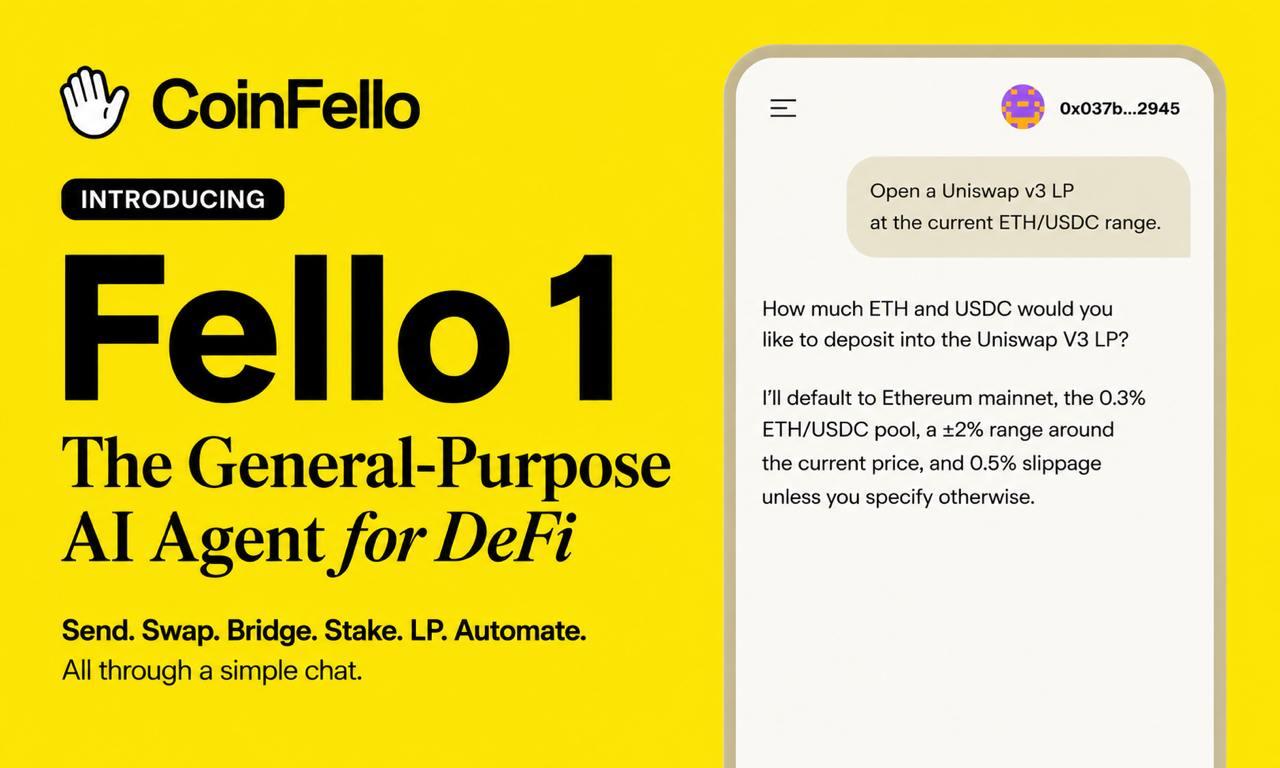
    Fort Worth, Texas, June 11, 2026 – CoinFello, a pioneer in self-sovereign AI agents for decentralized finance (DeFi), today announced the release of Fello 1. This significant upgrade transforms the company’s agent into a general-purpose AI crypto tool, enabling users to interact with any EVM-compatible smart contract and introducing new functionalities without requiring code updates. The launch broadens CoinFello’s scope from a specialized application to a comprehensive AI agent focused on simplifying the process of providing liquidity (LP) in DeFi.

    Beyond its foundational capabilities in sending, swapping, bridging, and staking, Fello 1 can now assist users in opening LP positions on Uniswap V2, V3, and V4. It also facilitates multi-step DeFi transactions, eliminating the need for protocol-specific interfaces or pre-built integrations. The system operates on a self-custodial delegation model, ensuring users retain control over their wallets and private keys while granting agents limited, user-defined permissions.

    This latest release builds upon CoinFello’s previous innovations, including Fello 0 and the CoinFello agent skill, a framework for secure agent delegation. Fello 1 is developed in accordance with MetaMask Smart Accounts standards, incorporating ERC-7710 and ERC-7715 delegation capabilities.

    Fello 1 not only offers general-purpose functionality but also enhances the LP experience for DeFi users. The agent handles all necessary calculations, monitors live positions, and clearly presents information on in/out-of-range status, recommendations, and impermanent loss, providing users with a transparent view of their actual returns.

    “Concentrated liquidity has been a significant yield opportunity in DeFi for years, but its complexity has been a barrier for many,” said jacobc.eth, Co-Founder & CEO of CoinFello. “Managing tick math, fee tiers, position monitoring, and impermanent loss requires considerable effort to do effectively. Fello 1 directly addresses these challenges, allowing users to capture yield without the burden of managing the underlying mechanics, all while maintaining full control of their private keys.”

    In contrast to narrowly integrated DeFi assistants, Fello 1 is engineered to interact directly with EVM smart contracts through generalized execution capabilities. This approach, according to the company, allows for broader protocol coverage and faster expansion of supported features without the need for dedicated integrations for each new application.

    Current functionalities include the management of liquidity positions, execution of multi-step transactions, interaction with ERC-4626 vaults, and integrations with protocols such as Aave, Uniswap V2, Uniswap V3, and Uniswap V4. CoinFello anticipates further enhancements for protocols like Pancakeswap and Aerodrome in upcoming updates.

    The launch coincides with a surge in interest in AI-powered crypto infrastructure and conversational blockchain interfaces. CoinFello positions Fello 1 as an execution layer designed to provide users with simplified access to decentralized finance while preserving their direct control over transaction approvals and wallet permissions.

    “Many AI agents in the crypto space today either operate on custodial systems or are confined to limited workflows,” stated MinChi, Co-Founder & COO of CoinFello. “We believe the next evolution of onchain AI will necessitate systems capable of operating across the full spectrum of EVM applications, while ensuring users remain actively involved in every transaction decision.”

    CoinFello has stressed that Fello 1 is not designed as an autonomous trading bot. Users are required to review and approve each transaction before execution, and delegation permissions can be modified or revoked at any time.

    The Fello 1 launch campaign is now active. Existing CoinFello users can access Fello 1 immediately, while new users can create accounts via the CoinFello application.

    About CoinFello
    CoinFello is an AI agent platform that facilitates the research, execution, and automation of onchain actions. Through plain language commands, users can perform actions such as sending, swapping, bridging, staking, creating LPs, and automating various crypto activities across EVM-compatible networks, all while maintaining full custody of their wallets and private keys. CoinFello employs a delegation model that grants AI agents only the specific permissions users choose to authorize.