Tag: Positive

  • TronBid Launches Flexible Marketplace for TRON Energy and Bandwidth Rentals

    TronBid Launches Flexible Marketplace for TRON Energy and Bandwidth Rentals

    TronBid has introduced a new marketplace and rental platform designed to streamline the trading of TRON network resources, specifically energy and bandwidth. This platform connects users needing these resources for transactions with holders of staked TRX who have unused resources available for monetization.

    The TRON network’s popularity for transactions, including USDT transfers, necessitates sufficient energy and bandwidth for smart contract execution. Without adequate TRON Energy, TRX may be burned to cover transaction costs. For users who frequently engage in transactions, renting energy presents a practical alternative to staking large amounts of TRX solely to generate the required network resources.

    TronBid’s platform addresses this need by offering a flexible ecosystem that integrates a peer-to-peer (P2P) marketplace, instant rental options, a Telegram bot, a calculator, and API access. This comprehensive approach empowers both buyers and sellers to create orders and set their own terms, fostering a more dynamic resource market.

    P2P Marketplace Dynamics

    The core of TronBid’s offering is its P2P marketplace, which allows supply and demand to directly influence price discovery. Unlike systems with a fixed rental rate, buyers can signal their desired price, and sellers can indicate their asking price. This structure encourages competition among energy providers on price and expands the marketplace with dedicated seller-created offers.

    Buyers can establish specific orders, detailing the required energy or bandwidth, the price per unit, and the desired rental duration. Sellers can review these active orders and fulfill those that align with their available resources and terms. Furthermore, sellers have the flexibility to post their own offers, specifying the resource, amount, asking price, and rental conditions.

    Diverse Rental Options and Features

    Beyond the P2P marketplace, TronBid provides ‘Quick Rent’ for users requiring immediate energy. This feature allows users to select a package, enter a TRON address, pay in TRX, and automatically receive delegated energy without waiting for a marketplace match. The platform also includes a Telegram bot, offering a convenient method for accessing energy rental services, particularly for mobile users. For businesses and developers, API access facilitates the integration of automated TRON energy rentals into applications such as wallets and payment services.

    By providing these varied options, TronBid offers an alternative to traditional methods of acquiring TRON network resources, such as staking TRX or incurring TRX burns for transaction fees. The platform enables users to manage their transaction costs more efficiently and allows resource holders to monetize their staked TRX without relinquishing ownership.

    Why This Matters

    The materials describe a narrow update: TronBid has introduced a platform that connects users needing TRON energy and bandwidth with holders of staked TRX who have unused resources to monetize. The two-sided structure is one of the most interesting features of the current TronBid platform.

    Broader Context

    Source materials place the factual news in this context: Sending USDT over the TRON network is particularly popular amid its speed and broad adoption. That said, TRC-20 transfers also require network resources.

  • Chainlink Shows Increased On-Chain Activity and Bullish Technical Signals Amidst Market Uncertainty

    Chainlink Shows Increased On-Chain Activity and Bullish Technical Signals Amidst Market Uncertainty

    Chainlink (LINK) is exhibiting a notable increase in on-chain activity and technical signals that have historically preceded price rallies. Over the past week, LINK has surged by approximately 8%. In the last 96 hours, transactions exceeding $1 million on the Chainlink network have risen significantly from around one to approximately 15, while active addresses have nearly doubled from about 2,450 to 4,800.

    Further bolstering bullish sentiment, Chainlink’s MVRV Ratio has formed a golden cross with its 200-day Simple Moving Average (SMA) for the first time in over a year. This technical pattern is historically considered a significant bullish indicator. According to market analysis, similar setups have preceded substantial rallies, including a 155% increase in November 2024 and an 85% rise in July 2025. If historical patterns hold true, this latest crossover could signal another significant upward movement for LINK, though past performance is not indicative of future results.

    Technical Outlook and Analyst Projections

    On the daily chart, LINK is currently testing the mid-range of a parallel channel at the $8.80 level. A daily close above this threshold could potentially lead to a 30% rally, targeting the channel’s upper boundary near $11. Some analysts suggest LINK is positioned within a strong long-term accumulation zone. A sustained close above $10.87 on higher timeframes might open the door for further price appreciation, with potential targets reaching $25, $50, and even $100, according to some market watchers.

    Standard Chartered has offered long-term price forecasts, projecting LINK to reach approximately $13 in 2026, $41 in 2027, $82 in 2028, $133 in 2029, and $200 by 2030. The bank anticipates that growing blockchain-based tokenization will play a major role in this climb. However, these are long-term forecasts subject to considerable market volatility and speculation.

    Expanding Ecosystem and Adoption

    Beyond technical indicators, Chainlink’s institutional adoption and network utility continue to expand. The oracle network has secured over $33 trillion in total transaction value, with approximately $30.06 trillion recorded in April 2026, indicating a substantial increase of over $3 trillion since that time. Institutions such as DTCC have processed live production transactions involving tokenized securities powered by Chainlink. Furthermore, initiatives like Project Pangea are bringing together over 50 banks to explore T+0 cross-border FX settlement using stablecoins, SWIFT, and Chainlink infrastructure. Adoption is also evident across the crypto industry, with platforms like BitGo, Robinhood, Aave, and OKX integrating Chainlink’s technology. Mantle has migrated its Super Portal to Chainlink’s Cross-Chain Interoperability Protocol (CCIP), and Lombard utilizes the protocol for cross-chain deposits. Circle’s Arc has also joined Chainlink Scale.

    Interpreting the Signals with Caution

    Despite these positive developments and signals, significant uncertainties remain. The historical precedent of the MVRV Ratio golden cross does not guarantee future performance, and market conditions can influence outcomes. The potential for a 30% rally or higher price targets hinges on specific technical breakouts that are not assured. Momentum indicators such as RSI, MACD, and ADX will become increasingly important if LINK breaks key trendlines, but their future impact is yet to be determined.

    In summary, Chainlink is currently displaying a combination of increased on-chain activity and bullish technical signals. While these indicators, supported by ongoing adoption and institutional integration, suggest potential for upward price movement, the inherent uncertainties of the crypto market mean that these signals should be interpreted with caution. The future trajectory will depend on various factors, including market dynamics and the successful execution of its technological roadmap.

    Why This Matters

    The materials describe a narrow update: Chainlink’s price has increased, and several on-chain and technical indicators suggest a potential for significant future price appreciation. Whether the current MVRV Ratio golden cross will repeat historical rally patterns.

    Broader Context

    Source materials place the factual news in this context: Chainlink has surged by almost 8% over the past week despite choppy price action across the broader crypto market.

  • MEW Integrates Ondo Perps for 24/7 Onchain Leveraged Trading

    MEW Integrates Ondo Perps for 24/7 Onchain Leveraged Trading

    MyEtherWallet Integrates Ondo Perps, Unlocking 24/7 Leveraged Trading for Onchain Equities, ETFs, and Commodities

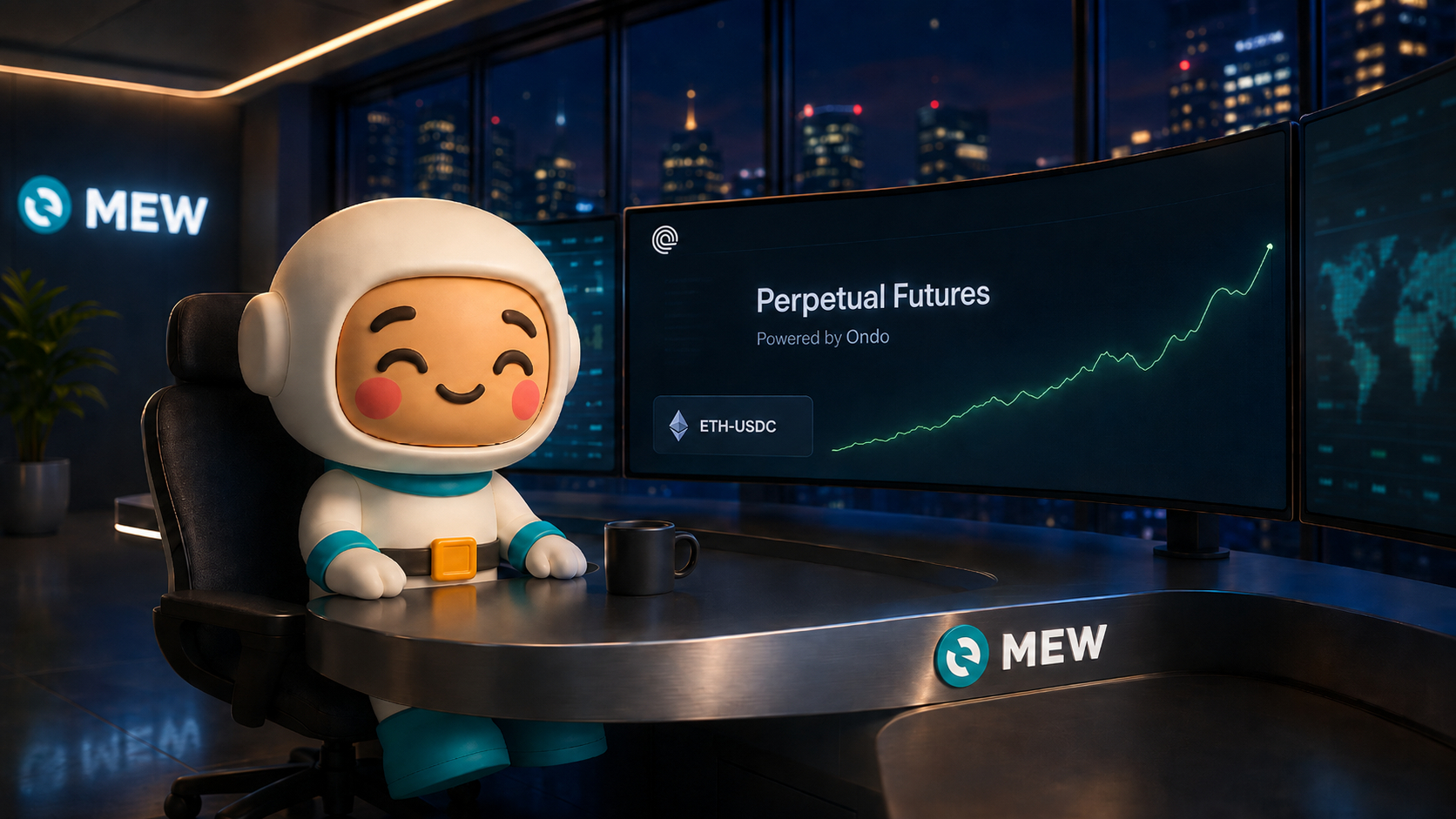
    LOS ANGELES – August 13, 2026 – MyEtherWallet (MEW), a prominent digital wallet provider, announced today its integration with Ondo Perps, a move that expands its decentralized finance offerings to include perpetual futures. This new feature allows users to trade derivative contracts with no expiration date, providing access to continuous perpetual contracts with up to 20x leverage on leading U.S. stocks, ETFs, and commodities, available 24 hours a day, seven days a week, directly on MyEtherWallet.com.

    The integration aims to bridge traditional financial markets with self-custodial Web3 technology. MEW users can now leverage Ondo Perps to establish long or short positions on major traditional market assets while retaining full control over their funds. In contrast to traditional brokerages, which often impose strict trading hours and geographical limitations, eligible users can now manage their exposure to global markets around the clock through any supported wallet connected to the MEW web interface.

    “Our mission has always been to make decentralized finance accessible, flexible, and fully self-custodial,” said Kosala Hemachandra, Founder and CEO of MEW. “Integrating Ondo Perps is a natural progression in our vision for the wallet as an all-in-one financial hub. Whether investors wish to buy and hold tokenized equities or manage risk with up to 20x leverage on stocks and commodities, they can now execute advanced trading strategies 24/7 without relinquishing control of their assets.”

    Key Features of MEW’s Ondo Perps Integration:

    • Access to perpetual futures trading with no expiration dates.
    • Leverage of up to 20x on U.S. stocks, ETFs, and commodities.
    • 24/7 trading availability.
    • Full self-custody of assets maintained by users.
    • Seamless integration with the MyEtherWallet interface.

    How to Access Ondo Perps on MEW:

    [Details on accessing Ondo Perps on MEW would typically be provided here, outlining steps for users.]

    For further information on MEW’s Ondo Perps integration and its latest portfolio features, visit www.myetherwallet.com.

    This product is not available nor intended for U.S. citizens. Restrictions apply. For more information, please refer to https://docs.ondoperps.xyz/.

    About MyEtherWallet (MEW)

    MyEtherWallet (MEW) is dedicated to providing simple, free, and secure access to the global financial system, empowering users to build wealth with digital assets. Since launching the first Ethereum user interface in 2015, MEW has continuously innovated, bringing self-custodial real-world assets and advanced trading tools to a wider audience, transforming blockchain technology into an accessible and user-friendly component of daily life.

  • Flare’s FXRP Now Enables On-Chain Options and Futures Trading for XRP Holders on Derive

    Flare’s FXRP Now Enables On-Chain Options and Futures Trading for XRP Holders on Derive

    Flare’s FXRP collateral has been integrated with the Derive platform, opening up on-chain options and perpetual futures trading for XRP holders directly from their wallets. This development provides XRP holders with new avenues for hedging positions and generating yield, migrating these financial instruments to decentralized infrastructure.

    FXRP, a representation of XRP on the Flare network, allows users to leverage their XRP holdings for derivative trading. Previously, XRP holders faced limited options for hedging or generating premium income without relying on centralized exchanges or custodians. The introduction of FXRP on Derive addresses this gap by offering a permissionless on-chain market.

    According to a press release shared with CryptoPotato, XRP holders can now trade on-chain options and perpetual futures using FXRP as collateral. This functionality enables hedging, premium generation, and directional trades directly from a user’s wallet. Derive’s XRP options are cash-settled in USDC, and the platform utilizes a Portfolio Margin V2 account system.

    FXRP reached the Flare mainnet in September 2025. Within its first week, the cap for FXRP was reached in just four hours, with 5 million tokens minted. In the seven months following its mainnet launch, over 155 million FXRP tokens had been minted. Before February, 82 million FXRP were deployed across DeFi applications, a figure that rose to 144 million since February.

    Derive is a significant participant in the on-chain options market, with its total value locked nearing $118 million. The platform’s integration with Flare’s FXRP is expected to increase on-chain activity for XRP derivatives and enhance hedging and yield generation opportunities for XRP holders.

    FXRP is created through Flare’s FAssets system, representing XRP on the Flare network via an overcollateralized system. The supply of FXRP backs lending, borrowing, and yield tokenization. In related news, Flare has also listed an FXRP/USDC spot pair on Hyperliquid.

    While these new capabilities offer expanded financial tools, the complexities and risks associated with options and perpetual futures trading remain. These instruments can be volatile, and users are advised to understand the potential risks before engaging in such trading activities. The integration aims to provide XRP holders with a credible path to participate in on-chain derivatives markets, offering more control and flexibility compared to traditional centralized platforms.

    Why This Matters

    The materials describe a narrow update: Flare’s FXRP, a representation of XRP on the Flare network, can now be used as collateral on the Derive platform. FXRP enables XRP holders to trade on-chain options and perpetual futures from their own wallets.

    Broader Context

    Source materials place the factual news in this context: Flare’s FAssets system.

  • Solana Surges Past Bitcoin, Ether in GSR Portfolio Shift

    Solana Surges Past Bitcoin, Ether in GSR Portfolio Shift

    GSR Adjusts Core3 Portfolio, Boosting Solana Allocation

    GSR, a prominent trading firm, has significantly increased its exposure to Solana within its Core3 model portfolio, raising its allocation to 43.7%. This strategic shift saw a reduction in holdings for both Ether, now at 39.5%, and Bitcoin, which has been trimmed slightly to 16.9%.

    The adjustment comes amid a period of “constructive” cryptocurrency market conditions over the past week, according to GSR. The firm noted that trading activity has remained relatively calm, and the move aligns with Solana’s recent stronger near-term price momentum. Despite this positive outlook, Solana’s trading volume has seen a decline over both seven-day and 30-day periods. Ether, even with its reduced portfolio weight, still posted the strongest 30-day return at 6.4%, while Bitcoin remains the smallest component of the portfolio. Longer-term trading activity for Bitcoin has also remained subdued.

    ETF Background

    GSR launched its first exchange-traded fund, the Crypto Core3 ETF, in April of this year. Traded on Nasdaq under the ticker BESO, the fund carries a 1% management fee. It offers active portfolio management and staking rewards on eligible assets. GSR has previously stated that the fund dynamically adjusts its allocation across the three major cryptocurrencies, rebalancing weekly based on research-driven signals aimed at generating additional returns.

    Market Speculation and Solana’s Outlook

    The portfolio rebalancing has sparked speculation on social media, with one user on X suggesting it could signal the beginning of an altcoin rotation.

    Solana is currently trading just above the $76 mark. Recent analysis from CryptoPotato highlighted several technical indicators pointing to potential further upside. Analyst Ali Martinez observed that SOL is trading within a parallel channel, with the $78 level proving significant. A breakout above the channel’s mid-range could pave the way for a move towards the upper boundary, approaching $100. A buy signal from the TD Sequential indicator on its daily chart further supports this bullish sentiment, as does a “golden cross” formation on the MACD.

    Bitcoin’s Stagnation and Potential Scenarios

    However, a separate analysis from Glassnode indicates that Bitcoin is currently trapped in a narrow trading range, with a notable absence of buyers. The price is positioned between the Median Realized Price of $63,000 and the Short-Term Holder Cost Basis of $68,700. Spot trading volume for Bitcoin has also fallen to its lowest point since 2019.

    Glassnode’s report suggests that sellers are exhibiting signs of exhaustion, and several indicators are approaching levels typically seen at previous bear market bottoms. Concurrently, leverage has been building on the long side. A sustained climb by Bitcoin above $68,700, supported by increased volume and renewed ETF inflows, would be viewed as a positive development. Conversely, a failure to rally or a drop below $58,500 could cast doubt on the current market bottom.

  • Ethereum Buy Signal: Now Is The Time

    Ethereum Buy Signal: Now Is The Time

    Ethereum, the second-largest cryptocurrency, last traded above the $2,000 mark at the beginning of June and has since fallen 60% year-to-date.

    Despite the significant downturn, many analysts perceive potential upside, with some viewing the current market conditions as an opportune moment to invest.

    As of this report, Ether (ETH) is valued at approximately $1,880. Some market participants appear to be awaiting definitive confirmation of a market bottom before entering, a sentiment that analyst Michael van de Poppe disputes. He argues that the optimal time to establish a position in ETH is precisely now.

    “It’s always a challenge to position yourself in the market, as that’s the nature of trading,” van de Poppe stated. “Previous market breakouts have historically yielded substantial returns, and ETH is known for its volatility. We’ve seen a 60% surge in less than a week previously, and a similar pattern occurred in 2023.”

    Van de Poppe indicated he would not be surprised by a significant upswing in the coming months, potentially seeing a rally to $3,000 within days or weeks. He further suggested that a “volatile move” is imminent, noting that ETH’s trading range is narrowing daily, which could precede a price surge.

    “I remain optimistic for the period ahead,” he concluded.

    Other commentators, including Ali Martinez and a user identified as Gerla, have also recently weighed in on Ethereum’s prospects. Martinez suggested that the drop to $1,580 in June could serve as a launchpad for a potential rally, targeting $3,000. He pointed out that this price level has historically preceded significant market recoveries.

    X user Gerla expressed an even more bullish outlook, identifying a Relative Strength Index (RSI) signal that has previously been followed by a substantial price increase. This analyst believes the next move could propel ETH to a new all-time high, surpassing $10,000.

    Several indicators suggest that ETH may indeed be poised for a considerable ascent. CryptoQuant recently reported that large investors, holding between 10,000 and 100,000 coins, and “mega-whales” have been accumulating aggressively since mid-2025. Concurrently, smaller investors have been selling, a dynamic typically viewed as a bullish signal.

    Another factor supporting a potential rally is the amount of ETH held on exchanges, which remains near a 10-year low. This indicates that a significant number of investors have moved their holdings from centralized platforms to self-custody, thereby reducing immediate selling pressure.

    Finally, institutional interest in ETH warrants attention. Since the beginning of July, spot Ethereum ETFs have experienced strong inflows, potentially signaling a positive price movement.

  • Blockchain Association Urges Supreme Court Review of Fed’s Payment Access Authority

    Blockchain Association Urges Supreme Court Review of Fed’s Payment Access Authority

    The Blockchain Association has filed an amicus brief with the U.S. Supreme Court, urging the justices to review a case involving Custodia Bank and the Federal Reserve. The brief supports Custodia Bank’s petition and argues that the Federal Reserve should not possess the authority to deny payment system access to eligible state-chartered banks. The association contends that a recent lower court ruling in favor of the Fed could allow regulators to effectively exclude lawful businesses, particularly within the digital asset industry, from the financial system.

    Core Dispute Over Payment System Access

    The central issue involves Custodia Bank, a state-chartered bank based in Wyoming offering digital-asset services, which has been seeking a master account with the Federal Reserve. Such an account would grant direct access to the U.S. payments system. However, an appeals panel ruled in October that eligibility alone did not entitle Custodia to a master account. Custodia Bank subsequently requested a rehearing of the case by the full Tenth Circuit in December.

    Arguments Against Federal Reserve Authority

    The Blockchain Association argues that the Federal Reserve’s actions threaten the integrity of the dual banking system, where both state and federal authorities can charter banks. According to the association, if the lower court’s ruling stands, federal regulators could override state banking decisions by controlling access to essential financial infrastructure. The crypto trade group stated that this scenario provides federal regulators a “quiet way to cut lawful businesses out of the banking system.”

    Concerns Over Regulatory Overreach and Historical Parallels

    In their brief, the Blockchain Association also drew parallels to “Operation Choke Point 2.0.” They described this as a program from the prior administration that allegedly used “vague rules, excessive discretion, informal guidance, and aggressive enforcement actions to pressure banks away from serving digital asset clients” and engaging with digital assets. The association views Custodia’s fight as the latest phase of this alleged campaign.

    The Blockchain Association argues that the Federal Reserve’s decision ratifies what they perceive as the Fed’s “misuse of its payment services to further an impermissible policy goal—debanking the digital-asset industry.” They further claim that federal regulators, “based on their own discretionary whims, can intrude on state prerogatives and debank lawful businesses,” a question they deem of “exceptional importance with broad consequences for the national economy.”

    An amicus brief, meaning “friend of the court,” is a legal filing submitted by a party not directly involved in a case but who has a strong interest in the subject matter. These briefs provide additional arguments and context to help the court make its decision.

    Uncertainty and Next Steps

    Key uncertainties remain regarding the case. It is not yet determined whether the Supreme Court will agree to hear Custodia Bank’s petition. Furthermore, the extent of the Federal Reserve’s ultimate control over access to the U.S. payments system remains a subject of ongoing legal and regulatory debate.

    Why This Matters

    The Blockchain Association has filed a brief supporting Custodia Bank’s petition to the Supreme Court, raising questions about the Federal Reserve’s authority over payment system access for state-chartered banks. Whether the Supreme Court will agree to hear the case remains uncertain.

    Broader Context

    The Blockchain Association is urging the Supreme Court to take up Custodia Bank’s fight with the Federal Reserve.

  • Monero Surges 13% Weekly Amid Bullish Analyst Outlook

    Monero Surges 13% Weekly Amid Bullish Analyst Outlook

    Monero Surges 13% Weekly Amid Analyst Optimism

    In a market where double-digit gains over a seven-day period are a rarity, Monero (XMR) stands out as a notable exception, sparking optimism among observers for further price appreciation.

    The privacy-focused cryptocurrency has crossed the $400 mark, currently trading around $404 according to CoinGecko. This represents a 13% increase over the past week, pushing its market capitalization beyond $7.5 billion and elevating it to the 16th-largest cryptocurrency, surpassing Cardano’s ADA.

    While the precise driver behind Monero’s resurgence remains somewhat elusive, some analysts have identified bullish chart patterns that could signal a sustained upward trend. Several days ago, the X user known as The Moon Show suggested that XMR might be forming a significant cup-and-handle pattern. “I’m watching for a clean handle followed by a breakout above $430. If that happens, things could move very fast,” they stated.

    Another X user, Lucky, who boasts nearly two million followers, characterized the upward movement as a “special breakout from a special privacy gem.” This analyst believes XMR has entered a bullish trend and projects a potential surge to nearly $600.

    Crypto With Gopal appears to be the most bullish on Monero, opining that the cryptocurrency has established a large triangle pattern. He noted that the price is consolidating near $400 following a strong recovery, with rising support and descending resistance creating a squeeze in momentum. “Bulls are holding the range as a major breakout setup develops. A clean breakout above the upper trendline could trigger a major expansion move toward the $1,000 target,” he forecasted.

    However, two key factors could potentially lead to a short-term pullback for XMR’s rally. Firstly, the asset’s Relative Strength Index (RSI), which measures the speed and magnitude of recent price changes to indicate potential trend reversals, currently stands at approximately 77. An RSI above 70 typically signals an overbought condition, suggesting a possible correction.

    Secondly, Monero’s exchange netflow data indicates a recent trend of inflows dominating outflows. This suggests that investors may be moving their assets from self-custody to centralized exchanges, which can increase immediate selling pressure.

  • XRP Holders Gain Access to Options and Perpetual Futures Trading on Derive via FXRP Collateral

    XRP Holders Gain Access to Options and Perpetual Futures Trading on Derive via FXRP Collateral

    XRP holders can now trade options and perpetual futures on the decentralized exchange Derive, utilizing Flare’s FXRP as collateral. This development, announced on Thursday, expands derivative trading capabilities for XRP holders within the decentralized finance (DeFi) ecosystem.

    FXRP, a token representing XRP on the Flare blockchain, is minted by users through Flare’s FAssets bridge. Once minted, FXRP can be deposited into a Derive Portfolio Margin V2 account, enabling users to trade derivatives directly from their wallets.

    Options contracts provide the right, but not the obligation, to buy or sell an asset at a predetermined price by a specific date. Perpetual futures allow speculation on an asset’s future price movements without an expiration date. According to Flare, these new trading options allow XRP holders to hedge against potential losses, earn premiums by selling options, or speculate on XRP’s price.

    “Options are often the last major market to develop around an asset, and XRP has been waiting for the infrastructure,” said Nick Forster, founder and CEO of Derive, in a statement. “FXRP gives one of crypto’s largest holder bases a credible path onchain, and adding Derive’s options markets means that capital can now be hedged, used to earn premium and traded with the same sophistication available around other major assets.”

    Derive’s XRP options will settle in USDC. If an option expires profitably for the buyer, Derive will pay out the difference in USDC while the FXRP collateral remains in the user’s account. Options sellers, however, must maintain sufficient USDC to cover settlement costs and meet margin requirements to avoid liquidation of their collateral.

    This integration broadens FXRP’s utility in decentralized finance. Earlier in the month, FXRP was approved as collateral for Sentora’s RLUSD vault on the Ethereum-based lending protocol Morpho, a service that allows XRP holders to bridge FXRP to Ethereum and borrow Ripple’s RLUSD stablecoin without selling their XRP.

    Why This Matters

    The materials describe a narrow update: Flare announced that XRP holders can now use FXRP, a token representing XRP on the Flare blockchain, as collateral to trade options and perpetual futures on the decentralized exchange Derive. XRP holders can use the products to hedge against losses, earn premiums by selling options, or speculate on the token’s price.

    Broader Context

    Source materials place the factual news in this context: Flare announced on Thursday that XRP holders can now use Flare’s FXRP as collateral to trade options and perpetual futures on decentralized exchange Derive.

  • Binance Launches bStocks for Tokenized Securities

    Binance Launches bStocks for Tokenized Securities

    Binance Launches Promotional Campaign for Tokenized Securities

    Binance is offering a special promotion on its tokenized securities, known as bStocks, allowing users to convert existing assets into bStocks at a fixed 1:1 rate with no fees. This offer is valid until August 26, 2026, at 23:59 UTC.

    How to Access and Utilize bStocks

    Users can access bStocks by selecting “Convert Now” from their deposit details. Once converted, these bStocks are available for 24/7 trading, withdrawal, or redemption for the underlying stock. The promotional campaign features a 1:1 conversion rate with zero fees. Daily per-user limits apply, and users are advised to check the Convert page for current restrictions.

    The tokenized securities offer full flexibility, enabling 24/7 trading on Binance and 1:1 redemption for the underlying stock without any fees.

    Currently supported bStocks include:

    • Tesla (TSLAon), available on ETH and BSC networks.
    • MicroStrategy (MSTRon), available on ETH and BSC networks.
    • Coinbase (COINon), available on ETH and BSC networks.
    • Circle (CRCLon), available on ETH and BSC networks.

    Important Notes on Tokenized Securities

    Deposited third-party tokenized securities can only be held or converted into bStocks and are not eligible for Spot trading. Binance reserves the right to modify or terminate the promotional campaign at any time.

    Understanding Binance bStocks Tokenized Securities

    Binance bStocks tokenized securities are classified as Certificates representing certain Financial Instruments, as per paragraph 92, Schedule 1 to the FSMR. It is crucial to understand that bStocks are not actual stocks or shares, and holding them does not grant direct ownership in the underlying listed company. Furthermore, bStocks do not imply any affiliation with the issuer of the underlying asset.

    These bStocks are offered through an Approved Prospectus in the ADGM (Abu Dhabi Global Market) and are not available in any other jurisdiction. No public offering is made outside of the ADGM. Tokenized securities are exclusively available to eligible users in permitted jurisdictions on a secondary market basis. Users are solely responsible for ensuring that accessing and trading tokenized securities is lawful within their jurisdiction. Binance disclaims any liability or obligation if access is sought from a prohibited or restricted jurisdiction. Binance may restrict, suspend, reject, cancel, or unwind access or transactions if it determines, at its sole discretion, that such actions may breach applicable law, product restrictions, eligibility criteria, sanctions requirements, or relevant offering documents.

    Tokenized securities can be held and transferred on-chain outside of the CSD (Central Securities Depository) environment. However, the transfer of tokenized securities back into the CSD environment is subject to specific conditions, and failure to meet these conditions may prevent trading, redemption, or other dealings within the CSD environment.

    The information provided in connection with tokenized securities is not intended as an offer, solicitation, promotion, recommendation, or invitation to buy or sell securities in any jurisdiction. Tokenized securities are not offered, sold, distributed, made available, or accessible in the United States or to, or for the account or benefit of, U.S. persons. These securities have not been registered under the U.S. Securities Act of 1933 or any U.S. state securities laws, and a public offering of bStocks will not be conducted in the United States or any other jurisdiction, with the exception of the ADGM. By accessing this product, users represent and warrant that they are not a U.S. person, are not located in the United States, are not acting for the account or benefit of any U.S. person, and will not access, purchase, sell, transfer, redeem, or otherwise transact in tokenized securities from within the United States.