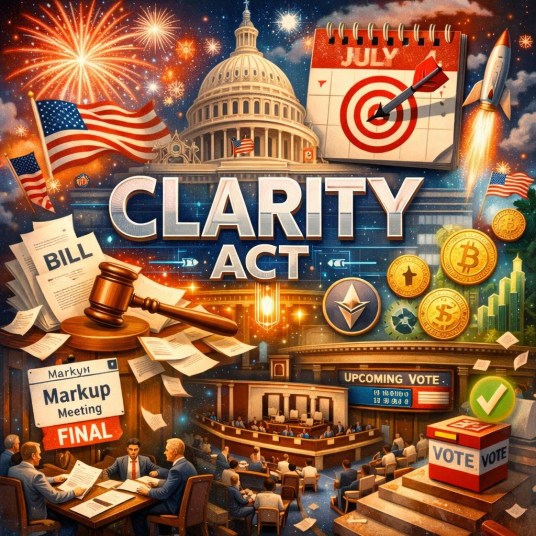
Senator Cynthia Lummis issued a strong warning this week on X: if the CLARITY Act fails to pass Congress during this session, American software developers could face prosecution simply for publishing code.
She described this scenario as a descent into “regulatory dark ages,” directly criticizing the Securities and Exchange Commission’s (SEC) enforcement-based approach, which has characterized U.S. crypto policy for the past three years.
Lummis emphasized the urgency of the situation, stating that this is the last viable legislative opportunity until at least 2030.
The Stakes
According to Lummis, if the CLARITY Act does not pass this Congress, American software developers will likely face prosecution in the near future simply for publishing code.
The Senate Banking Committee approved the CLARITY Act last week, but securing its passage on the Senate floor presents a different challenge.
Crypto advocacy groups have launched an extensive lobbying campaign to maintain momentum, arguing that the bill offers the industry’s only near-term path to a defined market structure framework. Without it, the SEC’s case-by-case application of the Howey Test to digital assets will continue unchallenged.
Key Provisions of the CLARITY Act
The CLARITY Act primarily aims to clarify jurisdictional issues. It would formally define ancillary assets, a category encompassing most altcoins, and specify which digital tokens linked to investment contracts are not securities. This would resolve the ambiguity the SEC has used to pursue enforcement actions without formal rulemaking.
The bill would require the SEC to establish Regulation DA, exempting certain ancillary-asset offerings from full registration if they raise $75 million or less over four years.
In addition to registration thresholds, the legislation would direct the SEC to modernize its investment contract definitions and set examination standards targeting illicit finance. This would replace informal supervisory pressure and guidance letters with binding rulemaking.
This shift is significant because the current framework allows the SEC discretion to threaten enforcement without triggering the procedural protections that formal rules would require.
The Act also addresses stablecoins through 1:1 reserve mandates, a provision Lummis views as crucial for maintaining the digital dollar’s international credibility.
The CLARITY Act’s market structure provisions would divide oversight between the SEC and the Commodity Futures Trading Commission (CFTC) based on asset classification, mirroring the existing structure in traditional finance.
Lummis has argued that the absence of this framework is accelerating capital flight to offshore hubs in the United Arab Emirates and Hong Kong, where institutional players can operate under defined rules.
The SEC’s continued reliance on enforcement as a primary policy tool is not a neutral stance. It is actively influencing where crypto infrastructure is being developed.