Author: Admin_Up

  • Hyperliquid Addresses Singapore Investor Alert Listing

    Hyperliquid Addresses Singapore Investor Alert Listing

    Hyperliquid Added to Singapore’s Investor Alert List, Platform Clarifies No Regulatory Breach

    Hyperliquid, a perpetual futures platform, has been added to the Investor Alert List (IAL) maintained by the Monetary Authority of Singapore (MAS). The platform has clarified that this inclusion does not signify a regulatory violation, enforcement action, or ban.

    In a statement released on X, Hyperliquid emphasized that its appearance on the IAL should not be construed as an indication of wrongdoing. The platform explained that the list is designed to identify entities that might be mistakenly perceived as being licensed, authorized, or regulated by the MAS.

    Hyperliquid noted that several prominent cryptocurrency exchanges and decentralized finance protocols have previously been featured on the list. According to the MAS, the Investor Alert List comprises entities that, based on available information, may be wrongly assumed to be licensed or regulated by the central bank.

    The regulator further stated that the list may also include entities offering investments or investment-related products that could be mistakenly viewed as authorized, recognized, registered, or accompanied by documentation lodged with the MAS.

    Responding to the development, Hyperliquid asserted its status as permissionless infrastructure, stating that it has never claimed to be licensed or authorized by the MAS. The platform advised users not to consider it as holding such approvals. Hyperliquid also highlighted that users retain self-custody of their assets, and all network transactions remain transparent and are fully settled on-chain.

    “The Hyperliquid ecosystem remains committed to engaging collaboratively and constructively with regulators and institutions globally and to supporting clear, well-designed frameworks for onchain finance,” the platform stated.

    Earlier this month, the MAS also placed Bybit Fintech Limited on its Investor Alert List. Bybit responded by stating its ongoing regular and constructive engagement with the MAS and detailing measures implemented to restrict access for users in Singapore. These measures include modifications to its terms of service and geo-blocking of Singaporean IP addresses.

    Hyperliquid’s native token, HYPE, showed minimal reaction to the news. HYPE traded around $62 over the past 24 hours. The token had previously reached over $75 in mid-June before experiencing a decline amid broader market volatility.

    Meanwhile, institutional demand for the token appears to remain robust. Data from SoSoValue indicated that U.S. spot HYPE ETFs recorded net inflows exceeding $108 million on June 25, marking the largest single-day inflow since their launch last month. These inflows followed five trading days in June that saw no net flows.

  • XRP Price Watch: Crash to $0.60 Looming as $1 Support Tested?

    XRP Price Watch: Crash to $0.60 Looming as $1 Support Tested?

    XRP Faces Persistent Selling Pressure, Testing Key Support Levels

    XRP continues to experience sustained selling pressure, with the broader market trend firmly favoring sellers. Analysis of the USDT chart indicates the cryptocurrency is on the verge of breaching a significant support area following another downward movement. Concurrently, the XRP/BTC pair has retreated towards a critical floor, underscoring the token’s ongoing weakness relative to Bitcoin.

    XRP/USDT Analysis

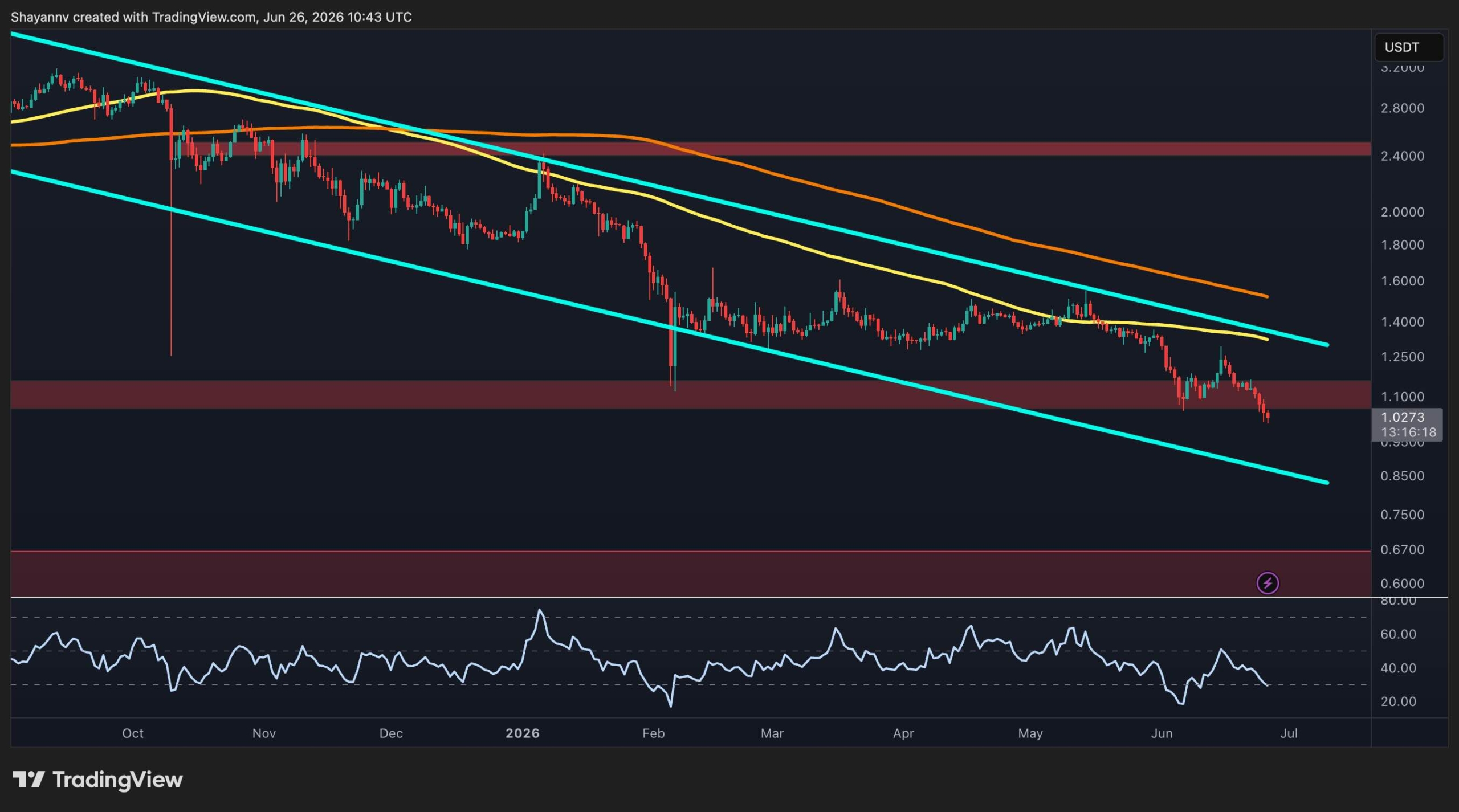
    Against the USDT pair, XRP has extended its long-term downtrend, adhering to a descending channel that has capped price action for several months. The asset is currently trading around $1.04, having narrowly avoided a break below the crucial $1.10 support zone, which has now transitioned into immediate resistance.

    XRP remains positioned below both its 100-day and 200-day moving averages, with the 100-day average situated near $1.25 and the 200-day average around $1.5. Both averages are exhibiting a downward slope, reinforcing the prevailing bearish market structure. The upper boundary of the descending channel is converging with these moving averages, forming a robust resistance cluster that buyers would need to overcome for any significant trend reversal to be considered.

    On the downside, the current support zone around $1.00 is under intense scrutiny. A confirmed breach below this level could open the path to the next major demand region, located approximately at $0.60. Momentum indicators also show continued deterioration, with the Relative Strength Index (RSI) trending towards oversold territory, suggesting that bearish pressure remains dominant, although short-term relief bounces cannot be entirely discounted.

    As long as XRP remains below the descending channel resistance and the key moving averages, the broader market structure will continue to favor sellers, irrespective of any recent stabilization.

    XRP/BTC Analysis

    Against Bitcoin, XRP is also trading within a clearly defined descending channel, reflecting persistent relative weakness over the past several months. The pair is currently trading around 1,720 satoshis, resting directly on a horizontal support level that has historically attracted buyers since May.

    However, the broader technical outlook remains bearish. The price is trading below both the 100-day and 200-day moving averages, which are positioned around 1,850 satoshis and 2,000 satoshis, respectively, with both averages continuing their downward trajectory. Consequently, any recovery attempt is likely to encounter substantial resistance in the 1,850 to 2,000 satoshi range, followed by the upper boundary of the descending channel.

    Should the current support at approximately 1,700 satoshis fail to hold, sellers could target the lower boundary of the channel, near the 1,500 satoshi area. Conversely, defending this level might facilitate another short-term rebound towards the channel resistance. Nevertheless, the overall structure would remain bearish unless XRP manages to reclaim the major moving averages and establish higher highs.

  • NOWPayments Adds Crypto Tax Tools for Global Businesses

    NOWPayments Adds Crypto Tax Tools for Global Businesses

    Crypto Tax Resources Launched to Aid Global Business Adoption

    Amsterdam, Netherlands – June 26, 2026 – As the global adoption of cryptocurrencies accelerates, businesses are finding it increasingly straightforward to accept digital assets. However, navigating the complex landscape of regulatory compliance across different jurisdictions remains a significant hurdle.

    To address this challenge, NOWPayments and KoinX have jointly developed Crypto Tax Educational Assets. These practical, jurisdiction-specific resources are designed to assist businesses that are either exploring or already engaged in accepting cryptocurrency payments. The resources are available free of charge.

    The educational materials move beyond theoretical research to offer actionable guidance on tax and accounting considerations, reporting expectations, and crucial regulatory factors that businesses must evaluate when operating with cryptocurrencies.

    According to the companies, this initiative is particularly relevant for merchants, platforms, and global enterprises operating in multiple regions where regulatory requirements can vary considerably.

    “At KoinX Books, our focus is on simplifying crypto accounting and financial compliance for businesses operating within the digital asset space,” stated Punit Agarwal, Founder of KoinX. “Our collaboration with NOWPayments represents another stride towards building a more interconnected and efficient infrastructure for Web3 businesses worldwide. As crypto adoption expands across regions like Spain and Europe, businesses require financial systems that are transparent, scalable, and audit-ready.”

    This partnership underscores a shared objective between NOWPayments and KoinX: to enhance the operational accessibility of crypto adoption for businesses.

    NOWPayments asserts that payment processing alone is no longer sufficient to support widespread business adoption of cryptocurrencies. Successful engagement in the digital asset economy increasingly demands operational confidence, educational support, and the necessary infrastructure to help businesses understand how to responsibly manage cryptocurrencies across various jurisdictions.

    “We believe businesses need more than just payment tools to thrive with crypto,” commented Kate Lifshits, CEO of NOWPayments. “Our ecosystem is evolving to support businesses at multiple stages of their crypto journey, from payment acceptance to operational and compliance readiness. These assets are a key component of that broader mission.”

    Businesses planning to accept cryptocurrency but uncertain about compliance requirements in their target markets can now access a free Crypto Tax Checklist for Spain, the EU, UAE, LATAM, and other key regions.

    About NOWPayments
    NOWPayments is a global cryptocurrency payment gateway that empowers businesses to accept payments and facilitate payouts in digital currencies. The platform supports over 350 cryptocurrencies and more than 30 stablecoins. It offers enterprise-grade tools including invoices, payment widgets, subscription services, payment buttons, donation tools, point-of-sale solutions, plugins, and fiat payment options. Businesses can also benefit from zero-fee payouts with settlement speeds as fast as one second, streamlining operations and enabling efficient scaling of crypto payments.

  • XRP Faces Steep Selling Pressure as Profit-to-Loss Ratio Hits Multi-Year Low

    XRP Faces Steep Selling Pressure as Profit-to-Loss Ratio Hits Multi-Year Low

    XRP Selling Pressure Intensifies as Profit-to-Loss Ratio Reaches Multi-Year Low

    On-chain analytics firm Glassnode reported that XRP holders are continuing to realize more losses than profits, with a key indicator reaching its lowest point since August 2022. This decline suggests increasing selling pressure as more holders divest their assets at a loss.

    According to the firm’s update on June 25, the 90-day simple moving average of XRP’s Realized Profit-to-Loss Ratio has fallen to 0.33, down from 0.38 on June 9. This metric, which compares realized profits against realized losses from on-chain transactions, serves as a gauge of overall market profitability.

    A ratio above 1 signifies that realized profits are greater than realized losses, while a value below 1 indicates that losses are more prevalent. The current reading implies that for every dollar of realized losses, only 33 cents in profit is being realized.

    Glassnode noted that this ratio peaked at approximately 50 during XRP’s market surge in 2025, a period characterized by profit-taking significantly outweighing sales at a loss. The subsequent sharp decline signals a substantial shift in market dynamics, with an increasing number of holders exiting their positions at a deficit.

    Based on these observations, the analytics firm indicated that the market is exhibiting signs of intense capitulation among participants moving XRP on-chain. The sustained weakness in the ratio, Glassnode added, suggests that capitulation pressure has become more pronounced in recent weeks.

    Separate data released by Glassnode on June 9 also highlighted a significant reduction in activity on the XRP Ledger. The 90-day average of total transaction fees has dropped from 5,900 XRP in February 2025 to approximately 500 XRP, marking a decrease of roughly 91.5%.

    Collectively, Glassnode’s data suggests that a weakening of network activity has coincided with the deterioration in holder profitability. The realized profit-to-loss ratio experienced a sharp increase during the 2025 rally before steadily declining through late 2025 and into 2026. Total transaction fees followed a similar downward trend after the speculative peak.

    The subdued on-chain metrics have led to varied interpretations among market participants. Some users on X have suggested that such low readings could signal seller exhaustion. Others have pointed to XRP’s ability to remain above the $1 mark despite the weak profitability data.

  • Kraken Seeks 15% Aave Stake at $385M

    Kraken Seeks 15% Aave Stake at $385M

    Kraken Eyes 15% Stake in Aave at $385 Million Valuation

    Cryptocurrency exchange Kraken is reportedly in discussions to acquire a 15% stake in decentralized finance protocol Aave, valuing the company at $385 million.

    Under the proposed deal, Kraken would invest 35,000 ETH, approximately $55 million, in exchange for 250,000 AAVE tokens, valued at $20 million, and a 15% common equity stake in Aave Group, the entity behind the protocol. This package is estimated to be worth around $71 million.

    The move comes as Aave is working to recover from the KelpDAO exploit in April, which led to billions of dollars in deposit withdrawals, although Aave’s own smart contracts remained uncompromised. For Kraken’s parent company, Payward, this acquisition represents a strategic diversification effort ahead of a potential initial public offering.

    This development coincides with Standard Chartered’s recent positive outlook on the AAVE token. Geoff Kendrick, an analyst at the bank, initiated coverage of AAVE with a price target suggesting nearly 50-fold upside by the end of the decade, projecting a price of around $4,000 compared to its current valuation of approximately $81. This forecast is based on the bank’s thesis that tokenization and on-chain credit will drive substantial growth in decentralized finance lending. The past week has seen both a major bank express confidence in the token and a prominent exchange invest in the company.

    However, a potential challenge arises for AAVE token holders and prospective buyers. Kraken’s deal values the Aave company at $385 million, while the AAVE token currently holds a market capitalization of roughly $1.24 billion. This means the token’s market cap is more than three times the equity valuation of the company. In traditional finance, company value is typically derived from ownership of the business and its cash flows. In the cryptocurrency space, however, the relationship between token value and company value has been a significant theme throughout the recent market cycle.

    With Aave, a substantial portion of the protocol’s economic activity is directed towards the token, through the DAO treasury and a buyback program that utilizes protocol revenue to repurchase AAVE. The company, in turn, primarily focuses on developing and operating the software. Consequently, the market appears to be valuing the token as capturing the majority of Aave’s worth, or perhaps indicating that the token is priced at a premium relative to the underlying business. Kraken’s proposed deal, by encompassing both tokens and equity, avoids taking a definitive stance. Nevertheless, for external observers, purchasing a token that trades at more than three times the valuation of the underlying company presents a complex investment decision.

    It remains to be seen whether the market will adjust to this valuation discrepancy or accept it.

    BlackBerry Surges 20% as It Pivots to Physical-AI Software

    BlackBerry shares experienced a significant surge of nearly 20% on Thursday, following an earnings report that surpassed expectations and an upward revision of its financial guidance. The former smartphone manufacturer is increasingly emphasizing its role in the burgeoning field of physical artificial intelligence and robotics.

    In the first quarter, the company reported revenue of $152.9 million, marking a 26% increase year-over-year and exceeding the approximately $138 million anticipated by analysts. Adjusted EBITDA also saw a substantial rise of 144%, and BlackBerry achieved its first positive fiscal first-quarter cash flow in nine years.

    The primary driver of this growth is QNX, BlackBerry’s embedded operating system, which saw a 26% increase in revenue to $72.3 million. QNX is a deterministic, safety-certified real-time operating system already integrated into over 275 million vehicles. The same attributes that ensure its reliability in automotive applications also make it highly valuable for robots and autonomous machines, where software malfunctions can have tangible physical consequences. Leading chipmakers such as Nvidia and AMD already utilize QNX in their smart car and robotics solutions. BlackBerry is now positioning QNX as a foundational infrastructure for software-defined vehicles, robotics, and industrial automation.

    The company’s new strategy highlights BlackBerry’s quiet emergence as a key provider of essential technology for the physical AI sector. Robots and autonomous systems require operating systems with unwavering reliability, a need that BlackBerry addresses with QNX. A survey commissioned by QNX revealed that 89% of robotics developers consider physical AI to be critical to their strategic objectives, and the recent stock performance suggests that Wall Street is beginning to recognize BlackBerry as a significant player in the AI and robotics landscape.

  • BitGo Cuts 15% of Staff Amid Crypto AI Layoffs

    BitGo Cuts 15% of Staff Amid Crypto AI Layoffs

    BitGo Cuts Workforce Amid Pivot to AI

    BitGo, a prominent crypto custody and infrastructure company, has announced significant workforce reductions, joining a growing trend among technology firms to streamline operations and pivot towards artificial intelligence. The company is cutting nearly 15% of its staff, according to a statement from co-founder and CEO Mike Belshe.

    In a tweet shared on Thursday, Belshe explained the decision, stating, “The ecosystem has evolved, and the way we build financial services has changed dramatically.” He elaborated that to maintain a competitive edge for its clients, BitGo must become “sharper” and more focused. The company’s strategic direction will now emphasize “security, trading, stablecoins, settlement, and AI-powered infrastructure.”

    While BitGo did not disclose the exact number of employees affected, its 2025 annual report indicated a workforce of 603 full-time employees, suggesting approximately 90 roles may have been eliminated. Belshe characterized the layoffs as a “one-time action” and expressed confidence that further cuts are not anticipated, noting that the company’s job board still features numerous open positions.

    These reductions come several months after BitGo’s initial public offering in January, where it priced its shares at $18, raising approximately $213 million and valuing the firm at over $2 billion. Despite a substantial 112.6% surge in first-quarter revenue compared to the previous year, reaching $3.8 billion, the company also experienced an widening of net losses.

    The market reaction to the news was largely negative. BitGo shares, trading under the ticker BTGO, saw a nearly 5% decline on Thursday, closing at $4.80. This represents a significant drop of approximately 73% from its IPO price.

    BitGo’s move aligns with a broader pattern of staff reductions across the cryptocurrency and technology sectors in 2026. Earlier this year, Jack Dorsey’s Block eliminated around 4,000 jobs, roughly 40% of its workforce, citing increased reliance on automation and AI tools. In May, Coinbase reduced its staff by 14%, while crypto data firm Dune let go of a quarter of its employees. Robinhood also trimmed its workforce by 10% in June amid a downturn in crypto revenue.

    The wider tech industry has seen over 120,000 job cuts since the beginning of the year, with major companies like Microsoft and PayPal identifying AI as a key factor driving these downsizing efforts. However, the extent to which AI is the sole or primary driver of these layoffs remains a subject of ongoing debate, with some analysts suggesting it may serve as a convenient justification amidst a challenging market environment.

  • XRP’s Key Levels Post-$1.00 Crash

    XRP’s Key Levels Post-$1.00 Crash

    Key Support Levels for XRP Under Scrutiny After Multi-Year Low

    Popular analyst Ali Martinez has identified the next critical support levels for Ripple’s cross-border token, XRP, following its descent to a new multi-year low of just over $1.00 yesterday. Market observers are closely watching this level, which could prove pivotal in determining XRP’s trajectory for the current cycle.

    The cryptocurrency market, including Ripple’s native asset, has experienced a significant downturn recently. XRP reached $1.60 in mid-May before falling to $1.05 in early June. A subsequent rebound to $1.30 was short-lived, as the token faced renewed selling pressure, driving it to $1.01 on most exchanges yesterday.

    Martinez commented on XRP’s recent performance, noting a bounce to its current trading price of $1.04. He highlighted that the token is currently testing a “major volume block at $1.06,” a significant price area where over 830 million XRP were traded. This level was considered the most crucial above $1.00, but it has since been breached as of press time.

    According to Martinez, attention now shifts to the next major volume clusters, which are positioned considerably lower. The first significant area, with 923 million XRP transacted, is located at $0.80. Two larger clusters, with 1.16 billion and 1.06 billion XRP traded respectively, are identified at $0.62 and $0.51.

    This juncture is considered highly significant for XRP, a sentiment echoed by CasiTrades. As previously reported, she indicated that XRP has approached its final capitulation level, with calls for further price declines intensifying. However, she believes the current retracement is “doing exactly what it should,” describing it as “perfect market structure.”

    The market crash on Thursday resulted in the liquidation of over 200,000 traders, with total liquidations exceeding $1.5 billion. Among those heavily impacted was a prominent Bitcoin and XRP whale. Data from Lookonchain reveals that a single wallet, ending in 0xf79C, saw nearly $48 million in Bitcoin and $28.5 million in XRP long positions liquidated.

    The market crash liquidated whale 0xf79C’s longs. His 809.9 $BTC ($47.68M) and 27.92M $XRP ($28.45M) long positions were fully liquidated, resulting in an $8.42M loss.

  • KLACUSDT Perpetual Contract Now Live with 20x Leverage

    KLACUSDT Perpetual Contract Now Live with 20x Leverage

    Bybit Lists KLACUSDT Perpetual Contract, Offering Up to 20x Leverage

    Cryptocurrency exchange Bybit has announced the listing of the KLACUSDT Perpetual Contract, making it available for trading with leverage of up to 20x.

    The new contract can also be accessed through Bybit’s Futures bots, including Futures Grid, Futures Martingale, and Futures Combo.

    Contract Details:

    • Contract Type: USDT Perpetual Contract
    • Trading Pair: KLACUSDT
    • Underlying Asset: Kla Corp (KLAC)
    • Settlement Asset: USDT
    • Tick Size: 0.01
    • Maximum Leverage: 20x
    • Capped Funding Rate: 2.5%
    • Funding Fee Settlement Interval: Every 8 hours
    • Trading Hours: 24/7

    Further information can be found on the official Kla Corp website at https://www.kla.com/.

  • ASMLUSDT Perpetual Contract Launches with 25x Leverage

    ASMLUSDT Perpetual Contract Launches with 25x Leverage

    Bybit Lists ASMLUSDT Perpetual Contract, Offering Up to 25x Leverage

    Cryptocurrency exchange Bybit has announced the listing of the ASMLUSDT Perpetual Contract, enabling traders to speculate on the price movements of ASML Holding (ASML) using Tether (USDT) as the settlement asset. Trading for the new contract is now live, with users able to access leverage of up to 25 times.

    The ASMLUSDT Perpetual Contract is also integrated into Bybit’s suite of Futures bots, including Futures Grid, Futures Martingale, and Futures Combo, providing automated trading strategies for users.

    Key details of the ASMLUSDT Perpetual Contract include:

    • Underlying Asset: ASML Holding (ASML)
    • Settlement Asset: USDT
    • Tick Size: 0.01
    • Maximum Leverage: 25x
    • Capped Funding Rate: 2%
    • Funding Fee Settlement Interval: Every 8 hours
    • Trading Hours: 24/7

    ASML Holding is a Dutch company that designs and manufactures photolithography systems for the semiconductor industry.

  • Ripple Faces Crucial Juncture, Pi Network Delivers Key Updates in June 26 Recap

    Ripple Faces Crucial Juncture, Pi Network Delivers Key Updates in June 26 Recap

    The cryptocurrency market is experiencing another sharp downturn, with several major digital assets seeing significant losses. Ripple’s XRP has fallen to its lowest point since late 2024, while Cardano’s ADA has fared even worse.

    Meanwhile, the Pi Network team has issued key announcements, hinting at major updates expected later this week.

    XRP Faces Critical Market Juncture

    Ripple’s cross-border token has shed another 21% of its value over the past month. Several hours ago, it plummeted to just above the psychologically significant $1 mark.

    Analyst CasiTrades, using the X platform, identified key support levels should bearish sentiment persist. She suggested $0.93 as a potential buying opportunity and $0.87 as a primary target. The analyst further posited that XRP is at its “most critical moment in the market cycle.”

    “Correction is approaching its final level. The fear will be LOUD! People will likely start calling for lower and lower prices as the level is reached. They’ll tell you the market is going to zero. But don’t let someone else’s fear cause you to miss your own opportunity. Every major trend begins when sentiment is at its worst. The correction is doing exactly what it should. This is a perfect market structure,” she stated.

    Another X user, Gerla, offered a similar outlook, claiming XRP is nearing the end of a seven-year wedge pattern and predicting that “the next move could be the biggest one in years.”

    Pi Network Teases Major Updates for Pi2Day

    The Pi Network’s Core Team has been actively releasing protocol updates and ecosystem advancements. The community, however, is anticipating more significant announcements that could potentially drive a price rally for PI. Attention is now focused on Pi2Day, a symbolic date celebrated annually on June 28.

    Earlier this week, Pi Network amplified speculation by referencing last year’s Pi2Day event, which featured the launch of Pi App Studio, Directory Staking, and node updates, among other releases.

    “Stay tuned on June 28 for what’s to come,” the team teased.

    The team also reminded users that June 28 serves as the final deadline for the Vibe Coder campaign, an initiative aimed at integrating AI-powered applications into the project’s distribution network via Pi App Studio. Furthermore, June 28 will mark the conclusion of the Pi Launchpad testing period, which includes the debut of the SLICE test token.

    Cardano’s ADA Struggles Amidst Broader Market Weakness

    Cardano’s ADA has fallen out of crypto’s top 20. Earlier today, its price briefly dipped below $0.14 for the first time since 2020. Contributing factors to its decline include the broader market collapse, concerning comments from Charles Hoskinson, and an exploit within the Cardano ecosystem project SecondFi.

    Popular analyst Ali Martinez noted that Cardano’s ADA TD Sequential indicator has flashed a buy signal, potentially indicating a resurgence to as high as $0.176. However, he cautioned that this revival might be short-lived and could be followed by another downward movement.

    “While this indicator signals a near-term bounce, the broader market structure suggests caution. This localized push may act as a trap to lure in buyers before hitting immediate resistance and continuing lower,” Martinez advised.