Category: Uncategorized

  • Bitcoin Consolidates Above Support, Faces Resistance Near $80.5K-$82.5K

    Bitcoin Consolidates Above Support, Faces Resistance Near $80.5K-$82.5K

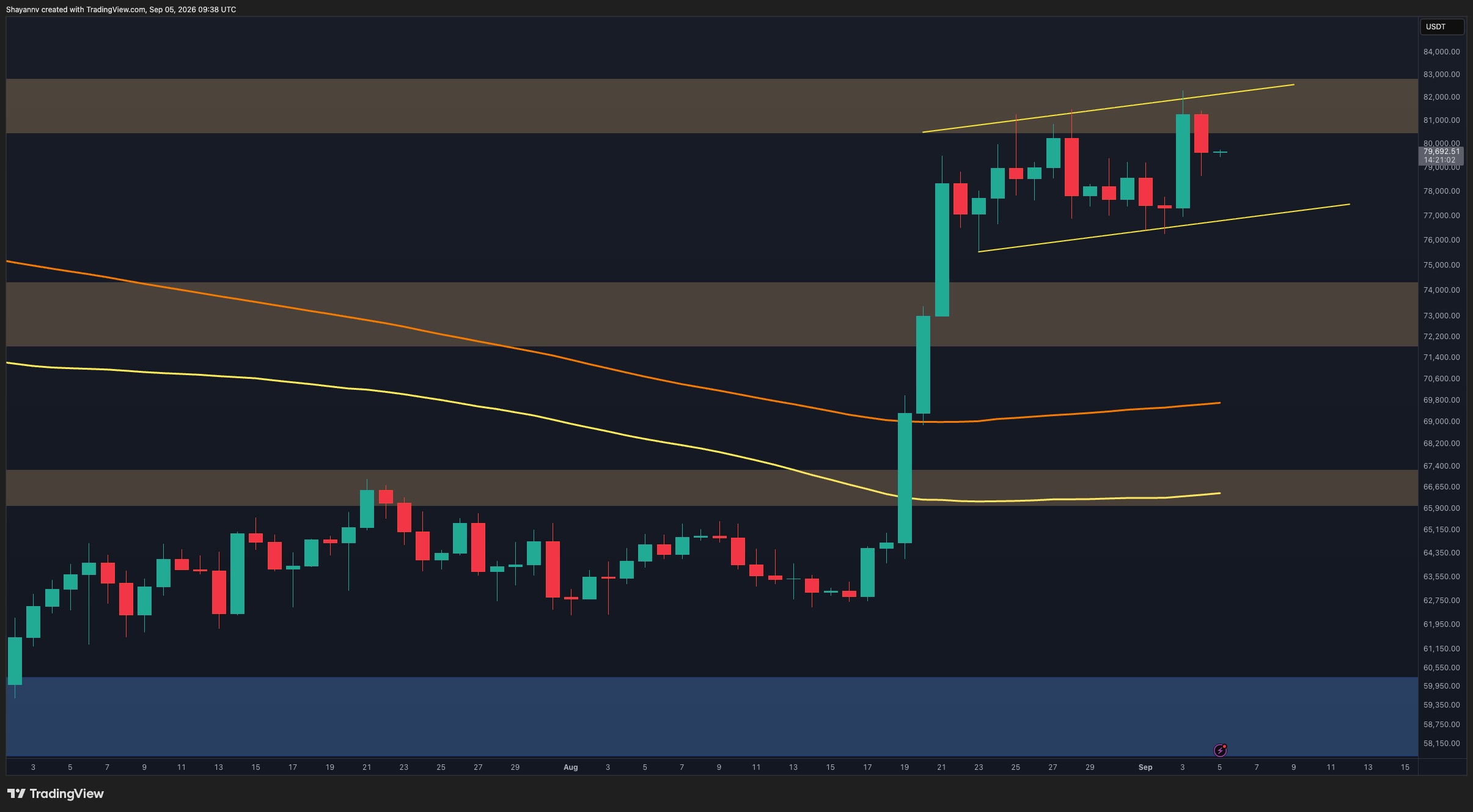
    Bitcoin is currently consolidating, trading below the $80,000 mark but holding above a crucial support channel near $76,000-$77,000. The cryptocurrency recently experienced a rejection from the resistance zone between $80,500 and $82,500, following a period of consolidation after a notable price move. This price action indicates that while the broader trend remains constructive, buyers are struggling to sustain momentum above key levels, leaving the market susceptible to liquidity-driven movements.

    Current Price Action and Key Levels

    Bitcoin’s daily structure shows strength compared to its pre-August phase. The asset remains above the former $72,000-$74,500 resistance zone and both moving averages, suggesting the overall bullish shift is intact despite recent momentum challenges. However, repeated selling pressure has been observed within the $80,500-$82,500 resistance area. The latest attempt to breach this zone briefly reached towards $82,000 before sellers pushed the price back below $80,000. This inability to establish acceptance above resistance indicates that supply remains active at higher price points.

    Technical Analysis: Support and Resistance Dynamics

    The asset continues to trade within a gradually ascending channel, with its lower boundary around the $76,000-$77,000 region serving as the most important nearby structural support. As long as Bitcoin remains above this level, the current price action can be interpreted as consolidation following a sharp rally, rather than a reported bearish reversal. A decisive move above the $80,500-$82,500 zone would strengthen the continuation scenario. Conversely, a loss of the channel support around $76,000-$77,000 could trigger a more substantial correction, potentially targeting the former $72,000-$74,500 zone as the next major area of interest.

    Liquidity Dynamics and Potential Scenarios

    The 4-hour chart highlights the market’s current indecision. Bitcoin rallied from the lower boundary of its ascending structure near $76,500-$77,000 and quickly tested the $81,000-$82,000 area. Sellers rejected this move, causing the price to drop towards $79,500, where it has entered tight short-term consolidation. This pattern contrasts the rising channel with repeated failures near its upper boundary. Buyers are defending higher lows, but they have yet to demonstrate sufficient momentum to convert the $80,500-$82,500 supply area into support. The $76,500-$77,500 region remains crucial; another test could determine the survival of the ascending structure. A strong reaction would keep a renewed push towards $81,000-$82,000 in play, while a move below this level would signal a transition into a deeper corrective phase.

    Analysis of the one-week Bitcoin liquidation heatmap reveals substantial liquidity on both sides of the current price, supporting the possibility of continued choppy trading and liquidity sweeps. Above the market, notable liquidation concentrations are observed around $81,000-$82,000, extending towards approximately $84,000. These clusters could attract price action if buyers regain momentum. However, the downside liquidity is particularly relevant following the latest rejection. A broad and dense concentration of liquidity is visible below the market, especially around the $76,000-$78,000 region, aligning closely with the lower boundary of the ascending technical structure. Consequently, the analysis suggests a downside liquidity sweep towards $76,000-$78,000 is a plausible near-term scenario before another recovery attempt. Such a move would not automatically invalidate the broader bullish setup, but a sustained move below this region would increase the probability of a deeper retracement towards the $72,000-$74,500 support zone.

    Why This Matters

    This market analysis is significant because Bitcoin’s current price action represents a critical juncture. The asset is holding above key support levels ($76K-$77K) and former resistance ($72K-$74.5K), indicating a constructive broader trend. However, repeated rejections at the $80.5K-$82.5K resistance zone highlight buyer struggles and the potential for liquidity-driven swings. The interplay between these levels and the surrounding liquidity pools will likely dictate Bitcoin’s near-term directional move.

    Broader Context

    Bitcoin remains locked in a consolidation phase after a notable price move. The latest rejection from the upper end of the structure shows that buyers are still struggling to generate sustained momentum above $80K. The broader trend remains constructive, although the current range leaves BTC vulnerable to further liquidity-driven swings before its next directional move.


  • Google Patches Actively Exploited Chrome Flaw (CVE-2026-85046)

    Google Patches Actively Exploited Chrome Flaw (CVE-2026-85046)

    Google has released security updates for its Chrome browser to address a high-severity type-confusion vulnerability, identified as CVE-2026-85046, which was reportedly being exploited in the wild. The vulnerability affects the V8 JavaScript engine, a core component used by Chrome for processing JavaScript and WebAssembly.

    Google reported in a security notice published Thursday that it is aware of an exploit for CVE-2026-85046 being used. The company stated that the patch is included in Chrome versions 152.0.7977.82 and 152.0.7977.83 for Windows and Mac, and version 152.0.7977.82 for Linux. Google indicated that the update will be rolling out over the coming days and weeks.

    Exploit Details Remain Unclear

    The nature of the exploit, including the identity of the attackers and their victims, remains unknown. Google has not disclosed whether the bug can be used for remote code execution or when further details about the exploit will be made public. This lack of immediate detail is consistent with Google’s practice of withholding some information until a majority of users and affected third-party projects have installed the necessary patches.

    CVE-2026-85046 is classified as a type-confusion bug. Such flaws typically occur when software misinterprets data types, potentially leading to memory errors or other unpredictable behavior. While Google has not directly linked this specific vulnerability to attacks on cryptocurrency users, browser wallets, exchange accounts, or trading extensions, these areas have been targeted by other methods in the past.

    Researcher Awarded Bounty

    Security researcher Salvatore Gulizia, also known by the alias Serotav, is credited with reporting the flaw on August 4. Google acknowledged his contribution by awarding him a bug bounty of $1,000.

    The recent Chrome update addresses a total of 12 security fixes. Among these are nine high-severity bugs and two medium-severity issues, in addition to the actively exploited CVE-2026-85046. Google also expressed gratitude to all security researchers who collaborated during the development cycle to prevent security bugs from reaching the stable channel.

    Google has not provided specific details regarding the capabilities of the exploit or the extent of its use. The company’s approach of limiting immediate disclosure aims to ensure that users are protected by the patch before detailed information becomes widely available, thereby mitigating further potential exploitation.

    Why This Matters

    The materials describe a narrow update: Google released security updates for Chrome to address a type-confusion vulnerability (CVE-2026-85046) that attackers were actively exploiting. The identity of the attackers.

    Broader Context

    Source materials place the factual news in this context: Google has patched a high-severity Chrome flaw after finding that attackers were already using it.

  • Binance Coin Reaches 7-Month High Driven by US Futures Launch and BNB Chain’s Tokenized Asset Activity

    Binance Coin Reaches 7-Month High Driven by US Futures Launch and BNB Chain’s Tokenized Asset Activity

    Binance Coin (BNB) has surged to a seven-month peak, trading at $770, a significant price movement attributed to two key developments: the launch of regulated perpetual futures contracts for BNB in the US by Kalshi, and reports highlighting the substantial role of BNB Chain in the trading of tokenized equities.

    In the past 24 hours, BNB experienced a notable increase of over 6%, reaching its highest point since early February. This rally occurred despite a broader market downturn following a strong US jobs report, which had previously was associated with a retracement in BNB’s price from $725 to $710 yesterday. The asset found support at $710 before its subsequent surge to $770.

    Regulatory Catalyst: Kalshi Futures
    The introduction of regulated BNB perpetual futures contracts in the US by Kalshi, an exchange overseen by the Commodity and Futures Trading Commission (CFTC), is a significant factor. For eligible US traders, leverage on these contracts is capped at approximately 4.5x. Kalshi also supports integrations with BNB Smart Chain (BSC) for managing international accounts and has previously added support for other altcoins such as ADA, AAVE, WLD, and VVV.

    Tokenized Asset Growth: BNB Chain’s Role
    Complementing the regulatory news, a Grayscale report, cited by Wu Blockchain, indicates that BNB Chain is a widely utilized network for trading tokenized equities. The report noted that the weekly spot volume for tokenized equities reached a peak of nearly $3 billion in August. Currently, only 5% of the tokenized equity market is deployed in on-chain finance. Among the networks facilitating this trading, Robinhood Chain leads, followed by BNB Chain and Solana.

    Grayscale has suggested that increased regulatory clarity in the US could potentially expand tokenized stocks from global, around-the-clock trading products into more productive on-chain financial assets. This perspective underscores the evolving landscape of tokenized markets and the potential for further integration with traditional finance.

    While BNB’s performance has shown resilience against broader market trends, certain uncertainties remain. The long-term impact of regulatory developments on tokenized assets and the precise definition of ‘eligible US traders’ for Kalshi’s futures contracts are areas that warrant continued observation. The future trajectory of BNB’s price will likely depend on these evolving regulatory frameworks and the sustained growth of utility on the BNB Chain.

    Why This Matters

    The materials describe a narrow update: Binance Coin experienced a significant price surge, reaching $770, its highest point in seven months. The exact impact of the US jobs report on BNB’s price beyond the immediate retracement.

    Broader Context

    Source materials place the factual news in this context: Binance Coin is among the top performers in the past 24 hours in the altcoin space, surging by over 6% and further extending its lead above XRP in terms of market cap placement.

  • AI Model Claude Generates Machine-Checkable Formal Proof of Fermat’s Last Theorem

    AI Model Claude Generates Machine-Checkable Formal Proof of Fermat’s Last Theorem

    An AI model named Claude has generated a formal proof of Fermat’s Last Theorem, producing a 13-million-line, machine-checkable document in just 11 days. While this achievement highlights the growing capabilities of AI in complex mathematical reasoning, Anthropic, the developer of Claude, emphasizes that the model formalized an existing proof rather than discovering new mathematics.

    Fermat’s Last Theorem, first claimed by Pierre de Fermat in 1637, states that no three positive whole numbers a, b, and c can satisfy the equation a^n + b^n = c^n for any integer value of n greater than 2. It took mathematicians approximately 358 years to establish a definitive proof. Andrew Wiles announced a proof in 1993, which was later found to contain a flaw. A corrected and complete proof by Wiles was published in May 1995, spanning 129 pages and relying on advanced mathematical concepts developed long after Fermat’s time.

    Broader Context

    Source materials place the factual news in this context: Fermat’s Last Theorem states that no three positive whole numbers a, b, and c can satisfy the equation a^n + b^n = c^n for any integer value of n greater than 2.

    The Challenge of Formal Proofs

    Formalization, as explained by mathematicians, involves translating a proof into a language so precise that a computer can verify every logical step without human interpretation. This is crucial because, historically, even complex proofs have been susceptible to human error or oversight. For instance, a prize offered in 1908 for a proof of Fermat’s Last Theorem attracted 621 incorrect submissions in its first year alone, underscoring the difficulty of ensuring mathematical rigor.

    AI’s Scale and Speed

    Claude’s proof generation is notable for its scale and speed. The 13-million-line output is significantly longer than previous proofs and was completed in a fraction of the time human mathematicians typically spend on such tasks. According to Anthropic, the AI used tools to manage the process, involving dozens of agents working in parallel to avoid duplication. The resulting proof is equivalent in length to approximately 160 novels.

    Mathematicians like Kevin Buzzard, who leads a project to formalize Wiles’s proof in the Lean system, have reviewed Claude’s output. Buzzard reported that the proof is mathematically sound. However, it is important to distinguish this formalization from independent mathematical discovery. Claude’s work is akin to creating a highly detailed, computer-verifiable record of an existing mathematical argument, rather than uncovering new theorems or methods.

    Implications for Mathematical Verification

    The implications of AI-generated formal proofs are significant for the field of mathematics. As mathematicians face an increasing volume of complex proofs, including those generated by AI, the need for efficient and reliable verification methods becomes paramount. Human verification of major mathematical proofs can take years; for example, the computer-assisted proof of the Kepler conjecture required four years before a review panel could suggest it with 99% certainty. AI formalization offers a potential solution to this bottleneck, providing deterministic and error-resistant verification.

    While Claude’s proof is machine-checkable, uncertainties remain regarding the long-term impact of AI on mathematical research and the definition of mathematical certainty. It is not yet certain whether Fermat himself possessed a valid proof for his theorem, and the advent of AI-generated proofs prompts a re-evaluation of how mathematical certainty is established and maintained in the digital age.

  • XRP Rally Ignites, Analysts Predict Shocking Targets

    XRP Rally Ignites, Analysts Predict Shocking Targets

    XRP Surges Amidst Analyst Optimism, With Some Predicting Astonishing Price Targets

    Despite a recent pullback from its mid-August peak, Ripple’s cross-border token, XRP, has demonstrated resilience, remaining up 40% from multi-year lows established less than a month ago. This upward momentum has fueled significant optimism among analysts, with some projecting exceptionally high future price points.

    A Shift in Analyst Sentiment

    While market observers like EGRAG CRYPTO have consistently expressed bullish views on XRP, the recent price target set by analyst Ali Martinez has captured the community’s attention. Martinez believes XRP has already reached its cycle bottom and is now on a recovery trajectory. Previously, he had indicated a more conservative target of $1.70, a level XRP briefly touched on August 21-22 following a rapid 70% surge in under 72 hours.

    However, XRP experienced a sharp rejection at that mark, falling below $1.35 last week. Its subsequent ability to stabilize above this level and rebound to the current $1.40 has reignited bullish sentiment, with Martinez now joining the chorus of optimistic forecasts.

    The $60 XRP Prediction

    In a recent post to his 166,000 followers, Martinez highlighted that XRP has been “forming a massive ascending triangle on the monthly chart.” He posited that a breakout above the key resistance level of $3.66, with a monthly close above it, would confirm this pattern and activate a technical target of approximately $60 per XRP.

    This ambitious prediction, if realized, would represent a nearly 4,200% increase from current levels, even over a decade. Such a valuation would propel XRP’s market capitalization to around $4 trillion, surpassing current market leaders like Bitcoin and even tech giants such as Amazon and Microsoft, assuming XRP’s supply remains constant, which is not the case.

    More Grounded, Yet Still Bullish, Forecasts

    While Martinez’s $60 target stands out, other analysts, including EGRAG CRYPTO, have also issued highly optimistic, albeit less extreme, predictions. Drawing on XRP’s historical performance, which has seen rallies of up to 2,400%, EGRAG CRYPTO outlined significant targets in a September 5 analysis. The most ambitious of these, mirroring XRP’s 2017-2018 bull phase, projects a potential price of $25. Slightly more conservative targets were set between $11 and $15.8.

    Although these figures may seem ambitious given the current market conditions, the significant shift in market structure over recent weeks lends some credence to the underlying bullish sentiment.

  • Ripple Expands Sports Partnerships with Florida Gators, Sponsors Stable Launch Competition

    Ripple Expands Sports Partnerships with Florida Gators, Sponsors Stable Launch Competition

    Ripple has announced a significant expansion of its US presence through a new partnership with the Florida Gators and its headline sponsorship of the Stable Launch startup competition. These developments underscore Ripple’s dual strategy of increasing brand visibility via sports affiliations and actively engaging with the technology startup ecosystem.

    The partnership with the Florida Gators includes placing the XRP logo on the team’s sports grounds, a deal reportedly valued at $5 million annually. This collaboration follows a similar agreement Ripple established with the Kansas Jayhawks. According to athletic director Scott Stricklin, the Gators organization views this partnership as an opportunity to embrace innovation and enhance fan experiences.

    In parallel, Ripple will serve as the headline sponsor for Stable Launch, a startup competition organized as part of Stablecon USA. The winning startup in this competition is set to receive a $200,000 investment prize. Whittney Levitt from Ripple is also reported to be a judge for the event.

    These announcements, made within the past 24 hours, highlight Ripple’s strategic approach to brand building. The verifiable financial details include the $5 million annual figure from the Florida Gators deal and the $200,000 investment prize for the Stable Launch winner. News of Ripple’s sponsorship of Stable Launch was shared on X, according to BankXRP.

    Why This Matters

    The materials describe a narrow update: Ripple has entered into a partnership with the Florida Gators, which includes placing XRP’s logo on the team’s grounds for an annual fee of $5 million. The partnership with Florida Gators is a continuation of Ripple’s US sports endeavors.

    Broader Context

    Source materials place the factual news in this context: Less than two months after announcing a major partnership with the Kansas Jayhawks, the company behind XRP has doubled down on its US sports endeavors by collaborating with the Florida Gators.

  • Pi Network Rolls Out 3 Major Upgrades: Impact for Pioneers

    Pi Network Rolls Out 3 Major Upgrades: Impact for Pioneers

    New Tools Aim to Boost Pi Network App Development

    The core team behind the popular Pi Network project has unveiled three new capabilities designed to enhance its ecosystem’s appeal to app developers. Alongside these new features, the project has also revamped its developer documentation as part of a broader initiative to increase real-world utility.

    This latest update follows several months of releases focused on expanding Pi beyond basic cryptocurrency transactions and providing users with more compelling reasons to engage with the ecosystem.

    Enhanced Developer Capabilities

    The three newly introduced developer capabilities are local storage, access to app-specific staking data, and file and video sharing. Local storage, in particular, stands out as a significant development.

    Selected Pi Browser applications, which have undergone a whitelisting process, can now store certain information directly on a user’s device. This eliminates the need for developers to manage their own backend infrastructure. Data such as user preferences, session inflation, and other relevant information can be stored locally, potentially reducing infrastructure costs and complexity while ensuring a consistent user experience across both Android and iOS devices.

    It is important to note that this locally stored data is not uploaded to Pi Network’s servers. The feature currently has limitations, including access being restricted to whitelisted apps, a finite storage capacity, and the potential for older data to be automatically removed.

    The second release, the Staking Data API, grants eligible developers the ability to view the amount of effective Pi a user has staked specifically for their application through Ecosystem Directory Staking. Developers could leverage this information to create application-specific features tailored to their most dedicated supporters.

    The third new feature, Pi.shareFile, enables applications to utilize a phone’s native sharing functionality for files, images, and videos. Examples provided in the project’s blog post include marketplace users sharing receipts or photos, and gaming or content applications allowing users to share video clips directly.

    Streamlined Documentation and AI Integration

    In addition to these three new features, Pi Network has announced the consolidation of previously dispersed developer resources into a single, comprehensive documentation platform. This new platform covers a wide range of topics, from app registration and sandbox development to authentication, Pi payments, Mainnet preparation, and launch procedures.

    The updated documentation also incorporates AI-assisted guidance for integrating authentication and payments. This initiative aims to reduce the friction involved in building applications for Pi, aligning with the project’s overarching strategy.

    The team stated that these releases address a critical challenge for the project and the long-term prospects of its native token: equipping developers with more tools and fewer technical hurdles to build applications that users genuinely want to utilize.

  • CoinRabbit Awarded ‘Best Crypto Lending Platform 2026’ Amidst Focus on Capital Preservation

    CoinRabbit Awarded ‘Best Crypto Lending Platform 2026’ Amidst Focus on Capital Preservation

    CoinRabbit has been recognized as the “Best Crypto Lending Platform 2026” by International Business Magazine, a distinction that underscores the platform’s operational model and its expansion into broader crypto asset management. The award highlights CoinRabbit’s lending product, which has facilitated over $1.45 billion in loans since 2020, and its commitment to capital preservation through a 100% capital reserve model and a strict no-rehypothecation policy.

    Award Recognition and Operational Stance

    According to reports, the “Best Crypto Lending Platform 2026” award from International Business Magazine acknowledges CoinRabbit’s efforts in ecosystem development. Central to its operations is a stated commitment to capital preservation. Since 2020, CoinRabbit has maintained a 100% capital reserve model, ensuring client assets are fully reserved and not reused or lent out elsewhere. This no-rehypothecation policy is presented as a key factor in providing borrowers with confidence in the security of their funds.

    Platform Performance and Accessibility

    CoinRabbit’s lending process is designed for efficiency, with loans typically processed in approximately 10 minutes. The platform utilizes crypto collateral for underwriting, eliminating the need for traditional credit checks. This streamlined approach accommodates a wide range of loan sizes, from a few hundred dollars to six-figure positions.

    Ecosystem Expansion and Executive View

    Beyond its core lending services, CoinRabbit has introduced a Private Program, specifically designed for high-net-worth clients with portfolios of $500,000 and above. This program aims to offer a more personalized, private banking-style experience. Walter Barrett, commenting on the award, noted that it recognizes years of product refinement and CoinRabbit’s evolution into a comprehensive crypto capital management solution.

    CoinRabbit stated its objective is to enhance both its lending product and its expanding services. The company positions itself as a crypto asset management platform prioritizing long-term capital preservation. Its offerings include instant payments, lending, yield generation, trading, and the Private Program, all accessible through a single platform.

    The award process, reportedly involving public nominations and jury review, assessed nominees on their work, progress, and contributions to their respective industries. CoinRabbit’s predictable borrowing experience, rapid processing times, and stated security policies are cited as contributing factors to this recognition.

    Why This Matters

    The materials describe a narrow update: CoinRabbit received an award for being the best crypto lending platform in 2026 from International Business Magazine. The award signifies CoinRabbit’s significant impact and progress in the crypto lending industry.

    Broader Context

    Source materials place the factual news in this context: CoinRabbit is moving beyond borrowing against crypto and building a broader ecosystem for managing digital-asset capital.

  • XRP Defends $1.40 Support; Analyst EGRAG CRYPTO Predicts Potential 100% Rally Contingent on Resistance Breach

    XRP Defends $1.40 Support; Analyst EGRAG CRYPTO Predicts Potential 100% Rally Contingent on Resistance Breach

    XRP is currently defending a crucial support level at $1.40, following a recent correction that saw its price dip below $1.35. This defense of the support level comes as analyst EGRAG CRYPTO has projected a potential 100% rally for XRP, targeting a price of $2.70.

    The price action in late August saw XRP recover from a pullback that moved it from $1.70 to $1.33 within a little over a week. The asset has since managed to stabilize above the $1.40 mark. This recovery has coincided with a significant increase in trading activity across major exchanges, with spot trading volumes reaching their highest levels since February during late August. Binance reported nearly $7.3 billion in XRP spot trades, followed by Upbit with $4.7 billion and Bithumb with $2.6 billion.

    Analyst EGRAG CRYPTO suggests that XRP is attempting to establish a bullish continuation pattern. According to EGRAG CRYPTO, if XRP successfully overcomes key resistance levels, it could potentially reach $2.70, which would represent a 100% increase from recent lows. However, this outlook is contingent on XRP breaching several resistance barriers. The first significant resistance is noted at $1.50, with a subsequent level at $1.60. A decisive daily close above both these levels would be necessary for XRP to target a psychological price of $2.00.

    Should XRP fail to break through these resistance levels, it may fall back to the $1.25-$1.30 support range, which has been tested successfully in the recent past. The analyst’s prediction of a $2.70 target is presented as a possibility rather than a certainty, with EGRAG CRYPTO acknowledging that demand remains present despite previous rejections at the $1.70 level.

    Further supporting the notion of growing demand are recent trends in ETF inflows. Financial products related to XRP experienced their best week of 2026 at the end of August, attracting over $110 million. This contributed to cumulative net inflows reaching a new all-time high of $1.66 billion. While the pace of inflows may have cooled in the past week, these funds have consistently closed in the green for the preceding two months. Additionally, reports indicate that large holders, often referred to as Ripple whales, have been actively accumulating XRP.

    Despite these positive indicators, significant uncertainties remain. The ability of buyers to reclaim and hold above the resistance areas that have previously capped XRP’s upward movements is a key factor. The realization of EGRAG CRYPTO’s $2.70 price target is dependent on overcoming these technical hurdles. While the current defense of the $1.40 support level and increased market activity are encouraging signs, the path forward for XRP is not guaranteed and remains subject to market dynamics and the successful breach of critical resistance points.

    Why This Matters

    The current price action shows XRP defending a support level at $1.40. The potential for a significant rally exists, but it is contingent on overcoming key resistance levels, as highlighted by analyst EGRAG CRYPTO’s prediction. The outcome remains uncertain and dependent on market dynamics.

    Broader Context

    Source materials place the factual news in this context: The price rally initiated by the cross-border token in mid-August was halted at $1.70, and the subsequent correction drove it south hard to under $1.35. XRP has since managed to rebound and is now sitting above a key support level at $1.40.

  • Coinbase Files for Single-Stock Perpetual Futures in US, Facing Regulatory Uncertainty

    Coinbase Files for Single-Stock Perpetual Futures in US, Facing Regulatory Uncertainty

    Coinbase has submitted notice registrations with the US Securities and Exchange Commission (SEC) to offer single-stock perpetual futures to US investors, a move that signals the company’s intent to expand its regulated derivatives offerings domestically. However, the filings, submitted on September 1, do not guarantee the product’s launch and are subject to regulatory review and approval from both the SEC and the Commodity Futures Trading Commission (CFTC).

    The practical implication of these filings is limited to initiating the regulatory process. Notice registrations open the door for a broker or exchange to offer a given product, but final approval and any associated conditions rest with regulators. This development comes as the US continues to sort out the regulatory classification of perpetual contracts, which carry no expiration date, allowing traders to bet on an asset’s price without owning it.

    Coinbase plans to work with both the SEC and the CFTC to bring more major financial products onshore. The company has already launched tokenized stock trading for customers outside the US in August and offers other futures products through Coinbase Derivatives, LLC. Coinbase Financial Markets, Inc. is registering as a security futures product broker-dealer under the Securities Exchange Act of 1934. The company also rolled out pre-IPO perpetual futures starting with SpaceX, with contracts for companies like Anthropic and OpenAI expected to follow.

    The market for pre-IPO perpetual futures has seen significant growth, expanding more than tenfold since May to approximately $12 billion, according to CryptoQuant. This burgeoning market faces a complex regulatory landscape. In May, the CFTC approved Kalshi to offer Bitcoin perpetual futures, marking the first time such a product cleared for the US market. However, this decision has been met with opposition from CME Group, which stated it would challenge the CFTC’s approval in court. CME Group argues that perpetuals should be regulated as swaps rather than futures, with CME CEO Terrence Duffy noting that the company’s exclusive licensing deals with benchmark providers mean any perpetual contract tied to those benchmarks must run through CME.

    CFTC Chair Michael Selig has defended the original approval of Kalshi’s product as a means to bring regulated, expiration-free products under US oversight. The regulatory uncertainty surrounding perpetual futures is a key aspect of this story, with ongoing debates about their classification and the potential for legal challenges.

    Several uncertainties remain regarding Coinbase’s filing. The timeline for the potential launch of single-stock perpetual futures in the US is unknown, and ultimate approval from the SEC and CFTC is not assured. The final classification of perpetual contracts under American law and the outcome of CME Group’s legal challenge are also significant factors that may shape the future of these products in the US market. The filings themselves do not guarantee that the product will launch on any set timeline.

    Why This Matters

    The materials describe a narrow update: Coinbase submitted notice registrations to the SEC to offer single-stock perpetual futures in the US. The timeline for the launch of single-stock perpetual futures in the US.

    Broader Context

    Source materials place the factual news in this context: Coinbase is working to bring single stock perps to the US.