Category: Uncategorized

  • Cardano, Sui Flash Buy Signals: Next Targets Revealed

    Cardano, Sui Flash Buy Signals: Next Targets Revealed

    Crypto Market Shows Signs of Life, ADA and SUI Lead Gains

    The cryptocurrency market has experienced a modest rebound over the past 24 hours, with Cardano’s ADA and the newly launched SUI token emerging as top performers. Several indicators suggest this upward trend may be in its nascent stages, coinciding with a recent surge in bullish sentiment among market analysts.

    Cardano’s native token, ADA, has seen a significant daily increase of 6%, successfully reclaiming the crucial $0.20 psychological level. Adding to the positive outlook, prominent analyst Ali Martinez highlighted that ADA’s Tom DeMark Sequential (TDS) indicator has generated a buy signal. Martinez noted that historically, such signals have preceded price bottoms and have been followed by substantial double-digit gains. “Now the indicator is signaling another rebound for ADA could be underway,” Martinez stated.

    Further bolstering the bullish narrative is the recent trend in exchange net flows. Data indicates that for several consecutive days, outflows from exchanges have surpassed inflows. This suggests a shift in investor behavior, with a move towards self-custody away from centralized platforms, potentially reducing immediate selling pressure.

    On social media platform X, user Sjuul | AltCryptoGems expressed surprise at ADA’s performance this cycle, observing “very strong higher highs, one after the other in a perfectly bullish fashion.” The user added, “Probably not a coin I would fade in the coming months.”

    Another X user, The Moon Show, commented that ADA “survived the deep retrace.” This user believes that a decisive move above the $0.205 level would signal a “much more serious” recovery.

    SUI Joins ADA in Bullish Momentum

    Meanwhile, SUI is trading at approximately $0.76, marking a 7% increase for the day. Similar to ADA, the SUI token appears poised for further gains, according to insights from Ali Martinez. He reported that SUI’s TDS indicator has also flashed a buy signal on its daily chart, suggesting that the recent price correction may be nearing its conclusion. “This indicator points to a potential 1–4 daily candlestick rebound or the beginning of a new bullish countdown. I’m watching for the rally to begin,” Martinez commented.

    Other notable analysts have also weighed in on SUI’s potential. Michael van de Poppe observed that SUI has outperformed Bitcoin, opining that “the uptrend has started.” Separately, Celal Kucuker suggested that SUI “is making a move,” forecasting a potential price surge to as high as $10 in a bull market scenario. Kucuker also hinted that September could be a favorable month for SUI, based on observed “OTC flows.”

  • XRP Consolidating Near $1.40, Approaching Technical Decision Point Amid Uncertainty

    XRP Consolidating Near $1.40, Approaching Technical Decision Point Amid Uncertainty

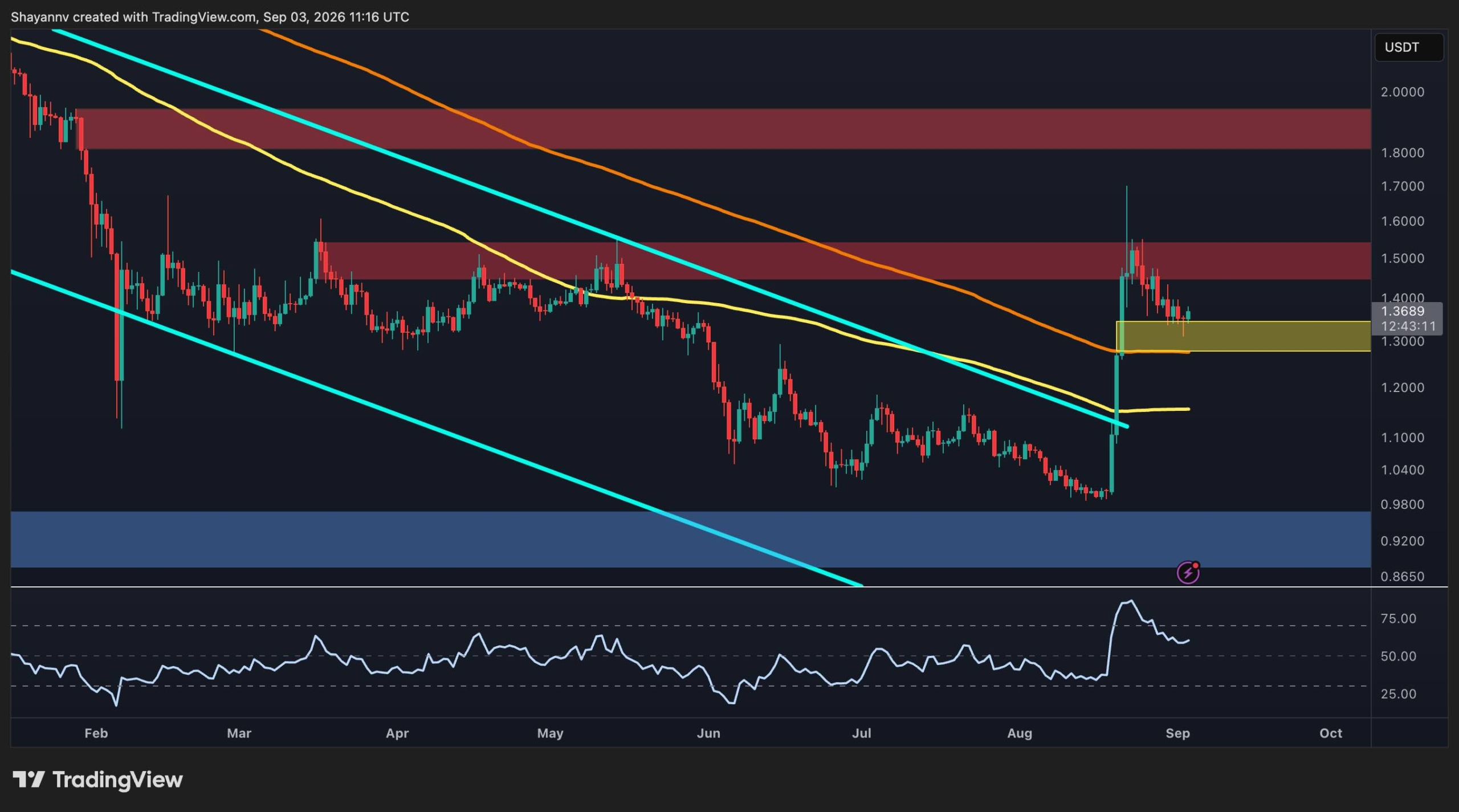
    XRP is currently consolidating near the $1.40 mark, a technical decision point following a notable move in late August. The cryptocurrency is testing key support and resistance levels, with its price action forming a descending structure that signals potential future direction, though the outcome remains uncertain.

    Following a sharp surge from approximately $1.00 to a spike near $1.70 in late August, XRP has entered a consolidation phase. According to the analysis, the broader market structure has improved considerably, yet the token remains beneath a major resistance zone. The current price action is being observed within a descending structure, defined by two downward-sloping trendlines on the 4-hour chart. This pattern indicates that a decisive move is on the horizon, which could determine whether the recent rally resumes or transitions into a deeper retracement.

    Key Technical Levels and Support

    The charts suggest that XRP has pulled back toward the $1.30 area, identified as an important demand zone and a clear bullish imbalance area. Importantly, XRP remains above both the 100-day and 200-day moving averages. The analysis indicates that this sustained position above key moving averages suggests the broader recovery structure is still intact, despite the recent correction.

    Resistance and Potential Upside

    The $1.5 region represents the primary resistance zone above the current price. This area has previously acted as a significant supply zone and has rejected XRP’s price multiple times. The analysis indicates that a daily close above this $1.50 level would strengthen the bullish case and could potentially lead toward the $2 region, an important psychological barrier for Ripple.

    Support and Potential Downside

    On the downside, the immediate support region is identified as the $1.25 bullish order block. As long as XRP continues to hold this zone, the descending structure could eventually resolve to the upside. However, a notable move below the $1.25 area would increase the probability of a deeper retracement toward a lower order block around $1.10. The analysis indicates that losing the $1.25 area would invalidate the immediate bullish setup and could send the price back toward the base of the recent rally.

    Momentum and Outlook

    The momentum picture has also cooled substantially from the extreme levels reached during the initial notable move. The daily Relative Strength Index (RSI) has fallen below 75, relieving overbought conditions while remaining above the neutral 50 area. This cooling of momentum is generally viewed as constructive, as XRP has been able to consolidate without a complete loss of its recent price movement.

    Overall, XRP is approaching a decision point. The analysis indicates that holding the $1.25 support and breaking above the descending trendline would favor a continuation of the rally above $1.50. Conversely, a failure to hold the $1.25 area would invalidate the immediate bullish setup. The outcome of this consolidation phase will be crucial in determining XRP’s short-to-medium term price action.

    Why This Matters

    The analysis focuses on XRP’s current price action and its critical technical juncture. The materials describe a narrow update: XRP experienced a significant notable move in late August, moving from around $1.00 to a spike near $1.70, and is now consolidating near $1.40. Whether the recent rally will resume or develop into a deeper retracement remains uncertain.

    Broader Context

    Source materials place the market analysis in this context: XRP is consolidating after its sharp late-August notable move, with the price now hovering close to $1.40. The analysis highlights key support around $1.25 and resistance near $1.50, with the price currently within a descending structure. The outcome hinges on whether it can overcome resistance or break down below support.

  • Cardano’s ADA Token Sees Modest Price Surge After Listing on Japan’s S.BLOX Exchange

    Cardano’s ADA Token Sees Modest Price Surge After Listing on Japan’s S.BLOX Exchange

    Cardano’s native token, ADA, experienced a price increase of approximately 5% over a 24-hour period following its listing on S.BLOX, a Japanese cryptocurrency exchange. The exchange, which is registered with local financial bureaus and linked to the Sony Group through a subsidiary, also listed Midnight’s NIGHT token. This development provides a regulated yen on-ramp for Japanese retail investors.

    S.BLOX added both ADA and the NIGHT token to its platform on August 24. Operating under the registration of Japan’s Kanto and Kinki Local Finance Bureaus, the exchange adheres to the country’s stringent regulatory framework for digital assets. The connection to Sony Group is through a subsidiary, and does not represent a direct partnership or integration with the broader Sony conglomerate.

    Promotional incentives for eligible users related to these listings ran through August 30, offering up to 10,000 yen (approximately $63 USD) for ADA and up to 14,000 yen (approximately $88 USD) for NIGHT token. The listing of the NIGHT token was reported as the first instance of a Japan-registered exchange supporting Midnight’s native token.

    Market Reaction and Historical Context

    In the immediate aftermath of the listing, ADA saw a price surge of about 5% within 24 hours, while the broader cryptocurrency market remained largely flat or experienced declines. This price action occurred despite ADA experiencing an 8.9% decline in the week following the August 24 news. At the time of reporting, ADA was trading around $0.205.

    Cardano founder Charles Hoskinson acknowledged the significance of the listing. However, the practical implications of such listings are often viewed as distribution wins rather than direct demand events, though demand has been observed. The listing suggests that ADA and NIGHT token have passed the compliance filters of a rigorous exchange licensing regime, signaling regulatory standing.

    This event is contextualized within Japan’s maturing stablecoin and digital-asset infrastructure, fitting into a broader regulatory expansion rather than a Cardano-specific breakout. Historically, Cardano has seen numerous announcements, including enterprise-adjacent headlines and integration pilots, that generated attention but did not lead to sustained price increases. ADA traded above $2.50 in late 2021, representing a decline of over 90% from its peak, despite a stream of milestone announcements since then. The token currently sits near $0.20.

    Uncertainties Remain

    There remains uncertainty regarding whether the regulated exchange listing was followed by the price surge or if other factors were involved. The long-term impact of the listing on ADA’s demand and price action is yet to be determined. It is also unclear to what extent this listing signifies a broader trend for Japanese crypto infrastructure or a Cardano-specific development. It is important to note that this listing does not indicate a partnership, product integration, or infrastructure deal with Sony Group.

    Broader Context

    Source materials place the factual news in this context: Japan’s stablecoin and digital-asset infrastructure has been maturing on its own track, and this listing fits that broader regulatory expansion rather than a Cardano-specific breakout.

  • Bitcoin Recovers from $76K, Faces $80K Resistance

    Bitcoin Recovers from $76K, Faces $80K Resistance

    Bitcoin Holds Above $78,000 Amidst Cautious Recovery, Key Resistance Looms

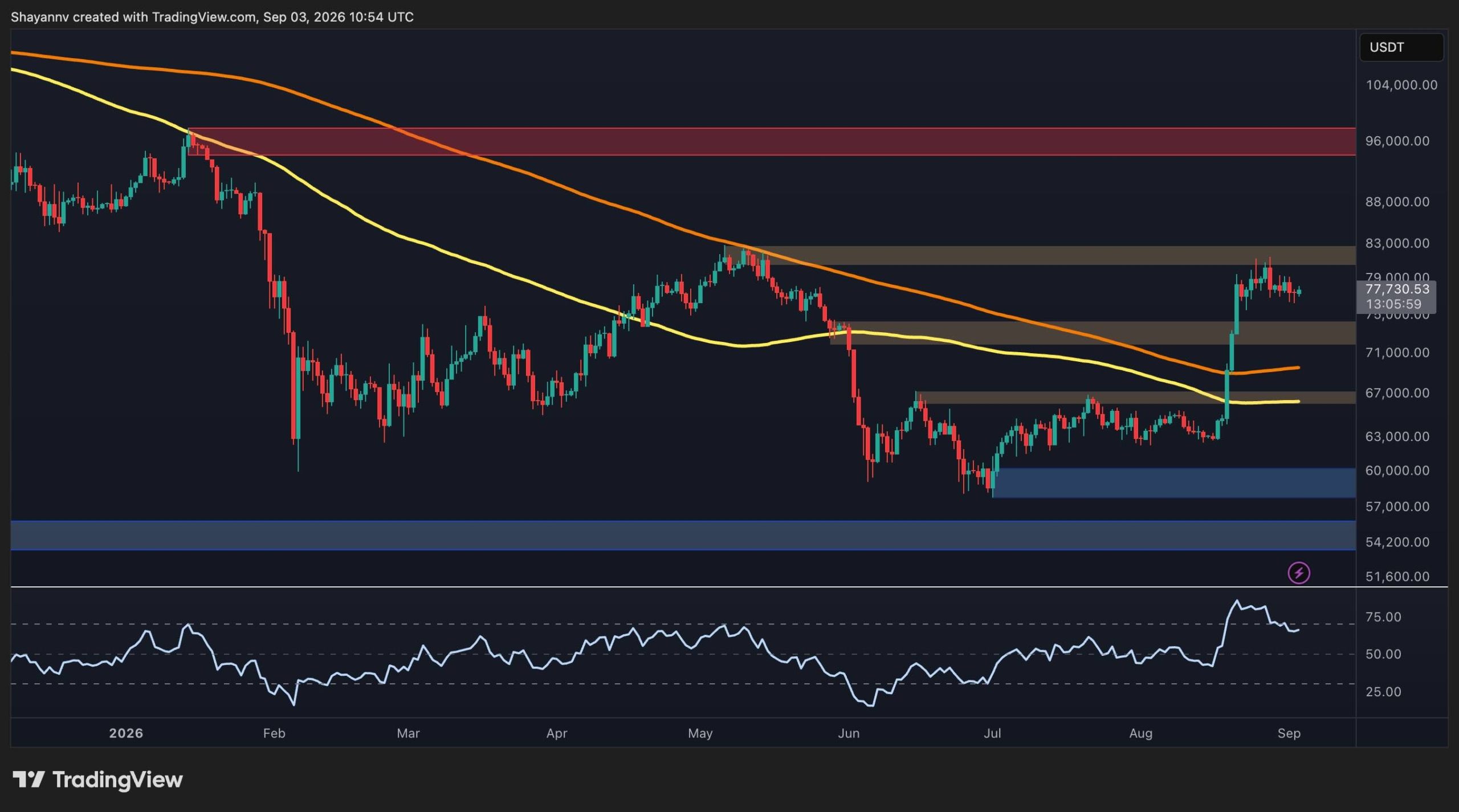
    Bitcoin is currently trading above the $78,000 mark, having staged a significant recovery from the $60,000 level. However, recent price action suggests that buyers have yet to achieve a decisive breakout above key resistance levels. Simultaneously, a notable increase in the exchange whale ratio is signaling potential bearish pressure from the supply side, contrasting with an otherwise constructive technical outlook.

    Daily Chart Analysis

    The daily chart reveals a substantial structural improvement following the rebound from the $60,000 support zone. Bitcoin (BTC) has successfully broken above the $67,000 area and subsequently reclaimed the $72,000 zone, which had previously acted as a resistance barrier. The cryptocurrency is now trading around $78,500, comfortably positioned above both major moving averages depicted on the chart.

    The immediate challenge for buyers lies at the $82,000 resistance zone. This area aligns with recent swing highs, presenting a significant hurdle. A daily close above this level would bolster the recovery structure by establishing a higher high after months of a downtrend, potentially paving the way for a move towards the $95,600 resistance region.

    Momentum indicators have also shown considerable improvement. The daily Relative Strength Index (RSI) has climbed from oversold territory during the June lows and is now approaching overbought conditions. However, the RSI has begun to trend lower after reaching elevated levels, suggesting a cooling of momentum rather than an acceleration.

    On the downside, the $72,000 zone represents the first major support level to monitor. Holding above this level would preserve the broader recovery trend, while a more significant correction could bring the $67,000 region back into focus.

    Therefore, the daily structure remains cautiously constructive. However, Bitcoin needs to overcome the $82,000 resistance to confirm that the recent recovery is evolving into a sustained bullish continuation, rather than another rejection from a key resistance point.

    Four-Hour Chart Perspective

    The four-hour chart presents a more cautious outlook. Since reaching the $82,000 area in late August, BTC has been consolidating within a structure resembling a falling wedge. The upper trendline of this formation has repeatedly capped upward advances, while the lower boundary is currently situated around $76,000.

    Bitcoin is presently testing the upper boundary of this structure once again. A successful breakout above this resistance line, which is currently near the $78,000 mark and trending downwards, would be the initial indication of buyers attempting to regain short-term control.

    A potential breakout could lead to another push towards the $82,000 area, which, as previously noted, stands as the most critical resistance level on the daily timeframe.

    Conversely, a failure to break out of the wedge and a subsequent move below $76,000 could trigger a deeper correction towards the $72,000-$74,000 area, which has transitioned into support after being previously breached to the upside. Maintaining this zone would be crucial for sustaining the recovery, as a breakdown could negate the positive price action observed by Bitcoin over the past few weeks.

    Exchange Whale Ratio Signals Caution

    The exchange whale ratio measures the proportion of exchange inflows associated with the largest transactions, offering insight into whether large holders are becoming more active in sending Bitcoin to exchanges. A rising ratio can indicate increased potential selling pressure, though it does not necessarily imply immediate selling by whales.

    The chart illustrates a sharp increase in the 30-day moving average of Bitcoin’s exchange whale ratio during the latest price recovery. This ratio has moved back towards the 0.32 area, nearing its highest visible levels on the chart, while BTC trades around $78,500.

    This development warrants close observation. While Bitcoin has recovered substantially from its June lows, the escalating whale ratio suggests that large transactions directed towards exchanges have also become more prominent. This could potentially shift the supply and demand balance in favor of sellers. If this elevated reading persists while Bitcoin struggles to break above the $80,000-$82,000 area, it could reinforce the likelihood of a rejection or consolidation.

    On the other hand, a decisive breakout above $82,000, coupled with a subsequent decline in the whale ratio, would offer more constructive confirmation. This would suggest that increased whale activity is not translating into significant distribution and that sufficient fresh demand exists to absorb any potential selling by large holders.

  • Arthur Hayes Identifies EUR/JPY as Key Liquidity Indicator, Contrasting with Fed Commentary

    Arthur Hayes Identifies EUR/JPY as Key Liquidity Indicator, Contrasting with Fed Commentary

    Arthur Hayes, chief investment officer of Maelstrom, has proposed that the euro-yen exchange rate (EUR/JPY) may offer a more insightful view into dollar liquidity affecting Bitcoin than recent statements from Federal Reserve officials. In an essay published Thursday, Hayes argued that potential funding stress within French banks could compel the Federal Reserve to inject liquidity into the US repo market, a development he suggests could be supportive for Bitcoin.

    Hedging his analysis, Hayes posits that mounting funding stress at French banks, which collectively handle a significant portion of US repo lending, could lead the Federal Reserve to increase its intervention in the repo market. He cited widening French government bond spreads and indications of capital withdrawal from these banks as evidence of this stress. According to Hayes, if these French banks reduce their participation in repo lending, the New York Fed might increase its reliance on its Reverse Repurchase Agreement (RPM) program. This program already accounts for a substantial portion of Treasury bill issuance, and Hayes suggests its pace could accelerate if the Treasury were to increase its purchases of longer-term bonds.

    Furthermore, Hayes linked his outlook for the EUR/JPY exchange rate to a broader strategy attributed to US Treasury Secretary Scott Bessent. Hayes forecasts that EUR/JPY could decline to 140 or lower by June of next year. He suggests this movement is tied to an effort to weaken the euro and strengthen Asian currencies, thereby enhancing the competitiveness of American exports. Hayes indicated that Bessent has already engaged in transactions to sell euros for yen through the Treasury’s Exchange Stabilization Fund, with the intention of routing capital through the Fed’s FIMA repo facility.

    In contrast to his focus on EUR/JPY, Hayes dismissed the relevance of recent comments from former Federal Reserve official Kevin Warsh. Warsh had previously emphasized the Fed’s commitment to its 2% inflation target, which coincided with a notable drop in Bitcoin’s price and an increase in market expectations for a September rate hike. Hayes stated that he does not pay attention to such commentary.

    At the time of writing, EUR/JPY was trading around 185. Bitcoin had experienced volatility in the preceding week, including a drop of approximately $3,000 following Warsh’s remarks and a broader market reaction to geopolitical events. Despite this, Bitcoin had seen gains of nearly 22% over the preceding 30 days, trading near $78,000.

    Hedging further, Hayes also provided long-term price targets for other digital assets, projecting ETH to reach $10,000 and ENA to reach $0.50 by the end of 2026. Maelstrom’s portfolio reportedly includes Bitcoin as a core long-term holding.

    It is important to note the uncertainties surrounding this analysis. The extent to which French banks may withdraw from repo lending, the precise timing and scale of any Federal Reserve liquidity injections, and the actual future trajectory of the EUR/JPY exchange rate remain subject to various market and policy factors. Hayes’s perspective offers a signal for monitoring liquidity dynamics, but it is not a definitive prediction of market movements.

    Why This Matters

    The materials describe a narrow update: Arthur Hayes, CIO of Maelstrom, published an essay arguing that the euro-yen exchange rate (EUR/JPY) is a more relevant indicator for dollar liquidity affecting Bitcoin than hawkish comments from Fed Chair Kevin Warsh. The exact timing and magnitude of potential Federal Reserve liquidity injections.

    Broader Context

    Source materials place the market analysis in this context: Arthur Hayes is the chief investment officer of crypto family office Maelstrom.

  • DWF Labs Receives VASP Regulatory Classification in British Virgin Islands

    DWF Labs Receives VASP Regulatory Classification in British Virgin Islands

    DWF Labs announced on September 3rd, 2026, that it has received Virtual Asset Service Provider (VASP) regulatory classification from the British Virgin Islands Financial Services Commission (BVI FSC). The classification was granted under the territory’s Virtual Assets Service Providers Act 2022.

    This authorization permits a DWF Labs entity to engage in the exchange of virtual assets and provide financial services related to virtual asset offerings. The regulatory classification enables institutional clients to access DWF Labs’ integrated OTC trading and market making capabilities, including spot trading across a wide range of digital assets and stablecoins, through a regulated BVI entity.

    Why This Matters

    The materials describe a narrow update: DWF Labs, through a group entity, has been granted VASP regulatory approval by the BVI FSC under the Virtual Assets Service Providers Act 2022. The approval enables institutional clients access to DWF Labs’ integrated OTC trading and market making capabilities, including spot trading across thousands of digital assets and stablecoins, through a regulated BVI entity.

    Broader Context

    Source materials place the factual news in this context: DWF Labs is an established, market-tested investor and market maker built to strengthen digital asset market infrastructure at scale.

    Regulatory Classification Granted

    The core event is that DWF Labs, through a group entity, has been granted VASP regulatory classification by the BVI FSC under the Virtual Assets Service Providers Act 2022. This classification enables institutional clients access to DWF Labs’ integrated OTC trading and market making capabilities, including spot trading across thousands of digital assets and stablecoins, through a regulated BVI entity.

    Jurisdictional Context

    The British Virgin Islands is a notable jurisdiction for digital asset activities. According to the FactSheet, the territory accounts for approximately 10% of the global tokenization of U.S. treasuries market, with a distributed value of $1.5 billion. Furthermore, BVI-domiciled entities facilitate over $1.2 billion in active, circulating stablecoins.

    Operational Enhancements

    DWF Labs stated that this VASP classification is a key step in its strategy to responsibly expand its regulated digital asset services to international institutional clients. The classification is expected to strengthen the company’s ability to deliver investment, incubation, and ecosystem development services, supporting token issuers and digital asset projects globally. It also reinforces DWF Labs’ focus on transparency and governance, allowing for the delivery of a broader range of solutions, products, and services.

    Company Overview

    Established in 2022, DWF Labs operates as an investor and market maker in digital assets. The firm is active on more than 80 centralized and decentralized exchanges and supports a significant portion of projects listed on CoinMarketCap, including over 20% of its Top 100 projects and 35% of its Top 1,000. DWF Labs has engaged with over 1,000 blockchain companies across various sectors, including Layer 1 and Layer 2 networks, DeFi, gaming, AI, payments, infrastructure, and tokenization. Its business lines encompass Liquidity, Investment and Incubation, Ecosystem Development, and OTC and Structured Markets. The firm also founded and incubated Falcon Finance.

    The BVI figures highlight the strength of both the regulatory and market infrastructure within which DWF Labs is now positioned to operate. This classification is part of DWF Labs’ broader commitment to operating within robust regulatory frameworks and expanding its regulatory footprint across key global markets.

  • Binance-Backed Altcoin Joins Crypto Top 100

    Binance-Backed Altcoin Joins Crypto Top 100

    Viral Altcoin Joins Crypto’s Top 100 After Binance Listing

    PONS, a relatively new altcoin that launched this summer, has reached a new all-time high and secured a spot among the 100 largest cryptocurrencies by market capitalization. The token’s recent surge has been fueled by a significant listing and optimistic future predictions.

    The cryptocurrency market frequently witnesses tokens that capture attention with rapid price appreciation. PONS, which is linked to Robinhood Chain and began trading in mid-July, is the latest example. In the past two weeks alone, its valuation has surged by nearly 1,300%, reaching a record high of approximately $0.55, according to CoinMarketCap. With a market capitalization of around $395 million, PONS now ranks as the 98th-largest cryptocurrency.

    The most recent upward momentum appears to have been driven by Binance, which included the token in its Binance Alpha section. This platform is designed to highlight emerging cryptocurrencies in their early stages, prior to potential official endorsement.

    The token’s remarkable performance has garnered significant attention within the industry. Crypto Tony, a prominent figure on X (formerly Twitter), expressed confidence that PONS “will no doubt” reach a $1 billion market capitalization “soon.”

    However, not all investors have profited from PONS. As previously reported, an anonymous individual acquired nearly 8 million PONS tokens approximately a month ago for about $443,000. Shortly after, the token experienced a price dip, prompting the investor to sell their entire holdings to limit losses, resulting in a $308,000 deficit. This decision proved to be ill-timed, as the same stash of tokens is now valued at over $4 million.

    As of September 3, PONS is not only a top performer but also the number-one trending cryptocurrency according to CoinGecko. It has outperformed well-known altcoins such as Arbitrum (ARB), Uniswap (UNI), and Hyperliquid (HYPE), while major cryptocurrencies like Bitcoin (BTC) and Ethereum (ETH) have not appeared in the top 10 trending list.

  • XRP Surges Past $2 on $474 Million ETF Inflows

    XRP Surges Past $2 on $474 Million ETF Inflows

    XRP Eyes $2 Mark Amidst ETF Inflows and Shifting Market Dynamics

    The prospect of XRP reaching the $2 mark is once again circulating within the crypto community. While some may dismiss this as mere speculation, a closer examination of the current market setup reveals the underlying drivers and the conditions necessary for such a surge. The focus, however, is not solely on short-term price models.

    An AI-driven simulation, analyzing 2,000 potential paths, projects a bullish 90-day scenario for XRP at $2.14, representing a 59% increase from its reference close of $1.35. The median outcome, however, suggests a more conservative price of $1.47. This optimistic outlook is largely predicated on sustained spot ETF inflows for six consecutive months.

    Data from SoSoValue indicates that U.S. XRP ETFs have attracted $474 million in inflows over the past quarter. Ripple itself has reported cumulative ETF inflows exceeding $1.5 billion, with over 769 million XRP tokens currently held in custody across five such funds.

    While these figures alone may not propel XRP to $2 or even $10, they signal a significant shift in the asset’s liquidity profile over the long term, driven by sustained institutional demand. This evolving landscape is crucial in distinguishing between short-term technical trading ranges and the potential for a long-term bullish trend.

    XRP is currently consolidating within the $1.36–$1.37 range, following a substantial rally in August that saw its price climb from approximately $0.99 to $1.70. This upward movement generated significant trading volume, with 3.2 billion tokens traded within the $1.35–$1.38 band, which has now emerged as the token’s most robust support level.

    A daily close below $1.35 could trigger a decline towards $1.20. Conversely, a sustained close above $1.55–$1.68 might pave the way for a move towards $1.86–$1.90, ultimately challenging the psychologically significant $2.00 level.

    Investors who acquired XRP around the $1.00 mark in early August are currently in a favorable position. However, with the asset’s market capitalization already reflecting expectations of significant institutional adoption, achieving substantial multi-fold returns becomes increasingly challenging. A move to $10, for instance, would require approximately a seven-fold increase from current levels, a feat unlikely to occur without substantial market catalysts.

    The divergence between an asset’s inherent value and its immediate return potential is precisely where discussions around new presale opportunities often arise. The dynamics of momentum plays in the micro-cap space present a different risk-reward profile.

    Maxi Doge Emerges as a New Contender

    Maxi Doge is positioning itself as a novel option for investors seeking significant upside potential. The project features a canine mascot and aims to leverage the energy of high-leverage trading, incorporating holder-only trading competitions with leaderboard rewards and a Maxi Fund to support liquidity and partnerships.

    The $MAXI token is currently priced at $0.0002837, with $4.8 million raised to date. Early holders can benefit from a dynamic staking Annual Percentage Yield (APY). However, the project’s reliance on meme-driven marketing and a high-leverage trading culture may not guarantee sustained traction post-launch. Investors are advised to conduct thorough research on Maxi Doge before its presale concludes.

  • Ripple News and XRP Price: September 3

    Ripple News and XRP Price: September 3

    Ripple Ecosystem Sees Growth in Asset Management and Tokenization Amid XRP Price Consolidation

    Recent days have brought significant developments within the Ripple ecosystem, focusing on asset management, custody, and tokenization. Concurrently, XRP has struggled to sustain its August rally, which briefly pushed it to approximately $1.70, leaving traders closely watching key resistance and support levels.

    Bitwise XRP ETF Surpasses $500 Million Milestone

    Bitwise’s spot XRP Exchange Traded Fund (ETF) has exceeded $500 million in assets under management, a remarkable achievement just nine months after its launch. According to CryptoPotato, the fund held roughly $507 million by the close of trading on Monday. This comes as U.S. spot XRP ETFs collectively attracted a record $1.66 billion in net inflows by the end of last week. Bitwise’s product leads this category with over $600 million in cumulative inflows, outpacing competitors such as Canary Capital’s XRPC and Franklin Templeton’s XRPZ. This milestone underscores a persistent demand for regulated XRP exposure, even as the token experiences a pullback from its August peak.

    Ripple and SettleMint Forge Partnership for Tokenized Asset Management

    Ripple Labs and SettleMint have announced a new partnership aimed at integrating Ripple Custody with SettleMint’s Digital Asset Lifecycle Platform. This collaboration is designed to provide regulated financial institutions with a unified system for the custody, issuance, and management of tokenized assets. The service is already operational in Asia, with plans for further expansion. Its target audience includes banks, market infrastructure operators, and sovereign entities. Ripple’s institutional solutions support assets such as RLUSD and XRP. The partnership also positions Ripple to capitalize on the growing tokenization market, which Boston Consulting Group estimates could reach $88 trillion over the next decade.

    Evernorth Nears Nasdaq Listing After SEC Approval

    Evernorth, a prominent treasury company focused on XRP, has cleared another significant regulatory hurdle. The U.S. Securities and Exchange Commission (SEC) has declared its registration statement effective. Shareholders of Armada Acquisition Corp. II, Evernorth’s merger partner, are scheduled to vote on the transaction on September 30th. Upon approval, the combined entity is expected to list on Nasdaq under the ticker symbol XRPN. To date, Evernorth has secured over $1 billion in gross proceeds from investors, including notable names like Ripple, SBI Holdings, Pantera Capital, Kraken, and Arrington Capital. The company’s strategy centers on holding and actively managing XRP as a corporate treasury asset.

    XRP Price Action and Analyst Outlook

    In terms of price action, XRP is currently trading around $1.35, with a market capitalization approaching $85 billion. The token has seen a decline of approximately 2% over the past few days and is down 6% on the weekly chart. Analysts remain divided on its future trajectory. Some foresee a potential retest of the $1.70 level if the current breakout holds. Others, however, point to immediate resistance in the $1.40 to $1.43 range, followed by $1.50. They caution that failure to surpass these levels could indicate weakness and a potential drop below $1.30.

  • STORJUSDT Perpetual Contract Risk Limit Adjusted

    STORJUSDT Perpetual Contract Risk Limit Adjusted

    Bybit to Adjust Risk Limits and Leverage for Select Perpetual Contracts

    Bybit, a cryptocurrency derivatives platform, announced it will be adjusting the risk limits and applicable leverage for certain Perpetual Contracts. The changes are intended to enhance the trading experience for users.

    Implementation Details

    The adjustments are scheduled to take effect and be automatically applied to user accounts by approximately 3:30 AM UTC on September 4, 2026.

    Affected Contracts

    The risk limits will be modified for the STORJUSDT Perpetual Contract. Updated information regarding the risk limits can be found on Bybit’s official website.

    Margin Requirements and Position Management

    If, by the September 4, 2026, 3:30 AM UTC deadline, a user’s existing position does not meet the new margin requirements, and the adjustment cannot be automatically applied, users will only be permitted to reduce their affected Perpetual Contract positions. Any orders aimed at increasing position size will be restricted until users select a supported risk limit or leverage.

    Bybit strongly advises users to manage their position and account risk proactively. This can be achieved by transferring additional funds or adjusting their settings before September 21, 2026, 3:30 AM UTC, to prevent potential liquidations.

    Impact on Copy Trading and Trading Bots

    These changes will also extend to positions held within Bybit’s Copy Trading and Trading Bot services. Existing positions under a Trading Bot will not be automatically closed, and the bot will not place new orders during a specified buffer period. Users are encouraged to manually terminate their bots or increase their investment within the bot before the buffer period concludes to accommodate the new risk limit.

    Further details on Bybit’s risk limit rules are available in their help center.