Category: Uncategorized

  • Bitcoin Price Predictions Vary Widely Amidst Market Uncertainty and Mixed Signals

    Bitcoin Price Predictions Vary Widely Amidst Market Uncertainty and Mixed Signals

    Bitcoin’s future price is subject to a wide range of predictions, with AI models and financial institutions offering forecasts that span from a potential $100,000 by the end of 2026 to a bearish target of $42,000. These divergent outlooks are occurring against a backdrop of mixed market signals, including recent ETF flows, investor sentiment indicators, and technical chart patterns, underscoring significant uncertainty in the cryptocurrency’s trajectory. The exact timing and impact of the FOMC meeting on July 28-29 remain uncertain, as do the ability of buyers to reclaim key resistance levels and the realization of bearish technical patterns.

    According to Claude Fable 5, an AI model, the bull case price target for Bitcoin is $100,000 by the close of 2026. Standard Chartered also carries a $100,000 year-end target and views current price dips as a potential buying opportunity. However, other analyses present a more cautious or bearish outlook. Citi recently revised its 12-month target for Bitcoin downwards, from $112,000 to $82,000, and now anticipates zero new ETF inflows for a full year. Furthermore, a head and shoulders pattern identified on the 3-day chart suggests a potential measured move towards $42,000 if the Fibonacci neckline at $55,298 is breached.

    Market sentiment, as measured by the Fear and Greed index, currently stands at 23, indicating ‘Extreme Fear.’ This level of fear has historically been interpreted by some as an entry point for conviction. Despite this, June saw significant outflows from Bitcoin ETFs, totaling $4.5 billion, marking it as the worst ETF month on record. This contrasts with a positive inflow of $221 million reported on July 2, which was the first positive inflow in ten sessions. At the time of reporting, Bitcoin was priced at $62,155, down 2.49% on the day, with a session high of $64,385 and a low of $61,750. Spot ETFs currently hold approximately $80 billion in Bitcoin.

    Technical indicators suggest fading momentum. The Relative Strength Index (RSI) is reading near 42, with its signal line around 46. This pattern, where momentum fades beneath its average and bounces are sold, is interpreted by some analysts as exhaustion rather than capitulation. For Bitcoin to reach the $100,000 target, buyers would need to reclaim the $68,000 resistance level and maintain support at $59,500.

    Macroeconomic factors also play a crucial role in shaping the outlook. The upcoming FOMC meeting on July 28-29 is seen as a potential catalyst. A dovish pivot from the Federal Open Market Committee could weaken the U.S. dollar, compress yields, and potentially drive institutional capital back into risk assets like cryptocurrencies.

    PlanB and Glassnode have flagged Q4 2026 as the likeliest window for a Bitcoin bottom. Historical price action indicates that Bitcoin topped near $126,000 in October 2025 and has since formed lower highs. A significant structural break was observed in February when the price dropped through $84,000, followed by a failed rally to approximately $82,000 in May.

    The inherent uncertainties surrounding Bitcoin’s future price remain substantial. The potential impact of the FOMC meeting, the ability of buyers to overcome key resistance levels, and the realization of bearish technical patterns all contribute to a complex and unpredictable market environment. The long-term impact of ETF ownership on Bitcoin’s traditional four-year cycles is also a subject of ongoing debate, with some analysts suggesting the cycle may be lengthening and becoming shallower.

    Why This Matters

    The materials describe a narrow update: Various AI models and financial institutions have issued price predictions for Bitcoin, ranging from bullish targets of $100,000 to bearish targets of $42,000, with differing analyses on ETF flows, market sentiment, and technical patterns. The exact timing and impact of the FOMC meeting on July 28-29.

    Broader Context

    Source materials place the factual news in this context: The article discusses predictions for Bitcoin’s price by various AI models and financial institutions.


  • Binance Capital Connect Introduces Express Interest-Only Mode

    Binance Capital Connect Introduces Express Interest-Only Mode

    Binance Introduces “Express Interest Only” Mode on Capital Connect

    Binance is launching “Express Interest Only” (EIO) mode on Capital Connect, a pioneering portfolio marketplace designed to connect professional trading teams with institutional investors. This new feature aims to provide a compliant avenue for trading teams to showcase their performance history to institutional investors, while simultaneously offering investors an early look at emerging strategies before they are officially available for investment.

    EIO Mode Functionality

    Under EIO mode, investment in portfolios is not directly available. Instead, institutional investors can submit non-binding expressions of interest. Trading teams will then receive anonymized demand signals via email notifications.

    Alongside the introduction of EIO mode, Capital Connect’s portfolio detail pages have been enhanced with more comprehensive performance metrics, detailed portfolio composition data, and information about the trading teams. These updates apply to both active and EIO portfolios. Access to this enhanced dashboard is restricted to whitelisted Capital Connect investors.

    EIO mode serves as a view-only listing for trading teams that have not yet obtained the necessary licenses to offer their strategies to external investors. This allows them to gauge interest from verified Capital Connect investors before undertaking the licensing process required to become fully open to investors on the platform.

    Key features of EIO mode include:

    • Visible Performance Data: Investors can access the same detailed performance metrics as active portfolios, including multi-period returns, risk metrics, Net Asset Value (NAV) history, and portfolio composition.
    • No Investment Available: All investment functionalities, such as subscribe and redeem options, are disabled.
    • Marketplace Badge: All EIO listings will be clearly marked with an “Express Interest Only” badge on the marketplace.
    • Restricted Visibility: EIO portfolios are only visible to logged-in, verified professional investors who meet Capital Connect’s qualification criteria. Users who are not logged in or do not meet these requirements will not be able to view EIO listings.
    • Limited Duration: Trading teams can remain in EIO mode for a limited period. The EIO mode expires after six months and may be extended for an additional three months, subject to review.

    How to Express Interest

    Investors can browse EIO portfolios alongside active portfolios, viewing full performance data. To express interest, users click “Express Interest” and complete a brief form. These submissions are non-binding, do not grant investment access, and do not guarantee direct contact with the trading team.

    For trading teams, EIO mode offers a way to showcase their performance track record to KYB-verified professional investors on Capital Connect. They will receive anonymized email notifications when an investor submits an interest form. It is important to note that investment and direct investor contact are unavailable while in EIO mode.

    Pathway to Active Status

    Trading teams operating in EIO mode are required to pursue the necessary licensing to transition to active status. Once licensed and after maintaining a 30-day active track record on Capital Connect, their portfolios can be moved to active status.

    Existing Portfolio Account Trading Teams are advised to contact their dedicated Account Manager. Binance will review applications before listing strategies in EIO mode. New entities must complete KYB onboarding and configure their Portfolio Account before applying for an EIO mode listing. Detailed onboarding instructions are available from dedicated Account Managers.

    Investors can access the Capital Connect marketplace directly on Binance. KYB-verified users who are VIP 3 or above are eligible to access Capital Connect, including EIO portfolios.

  • XRP Tests Key Support Level Amid Divergent Analyst Views and Institutional Selling

    XRP Tests Key Support Level Amid Divergent Analyst Views and Institutional Selling

    XRP is currently trading around the $1.07 mark, testing a critical support level, a situation met with sharply divergent outlooks from market analysts. Institutional investors have also recently begun reducing their exposure to the cryptocurrency, adding to the prevailing uncertainty.

    XRP at a Crossroads
    The cryptocurrency space is closely watching XRP’s price action as it hovers near a significant support level. As of press time, XRP is valued at approximately $1.07, reflecting a 5% decrease over the past week. Whether XRP will continue to fall or rebound to new highs remains uncertain.

    Divergent Analyst Outlooks
    Analysts are divided on XRP’s future trajectory. Some foresee a potential move below the $1 mark, with some market observers suggesting a possible decline toward the $0.90-$0.93 liquidity zone, potentially extending to a macro support level around $0.87. These views suggest that the current market structure may favor sellers and could lead to further downward price movement.

    Conversely, other market participants remain optimistic, pointing to historical patterns that have previously preceded significant rallies. Some analysts believe XRP could be repeating a macro pattern that has coincided with substantial gains in the past, with projections of a return to new all-time highs. Speculation exists regarding a potential price of $7 by year-end, though such targets are considered ambitious by some.

    Institutional Investor Behavior Shift
    Recent weeks have seen a shift in institutional investor behavior. Up until the beginning of July, inflows into spot XRP Exchange-Traded Products (ETPs) consistently surpassed outflows. However, this trend has reversed, with pension funds, hedge funds, and other conservative investors reportedly reducing their exposure. This has reportedly forced entities such as Bitwise, Canary Capital, Franklin Templeton, 21Shares, and Grayscale to sell XRP to maintain the proper backing of their shares.

    Navigating Uncertainty
    This institutional selling pressure adds a layer of complexity to the market analysis. While positive online sentiment regarding XRP has surged recently, the actions of these larger investors suggest a more cautious approach. The waning interest in spot XRP ETPs in recent weeks contrasts with the persistent loyalty often associated with the XRP community.

    The divergence in analyst opinions highlights the inherent uncertainty in the cryptocurrency market. While some foresee a continuation of the bear market for XRP, others anticipate a potential rebound. The possibility of XRP reaching new all-time highs, potentially above $9, is discussed, though the required market capitalization for such a surge, exceeding $350 billion, is viewed by some as a significant hurdle.

    Navigating this period of uncertainty requires careful consideration of all available signals. The current price action at a key support level, coupled with the contrasting views of market analysts and the recent actions of institutional investors, underscores the speculative nature of XRP and the broader crypto space. The future direction of XRP remains a subject of considerable debate, with no clear consensus emerging from the current market data.

    Why This Matters

    The materials describe a narrow update: XRP is currently trading around $1. Whether XRP will continue to fall or rebound to new highs.

    Broader Context

    Source materials place the market analysis in this context: Ripple’s cross-border token remains one of the most talked-about topics in the crypto space.

  • Perplexity AI Forecasts XRP Price Surge by End of 2026

    Perplexity AI Forecasts XRP Price Surge by End of 2026

    Perplexity AI has projected a bullish future for XRP, forecasting a price range of $3 to $5 by 2026, a significant leap from its current trading price of $1.06. This prediction suggests a potential near fivefold increase for a cryptocurrency that has experienced a year-long decline.

    The Bull Case for XRP

    The optimistic outlook for XRP hinges on its transition from a speculative trading asset to a functional utility token. Perplexity AI highlights several key factors: sustained institutional demand, consistent ETF inflows, and increasing transaction volume on Ripple’s payment network.

    These elements, when combined, could create a “supply shock” amplified by a narrative repricing, a combination historically known to drive substantial price appreciation. The stability of ETF investments is particularly noteworthy, as they are less prone to rapid divestment during market downturns compared to “hot money.” If Ripple’s payment network continues to absorb XRP from speculative markets, a shrinking supply coupled with growing interest could fuel significant price gains.

    Achieving a $3 price target from $1.06 does not require extraordinary market events, but rather a single quarter where the narrative surrounding XRP aligns with actual transaction flows.

    The Bear Case for XRP

    Conversely, the bearish outlook for XRP is currently more strongly supported by market data. Perplexity AI identifies a scenario where inflows diminish, adoption lags behind expectations, and overall cryptocurrency market risk appetite weakens.

    In such a climate, XRP could become trapped between $1 and $1.50, despite ongoing optimistic pronouncements. This price range has largely defined XRP’s trajectory since February, and recent market activity offers little indication that this consolidation will break to the upside.

    XRP is currently in a pronounced downtrend, having peaked near $3.66 in August 2025 and consistently printing lower highs each month since. Significant structural breaks occurred with the decline through $2.40 in October and the sharp drop below $1.20 in February. Since February, XRP has traded within a range of approximately $1.30 to $1.60 before breaking lower in June. This pattern suggests a descending channel, with continuation of this trend being the most probable scenario until evidence to the contrary emerges.

    As of the latest close, XRP was trading at $1.06696, down 1.70% for the session. Immediate support is identified at $1.05, with psychological support at $1.00. Resistance levels are situated at $1.20, $1.40, and the February high of $1.60.

    The Relative Strength Index (RSI) stands at approximately 41, with its signal line near 45, indicating negative momentum as the indicator continues to trend below its average. This suggests a gradual decline rather than an imminent bottom.

    For Perplexity AI’s bullish price prediction to materialize, XRP must first reclaim the $1.20 resistance level and then break through $1.60. Until then, the $1 to $1.50 range remains the most likely forecast based on current chart patterns.

    The Search for the Next Catalyst

    Major cryptocurrencies like Bitcoin, Ethereum, and XRP have been testing similar resistance levels for weeks. The catalyst for the next significant upward movement is often perceived to be just one data release away. Institutional inflows are consistently anticipated for the following quarter, and traders awaiting a breakout are essentially waiting for decisions made on other entities’ balance sheets.

    Early-Stage Infrastructure Plays

    In contrast, early-stage infrastructure projects operate under different dynamics. Capital that might be negligible at Bitcoin’s scale can significantly impact smaller, undiscovered projects. The potential for asymmetric returns lies in the discrepancy between a project’s intrinsic value and its current market valuation, a gap that exists because the project has yet to gain widespread recognition. Once discovered, this gap tends to close.

    Addressing Cross-Chain Fragmentation

    Cross-chain fragmentation has been a persistent issue in decentralized finance (DeFi) since the advent of blockchain bridges. Major networks like Bitcoin, Ethereum, and Solana were designed as independent systems with no inherent interoperability. Transactions between these networks incur costs in the form of fees, slippage, and execution failures. Bridges, intended as solutions, have instead become mechanisms for extracting value.

    LiquidChain aims to eliminate these fees by operating three networks within a single execution layer, allowing for unified deployment and interaction without a “cross-chain tax.” Perplexity AI has identified LiquidChain as a project worth monitoring. Its presale is currently priced at $0.01454, with over $860,000 raised.

    However, LiquidChain’s execution remains unproven, and its adoption is uncertain. Established assets offer predictable returns with clearly defined upside limits. LiquidChain, on the other hand, represents an entry point that may disappear once it gains market traction.

  • Binance Marks Ninth Anniversary with 323 Million Users, Expands into Traditional Financial Products

    Binance Marks Ninth Anniversary with 323 Million Users, Expands into Traditional Financial Products

    Binance, the global cryptocurrency exchange, is celebrating its ninth anniversary, reporting a significant milestone of 323 million registered users worldwide. The company also announced its strategic expansion into traditional financial products, including direct stock trading and tokenized U.S. equities, according to the firm’s report.

    Launched in July 2017, Binance has grown to operate in over 100 countries. The exchange’s user base now represents approximately 43% of the estimated 741 million global cryptocurrency owners. In the first half of 2026, Binance saw a 7% increase in registered users and a 9% rise in institutional users. This growth in user activity was accompanied by substantial trading volumes. Binance’s cumulative trading volume has reached $156 trillion, with an additional $11.4 trillion added in the first six months of 2026. Total trading activity in this period was 7.8% higher than at the end of 2025.

    Diversification into Traditional Finance

    The company’s diversification into traditional finance has shown early traction. Monthly trading volume for Binance’s traditional finance offerings has exceeded $80 billion since March. In June, Binance introduced direct stock trading, which achieved $1 billion in assets under management within 30 days of its launch and generated over $3 billion in cumulative trading volume. Furthermore, Binance’s tokenized U.S. equities, known as bStocks, reached $100 million in assets under management within two weeks of their introduction. Notably, 47% of bStocks trading activity occurred outside regular U.S. market hours.

    Binance stated its aim to serve both retail users and institutional participants through a wider range of financial products. Recent launches, including stocks and tokenized assets, support Binance’s goal of improving access to global markets. The company also launched a community campaign called “Built by You” with up to $4.5 million in rewards.

    Binance’s expansion into traditional financial products, alongside its substantial user growth, signifies a strategic pivot. This move leverages its extensive user base to tap into new market segments. The anniversary comes as regulatory frameworks continue to evolve in major markets and institutional participation in digital assets remains a key industry trend.

    Broader Context

    Source materials place the factual news in this context: The anniversary comes as regulatory frameworks continue to evolve in major markets and institutional participation in digital assets remains a key industry trend.

    Significance of the Developments

    Binance’s ninth anniversary is marked by significant user growth to 323 million globally and the expansion of its offerings to include traditional financial products such as direct stock trading and tokenized U.S. equities. The growth in user activity was accompanied by higher trading volumes, with monthly trading volume for traditional finance offerings exceeding $80 billion since March. The introduction of direct stock trading and tokenized equities has shown early traction, with substantial assets under management and trading volumes reported within weeks of launch. These developments indicate Binance’s strategic diversification beyond cryptocurrency, leveraging its established user base to enter new financial markets. The reported metrics do not suggest price direction or market shifts.

  • Cat Meme Coin Surges 2,000% in a Week: The Driving Force

    Cat Meme Coin Surges 2,000% in a Week: The Driving Force

    Viral Cat-Themed Meme Coin Explodes by 2,000% in a Week: What’s Behind the Madness?

    The broader cryptocurrency market has endured a persistent bearish phase in recent months, with countless leading digital assets, including Bitcoin (BTC), Ethereum (ETH), Ripple (XRP), Solana (SOL), and Cardano (ADA), experiencing significant declines.

    However, the sector, comprising thousands of tokens, has seen a few outliers defy the ongoing carnage by charting substantial gains. Cash Cat (CASHCAT) stands out as one of the most notable examples, with its price skyrocketing by 2,000% over the last week. Below is a detailed breakdown of its performance and what may lie ahead.

    At the start of July, the cat-themed meme coin was trading well below $0.01 with a market capitalization of around $3 million. Over the past few days, however, there has been a remarkable uptick, and CASHCAT now stands at approximately $0.17, with a capitalization of just under $200 million. This positions it as the 176th-largest cryptocurrency.

    Perhaps the most evident reason for the price explosion is the meme coin’s affiliation with the official Robinhood platform, which recently launched its own blockchain. Following this development, CASHCAT dominated the network with massive transaction volume, thousands of traders, and high liquidity.

    Another significant factor is the backing from Binance. The world’s largest crypto exchange added the token to its perpetual services, allowing traders to utilize up to 10x leverage.

    Investor interest is also notably high. The analytics platform Lookonchain revealed that an anonymous market participant spent 519 ETH (over $920,000) to purchase 6.12 million CASHCAT coins. Prior to this, the entity disclosed that another investor had successfully cashed out $1 million in the meme coin after an initial investment of less than $1,000, naturally triggering speculation of potential inside information.

    In a separate instance, an individual who sold too early made “only” a 10x return on their initial $69 investment. Had they held on longer, they could have amassed a fortune, Lookonchain noted.

    CASHCAT is indeed experiencing a surge, with many analysts predicting further gains in the near future. Some even suggest that Coinbase could be the next major exchange to support the token, potentially adding more fuel to the rally.

    Despite the overall enthusiasm, traders and investors must exercise extreme caution when dealing with such meme coins, as they are often driven purely by hype. Once that momentum fades, the price typically follows suit.

    The crypto community is well aware of other tokens of this nature that recently charted substantial gains only to collapse by double digits within minutes. One such example is MemeCore (M), whose price hovered around $3 in late June before nosediving to approximately $0.50 following allegations of manipulation.

    Siren (SIREN) also warrants mention. Last month, the token experienced a dramatic crash from around $1.30 to $0.05 after its controller reportedly sold approximately 94% of the supply.

  • Ripple XRP Surges on SWIFT Blockchain News

    Ripple XRP Surges on SWIFT Blockchain News

    SWIFT Launches Blockchain-Based Ledger for 24/7 Tokenized Cross-Border Payments

    SWIFT has officially moved its blockchain-based shared ledger into live operational use, enlisting 17 pioneer banks to facilitate round-the-clock tokenized cross-border payments. The financial messaging giant’s payments framework also lists over 30 institutions with existing ties to Ripple XRP.

    This development marks a significant shift, with banks increasingly embracing blockchain technology rather than opposing it. SWIFT’s new ledger, built on Hyperledger Besu and Chainlink CCIP, is currently being tested by 17 banks for 24/7 tokenized cross-border payment capabilities.

    From Pilot to Production: A Nine-Month Evolution

    The SWIFT pilot program has been in development for nine months, representing a decisive transition from a prototype to a production-ready system. The 17 participating banks are now live on a blockchain-based shared ledger that manages tokenized bank deposits, not public cryptocurrencies. This enables real-time settlement capabilities for the institutions involved.

    SWIFT’s native ledger settles transactions using tokenized bank deposits, distinct from XRP. The token itself is not integrated into the standard payment flow and is not a requirement for SWIFT’s native ledger or payment processes.

    Indirect Ties to Ripple and XRP

    However, an indirect connection exists through Ripple’s On-Demand Liquidity (ODL) product, which utilizes XRP as a bridge asset for instant settlement. The extent to which this route is utilized depends on how individual banks implement Ripple’s liquidity services.

    The move by SWIFT confirms a broader trend within the financial industry, aligning with Ripple’s long-term vision of always-on, programmable settlement that aims to eliminate the need for pre-funded nostro accounts in various destination currencies.

    Broader Framework and Ripple Relationships

    The more than 30 banks listed within SWIFT’s wider payments framework, which have existing relationships with Ripple, represent a group separate from the 17 live pilot participants. The degree of overlap between these groups has not been specified. Inclusion in SWIFT’s framework does not automatically signify that these institutions have activated ODL or routed liquidity through XRP.

    Many of these banks currently leverage RippleNet solely for messaging purposes, without engaging with the token. The potential for an upgrade path from messaging to liquidity provisioning, where actual XRP demand could materialize, remains at the discretion of each bank.

    Ripple has continued its pause on programmatic XRP sales, concentrating on over-the-counter sales to provide increased XRP liquidity to customers utilizing RippleNet’s ODL service, branded as “Ripple Payments.” This enhanced liquidity is considered crucial as ODL evolves and expands into new markets.

    SWIFT’s Future Ambitions and Ripple’s Institutional Growth

    SWIFT has also articulated its future strategy, aiming to become a platform for programmable money and agentic commerce. The organization envisions a future where payments execute automatically upon meeting predefined conditions, without requiring manual authorization for each transaction.

    In parallel, Ripple has strengthened its institutional positioning. The company joined SWIFT earlier in 2026, facilitating direct global bank access and unified management of both fiat and cryptocurrency flows. Ripple has also partnered with Kyobo Life Insurance for real-time tokenized government bond settlement.

    Ripple’s institutional credibility has been bolstered by its engagement with European regulators, a key prerequisite for the institutional adoption that the SWIFT partnership represents.

    SWIFT’s Development: A Credibility Boost, Not Immediate XRP Demand

    The SWIFT development is viewed as a significant credibility event for Ripple’s ecosystem, rather than an immediate driver of XRP demand. The token’s potential upside is contingent on banks actively utilizing XRP-enabled On-Demand Liquidity routes in live payment corridors, thereby creating genuine settlement demand. Without this, the SWIFT-Ripple connection remains a structural alignment rather than a direct adoption of the token.

    In the near term, the success of XRP hinges on institutions moving beyond messaging to incorporate XRP-enabled liquidity for tokenized cross-border payments. Ripple’s ongoing institutional build-out, including its involvement in the UK’s wholesale digital markets taskforce, suggests a regulatory environment that is becoming more conducive to such decisions.

    The performance of XRP is also influenced by the strength of Bitcoin and broader altcoin sentiment. A sustained increase in Bitcoin’s market dominance above 59% could exert pressure on XRP and other altcoins. The SWIFT narrative signifies genuine structural progress for Ripple, but this progress does not yet mandate XRP demand in the same way that direct token adoption would.

  • XRP Tests Demand Zone Between $1.02 and $1.08; Price Direction Remains Uncertain

    XRP Tests Demand Zone Between $1.02 and $1.08; Price Direction Remains Uncertain

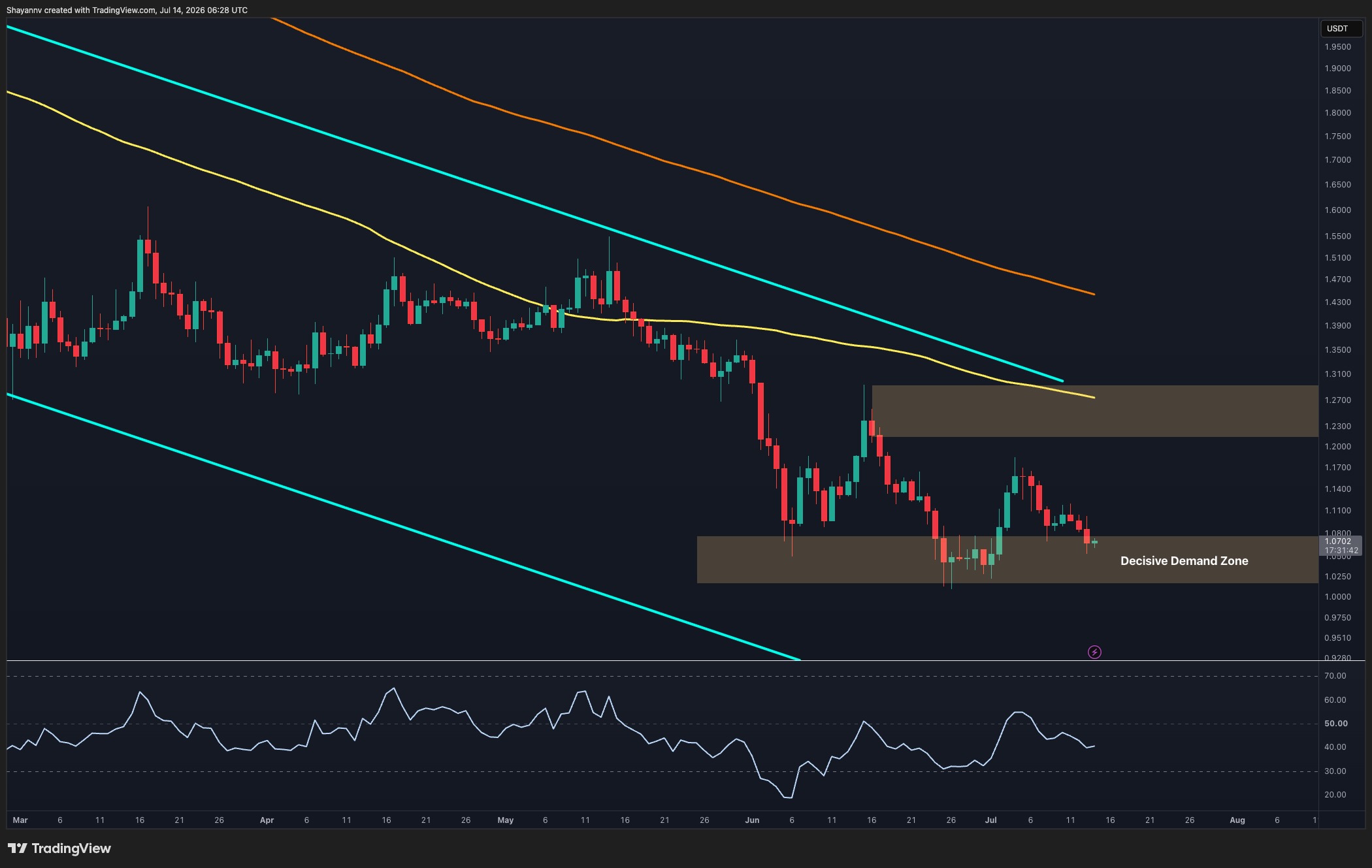
    XRP is currently testing a demand zone between $1.02 and $1.08, a level that technical analysis suggests could influence whether the asset stabilizes or faces further downward pressure. It remains uncertain whether XRP will stabilize or extend its decline from this point.

    Technical Landscape: Descending Channel and Resistance

    On the daily timeframe, XRP has been trading within a large descending channel that has contained its price action since the beginning of the year. The asset recently experienced a rejection from the upper resistance region, specifically around the $1.22 to $1.29 area. According to the analysis, this supply zone has repeatedly capped bullish advances throughout the downtrend. The rejection occurred near the confluence of the descending channel’s upper boundary and the 100-day moving average, reinforcing the significance of this resistance area.

    The Demand Zone: Support and Potential Outcomes

    Following this rejection, XRP has retraced towards the key demand zone located between $1.02 and $1.08. As per the source, this area has attracted buyers and represents a support level on the daily chart. As long as the price remains above this zone, the market could continue consolidating within the lower portion of the channel.

    Short-Term Signals and Uncertainty

    The 4-hour chart offers a closer look at recent price weakness. XRP experienced a rally from the lower demand zone but failed to sustain momentum after reaching resistance at the descending trendline and the overhead supply region around $1.22-$1.29. Since then, the asset has produced a series of lower highs and lower lows, reflecting short-term bearish pressure, the article states.

    The market has now returned to the demand zone around $1.03-$1.08 on the 4-hour chart. This area has acted as the foundation for rebounds since late June, according to the analysis. This zone remains a level to monitor.

    Potential Scenarios

    Two primary signals emerge from this price action. Firstly, a move below the $1.02-$1.08 demand zone could lead to a decline for XRP. This scenario would likely invalidate the current stabilization attempt and expose the lower boundary of the descending channel, potentially opening the door for further downside.

    Secondly, a defense of the $1.02-$1.08 demand zone could trigger a relief rally. Such a move might see XRP test the descending trendline and the $1.22-$1.29 resistance zone again. This outcome would keep XRP within its broader consolidation structure, preserving the possibility of a larger move later, though it is uncertain if such a move will occur.

    Conversely, a loss of the demand zone would represent a structural deterioration and likely shift momentum in favor of sellers. For now, the token remains positioned at a support area. While the broader trend continues to favor caution below the major moving averages and descending channel resistance, the $1.02-$1.08 demand zone remains a key level to defend to prevent another leg lower, according to the article.

    Broader Context

    Source materials place the market analysis in this context: Ripple’s XRP remains trapped within a broader bearish market structure despite several recovery attempts over the past few weeks.

  • Ripple, Coinbase, Circle Launch x402 Foundation for Open AI Payment Protocol

    Ripple, Coinbase, Circle Launch x402 Foundation for Open AI Payment Protocol

    Ripple, Coinbase, and Circle have joined forces as premier members of the newly established x402 Foundation, an initiative hosted by the Linux Foundation. The foundation is dedicated to developing an open protocol designed to embed payments directly into web interactions, enabling AI agents and applications to send and receive money seamlessly.

    The x402 protocol, initially contributed by Coinbase, aims to standardize machine-to-machine payments. This development is poised to become critical as AI agents evolve from making recommendations to independently purchasing services, accessing paid APIs, and completing transactions.

    According to Ripple, open standards like x402 are foundational for creating trusted, interoperable payment systems for AI. Markus Infranger, senior vice president of RippleX, stated that as AI agents increasingly manage transaction lifecycles, they require payment methods as fast and reliable as data exchange. Ripple has reportedly developed XRP Ledger infrastructure that supports the x402 protocol, potentially facilitating transactions using XRP and the company’s RLUSD stablecoin.

    Emphasizing collaboration, the x402 Foundation’s governance model is designed to be open and vendor-neutral. This approach aims to ensure the emerging payment infrastructure supports diverse networks and payment methods without control by a single entity. The foundation’s mission is to lay the groundwork for efficient and secure AI-driven commerce.

    The collective involvement of major players like Ripple, Coinbase, and Circle, under the governance of the Linux Foundation, signifies a coordinated effort to shape the future of AI-driven financial interactions. The protocol’s focus on interoperability and open standards seeks to foster trust and broad adoption in this rapidly advancing technological landscape.

    Why This Matters

    The materials describe a narrow update: Several cryptocurrency-related companies, including Ripple, Coinbase, and Circle, have become premier members of the newly launched x402 Foundation. The protocol could become increasingly important as AI agents move from making recommendations to actually purchasing services, accessing paid APIs, and completing transactions entirely on their own.

    Broader Context

    Source materials place the factual news in this context: Ripple is proud to join the x402 Foundation as a Premier Member.

  • UK Defers Capital Gains Tax on Crypto in DeFi, Effective 2027

    UK Defers Capital Gains Tax on Crypto in DeFi, Effective 2027

    HM Revenue & Customs (HMRC) has reported a significant shift in the UK’s tax policy, deferring Capital Gains Tax (CGT) on cryptoassets deposited into Decentralized Finance (DeFi) lending protocols and liquidity pools. This change, effective from April 6, 2027, will amend the Taxation of Chargeable Gains Act 1992, moving away from previous guidance that treated such deposits as taxable disposals.

    Under the new rules, depositing cryptoassets into DeFi lending protocols and liquidity pools will no longer be considered a taxable disposal. Instead, CGT will be deferred until a genuine economic disposal of the assets occurs. This ‘no gain, no loss’ treatment applies to several DeFi activities, including lending a single cryptoasset, borrowing one, and supplying tokens to automated market makers. Consequently, entering or exiting these arrangements using the same asset will not trigger a tax event.

    A taxable gain or loss will now arise only upon a real disposal of the assets. In the context of liquidity pools, a tax event is triggered if a user withdraws a different quantity of tokens than they initially deposited. Furthermore, collateral posted to borrow against cryptoassets will also be disregarded for CGT purposes.

    HMRC estimates that this policy change will affect approximately 700,000 individuals and trustees. This update addresses concerns raised by stakeholders regarding disproportionate administrative burdens, aiming to align tax treatment more closely with the economic realities of DeFi transactions. Previously, under HMRC’s 2022 guidance, the act of moving tokens into a DeFi arrangement could itself be deemed a disposal, potentially triggering CGT even before any sale of the underlying asset.

    The legislative process for this change has been ongoing, starting with a call for evidence in 2022, followed by a consultation in 2023, and a summary of responses published at Budget 2025. The measure’s final costing is subject to certification by the Office for Budget Responsibility.

    Industry figures have reacted positively to the development. Stani Kulechov, founder of Aave, described the approach as being “the right direction,” suggesting that alternative treatments would have imposed significant paperwork on taxpayers. Kulechov also noted this outcome as an example of how industry feedback can influence policy, drawing a parallel to past industry input on a £20,000 cap for individual stablecoin holdings. He also highlighted separate HMRC plans to tax stablecoins more akin to traditional currency.

    The shift signifies a maturing regulatory landscape for DeFi in the UK, with the growing body of tax rules reflecting the sector’s development. While the new rules are set to take effect in April 2027, providing users and protocols with over a year to adapt, the final costing requires official certification.

    Why This Matters

    The materials describe a narrow update: HMRC has reported that depositing cryptoassets into DeFi lending protocols and liquidity pools will no longer be considered a taxable disposal. The measure’s final costing still needs certification by the Office for Budget Responsibility.

    Broader Context

    Source materials place the factual news in this context: The UK’s HM Revenue & Customs has reported that depositing cryptoassets into DeFi lending protocols and liquidity pools will no longer count as a taxable disposal, deferring any capital gains tax until an investor makes a genuine economic disposal of the assets.