Category: Uncategorized

  • Ripple Partners with x402 Foundation for RLUSD AI Payments; XRP Price Outlook Uncertain

    Ripple Partners with x402 Foundation for RLUSD AI Payments; XRP Price Outlook Uncertain

    XRP Price Edges Higher Amid AI Payment Developments, Chart Resistance Remains

    XRP’s price is once again drawing attention as it hovers around $1.11, marking a roughly 3.6% increase over the past 24 hours. Despite this upward movement, the cryptocurrency continues to face a significant resistance zone that has thwarted several intraday rallies this week.

    The current market action has been characterized by a gradual ascent rather than a decisive breakout. However, Ripple’s reported collaboration with the x402 Foundation to support AI payments powered by RLUSD is providing a renewed impetus to the long-term narrative surrounding the digital asset.

    The x402 initiative aims to establish RLUSD, Ripple’s dollar-backed stablecoin, as a settlement asset for autonomous AI agents. This concept has gained considerable traction, particularly after the XRP Ledger successfully processed over one million agentic transactions, each utilizing a fixed network fee of 0.0002 XRP. The x402 Foundation boasts an impressive roster of major industry players, including AWS, Google, Visa, Mastercard, Stripe, Circle, and Coinbase, underscoring the project’s substantial industry backing beyond mere promotional efforts.

    Ripple has expressed pride in joining the x402 Foundation as a Premier Member, stating, “As AI agents begin to take on more of the transaction lifecycle, they’ll need a way to pay that’s as fast and reliable as the way they already exchange data. We’ve been helping build that future on the XRP Ledger…”

    Concurrently, macroeconomic conditions have shown signs of improvement. The US consumer inflation rate for June registered at 3.5% year-over-year, aligning with expectations as energy prices contributed to a moderation in the monthly index. This development has somewhat alleviated concerns regarding tighter monetary policy, fostering a more positive sentiment across both equity and cryptocurrency markets.

    Ripple’s focus on payment solutions has been a consistent theme for months, and RLUSD continues to broaden its reach. Nevertheless, the price action needs to validate this narrative. Until buyers can engineer a clear breakout, XRP is likely to remain in a cautious, wait-and-see mode, with fundamental developments providing a supportive backdrop while technical charts present a degree of restraint.

    XRP is currently trading around $1.11, having climbed approximately 3.5% in the last 24 hours. The trading session saw a range between $1.06 and $1.12, with its market capitalization nearing $69 billion. The price is still consolidating below the $1.12 mark, a pattern that often suggests the market is accumulating energy before its next significant move.

    Support levels are holding firm around $1.05 to $1.06, areas where buyers have consistently emerged. Meanwhile, resistance extends from $1.11 to $1.15, a zone that sellers have defended on multiple occasions. Trading volume has also seen an uptick, hinting at potential accumulation, though a decisive close above $1.12 would lend further credence to this possibility.

    Three potential scenarios are currently in play. The most optimistic outlook involves a daily close above $1.15, which could pave the way for a move towards the $1.20 to $1.30 range over time. The base case scenario anticipates XRP trading within the $1.07 to $1.13 range as traders assess incoming macroeconomic data. This period of consolidation can sometimes be a deliberate market strategy to encourage patience.

    Conversely, the bearish scenario is straightforward. A decisive breach below $1.05, supported by substantial trading volume, would shift momentum back to sellers and could drive XRP prices down to the mid-$0.90s. While longer-term price forecasts remain constructive, the immediate future of XRP’s price action appears to be dictated by technical chart patterns.

    At a price of $1.10 and a market cap of $68 billion, XRP represents a substantial asset. However, the asymmetric upside potential that early adopters experienced is structurally less accessible at this scale. This mathematical reality often prompts traders to seek opportunities in earlier-stage projects.

    Technical analysis of XRP suggests that the next significant price movement could take several weeks to materialize, a timeframe that aligns with the investment window offered by presale opportunities.

    Maxi Doge ($MAXI), an ERC-20 meme token, has emerged with a unique concept: a formidable canine entity embodying 1000x leverage trading energy, coupled with community-driven mechanics that extend beyond typical meme coin pumps. The project has successfully raised $4.8 million, with its current presale price at $0.0002829 and offering a dynamic staking APY to holders. Key features include exclusive trading competitions for holders with leaderboard rewards, a Maxi Fund treasury dedicated to liquidity and partnerships, and a marketing strategy rooted in viral “gym-bro” culture.


  • Binance XRP Holdings Dip to February Lows Amidst Ripple Price Support Defense

    Binance XRP Holdings Dip to February Lows Amidst Ripple Price Support Defense

    Binance XRP Reserves Hit Lowest Level Since February Amid Price Rebound

    Binance’s holdings of XRP have dwindled to approximately 2.61 billion tokens, marking their lowest point since February and remaining at this level since the beginning of July. This decline in exchange reserves has coincided with a recent uptick in XRP’s price, which has gained over 3% in the past 24 hours, reversing a downward trend that had seen the token approach $1.06.

    Exchange Balance Drains Amid Limited Inflows

    According to Arab Chain, a contributor to CryptoQuant, there have been no significant inflows to replenish Binance’s XRP reserves in recent months. This lack of replenishment is the primary reason the reserve figure has stabilized near its February low, rather than increasing.

    A decrease in exchange balances is often interpreted as a bullish signal, suggesting that investors are moving their holdings into private wallets rather than preparing to sell. However, this signal has taken time to manifest in price action. Arab Chain noted that XRP had been declining towards $1.06 while reserves were depleting, indicating that factors such as liquidity, trading activity, and investor sentiment were overriding the impact of reduced exchange supply.

    Cumulative Volume Delta Signals Selling Pressure

    In a separate market analysis, the same analysts examined the Binance CVD Confirmation Score, which combines price data with Cumulative Volume Delta (CVD) to gauge the dominance of buy or sell orders in the spot market. The current CVD reading stands at -6.93 million, indicating that sell orders have outweighed buy orders as XRP has fallen from above $2.00 earlier this year towards the $1.07 level.

    Short-Term Outlook Remains Cautious

    The 30-day Price-CVD Confirmation Score is currently hovering near 0.84. While Arab Chain describes this figure as “reasonably healthy,” they believe it falls short of confirming a genuine shift in buying demand. According to their analysis, a sustained move into positive CVD territory, coupled with a stronger confirmation score, would be necessary to signal a true reversal in buying interest.

    Despite these cautious indicators, XRP’s price has seen a modest improvement. Data from CoinGecko shows the asset trading around $1.11 at the time of writing, having gained approximately 3.7% in the last 24 hours and fluctuating between $1.07 and $1.12 during that period. However, the world’s sixth-largest cryptocurrency by market capitalization remains down 7% over the past month and over 61% year-over-year. Daily trading volume has surged by 31% compared to the previous day, reaching $1.26 billion.

    Divergent Market Predictions

    The current state of XRP has led to divided opinions among market observers regarding its future trajectory. Popular trader Diana has identified $1.08 as a critical level, warning that a breach of this support could lead to XRP falling to the $0.90-$0.93 zone before potentially reaching the macro support at $0.87. Analyst CasiTrades shares a similar technical outlook, viewing a potential drop to $0.87 as the conclusion of a year-long correction.

    Conversely, other analysts are looking beyond short-term price fluctuations. Crypto Patel suggests that XRP is forming a pattern that has historically preceded rallies exceeding 1,000%. Crypto investor Celal Kucuker pointed to a 500% monthly gain two years ago as a reason to remain optimistic about XRP reaching $7 by the end of the year.

  • SMHUSDT Perpetual Contract Launches with 20x Leverage

    SMHUSDT Perpetual Contract Launches with 20x Leverage

    Bybit Launches SMHUSDT Perpetual Contract with Up to 20x Leverage

    Cryptocurrency exchange Bybit has announced the listing of its SMHUSDT Perpetual Contract, enabling traders to speculate on the price movements of the VanEck Semiconductor ETF (SMH) using Tether (USDT) as the settlement asset. Trading for the new contract is now live, offering leverage of up to 20 times.

    The SMHUSDT Perpetual Contract is also accessible through Bybit’s suite of Futures bots, including Futures Grid, Futures Martingale, and Futures Combo, providing automated trading strategies for users.

    Key details of the SMHUSDT Perpetual Contract include:

    • Underlying Asset: VanEck Semiconductor ETF (SMH)
    • Settlement Asset: USDT
    • Tick Size: 0.01
    • Maximum Leverage: 20x
    • Capped Funding Rate: 2.5%
    • Funding Fee Settlement Interval: Every 8 hours
    • Trading Hours: 24/7
  • Spot Trading Tick Size Updates

    Spot Trading Tick Size Updates

    Binance Adjusts Tick Sizes for Spot Trading Pairs to Enhance Liquidity

    Singapore, Singapore – [Date of Publication] – Binance, a leading cryptocurrency exchange, announced today that it will implement adjustments to the tick sizes for a select group of spot trading pairs. The changes, scheduled to take effect by July 22, 2026, at 05:00 (UTC), aim to boost market liquidity and refine the trading experience for users.

    The tick size, defined as the minimum increment by which a security’s price can change, will be modified for specific trading pairs. Binance has advised users to consult its Trading Rules for a comprehensive overview of tick sizes across all available spot trading pairs.

    These adjustments are not expected to impact the functionality of spot trading or other related services.

    API Users to See Tick Size Changes

    Application Programming Interface (API) users will also experience changes to tick sizes. Binance recommends that API users utilize the GET /api/v3/exchangeInfo endpoint to access the most current tick size information. Further details and updates will be available in the API Changelog.

    Existing spot orders will remain unaffected by the tick size update. Orders placed prior to the implementation of the new tick sizes will continue to be matched according to the original specifications.

    Binance encourages users to update their trading bots accordingly to mitigate any potential disruptions to their trading activities. The exchange has apologized for any inconvenience these changes may cause.

    Specific Tick Size Adjustments Detailed

    The following table outlines the specific tick size adjustments for the affected trading pairs:

    | Trading Pair | Previous Tick Size | Updated Tick Size |
    |—|—|—|
    | AUCTION/USDC | 0.01 | 0.001 |
    | AUCTION/USDT | 0.01 | 0.001 |
    | BB/TRY | 0.001 | 0.0001 |
    | BB/USDC | 0.0001 | 0.00001 |
    | BB/USDT | 0.0001 | 0.00001 |
    | BERA/TRY | 0.01 | 0.001 |
    | BERA/USDC | 0.001 | 0.0001 |
    | BERA/USDT | 0.001 | 0.0001 |
    | EPIC/USDC | 0.001 | 0.0001 |
    | EPIC/USDT | 0.001 | 0.0001 |
    | ETHFI/USDC | 0.001 | 0.0001 |
    | ETHFI/USDT | 0.001 | 0.0001 |
    | FIL/FDUSD | 0.001 | 0.0001 |
    | FIL/USDC | 0.001 | 0.0001 |
    | FIL/USDT | 0.001 | 0.0001 |
    | GLMR/USDT | 0.0001 | 0.000001 |
    | GTC/USDT | 0.001 | 0.00001 |
    | HFT/USDT | 0.0001 | 0.000001 |
    | LQTY/USDT | 0.001 | 0.0001 |
    | PEPE/JPY | 0.000001 | 0.0000001 |
    | QI/USDT | 0.00001 | 0.000001 |
    | RARE/TRY | 0.001 | 0.0001 |
    | RARE/USDC | 0.0001 | 0.00001 |
    | RARE/USDT | 0.0001 | 0.00001 |
    | RESOLV/TRY | 0.01 | 0.0001 |
    | RESOLV/USDC | 0.0001 | 0.00001 |
    | RESOLV/USDT | 0.0001 | 0.00001 |
    | STRK/TRY | 0.01 | 0.001 |
    | STRK/USDC | 0.0001 | 0.00001 |
    | STRK/USDT | 0.0001 | 0.00001 |
    | ZIL/USDT | 0.00001 | 0.000001 |

    Note on USDC Redemption

    Separately, holders of USDC have a legal claim against Circle SAS, the EU issuer of USDC. These holders are entitled to request redemption of their USDC from Circle SAS at any time and at par value.

  • US and UK Propose Joint Roadmap for Stablecoin and Tokenized Asset Regulation

    US and UK Propose Joint Roadmap for Stablecoin and Tokenized Asset Regulation

    The U.S. Treasury and HM Treasury have jointly released a roadmap outlining 10 recommendations aimed at aligning regulatory approaches to stablecoins and tokenized assets. This coordinated effort seeks to facilitate cross-Atlantic blockchain-based finance by harmonizing regulations between the two major financial centers.

    The recommendations, published on Tuesday, July 15, 2026, stem from the Transatlantic Taskforce for Markets of the Future, established in September 2025. The roadmap comprises five recommendations focused on digital assets and five addressing traditional capital markets. Importantly, these recommendations are not binding rules, allowing each country to proceed with its own regulatory processes while adhering to a shared direction.

    Key Recommendations for Digital Assets

    On the digital asset front, the taskforce proposes that regulators, including the Bank of England, FCA, SEC, and CFTC, develop common approaches to tokenized assets. This includes addressing settlement finality for tokenized securities and exploring the use of stablecoins and tokenized money market funds as collateral at clearing houses. A key proposal is the establishment of a private sector-led group to spend a year testing cross-border tokenization use cases. Furthermore, the roadmap advocates for a “multi-money ecosystem” where stablecoins, tokenized bank deposits, and other forms of digital money can coexist.

    Stablecoin Principles and Global Standards

    Alongside the recommendations, the U.S. and UK governments are developing a joint statement on stablecoins, emphasizing the need for a dynamic cross-border market. The statement supports the principle that payment stablecoins should be fully backed, on at least a one-to-one basis, by high-quality liquid assets. These principles align with the U.S. GENIUS Act, federal stablecoin legislation signed last year, which has an effective date of 2027. Another recommendation calls for a technology-neutral review of how the Basel Committee addresses banks’ crypto exposures.

    Regulatory Context and International Alignment

    This alignment initiative occurs as both nations are developing their own regulatory frameworks. The U.S. is implementing the GENIUS Act, with its 2027 effective date, while the UK’s cryptoasset regime is scheduled to take effect in October 2027. Both countries are also working to align with or precede the European Union’s Markets in Crypto-Assets (MiCA) regulation, which has been fully in force since the end of 2024 and is slated for revision in 2027.

    However, the recommendations stop short of mutual recognition, meaning a stablecoin licensed in one country would still need to meet the other’s regulatory requirements to operate there. This aspect highlights an area of uncertainty regarding the precise form of future regulatory alignment or recognition between the U.S. and UK.

    Industry Reaction and Future Outlook

    Industry participants have reacted positively to the roadmap. Katie Harries, Coinbase’s head of policy for Europe, described the recommendations as a “critical moment for transatlantic cooperation,” noting the opportunity for the two financial centers to “reimagine global capital markets through tokenisation.”

    For the UK, this initiative builds on its ambition to “minimize frictions” between the two countries, as previously suggested by Economic Secretary to the Treasury Lucy Rigby. Rigby had indicated that alignment could take the form of “some forms of recognition or alignment,” and had previously stated that digital assets hold the potential for a “complete transformation” of the country’s markets. The UK government is also advancing its own stablecoin rules, an FCA-run stablecoin sandbox, and a consultation on a unified framework for traditional and tokenized payments.

    Key uncertainties remain regarding whether stablecoins and tokenized money market funds can serve as collateral at clearing houses, and the specific outcomes of the proposed private sector testing group for cross-border tokenization. The exact nature of future regulatory recognition or alignment between the U.S. and UK also remains to be determined.

    Why This Matters

    The materials describe a narrow update: The U. Whether stablecoins and tokenized money market funds can serve as collateral at clearing houses.

    Broader Context

    Source materials place the factual news in this context: The U.S. and UK have laid out a joint roadmap for aligning how they regulatestablecoins,tokenized assets, and digital money, a coordinated push by two of the world’s largest financial centres to let blockchain-based finance move more easily across the Atlantic.

  • CT3 Enhances Decentralized Storage with New Dedicated Contracts Model

    CT3 Enhances Decentralized Storage with New Dedicated Contracts Model

    CT3 has transitioned its decentralized storage infrastructure to a dedicated Storage Contracts model, a strategic move designed to support platform growth, enhance infrastructure scalability, and expand storage capacity. This architectural shift addresses limitations of the previous single-contract system and establishes a more robust framework for future development.

    The new Storage Contracts model replaces the prior approach of processing all uploads through a single main collection and smart contract. This older method presented challenges in scaling flexibility and managing storage capacity as network activity expanded. The transition, effective July 15th, 2026, introduces a system where new uploads are distributed across multiple dedicated Storage Contracts.

    Each Storage Contract is linked to a fixed amount of storage capacity and operates as an independent segment of the infrastructure. This segmentation facilitates better workload distribution, improves transparency in resource utilization, and enables more effective capacity management. The model distributes workloads across these multiple smart contracts, enhancing overall platform resilience and scalability. Individual areas of the platform can now scale independently without requiring a complete system rebuild.

    CT3’s decentralized storage infrastructure integrates independent nodes, the ct-3.cloud interface, NFT access keys, and blockchain verification. Users upload files via ct-3.cloud, with data distributed across network nodes. An NFT key is generated for each stored object, confirming access rights and containing relevant storage metadata. The platform sources storage capacity from node operators and offers it to ct-3.cloud customers at market prices.

    A key feature of the new model is the opportunity for participants to finance the deployment of new Storage Contracts and the addition of storage capacity. These participants contribute to the expansion of CT3’s infrastructure, with profits generated from the allocated capacity shared between the financing participant and CT3. The financial performance of each contract depends on its utilization rate and the prevailing market price for storage services; higher utilization leads to greater potential returns.

    Transparency and verification are central to the Storage Contracts model. The operation of each contract is verifiable on the blockchain. Files stored within a contract’s capacity are represented by NFT keys containing storage-related metadata. Investors can verify issued NFTs, collection activity, and the actual use of financed capacity through the smart contract address, allowing for independent confirmation of storage utilization and contract performance.

    For existing ct-3.cloud users, the transition is seamless, requiring no additional action. The platform has seen significant adoption, with over 180,000 unique users and more than 500,000 uploads completed.

    The Storage Contracts model enables CT3 to add new resources in a structured manner and allocate them to specific use areas, addressing situations where demand growth may outpace the addition of new capacity from node operators. This strategic evolution is designed to support the continued growth of the CT3 ecosystem and its decentralized storage offerings.

    Why This Matters

    The materials describe a narrow update: CT3 has moved from a single main collection and smart contract for uploads to a new model using dedicated Storage Contracts. The new architecture aims to address the limitations of the previous single-contract model in handling increased demand and diverse data categories.

    Broader Context

    Source materials place the announcement in this context: CT3 today announced the transition of its decentralized storage infrastructure to a dedicated Storage Contracts model designed to support continued platform growth, improve infrastructure scalability, and expand storage capacity as demand increases.

  • Pi Network Price Surge: PI Jumps 10%

    Pi Network Price Surge: PI Jumps 10%

    PI Plummets 40% Amidst Sell-Off, Recovers 10% From Lows

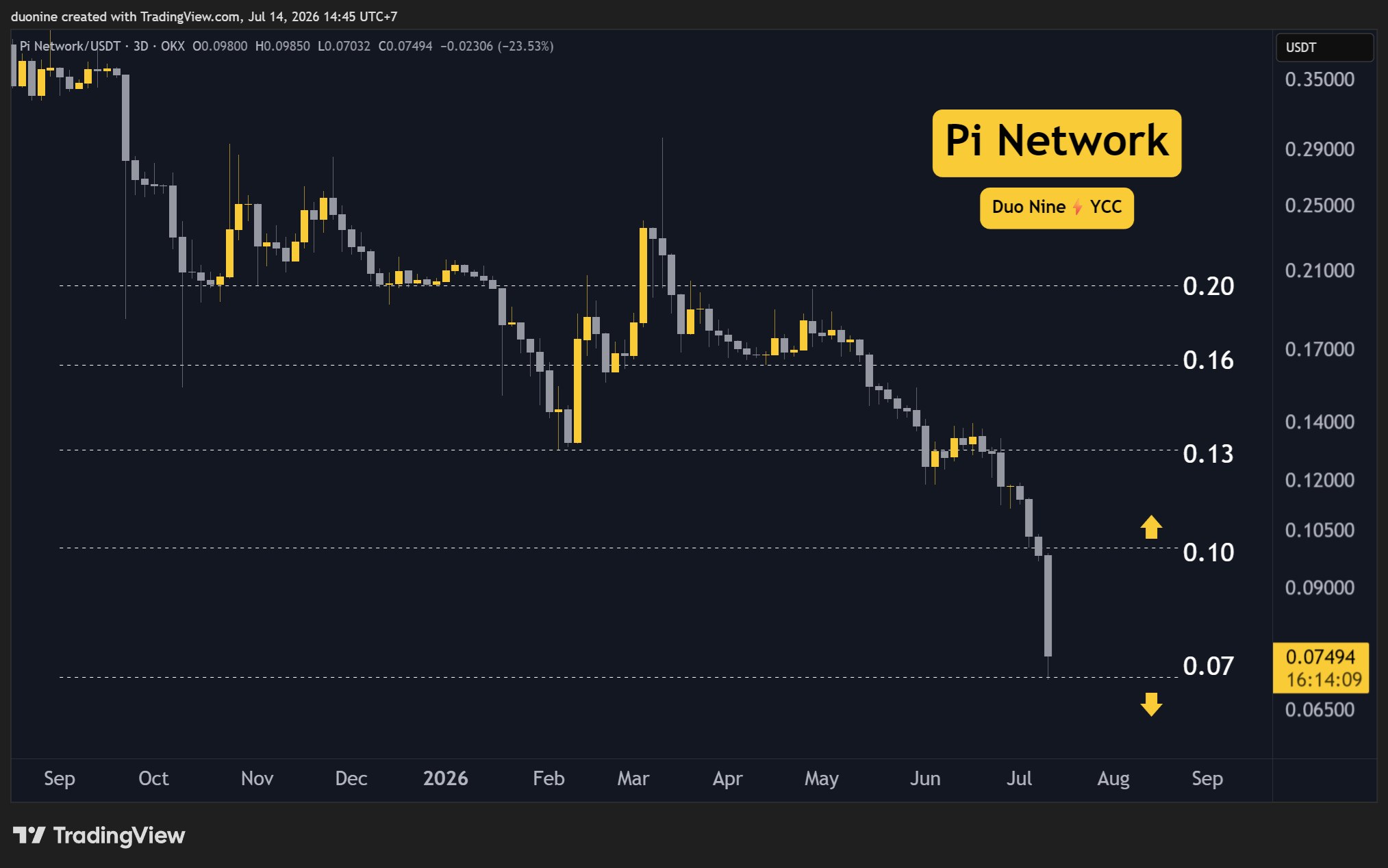
    The cryptocurrency PI experienced a dramatic 40% decline this week, driven by a significant sell-off that pushed its price to consecutive all-time lows. However, the asset has since rallied 10% from these troughs, prompting speculation about whether a market bottom has been established.

    Key Technical Levels

    Key support for PI is identified at $0.07, while resistance levels are positioned at $0.10, $0.13, and $0.16.

    Market Downturn and Investor Sentiment

    PI endured one of its most challenging weeks of 2026 after losing the critical support at $0.10. This level subsequently flipped to resistance, triggering a wave of selling pressure that sent the price into a sharp decline, ultimately reaching a new record low of $0.07.

    Investor confidence appears to have evaporated, with buyers largely absent from the market. Data from the past ten days shows only a single day closing in positive territory, underscoring an overwhelmingly bearish sentiment. This suggests the downtrend may be entering a new phase where a bottom could form more rapidly.

    Signs of a Potential Rebound

    In the past several hours, PI has shown signs of recovery, trading at $0.08 as of press time. However, it remains uncertain whether this represents a sustainable rebound or a temporary “dead-cat bounce.”

    Factors Contributing to the Decline

    The loss of support at $0.10 coincided with a surge in sell volume, exacerbating the downward spiral. This likely triggered cascading liquidations, further intensifying pressure on the declining price.

    While selling pressure has eased compared to the previous day, the market remains dynamic, and the situation could still shift. The price has held above $0.07 and seen a bounce to $0.08, but this could be a brief pause before further declines to new lows.

    Momentum Indicators and Future Outlook

    Heavy selling has driven momentum indicators to extreme levels. The daily Relative Strength Index (RSI) is currently at 12, a historically low point for this cryptocurrency. Such extreme readings can often signal potential market bottoms.

    The hope is that this price action will mark the end of the downtrend, allowing PI to consolidate and confirm a stable bottom. Should the support at $0.07 fail to hold, buyers may retreat further, with potential support levels at $0.06 or even $0.05. The immediate resistance remains at $0.10.

  • Finassets Adjusts Affiliate Revenue Share Program, Offering 40% First-Year Payout

    Finassets Adjusts Affiliate Revenue Share Program, Offering 40% First-Year Payout

    Finassets, a crypto payment gateway, has updated its affiliate revenue share program, introducing a 40% payout for processing revenue generated by a referred merchant in the first year. Following this initial period, the revenue share will be 20% for the subsequent five years, establishing a total earning window of six years per merchant.

    The company, founded in 2021 and registered in Panama, aims to differentiate its offering in the competitive crypto affiliate program market. This revised model emphasizes sustained earnings derived from ongoing merchant processing volume, a departure from programs that focus primarily on short-term trading activities. According to Finassets, this structure is designed to allow partners to benefit from merchant relationships over an extended period without continuous new referral efforts.

    “Most cryptocurrency affiliate programs ask partners to keep generating referrals just to keep earning,” stated Vitalijs F., CEO of Finassets. “We built this revenue share model so one merchant relationship can keep paying out for years, without additional marketing efforts from the partner after the introduction.”

    The program is available to eligible B2B participants in selected international markets, subject to Finassets’ terms and applicable jurisdictional requirements. Operational aspects for partners include same-day crypto payouts and dedicated account managers, with deposits typically reported within approximately 30 seconds of network confirmation.

    Several program specifics remain undisclosed. The criteria for ‘eligible B2B participants’ and the scope of ‘selected international markets’ are not detailed. Furthermore, the precise ‘programme terms’ and ‘applicable jurisdictional requirements’ are not fully outlined, nor is the ‘merchant profile’ used for extending the earning term beyond the initial six years.

    Finassets provides services including crypto invoicing, payment links, payment buttons, mass payouts, API integration, and crypto checkout, supporting approximately 70 cryptocurrencies.

    Why This Matters

    Finassets, a crypto payment gateway, has adjusted its affiliate revenue share program. The company’s stated aim is to provide a more lucrative and stable earning potential for partners tied to ongoing merchant processing revenue. However, specific details regarding eligibility for B2B participants and the selected international markets are not yet disclosed.

    Broader Context

    Finassets operates as a crypto payment gateway for businesses. The company was founded in 2021 and is registered in Panama. This update to its affiliate program is presented as a strategic move to attract and retain B2B partners by offering a longer earning window and a higher initial revenue share compared to some industry alternatives.

  • XRP Price Action Ambiguous: Key Levels and Technical Signals Under Scrutiny

    XRP Price Action Ambiguous: Key Levels and Technical Signals Under Scrutiny

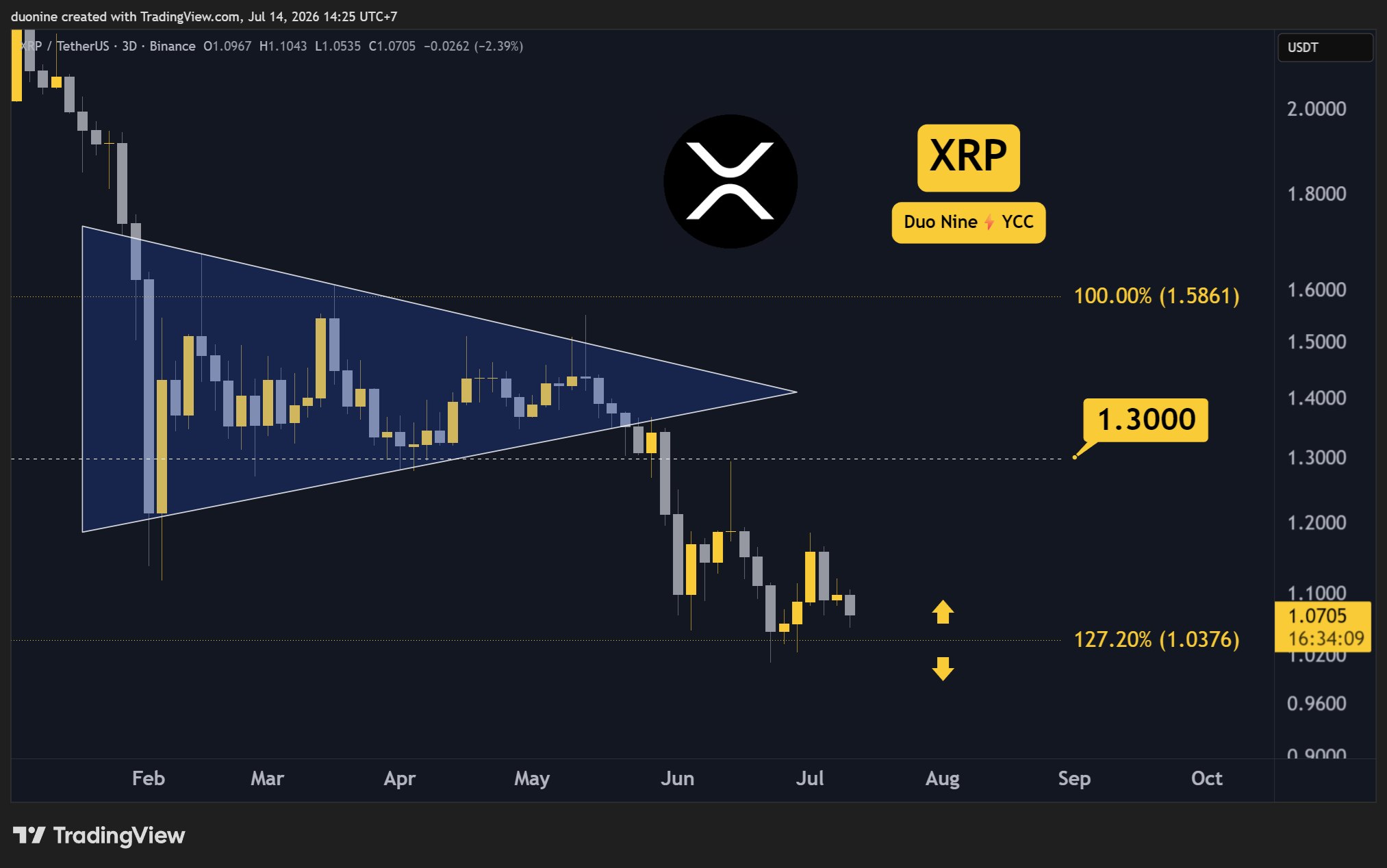
    XRP’s price action this week presents a complex picture, with a recent dip below $1.07 followed by a rebound, yet key technical indicators offer only tentative signs of a potential reversal rather than a reported trend change. The cryptocurrency experienced a notable price drop, falling below the $1.07 mark, before staging a recovery. However, according to the analysis, XRP still needs to reclaim a key level before its price action can be considered more bullish.

    Downtrend and Rebound:

    XRP entered an evident downtrend in the weeks prior to the article, with sellers taking control of price action around the $1.18 level. This downtrend drove XRP to a low under $1.07. Although it appeared primed to retest the $1.00 support level, it has since rebounded swiftly, and there is no immediate danger in sight, as per the source. The current low is reported at $1.01.

    Technical Indicators Signal Potential:

    From a technical perspective, the data suggests two signals that could influence future price movements. Firstly, sell volume has been declining for months. This trend, according to the article, could provide buyers with an opening to regain control. Secondly, another interesting signal appears on the 3-day Relative Strength Index (RSI), which shows a clear bullish divergence. While the XRP price has been making lower lows, the RSI has been making higher lows. This is described as an early signal that could hint at a major reversal ahead.

    Conditions for Trend Shift:

    However, these signals are presented with significant caveats. To turn bullish on this price action, XRP will need to hold above the $1.00 support level and make a higher low. As long as buyers can prevent bears from reaching the $1.01 level, they have a chance to reverse the downtrend and regain momentum. This scenario would also require an increase in buy volume, the article states.

    Key levels to watch include the support at $1.00 and resistance levels at $1.3, $1.6, and $2. For a bullish reversal to be reported, XRP’s correction needs to stop at $1.00 and then slowly recover its most recent losses. A higher high above $1.18 would serve as confirmation, according to the analysis.

    Navigating Uncertainty:

    It remains uncertain whether the $1.00 level will ultimately act as support or turn into resistance. It is too early to definitively call the price action bearish until this level is tested as resistance. Buyers will have another opportunity to show up at this key level and push bears away. The current price action is characterized by ambiguity, with potential upside indicated by technical divergence, but contingent on holding critical support and demonstrating sustained buying pressure. The market is watching to see if XRP can consolidate above $1.00 and build momentum for a sustained recovery.

    Why This Matters

    The materials describe a narrow update: XRP’s price fell below $1. Whether the $1.00 level will turn into resistance.

    Broader Context

    Source materials place the market analysis in this context: XRP’s price dipped below $1.07 yesterday, but the impressive market rebound helped it erase most losses. However, it still needs to reclaim a key level before it turns more bullish.

  • Market Reassesses Corporate Bitcoin Demand Amid Scrutiny of Funding Conditions and Uncertainties

    Market Reassesses Corporate Bitcoin Demand Amid Scrutiny of Funding Conditions and Uncertainties

    The market’s perception of corporate Bitcoin treasury demand is undergoing a shift, moving away from a sole focus on accumulation volume towards a more critical evaluation of the underlying financial conditions and risks that enable these holdings. This reassessment, according to QCP Capital, was catalyzed by a relatively small sale of Bitcoin by Strategy in late May.

    While Strategy’s sale of 32 BTC was immaterial compared to its substantial holdings of 846,842 BTC, it challenged a long-held market assumption: that corporate treasuries would exclusively buy Bitcoin and never sell. This event prompted investors to question whether these treasury holdings were truly untouchable. Even after Strategy resumed buying within weeks, the market’s reaction indicated a greater focus on the funding capacity, balance-sheet liquidity, and overall confidence in the corporate treasury model, rather than solely on the volume of accumulation. The exact timing and magnitude of future corporate Bitcoin purchases remain uncertain, as do the stability of ETF inflows into Bitcoin, the future pricing of preferred securities and convertible instruments related to Strategy, and the future premium on Strategy’s ability to raise capital.

    Corporate Holdings and Strategy’s Dominance

    Public companies collectively hold approximately 1.26 million BTC, with Strategy accounting for roughly two-thirds of this total. This concentration means that Strategy’s actions, issuance conditions, and reserve policies significantly influence Bitcoin sentiment beyond their direct impact on the spot market. In Q2, the financial structures supporting corporate Bitcoin accumulation came under increased scrutiny. Instead of relying on purchase announcements, investors are now closely monitoring metrics such as mark-to-market net asset value (mNAV), equity issuance, preferred demand, convertible capacity, and cash reserves to gauge treasury demand. The future cash reserves of companies holding Bitcoin are also a point of uncertainty.

    Financial Health and Funding Conditions

    QCP Capital explained that favorable funding conditions allow companies to raise capital, expand their Bitcoin reserves, and reinforce confidence in the treasury model. Conversely, tightening conditions can create cash needs due to recurring preferred-stock obligations, as potentially indicated by Strategy’s May sale. Despite these concerns, Strategy’s equity continues to trade above the combined value of its Bitcoin net asset value and U.S. dollar reserves, suggesting a premium on its ability to raise capital, even with approximately $22.2 billion in preferred securities and convertible instruments ranking ahead of its common equity.

    Future Outlook and Potential Risks

    Looking ahead to Q3, QCP Capital outlined potential scenarios for Bitcoin. Their base case anticipates Bitcoin trading between $60,000 and $75,000, supported by stabilizing ETF inflows and corporate treasury demand. A sustained reclaim of $75,000 could potentially drive prices toward $80,000-$82,000. However, the firm warned that renewed ETF outflows, a stronger dollar, or rising real yields could lead to a break below $58,000-$60,000, signaling a more bearish outlook. The precise impact of a stronger dollar or rising real yields on Bitcoin prices remains uncertain. It is also uncertain whether Strategy will become a major seller of Bitcoin in the future.

    Bitwise CIO Matt Hougan also commented on Strategy’s future influence, suggesting that the company is unlikely to dominate Bitcoin demand in the next market cycle as it has previously. Hougan does not anticipate Strategy becoming a major seller, viewing it as a net buyer if crypto asset prices recover.

    Continued net accumulation by Strategy and other public companies, coupled with stabilizing ETF inflows, could strengthen Bitcoin’s absorption capacity and help repair market confidence. However, QCP warned that slower purchases, weaker preferred pricing, a compressed mNAV premium, or declining cash reserves would indicate growing stress, potentially making the corporate treasury bid more selective and increasing sentiment risk. The market’s focus has undeniably shifted, requiring a deeper dive into the financial health and sustainability of corporate Bitcoin holdings.

    Why This Matters

    The materials describe a narrow update: Strategy’s sale of 32 BTC in late May, despite being a small amount relative to its holdings, challenged the market’s assumption that corporate treasuries only buy Bitcoin and never sell. The exact timing and magnitude of future corporate Bitcoin purchases.

    Broader Context

    Source materials place the market analysis in this context: Corporate treasury demand remains one of Bitcoin’s most important structural sources of support.