Category: Uncategorized

  • Kiyosaki’s Crypto and Gold Strategy: Why No Dip Buying?

    Kiyosaki’s Crypto and Gold Strategy: Why No Dip Buying?

    Kiyosaki Explains His Approach to Buying Assets Amid Market Declines

    Robert Kiyosaki, the author of the influential investment book “Rich Dad, Poor Dad,” has shared his perspective on asset acquisition, emphasizing that current prices are not the sole determinant of opportune investment timing. He elaborated on his readiness to increase holdings in Bitcoin (BTC), Ethereum (ETH), silver, and gold, even as these assets have experienced recent downturns.

    The past year has been tumultuous for investors across various asset classes. Bitcoin began the year with an ascent towards $100,000, a level it failed to breach, followed by several challenging months. The cryptocurrency’s correction reached a low of $59,100 in early June. Ethereum mirrored this trend, dropping to $1,500 a few weeks prior. While both have seen some recovery since, they remain significantly down year-to-date.

    Even traditionally stable assets like silver and gold have seen substantial losses. Silver, which traded above $120 at the start of the month, is now nearly 50% below that peak. Gold, after soaring to $5,600 per ounce, has experienced a painful crash, ending the business week below $4,160 per ounce, a correction of 25%.

    Kiyosaki contends that these price drops are not the only crucial factor. He admitted to recently making the error of allowing “price to determine reasons to buy or sell any asset.” He has since learned to prioritize understanding the “context” or environment surrounding an asset, rather than its price alone.

    The author and investor explained his shift in focus to the technical charts of Bitcoin, Ethereum, silver, and gold. He stated he “will buy when prices reverse their decline.” Furthermore, he predicted that the two precious metals are “poised for a massive rise in prices.”

    The year-to-date declines and significant drops from their respective January peaks have raised questions about the safe-haven status of both Bitcoin and gold among some analysts. Market observer Charlie Bilello recently noted the difficulty in explaining these price drops, particularly when most major stocks have seen double-digit gains.

    Bilello attributes a significant portion of this movement to investor rotation, with capital shifting towards the technology sector, largely driven by the artificial intelligence boom. He suggested that investors are favoring assets with earnings momentum over stores of value that offer negligible yield.

  • Bitcoin Price Plunge Risk: Top Corporate Buyer Turns Seller

    Bitcoin Price Plunge Risk: Top Corporate Buyer Turns Seller

    Bitcoin’s Next Major Downturn Could Come From Its Biggest Corporate Buyer

    Bitcoin’s next significant price decline may not originate from miners, exchange-traded fund (ETF) outflows, macroeconomic data, undisclosed large holders, or even geopolitical instability. Instead, the cryptocurrency’s largest and most prominent corporate purchaser could become the catalyst if it transitions from a consistent buyer to a recurring seller, a scenario many critics and experts have long feared.

    In light of these concerns, we sought the perspective of ChatGPT on the potential threat and the possible downside for Bitcoin if the company, Strategy, begins liquidating its cryptocurrency holdings to cover dividends or other operational expenses.

    Peter Schiff, a vocal critic of cryptocurrencies, is not alone in raising alarms about Strategy’s approach to funding its Bitcoin accumulation through its STRC (perpetual preferred stock). Earlier reports highlighted warnings from popular crypto analyst Kaleo, who suggested the company might need to sell at least 50,000 Bitcoin over the next two years to meet dividend obligations and other financial commitments.

    ChatGPT cautioned that if the largest corporate holder of Bitcoin begins to offload substantial portions of its reserves, beyond the 32 units sold several weeks ago, the immediate market reaction could send the asset plummeting towards multi-year lows of $52,000. This represents a baseline scenario, a preliminary shockwave. A more profound correction, driven by a significant erosion of confidence in Strategy’s capital structure, could potentially push Bitcoin down to $45,000.

    The artificial intelligence model indicated that while it is highly improbable Strategy would divest “hundreds of thousands of coins,” the primary risk to Bitcoin’s price lies in a fundamental shift in market narrative.

    “For years, Strategy served as the market’s most dependable corporate Bitcoin buyer,” ChatGPT explained. “When Bitcoin experienced dips, investors anticipated that Michael Saylor’s company would raise capital and increase its holdings, establishing a psychological floor. If the market begins to believe that Strategy must sell Bitcoin to service its financial instruments, that floor could rapidly transform into resistance.”

    STRC, also known as Stretch, is the company’s variable-rate perpetual preferred stock. In essence, investors purchase STRC to receive a cash yield, while Strategy utilizes the capital raised to bolster its Bitcoin-centric balance sheet. The instrument is designed with a stated value of $100.

    The company possesses the ability to adjust the dividend rate to maintain STRC’s trading price close to this $100 benchmark. When the shares trade at or above $100, the model functions as intended: Strategy can issue additional preferred shares through at-the-market programs, generate cash, acquire more Bitcoin, and sustain its operational cycle.

    However, when the $100 par value is breached, the structure faces significant challenges. At current prices below $90, STRC is no longer behaving as a stable, high-yield instrument. Instead, it is trading at a substantial discount relative to the level the firm aims to maintain, creating a cascade of issues.

    Strategy’s capacity to issue more STRC is diminished, as selling new shares below the intended $100 threshold would contravene the product’s design or signal that investors are demanding a considerably larger discount.

    Furthermore, the dividend rate may need to be increased to attract new buyers. Critically, instead of allocating proceeds from STRC to acquire more Bitcoin, Strategy might be compelled to tap into its cash reserves, sell common stock, or, as previously indicated, sell Bitcoin holdings to ensure timely dividend payments.

  • Bitcoin Activity Surges Amidst Price Plunge

    Bitcoin Activity Surges Amidst Price Plunge

    Bitcoin Network Activity Surges Amidst Price Slump

    Despite Bitcoin trading at a significant discount, nearly 50% below its all-time high of $126,080, the cryptocurrency’s network is experiencing a surge in transaction activity.

    Data compiled by crypto analytics firm CryptoQuant reveals a consistent upward trend in network activity since January 2026. This activity has recently reached its highest point since late 2024, now standing just 7% shy of the peak levels recorded in September 2024.

    “This above-trend reading has been sustained for several weeks and marks the first positive activity regime since mid-2024, contrasting sharply with Bitcoin’s ongoing bear market price decline,” CryptoQuant stated in its analysis.

    Both total and daily average transaction counts have approached record highs, according to the firm. This comes after a period of contraction in network activity that began in December 2024.

    However, the economic value of these burgeoning transactions is notably diminished. “The economic content of these transactions differs materially from prior high-activity periods,” the report emphasizes.

    Transaction cohorts involving less than 0.01 BTC and less than 0.001 BTC have both seen substantial increases. Collectively, these small-value transactions now account for approximately 80% of daily transactions, a significant jump from 44% in 2023, according to CryptoQuant’s data. The firm interprets this as an indicator of “protocol-driven activity,” which sustains high transaction volumes but at a lower value per transaction.

    Further supporting this notion of protocol-level activity is a concurrent rise in the use of “OP_RETURN.” This field within Bitcoin transactions allows users to embed additional information. The byte limit for this field was removed last year following a contentious debate.

    “Usage has spiked to near-record levels in 2026,” the analytics firm noted, citing Bitcoin NFT activity and time-stamping services as examples of OP_RETURN applications. “These protocols generate high volumes of dust-value transactions, directly explaining the low-value cohort surge.”

    While its network transaction count is on the rise, Bitcoin’s price has not followed suit. BTC has seen a 17% decline in the past 30 days, with recent trades occurring around $63,865.

  • XRP Faces Weekly Rejection: What’s Next for Ripple?

    XRP Faces Weekly Rejection: What’s Next for Ripple?

    XRP Faces Persistent Selling Pressure, Key Support Levels Tested

    XRP continues to struggle against both the U.S. dollar and Bitcoin, trading within a persistent bearish pattern. While buyers have managed to defend crucial support zones in recent weeks, the overall trend has yet to signal a definitive reversal, with the token remaining below key moving averages and a descending trendline resistance.

    XRP/USD Dynamics

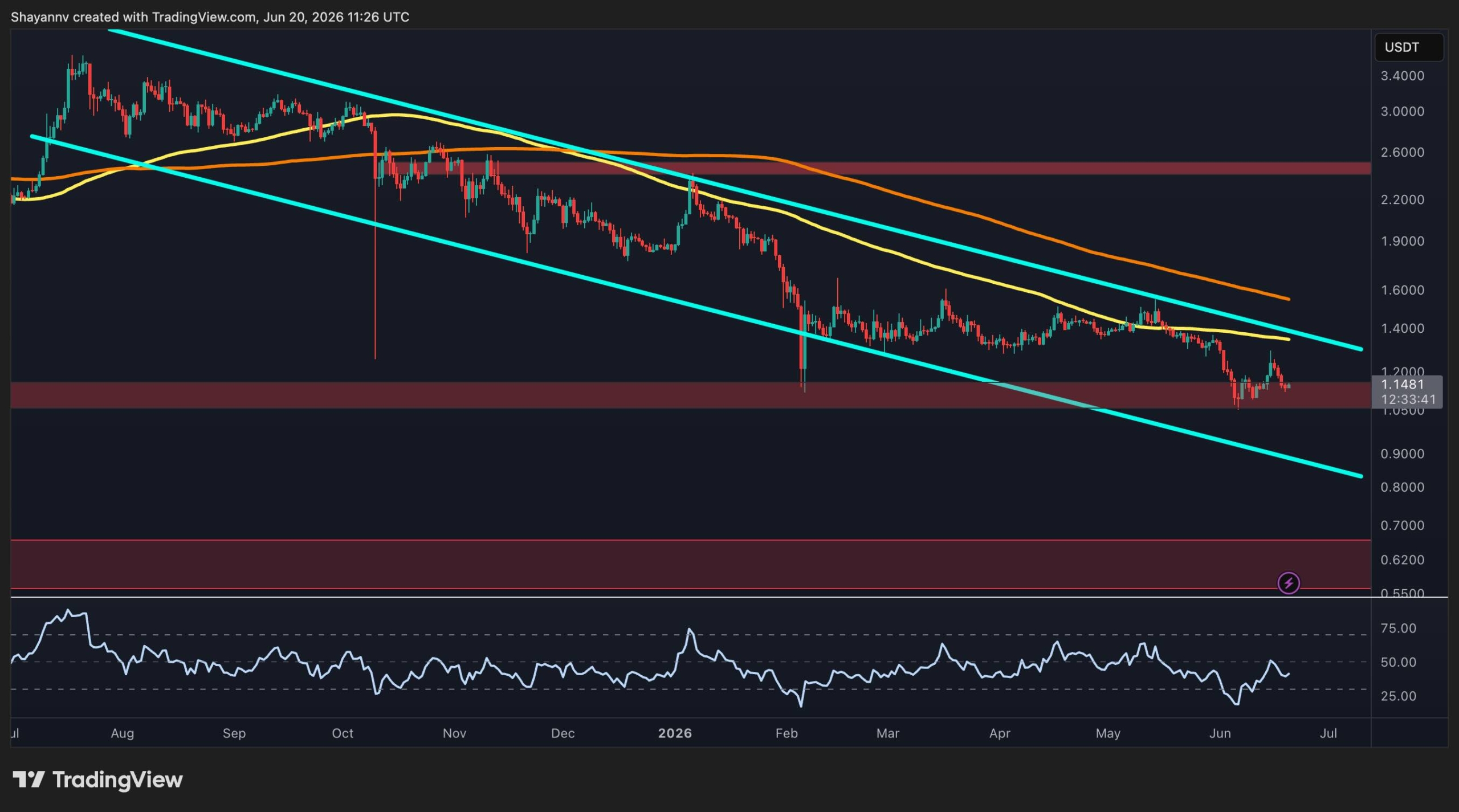
    On the USDT pair, XRP is confined within a large descending channel that has dictated price action since the latter half of 2025. A recent downturn saw the asset retreat to a critical support zone near $1.1, where buying interest has once again emerged to stave off a steeper decline. This area has served as a significant demand region throughout the current correction and remains the most vital support level on the chart. A decisive breach of this zone could pave the way for a move towards the next major downside target around the $0.60 region, which represents the next discernible demand area on higher timeframes.

    On the upside, XRP faces multiple resistance layers. The upper boundary of the descending channel currently aligns with the 100-day moving average, situated around $1.35. Higher still, the 200-day moving average sits at approximately $1.75. Beyond these technical indicators, the significant supply zone at $2.5 remains the pivotal level that buyers must reclaim to shift the long-term structure in their favor.

    Meanwhile, overall momentum remains subdued. Although the Relative Strength Index (RSI) has stabilized above oversold territory, it has yet to exhibit the bullish divergence or strength typically associated with a sustainable trend reversal. As long as XRP remains below the descending channel resistance and major moving averages, the broader market structure will continue to favor sellers, despite recent stabilization.

    XRP/BTC Performance

    The BTC pair presents a similarly cautious outlook, underscoring XRP’s ongoing relative weakness against Bitcoin. Following an extended decline within a descending channel, XRP/BTC has recently entered a consolidation phase above a key support area around 1,720 SATs. This level has been tested multiple times since May and continues to attract demand, forming the base of the current trading range.

    However, despite holding support, buyers have repeatedly failed to achieve a sustained breakout above the nearby resistance zone around 1,850 SATs. This area coincides with the 100-day moving average and has acted as a ceiling throughout June. A loss of the 1,720 SATs support floor could expose the next major demand area significantly lower, around 1,500 SATs. Conversely, a successful breakout above the 1,850 SATs level could open the possibility of a move towards the next resistance region near 2,000 SATs, where further supply is expected to emerge.

    Ultimately, the BTC pair suggests that XRP has yet to establish meaningful relative strength, reinforcing the cautious sentiment observed on the USDT chart. Until buyers reclaim nearby resistance levels and break the broader descending structure, rallies are likely to be interpreted as corrective moves rather than the commencement of a new bullish trend.

  • Pi Price Recovers from Support Amidst Pi Network Warning

    Pi Price Recovers from Support Amidst Pi Network Warning

    Pi Network Protocol Update Faces Delays, Team Urges Node Operators to Expedite

    The anticipated protocol update for the Pi Network is experiencing delays, prompting the project’s development team to call on certain node operators to accelerate their efforts to ensure its timely completion. Concurrently, the network’s native token has shown signs of recovery, rebounding from a critical support level.

    The ongoing series of crucial protocol updates commenced in late February, with earlier versions being implemented on or ahead of schedule. However, protocol version 24 marked a departure from this trend, introducing a delay. This upgrade, primarily aimed at enhancing the underlying infrastructure supporting node operations and mainnet activity, encountered unforeseen setbacks.

    Following the completion of version 24, the team established a deadline for the subsequent update, version 25, which was slated for completion by June 18. However, well in advance of this date, the Core Team issued a warning regarding potential further delays in the required timeframe.

    Several days after the June 18 deadline had passed, the team provided an update on the status of the new version. They confirmed that the majority of Mainnet node operators have successfully upgraded to protocol version 25. The team urged those who have not yet completed the upgrade to do so “at your earliest convenience,” emphasizing that failure to comply risks disconnection from the network.

    A message posted by the Pi Network (@PiCoreTeam) on June 20, 2026, stated: “Reminder for all Pi Mainnet Node operators: The majority of Mainnet node operators have already successfully upgraded to Protocol v25. If you have not yet upgraded your node, please do so at your earliest convenience to remain connected to the network.”

    PI Token Shows Resilience Amidst Market Volatility

    The native token of the Pi Network ecosystem experienced a significant downturn in early June, coinciding with a broader market crash, and fell to a new all-time low below $0.12. In the subsequent weeks, the token attempted a recovery, nearing the $0.14 mark. However, it faced resistance at this level and yesterday tested a key support at $0.13.

    At this juncture, buying interest emerged, preventing a further decline to new lows. The PI token has since seen a daily increase of over 4%, trading at approximately $0.135. While this represents a 15% rise from its all-time low, the broader market context remains challenging, with the token showing a 95.4% decrease from its all-time high recorded in February 2025.

    Reports from yesterday indicated a promising token unlocking schedule for the upcoming month, with an average of only 4.2 million coins set to be released daily. Such a trend could potentially alleviate immediate selling pressure.

  • Hayes Sells All ETH Holdings at a Loss

    Hayes Sells All ETH Holdings at a Loss

    Arthur Hayes Sells Entire Ethereum Stake Days After Purchase, Incurring Significant Loss

    Arthur Hayes, the former CEO of cryptocurrency exchange BitMEX, has once again engaged in a rapid and reportedly unprofitable trading maneuver, this time liquidating his entire Ethereum (ETH) position just days after acquiring it. The move follows a pattern of what some observers have described as erratic crypto market activity from Hayes.

    On-chain data analyzed by Lookonchain revealed that Hayes had amassed a substantial ETH holding starting June 17. His initial purchase involved 1,400 ETH for $2.51 million. He continued to expand his stake in the following days, including another significant acquisition of 1,500 ETH for $2.63 million. In total, Hayes acquired approximately 5,900 ETH for $10.58 million, at an average price close to $1,800 per token.

    However, Lookonchain analysts reported that Hayes proceeded to sell even more than he had bought. Wallets associated with him disposed of 6,000 ETH for $10.14 million on Friday, resulting in a loss exceeding $600,000 within a matter of days. A social media post from Lookonchain highlighted the situation, stating, “Arthur Hayes (@CryptoHayes) is buying high and selling low again.”

    The swift sale and subsequent loss have drawn sharp criticism from the crypto community, particularly given Hayes’ recent history of allegedly promoting altcoins only to sell them shortly thereafter. Many comments on social media platforms expressed disapproval of his trading strategy.

    Interestingly, while many altcoins Hayes has recently offloaded have seen price declines, Ethereum has shown resilience. Since his average selling price, ETH has seen a slight increase, trading above $1,720.

    Meanwhile, other significant market players appear to be accumulating ETH. Data from the same monitoring resource indicates substantial inflows into private wallets. A wallet linked to K3 Capital withdrew 10,000 ETH, valued at over $17 million at the time of reporting, from Binance. Separately, a wallet associated with Chun Wang purchased and transferred 7,650 ETH, worth approximately $13 million, out of the world’s largest cryptocurrency exchange.

    These large-scale acquisitions are occurring as analysts continue to debate whether Ethereum, the second-largest cryptocurrency by market capitalization, is approaching a potential bear market bottom. Some market watchers believe that ETH may find its floor sooner than Bitcoin.

  • Schwab to Launch S&P 500 Prediction Markets with Cboe

    Schwab to Launch S&P 500 Prediction Markets with Cboe

    Charles Schwab Eyes Prediction Markets with S&P 500 Wagers

    Financial services behemoth Charles Schwab is preparing to enter the rapidly growing prediction markets sector, according to a report from The Wall Street Journal.

    The discount brokerage had signaled its intentions earlier this year during its first-quarter earnings call, with CEO Rick Wurster stating the company would “likely have prediction markets.” Wurster, however, differentiated these offerings from those focused on sports, politics, and entertainment, emphasizing a focus on financial market outcomes.

    Sources familiar with the matter told The Wall Street Journal that Schwab will facilitate contracts through Cboe Global Markets, enabling users to place wagers on the performance of the S&P 500, the widely followed index representing the largest publicly traded U.S. companies.

    These new markets are expected to function similarly to asset price markets offered by existing prediction platforms like Kalshi and Polymarket. In these models, participants are presented with a binary choice: whether an asset will finish above or below a specified price. For instance, on Myriad, a product from Decrypt’s parent company Dastan, users can bet on whether Bitcoin will trade above or below a certain price on a given day and time.

    Schwab is also reportedly planning a feature called the “Plus Zone.” This would reward users based on how closely the S&P 500’s closing price aligns with the market’s target number, offering a discounted payout even for predictions that are only partially correct.

    The new prediction markets are slated for launch in the coming months. The report suggests that Schwab may eventually expand these offerings to include other indexes and key financial benchmarks.

    This move follows Schwab’s recent expansion into cryptocurrency. Last month, the firm launched spot trading for Bitcoin and Ethereum for a select group of its retail customers, a rollout that began after a successful internal pilot program. Further expansion to more customers is anticipated in the coming months.

    With $11.8 trillion in total customer assets, Charles Schwab has also expressed interest in the stablecoin market. CEO Rick Wurster indicated last July that offering stablecoins is “something we do want to be able to offer.”

    Shares of Charles Schwab Corporation (SCHW) closed down nearly 3% on Thursday, trading around $91.70. U.S. markets will be closed on Friday in observance of the Juneteenth holiday.

  • Celsius Founder Banned From CFTC Markets

    Celsius Founder Banned From CFTC Markets

    Celsius Founder Banned from CFTC Markets

    Alexander Mashinsky, the founder and former CEO of Celsius, has been permanently barred from trading in markets regulated by the U.S. Commodity Futures Trading Commission (CFTC). This action follows a federal court’s approval of a consent order that resolves the regulator’s 2023 enforcement case against him.

    The order, issued by the U.S. District Court for the Southern District of New York, also permanently prohibits Mashinsky from violating specific anti-fraud provisions of the Commodity Exchange Act and CFTC regulations. Furthermore, he is barred from future registration with the agency.

    The CFTC initiated its lawsuit against Mashinsky and Celsius Network in July 2023. The regulator alleged that Celsius operated a digital asset platform where customer cryptocurrencies were pooled and used to generate revenue, with customers promised weekly interest payments or rewards.

    According to the complaint, Mashinsky and Celsius misled hundreds of thousands of customers between 2018 and at least June 2022 by making false or misleading statements regarding the platform’s security, profitability, and regulatory status.

    The CFTC contended that Mashinsky actively promoted Celsius through various channels, including public videos, livestreams, blog posts, social media, and the company’s website. In these communications, he reportedly presented Celsius as a secure repository for digital assets, drawing comparisons to traditional banking while also highlighting high-yield returns for customers.

    However, the CFTC asserted that Celsius engaged in increasingly risky investment strategies to fulfill its promised returns. These strategies allegedly included extending millions of dollars in uncollateralized loans and participating in unregulated decentralized finance agreements. While customers were assured their assets were safe and generating returns, the company was reportedly incurring significant losses.

    The complaint detailed that customer funds were not as secure as Celsius had claimed, ultimately leading the company to file for bankruptcy. The CFTC stated that Celsius handled approximately $20 billion in customer funds during its operations. In July 2023, a separate consent order was entered against Celsius itself, leaving Mashinsky as the sole remaining defendant in the CFTC’s civil action.

    The CFTC’s case was distinct from, though related to, a criminal case brought by federal prosecutors in New York on July 11, 2023, concerning the same alleged actions by Mashinsky. Mashinsky subsequently pleaded guilty on December 3, 2024, to one count of commodities fraud and one count of securities fraud.

    He was sentenced on May 8, 2025, to 12 years in prison and ordered to pay a $50,000 fine. The court also mandated that he forfeit $48.39 million for his involvement in the commodities and securities fraud committed at Celsius.

  • GPT-5.6 Rumors Swirl as Users Report ChatGPT Gains Intelligence

    GPT-5.6 Rumors Swirl as Users Report ChatGPT Gains Intelligence

    Users Report Noticeable Changes in ChatGPT, Hinting at GPT-5.6 Testing

    A palpable shift in ChatGPT’s performance this week has not gone unnoticed by its user base. Across social media platforms, particularly X, users have been sharing screenshots and timing tests, coalescing around a prevailing theory: OpenAI is discreetly conducting A/B tests of a new model, GPT-5.6, within ChatGPT, offering it to select users who typically access GPT-5.5 Pro.

    Developer Anshu Chimla posted a comparative video on Thursday showcasing one-shot landing pages, accompanied by the caption: “Well well well, I’m one of the lucky ones with early GPT-5.6 Pro access.”

    Developers Observe Performance Shifts

    Developer Dobroslav Radosavljevič also took to X, describing the experience within Codex, OpenAI’s coding agent, as feeling “waaaaaaaay different than [the] 5.5 model.” While some users in the replies expressed belief, others dismissed the observations as a placebo effect.

    A consistent theme emerging from these discussions is the significant increase in processing time. Conor Dart, an X user who has been amplifying these rumors, conducted a test generating a one-prompt 3D browser game complete with physics and camera controls. The task, which took just over an hour to complete, starkly contrasted with GPT-5.5 Pro’s typical 10-minute generation time.

    “Not perfect, but for a one-prompt AI game dev test, this is seriously impressive,” Dart remarked.

    AI Insiders Weigh In on Potential New Model

    AI insider Chetas Lua reported a similar slowdown while testing a robotic simulation, expressing strong conviction that the results stemmed from OpenAI’s new model. “GPT 5.6 Pro continues to mog [Anthropic’s Fable 5] in 3D test,” Lua wrote. “Working on games one shot too.” In a separate post, Lua noted response times extending to 20 or 40 minutes, a pace not seen since before the release of GPT-5.5 Pro.

    However, not all comparisons favored the rumored model. Chris, an AI benchmarker on X, presented a spaceship-building prompt to both models. The suspected GPT-5.6 Pro took 87 minutes, compared to GPT-5.5 Extra High’s 34 minutes and 42 seconds.

    “As I’ve said before, based on great authority, GPT-5.6 will be an incremental/solid improvement over GPT-5.5, not a Fable killer,” Chris stated, while also noting that Fable 5 still outperformed both models in the spaceship’s core geometry. “My rough expectation has been that it would trade blows with Fable 5 on some benchmarks, maybe win around half depending on the category, but not clearly surpass it overall.”

    Leaked Details Suggest Advanced Capabilities

    Further details emerged from a post attributed to leaker Pankaj Kumar, suggesting a knowledge cutoff extended to December 2025. The leaks also indicated a potential increase in the “Juice Value,” a reasoning-effort setting, from 768 to 960. Additionally, the generation of SVG and 3D designs is reportedly robust enough to surpass Fable 5 in certain tasks.

    While these details have not been officially confirmed by OpenAI, they align with user observations of enhanced reasoning capabilities, an unfinished front-end, and a release candidate codenamed Kindle-Alpha.

    Stealth Testing and Anticipated Launch

    AI influencer Leo, citing unnamed sources, suggested in a thread that the suspected model is currently undergoing “stealth testing” for select Pro accounts when GPT-5.5 Pro is chosen in ChatGPT. A public launch is reportedly slated for the following Thursday, June 25.

    OpenAI’s Internal Communications and Market Pressures

    The closest indication of an official OpenAI stance comes from a memo reportedly sent by Chief Scientist Jakub Pachocki to staff, describing the next model as a “meaningful improvement” over GPT-5.5, according to a report by The Information. This memo, however, does not confirm A/B testing, a release date, or any specific technical details circulating on X, but it does validate the development of a new model.

    Decrypt reached out to OpenAI for comment regarding the testing of GPT-5.6 within ChatGPT, but received no response by the time of publication.

    Several factors may be driving OpenAI to potentially accelerate the release of a new flagship model. China’s open-source model GLM-5.2 is closely trailing Claude Opus 4.8 on the FrontierSWE benchmark, a metric assessing AI agents on multi-hour, open-ended engineering projects, and has already surpassed GPT-5.5 on the same test.

    Meanwhile, Anthropic is navigating its own challenges. The company’s leading models, Mythos 5 and Fable 5, have been temporarily withdrawn following a U.S. export control directive issued on June 12, due to a disputed jailbreak vulnerability. This situation has created an opening in the high-end market that both GLM-5.2 and a potential GPT-5.6 are positioned to exploit.

    Furthermore, financial considerations are at play. The Wall Street Journal reports that OpenAI is reportedly considering price reductions on the tokens it charges developers and enterprises, anticipating similar moves from Anthropic as both companies prepare for potential IPOs.

    Whether these developments culminate in an official GPT-5.6 release remains to be seen, as OpenAI has maintained silence amidst a week of leaked information and stealth-testing claims. However, traders on Polymarket are actively speculating, with contracts for a launch between June 22 and June 28 reaching as high as 89% this week.


  • Strive Blames Leverage Liquidations for STRC Plunge

    Strive Blames Leverage Liquidations for STRC Plunge

    Digital Credit Offerings Plunge Amidst Leverage Liquidation

    Preferred share offerings tied to Bitcoin treasury firms experienced their most significant downturn on Thursday, a day marked by sharp price declines attributed to leveraged positions, according to Strive CEO Matt Cole. Cole, however, maintained that the underlying credit instruments remain sound.

    The price drops affected SATA and STRC, the preferred equity and digital credit products respectively from Strive and Bitcoin treasury giant MicroStrategy. Both fell considerably below their par values, the price points at which they are intended to trade.

    “Today was the most difficult day in the history of digital credit,” Cole stated on X Thursday afternoon. “What happened today was a leverage liquidation event, not a deterioration in underlying credit quality.”

    Cole explained that investors often increase their exposure to attractive yield opportunities with perceived limited volatility by borrowing capital, a practice known as leveraging. “Many eventually decide that owning it is not enough. They borrow against it. They lever it,” he wrote. “That works until it doesn’t.”

    Both SATA and STRC saw exceptionally high trading volumes on Thursday. According to data shared by Strive’s Chief Risk Officer Jeff Walton, SATA recorded its second-largest trading day with $153 million, while STRC had its fourth-largest with $941 million. Walton suggested these figures, when contrasted with the significantly lower daily trading volumes of larger preferred equity instruments like JPMorgan’s JPM.PD and Blackrock’s PFF, indicate a higher likelihood of a leverage unwind.

    “Leverage appears to have been flushed, fundamentals intact, and the instruments absorbed the flow and found bids throughout the day,” Walton posted on X.

    When questioned on X about the concentration of SATA leverage, Walton indicated that Strive is “aware of a couple anecdotal sources” and is conducting a “deeper postmortem analysis” to be shared later.

    SATA and STRC are designed to trade around $100 per share. However, on Thursday, SATA dropped to a low of $92.88, while STRC fell further, reaching a daily low of $82.53 before closing at $88.59.

    While it is typical for STRC to trade below its par value following its dividend date, analysts told Decrypt on Thursday that uncertainty surrounding the firm’s dividend payment strategy appears to be contributing to “continued weakness.”

    These digital credit products, created to help Strive and MicroStrategy accumulate funds for Bitcoin purchases, have attracted retail investors seeking dividends and lower volatility compared to the firms’ common equities or direct Bitcoin exposure. However, questions about how dividend obligations will be met have raised skepticism regarding the financial engineering of these products. Last month, MicroStrategy sold 32 BTC for $2.5 million, a move signaled by Michael Saylor, demonstrating the firm’s willingness to deviate from its “never sell” stance if necessary.

    Despite bolstering its cash reserves and consistently messaging its ability to meet obligations, MicroStrategy’s common shares and preferred equity have continued to underperform. By the close of trading on Thursday, MicroStrategy (MSTR) had fallen an additional 3.46% to $112.53, marking a decline of over 32% in the past month. Shares in Strive (ASST) decreased by 3.8% to $14.85, bringing its monthly losses to nearly 6%. U.S. markets will be closed on Friday for the Juneteenth federal holiday.