Category: Uncategorized

  • GLAAD: AI Fails LGBTQ Users, Risks Mount

    GLAAD: AI Fails LGBTQ Users, Risks Mount

    AI Amplifying Anti-LGBTQ Bias, Discrimination, Report Finds

    Artificial intelligence is exacerbating anti-LGBTQ bias, misinformation, and discrimination, with potential impacts spanning healthcare, employment, housing, and privacy, according to a new report from the advocacy organization GLAAD.

    The report, titled “Build for Everyone: A Framework for LGBTQ Representation and Safety in AI,” released Wednesday, asserts that LGBTQ safety should be a fundamental requirement in the development of responsible AI.

    GLAAD warns that AI systems trained on biased or incomplete data risk reinforcing stereotypes, silencing LGBTQ voices, exposing users to privacy vulnerabilities, and producing discriminatory outcomes as the technology becomes increasingly integrated into daily life.

    “AI is a civil rights issue,” GLAAD President and CEO Sarah Kate Ellis stated in the report. “Neutrality is no longer an option. To build AI that is ethical, inclusive, and responsible, tech leaders must proactively embrace intentional practices to create safe products.”

    The study identified several areas of concern, including biased training data, the proliferation of anti-LGBTQ misinformation, discriminatory results from predictive AI systems, failures in content moderation, and privacy risks. The report argues that AI trained on incomplete or inaccurate information about LGBTQ individuals can perpetuate harmful stereotypes.

    Ellis contended that responsible AI is not only beneficial for business but also essential for future-proofing AI companies. “More than 20 percent of Gen Z is LGBTQ,” she wrote. “These are your future employees and consumers.”

    A 2023 study by advisory and investment firm LGBT Capital indicated that the global buying power of LGBTQ individuals stands at $4.7 trillion, a figure projected to reach $33 trillion by 2030.

    “To put that in perspective, if we were a country, we would be the 4th largest economy in the world,” Ellis noted.

    The GLAAD report emerges amidst ongoing discussions about AI bias. In May, researchers observed that prominent AI models consistently favored Catholicism in their responses while exhibiting less favorable treatment toward Jehovah’s Witnesses, atheism, and agnosticism.

    Earlier this month, former xAI engineer Devin Kim filed a lawsuit against xAI and SpaceX, alleging wrongful termination after he raised concerns about Grok’s inadequate safeguards against misinformation and bias. Concurrently, Elon Musk’s xAI is engaged in a legal dispute with the state of Colorado over a law mandating that companies assess and mitigate discrimination risks in AI systems used for decisions related to housing, employment, and lending.

    GLAAD emphasizes that the implications of AI bias extend beyond simple chatbot interactions and image generation.

    “While not specific to LGBTQ people, we must also mention other emerging challenges as AI development and adoption progresses,” the study stated. “These can include model hallucinations or sycophantic behavior that generate misinformation, including about consequential topics such as health or elections.”

    These concerns are amplified, the study noted, as companies deploy AI agents capable of performing tasks with minimal human supervision. GLAAD cautioned that autonomous agents could inherit existing biases and automate discriminatory outcomes, such as excluding LGBTQ-affirming healthcare providers from search results or making incorrect assumptions about users’ identities.

    To mitigate these risks, GLAAD urged developers to enhance LGBTQ representation in training data, bolster privacy protections, ensure human oversight of moderation systems, and collaborate more closely with advocacy groups. The report also calls for increased industry accountability and regulatory scrutiny.

    “Failure to account for LGBTQ experiences and issues in training data, product design, and governance can result not only in harm to marginalized communities but also in inaccurate, lower-quality products that may undermine user trust in a growing demographic,” the study concluded.


  • Allbirds Soars on AI Pivot and Smartbird Rebrand

    Allbirds Soars on AI Pivot and Smartbird Rebrand

    Allbirds, the footwear company once synonymous with its wool runners and a strong emphasis on sustainability, is pivoting entirely away from its original business. It is reinventing itself as an artificial intelligence infrastructure firm under a new banner: Smartbird.

    The San Francisco-based company, which is publicly traded on Nasdaq under the ticker BIRD, announced Wednesday that it has finalized the sale of its Allbirds shoe and apparel operations. This move, initially disclosed in April, also saw the appointment of Nadia Carlsten, a seasoned executive from the AI and advanced computing sector, as its new president, CEO, and a member of its board.

    Investors responded favorably to the latest developments. BIRD shares surged 52% on the day, reaching a recent price of $5.99. This follows a volatile period in April, when the stock saw a significant jump from $2.49 to a high of $24.31 before retracing most of those gains. Despite the fluctuations, BIRD shares remain up 46% year-to-date.

    Carlsten joins Smartbird from DCAI, a company specializing in GPU compute infrastructure, where she previously served as CEO. In that role, she was instrumental in the launch of a sovereign AI supercomputer in collaboration with Nvidia. Her professional background also includes positions at Google spinoff SandboxAQ and Amazon Web Services, where she contributed to the introduction of Amazon’s quantum computing service. Carlsten holds degrees in chemistry and physics from the University of Virginia and an engineering doctorate from the University of California at Berkeley.

    She succeeds Joe Vernachio, who is departing the company and its board. Lily Yan Hughes, an independent director, has been appointed board chair, while Annie Mitchell will continue in her role as chief financial officer. The company had previously considered rebranding as NewBird AI before ultimately selecting Smartbird.

    “Smartbird is entering the market at a pivotal moment in the evolution of AI infrastructure,” Carlsten stated. “AI is rapidly becoming mission-critical for organizations across every industry, yet many organizations lack a practical path to deploy and operate the dedicated infrastructure these workloads require.”

    She further elaborated, “There is a clear opportunity to meet the growing need for enterprise-grade AI infrastructure that delivers control and performance without the capital and operational burden of hardware ownership. With a differentiated strategy, significant capital, and the opportunity to build an exceptional team, we are uniquely positioned to capitalize on one of the most significant infrastructure opportunities of the next decade.”

    As part of this strategic shift, the company has increased its convertible financing facility from $50 million to $100 million. This infusion of capital will enable Smartbird to develop what it describes as managed, dedicated AI computing clusters for its enterprise clients. The company indicated that it is actively engaged in discussions with potential customers and is currently designing its initial cluster deployments.

  • AI Predicts Hyperliquid Could Overtake Ripple by 2026

    AI Predicts Hyperliquid Could Overtake Ripple by 2026

    HYPE, the native token of the decentralized crypto exchange Hyperliquid, has experienced a remarkable surge, reaching a new all-time high even as the broader digital asset market continues to grapple with a prolonged downturn. The token recently outpaced Dogecoin (DOGE) to claim the 10th position among the largest cryptocurrencies by market capitalization. This development prompted an inquiry into whether HYPE could potentially surpass Ripple’s XRP within the current year, with insights sought from three prominent AI-powered chatbots.

    HYPE’s Ascent and Market Position

    Earlier this week, HYPE’s price climbed to a historic peak of approximately $77, accompanied by a market capitalization reaching around $16 billion. Despite this significant appreciation, HYPE’s valuation remains considerably lower than XRP, which currently boasts a market capitalization of roughly $74 billion.

    AI Perspectives on HYPE’s Potential to Overtake XRP

    ChatGPT assessed the likelihood of HYPE surpassing XRP as low, citing the substantial market cap disparity. However, OpenAI’s platform did identify several potential catalysts that could drive HYPE’s valuation to such levels. These include the growing popularity of Hyperliquid, its potential expansion to rival major exchanges like Binance, and endorsements from influential figures within the industry.

    The report also referenced Arthur Hayes, co-founder of BitMEX, who had a significant stake in HYPE. While Hayes reportedly sold his holdings, the blockchain analytics platform Lookonchain suggested he may have repurchased nearly 34,000 HYPE tokens for over $2 million, a claim Hayes has since denied.

    ChatGPT further suggested that institutional interest could positively impact HYPE. Data indicates that inflows into spot HYPE exchange-traded funds (ETFs) have recently outweighed outflows, accumulating approximately $180 million in net inflows. This figure, however, falls short of the $1.44 billion attracted by XRP-based ETFs since their introduction in late 2025.

    Perplexity echoed a similar sentiment, positing that a significant rise for HYPE is only conceivable within a “narrow sense.” The AI highlighted that beyond its market cap advantage, XRP benefits from a large and dedicated community, which could present a formidable obstacle to HYPE’s ascent. Perplexity elaborated, stating, “In 2026, HYPE can plausibly flip XRP on price momentum, narrative strength, or even short-term market cap at times, but XRP has a much larger base to overtake, so a full sustained flip is less likely without a major rotation in capital.”

    Google’s Gemini offered a more cautious outlook, identifying pure mathematics as the primary challenge for HYPE, rather than its utility. Gemini characterized XRP as a “highly liquid, large-cap legacy asset” with a market cap that remains in the tens of billions of dollars even during market corrections, supported by “deep institutional plumbing and international remittance use cases.” Gemini concluded, “For HYPE to flip XRP, it would need to see an astronomical influx of capital, multi-billion-dollar daily trading volumes, and massive speculative retail FOMO – all while XRP would have to severely stagnate or decline.”

  • Bitcoin Recovery Hinges on Key Support

    Bitcoin Recovery Hinges on Key Support

    Bitcoin’s recovery has stalled after hitting a significant resistance cluster, with the cryptocurrency now consolidating below a key supply zone. Current price action indicates bulls are striving to maintain upward momentum, but the market is at a pivotal juncture where the next move—either a breakout or rejection—will likely dictate the short-term trend.

    Daily Chart Dynamics

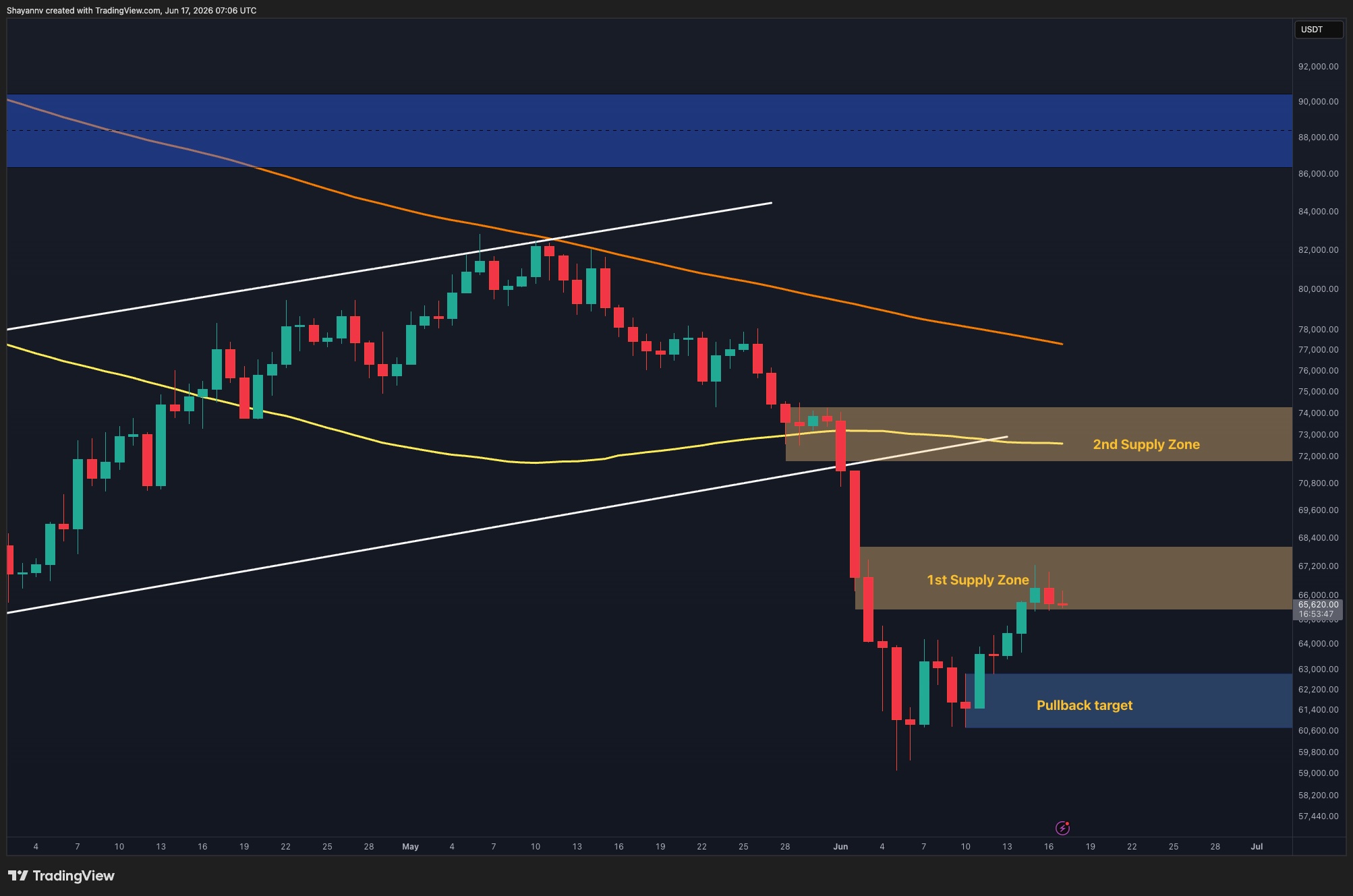
    On the daily chart, Bitcoin is trading near $65,000, having rebounded from the $60,000 support level earlier this month. This recovery has propelled the price directly into the initial major supply zone, situated between $65,000 and $67,000, where selling pressure has begun to manifest.

    Recent daily candles show consolidation within this resistance area rather than an immediate sell-off, which is generally viewed as a positive sign for buyers. However, Bitcoin remains below its 100-day moving average, which is hovering around $72,000, and its 200-day moving average, located near $77,000. This suggests that the broader upward trend has not yet fully re-established itself.

    Should buyers successfully reclaim the current supply zone, the next upward target would be the higher resistance region between $72,000 and $74,000. This area is significant as it coincides with the second supply zone, the 100-day moving average, and the lower boundary of a previously breached ascending channel, presenting the next substantial obstacle for the market.

    On the downside, the $60,000 to $62,000 range continues to serve as the critical support zone. As long as Bitcoin maintains its position above this level, the recent recovery structure is expected to remain intact.

    Four-Hour Chart Perspective

    The four-hour chart illustrates the recent rally into the $65,000-$67,000 supply zone, following a breakout from an ascending recovery channel. After reaching the upper limit of this zone near $66,800, Bitcoin has entered a phase of sideways consolidation.

    The latest price movements suggest that neither bulls nor bears currently hold dominant control. The asset is holding above the former breakout region, roughly between $64,000 and $65,000, while sellers have so far prevented a decisive breach of the supply zone.

    A breakout above $67,000 would bolster the bullish outlook and potentially pave the way toward the higher resistance area around $72,000. Conversely, a failure to hold the $64,000 support region could trigger a more significant pullback toward the demand zone between $61,000 and $62,000.

    For the immediate future, the short-term technical structure remains constructive, provided that higher lows continue to form above the recent breakout area.

    Liquidity Heatmap Analysis

    The Binance liquidation heatmap reveals a notable concentration of liquidity both above and below the current price. However, the closest and most significant cluster of liquidity is situated between $67,000 and $69,000.

    Given that Bitcoin is currently consolidating around $65,000, this overhead liquidity zone could act as a short-term magnet. A move through the current supply region might trigger liquidations of short positions, potentially accelerating momentum toward the $68,000-$69,000 area.

    Concurrently, a substantial liquidity pocket exists below the market, between $62,000 and $63,000. If Bitcoin were to lose the $64,000 support area, the market could be drawn lower to absorb this liquidity before establishing its next directional trend.

    Overall, the heatmap indicates that the market is currently positioned between two major liquidity pools. Considering the proximity of the upper cluster and Bitcoin’s ability to hold within the $65,000-$67,000 resistance zone, the short-term bias leans slightly toward an upward sweep of liquidity into the $67,000-$69,000 region before a more significant directional decision is made.

  • Ethereum Price Surge Possible After FOMC, Glamsterdam Tests Conclude

    Ethereum Price Surge Possible After FOMC, Glamsterdam Tests Conclude

    Ethereum Price Holds Steady as Investors Await FOMC Decision and Key Upgrade

    Ethereum’s price is currently trading below the $1,800 mark, consolidating within a narrow range as the market anticipates the Federal Open Market Committee’s (FOMC) interest rate decision. Two significant factors, one macroeconomic and the other protocol-level, are poised to influence the trajectory of Ether (ETH).

    Glamsterdam Upgrade Nears Final Testing Phase

    On the development front, the Ethereum Foundation has confirmed that testnets are actively running with all planned Ethereum Improvement Proposals (EIPs) for the upcoming Glamsterdam upgrade. This significant network enhancement combines the Amsterdam execution layer and the Gloas consensus layer hard fork, marking the final stage of pre-public testnet development.

    If these tests proceed without major disruptions, the mainnet activation is slated for the latter half of 2026. The Glamsterdam upgrade is primarily focused on Layer 1 scalability. Features like proposer-builder separation (ePBS) and block aggregation (BALs) are designed to accelerate block processing and enable future parallel execution. Additionally, a proposed adjustment to gas fees could reduce the cost of simple ETH transfers by up to 71%, potentially helping Ethereum reclaim market share from rivals like Solana and other major Layer 1 blockchains.

    Market Dynamics and Technical Outlook

    Recent market activity saw significant accumulation, with “whales” acquiring approximately 400,000 ETH between Sunday and Monday, briefly pushing the price up by 6%. However, this momentum has since subsided, with the price returning to its established range.

    Technically, Ethereum’s price action presents a discernible, albeit not definitive, structure. Intraday trading has been capped below $1,800, with the consolidation zone identified between $1,760 and $1,800. The $1,800 level represents the first significant resistance. A decisive move above this threshold, particularly breaking through the $2,000 zone which aligns with the lower boundary of the Ichimoku cloud, could signal a breakout. Such a move might lead to a measured advance towards $2,200, with a broader target of $3,000–$3,050 if sustained momentum is achieved.

    FOMC Decision and Protocol Developments as Catalysts

    A dovish stance from the FOMC, potentially including a surprise rate cut or easing language, could trigger a relief rally for ETH, with some analyses suggesting a potential move towards the $2,600–$2,700 range. Concurrently, progress on the Glamsterdam testnet provides a protocol-level catalyst.

    Conversely, if the Federal Reserve maintains an ambiguous stance, ETH is likely to remain range-bound for another week as traders await clearer market signals. Given that the FOMC is widely expected to hold rates steady within the 350-375 basis point range, the current price action may already reflect this anticipation.

    Institutional Interest and Emerging Infrastructure Plays

    Analysts at Standard Chartered have highlighted the ongoing momentum of Ethereum Exchange-Traded Fund (ETF) inflows, bolstered by institutional interest in products like BlackRock’s staked ETHB. While this represents a structural demand, it may not immediately override short-term macroeconomic influences.

    Ethereum’s current price at $1,800 signifies a recovery from multi-month lows. However, the percentage upside from this level is structurally less than it was six months ago. The combination of whale accumulation and ETF inflows suggests conviction at current levels. Yet, the persistent range-bound trading indicates that the market is pricing in uncertainty rather than immediate opportunity. This environment often favors early-stage infrastructure projects that attract capital rotating away from more established, crowded large-cap assets.

    LiquidChain Aims to Unify Fragmented Liquidity

    In this landscape, projects addressing core infrastructure challenges are gaining attention. LiquidChain ($LIQUID) is an L3 infrastructure project designed to tackle the issue of fragmented liquidity across major blockchains like Bitcoin, Ethereum, and Solana. Its Unified Liquidity Layer aims to integrate BTC, ETH, and SOL execution environments into a streamlined, single-step architecture.

    LiquidChain’s proposition allows developers to deploy applications once and access all three ecosystems. The project’s presale is currently priced at $0.0147, having raised $850,000 to date. Key features include Verifiable Settlement and a Deploy-Once Architecture, intended to mitigate cross-chain friction, which currently results in measurable slippage and latency for DeFi protocols. The LiquidChain presale warrants consideration before its next price adjustment.

  • Coinbase Stock, Options Surge: Analyst Bullish on Evolving Exchange

    Coinbase Stock, Options Surge: Analyst Bullish on Evolving Exchange

    Coinbase Unveils Ambitious Expansion Beyond Crypto, Analyst Sees Major Upside

    Coinbase hosted an event Tuesday to unveil a suite of upcoming product additions, including tokenized equities trading and the introduction of options trading for both cryptocurrency and stocks. Prominent analysts believe these moves signal significant upside potential for the crypto exchange as it broadens its offerings well beyond traditional crypto trading.

    On Wednesday, Mark Palmer, Managing Director and Senior Research Analyst at Benchmark-StoneX, stated that the firm is maintaining its price target for Coinbase’s stock (COIN) at $270. This represents a nearly 60% increase from its closing price of over $169 on Tuesday.

    “The ambition on display was sweeping enough to put every brokerage, bank, and fintech in the country on notice,” Palmer wrote in a note to clients. “The company unveiled a suite of products spanning stocks, derivatives, artificial intelligence, and consumer finance, extending the strategy it first announced last December and pushing the platform well beyond crypto into every asset class it can reach.”

    Coinbase used its Tuesday event to reveal several new products as it aims to become an “everything exchange.” The most significant announcement was the upcoming launch of tokenized U.S. equities. Coinbase stated these will represent real shares backed 1:1, with automatic dividend payouts, distinguishing them from rival tokenized stock products which the company characterizes as derivatives.

    The company also plans to introduce options trading for both cryptocurrencies and traditional equities, and will enable users to transfer existing stock portfolios onto its platform. Additional updates include the ability to borrow against staked Solana, a Coinbase One Card travel portal offering 5% Bitcoin rewards, USDC-backed card access, and new short-term crypto price-prediction contracts.

    “In our view, the company’s update yesterday provided the clearest evidence yet that it is rapidly evolving from a cyclical crypto brokerage into a foundational infrastructure platform linking the emerging on-chain economy to the traditional one,” Palmer added.

    Coinbase’s stock (COIN) traded relatively flat on Wednesday, recently hovering just above $169, according to Yahoo Finance data. The shares have experienced a 13% decline over the past month and are down 25% year-to-date, reflecting broader declines in the cryptocurrency market.

    In May, Coinbase announced a workforce reduction of 14%, citing a strategy to enhance efficiency with a smaller team by leveraging artificial intelligence. The firm also reported its second consecutive quarterly loss, with a deficit of $394 million for the first quarter of 2026.

  • Warsh’s First Fed Decision Looms Over Crypto

    Warsh’s First Fed Decision Looms Over Crypto

    Fed Policy Decision Looms as Key Event for Crypto Market

    The Federal Open Market Committee (FOMC) is set to convene on Wednesday, June 17, for a policy decision that marks the first under new Chair Kevin Warsh. Bitget CEO Gracy Chen has identified this meeting as a pivotal macroeconomic event for the cryptocurrency sector.

    Chen described the current economic landscape as exceptionally challenging, characterized by persistent inflation and a White House keen on increasing liquidity, all while the Federal Reserve appears more internally divided than in recent years.

    Market observers, based on online commentary, do not anticipate any changes to interest rates, with a hold being widely priced in. Some analysts, such as HaxKai, suggest that focusing solely on the rate decision itself is a misdirection, stating that “watching the rate decision itself is watching the wrong thing.”

    Instead, the focus is expected to be on the FOMC’s “dot plot,” which signals future rate expectations, and, crucially, on how Warsh navigates his inaugural press conference as chair. Chen believes that cryptocurrencies have evolved into a truly cross-asset class, a dynamic that older analytical frameworks fail to adequately capture.

    “The old idea that crypto only trades on crypto-native narratives is outdated,” Chen posted on X. “Today, BTC, US equities, gold, FX and commodities are all reacting to the same macro question: Where is liquidity going next?”

    Chen anticipates that if Warsh adopts a hawkish tone, the U.S. dollar is likely to strengthen, exerting downward pressure on gold and risk assets. Conversely, a dovish stance from Warsh could potentially trigger a relief rally across equities and cryptocurrencies. However, she cautioned that the market would likely scrutinize the justification for any easing measures given the prevailing high inflation.

    This perspective is supported by recent data. An analysis by Charlie Bilello on June 16 indicated that Bitcoin and gold are the only major asset classes showing losses year-to-date in 2026, with cryptocurrency down 27%, while the S&P 500 has gained 9% and small-cap stocks have risen 19%.

    Previous analysis by XWIN Research on Warsh suggested a greater emphasis on balance sheet reduction over interest rate cuts. This research also posited that reducing liquidity through quantitative tightening could negatively impact risk assets, even if short-term rates remained unchanged.

    In contrast, investor Ran Neuner expressed a “mega bullish” outlook heading into the meeting. His reasoning is that any indication of the Fed moving away from a rate hike path could bolster risk assets, particularly if inflation expectations decline alongside lower oil prices.

    HaxKai, however, remains less optimistic. They pointed out that Bitcoin has historically declined following most FOMC meetings and noted that the recent rally from $59,000, which stalled at $67,000 earlier this week, leaves considerable room for a downturn. Consequently, they advised traders to exercise caution and avoid making immediate moves in the aftermath of the announcement.

    At the time of this report, Bitcoin was trading near the $65,000 mark, representing a roughly 2% decrease from the previous day but a nearly 6% gain over the preceding seven days.

  • Coinbase Aims for ‘Everything Exchange’ with Stocks, Perps, and AI

    Coinbase Aims for ‘Everything Exchange’ with Stocks, Perps, and AI

    Coinbase Aims to Be the “Everything Exchange” with New Stock and Derivatives Offerings

    Coinbase unveiled a comprehensive suite of new products on Tuesday as part of its latest System Update, marking its most significant step yet toward becoming what it describes as the “everything exchange.”

    The extensive list of updates allows customers to trade U.S. stocks, ETFs, and indexes alongside cryptocurrencies, and even transfer existing stock portfolios from other brokerages. The platform is also introducing:

    The core proposition is that the traditional divide between crypto and traditional finance is dissolving, and Coinbase intends to be the singular application bridging that gap. Users can now move their equities from platforms like Schwab or Robinhood, trade options and crypto in one place, borrow against staked SOL, and utilize an AI advisor to manage their entire portfolio. This effectively positions Coinbase as a brokerage, a bank, and a robo-advisor integrated with a crypto exchange, offering users an unprecedented range of options.

    The question remains whether these advancements will significantly impact Coinbase’s market position.

    While these updates are not groundbreaking in their individual components, the overarching vision is compelling. Agentic trading is widely seen as the future, and providing the infrastructure for AI agents is a strategic move. Furthermore, tokenized stocks and perpetual futures are experiencing a surge in popularity, bolstered by the remarkable success of platforms like Hyperliquid. If the overall market for these assets continues to expand—with Standard Chartered projecting a 40-fold increase in real-world assets by 2030—Coinbase may be able to grow its business without necessarily capturing market share from competitors, simply by benefiting from broader market growth.

    SpaceX Acquires AI Coding Startup Cursor for $60 Billion

    Just days after its historic initial public offering, SpaceX is already deploying its newly acquired stock.

    Yesterday, the company announced its agreement to purchase Anysphere, the developer of the AI coding tool Cursor, for $60 billion in an all-stock transaction. Cursor will be integrated into xAI. This valuation represents nearly double the $29 billion valuation Cursor held in November.

    Cursor’s rapid growth trajectory supports this valuation increase. The company saw its annual recurring revenue climb from $100 million in 2024 to $1 billion by late 2025, and exceeded $2 billion by February. This represents the fastest scaling of any software company, with approximately 50,000 engineering teams and nearly 70% of the Fortune 1000 companies, including Nvidia and Salesforce, as clients.

    Cursor has historically relied on external AI models, incurring substantial costs for services from Anthropic and OpenAI. At one point in 2025, its estimated annual payments to Anthropic reached $650 million against revenues of roughly $500 million, a gross margin that would be unsustainable for most software companies. Compounding the issue, its primary supplier, Anthropic, is also a direct competitor through its Claude Code product, meaning Cursor was effectively subsidizing the development of a rival.

    A pivotal shift in Cursor’s business model involved ceasing its reliance on rented AI. The company’s proprietary Composer model and a more cost-effective model routing system led to slight gross-margin profitability in its enterprise segment by April. This is precisely where SpaceX’s acquisition becomes strategically advantageous. Cursor already had an agreement to utilize xAI’s Colossus supercomputer. Ownership will allow Musk to provide Cursor with low-cost computing power, shift more workload to xAI’s models, and ultimately improve margins while reducing dependence on Anthropic. Cursor had previously rejected acquisition offers from OpenAI twice to maintain its independence, making this move by Musk—using SpaceX’s public stock for his first major enterprise AI acquisition—particularly noteworthy. At a projected $6 billion run rate, the $60 billion acquisition price represents less than a 10x multiple of forward revenue, suggesting a favorable deal for SpaceX.

    Corporate Treasuries & ETFs
    Meme Coin Tracker

  • Ex-Goldman Analyst Predicts XRP Surge to $1,000

    Ex-Goldman Analyst Predicts XRP Surge to $1,000

    Ex-Goldman Sachs Analyst Predicts $1,000 XRP Price by 2030

    A former Goldman Sachs analyst has set an ambitious price target of $1,000 for XRP by the year 2030, a projection significantly higher than current market expectations. XRP is presently trading around $1.20, experiencing a 3.5% decline over the past 24 hours, mirroring a broader market downturn as investors await the Federal Open Market Committee (FOMC) meeting.

    Dom Kwok, co-founder of the Web3 education platform EasyA and a former analyst at Goldman Sachs, shared his outlook on The Rollup podcast. “I think it could go over $1,000 in the next four to five years,” Kwok stated.

    His forecast is based on the premise that mass cryptocurrency adoption will increasingly flow through XRP, rather than established players like Bitcoin or Ethereum. Kwok argues that new retail investors are often priced out of these larger-cap assets and are likely to gravitate towards more affordable and practical alternatives.

    This $1,000 target stands in stark contrast to the institutional consensus, which typically falls within the $3 to $20 range. On-chain data reveals that wallets holding at least one million XRP now control a substantial 74.1% of the total supply. These large holders have been actively accumulating, adding 1.53 billion tokens in the last six months.

    Market Dynamics and Technical Outlook

    Simultaneously, a de-escalation of tensions between the U.S. and Iran has boosted risk appetite, pushing Bitcoin towards the mid-$60,000s and consequently lifting XRP.

    Despite its current price of $1.20 and a 8% weekly gain, XRP is in a corrective phase. However, its technical structure remains robust. The Relative Strength Index (RSI) is hovering near 62, indicating a constructive, non-overbought condition. A recent three-day MACD bullish crossover remains intact, and a decade-long rising trendline has not been breached.

    Key support levels are identified in the $1.10–$1.15 zone, with mid-term resistance previously flagged at $1.43–$1.55 by various technical analyses. The asset has since surpassed these levels, establishing a new trading range.

    Should the U.S. legislative CLARITY Act progress and pass, it could accelerate XRP-linked ETF inflows. Coupled with continued whale accumulation, this would tighten supply and potentially drive the price to retest recent highs and move towards $2, aligning with Standard Chartered’s conditional $8 target.

    The $1,000 Projection: A Bold Vision

    The $1,000 price prediction necessitates a market capitalization in the tens of trillions. Such a valuation hinges on assumptions regarding the widespread adoption of global financial infrastructure, a scenario that is theoretically plausible but practically extraordinary. Kwok’s framing of this potential shift through an internet-era analogy offers an intellectually coherent perspective.

    XRP’s bullish case is heavily reliant on the maturation of financial infrastructure, with the expectation that genuine adoption will follow the development of useful applications built on accessible networks. This same thesis is currently driving early interest in other layers of the blockchain stack.

    Even within a confirmed XRP uptrend, an entry point at $1.20 means investing in an asset with a $75 billion market capitalization, compressing the potential for outsized returns. Early-stage infrastructure projects, however, still present this significant asymmetry.

    LiquidChain: A New Infrastructure Play

    LiquidChain ($LIQUID) is emerging as a Layer 3 infrastructure project, positioning itself as a cross-chain liquidity layer. It aims to fuse liquidity from Bitcoin, Ethereum, and Solana into a unified execution environment.

    The project’s architecture features a Unified Liquidity Layer, Single-Step Execution, Verifiable Settlement, and a Deploy-Once model, enabling developers to access all three ecosystems without the need for redeployment. The presale is currently priced at $0.0147, having raised $850,000 to date.

  • India Bans Telegram; Crypto Markets Tumble

    India Bans Telegram; Crypto Markets Tumble

    India Orders Telegram Delisting, Sparking Crypto Market Concerns

    India’s directive for Google and Apple to remove Telegram from their app stores has sent ripples through the cryptocurrency market, with the native token GRAM experiencing a notable decline. The move, affecting an estimated 104 to 150 million users, effectively cuts off Telegram’s largest national user base.

    Temporary Ban Tied to Exam Re-examination

    The delisting order, enacted under Section 69A of India’s Information Technology Act, is explicitly temporary. It is linked to the NEET-UG medical entrance re-examination, scheduled for June 21. The Internet Freedom Foundation has criticized the decision, labeling the shutdown of Telegram a “band-aid solution” and a “disproportionate answer to exam fraud.”

    TON Blockchain’s Distribution Moat Under Threat

    The investment thesis for the TON blockchain and its native token, GRAM, hinges on Telegram’s vast user base as a distribution channel. The Indian government’s order has highlighted a vulnerability, demonstrating that this “moat” can be compromised.

    Broader Crypto Market Implications

    The decision is expected to impact the broader cryptocurrency market, given India’s significant number of active crypto holders. Telegram, alongside platforms like X, serves as a hub for many of these crypto communities.

    Government Action Driven by Exam Leak Allegations

    India’s Ministry of Electronics and Information Technology, acting on a request from the National Testing Agency (NTA), invoked Section 69A of the IT Act. The NTA had previously canceled the original May 3 exam due to allegations of a paper leak, with Telegram channels reportedly involved in the distribution and fabrication of leaked materials.

    Message Editing Feature Disabled

    In a separate directive, Telegram has been ordered to disable its message-editing feature for Indian users until June 30. This measure targets a specific function investigators believe cheating networks exploited to create fabricated evidence of exam leaks. The current delisting order is set to expire on June 22, 2026, the day after the re-examination.

    Telegram CEO Alleges BGP Hijacking

    Telegram CEO Pavel Durov has vehemently opposed the ban, accusing Indian telecom provider Reliance of employing BGP hijacking. Durov claims Reliance is manipulating the Border Gateway Protocol via autonomous system number AS18101 to disrupt Telegram access for users outside India, including in the United Arab Emirates. He further alleged that Reliance and WhatsApp collaborated to lobby for the ban, citing Reliance’s partial ownership by Meta as a potential motive.

    Telecom Industry Source Disputes Claims

    A senior source within the Indian telecom industry has refuted Durov’s allegations, suggesting a conflation of two distinct entities: Reliance Communications, which manages subsea cables and holds AS18101, and Reliance Industries Ltd, the parent company of Jio, where Meta holds a minority stake without operational control. The source characterized Durov’s claims as either a misunderstanding or deliberate misinformation. At the time of publication, Telegram, Jio, Meta, and Reliance Communications had not responded to media inquiries.

    Investment Calculus Affected by Ban’s Nature

    The disruption to Telegram’s crypto-related services in India, including tap-to-earn games, quiz apps, and Web3 mini-apps, has immediate consequences for users. The long-term implications for the TON blockchain and GRAM depend on the nature of the ban. If it is purely regulatory, driven by exam integrity concerns, it may be temporary. However, if Durov’s allegations of competitive warfare and lobbying hold true, the ban could be an instrument of market suppression, with potentially more complex and lasting effects. The BGP hijacking claim, if substantiated, would independently raise alarms about manufactured disruptions to internet traffic beyond government directives.