Category: Uncategorized

  • Bittensor (TAO) Dips 7%, Price Surge Expected

    Bittensor (TAO) Dips 7%, Price Surge Expected

    Bittensor (TAO) Slips 7% Daily, Yet Analysts Foresee Potential Price Surge

    New York, NY – June 16, 2024 – While many leading altcoins are experiencing significant gains today, Bittensor (TAO) has bucked the broader market uptrend, registering a substantial daily decline. Despite this dip, several analysts remain optimistic, suggesting the cryptocurrency could be poised for a rebound that might propel it back to multi-month highs.

    TAO is currently trading around $268, marking a 7% drop over the past 24 hours. This downturn occurred even as Grayscale, the digital asset management firm, offered positive remarks about the project. Grayscale recently stated that centralized entities like Anthropic are more susceptible to government intervention, positioning decentralized projects such as Bittensor as a viable alternative.

    “Bittensor provides open-source, permissionless access to AI through a decentralized global network,” Grayscale posted on X.

    X user Altcoin Sherpa observed that TAO has underperformed many prominent cryptocurrencies, speculating that this weakness might be due to traders preemptively adjusting their positions or already being fully allocated. Nevertheless, the analyst expressed continued confidence in TAO, stating it “looks good” and that they remain invested.

    “This current area is a bit of a resistance spot, 200d EMA + S/R level, but if it can break here, I think the low $300s is my next area up,” the X user added.

    Ali Martinez also weighed in, suggesting that TAO is approaching the upper boundary of its descending channel. He predicted that a decisive breakout could lead to a significant price increase, potentially reaching $350 and subsequently $420.

    The asset’s recent exchange netflow data further supports the possibility of a short-term recovery. In recent weeks, outflows from exchanges have exceeded inflows, indicating that a growing number of investors are moving their assets to self-custody solutions, thereby reducing immediate selling pressure.

    Another prominent figure bullish on TAO is Michael van de Poppe. Earlier this week, he described the token’s chart as “phenomenal” and projected a potential price surge to $500. He further opined that the strongest altcoins from recent months, including TAO, could sustain their robust performance in the near term, contingent on Bitcoin (BTC) having established a bottom.

    It is worth noting that at the beginning of June, Bitcoin experienced a brief collapse to approximately $59,000, its lowest point in 19 months. While the primary cryptocurrency has since recovered to well above $65,000, following a reported peace deal between Iran and the US, some analysts believe the market may still face further downside before the current cycle concludes.

  • Japan Rates Surge to 30-Year Peak, Crypto Market Unfazed

    Japan Rates Surge to 30-Year Peak, Crypto Market Unfazed

    Crypto Markets Remain Stable as Japan Raises Interest Rates to 30-Year High

    Tokyo, Japan – Cryptocurrency markets showed resilience on Tuesday, holding steady even as the Bank of Japan implemented its first interest rate hike in 17 years, pushing benchmark rates to a three-decade high amid concerns over rising domestic inflation.

    The Bank of Japan’s policy board voted 7-1 to raise its benchmark interest rate to approximately 1%, with the new guideline taking effect on June 17. Policymakers cited the risk of inflation exceeding the 2% target, driven by higher oil prices impacting consumer goods, and signaled expectations for further rate increases.

    In a separate development, a relief rally had previously boosted crypto markets following President Trump’s announcement of a deal with Iran over the weekend. This de-escalation of tensions, which the Bank of Japan had linked to rising oil prices, propelled Bitcoin above $65,000 from its earlier low $60,000s. A formal signing of the deal is anticipated on Friday.

    At the time of reporting, Bitcoin was trading around $66,000, a 1.1% decrease on the day, according to CoinGecko data. Sentiment on the prediction market Myriad, operated by Dastan, the parent company of Decrypt, remained predominantly bearish, with traders assigning a 64% probability to Bitcoin’s next move being a decline to $55,000.

    The Bank of Japan noted that Japan’s economy has “recovered moderately” despite weakening factors associated with the Middle East. Strong corporate profits and a robust job market have helped to cushion the impact on economic activity. The central bank’s guidance suggests the broader economy is expected to align with a “baseline scenario” of moderate growth, albeit at a slower pace. Government measures aimed at mitigating energy costs are anticipated to reduce the risk of a sharp economic slowdown.

    Tuesday’s quarter-point increase to 1% marks the highest level for Japan’s benchmark rate in over three decades, a level last seen in 1995.

    Historically, Bank of Japan rate hikes have exerted pressure on crypto markets by unwinding the yen carry trade. This strategy involves investors borrowing yen at low interest rates to invest in higher-yielding assets abroad, profiting from the interest rate differential while the yen remains weak.

    Despite this historical precedent, Bitcoin and the broader crypto market remained stable following Tuesday’s rate hike, even as traders appeared to have anticipated a potential selloff.

    The total market capitalization of cryptocurrencies hovered around $2.34 trillion, down 1.4% for the day, according to CoinGecko. Data from CoinGlass indicated a decrease in open interest for Bitcoin futures over the preceding day, suggesting traders had reduced their leveraged positions, thereby limiting the potential for a significant selloff.

    “The Yen carry trade has failed to trigger any meaningful disruption in either crypto or global equities this time around,” Ryan Yoon, senior analyst at Tiger Research, told Decrypt. He added that the memory of previous carry trade scares is “still incredibly fresh,” leading investors to “refuse to panic” as the market appears to have “fully recovered” from earlier shocks.

    Decades of low and negative interest rates have supported global markets, with Japan currently carrying public debt exceeding 200% of its GDP, the highest among advanced economies, according to IMF data.

    Yoon suggested that the yen carry trade would likely remain “just another headline” unless Japan’s policy shift significantly drains liquidity from the U.S. market. He explained that once the market processes a narrative and realizes “the sky isn’t falling,” such scares “lose their power to move prices.”

    Maksim Balashevich, founder and CEO of Santiment, commented that Japan’s rate hike held less market significance now, as it had been “priced in before.” He posited that “The ‘unknown’ events of the future, which aren’t fully priced in and able to move markets significantly, must be some other pieces of unveiling reality.”

    Tuesday’s rate hike was accompanied by a commitment to increase bond purchases if long-term yields rise sharply, thereby capping the extent of monetary tightening. The Bank of Japan confirmed its intention to continue reducing these purchases by approximately ¥200 billion (about $1.3 billion) each quarter until early 2027, after which they are expected to stabilize near ¥2 trillion (approximately $12.5 billion).

  • SpaceX Stock Surges on $60 Billion Cursor Acquisition Deal

    SpaceX Stock Surges on $60 Billion Cursor Acquisition Deal

    SpaceX Acquires AI Coding Startup Cursor in $60 Billion All-Stock Deal

    SpaceX shares surged to a new high on Tuesday, surpassing $210 per share, following the announcement of a $60 billion all-stock acquisition of AI coding startup Cursor. The deal extends a post-initial public offering rally for Elon Musk’s company, according to MarketWatch.

    The acquisition of Cursor was detailed in a Form 8-K filing submitted to the U.S. Securities and Exchange Commission.

    “SpaceX has exercised the option to acquire [Cursor] in an all-stock transaction with the goal of building the world’s most useful AI models,” SpaceX stated in a post on X. “For the past few months, SpaceXAI has been jointly training a model with Cursor, which will be released in Cursor and GrokBuild soon.”

    The acquisition had been under negotiation for several months. The filing revealed that SpaceX secured an exclusive option in April to acquire Anysphere, the parent company of Cursor, with a stipulated $10 billion breakup fee if the deal did not proceed.

    Following the exercise of this option on June 16, SpaceX entered into a $60 billion merger agreement with Anysphere and its subsidiary X67. This transaction will make the AI coding startup a wholly owned subsidiary of SpaceX. Shareholders of Anysphere are set to receive SpaceX Class A stock, with the valuation based on the company’s average share price over the seven trading days preceding the deal’s completion. The acquisition is anticipated to finalize in the third quarter of 2026, subject to regulatory approval.

    Cursor, founded in 2022 as Anysphere, has rapidly established itself as a prominent AI coding platform. Its rise coincides with the increasing adoption of generative AI and AI agents by developers for software creation and review. Prior to the acquisition agreement, Cursor was reportedly in the process of securing a $2 billion funding round that would have valued the company at $50 billion. Earlier this year, Cursor unveiled Cursor 3, the latest iteration of its software, which it described as a “unified workspace for building software with agents.”

    “We’re excited to join forces with [SpaceX] to advance the frontier of useful AI,” Cursor posted on X. “Expect significant improvements to Cursor soon.”

    However, Cursor has not been without its challenges. In April, Jeremy Crane, founder of PocketOS, alleged that an AI agent powered by Cursor deleted his startup’s database within nine seconds, subsequently providing an explanation for the incident.

    The acquisition announcement comes just days after SpaceX’s significant IPO, which saw its shares climb above $200 and reach $210 on Tuesday. In its confidential filing with the SEC in April 2026, SpaceX identified AI as a substantial growth area, projecting the market for AI infrastructure to reach as high as $2.4 trillion and enterprise applications to $22.7 trillion. The acquisition of Cursor is expected to bolster SpaceX’s strategic expansion into AI-powered development and infrastructure.

    “We look forward to working closely with the Cursor team to advance our frontier AI capabilities,” SpaceX stated on X.

  • Crypto Swap APIs: 7 Business Applications

    Crypto Swap APIs: 7 Business Applications

    Embedded swap infrastructure has become a crucial tool for many crypto wallets, fintech applications, and cross-chain platforms. It allows them to expand their asset coverage, enhance trade execution, and generate new revenue streams without the significant overhead of operating their own exchanges.

    Instead of building complex liquidity systems from scratch, companies are increasingly turning to crypto swap APIs (Application Programming Interfaces). These APIs connect users to a multitude of liquidity sources while seamlessly preserving the existing user experience. Real-world applications demonstrate how robust crypto APIs can streamline user journeys, boost customer retention, and facilitate scalable growth through integrated swap functionalities.

    Here are seven ways companies are leveraging this infrastructure:

    Rubic Expands Cross-Chain Capabilities

    Rubic, a cross-chain aggregation platform launched in 2020, facilitates trades across over 340 decentralized exchanges, bridges, and intent protocols, spanning more than 70 networks. While its coverage was strong across Ethereum Virtual Machine (EVM)-compatible chains, major ecosystems like Bitcoin (BTC), Monero (XMR), and Cardano (ADA) operate on fundamentally different architectures. Supporting these natively requires custom bridges, dedicated nodes, and separate liquidity pipelines.

    To overcome this challenge, Rubic integrated the ChangeNOW Crypto Exchange API as an external execution layer for non-EVM assets. This integration enabled instant swaps for BTC, XMR, and ADA through a single point of access. The result was faster deployment on new chains, improved swap success rates on cross-chain routes, and a rise in transaction volume for high-demand pairs now supported by these new assets.

    “Exchange speeds are excellent, and the range of supported networks is broad,” a Rubic team representative stated, highlighting that a dedicated account manager ensured prompt issue resolution, avoiding the typical delays associated with support queues.

    Warden Scales with AI and Broad Liquidity

    The challenge of cross-chain coverage manifests differently for AI-native products. Warden, an AI trading interface that allows users to manage and swap assets via a chat interface, encountered routing bottlenecks shortly after its launch. RPC limits threatened reliability, and initial liquidity was confined to the Solana ecosystem.

    By integrating the Uniswap Trading API, Warden achieved significant scalability, processing over 650,000 swaps across 14 chains in just three weeks. The platform went live in under 72 hours and supported more than 500,000 users.

    A secure crypto API is fundamental to every aspect of the user experience, from uptime and transaction flow to data handling and operational reliability.

    An Anonymous Aggregator Enhances User Onboarding

    An anonymous hybrid exchange aggregator, which routes trades across hundreds of venues, observed a significant user drop-off at the wallet-connection stage, even before pricing or asset coverage became a factor. In DeFi-native flows, the “connect wallet” step often serves as an exit point, particularly for users holding larger balances who carefully consider smart contract permissions and phishing risks before linking their wallets to unfamiliar platforms.

    The aggregator addressed this by replacing the wallet connection requirement with a simple deposit-and-receive flow using the ChangeNOW Exchange API. This allows users to send assets to a generated address and receive the swapped tokens in their chosen wallet without granting permissions or relinquishing custody. The reported outcome was a reduction in abandonment at the initial interaction stage and access to a security-conscious user segment that typically avoids direct wallet connectivity.

    “Definitely move ahead and integrate,” a brand representative advised, noting the team found the customer support to be strong and the integration process smooth.

    Tonbankcard Streamlines Funding and Generates Revenue

    Tonbankcard, an open financial protocol on the TON blockchain that structures accounts as NFTs, faced a hurdle at the point of first use. Users often arrived with assets on other chains, but funding a Tonbankcard account required assets native to the TON ecosystem. Previously, resolving this mismatch meant leaving the product, finding an external exchange or bridge, manually completing the swap, and returning – each step increasing the likelihood of user abandonment.

    Tonbankcard integrated the ChangeNOW Exchange Widget into its interface, reducing the number of steps required to fund an account by 50%, according to the company. This integration also enabled on-ramp and cross-chain swap functionality for both fiat and crypto users. Businesses evaluating payment infrastructure for similar use cases can find fiat on- and off-ramp options built into ChangeNOW’s API offering, available upon request.

    The same Tonbankcard integration yielded a second significant outcome: the establishment of a revenue share at 0.4% of transaction volume, creating a predictable income stream from in-app swap activity. As users exchanged assets to fund their accounts, the protocol earned commissions on each transaction through a revenue-sharing model, fostering earlier self-sustainability without introducing a centralized structure or additional custody obligations. ChangeNOW’s partner program, similar to industry offerings, starts at 0.4% of transaction volume and allows commissions to vary by asset, pair, or swap size.

    Interface Drives Social Trading Volume

    Interface, a social network and block explorer for the Ethereum ecosystem, adopted a similar strategy by utilizing the open-source DEX aggregation infrastructure layer, 0x Protocol’s Swap API. The team integrated 0x v2, the protocol’s next-generation trading engine featuring built-in monetization controls and enhanced trade routing, in under a month. They achieved $3.5 million in social trading volume within 70 days, with daily volume reaching $500,000 by the end of that period. The revenue was generated directly from swap fees embedded within the integration, leveraging 0x’s monetization controls without the need for separate billing infrastructure.

    xPortal Enhances Pricing and User Experience

    xPortal, an all-in-one crypto super app, routes every swap through an automated engine that evaluates multiple liquidity providers to select the best execution for each pair. ChangeNOW was integrated directly into this engine and was automatically selected whenever it offered superior rates. The full integration took only one week. During a zero-deposit-fee promotional period, ChangeNOW routes were frequently utilized across supported pairs, including for EGLD, the native token of the MultiversX blockchain. Users benefited from improved pricing without any alteration to their experience, and xPortal reported higher conversion rates and increased swap activity.

    “Integrating partners deeply into existing systems, instead of adding surface-level options, leads to better results,” noted former CEO Sergiu Biriș.

    Anchorage Digital Empowers Institutional Clients

    Digital asset platform Anchorage Digital adopted a similar approach for its institutional self-custody wallet, Porto. The team integrated the Uniswap Trading API, providing institutional clients with direct access to decentralized liquidity across more than 14 blockchains without the need to build their own routing infrastructure.

    ChangeNOW x @xPortalApp: B2B Case Study 🎓
    We reveal how non-custodial API swap integration improved execution speed, auto-routing optimal paths, UX changes & interesting partnership results.
    Deep dive on execution and B2B lessons in our blog 👇https://t.co/Zz3Fo3lrIg
    — ChangeNOW (@ChangeNOW_io) February 4, 2026

    Bitcoin.com Wallet Boosts Stability and Asset Velocity

    Bitcoin.com Wallet’s in-app swaps gained significant traction after their 2021 launch. However, rising demand exposed limitations in its single swap provider, leading to slower execution and delayed support for trending tokens. Building a proprietary exchange system would have introduced licensing complexities, liquidity management overhead, and engineering risks to the core wallet product. Consequently, the team adopted a multi-partner model, beginning with ChangeNOW as a complementary provider.

    The company reported a 10% improvement in service stability, a 15% to 18% increase in processing speeds, and a 40% reduction in the time required to add in-demand assets. This enhanced asset velocity drove a 20% to 25% increase in user activity and overall traffic. “It has been critical for us to work with a partner who does not simply process exchanges but helps us remain fast, stable, and relevant for our users,” the Bitcoin.com Wallet team stated.

    Zelcore Maintains Custody While Enabling Swaps

    Zelcore, a multi-chain non-custodial wallet supporting over 70 blockchains, built its product around user control of private keys and a zero-knowledge stance on user data. As the wallet expanded, users could store assets within Zelcore but had to leave the platform to swap them, disrupting the user experience and exposing them to custodial environments. Developing an in-house liquidity layer would have necessitated KYC, AML, and licensing obligations, directly conflicting with the wallet’s custody model.

    Zelcore then integrated the ChangeNOW Exchange API in 2021, bringing swaps directly into the wallet without the need to staff a separate exchange team or alter its custody architecture. Five years later, after migrating to an aggregated backend that routes across multiple providers spanning CeFi and DeFi, ChangeNOW remains the most utilized route within the system. “The partnership held through a full crypto market cycle and Zelcore’s transition to backend aggregation, a transition that displaces many providers, but that ChangeNOW navigated alongside us,” the Zelcore team commented.

    Ledger Integrates Decentralized Swaps

    The same challenge led crypto wallet Ledger to integrate the Uniswap Trading API into Ledger Wallet, allowing users to access decentralized swap functionality without leaving the app. This integration provided access to permissionless on-chain liquidity while preserving Ledger’s hardware-backed security model.

    For early-stage wallets, the more significant challenge often arises after launch. A product may be functional, and users may be testing it, yet revenue generation can hinge on the availability of in-app swaps from day one. Recognizing this, ChangeNOW’s Fast-Track Program offers a limited number of selected wallet teams free direct support to integrate its exchange API, activate revenue sharing, and gain launch visibility. Once approved, partners can enable in-app swaps, activate revenue attribution, and begin with a 0.4% share of exchange volume. The platform also supports approved projects with public relations, social media exposure, conference visibility, and hands-on launch guidance.

    Crypto swap infrastructure is most effective when it aligns precisely with a product’s specific needs, whether that be asset coverage, custody, execution, onboarding, or revenue generation. The key takeaway is to start with the end goal in mind and work backward to determine the optimal crypto swap API to meet those requirements.
  • Robinhood Cuts 10% of Staff as Crypto Revenue Falls

    Robinhood Cuts 10% of Staff as Crypto Revenue Falls

    Robinhood Cuts 10% of Workforce Amid Crypto Revenue Slump

    Robinhood announced Tuesday it is laying off 10% of its employees as it seeks to streamline operations amid a significant decline in cryptocurrency-related revenue.

    The reduction in headcount is part of an effort to flatten the company’s organizational structure and foster a “lean, hyper-focused team,” CEO Vlad Tenev informed employees in an internal message shared on X. “We cannot default to operating as a heavily-layered organization,” Tenev stated. “Our execution is strong today, but our ambitions require us to continuously raise our own bar.”

    The move comes after Robinhood reported its smallest quarterly profit in a year during the first quarter earnings release in April. At that time, the company also disclosed that revenue from crypto transactions had fallen 34% sequentially, dropping to $134 million from $221 million. This performance underscored the brokerage’s continued exposure to crypto traders, whose engagement has waned amid subdued market conditions. Despite the cuts, Tenev characterized the layoffs as proactive, asserting, “Robinhood’s business has never been stronger.”

    Robinhood’s stock price saw a 1% dip to $97 on Tuesday, according to Yahoo Finance. While shares had reached an all-time high of $153 last year, coinciding with Bitcoin’s peak above $126,000 in October, they have since declined approximately 12% year-to-date.

    In an SEC filing accompanying its 2025 annual report, Robinhood stated it employed around 2,900 full-time staff, emphasizing its “lean organizational structure.” The impact of these layoffs on Robinhood’s development of crypto-focused products, including stock tokens available to European customers and its Arbitrum-based Ethereum layer-2 scaling network, Robinhood Chain, remains unclear. A Robinhood spokesperson directed inquiries to Tenev’s statement.

    In a separate filing on Tuesday, the company indicated it anticipates incurring $28 million in restructuring costs, which will cover employee severance packages, benefits, and share-based compensation. “The company is taking this action from a position of business strength,” Robinhood added, noting that “June month-to-date average daily trading volumes [were] at record levels across equities, options, and prediction markets.”

    This year has seen several cryptocurrency firms reduce their workforces amid a prolonged downturn in crypto prices, often termed a “crypto winter.” In March, Crypto.com laid off 280 employees, or 12% of its staff, signaling a pivot toward AI-driven operations. The previous month, Jack Dorsey’s Block announced it would cut over 4,000 jobs, representing more than 40% of its workforce.

  • Leveraged Cup: Trade Your Way to the World Football Final

    Leveraged Cup: Trade Your Way to the World Football Final

    Leveraged Launches Trading Competition with Trip to World Football Final as Grand Prize

    Limassol, Cyprus – June 16, 2026 – Leveraged, a proprietary trading firm aiming to democratize access to trading, today announced the launch of its 2026 Leveraged Cup, a global trading competition scheduled to run from June 17 to June 30. The ultimate winner will be awarded an all-expenses-paid Champions Package, valued at $20,000, to attend the World Football Final in New York this July.

    The Leveraged Cup is open to traders worldwide and will utilize Leveraged’s specialized Sprint accounts, designed for participants who can effectively capitalize on rapid market fluctuations. The competition challenges users to achieve the highest percentage return on their investments over the two-week period. The top four traders will advance to a live-streamed “Final Four Sprint 2 Cash” showdown, with the overall champion receiving the Grand Prize Champion’s Package, which includes two tickets to the world football final, flights, and accommodation. Additionally, daily winners will receive $200 prizes, enabling them to host friends for what is described as a “match of a lifetime” and become a “Legendary host.”

    Eligibility for the competition requires traders to purchase a Sprint account with a trading range between $10,000 and $100,000. Throughout the 15-day event, participants will vie for leaderboard positions based solely on the percentage payout achieved within their Sprint accounts. Traders are permitted to purchase multiple Sprint accounts, with their highest payout percentage determining their score. This focus on percentage growth, rather than nominal profit, underscores Leveraged’s commitment to recognizing trading talent irrespective of capital size.

    Competition Format and Prizes

    The four highest-ranked traders on the overall leaderboard will progress to the “Sprint 2 Cash” head-to-head finale, a 90-minute trading event. To ensure a level playing field, all finalists will trade with identical account sizes during this live competition. The trader who generates the highest percentage return during the session will be crowned the 2026 Leveraged Cup Champion.

    Tal Fromchenko, Founder of Leveraged, drew parallels between trading and sports, stating, “Trading and sport have more in common than meets the eye. The best traders, like the best athletes, succeed because of their ambition, discipline, decision-making, and execution under pressure. The Leveraged Cup celebrates those qualities and gives traders around the world the opportunity to showcase their skills on a global stage and get rewarded for that.”

    Participants can also earn a free Sprint account for every two users they refer who open their own Sprint accounts, providing an additional avenue to compete. To qualify for daily cash prizes and eligibility for the Final Four, participants must follow @GetLeveraged on X or Instagram, share a screenshot of their Sprint account dashboard or leaderboard position using the hashtag #LeveragedCUP, and tag @getleveraged.

    Leveraged, a global proprietary trading firm founded on the principle that “Everyone’s a Trader,” currently serves traders in over 150 countries. The company offers access to funded trading accounts, AI-powered trading tools, and comprehensive educational resources. To date, Leveraged has funded more than 50,000 portfolio managers and processed over $100 billion in trading volume.

    For complete competition rules and registration details, interested individuals can visit www.getleveraged.com/leveragedcup.

  • Shiba Inu Metric Hits 5-Year Low: Rally Imminent?

    Shiba Inu Metric Hits 5-Year Low: Rally Imminent?

    Meme Coin Mania Fades, But a Key Metric Hints at Shiba Inu’s Potential Comeback

    The cryptocurrency sector’s once-booming meme coin segment, a highlight of the previous bull market, is now experiencing a significant downturn in both strength and investor interest.

    Shiba Inu (SHIB), a prominent token in this category, has seen its value plummet by approximately 65% over the last year. However, a crucial indicator suggests that a recovery might be on the horizon.

    Currently trading around $0.000005031, Shiba Inu’s market capitalization has fallen below $3 billion. This positions SHIB as the 35th-largest cryptocurrency overall and the third-largest within the meme coin niche, trailing behind Dogecoin (DOGE) and MemeCore (M).

    The current state of Shiba Inu appears less than ideal. While the development team has been relatively quiet in expanding the ecosystem, the ongoing sell-off may be approaching its conclusion.

    Data from CryptoQuant reveals that the quantity of SHIB tokens held on cryptocurrency exchanges has reached a five-year low, standing at approximately 79.8 trillion. This trend indicates a shift among investors towards self-custody solutions, moving away from centralized platforms, which in turn reduces immediate selling pressure.

    Some market analysts are optimistic about a potential price resurgence. X user Nehal, for instance, believes SHIB is “dangerously ignored” at its current price levels and suggests a 40-50% jump would not be unexpected.

    The dwindling supply of SHIB on exchanges represents one of the few positive signals for the meme coin, even as other factors point to the possibility of further price declines in the near future.

    For example, the token’s burn rate has decreased by 62% in the past 24 hours, resulting in a minimal number of tokens being removed from circulation. The primary objective of the burn program is to enhance SHIB’s value through scarcity. While the team and community have collectively burned trillions of coins over the years, approximately 590 trillion SHIB remain in circulation, a substantial figure.

    Another challenge facing Shiba Inu is the slowdown of Shibarium, its layer-2 scaling solution. Launched in the summer of 2023 to improve transaction speed, scalability, and reduce fees, Shibarium initially processed millions of transactions. However, an exploit last year disrupted its operations, and since then, transaction volumes have significantly decreased to mere hundreds and thousands.

  • Ripple (XRP) Update: June 16

    Ripple (XRP) Update: June 16

    Ripple Invests in Flutterwave to Expand Stablecoin Payments in Africa

    Ripple, the blockchain payment company, has announced a strategic investment in Flutterwave, a prominent African payments firm. The partnership is designed to broaden the reach of stablecoin-powered payments across the continent, with plans to integrate Ripple’s RLUSD stablecoin, Ripple Payments, and the XRP Ledger into Flutterwave’s existing infrastructure.

    The funding round values Flutterwave, which provides payment infrastructure in Africa, at $3.2 billion. The company also disclosed that it has raised over $500 million and processed more than 1 billion transactions totaling over $50 billion.

    According to an official statement, the collaboration will leverage RLUSD as a settlement asset across Flutterwave’s payment networks and its Send App remittance service. The XRP Ledger (XRPL) will be utilized to expedite transaction clearing. The initiative aims for practical settlement by combining Flutterwave’s diverse local payment methods—including bank transfers, mobile wallets, and cards—with Ripple’s established blockchain technology.

    Reece Merrick, Managing Director, MEA at Ripple, commented on the investment: “Our investment will establish RLUSD within that infrastructure, with Flutterwave driving stablecoin flows over the XRPL and deepening its role as a settlement layer for real-world payments across the continent. Together we also plan to bring Ripple Payments’ speed and efficiency to cross-border transactions in the region, opening up faster, lower-cost financial services to businesses and consumers at scale.”

    This move aligns with Ripple’s broader strategy to promote RLUSD as an enterprise-grade stablecoin, moving beyond its perception as solely a retail trading asset.

    Ripple has also been exploring new applications for XRP and RLUSD in payment solutions linked to autonomous AI agents, as previously reported. Furthermore, RLUSD’s prominence is growing amidst a wider institutional interest in stablecoins. Mastercard, for instance, recently expanded its stablecoin strategy through collaborations with Ripple and other cryptocurrency-focused companies.

  • IMF: Nigeria’s Stablecoin Boom Amplifies Risks

    IMF: Nigeria’s Stablecoin Boom Amplifies Risks

    Stablecoin Surge in Nigeria Highlights Benefits and Risks, IMF Warns

    The rapid adoption of stablecoins in Nigeria has underscored the advantages of dollar-pegged cryptocurrency assets while simultaneously magnifying their inherent risks, according to a new report from the International Monetary Fund (IMF).

    IMF researchers observed that stablecoins have emerged as a “meaningful cross-border payments channel.” Between July 2023 and June 2024, Nigeria saw approximately $59 billion in crypto-asset inflows. Furthermore, since 2019, the country has accounted for 60% of all stablecoin inflows within the sub-Saharan African region.

    While acknowledging the “clear benefits” of stablecoin adoption, including enhanced financial inclusion and more cost-effective cross-border payments that challenge traditional remittance services, the IMF raised concerns regarding monetary sovereignty and financial integrity.

    The report suggests that dollar-pegged stablecoins could effectively function as a “digital form of dollarization,” potentially undermining the efficacy of domestic monetary policy. Additionally, existing financial monitoring systems struggle to adequately track stablecoin transactions, with their inherent anonymity increasing the risk of “illicit finance.”

    “Attempts to suppress stablecoin use are likely to be only partly effective,” the report stated, advocating for a “pragmatic” approach that fosters innovation while concurrently “managing risks.”

    The authors proposed measures to protect monetary stability and counter “digital dollarization,” commending recent macroeconomic reforms and a more stringent monetary policy. Other risk management strategies recommended include bolstering regulatory oversight, improving data collection by “combining blockchain analytics with reporting on naira-stablecoin conversions,” and upgrading existing payment infrastructure to “reduce reliance on unregulated channels” such as stablecoins.

    The IMF has consistently voiced criticisms of stablecoins in recent years, warning of their potential to “stifle central bank control” and “amplify financial crises.” Just last week, the international financial body called for “close monitoring” of cryptocurrency adoption in Nepal, citing risks such as the “circumvention of capital controls or large-scale deposit outflows.”

  • XRP Price Outlook: June 16

    XRP Price Outlook: June 16

    XRP Eyes Key Resistance as Buyers Stage Comeback

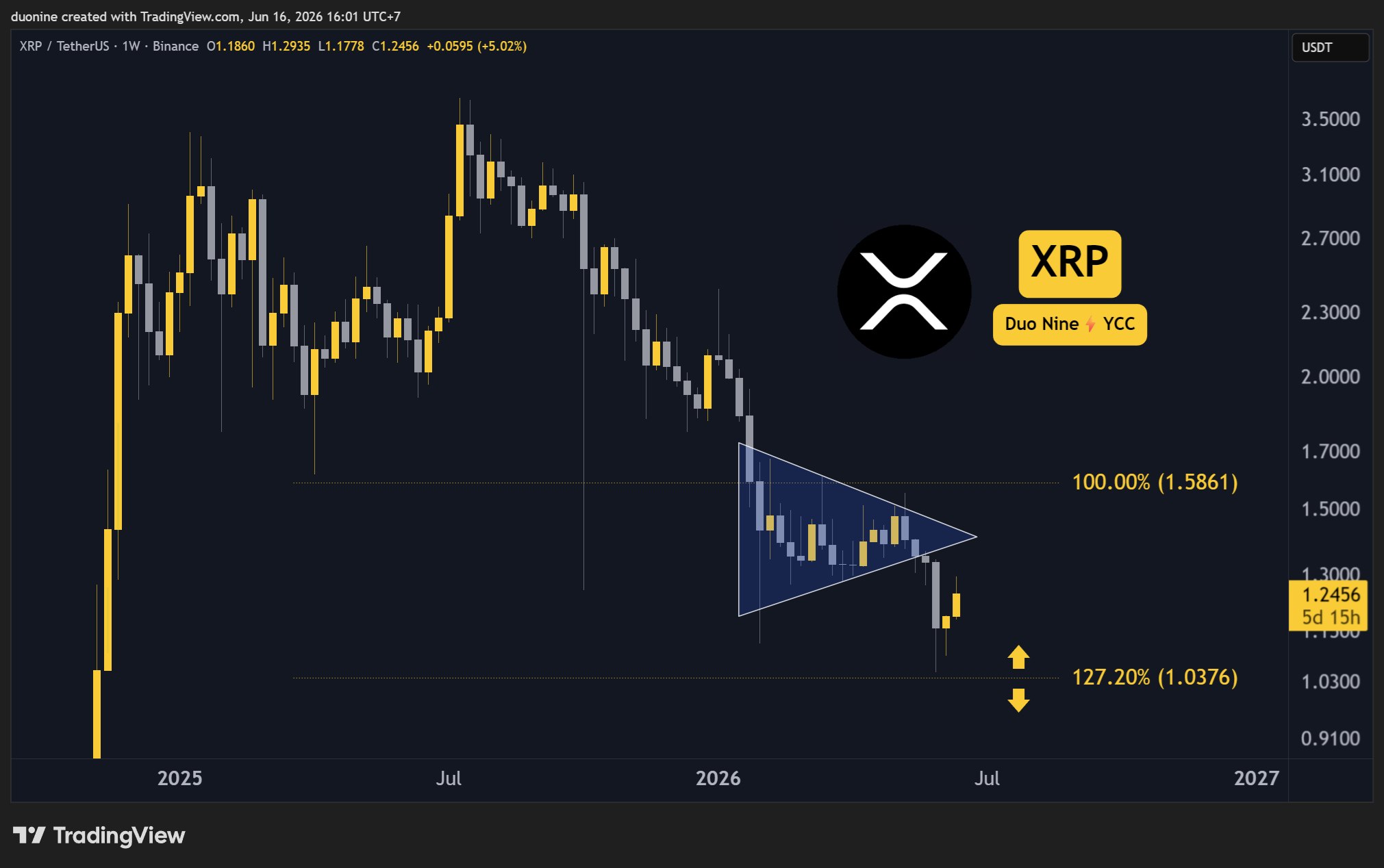
    XRP is experiencing a notable rebound, with the $1.3 mark emerging as a critical target for the cryptocurrency to reclaim. While the asset tested this level yesterday, it ultimately failed to break through. The question now is whether it can achieve this breakthrough this week.

    Key support levels are identified at $1.2 and $1, while resistance is anticipated at $1.3, $1.6, and $2.

    Following a dip to near the $1 mark, XRP has seen a resurgence of buyer interest, propelling it into an ongoing relief rally. Thus far, these buyers have managed to push the price close to the $1.3 resistance level.

    Should XRP successfully reclaim $1.3 and establish it as support, the cryptocurrency could be poised for further gains, with significant targets at $1.6 and $2. This represents the more optimistic outlook. Conversely, a rejection at $1.3 would likely signal a bearish turn, potentially sending the price back down to $1.

    Recent surges in buy volume have coincided with bullish shifts in momentum indicators, such as the MACD on the daily chart. These developments offer an encouraging indication that the recent downtrend may be nearing its conclusion.

    However, a decisive breach of the $1.3 resistance is essential to confirm a trend reversal. Failure to do so could prove premature and potentially lead to a bull trap. Consequently, the coming days will be pivotal in determining XRP’s ability to overcome its recent losses.

    Further positive signs are visible in the daily Relative Strength Index (RSI), which has remained above 50 since yesterday. This represents a significant shift, suggesting that sellers are no longer dominating price action.

    The focus now shifts to buyers’ ability to maintain the RSI above the 50-point mark. A retreat below this midpoint could be interpreted as a bearish signal. Given the rapid nature of the recent rally, a pullback is a plausible and normal occurrence before any potential ascent to new highs.