Category: Uncategorized

  • Gemini AI Forecasts Grim Bitcoin Outlook for 2026

    Gemini AI Forecasts Grim Bitcoin Outlook for 2026

    Google Gemini AI Offers Measured Bitcoin Outlook for 2026

    Google’s Gemini AI has presented a forecast for Bitcoin’s price that, while not reaching the speculative highs some anticipate, offers a grounded perspective on the cryptocurrency’s potential trajectory. The AI’s bull case for Bitcoin by late 2026 projects a price range of $92,000 to $98,000, a ceiling that stops just short of six figures.

    This prediction stands in contrast to Bitcoin’s previous peak of $126,000 within the current cycle. For investors who have become accustomed to more aggressive price targets, the prospect of Bitcoin essentially returning to levels seen six months prior may not be the headline-grabbing news they hoped for.

    However, this measured approach is precisely what lends credibility to Gemini’s prediction. The AI appears to be modeling a more mature Bitcoin market, one influenced by the integration of traditional finance and characterized by a more stable structure that prioritizes institutional flows over extreme speculative surges.

    The anticipated post-halving supply reduction and ongoing corporate dollar-cost averaging into spot ETFs are recognized as significant upward price drivers. Yet, Gemini identifies persistent macroeconomic headwinds as a limiting factor, preventing Bitcoin from surpassing the $100,000 mark within this timeframe. This outlook represents a sophisticated market assessment rather than a speculative “moonshot,” which may prove unsettling for those who have invested based on a $100,000 price narrative.

    Bearish Scenario and Current Market Dynamics

    The AI’s bear case forecasts a price range of $48,000 to $54,000. This scenario is predicated on a potential slowdown in institutional inflows, stricter global regulations on stablecoins, and broader liquidity contractions if the Federal Reserve maintains higher interest rates for an extended period. Such a decline, while not unprecedented in Bitcoin’s history, would represent a significant frustration for those anticipating new all-time highs.

    Currently, Bitcoin is trading around $66,518, positioned at a critical historical juncture. The broader chart reveals a narrative of a 2024 breakout, a run to $126,000, a subsequent correction, a stalled recovery in March around $82,000, and a recent dip to $60,000 before the current rebound.

    The cryptocurrency has now re-entered the $65,000 to $68,000 zone, a level that previously served as a key breakout point in 2024. The immediate technical question revolves around whether this zone will hold as support or act as a liquidity trap.

    The $70,000 to $72,000 level presents the next significant hurdle, marking the point of a May breakdown and a concentration of trapped supply. A decisive move above this range on substantial volume could significantly alter the market sentiment, potentially opening pathways toward $80,000 and ultimately the $92,000 to $98,000 target range identified by Gemini. Conversely, a daily close below $62,000 could re-establish a downward trajectory toward $54,000, the upper limit of the bear case.

    Technical Indicators and Future Outlook

    The Relative Strength Index (RSI) offers a nuanced perspective. Currently at 44.75, with its signal line at 28.73, the significant gap between them suggests a divergence. This indicates that while momentum experienced a sharp decline to oversold levels during the recent price flush, it has since recovered towards neutral territory, while price action is still consolidating. An RSI leading price in recovery is often viewed as a more robust signal, potentially preceding sustained upward movements rather than temporary bull traps.

    While this does not guarantee Gemini’s bull case will materialize, it does suggest that the $60,000 low is more likely to represent a floor than a stepping stone to lower prices. The initial provocative headline urged caution, but the technical indicators suggest that the market’s lowest point may already be in the rearview mirror.

    Strategic Shifts in the Crypto Landscape

    A discernible rotation is underway within the cryptocurrency market, though its significance may only become apparent in hindsight. Large-cap cryptocurrencies like Bitcoin, Ethereum, and XRP are encountering resistance, with their upside potential increasingly dependent on external catalysts that remain uncertain.

    The delay in anticipated macroeconomic tailwinds and the postponement of institutional inflows suggest that holding these established assets may become a passive waiting game. Investors who have navigated multiple market cycles often prioritize proactive capital deployment over waiting for clear signals.

    Early-stage infrastructure projects, operating with significantly smaller market capitalizations, offer a different dynamic. Modest capital rotations can lead to substantial price movements, driven by the asymmetry between current valuations and the future potential of nascent technologies.

    The fragmentation of liquidity across different blockchain ecosystems, such as Bitcoin, Ethereum, and Solana, incurs significant costs for decentralized finance (DeFi) users through fees, slippage, and failed transactions. Projects aiming to unify these disparate liquidity pools, like LiquidChain, which proposes a single execution layer for multiple networks, address this fundamental inefficiency.

    The market has yet to fully price in the potential of such solutions. LiquidChain’s presale, currently at $0.01454 with over $840,000 raised, represents an early-stage opportunity. While the risks associated with unproven execution and uncertain adoption are present, this offers a chance to invest at the foundational level of a project with the potential to reshape cross-chain interactions. This contrasts with established assets, which, while offering a more predictable path, may have already reached their visible ceilings.

  • BlackRock Launches Bitcoin ETF, Offers Yield for Capped Gains

    BlackRock Launches Bitcoin ETF, Offers Yield for Capped Gains

    BlackRock is launching a new exchange-traded fund that aims to offer investors exposure to Bitcoin’s potential gains while also providing double-digit payouts, the financial giant announced Tuesday.

    New ETF Offers Hybrid Bitcoin Exposure

    The iShares Bitcoin Premium Income ETF, set to trade on the Nasdaq under the ticker BITA, is designed to allow investors to participate in Bitcoin’s upside while generating monthly income from options premiums, according to a BlackRock press release. The fund will hold a mix of actual Bitcoin and BlackRock’s iShares Bitcoin Trust ETF (IBIT) to track the digital asset’s market price. To generate cash for monthly distributions, the fund will sell options contracts on up to 35% of its portfolio.

    Robert Mitchnick, BlackRock’s head of digital assets, described the ETF in an interview with Decrypt as a “hybrid Bitcoin exposure product” that offers a distinct payoff and yield profile compared to the firm’s existing $48.6 billion IBIT.

    “The way the math works today, you can think of it as 70% upside retention in IBIT and a mid-to-high-teens yield,” Mitchnick explained. “We believe it will be quite compelling to many investors.”

    Generating Yield Through Options

    The ETF generates its payout by selling call options on a portion of its holdings each month. These options grant buyers the right to purchase the fund’s IBIT shares at a predetermined price if the market rises, in exchange for an upfront fee known as a premium.

    Given Bitcoin’s historically high volatility, these premiums are typically substantial, enabling the ETF to generate consistent income. BlackRock stated this income will be distributed to investors under a “favorable blended tax treatment” on gains realized from option premiums.

    Mitchnick suggested that the ETF’s yield component and its relatively conservative approach could make it more attractive to financial advisors and other institutional investors who may not yet have exposure to digital assets, compared to IBIT.

    “There’s no question that one of the challenges they’ve had in embracing Bitcoin in the past has been the absence of yield,” he noted, citing insurers and pension funds as examples.

    Competitive Landscape

    BlackRock filed for BITA in January. The product is poised to compete with the NEOS Bitcoin High Income ETF, which debuted in 2024 and carries a higher expense ratio. In April, Goldman Sachs also filed for a similar yield-generating product.

    While BlackRock has introduced several ETFs tracking Ethereum’s spot price, Mitchnick indicated the firm has no immediate plans for similar products for that asset, as one of its existing offerings already provides yield-like payouts through staking.

    “As successful as our Ethereum products have been, Bitcoin is on a completely different level,” he added. “There’s significantly more client demand, so the opportunity to build adjacent products on Bitcoin is greater than for any other crypto asset.”

  • Hyperliquid ETFs Attract $172M as HYPE Reaches Record High

    Hyperliquid ETFs Attract $172M as HYPE Reaches Record High

    Hyperliquid ETFs Outperform Bitcoin Amid Shifting Investor Sentiment

    Hyperliquid Exchange Traded Funds (ETFs) are experiencing a significant surge, starkly defying recent macroeconomic challenges and a broader cooling in the cryptocurrency market during the second quarter.

    The protocol’s native token, HYPE, has mirrored this momentum, climbing over 73% in the past month and an impressive 196% year-to-date, reaching an all-time high of $75.96 on Tuesday, according to CoinGecko data.

    Institutional fund flows further underscore this trend. Three newly launched Hyperliquid ETFs have collectively attracted nearly $172 million in net inflows since their debut in May. This stands in contrast to Bitcoin ETFs, which have seen outflows of almost $5.6 billion over the same period, as reported by SoSoValue.

    This divergence suggests a growing institutional appetite for the protocol’s fee-generating architecture and its underlying token, moving away from narrative-driven, speculative, and non-yielding altcoins.

    Bitwise’s BHYP is leading the HYPE ETF market, boasting approximately $107 million in cumulative net inflows and $122.8 million in net assets. It is followed by 21Shares’ THYP with $60 million and Grayscale’s HYPG with $8.6 million. The combined trading volume across these three products has approached $900 million.

    Unlike Bitcoin ETFs, which are largely influenced by macroeconomic factors and have experienced capital outflows amid geopolitical uncertainty and rising Treasury yields, HYPE ETF inflows reflect a conviction in a protocol that generates tangible, measurable fees, Jeff Mei, COO of BTSE, told Decrypt.

    “HYPE’s resilience indicates that the market is beginning to price in protocol fundamentals,” Mei stated. “The Assistance Fund burn creates supply pressure, and Coinbase’s $5 billion USDC program injects sustained liquidity that compounds Hyperliquid’s competitive moat.”

    The divergence is also attributed to Hyperliquid’s “shift toward diversifying revenue streams,” as noted in a May 14 report by 21Shares. The report highlighted the protocol’s ability to generate fees from sources beyond crypto perpetuals, including commodities, equities, and pre-IPO markets.

    The pre-market pricing of CBRS perpetuals before an initial public offering (IPO) captured Wall Street’s attention by accurately mirroring its eventual NASDAQ opening price within 1.3%. The platform’s SpaceX IPO further solidified its value proposition.

    SpaceX’s SPCX perpetual, launched by TradeXYZ through the platform’s permissionless HIP-3 framework, generated approximately $1.4 billion in volume in a single trading session, according to data from hl.eco. This contract accounted for roughly 30% of all HIP-3 volume on that day.

    “Investors can actually see the [Hyperliquid] protocol capturing market share and generating meaningful fees, which makes the value proposition very different,” Sammi Li, CEO of Ju.com, told Decrypt.

    Two key structural features are reinforcing this institutional thesis.

    Firstly, the protocol’s core Assistance Fund (AF) mechanism automatically directs between 97% and 99% of Hyperliquid’s trading fees into token buybacks. This creates an immediate, non-speculative link between daily trading volume and demand for the native asset.

    Secondly, Hyperliquid’s multi-billion-dollar stablecoin layer has undergone structural evolution. This includes Coinbase, which serves as the official treasury deployer for the platform’s existing USDC reserves. The recently activated AQAv2 program allows $5 billion in USDC to earn a 4% yield, with 90% of this yield being redirected to the AF. This process enhances the protocol’s liquidity advantage and, consequently, fuels the token buyback mechanism.

    Li concurred, adding that Hyperliquid is not solely reliant on a bull market. “In fact, volatile markets often create more trading opportunities,” she observed. “When traders are actively hedging and repositioning, volumes stay strong, and that’s ultimately what drives protocol revenues. The market seems to be recognizing that.”

    Li emphasized that the most critical metric for Hyperliquid’s future is not its price but its ability to continue attracting users, liquidity, and trading volume. “If Hyperliquid continues executing at its current pace and keeps gaining share in the derivatives market, I wouldn’t be surprised to see institutional interest continue growing,” she said.

    For the present, the data and fundamental analysis favor Hyperliquid. In a month where Bitcoin ETFs have seen billions in outflows, HYPE ETFs have attracted $172 million, and this divergence shows no immediate signs of abating.

    Options markets suggest a 10-15% probability of HYPE reaching $100 by the end of July, according to a tweet on Monday from Nick Forster, co-founder and CEO of on-chain options platform Derive.

  • XRP Breakout Hinges on Key Level: Analyst

    XRP Breakout Hinges on Key Level: Analyst

    XRP Surges Amid Market Rally, But Analyst Cautions on True Breakout

    The cryptocurrency market experienced a broad upturn, largely attributed to news of a permanent deal between the United States and Iran. Within this positive environment, Ripple’s XRP token emerged as a standout performer among larger-cap cryptocurrencies, climbing from $1.05 at the beginning of the month to nearly $1.30 yesterday.

    However, the token’s upward momentum has since stalled, with its current price hovering just below $1.25. EGRAG CRYPTO, a prominent analyst closely monitoring XRP’s price action, suggests that a definitive breakout confirmation remains some distance away.

    In a recent post on X, the analyst highlighted that the recent wick from multi-year lows was not a random occurrence. Nevertheless, they observed that sellers quickly reappeared at the critical $1.30 resistance level, while buyers emerged to support the price just above $1.00. Currently, XRP is trading within this range, and its future price trajectory hinges on several key levels.

    According to EGRAG CRYPTO, these crucial levels are:

    • $1.11: Survival Zone
    • $1.21: First Strength
    • $1.28: Structure Improves
    • $1.35–$1.38: Bulls Gaining Control
    • $1.51: Major Breakout Zone

    The analysis indicates that XRP has successfully surpassed the “First Strength” area, trading above $1.21. However, achieving a confirmed breakout necessitates reclaiming several other significant resistance zones. The ultimate challenge, termed the ‘final boss’ by the analyst, lies at $1.51. XRP has tested this level multiple times between February and mid-May, only to be met with rejection and subsequent price declines.

    Earlier reports from CryptoPotato noted an improvement in the overall market sentiment surrounding XRP in recent days, following a dip to multi-month lows. Analysts at Santiment Intelligence have frequently pointed out that such significant declines in market sentiment often precede market reversals, a pattern that appears to be repeating.

    A contributing factor to XRP’s recent resurgence is the inflow into spot Ripple ETFs. In contrast to many other cryptocurrency-focused exchange-traded funds, those tracking XRP have seen another positive week, with Monday also marking a minor gain.

    Furthermore, the company behind XRP continues to generate news. Yesterday, Gate.io announced the listing of Ripple’s stablecoin and introduced a trading pair against XRP, marking the latest adoption development.

  • Pi Network Price Forecast: June 16

    Pi Network Price Forecast: June 16

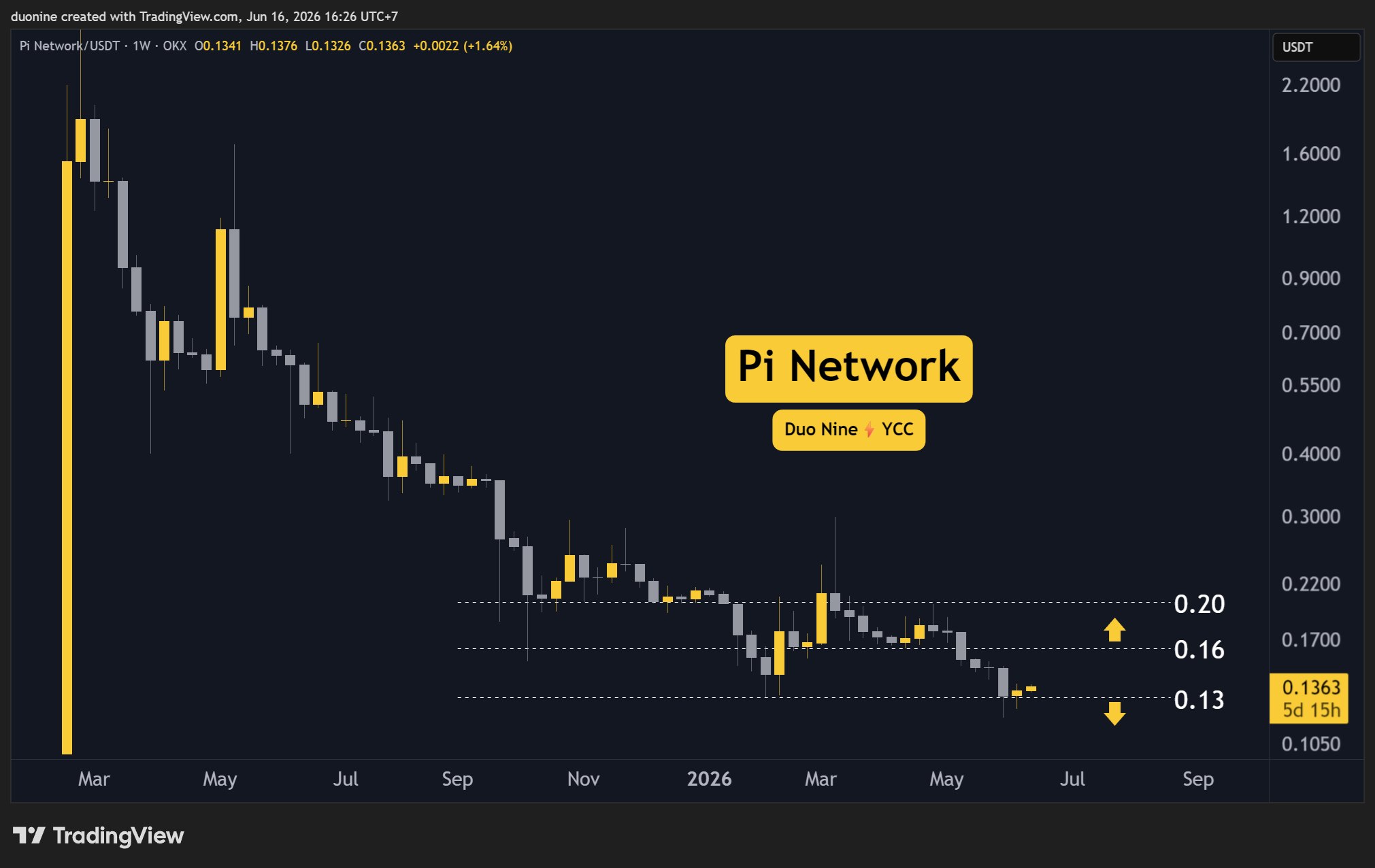
    PI Reclaims $0.13 as Buyers Emerge, Signaling Potential Upside

    Key Support: $0.13
    Key Resistance: $0.16, $0.20

    Pi Network’s native token, PI, has shown signs of recovery, reclaiming the $0.13 level and holding steady above it. This resurgence, driven by renewed buyer interest, suggests a potential shift from its recent downtrend. Analysts are closely watching the $0.13 mark as a critical support level, with the price action leaning bullish as long as it remains above this threshold.

    Bullish Divergence Signals Potential Trend Reversal

    Despite the price reaching a lower low, the daily Relative Strength Index (RSI) has printed a higher low. This bullish divergence is a significant indicator, hinting at a possible conclusion to the prevailing downtrend. For this bullish sentiment to solidify, PI will need to overcome immediate resistance at $0.16, followed by a more substantial hurdle at $0.20.

    Low Volume Presents a Cautionary Note

    While PI is gradually moving upward, trading volume has remained subdued and is currently declining. This lack of robust buying activity could make the current gains vulnerable. A significant push from sellers could easily negate the recent upward momentum, leaving buyers exposed.

    The Importance of Volume Confirmation

    Ideally, any sustained price increase should be accompanied by a corresponding rise in buying volume. Without this confirmation, the current rally risks becoming a “bull trap,” where early buyers find themselves caught as sellers reassert control.

    Momentum Indicators Point to Upward Bias

    Momentum indicators, including the daily Moving Average Convergence Divergence (MACD), are currently displaying a clear bullish bias. This positive outlook has been in effect since PI successfully reclaimed and sustained the $0.13 level. The prevailing sentiment suggests that the price is likely to continue its ascent, at least towards the initial resistance level of $0.16.

    The Road Ahead: Resistance and Potential Reversal

    The critical question for investors is whether buyers can muster sufficient strength and volume to break through the $0.16 resistance. A failure to do so could embolden sellers, potentially leading to a swift decline back to the $0.13 support level.

  • South Korea Busts Crypto Laundering Ring Linked to $11M Cambodian Scam

    South Korea Busts Crypto Laundering Ring Linked to $11M Cambodian Scam

    South Korean Police Target Crypto Laundering for Cambodia-Based Phishing Ring

    South Korean authorities have apprehended dozens of individuals accused of laundering funds for a Cambodia-based phishing operation through cryptocurrency transactions. The crackdown comes as an expert from Chainalysis warns that the ecosystem of scam compounds in Southeast Asia continues to pose a “persistent concern” despite years of efforts to dismantle criminal networks.

    The Seoul Metropolitan Police Agency’s crime investigation division reported that 23 suspects have been referred for charges including violations of the Foreign Exchange Transactions Act and the Specific Financial Information Act. Two individuals, identified only as A and B, have been detained, according to local media.

    In addition to these arrests, 33 other suspects were apprehended for allegedly engaging in the illegal exchange of $4.1 million (6.3 billion won) in cryptocurrency. The alleged ringleader, known only as C, remains at large and is now the subject of an Interpol Red Notice.

    Investigators also secured approximately $431,000 (650 million won) in illicit proceeds through pre-indictment confiscation.

    Police stated that the group, acting under C’s directives, moved around $11.1 million (16.8 billion won) between February 2024 and April 2025. Their method involved purchasing the USDT stablecoin, transferring it between domestic and overseas exchanges, and then cashing out into foreign currency or South Korean won for a fee.

    A review of over 11,300 linked accounts revealed 265 instances of phishing-related harm, encompassing voice phishing and investment fraud, with a total value of $17 million (25.7 billion won).

    Authorities urged the public to exercise caution, emphasizing that “acting as an agent for another person’s virtual asset trading or exchanging virtual assets for Korean Won can also be subject to punishment.”

    Persistent Threat in Southeast Asia

    Xue Yin Peh, head of investigative strategy and collections for APAC at Chainalysis, told Decrypt that increased international scrutiny has yielded concrete results against the “persistent problem” of scam compounds and their associated illicit networks. She highlighted significant actions from the past year, including the recovery of 61,000 Bitcoin by UK authorities and a $15 billion forfeiture linked to the Prince Group, noting these cases signify “a meaningful shift toward dismantling the global financial infrastructure that supports crypto fraud.”

    However, Peh observed that transnational criminal networks have “demonstrated significant flexibility and resilience,” relocating within and beyond Southeast Asia and adapting their operational models as enforcement tightens. These networks rely on a broad illicit ecosystem comprising laundering networks, infrastructure, and trafficked labor, which she described as “remarkably resilient,” with new service providers “quickly filling gaps left by enforcement takedowns.”

    Stablecoins like USDT remain the preferred tool for illicit fund flows because, as Peh explained, criminals utilize them “for largely the same reasons legitimate users do”: liquidity, portability, and relative price stability. She added that on-chain transactions are “transparent and traceable,” and issuers can freeze funds once illicit activity is detected.

    Peh believes that cases like this “certainly can, and already have” bolstered the argument for enhanced global oversight of stablecoins. She suggested that stablecoin issuers should be integral to the “fraud-prevention front line” and that clearer legal frameworks are necessary to facilitate coordination among issuers, exchanges, banks, and authorities when victim funds are at risk.

    In November, Interpol designated scam-compound networks as a global transnational threat. The same month, U.S. agencies established a multi-agency Scam Center Strike Force to track illicit funds. The Strike Force has since frozen, seized, and forfeited over $580 million in cryptocurrency linked to networks operating out of Burma, Cambodia, and Laos.

    Around the same period, Taiwanese prosecutors charged 62 individuals in connection with the network of Cambodian tycoon Chen Zhi, chairman of Prince Group. Chen Zhi was extradited to China earlier this year amid allegations linking his business empire to cyber scam networks.

    In April, Cambodia enacted its most stringent anti-scam legislation to date via royal decree, imposing potential life sentences on compound operators. However, analysts have cautioned that such measures might merely shift the illicit trade across borders rather than eradicate it.

  • Hyperliquid Surges on ETF Inflows and SpaceX Support

    Hyperliquid Surges on ETF Inflows and SpaceX Support

    HYPE Price Surges Amidst ETF Inflows and SpaceX Perpetual Trading Boom

    Hyperliquid’s native cryptocurrency, HYPE, is experiencing a significant surge today, with double-digit gains as trading activity intensifies across various market segments.

    At the time of reporting, HYPE is trading near $72, approaching its all-time high. This represents a roughly 10% increase over the past 24 hours, positioning it as one of the top-performing digital assets in that period. The upward momentum is attributed to increased buying in exchange-traded funds (ETFs) and renewed interest in Hyperliquid’s ecosystem, bolstered by the success of its SpaceX perpetual futures trading.

    Data from SoSoValue indicates that regulated products associated with HYPE are becoming a substantial component of the token’s market structure. The three ETFs currently available, managed by Bitwise, 21Shares, and Grayscale, collectively hold approximately $209 million worth of HYPE, representing about 1.4% of its total market capitalization.

    During this recent rally, net inflows into these ETFs over the last 24 hours have exceeded $17 million, bringing the cumulative total to $171 million. This suggests a robust and sustained interest in Hyperliquid’s underlying cryptocurrency.

    In contrast, Bitcoin ETFs have seen outflows of around $64 million, indicating a potential shift in investor appetite towards altcoins. This trend is further supported by positive flows into Ethereum, Solana, and XRP ETFs.

    Another significant factor driving HYPE’s performance is Hyperliquid’s expanding presence in non-cryptocurrency markets, facilitated by HIP-3.

    The chart below illustrates that the SpaceX-linked perpetual contract (SPCX-USDC) has recorded over $1.12 billion in trading volume in the past 24 hours. Open interest is nearing $300 million, with the contract trading around $212.

    This development follows broader market attention on perpetuals linked to SpaceX. Notably, following its initial launch, SPCX quickly became the most actively traded asset on the platform, with trading volumes surpassing $1.3 billion.

    This success underscores Hyperliquid’s capability to facilitate liquid markets for assets beyond traditional cryptocurrency pairs. The exchange has previously demonstrated this with commodities like gold and oil, establishing itself as a preferred venue for trading oil using cryptocurrency.

  • Spot Trading Pairs Delisted June 16, 2026

    Spot Trading Pairs Delisted June 16, 2026

    Bybit to Delist H/USDC and ICNT/USDC Spot Trading Pairs

    Cryptocurrency exchange Bybit announced today that it will delist two of its spot trading pairs, H/USDC and ICNT/USDC, effective June 16, 2026, at 8 AM UTC. The decision follows a routine review of listed pairs aimed at ensuring a secure and dependable trading environment for its users, in accordance with Bybit’s Token Management Rules.

    The evaluation process considers key metrics including market performance, liquidity, and trading volume.

    Important Considerations for Traders

    Bybit has provided specific guidance for users holding positions in the affected trading pairs:

    • Order Cancellation: Traders are advised to cancel any outstanding orders for H/USDC and ICNT/USDC before the trading cessation. Any orders left open after the deadline will be automatically removed by the system.
    • Trading Bots: Active Spot Grid Bots and DCA Bots utilizing these tokens will be automatically terminated. Users are encouraged to close their bots in advance to effectively manage their assets.
    • Token Availability: The delisting of these specific spot trading pairs will not impact the availability or trading of the underlying H and ICNT tokens on Bybit. These tokens can still be traded through other available pairs.
    • Deposits and Withdrawals: Deposits and withdrawals for the underlying tokens will continue to be supported unless further notice is issued.
  • Bybit to Support Axelar Network Upgrade

    Bybit to Support Axelar Network Upgrade

    Bybit to Support Axelar Network Upgrade, Halting Deposits and Withdrawals Temporarily

    Cryptocurrency exchange Bybit has announced its support for the upcoming Axelar (AXL) v1.4.7 network upgrade. The upgrade is scheduled to occur on June 16, 2026, at approximately 2:30 PM UTC, or at block height 30,135,800.

    To facilitate a seamless transition, Bybit will temporarily suspend all deposits and withdrawals for Axelar (AXL) starting at 1:30 PM UTC on the same day. The exchange has assured users that other trading activities will remain unaffected during this period.

    Bybit also stated that no further announcements will be made regarding the resumption of deposit and withdrawal services. Users seeking to be notified when these services are back online are advised to visit the Deposit or Withdrawal page and activate the “Set Alert” function.

    Further details concerning the Axelar network upgrade can be found in the official release notes.

  • XRP Recovers Sharply After Sentiment Plunge

    XRP Recovers Sharply After Sentiment Plunge

    XRP Stages ‘Impressive Comeback’ After Sentiment Slump

    XRP has “staged an impressive comeback,” according to on-chain analytics firm Santiment, which reported Monday that the token surged more than 13% in a 24-hour period, reclaiming the $1.28 level for the first time in two weeks.

    Traders have reportedly reacted positively to news suggesting a resolution to the US-Iran conflict, which had been a “major source of uncertainty that had pressured risk assets.”

    XRP has experienced a challenging year, falling over 50% from its January peak of more than $2.30 to a low of $1.10 on June 11, before beginning its recovery. Santiment noted that this rebound is particularly significant as it occurred after sentiment had dipped to some of its lowest levels of 2026, “creating the conditions for a powerful relief rally once fear began to fade.”

    The firm frequently observes that periods of maximum fear and doubt can precede relief rallies, as markets often move contrary to prevailing crowd expectations. XRP has also benefited from strong support among its largest holders, with “whales” dominating the ecosystem. On-chain data from Santiment indicates that wallets holding at least 1 million XRP now control over 74% of the total supply, having accumulated an additional 1.53 billion tokens in the past six months.

    Analyst CasiTrades pointed out that the $1.30 level represents a significant resistance point, and there remains a possibility that XRP could fail to break through and retreat to support at $0.90. However, she also commented that the recent bounce has been stronger than anticipated. “If this momentum continues, we may be looking at the early stages of a new trend rather than a final move lower,” she stated, adding, “What I’m seeing right now is strength. Potentially the strongest we’ve seen in months! It still needs confirmation, but it’s exciting to finally see some life in this market!”

    XRP Tests Major Resistance at $1.30

    The cryptocurrency market is currently experiencing notable momentum, with XRP’s price approaching a critical resistance level around $1.30.

    Other Cryptocurrencies Outperform XRP

    While XRP’s 13% recovery bounce is considered impressive, other digital assets have seen even greater gains. Zcash, for instance, has surged nearly 30% in recent days, reaching $535 on Monday, its highest point since a significant decline on June 4. This surge followed a security audit by Anthropic’s Claude Mythos, which reportedly found no serious vulnerabilities in the Zcash protocol.

    Bittensor’s TAO token has also experienced a substantial increase, skyrocketing more than 30% in recent days to reach $285. This upward movement has been attributed to the US blockade of Anthropic’s flagship Fable 5 and Mythos 5 models, which has reportedly spurred increased interest and investment in decentralized artificial intelligence solutions.