Category: Uncategorized

  • iGaming Faces Regulatory and Growth Pressures

    iGaming Faces Regulatory and Growth Pressures

    iGaming Sector Faces Dual Pressures of Intensifying Regulation and Global Expansion

    Norwich, United Kingdom – June 15, 2026 – The iGaming industry is navigating a complex landscape defined by heightened regulatory scrutiny and persistent global market expansion, according to a new industry overview released by NyesteCasino.com, a prominent iGaming analysis resource. Operators are grappling with a delicate balance between risk management and aggressive growth strategies, a challenge underscored by U.S. Senate hearings, evolving legal interpretations, the localization of crypto casinos, and a surge in World Cup betting activity.

    Across the United States, Europe, Southeast Asia, and South America, regulators have been tightening rules concerning prediction markets, sweepstakes casinos, and the use of credit cards for deposits. Simultaneously, online gambling platforms, content providers, and policy advisors have accelerated product innovation and launched targeted, region-specific sports marketing campaigns.

    NyesteCasino.com’s analysis suggests these developments signal a significant structural shift within the industry, where agility in compliance is rapidly becoming as crucial for success as product quality. Despite increasing regulatory headwinds, the pace of innovation and sustained market demand indicate continued sector growth.

    Prediction Markets: A Battlefield of Courts, Congress, and Cross-Border Bans

    The week commenced with a highly anticipated hearing before the U.S. Senate Commerce Subcommittee, titled “No Sure Bets.” Held on May 20 under the chairmanship of Senator Marsha Blackburn, the session signaled further deliberations to come. A central point of contention emerged between American Gaming Association CEO Bill Miller and former Congressman Patrick McHenry regarding the future of prediction markets. Miller argued that sports event contracts function as clandestine betting operations, circumventing state licensing, tax regulations, and integrity safeguards. McHenry, representing the Coalition for Prediction Markets, countered that existing Commodity Futures Trading Commission (CFTC) oversight is effective.

    Adding to the legal complexities, on May 22, a panel from the Ninth Circuit Court of Appeals rejected stay requests from both Kalshi and Polymarket, refusing to halt state enforcement proceedings in Nevada and Washington. The court ruled that a federal preemption defense under the Commodity Exchange Act alone does not establish federal jurisdiction. This decision strengthens the ongoing dispute in the New Jersey appeals court, which had previously upheld an injunction against Kalshi, and further accelerates the process towards a potential Supreme Court review of state jurisdiction over event contracts.

    In Indonesia, the Ministry of Communication and Digital Affairs classified Polymarket as an online gambling site, disregarding its crypto-based structure, and requested a national ban on the platform on May 25. This action was prompted by a viral contract concerning whether President Prabowo Subianto would resign before the end of his term in October 2029, which generated approximately $46,000 in trading volume. Polymarket is now inaccessible in over 33 jurisdictions worldwide, including India, Brazil, and Singapore, with more countries implementing bans.

    State-Level Regulations: Tennessee Enacts Anti-Sweepstakes Bill

    State-level restrictions on online gambling law have also emerged in Tennessee. Governor Bill Lee signed two significant bills into law during the week. Senate Bill 2136 designates Tennessee as the ninth U.S. state to completely ban sweepstakes casinos and dual-currency systems, empowering the attorney general to enforce the ban. Senate Bill 1992, the second bill signed by the governor, classifies anyone who deliberately influences the outcome of an event while holding a prediction market contract with a Class E felony. These legislative actions are expected to influence other state legislatures considering similar regulations.

    Europe and Brazil: Tax Proposals, Ad Restrictions, and Credit Bans

    The European Parliament held a plenary debate on May 20 concerning a proposed EU-level gambling levy. Budget Commissioner Piotr Serafin confirmed that the Commission is actively evaluating this option, alongside levies on digital services and crypto-assets, as part of the next Multiannual Financial Framework. Proponent Member of the European Parliament Victor Negrescu estimated the levy could generate between €2 and €4 billion annually for education, youth, and addiction prevention programs. However, opponents from the EPP and ECR blocs voiced concerns regarding subsidiarity, competitiveness, and national tax sovereignty, with any operational package anticipated for January 2028.

    In anticipation of the FIFA World Cup tournament, scheduled from June 11 to July 19, Belgium’s Kansspelcommissie and the Netherlands Gambling Authority issued formal advertising warnings to licensed operators. France’s ANJ reported a year-on-year increase of over 25% in operator marketing budgets as the tournament approaches. Meanwhile, Brazil formalized rules on May 25 to prohibit Pix Crédito as a deposit method on regulated betting platforms. This move was partly influenced by a Folha de São Paulo audit that revealed major banks, including Bradesco and Banco do Brasil, were still processing credit transfers into betting accounts as recently as mid-May.

    Editorial Perspective

    “This week clearly illustrates that the iGaming sector is entering a phase where regulatory acumen is as strategically vital as product development,” stated the editorial team at NyesteCasino.com. “The debate surrounding prediction markets alone spans courtrooms, congressional hearings, and international bans, and it remains far from resolved. Operators adept at tracking and adapting to this multi-jurisdictional complexity, while simultaneously executing World Cup campaigns and localization strategies, will be best positioned for the latter half of 2026.”


  • XRP Surges on Bullish Signals and ETF Hopes

    XRP Surges on Bullish Signals and ETF Hopes

    XRP Price Surges Amidst Bullish Technicals and ETF Inflows

    XRP experienced a significant upward movement today, climbing 9% from a low of $1.1 to $1.24, with analysts predicting further gains. This surge is attributed to a confluence of two key factors.

    Ascending Triangle Formation and ETF Momentum

    On the 4-hour chart, XRP has formed a textbook ascending triangle pattern, currently testing horizontal resistance. This technical setup is being bolstered by two consecutive weeks of positive inflows into XRP Spot Exchange-Traded Funds (ETFs). The pattern has a clearly defined price target, awaiting a catalyst for a breakout.

    Data released for the week ending June 12, 2026, revealed net inflows of $10.68 million into XRP Spot ETFs. This marks the second consecutive week of positive inflows, bringing the cumulative net inflow to $1.44 billion and total Assets Under Management (AUM) to $978.86 million.

    The Significance of ETF Inflows

    The importance of these figures lies in their potential to attract further investment. Crossing the $1 billion AUM threshold often garners increased media attention within traditional finance circles. This, in turn, tends to draw in additional investors who often gauge the credibility of a product by its AUM.

    Macroeconomic Tailwinds and Fundamental Utility

    The broader market sentiment has also improved, partly due to a perceived peace deal between the US and Iran, providing a lift to the entire altcoin market. However, the specific ETF data and chart structure suggest that XRP’s recent performance has a more substantial foundation than a mere sentiment-driven trade.

    Furthermore, Ripple’s business developments are signaling growing adoption. The integration of OpenPayd for Ripple Payments and the ongoing minting and burning of RLUSD point to an expansion of real-world settlement utility, which could provide a more durable anchor for demand over time.

    A recent announcement highlighted that Ripple partner OpenPayd has confirmed plans for a Nasdaq listing, underscoring the ongoing significance of their collaboration. The continued focus on fiat rails, RLUSD support, and cross-border payments suggests a robust ecosystem where an OpenPayd public listing could enhance visibility.

    Technical Analysis and Price Targets

    XRP is currently trading around the $1.25 mark. The ascending triangle on the 4-hour chart, which began forming in early June, shows a series of higher lows converging against horizontal resistance in the $1.18–$1.19 zone.

    The price recently found support at $1.12, coinciding with the 50-period moving average, before rallying towards the upper boundary of the triangle. This defense of the moving average is a critical structural signal, indicating that buyers are systematically supporting dips rather than reacting to them.

    The measured move target for the ascending triangle breakout suggests a potential price of $1.32, which is still more than 5% above the current resistance level. Previous analysis has identified the $1.20 level as key downside support, with the $1.45–$1.50 band representing the next significant resistance area should the initial breakout extend.

    Institutional Momentum and Emerging Infrastructure Plays

    While XRP is showing a strong breakout and a potentially favorable risk-reward profile for traders, a 10% move in an asset with a market capitalization exceeding $70 billion presents a different structural risk-reward dynamic compared to investing in early-stage infrastructure projects before their narratives are fully priced in by the market.

    Traders monitoring XRP’s institutional momentum driven by ETF flows may find it beneficial to cross-reference this with the current pricing of early-stage capital in cross-chain infrastructure plays.

    LiquidChain: A New Cross-Chain Liquidity Layer

    LiquidChain ($LIQUID) is emerging as a Layer 3 infrastructure project aiming to establish itself as a cross-chain liquidity layer. It seeks to unify liquidity from Bitcoin, Ethereum, and Solana into a single execution environment. The project’s architecture features a Unified Liquidity Layer with single-step execution, verifiable settlement, and a deploy-once model, allowing developers to access multiple ecosystems without the need for chain-specific rebuilding.

    The presale for LiquidChain is currently priced at $0.0147 per $LIQUID token, having raised $840,000 to date. Investors are encouraged to research LiquidChain’s presale structure before the current round concludes.

  • Strategy Buys 1,587 BTC as Bitcoin Selloff Fears Recede

    Strategy Buys 1,587 BTC as Bitcoin Selloff Fears Recede

    MicroStrategy Buys More Bitcoin as Sale Concerns Subside

    Two weeks after its first Bitcoin sale in nearly four years, business intelligence firm MicroStrategy has once again signaled its commitment to the cryptocurrency, acquiring an additional 1,587 BTC for approximately $100 million.

    The average purchase price for this latest acquisition was just over $63,000 per Bitcoin. Concurrently, the company bolstered its U.S. dollar reserves by $100 million, bringing its total cash holdings to $1.1 billion. MicroStrategy’s total Bitcoin holdings now stand at 846,842 BTC, currently valued at nearly $56 billion.

    The company’s recent activity was highlighted in a June 15, 2026, tweet from co-founder Michael Saylor: “Strategy has acquired 1,587 BTC for $100 million to increase our $BTC Reserve to ₿846,842. We have also increased our USD Reserve by $100 million to $1.1 billion. $MSTR $STRC.”

    This latest purchase follows a sale of 32 BTC by MicroStrategy a few weeks prior. Contrary to speculation that this signaled a capitulation, the sale was reportedly to fund preferred stock distributions, including cash dividends across the company’s stock series.

    The earlier sale, occurring amidst a period of significant Bitcoin price volatility that saw the cryptocurrency dip below $60,000 for the first time in 19 months, raised some eyebrows within the crypto community. It even prompted CNBC personality Jim Cramer to suggest that the firm and Saylor had “killed” Bitcoin.

    Saylor swiftly addressed these concerns, refuting the “fear, uncertainty, and doubt” (FUD) and clarifying that he had never stated the company would refrain from selling Bitcoin if necessary. However, he reiterated his belief that individual investors should avoid selling their holdings.

    MicroStrategy resumed its aggressive Bitcoin accumulation strategy last week, purchasing 1,550 BTC for just over $100 million.

    Prominent figures in the cryptocurrency space, including Samson Mow and Lyn Alden, defended Bitcoin following the sale. They argued that an entity as committed to Bitcoin as MicroStrategy could not “kill” the cryptocurrency with a single, relatively small sale from its substantial holdings.

  • ETH Nears $2K Amidst Peace Deal Optimism

    ETH Nears $2K Amidst Peace Deal Optimism

    Ethereum Price Surges Amid Peace Deal Optimism, Analysts Eye Historic Oversold Levels

    Ethereum’s native cryptocurrency, ETH, is trading at $1,739, marking a 4% increase over the past 24 hours. The upward momentum in risk assets, including ETH, appears to be fueled by a recent peace deal in the Strait of Hormuz, a development that has traders anticipating a significant market shift not seen in years. The central question for investors is not if ETH will rebound, but whether the current price point represents the final opportunity to enter before the $2,000 mark becomes an increasingly distant prospect.

    One prominent analyst has declared ETH to be the most oversold it has ever been in its history, a claim that warrants closer examination.

    Technical Indicators Point to Historic Lows

    On June 14, 2026, analyst Ash Crypto highlighted that Ethereum’s monthly Relative Strength Index (RSI) has fallen below levels previously recorded during the 2018 and 2022 bear market bottoms. Historically, these periods of extreme oversold conditions have preceded substantial recoveries, often in the hundreds of percentage points.

    A tweet from Ash Crypto detailed the current situation: “$ETH is now the most oversold it has EVER been in its history. – Down -70% from its ATH – Price at the same level as 4 years ago – Monthly RSI more oversold than the 2018 and 2022 bear market bottoms In the last bear cycle, ETH crashed -82% from its ATH and formed a bottom in…”

    Currently, ETH is trading down nearly 70% from its all-time high and is priced at levels last observed four years ago. The digital asset has shown resilience, bouncing from a swing low of $1,603 and subsequently pushing towards $1,731 before consolidating above the 23.6% Fibonacci retracement level of that range.

    Macroeconomic Factors and Market Sentiment

    The recent peace deal in the Strait of Hormuz has injected positive sentiment into broader risk markets. Bitcoin, for instance, has reclaimed the $65,000 level, with larger-cap altcoins following suit. This macroeconomic backdrop is crucial, as sustained recoveries in ETH have historically been contingent on Bitcoin’s upward trajectory.

    Ethereum is currently holding above the $1,700 pivot point, having successfully breached what Bitget has identified as a key resistance level. This technical achievement signals a notable improvement in the market’s outlook for the cryptocurrency.

    Trading volume supports this positive trend. The 24-hour trading volume stands at $26 billion against a market capitalization of $210 billion, indicating robust participation rather than speculative price action.

    Near-Term Price Outlook and Potential Scenarios

    The technical structure of ETH’s chart suggests a period of consolidation within a range, but with underlying energy building. Immediate support levels are identified at $1,665 and $1,640, while resistance is encountered at $1,690, $1,701, and $1,715. CoinCodex projects a potential near-term high of approximately $1,845.

    Should ETH maintain its hold above $1,700 and clear the $1,734 level, the path could open up to $1,923 and subsequently $2,133. The base case scenario for the week anticipates consolidation between $1,665 and $1,780, with a gradual ascent towards $1,845, provided Bitcoin’s sentiment remains stable.

    Conversely, a daily close below $1,603 would invalidate the current bounce thesis and could lead to a retest of the $1,585 level and potentially lower prices.

    The Case for a Historic Recovery

    The structural argument for a significant rebound is bolstered by the RSI data. Historically, monthly RSI readings at such extreme lows have preceded sharp recoveries rather than prolonged downturns. While this does not guarantee that the market has definitively bottomed, the current asymmetry presents a compelling case that is difficult to overlook.

    At $1,720, ETH presents an attractive proposition based on historical metrics. However, even a move to $2,022 would represent a roughly 17% upside for an asset with a market capitalization exceeding $200 billion. While significant in absolute terms, this potential gain is modest when compared to the historical multiplication of capital seen in earlier-stage investments.

    The dynamics of ETH’s market capitalization underscore the tactical rationale for some investors to consider rotating into smaller, pre-launch projects during periods of macro recovery.

    Emerging Opportunities in the Ecosystem

    One such project gaining attention is LiquidChain ($LIQUID), an L3 infrastructure initiative focused on developing a Cross-Chain Liquidity Layer. The project aims to integrate liquidity from Bitcoin, Ethereum, and Solana into a unified execution environment.

    LiquidChain’s value proposition centers on its structural innovation: a Unified Liquidity Layer with Single-Step Execution and Verifiable Settlement. This architecture would enable developers to deploy applications once and access all three major blockchain ecosystems without the complexities of bridging.

    The project’s presale is currently priced at $0.0147, having raised $841,128.18 to date. Early-stage infrastructure plays at this funding stage carry inherent risks, including unproven liquidity, execution capabilities, and adoption rates. The current entry price reflects these risks. Investors are encouraged to research LiquidChain thoroughly before the presale price potentially increases.

  • Philippines Tightens Crypto Listings, Bans Privacy Coins

    Philippines Tightens Crypto Listings, Bans Privacy Coins

    Philippines Tightens Crypto Regulations with New Listing Rules

    The Philippines is reinforcing its oversight of cryptocurrency markets with new guidelines for digital asset listings. The Bangko Sentral ng Pilipinas (BSP), the nation’s central bank, has mandated that all licensed Virtual Asset Service Providers (VASPs) must implement stringent due diligence and accreditation procedures before making digital assets available to consumers.

    Promoting Financial Stability and Consumer Protection

    According to a memorandum signed by Deputy Governor Lyn Javier, these new rules are designed to “promote financial stability and protect the financial welfare of customers by ensuring that VA services are provided in a safe, sound, and consumer-centric manner.”

    Ban on Privacy Coins

    In a significant move, the central bank has also prohibited the listing or support of anonymity-enhancing cryptocurrencies, commonly known as privacy coins, by VASPs.

    Enhanced Monitoring and Delisting Thresholds

    The latest directive requires exchanges to continuously monitor their listed assets and establish specific thresholds that would trigger suspensions or delistings. These triggers include the loss of liquidity, issuer insolvency, involvement in scandals or scams, de-pegging from a stable value, material security breaches, or misleading disclosures.

    Alden Yburan, head of crypto at GCash, described the new listing standards as “long overdue” and a “minimum bar any responsible platform should already be applying.” He believes that stronger listing requirements will ultimately lead to “better products.”

    However, Yburan expressed mixed feelings about the ban on privacy coins. He acknowledged that assets like Monero and Zcash “exist for legitimate reasons,” as privacy is a “foundational value in crypto, the ability to transact without surveillance.” Yet, he also noted the Philippines’ significant remittance market, stating, “PH is remittance-heavy, we can’t be positioning the ecosystem as a trusted financial infra while simultaneously allowing anonymity-enhancing assets to flow freely.”

    Compliance with Securities Regulations

    The memorandum also highlights that platforms may need to comply with securities regulators. If a token is offered as a security, VASPs will be required to adhere to “the SEC’s CASP Rules and Guidance.”

    A Dual Regulatory Landscape

    The Philippines ranks ninth globally on Chainalysis’s 2025 Global Crypto Adoption Index, reflecting strong grassroots adoption in the Asia-Pacific region. The new listing rules fit into a regulatory framework where crypto firms are accountable to two distinct authorities: the Securities and Exchange Commission (SEC) for crypto-asset service providers on the securities side, and the BSP for licensing VASPs involved in payment and transaction services. Firms must meet the requirements of both bodies independently.

    Last June, the SEC introduced Memorandum Circular No. 5, which mandated crypto-asset service providers (CASPs) to register locally, maintain $1.8 million (₱100 million) in paid-up capital, store customer data within the Philippines, and report to both the SEC and the Anti-Money Laundering Council. By August, the SEC had blocked access to 10 offshore platforms, including OKX, Bybit, Kraken, and KuCoin.

    Luis Buenaventura, President at the Blockchain Council of the Philippines, previously commented that the SEC’s rules created “a competitive advantage for licensed players” and that the broader crackdown would steer users toward compliant services.

    Legislative Efforts and Binance’s Return Bid

    Lawmakers are also exploring separate initiatives, including Senate Bill 1330, which proposes to place the national budget on-chain, following public outcry over approximately $9.2 billion in flagged public works spending.

    Meanwhile, global crypto exchange Binance is seeking to re-enter the Philippine market through a local partner, BlockShoals Technologies Inc. BlockShoals received initial clearance from the SEC in November under the StratBox regulatory sandbox, according to local media reports. However, the BSP has clarified that neither Binance nor BlockShoals currently holds a VASP license, and participation in the sandbox “doesn’t substitute for central bank licensing.”

    The SEC has since refined its stance, reclassifying Binance as a “global crypto-asset service provider” rather than a global VASP. The commission now requires BlockShoals to integrate with a licensed domestic VASP within 90 days before it can onboard any users through Binance’s infrastructure.

  • Iran Peace Deal Boosts Bitcoin; Japan’s Crypto ETF Market Hits $6.4B; WLFI, White House UFC Match

    Iran Peace Deal Boosts Bitcoin; Japan’s Crypto ETF Market Hits $6.4B; WLFI, White House UFC Match

    Bitcoin experienced a rare surge in value, with “green candles” appearing on charts, as a reported peace deal between former President Donald Trump and Iran appeared to inject momentum into the market. Simultaneously, preparations for cryptocurrency exchange-traded funds (ETFs) in Japan signal substantial institutional inflows are on the horizon. Adding to the day’s notable events, a White House-hosted UFC event is slated to highlight Trump’s characteristic flair.

    Bitcoin climbed back above the $65,000 mark, reaching $65,800 earlier today, while Ethereum reclaimed $1,700. These gains contributed approximately $60 billion to the total cryptocurrency market capitalization, occurring amidst nearly $250 million in liquidations of short positions.

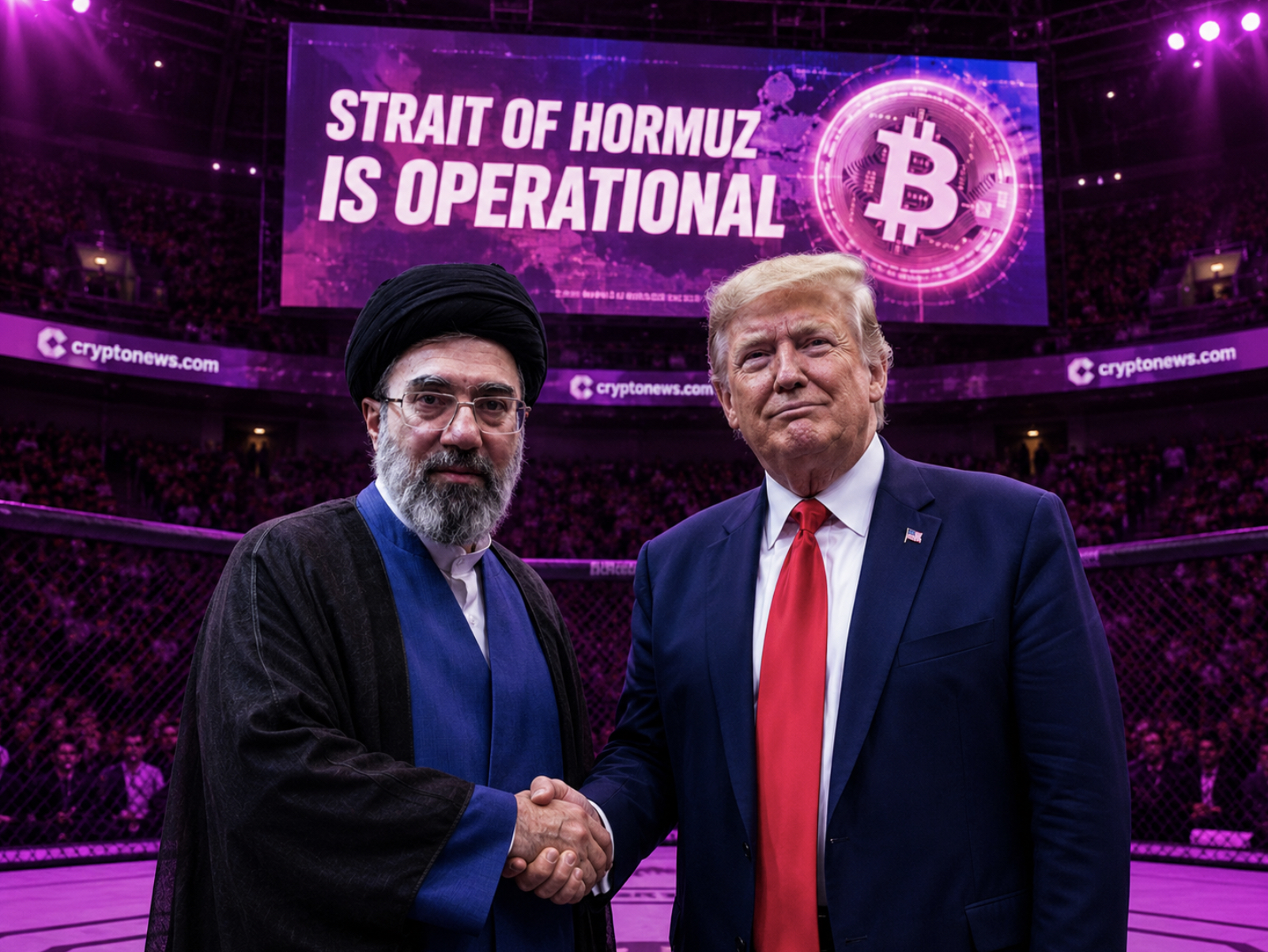
    The reported Trump-Iran peace agreement, which reportedly extends a ceasefire by 60 days, reopens the Strait of Hormuz, lifts the U.S. naval blockade on Iranian ports, and permits Iran to resume oil exports, appears to be driving Bitcoin’s ascent. Iran has also reaffirmed its commitment not to pursue nuclear weapons, with negotiations commencing over its enriched uranium stockpile under international supervision.

    The Four-Point Trump-Iran Peace Deal

    According to Senator JD Vance, the proposed deal includes the following provisions:

    • Preventing Iran from acquiring nuclear weapons.
    • Immediate reopening of the Strait of Hormuz.
    • Lifting the U.S. naval blockade.
    • Unlocking significant investment across the region.

    The agreement, announced by Iran today following repeated statements from Trump, could potentially re-establish global oil flows and represent the most significant de-escalation in the region since the conflict began. Oil prices saw a decline on the news, providing a clear boost to risk assets such as cryptocurrencies.

    The Iran deal propelled Bitcoin above the $65,000 level in under 30 minutes, coinciding with the Japan vs. Netherlands World Cup game. Trump’s consistent pressure and public commentary are credited with paving the way, as markets began to price in reduced geopolitical risk. Iran’s own announcement today further shifted the uncertainty, creating a bullish sentiment for the market.

    Japan’s Crypto ETF Preparations

    Japan’s Financial Services Agency (FSA) is reportedly preparing for the launch of spot cryptocurrency ETFs and investment trusts. Major financial institutions including SBI, Rakuten, Nomura, Daiwa, SMBC, and Mizuho are understood to be developing new products. The country currently has 13 million cryptocurrency accounts holding an estimated $34 billion, with potential tax reductions from 55% to 20%. Analysts project that the Japanese crypto ETF market could attract approximately $6.4 billion in inflows once launched.

    While the Bank of Japan’s recent interest rate hike could exert short-term pressure on risk assets by increasing borrowing costs, the forthcoming Japan crypto ETF launches are expected to act as a significant counterforce. These launches are anticipated to attract fresh institutional capital and lend greater legitimacy to the cryptocurrency sector. The combination of lower taxes and regulated products could accelerate both retail and corporate adoption.

    Trump Family’s Crypto Ventures and White House Event

    Meanwhile, in the United States, the current administration has spent months advocating for pro-crypto policies, supporting Bitcoin and Ethereum ETFs, and even exploring the concept of a Strategic Bitcoin Reserve. Concurrently, projects associated with the Trump family have continued to find avenues to capitalize on the industry’s growth. Through World Liberty Financial (WLFI), the family reportedly has exposure to token sales, stablecoin revenue, and speculative trading.

    While these activities do not inherently prove wrongdoing, they present a complex scenario where Trump is a prominent political advocate for cryptocurrency while also appearing to be a significant beneficiary.

    The White House UFC event serves as a notable example. Trump’s understanding of attention dynamics is well-established, and cryptocurrency markets are heavily influenced by it. The White House is hosting a UFC event where World Liberty Financial will contribute $250,000 in USD1 stablecoins to the UFC Freedom 250 fight-night bonus pool. The event is scheduled to take place on the White House South Lawn, coinciding with President Trump’s 80th birthday, and will feature USD1 branding within the Octagon.

    Regardless of the specific outcomes, Trump’s cryptocurrency ventures have reportedly performed well, while many retail investors have faced losses. This situation has led some observers to view the ecosystem less as a political movement and more as an “extraction machine.”

    Regulatory Developments and Market Movements

    Beyond the White House activities, the cryptocurrency industry continues to evolve. Binance, Coinbase, Kraken, and Crypto.com have delisted USDT for European Union users as the Markets in Crypto-Asset (MiCA) regulations come into effect. Tether’s decision to forgo the licensing process has created short-term challenges, though the market has largely perceived it as a regulatory hurdle.

    In parallel, Senator Cynthia Lummis remains a proponent of clearer cryptocurrency regulations, emphasizing the necessity of regulation to protect investors rather than solely benefiting the industry.

    Charles Hoskinson has also addressed controversy surrounding a 1,096 BTC payment linked to Cardano’s 2016 crowdsale audit. The Bitcoin, valued at less than half a million dollars at the time, is now worth approximately $70 million, a situation Hoskinson described as a “painful but necessary” operation.

    While markets are currently benefiting from easing geopolitical tensions, Donald Trump remains a dominant narrative in the cryptocurrency space. Bitcoin was envisioned to eliminate the need for powerful intermediaries. However, a significant bullish argument for crypto in 2026 appears to be the fact that the President of the United States has become one of its most effective promoters.

  • XRP Rally Fueled by Unexpected Exchange Activity

    XRP Rally Fueled by Unexpected Exchange Activity

    Ripple’s XRP Sees Price Rebound Fueled by South Korean Exchange Dominance

    Ripple’s (XRP) price has experienced a notable rebound, climbing from $1.11 to $1.18, a surge attributed to shifting wallet-flow trends, according to analytics firm CryptoQuant.

    Upbit Emerges as Key Driver

    South Korea’s largest cryptocurrency exchange, Upbit, has emerged as the dominant platform for XRP deposit-wallet activity among major exchanges. Data indicates that Upbit’s XRP Net Wallet Flow Dominance surged from 13% on June 7 to 31% by June 14, marking its highest point since May. This signifies a significant concentration of XRP deposit activity on the platform.

    Divergent Trends Across Major Exchanges

    In contrast to Upbit’s ascendance, several other prominent exchanges have witnessed a decline in their XRP deposit-wallet dominance during the same period. Coinbase, for instance, recorded the most substantial drop, falling from 27% on May 7 to 0% on June 14. This suggests a considerable weakening of deposit-wallet activity on Coinbase, or a relative strengthening of withdrawal activity.

    Binance also experienced a decrease in dominance, slipping from 16% to 13%, while Crypto.com saw its share fall from 9% to 3%.

    CryptoQuant highlighted this divergence, stating, “The takeaway is that XRP’s rebound is being driven by a divided flow structure.” This indicates that the recent price appreciation is not a result of evenly distributed activity across exchanges but rather a clear rotation of interest towards Upbit, with other major platforms moving in the opposite direction.

    Analyst Outlook on XRP Price Action

    Crypto analyst Egrag Crypto previously noted that bullish sentiment remains strong on lower time frames as long as XRP’s price holds above the $1.134-$1.14 range. The analyst identified $1.193 as the initial significant resistance level, with a potential move towards $1.26 if momentum continues to build. On the downside, $1.09 is considered the primary support level, and a breach below $1.05 could signal a more substantial correction.

    XRP ETFs Continue to Attract Inflows Amidst Broader ETF Outflows

    Despite a general trend of investors withdrawing funds from most cryptocurrency ETFs, spot XRP funds have continued to attract fresh capital. Data from SoSoValue reveals that XRP ETFs saw inflows of nearly $10.7 million over the past week. This stands in stark contrast to U.S. spot Bitcoin ETFs, which experienced significant outflows totaling $314.8 million, and Ethereum ETFs, which saw outflows of approximately $14.91 million.

  • XRP Price Surge: What’s Driving Today’s Rally and What’s Next?

    XRP Price Surge: What’s Driving Today’s Rally and What’s Next?

    Ripple’s XRP Surges Amid Geopolitical Deal Hopes and ETF Inflows

    The cryptocurrency market has seen a broad upturn since a significant announcement by U.S. President Donald Trump on Sunday evening, with some digital assets experiencing more pronounced gains than others.

    Ripple’s cross-border token, XRP, stands out, having appreciated over 3% on a daily basis. This performance outpaces Ethereum’s (ETH) 2.5% increase and Bitcoin’s (BTC) 1.9% rise.

    The primary driver for XRP’s notable recovery appears to be the deal announcement made by President Trump. Reports indicate that the President also authorized the toll-free opening of the Strait of Hormuz and the removal of the U.S. naval blockade. This agreement is anticipated to be finalized by the end of the week, with reports from Pakistan and India corroborating Trump’s statements. Positive geopolitical news typically garners a favorable reception in risk-on cryptocurrency markets, particularly benefiting larger-cap altcoins.

    However, additional factors may be contributing to XRP’s specific gains. Exchange-traded funds tracking its performance are reportedly bucking the broader ETF trend. These funds attracted over $10 million in the past business week, a stark contrast to the $15 million in net outflows from ETH ETFs and the more than $300 million withdrawn from Bitcoin ETFs.

    Furthermore, a report from CryptoQuant highlights a surprising shift in trading patterns. South Korea’s largest cryptocurrency exchange, Upbit, has emerged as the platform with the highest concentration of XRP deposit-wallet activity. CryptoQuant analysts suggest that XRP’s rebound is being fueled by a “divided flow structure.”

    Popular analyst Ali Martinez recently observed that the TD Sequential indicator had signaled a buy for XRP following its recovery above the $1.10 mark. He further noted that a breakout from the asset’s current symmetrical triangle pattern could potentially lead to an additional 14% price movement.

    Fellow analyst CW has identified the next key resistance levels should the token’s rally persist. The first significant hurdle is a sell wall at $1.25, followed by $1.40, an area where a substantial cluster of short positions is concentrated.

    Meanwhile, CRYPTOWZRD cautioned that XRP closed indecisively on Sunday, despite the late rally. Their analysis indicates that XRP needs to decisively reclaim the $1.18 level to unlock further upside potential. The cross-border token is currently testing this critical price point.

    XRP Daily Technical Outlook: $XRP closed indecisively and its intraday chart is trading within a range. Above $1.1800 will offer a long, but a rejection at this resistance will offer a short. Moving below $1.1000 will offer further decline pic.twitter.com/HkGXX2tpj6
    — CRYPTOWZRD (@cryptoWZRD_) June 15, 2026

  • Crypto Markets: 3 Key Movers This Week

    Crypto Markets: 3 Key Movers This Week

    Markets Brace for Key Economic Data and Fed Decision Amid Peace Deal Hopes

    Cryptocurrency markets saw modest gains over the weekend and continued their upward trend on Monday, raising questions about the sustainability of this momentum throughout the week.

    Meanwhile, a significant peace deal involving Iran has been announced, with Pakistan confirming the agreement, U.S. leaders and Iranian media endorsing it, and Qatar offering its backing, according to The Kobeissi Letter. This development coincides with U.S. stock futures trading in positive territory and a notable decline in oil prices. The question on many minds is whether this week will finally see a definitive resolution to the ongoing tensions.

    President Trump announced on Truth Social late Sunday, “The deal with the Islamic Republic of Iran is now complete. Congratulations to all!” He further stated, “I hereby fully authorize the toll-free opening of the Strait of Hormuz, and, simultaneously herewith, authorize the immediate removal of the United States Naval blockade.”

    In response to these developments, oil prices have plummeted to their lowest levels since before the conflict began. West Texas Intermediate (WTI) crude dropped 4% to $80 per barrel, while Brent Crude fell 3.4% to $84 per barrel.

    The economic calendar for the week ahead is packed with significant data releases. Monday will feature May’s Industrial Production figures, followed by May Housing Starts on Tuesday. Wednesday is set to release the month’s Retail Sales report.

    However, all eyes will be on the Federal Reserve’s interest rate decision and Kevin Warsh’s inaugural meeting as Fed Chair on Wednesday. Economists remain divided on how Warsh will navigate interest-rate policy.

    “It all puts Warsh in a difficult position,” Joseph Brusuelas, chief economist at RSM, commented to MarketWatch. “He campaigned for the job with a promise of rate cuts, which the executive branch has called for. But the recent rise in prices and the broadening out of inflation make any rate cuts difficult. It’s this quandary that will define the start of the Warsh era at the Fed.”

    Key Events This Week:

    • Monday: May Industrial Production data
    • Tuesday: May Housing Starts data
    • Wednesday: May Retail Sales data
    • Wednesday: Fed Interest Rate Decision and Kevin Warsh’s First Meeting as Fed Chair
    • Thursday: June Philly Fed Manufacturing Index

    According to the CME Fed Watch tool, there is currently a 96.6% probability that interest rates will remain unchanged this week. Thursday will also see the release of June’s Philly Fed Manufacturing Index, while U.S. markets will be closed on Friday for the Juneteenth federal holiday.

    Digital assets are experiencing a rare green Monday in Asia, with markets collectively gaining 1.3% following the news of the Middle East peace deal.

    Bitcoin has climbed 1.6% to reclaim the $65,500 mark, its highest level in 11 days. The cryptocurrency faces resistance just above $67,000, which will be the next target for sustained upward momentum.

    Ether has seen a 2.3% increase but remains relatively weak, trading just above $1,700. The psychological barrier of $2,000 represents a significant hurdle for the asset to overcome. Altcoins have largely followed the positive trend, with notable gains observed in Hyperliquid, Zcash, and Cardano.

  • DOGECOIN REBOUNDS: Bigger Gains Ahead?

    DOGECOIN REBOUNDS: Bigger Gains Ahead?

    Dogecoin Sees Renewed Momentum, Eyes Potential Rally Above $0.09

    Dogecoin (DOGE) has initiated a fresh upward movement from the $0.0850 zone against the US Dollar, with current indicators suggesting potential for a larger rally. The cryptocurrency is now encountering resistance near the $0.090 mark.

    Dogecoin Price Analysis

    DOGE has staged a notable ascent, surpassing the $0.0850 and $0.0880 resistance levels. The digital asset is currently trading above the $0.0870 level and its 100-hourly simple moving average. A bullish trend line, with support identified at $0.0870 on the hourly chart of the DOGE/USD pair, is also forming. Analysts suggest that the price could continue its upward trajectory if it maintains its position above $0.0850.

    The cryptocurrency’s price found solid footing above the $0.0850 zone, mirroring recent gains seen in Bitcoin and Ethereum. DOGE’s advance saw it break through the $0.0865 and $0.0870 resistance points, posting gains of over 2% and testing the $0.0890 area. This surge also saw the price move beyond the 38.2% Fibonacci retracement level of the recent decline from a swing high of $0.0920 to a low of $0.0855.

    Upside Potential and Hurdles

    With Dogecoin trading above the $0.0870 level and the 100-hourly SMA, sustained bullish activity could prompt further increases. Immediate upside resistance is situated around the $0.0890 level and the 50% Fibonacci retracement mark of the aforementioned downward move. The first significant hurdle for bulls is anticipated near the $0.0905 level, followed by major resistance at $0.0920. A decisive close above $0.0920 could propel DOGE towards the $0.0950 resistance, with further gains potentially targeting the $0.10 level. The next key target for optimistic traders could be $0.1050.

    Potential for Decline

    Conversely, if Dogecoin’s price falters to break above the $0.090 threshold, a downward correction could ensue. Initial support on the downside is observed at the $0.0870 level, with the next significant support located at $0.0855. The primary support zone remains at $0.0850. A breach below this $0.0850 support could trigger further declines, potentially pushing the price towards the $0.0820 level or even $0.080 in the short term.

    Technical Indicators

    The hourly MACD for DOGE/USD is currently showing a loss of momentum within the bullish zone. The hourly RSI for DOGE/USD is positioned above the 50 level.

    Major Support Levels: $0.0870, $0.0855
    Major Resistance Levels: $0.090, $0.10