Category: Uncategorized

  • Coinbase: Bitcoin Must Prepare for Quantum Threat Now

    Coinbase: Bitcoin Must Prepare for Quantum Threat Now

    Coinbase Council Urges Proactive Quantum Security Preparations for Blockchains

    Coinbase’s quantum advisory council is pressing blockchain developers to begin preparing for a post-quantum future immediately, arguing that the technical work required to upgrade Bitcoin, Ethereum, and other networks should not be delayed until a consensus is reached on how to handle vulnerable or abandoned coins.

    In a report released Thursday, the council highlighted one of the most contentious issues facing the industry: the fate of cryptocurrencies whose owners fail to migrate to quantum-safe addresses.

    “No quantum computer can break blockchain cryptography right now,” the council stated. “But timelines are uncertain, and the crypto community needs to start preparing now rather than debating exactly when the threat will arrive.”

    Launched in January, Coinbase’s Independent Advisory Board on Quantum Computing and Blockchain comprises researchers from academia and industry, including representatives from Stanford University, the University of Texas at Austin, the Ethereum Foundation, Eigen Labs, Bar-Ilan University, and UC Santa Barbara. The board’s mission is to study quantum risks to blockchain networks.

    The report emerges as researchers warn that a “cryptographically relevant quantum computer”—one powerful enough to break the elliptic curve digital signatures that secure Bitcoin, Ethereum, and other major blockchains—is more likely than not to exist as early as 2030.

    According to the advisory council, this issue could impact millions of Bitcoin currently held in legacy addresses where public keys are already exposed, rendering them directly susceptible to future quantum attacks.

    “Many of these are believed to be Satoshi’s coins or funds whose owners have long since lost their keys,” the report noted. “Factor in address reuse across other address types, and approximately 7 million Bitcoin total are currently considered quantum-vulnerable.”

    The report outlines three potential approaches for coins that do not migrate to quantum-safe addresses. The first option is to permanently freeze, or “burn,” these coins after a specified deadline. The second is to take no action, allowing users to decide their course, with the council adding that “forcing coins to be burned overrides property rights and sets a precedent for network-level interference that conflicts with Bitcoin’s core principles.” The third approach suggests intermediate steps, such as limiting the number of vulnerable coins that can be moved per block or accepting special cryptographic proofs in lieu of legacy signatures, enabling users to “pre-commit to migrations without publicly moving funds yet.”

    “We stress that the above proposals are compatible with each other; there is no reason to not adopt more than one or all of them, since each has its own advantages,” the council wrote.

    This debate unfolds as major blockchain networks begin their own preparations for a post-quantum era. In January, the Ethereum Foundation established a team to coordinate Ethereum’s transition to post-quantum security and has been exploring the replacement of validator and wallet signatures with quantum-resistant alternatives. This was followed in February by Ethereum co-founder Vitalik Buterin’s release of a roadmap for quantum upgrades.

    In April, the Coinbase advisory council cautioned that proof-of-stake networks, including Ethereum and Solana, might be particularly vulnerable to future quantum attacks. This is because the validator signatures used to secure these blockchains rely on cryptography that quantum computers could eventually compromise.

    On Tuesday, the Stellar Development Foundation unveiled a roadmap for migrating users to quantum-safe cryptography. Meanwhile, Bitcoin developers continue to deliberate on how vulnerable coins should be migrated and what actions should be taken regarding those that remain unmoved.

    “The right time to prepare for a cryptographic transition is before it becomes urgent,” a Coinbase Advisory Board spokesperson previously told Decrypt. “Our view is that customer assets are safe today, but the industry should not confuse ‘not imminent’ with ‘not important.’”


  • Crypto Trading Dives to 2-Year Low Amid Market Exhaustion

    Crypto Trading Dives to 2-Year Low Amid Market Exhaustion

    Crypto Trading Volumes Plunge to Two-Year Lows as Market Fatigue Sets In

    New data from on-chain analytics firm Santiment indicates that trading activity across cryptocurrency’s largest non-stablecoin assets has fallen to levels not seen since 2024. According to the firm, this slowdown suggests a market where traders have largely retreated, a condition that has historically preceded relief rallies as confidence gradually returns.

    Santiment’s analysis, shared on X on June 11, highlighted that top-cap assets are experiencing two-year lows in trading volumes. The firm framed this as a potential capitulation signal rather than an indicator of another downward trend.

    “Traders appear reluctant to aggressively buy or sell as macro uncertainty, geopolitical tensions, and recent liquidations keep participants on the sidelines,” Santiment stated.

    While low activity can often be interpreted as bearish, Santiment pointed out that periods of weak participation have historically preceded some of crypto’s strongest recoveries. The firm noted that markets rarely see significant upward reversals when investors are actively chasing prices, and that turning points often emerge when traders become disengaged and anticipate little movement.

    Supporting Santiment’s observations on trading flow, data from CoinGecko showed that Bitcoin’s 24-hour trading volume stood at approximately $30 billion, a nearly 20% decrease from the previous day. Ethereum’s volume saw a more modest decline of 1.40%, while Tron (TRX) and BNB experienced dips of 4% and 10%, respectively.

    Despite the general trend, some altcoins registered upticks. Solana (SOL), for instance, saw a 23% increase in its 24-hour trading volume, and Ripple’s XRP experienced an 11% rise.

    Santiment suggests that this market environment, characterized by idle capital despite ongoing industry development and institutional involvement, is increasingly searching for a catalyst for renewed movement.

    “If confidence begins returning, just a small amount of inflows could be enough to spark a much-needed relief rally as sidelined capital re-enters the sector,” the firm concluded.

    The lack of participation from crypto investors is not occurring in isolation, as the on-chain landscape has become more challenging recently. Data published earlier this week by CryptoQuant contributor Axel Adler Jr. revealed that Bitcoin’s realized cap 30-day change had fallen to -1.1%, marking the deepest level of capital outflows since mid-March, with approximately $12 billion exiting the network since a May peak.

    Meanwhile, Bitcoin’s adjusted SOPR, a metric that measures whether coins are being sold at a profit or loss, has remained below 1.0 for 13 consecutive days. This reading indicates that BTC moved on-chain is being sold at an average loss, which Adler associated with weaker holders exiting the market.

  • Crypto Platforms Open SpaceX Access Ahead of $1.75 Trillion IPO

    Crypto Platforms Open SpaceX Access Ahead of $1.75 Trillion IPO

    Crypto Fuels Speculation Ahead of SpaceX IPO

    As Wall Street braces for SpaceX’s highly anticipated initial public offering, the cryptocurrency industry is providing investors with a range of avenues to speculate on the rocket-maker’s debut, which is valued at an estimated $1.75 trillion. With traditional brokerage accounts heavily oversubscribed, digital asset markets are enabling a broader spectrum of participation.

    These alternative investment options include wagers placed on prediction markets, bets executed through perpetual futures contracts, and the acquisition of synthetic assets designed to track the performance of Elon Musk’s aerospace company.

    It is important to note that many of these crypto-based products do not offer dividends, voting rights, or a direct claim on SpaceX’s assets. Furthermore, a significant portion of these offerings are not accessible to U.S. investors, a situation influenced by the evolving regulatory landscape surrounding tokenized assets.

    These diverse offerings highlight the increasing convergence of traditional and digital asset markets. However, SpaceX’s high-stakes IPO is poised to serve as a critical test case, potentially exerting considerable influence on market sentiment towards these emerging investment vehicles.

    The emergence of these crypto-linked products follows a period of scrutiny. Approximately a year ago, controversy arose around “stock tokens” offered by Robinhood to European customers, which were linked to companies like SpaceX and OpenAI. The ChatGPT creator had asserted that these tokens did not represent actual shares, prompting Robinhood to clarify that they were “tokenized contracts that follow their price, recorded on a blockchain.”

    On the prediction market platform Polymarket, users can currently place wagers on SpaceX’s closing market capitalization on its debut day, with projections ranging between $2 trillion and $2.5 trillion. Notably, Kalshi, a U.S.-based and regulated platform, is not facilitating similar bets.

    Meanwhile, Myriad, a prediction market operated by Dastan, the parent company of Decrypt, indicated a 94% probability that SpaceX’s market cap would exceed $1.3 trillion on Friday.

    Payward, the parent company of cryptocurrency exchange Kraken, is offering tokens backed by SpaceX shares, priced at the firm’s fixed offering rate of $135 per share. These tokens, available through xStocks, aim to provide access to overseas investors who often face challenges participating in U.S. IPOs, and are now accessible in over 100 countries.

    “A retail investor in Medellín, Madrid, or Malaysia can have similar access,” stated Mark Greenberg, Global Head of Payward Services, earlier this month. “Going public should mean public to everyone.”

    Coinbase International has introduced a pre-IPO perpetual futures contract for SpaceX, referencing the company’s implied market valuation. According to the exchange’s website, positions are scheduled to adjust accordingly once the rocket-maker officially debuts.

    On the decentralized exchange Hyperliquid, traders can speculate on SpaceX using similar perpetual derivatives, which trade 24/7 and do not expire. As of this report, a market established via TradeXYZ valued Musk’s firm at $168 per share.

    Even as SpaceX’s IPO approached, crypto exchanges continued to launch new products. Backpack, for instance, has introduced a service enabling users to trade Solana-based tokens tied to SpaceX on its platform or within self-custodial wallets, with the intention of these tokens being redeemable for traditional stock.

  • Coinbase Unveils AI Trading and Payment Tool

    Coinbase Unveils AI Trading and Payment Tool

    Coinbase Launches Platform for AI Agents to Trade Crypto, Manage Portfolios

    Coinbase, a prominent cryptocurrency exchange, has unveiled Coinbase for Agents, a new tool designed to empower artificial intelligence systems to conduct cryptocurrency trades, execute payments, and manage investment portfolios on behalf of users. The launch comes as technology and financial firms accelerate efforts to build the infrastructure for an AI-driven economy.

    This development follows a broader industry trend where companies across technology, payments, and cryptocurrency are racing to establish the foundational systems that will enable AI agents to perform real-world transactions.

    “We’ve been experimenting and building toward this for years with agentic wallets, payment rails, and trading tools, but all from a developer-facing perspective,” Lincoln Murr, head of AI product at Coinbase, told Decrypt. “We believe agents are no longer a niche developer curiosity, but really a primary way people interact with the internet.”

    Coinbase for Agents grants AI agents access to both financial data and transaction capabilities. This allows them to analyze portfolios and take actions within user-defined parameters. The product is available in two forms: an integration for web-based AI assistants via the Model Context Protocol (MCP) and a command-line interface for developers.

    The MCP integration enables the product to work with web-based AI platforms such as ChatGPT and Claude, as well as other services that adhere to the MCP standard, Murr explained. The command-line version is compatible with terminal-based environments, including Hermes Agent, Anthropic’s Claude Code, OpenAI Codex, and OpenClaw.

    Coinbase also introduced Coinbase Advisor, which it describes as an “SEC- and CFTC-registered in-app financial advisor.” This feature offers AI-powered recommendations and guidance directly within the Coinbase application.

    Potential applications for Coinbase for Agents include portfolio rebalancing, automated recurring investment strategies, cash management, and the acquisition of premium datasets to inform trading decisions. The company stated that agents can operate within isolated portfolios and will eventually support additional controls, such as spending limits, restrictions on trade sizes, and permissions governing access to specific services.

    “If it’s on Coinbase, your agent can trade it with Coinbase for Agents,” Murr said. “At launch, that means the full range of crypto spot markets and derivatives available on Coinbase today. As we expand the platform—equities, prediction markets, and beyond—those will become available to agents too. And once x402 support is added soon, payments will support Base and Solana.”

    Coinbase is among the latest companies to invest in the vision of AI agents becoming active economic participants, moving beyond their current role as mere recommendation engines.

    Earlier this month, crypto payments firm MoonPay launched MoonAgents, a desktop application that allows Claude and OpenAI Codex to interact with crypto wallets, facilitate token swaps, and engage with prediction markets and other blockchain services.

    On Wednesday, Mastercard unveiled Agent Pay for Machines, a platform designed to support autonomous machine-to-machine payments across its network. This initiative is backed by over 30 partners, including Coinbase, Stripe, Cloudflare, and Ripple.

  • Japan’s Crypto Regulation Boosts XRP

    Japan’s Crypto Regulation Boosts XRP

    Japan Rewrites Crypto Rules, Potentially Boosting XRP

    Japan’s parliament has passed landmark legislation that reclassifies cryptocurrencies as financial instruments, a move analysts suggest could unlock significant institutional demand for assets like XRP. The bill, approved by the House of Representatives, shifts crypto regulation from the Payment Services Act to the Financial Instruments and Exchange Act (FIEA), the same framework that governs traditional securities such as stocks and bonds.

    Regulatory Shift and Institutional Interest

    The Financial Services Agency in Japan has reported over 14 million open crypto accounts, with a substantial portion held by individuals earning under ¥7 million ($43,600) annually. This new regulatory framework introduces measures akin to stock markets, including insider-trading bans and mandatory disclosure rules for crypto projects. Crucially, it paves the way for the creation of crypto exchange-traded funds (ETFs).

    While the new rules are set to take effect in 2027, XRP is seen as being in a prime position to benefit sooner. The digital asset is already integrated into Japanese banking infrastructure through pilot programs linked with SBI.

    XRP Price Outlook

    XRP is currently trading around $1.10, having retreated from a resistance zone near $1.50 that capped its performance in the first quarter. Technical analysis suggests a potential rebound toward $2.00, with more significant resistance anticipated around $2.40. Trading volume has been consolidating, indicating a potential for a swift price movement.

    Analysts note that a critical support level lies between the current price and $1. A breach below this zone could undermine the near-term bullish outlook, while holding above it would maintain the current positive structure.

    Potential Upside and Investment Considerations

    With the regulatory developments in Japan and a constructive macroeconomic environment, some analysts project realistic upside targets for XRP between $1.50 and $2.50. A flat 20% capital gains tax rate for qualified Japanese investors could further enhance XRP’s attractiveness to institutional investors.

    However, research into XRP’s price dynamics suggests that regulatory clarity alone may not trigger immediate price surges. Significant price movements typically occur when capital begins to flow into the market.

    While the Japanese regulatory catalyst is considered significant, the current trading environment for XRP, with considerable resistance levels, may not offer the most asymmetric risk-reward profile for traders seeking substantial gains. Investors looking for higher multiples are reportedly exploring earlier-stage projects.

    Emerging Infrastructure Plays

    One such area of interest is in infrastructure projects, particularly those addressing cross-chain liquidity issues. LiquidChain ($LIQUID), a Layer 3 infrastructure project, aims to solve the problem of fragmented liquidity across ecosystems like Bitcoin, Ethereum, and Solana, enabling more efficient communication and execution.

    LiquidChain’s platform is designed to fuse liquidity from these major blockchains into a unified execution environment, featuring Single-Step Execution and Verifiable Settlement as key technical innovations. This “Deploy-Once Architecture” is intended to reduce the overhead associated with multi-chain deployments, which currently fragment developer attention and capital.

    The LiquidChain presale is ongoing, with $LIQUID priced at $0.01468 and over $835,000 raised to date. Investors are advised to conduct their own research into LiquidChain before its next price stage.

  • Bithumb CEO Faces Bribery Probe Over Hiring Scandal

    Bithumb CEO Faces Bribery Probe Over Hiring Scandal

    Bithumb CEO Under Bribery Investigation in South Korea Over Lawmaker’s Son Hiring

    South Korean police are investigating Bithumb CEO Lee Jae-won over allegations of bribery connected to the hiring of individuals with ties to independent lawmaker Kim Byung-ki.

    According to Yonhap News, the Seoul Metropolitan Police Agency’s Public Crime Investigation Unit is examining claims that Lee approved the hiring of Kim’s second son following a direct employment request from the lawmaker.

    The investigation originated from statements made by a former aide to Kim, who had previously leveled other accusations against the lawmaker. This aide informed the police that Kim met with Lee at a Seoul restaurant in November 2024 and solicited the hiring of his son.

    Investigators suspect the alleged hiring may be linked to Kim’s actions while serving on the National Assembly’s Political Affairs Committee. Authorities believe Kim may have focused his legislative efforts on criticizing alleged monopolistic practices by Dunamu, the operator of rival cryptocurrency exchange Upbit, in exchange for his son securing employment at Bithumb.

    Earlier this month, police designated Lee as a bribery suspect during a second search warrant operation targeting Bithumb’s headquarters in Seoul’s Gangnam district and several associated locations. During an initial raid in February, investigators had already identified Kim as a suspect in connection with alleged preferential hiring practices related to his son’s recruitment, while Bithumb was listed as a witness.

    Police are currently reviewing materials seized during these searches and are expected to question individuals involved in the hiring process to determine their awareness of any job solicitation efforts.

    Beyond this hiring controversy, Bithumb has recently been involved in several other legal and compliance-related disputes. In May, a South Korean court issued a temporary injunction blocking a six-month partial business suspension imposed on the cryptocurrency exchange by the Financial Intelligence Unit (FIU).

    The court’s decision has halted the sanctions pending a final ruling on Bithumb’s legal challenge against the financial regulator. The FIU had accused the exchange of approximately 6.65 million violations of financial regulations, including failures in customer identity verification and transaction monitoring. Regulators also imposed a fine of 36.8 billion won on Bithumb and issued warnings to several company officials.

    In April, Bithumb initiated legal proceedings to freeze 7 Bitcoin that remained unaccounted for following a significant payout error during a promotional event. Due to a system input mistake, the exchange inadvertently distributed Bitcoin instead of Korean won to users. While most of the funds were quickly recovered, some recipients allegedly refused to return the remaining assets, prompting Bithumb to seek a provisional seizure.

  • World Cup Poised to Drive Billions to Prediction Markets

    World Cup Poised to Drive Billions to Prediction Markets

    World Cup Kicks Off, Betting Markets Brace for Financial Goals

    The 2026 FIFA World Cup is set to commence Thursday across stadiums in the United States, Canada, and Mexico. While fans will be captivated by the sport itself, Wall Street is keenly observing a different kind of outcome: the billions of dollars anticipated to flow through sportsbooks and prediction markets over the coming month.

    With an expanded 48-team format featuring 104 matches, the tournament offers approximately 60% more betting opportunities than previous World Cups. Analysts at investment firm Bernstein project an incremental handle exceeding $3 billion, with a broader consumer spending uplift of up to $10 billion across sports betting and prediction platforms.

    This represents a significant financial surge during what is typically a slower period for the online sports betting industry. Bernstein has characterized the World Cup as a “potential watershed moment” for prediction markets and online sports betting, suggesting it could amplify the recent growth seen by platforms like Kalshi and Polymarket, thereby driving future expansion.

    “Predictions are already showing momentum ahead of the first whistle,” Bernstein analysts noted. DraftKings reported this week that its annualized consumer volume in May increased by 24% month-over-month to $1.3 billion, with total traded volume rising 34% to $3.1 billion, continuing a rapid upward trend over the past three months.

    “We have long maintained that prediction markets offer a new avenue for monetizing sports engagement, rather than posing a fundamental challenge to existing betting operations,” the analysts added. “Kalshi and Polymarket have achieved rapid scaling, primarily in California, Texas, Georgia, and Florida. However, we believe the World Cup presents an opportunity for other players in the market to accelerate customer acquisition, potentially leading to a trillion-dollar market volume by 2030.”

    Robinhood is leveraging the event for the commercial debut of Rothera, its own CFTC-licensed prediction markets exchange. Coinbase, which reported surpassing $100 million in annualized prediction markets revenue within two months of launching its product in early 2026, is offering World Cup-related contracts through its partnership with Kalshi.

    On Myriad, a prediction market platform operated by Dastan, the parent company of Decrypt, users currently favor Spain to win the World Cup, assigning the team an 18% probability. France is a close second, with a 17% chance.

  • Audiera (BEAT) Skyrockets 1,300% in a Month: Short or Buy the Dip?

    Audiera (BEAT) Skyrockets 1,300% in a Month: Short or Buy the Dip?

    Audiera (BEAT) Skyrockets 1,300% Amidst Market Downturn, Sparking Debate Among Analysts

    The cryptocurrency market has experienced a significant downturn over the past month, with major digital assets like Bitcoin (BTC) and Ethereum (ETH) seeing double-digit percentage drops. Amidst this widespread decline, the lesser-known altcoin Audiera (BEAT) has emerged as a striking exception, with its price surging by over 1,300%. This dramatic rally has propelled its market capitalization to nearly $2.5 billion, positioning it as the 39th-largest cryptocurrency and surpassing established projects such as Bittensor (TAO) and World Liberty Financial (WLFI).

    Analyst Reactions Divided on BEAT’s Trajectory

    Audiera’s impressive performance in the current bear market has captured the attention of numerous analysts and traders. One X user, Sunny, highlighted the token’s ascent past the $8 mark, noting that many market participants who had bet against its rise have been caught off guard. Sunny also pointed out that only 288 million of the total 1 billion BEAT coins are currently in circulation, with the next unlock scheduled for 21.24 million units. “The market is paying close attention to the price, but the supply structure remains an important part of the story. As interest around BEAT keeps growing, it remains one of the more interesting tokens to follow this cycle,” Sunny concluded.

    However, not all analysts share this optimistic outlook. OlusileCrypto expressed a bearish sentiment, arguing that BEAT’s price may have reached its peak and warning investors to be cautious of a potential sell-off. ProMint took a more critical stance, describing BEAT as “a new crime created by CEXes” and labeling it “a manipulative asset,” drawing parallels to RAVE and LAB, and predicting its eventual collapse to zero.

    Technical Indicators and Future Price Predictions

    From a technical perspective, Audiera’s Relative Strength Index (RSI) has surpassed 70, indicating that the token is overbought and potentially due for a pullback. Despite these cautionary signals, some analysts remain bullish on BEAT’s prospects. X user Nehal anticipates a further rise above $13, while Nazim believes the coin could reach close to $30, though he also cautioned that this peak could be followed by a sharp decline to $0.50.

    Crypto with Harris ₿ reported a profit of over $32,000 from closing a long position in BEAT when it was trading around $6. This analyst suggested that a further increase to $15-$18 would not be surprising before a significant correction occurs.

  • Banks Urge Broader Stablecoin Regulation

    Banks Urge Broader Stablecoin Regulation

    Banking Groups Urge Clarity on Stablecoin Oversight

    U.S. banking trade groups are urging federal regulators to clarify which entities are responsible for overseeing stablecoin transactions after their initial issuance. This push marks a new front in a policy debate that has seen cryptocurrency firms warn that stringent anti-money laundering (AML) rules could drive regulated dollar-backed tokens out of the decentralized finance (DeFi) sector.

    In two joint comment letters released Wednesday, the Bank Policy Institute (BPI) and The Clearing House argued that current regulations do not impose sufficient obligations on DeFi firms, certain digital asset custodians, and exchanges. The groups contend that most illicit activity occurs in the secondary market, making oversight of this stage critical as regulators develop stablecoin AML rules.

    Calls for a Flexible AML Regime

    The banking organizations emphasized the need for a “flexibility first” approach in their letters. They suggested that regulators should allow banks to concentrate resources on the most pressing threats, moving away from a “check-the-box compliance” mentality and addressing the existing gaps in stablecoin secondary markets.

    The BPI and The Clearing House specifically noted in their stablecoin letter that the Financial Crimes Enforcement Network (FinCEN) and the Office of Foreign Assets Control (OFAC) “correctly recognize” that the “majority of illicit finance involving payment stablecoins occurs on the secondary market.” They also pointed out that permitted payment stablecoin issuers “may have less information on secondary market transactions than on primary market transactions.”

    Stablecoins are digital tokens designed to maintain a stable value, typically pegged to a fiat currency like the U.S. dollar. Issuers are responsible for creating and redeeming these tokens and managing the reserves that back them. Under legislation like the GENIUS Act, certain issuers can qualify as “permitted payment stablecoin issuers,” authorizing them to operate in the U.S.

    Industry Divided on Oversight Responsibilities

    Earlier this week, crypto investment firm Paradigm and the Hyperliquid Policy Center issued a warning that broad AML rules could displace regulated dollar tokens from DeFi. They argued that stablecoin issuers should not be held liable for activities they cannot monitor or control once tokens enter secondary markets.

    The differing perspectives from the banking and crypto industries highlight a growing tension over how to regulate stablecoin activity post-issuance without making issuers directly responsible for transactions beyond their control.

    Charles d’Haussy, CEO of the dYdX Foundation, commented that both industry letters overlook existing compliance tools embedded within major stablecoins and utilized by DeFi platforms.

    “What is missing from both submissions is a basic technical fact: AML monitoring in stablecoins does not stop at issuance,” d’Haussy told Decrypt. He explained that every transfer of USDC or USDT passes through the issuer’s master smart contract, where freeze and blacklist controls operate in real-time. Furthermore, he noted that most leading DeFi platforms conduct on-chain trade screening, suggesting the regulatory gap is “narrower than either letter acknowledges.”

    D’Haussy believes the primary enforcement challenge lies with “offshore exchanges and unhosted wallets operating outside FATF’s Travel Rule framework, not the compliant DeFi infrastructure that is already doing the work.”

    Beyond the technical aspects of monitoring, broader oversight could facilitate the scaling of stablecoin markets by “narrowing the gap” between crypto and traditional finance, according to Dominick John, an analyst at Zeus Research. For DeFi firms, custodians, and exchanges, this could translate to enhanced Know Your Customer (KYC) checks and transaction controls, potentially leading to “clearer rules, stronger trust, [and] bigger institutional flows.”

  • CoinFello Launches Fello 1 for General DeFi

    CoinFello Launches Fello 1 for General DeFi

    CoinFello Launches Fello 1, Expanding AI Agent Capabilities for DeFi

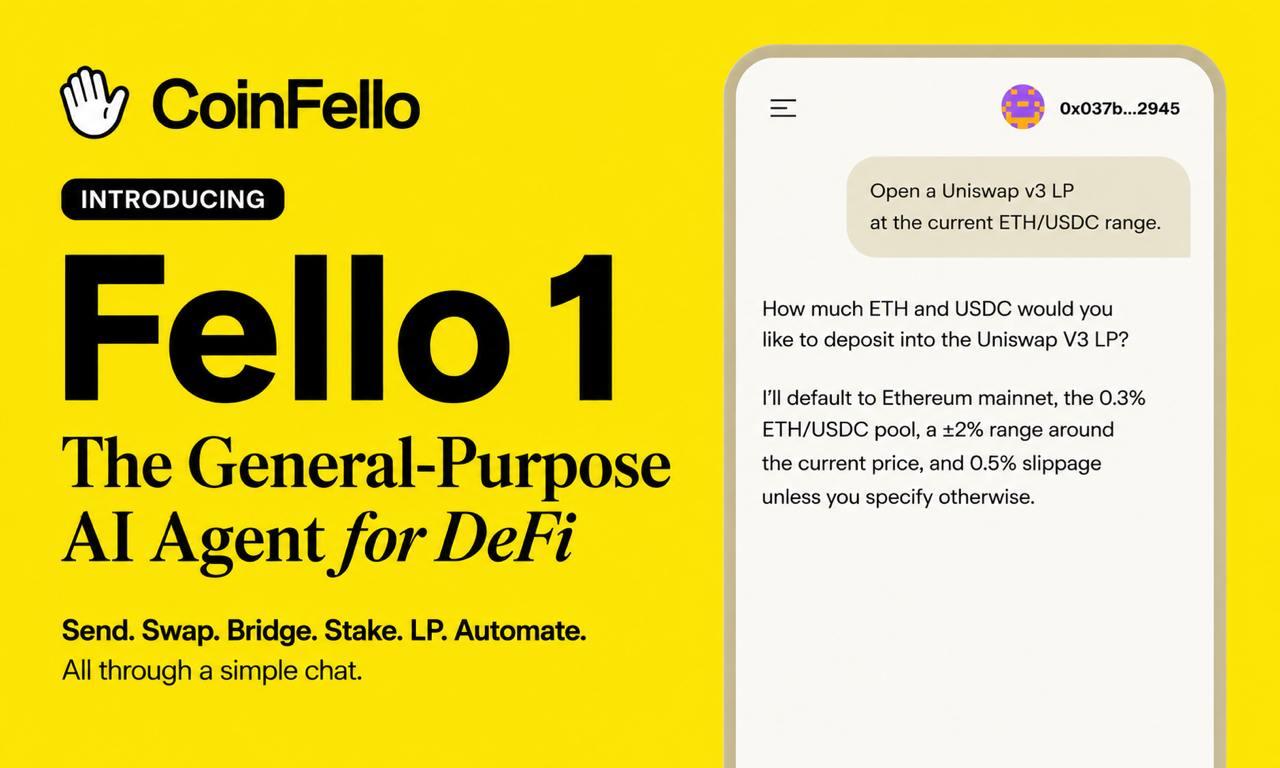
    Fort Worth, Texas, June 11, 2026 – CoinFello, a pioneer in self-sovereign AI agents for decentralized finance (DeFi), today announced the release of Fello 1. This significant upgrade transforms the company’s agent into a general-purpose AI crypto tool, enabling users to interact with any EVM-compatible smart contract and introducing new functionalities without requiring code updates. The launch broadens CoinFello’s scope from a specialized application to a comprehensive AI agent focused on simplifying the process of providing liquidity (LP) in DeFi.

    Beyond its foundational capabilities in sending, swapping, bridging, and staking, Fello 1 can now assist users in opening LP positions on Uniswap V2, V3, and V4. It also facilitates multi-step DeFi transactions, eliminating the need for protocol-specific interfaces or pre-built integrations. The system operates on a self-custodial delegation model, ensuring users retain control over their wallets and private keys while granting agents limited, user-defined permissions.

    This latest release builds upon CoinFello’s previous innovations, including Fello 0 and the CoinFello agent skill, a framework for secure agent delegation. Fello 1 is developed in accordance with MetaMask Smart Accounts standards, incorporating ERC-7710 and ERC-7715 delegation capabilities.

    Fello 1 not only offers general-purpose functionality but also enhances the LP experience for DeFi users. The agent handles all necessary calculations, monitors live positions, and clearly presents information on in/out-of-range status, recommendations, and impermanent loss, providing users with a transparent view of their actual returns.

    “Concentrated liquidity has been a significant yield opportunity in DeFi for years, but its complexity has been a barrier for many,” said jacobc.eth, Co-Founder & CEO of CoinFello. “Managing tick math, fee tiers, position monitoring, and impermanent loss requires considerable effort to do effectively. Fello 1 directly addresses these challenges, allowing users to capture yield without the burden of managing the underlying mechanics, all while maintaining full control of their private keys.”

    In contrast to narrowly integrated DeFi assistants, Fello 1 is engineered to interact directly with EVM smart contracts through generalized execution capabilities. This approach, according to the company, allows for broader protocol coverage and faster expansion of supported features without the need for dedicated integrations for each new application.

    Current functionalities include the management of liquidity positions, execution of multi-step transactions, interaction with ERC-4626 vaults, and integrations with protocols such as Aave, Uniswap V2, Uniswap V3, and Uniswap V4. CoinFello anticipates further enhancements for protocols like Pancakeswap and Aerodrome in upcoming updates.

    The launch coincides with a surge in interest in AI-powered crypto infrastructure and conversational blockchain interfaces. CoinFello positions Fello 1 as an execution layer designed to provide users with simplified access to decentralized finance while preserving their direct control over transaction approvals and wallet permissions.

    “Many AI agents in the crypto space today either operate on custodial systems or are confined to limited workflows,” stated MinChi, Co-Founder & COO of CoinFello. “We believe the next evolution of onchain AI will necessitate systems capable of operating across the full spectrum of EVM applications, while ensuring users remain actively involved in every transaction decision.”

    CoinFello has stressed that Fello 1 is not designed as an autonomous trading bot. Users are required to review and approve each transaction before execution, and delegation permissions can be modified or revoked at any time.

    The Fello 1 launch campaign is now active. Existing CoinFello users can access Fello 1 immediately, while new users can create accounts via the CoinFello application.

    About CoinFello
    CoinFello is an AI agent platform that facilitates the research, execution, and automation of onchain actions. Through plain language commands, users can perform actions such as sending, swapping, bridging, staking, creating LPs, and automating various crypto activities across EVM-compatible networks, all while maintaining full custody of their wallets and private keys. CoinFello employs a delegation model that grants AI agents only the specific permissions users choose to authorize.