Tag: DeFi

  • Tokenized Funds Surge, Outpacing Stablecoins Fourfold

    Tokenized Funds Surge, Outpacing Stablecoins Fourfold

    Tokenized Funds Surge as On-Chain Investors Seek Yield

    Two years ago, tokenized funds were a minor presence in the stablecoin market, accounting for just $2.99 for every $100 held in stablecoins. That figure has now surged to $11.39, a nearly fourfold increase, signaling a clear trend: investors operating on-chain are actively seeking yield and finding it in these new financial instruments.

    This shift occurs against the backdrop of a stablecoin market valued at approximately $300 billion, still heavily dominated by USDT and USDC. Tokenized real-world assets, encompassing Treasury-backed funds and money market products, now represent between 10% and 17% of this stablecoin universe, depending on the methodology used for calculation.

    The growth, however, has not been uniform. A select few products from major issuers are driving the majority of this activity. Circle’s USYC has amassed an estimated $2.5 billion to $3 billion in value, while BlackRock’s BUIDL fund, which garnered significant attention upon its launch on Ethereum, holds approximately $2.2 billion to $2.7 billion. Ondo’s USDY has also secured a notable position, with a valuation around $2.1 billion to $2.3 billion.

    The total value of tokenized Treasury and money market funds currently ranges between $15 billion and $33 billion. This broad range reflects the inherent challenges in tracking assets distributed across multiple blockchains and structured in various formats. During periods of peak expansion, some of these products have experienced monthly growth rates of 8% to 10% or even higher.

    The appeal of tokenized funds is straightforward. Traditional stablecoins like USDT and USDC function as digital dollars, ideal for payments and settlements, but they do not offer any returns to their holders. The issuers typically generate yield on the reserves backing these tokens, retaining the profits. Tokenized funds invert this model by distributing short-term Treasury yields directly to investors, transforming idle on-chain capital into an income-generating asset.

    Favorable Regulatory Outlook

    The evolving regulatory landscape appears to be surprisingly supportive of tokenized funds, particularly when compared to stablecoins. The GENIUS Act, anticipated to take shape in 2025, is expected to place explicit restrictions on yield payments for payment stablecoins while simultaneously designating tokenized funds as acceptable reserves.

    Institutional Interest and Infrastructure Potential

    JPMorgan analysts estimate that tokenized funds currently constitute about 5% of the broader stablecoin ecosystem. Their assessment suggests that without substantial legal adjustments, particularly concerning transferability and cross-platform interoperability, tokenized funds are unlikely to capture more than 10% to 15% of the total stablecoin market.

    The issue of transferability remains a significant hurdle. Most tokenized fund shares lack the seamless transferability of stablecoins. They are subject to Know Your Customer (KYC) requirements, redemption windows, and compliance protocols, rendering them less liquid than a simple USDT transaction.

    Beyond their yield-generating capabilities, tokenized funds are also emerging as crucial infrastructure components. Several protocols are already utilizing tokenized Treasury products as collateral or reserves to back other stablecoins. Ethena’s products, for instance, have integrated tokenized assets into their reserve structures.

    For institutional investors, this inherent composability is a key attraction of blockchain technology. BlackRock’s launch of BUIDL was not merely a speculative endeavor, nor did JPMorgan begin analyzing tokenized fund market share without strategic intent. These firms foresee a future where the on-chain settlement of traditional financial products becomes commonplace and are positioning themselves accordingly.

    Future Considerations

    The final form of the GENIUS Act will be critically important. If it solidifies yield restrictions on payment stablecoins while establishing clear compliance pathways for tokenized funds, a significant rotation of capital is likely to accelerate.

    Furthermore, the impact of potential interest rate reductions remains a key consideration. Tokenized Treasury funds are currently attractive due to elevated short-term rates. Should the Federal Reserve implement aggressive rate cuts, the yield advantage driving this market shift would diminish, potentially making the friction costs associated with tokenized funds harder to justify compared to the simplicity of holding a standard stablecoin.

  • Jupiter COO: DeFi Must Be 5-10x Better Than Traditional Finance for Institutional Capital

    Jupiter COO: DeFi Must Be 5-10x Better Than Traditional Finance for Institutional Capital

    Decentralized finance (DeFi) needs to offer a value proposition that is five to ten times superior to traditional financial services to attract significant institutional capital, according to Kash Dhanda, Chief Operating Officer of Jupiter. This benchmark highlights a critical requirement for DeFi’s maturation and its potential for broader institutional adoption.

    In response to this challenge, Jupiter has strategically restructured its product suite into three core pillars: Trade, Earn, and Manage. This reorganization aims to transform Jupiter from a decentralized exchange aggregator into a comprehensive on-chain financial platform, positioning it as a “super app” for decentralized finance. The restructuring, which occurred in July 2026, is designed to provide a more integrated and robust user experience, drawing parallels with the organizational structure of traditional financial institutions.

    Jupiter’s operational scale is substantial, evidenced by over $1.2 trillion in processed trading volumes and more than 44 million connected wallets, contributing to its position as the platform with the highest total value locked (TVL) on the Solana blockchain. Additionally, Jupiter Lend has reached a total supply of $1 billion, signaling growing traction in its lending services.

    The “5-10x better” standard implies fundamental improvements over existing financial infrastructure. This could translate to near-instantaneous settlement times, 24/7 operation of lending markets without intermediaries, transparent and auditable collateral backing, and yield products accessible globally, not just to accredited investors. Such enhancements are considered essential to attract institutional players who prioritize efficiency, security, and transparency.

    Jupiter’s strategic initiatives extend beyond its core offerings. The platform has introduced Offer Book to integrate fixed-rate lending into the DeFi ecosystem. Furthermore, JupUSD, a stablecoin developed in collaboration with Ethena, and the GUM omnichain hub, which expands Jupiter’s reach beyond Solana, are part of its broader strategy to build a more complete financial ecosystem.

    The growth metrics reported by Jupiter suggest its strategy is resonating within the market. The significant trading volumes and user engagement, coupled with the milestone in Jupiter Lend’s total supply, indicate that the platform is successfully attracting and retaining users. Continued growth in lending volumes could signify a shift towards more sophisticated DeFi participation, where users engage with multiple financial products beyond simple token swaps.

    Why This Matters

    The materials describe a narrow update: Jupiter’s COO, Kash Dhanda, stated that decentralized finance (DeFi) requires a 5-10x improvement over existing financial infrastructure to attract significant institutional capital. The restructuring into Trade, Earn, and Manage pillars mirrors how traditional financial platforms organize their offerings.

    Broader Context

    Source materials place the factual news in this context: Jupiter has been putting infrastructure behind the thesis, restructuring its entire product suite in July 2026 into three focused pillars: Trade, Earn, and Manage.

  • Aave Unlocks Tokenized US Stocks for USDC Collateral

    Aave Unlocks Tokenized US Stocks for USDC Collateral

    Aave V4 Launches Equities Hub on Base, Enabling Non-US Users to Borrow USDC Against Tokenized US Stocks

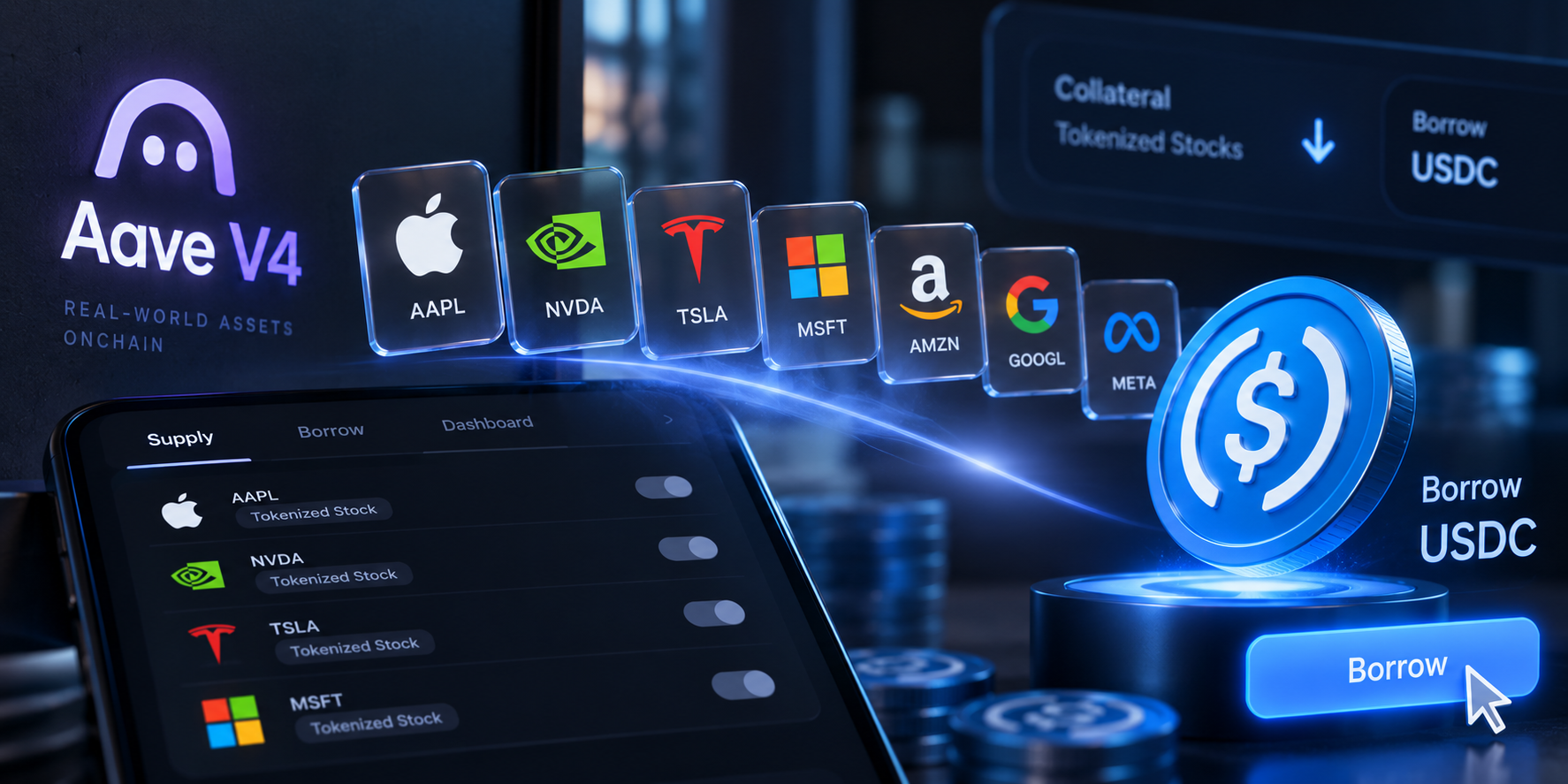
    Decentralized finance protocol Aave V4 has launched its Equities Hub on the Base network, allowing eligible non-US users to borrow USDC by using seven tokenized US stocks issued by Coinbase as collateral. This feature marks a significant expansion for Aave, extending its lending capabilities beyond purely crypto assets and tapping into the vast liquidity of the public equity markets, estimated at nearly $150 trillion, through tokenization.

    The Equities Hub went live on September 25th, initially listing seven tokenized stocks tracking major companies: Apple, Amazon, Alphabet, Meta, Microsoft, Nvidia, and Tesla. All these assets are issued by Coinbase. Chainlink is providing on-chain pricing for these seven assets through its tokenized stock price feeds.

    The Equities Hub operates on Aave V4’s “Hub and Spoke” architecture, consolidating all stock collateral into a single USDC market. However, risk parameters are set independently for each asset. This design ensures that issues with one stock will not affect others, a crucial consideration given the varying volatility of US equities.

    Risk parameters set by Aave’s risk supplier, LlamaRisk, include a total collateral cap of approximately $29 million for the seven stocks, a USDC supply cap of $32 million, and a borrowing cap of $21 million. The collateral factor, which determines how much can be borrowed against an asset, ranges between 65% and 79%, depending on the specific stock.

    Currently, these seven tokenized stocks are only available as collateral and cannot be borrowed. Aave has indicated that it may introduce more tokenized stocks from Coinbase in the future, and potentially include GHO as a borrowable asset. However, any such additions would be subject to governance and risk assessments.

    Stani Kulechov, founder and CEO of Aave Labs, stated in an announcement that public equities represent one of the largest pools of capital globally, and tokenization is bringing this capital onto the blockchain. “Until now, tokenized stocks were just something you could hold or trade,” Kulechov said. “Today, they become collateral against which you can borrow.”

    This is not the first time Kulechov has highlighted the potential of tokenized assets. In a mid-September interview with The Block, he noted that institutions “bring scale,” which could drive a substantial increase in on-chain lending demand. He believes that tokenization and DeFi are no longer technical challenges but rather marketing and adoption issues.

    Following the obstruction of the CLARITY Act in the Senate by a vote of 49 to 50, Kulechov suggested that DeFi might need to adopt an “Uber-like” strategy, expanding to a sufficient user base to compel lawmakers to address regulatory concerns.

    This collaboration involves three key players: Aave providing the DeFi lending protocol, Coinbase issuing the tokenized stocks, and Chainlink supplying the on-chain pricing.

    Johann Eid, Chief Business Officer at Chainlink, commented that Aave’s adoption of Coinbase’s tokenized stocks, coupled with Chainlink as the official oracle solution, is a significant step towards bringing the global stock market, valued at over $150 trillion, onto the blockchain.

    Antonio García-Martínez, Head of Growth at Base, pointed out that eligible clients outside the US can now borrow USDC using these stocks, while USDC providers can earn interest. This initiative introduces a new source of liquidity to the Base ecosystem and creates a closed loop with Coinbase’s own tokenized stock offerings.

    Aave has accumulated $3.6 trillion in deposits and facilitated over $1 trillion in total loans. The introduction of tokenized US stocks positions the protocol to move beyond pure crypto lending towards broader real-world asset (RWA) collateralized lending. However, the initial cap of $29 million is considered conservative and still a distance from attracting institutional-grade capital.

    Two key areas to watch in the future are whether LlamaRisk will relax the collateral cap and whether Aave will allow tokenized stocks to be borrowed as assets, not just used as collateral. If institutions can directly borrow tokenized stocks on-chain for shorting or hedging, Aave would truly become a cross-asset lending protocol. In the short term, this launch appears more like a technical validation, with the stability of the Hub and Spoke architecture in handling traditional asset risk parameters being a critical determinant for future steps.

  • Tokenized Asset Count Surges to 1,473 This Year

    Tokenized Asset Count Surges to 1,473 This Year

    Mantle Network Reports Explosive Growth in Tokenized Assets

    Mantle Network is experiencing a significant surge in its tokenized asset business, with both the number of assets on its platform and their total value reaching unprecedented levels. The network now hosts 1,473 tokenized assets, a dramatic increase from just 71 at the start of 2026. Concurrently, the Distributed Asset Value has climbed to approximately $476.1 million, marking a roughly 110% increase over the past 30 days.

    Asset Count Surges More Than Twentyfold

    The growth in Mantle’s tokenized asset count has been substantial, more than twentyfold since January. This expansion goes beyond typical month-to-month fluctuations often seen in Total Value Locked (TVL) metrics. The network attributes this acceleration to a broadening array of tokenized products, including equities, exchange-traded funds (ETFs), regulated stablecoins, and yield-bearing assets. Key issuers and infrastructure providers within the Mantle ecosystem include xStocks, Securitize, Ethena, and Paxos.

    Beyond Issuance: Focus on Distribution

    The increasing diversity of tokenized assets, encompassing stocks, funds, stablecoins, and structured products, signifies a maturation of the tokenization market beyond its initial focus on Treasury products. While the technical and legal challenges of representing regulated financial assets on public blockchains are increasingly being addressed, Mantle is emphasizing the crucial next stage: distribution.

    The network aims to facilitate the liquidity, collateral use, settlement, and integration of these tokenized assets by connecting issuers with exchanges, custodians, market makers, and decentralized finance (DeFi) protocols. This strategic positioning focuses on the ecosystem’s ability to distribute assets, a factor Mantle believes will capture as much value as the issuance itself.

    While the $476 million figure remains modest compared to traditional securities markets, the rapid pace of growth is a significant indicator. The jump from 71 to 1,473 tokenized assets in less than a year suggests a rapidly expanding ecosystem, moving beyond a few dominant products to a more robust and diversified market. Tokenized finance is beginning to resemble a functional market rather than a series of isolated experiments.

  • Circle’s cirBTC Token Surpasses 5,000 Issued, Highlighting Regulated Custody and Rapid Growth

    Circle’s cirBTC Token Surpasses 5,000 Issued, Highlighting Regulated Custody and Rapid Growth

    Circle’s wrapped Bitcoin token, cirBTC, has surpassed 5,000 issued tokens since its launch on June 8, 2026, marking a significant milestone in its early adoption within the institutional-grade wrapped Bitcoin market. The token’s supply experienced rapid growth, increasing from approximately 40 tokens in mid-August 2026 to over 5,000 by late 2026, a more than 100-fold expansion in a matter of months.

    Each cirBTC is backed 1:1 by native Bitcoin held in custody by Circle National Trust, a federally chartered trust bank. This regulated custody arrangement is a key differentiator, offering a level of compliance and trust that may appeal to institutional investors. Transparency regarding the backing is provided through Chainlink Proof of Reserve, which offers real-time on-chain verification.

    Users can mint and redeem cirBTC via Circle Mint, the same platform used for Circle’s USD Coin (USDC). This integration offers a streamlined experience for existing Circle customers, as the APIs are identical to those used for USDC, potentially reducing the technical barrier for institutions already integrated with Circle’s ecosystem.

    CirBTC is available on both the Ethereum mainnet and Circle’s own Layer 1 blockchain, Arc. The token enters a competitive market that includes established players like Wrapped Bitcoin (wBTC) and Coinbase’s cbBTC. Circle is positioning cirBTC as an institutional-grade contender, emphasizing its regulated custody and reserve verification processes.

    As of September 24, 2026, the circulating supply of cirBTC was approximately 4,300.68 tokens, with total reserves standing at roughly 4,448.19 BTC. This data indicates a reserve cushion beyond the 1:1 backing.

    Circle is emphasizing collateralized borrowing as a practical use case for cirBTC. However, the long-term success of cirBTC will likely depend on its ability to achieve liquidity depth comparable to established tokens like wBTC across major decentralized finance (DeFi) protocols. Deep liquidity is crucial for institutions to manage large positions efficiently without significant market impact.

    The federally chartered status of Circle National Trust provides cirBTC with a compliance profile that may be difficult for competitors to replicate quickly. As regulatory clarity around tokenized assets and digital custody continues to evolve in the U.S., a federally chartered custodian could become a prerequisite for certain institutional investors.

    Why This Matters

    The materials describe a narrow update: Circle launched cirBTC, a 1:1 Bitcoin-backed token, on June 8, 2026. Whether cirBTC can close the gap with wBTC in terms of liquidity depth across major DeFi protocols.

    Broader Context

    Source materials place the factual news in this context: Circle launched cirBTC on June 8, 2026.

  • Ethena Integrates Tokenized Stocks with Binance

    Ethena Integrates Tokenized Stocks with Binance

    Ethena Ventures into Global Equities with Binance Partnership for Synthetic Dollar Backing

    Ethena, a decentralized finance protocol, is expanding its synthetic dollar strategy into the global equities market, a move largely unexplored by its DeFi peers. The protocol, renowned for its delta-neutral basis trades in Bitcoin and Ethereum, has announced a collaboration with Binance. This partnership will leverage tokenized U.S. stocks as collateral for USDe, Ethena’s synthetic dollar.

    Strategic Expansion into Tokenized Equities

    The framework for this tokenized equity basis trade received formal approval from Ethena’s Risk Committee on August 28, 2026. Ethena founder Guy Young described this development as the most significant expansion since the launch of USDe.

    The operational mechanism closely mirrors Ethena’s existing crypto basis strategy, adapted for equity markets. Ethena will hold Binance’s bStocks, which are tokenized representations of U.S. equities, as its collateral. Concurrently, the protocol will short corresponding equity perpetual futures to eliminate any directional market exposure.

    This strategy functions similarly to holding a stock and a simultaneous, equal-sized short position. Such a setup renders the investor indifferent to the stock’s price movement, as the primary source of return becomes the funding rate paid by leveraged long positions to maintain their trades. This funding rate mechanism is the core of the yield generation for Ethena.

    Binance’s equity perpetual market has seen substantial activity, with open interest exceeding $2.9 billion. This figure is significant as open interest represents the pool from which funding payments are drawn.

    Leveraging Equity Market Scale and Dynamics

    Guy Young articulated Ethena’s rationale: the equities market’s sheer scale far surpasses that of cryptocurrency, and the funding dynamics within equity perpetuals have historically been more advantageous. He indicated that funding rates from equity perpetuals could potentially be around five times higher than those generated by comparable Bitcoin basis trades.

    According to the framework documentation, the average equity basis over the past six months stood at 3.56%.

    Diversification and Risk Mitigation for USDe Holders

    For holders of USDe, this expansion signifies a diversification of the collateral backing the synthetic dollar. Instead of relying solely on crypto-denominated basis trades, a portion of USDe’s backing can now be derived from equity market dynamics. This is particularly beneficial during sharp crypto market downturns. In such scenarios, leveraged crypto longs face liquidation, leading to a reduction in open interest and potentially negative funding rates, where the short side must pay. Equity perpetuals, which do not move in lockstep with crypto, offer a partial hedge against these risks.

    Validation for Binance’s bStocks

    For Binance, this partnership serves as a validation of its bStocks product, demonstrating its utility as functional collateral within an active decentralized finance strategy. The structured framework, approved by Ethena’s Risk Committee, incorporates stringent trading criteria, underscoring the deliberate nature of the August 28 approval.

  • FXRP Marks One Year of Enabling XRP Access to Ethereum DeFi

    FXRP Marks One Year of Enabling XRP Access to Ethereum DeFi

    One year after its launch, FXRP, a representation of XRP tokens, has enabled XRP holders to access decentralized finance (DeFi) applications on the Ethereum network. According to Flare, approximately 130 million FXRP have been deployed within various DeFi protocols.

    This milestone signifies an expansion of utility for XRP holders, allowing them to engage with Ethereum’s DeFi ecosystem. FXRP enables XRP to be utilized in applications such as vaults and lending markets, which were previously inaccessible to native XRP tokens.

    The deployment of 130 million FXRP in DeFi applications indicates a growing integration of XRP into broader decentralized financial activities. This development offers XRP holders new avenues for participation and potential yield generation within the Ethereum DeFi landscape.

    The integration of XRP into Ethereum’s DeFi space through FXRP highlights a trend of increasing interoperability and expanded utility for established digital assets within the broader cryptocurrency market. This one-year anniversary serves as a marker for the progress made in bridging different blockchain ecosystems and enhancing the functionality of digital assets.

    Why This Matters

    The materials describe a narrow update: One year after the launch of FXRP, XRP holders can now utilize a token representation of their XRP within vaults, lending markets, and other decentralized finance (DeFi) applications on the Ethereum network. FXRP has enabled XRP to gain access to financial applications beyond its native ecosystem.

    Broader Context

    Source materials place the factual news in this context: A year after FXRP launched, XRP holders can use a representation of their tokens in vaults, lending markets, and applications on Ethereum.

  • Aerodrome’s Slipstream V3 Upgrade Introduces Protocol-Native MEV Auction and Dynamic Fees

    Aerodrome’s Slipstream V3 Upgrade Introduces Protocol-Native MEV Auction and Dynamic Fees

    Aerodrome has upgraded its concentrated liquidity automated market maker (AMM) with Slipstream V3, introducing a protocol-native Miner Extractable Value (MEV) auction and a dynamic fee model. This upgrade aims to capture value previously lost to bots and redistribute it to liquidity providers and sAERO token holders, while also enhancing capital efficiency.

    MEV Capture and Redistribution
    The core of the Slipstream V3 upgrade is the integration of an internal MEV auction directly into the AMM. This mechanism is designed to capture the value generated from MEV opportunities, such as front-running or sandwich attacks, which traditionally benefits bots operating outside the protocol. According to the protocol’s estimates, the proceeds from this MEV internalization could potentially reach tens of millions. These captured funds are slated to be distributed to liquidity providers and holders of the sAERO token, creating a new income stream that was previously lost to the mempool.

    Dynamic Fees and Capital Efficiency
    Slipstream V3 also features a dynamic fee model that adjusts based on market volatility. This model is intended to provide better compensation for liquidity providers during periods of high market activity, addressing a common complaint about static fee tiers in traditional AMMs. Slipstream claims this approach can achieve capital efficiency up to 4,000x compared to traditional constant-product AMMs in targeted price ranges, though the precise impact of this claim requires further observation.

    The concentrated liquidity model employed by Slipstream V3 follows the design philosophy pioneered by Uniswap V3, allowing liquidity providers to allocate their capital to specific price ranges for potentially higher returns. This approach contrasts with older AMM models that spread liquidity across the entire price curve.

    Strategic Context and Future Plans
    Aerodrome currently operates on the Base blockchain, while its sister protocol, Velodrome, is based on Optimism. Both protocols are part of a broader strategy to consolidate under a single AERO token. The upgrade also includes features aimed at institutional compliance, with planned integrations into platforms like Circle’s Arc. Aero Lite has already launched Slipstream pools on Circle’s Arc, which is designed with institutional compliance in mind.

    This development positions Slipstream V3 as a notable implementation in the DeFi space. While Uniswap V4 introduced hooks that theoretically allow for similar MEV strategies, Slipstream has delivered a production-ready implementation. Other decentralized exchanges like Curve, Balancer, and Trader Joe have their own concentrated liquidity approaches, but none currently internalize MEV at the protocol level in the same manner.

    Future plans include a deployment on the Ethereum mainnet in Q2 2026. The full consolidation of Aerodrome and Velodrome under a single AERO token beyond this deployment remains a point of future development.

    Key uncertainties surrounding the upgrade include the exact amount of projected revenue from MEV internalization and the precise impact of the 4,000x capital efficiency claim. The timeline for the complete consolidation of Aerodrome and Velodrome also remains to be fully detailed.

    Why This Matters

    The materials describe a narrow update: Slipstream V3, an upgrade to Aerodrome’s concentrated liquidity AMM, has implemented an internal MEV auction to capture value previously lost to bots and redistribute it to liquidity providers and sAERO token holders. The exact amount of projected revenue from MEV internalization.

    Broader Context

    Source materials place the factual news in this context: Traditional decentralized exchanges lose substantial value to MEV extraction, where bots front-run or sandwich user trades to profit from predictable price movements.

  • DeepBook App Launches on Sui Mainnet, Introducing Ultra-Short-Term Prediction Markets

    DeepBook App Launches on Sui Mainnet, Introducing Ultra-Short-Term Prediction Markets

    The DeepBook App has launched in alpha on the Sui mainnet, introducing an integrated trading interface that combines spot markets, margin trading, and a novel prediction market feature. This new offering allows users to speculate on Bitcoin price movements with expiry windows as short as one minute, significantly compressing the typical speculation timeline in decentralized finance.

    According to the FactSheet, the platform’s core feature, ‘Predict,’ enables traders to engage with Bitcoin price movements, with initial expiry windows set at a minimum of one minute from the time a position is opened. This approach differs from traditional prediction markets, which are often event-based, by focusing on price-based speculation. The system utilizes advanced oracles for dynamic pricing and a continuous strike model, aiming to provide greater accessibility compared to rigid traditional options.

    DeepBook operates on a shared on-chain central limit order book (CLOB), a system that directly connects buyers and sellers. This CLOB has reportedly processed over $20 billion in cumulative trading volume across more than 15 applications within the Sui ecosystem. The DeepBook App provides users with a direct interface to this existing infrastructure.

    In addition to the prediction markets, the app offers spot trading with pairs such as SUI/USDC, xBTC/USDC, and DEEP/USDC, alongside margin trading capabilities. The integration of these diverse trading functions into a single interface is a notable product design aspect, as many DeFi users currently navigate multiple protocols for similar functionalities.

    The ‘Predict’ feature was initially tested on Sui’s testnet in May 2026, in collaboration with Block Scholes. The waitlist for the alpha launch reportedly surpassed 150,000 traders, indicating significant user interest.

    The underlying Sui network’s infrastructure plays a crucial role in enabling the rapid execution required for such short-term trading. Sui’s network average finality speed is approximately 390 milliseconds, allowing transactions to settle in under half a second. This speed is cited as a factor that shifts the trading bottleneck from blockchain performance to user interaction speed.

    The DEEP token is integral to the DeepBook ecosystem, serving functions related to trading fee management, user incentives, and governance.

    DeepBook’s model is characterized by its price-based, rather than event-based, prediction markets and its compressed speculation window, which the FactSheet suggests resembles high-frequency trading more than traditional prediction markets. The continuous strike model further differentiates it from conventional options, aiming for increased retail accessibility. The shared liquidity model, where the CLOB supports multiple applications, also means that the depth available to Predict traders is not isolated to the DeepBook app itself. Bitcoin is the initial asset for the Predict feature, with plans to expand to other assets anticipated.

    Why This Matters

    The materials describe a narrow update: The DeepBook App has launched in alpha on the Sui mainnet, offering an integrated trading interface for spot markets, margin trading, and prediction markets. DeepBook operates a shared on-chain central limit order book, or CLOB, which connects buyers and sellers directly, rather than routing trades through automated market makers that rely on liquidity pools.

    Broader Context

    Source materials place the factual news in this context: The DeepBook App went live in alpha on the Sui mainnet on September 24, bringing with it something the network has been building toward for years: a fully integrated trading interface that combines spot markets, margin, and ultra-short-term prediction markets under one roof.

  • Arch Lending Plans to Explore Tokenized Equities as Collateral Amid Market Growth

    Arch Lending Plans to Explore Tokenized Equities as Collateral Amid Market Growth

    Arch Lending, a crypto lender, is reportedly planning to expand its services to accept tokenized equities as collateral for loans. This potential move aligns with the growing market for onchain stocks and the exploration of new collateral use cases within the digital finance space.

    The market for tokenized equities has seen significant expansion, with distributed tokenized stock value climbing to approximately $3.15 billion from about $630 million a year ago, according to RWA.xyz data. This growth indicates an increasing adoption of tokenized traditional assets within the blockchain ecosystem.

    Arch Lending has previously diversified its collateral offerings beyond cryptocurrencies, recently launching loans backed by tokenized real-world assets like Paxos Gold and Tether Gold. However, Bitcoin (BTC) continues to dominate its existing loan book, representing over 80% of its value, as stated by Himanshu Sahay.

    This strategic exploration into tokenized equities follows similar initiatives by other platforms. In February, Ondo Finance introduced DeFi lending markets for its tokenized ETFs, including the SPDR S&P 500 ETF and Invesco QQQ, via an integration with the Morpho lending protocol. These tokenized ETFs are now usable as collateral for borrowing on Ethereum.

    Tokenized stocks are also finding broader applications. Kraken began allowing 10 of its xStocks to back futures and margin positions in July, and Coinbase launched its B20 stocks on the Base network in August, featuring price-feed infrastructure to support DeFi borrowing and lending.

    Despite the market’s expansion, lending against tokenized equities remains limited, with expectations of increased competition as more lenders are anticipated to enter the space. Arch Lending’s planned entry is positioned as a development within this evolving market, with the potential for multiple lenders to eventually offer credit against tokenized assets.

    Arch Lending anticipates entering the tokenized equity lending market “pretty soon,” according to Sahay. The company has also observed a recent rise in interest for XRP as collateral, particularly among U.S. borrowers. Uncertainties remain regarding the specific launch timeline, the exact number of future market participants, and the precise types of tokenized equities Arch Lending will prioritize.

    Why This Matters

    The materials describe a narrow update: Arch Lending, a crypto lender, intends to offer loans backed by tokenized equities. Specific date for Arch Lending’s entry into the tokenized equity lending market.

    Broader Context

    Source materials place the factual news in this context: Arch Lending’s Himanshu Sahay said on Cointelegraph’s Chain Reaction podcast that the lender plans to move into tokenized equities as onchain stocks gain traction as collateral.