Tag: Market Trends

  • Pi Network Token Recovers Post-ATL; Bitcoin Reclaims $60K

    Pi Network Token Recovers Post-ATL; Bitcoin Reclaims $60K

    Bitcoin Recovers Above $61,000 After Sharp Decline

    Bitcoin has staged a recovery, climbing back to around $61,000 after a significant drop of several thousand dollars in less than 12 hours. The cryptocurrency had fallen to a multi-year low.

    While most altcoins remain in negative territory on a daily basis, they have managed to recoup some of their losses. This is particularly evident for Zcash (ZEC), which experienced a substantial sell-off yesterday, and Pi Network’s PI token, which had hit consecutive all-time lows.

    A Tumultuous Period for Bitcoin

    The past week, and indeed the last three weeks, have been particularly challenging for Bitcoin and its investors, especially those betting on a downturn. The digital asset was trading above $82,000 in mid-May before its sharp decline began, falling to $74,000 by the end of the month. However, this was merely the prelude to further pain, as June brought significant volatility within its first five days.

    Bitcoin quickly breached the crucial $70,000 support level, giving bears considerable control. They proceeded to push the price below successive key support points, with $68,000, $65,000, and $62,000 all giving way. The asset then found itself perilously close to the $60,000 mark, a level that had previously provided a floor during the February crash.

    Buyers Step In After Historic Low

    Although buyers initially managed to defend the $60,000 level, it ultimately succumbed yesterday, sending Bitcoin plummeting to just over $59,000. This marked its lowest price since before the November 2024 US presidential elections. After shedding approximately $23,000 in a matter of weeks, BTC has finally shown signs of a minor recovery, bouncing back to $61,000 as of this report.

    Bitcoin’s market capitalization has risen to $1.225 trillion, according to CoinGecko, and its dominance over altcoins has reclaimed the 56% level.

    Altcoins Show Mixed Performance

    While most cryptocurrency assets experienced a downturn yesterday, Zcash emerged as the worst performer. This was attributed to the discovery of a vulnerability in its code and reports of Arthur Hayes liquidating his entire holdings. At one point, ZEC had plunged by over 50%, falling from $630 to below $300. However, it has since shown a swift rebound and is now trading above $370.

    Pi Network’s native token, PI, had registered several consecutive all-time lows, dropping below $0.15 earlier this week. The latest low, according to CoinGecko data, was under $0.12. The token has since managed to recover from that level and is currently trading approximately 7% above its all-time low.

    Ethereum (ETH) fell to $1,500 yesterday but is now trading close to $1,600. Binance Coin (BNB) has returned to $580, and XRP is back at $1.10. Stellar (XLM) and Cardano (ADA) are among the few altcoins trading in positive territory today.

    The total cryptocurrency market capitalization had dipped to $2.1 trillion yesterday. Although it has recovered some of these losses, it remains below $2.2 trillion on CoinGecko.


  • Hayes Sells Crypto X: Investors Outraged

    Hayes Sells Crypto X: Investors Outraged

    Crypto Community Erupts Over Arthur Hayes’ Altcoin Sales

    Arthur Hayes, once a vocal proponent of several altcoins including WLD, ZEC, HYPE, and NEAR, has revealed he has sold nearly all of his holdings in these assets well before his previously stated price targets were met. This move has ignited a significant backlash from the cryptocurrency community, with many accusing Hayes of orchestrating hype around these tokens only to offload them at inflated prices.

    WLD Sale Follows SpaceX IPO Speculation

    Just days prior, Hayes had indicated he would hold his Worldcoin (WLD) position at least through the initial week of SpaceX’s anticipated Initial Public Offering (IPO), citing a shared connection with Elon Musk. He had predicted the IPO would be a “face-melting” event. However, his sentiment shifted dramatically after observing a sharp decline in SpaceX’s stock on Friday amidst a broader market downturn. Hayes attributed his decision to sell his WLD holdings to the perceived negative trajectory of the newly listed shares.

    On-Chain Sleuths Question Hayes’ Tactics

    Prominent on-chain investigator ZachXBT was among the first to publicly question Hayes’ recent actions. ZachXBT queried the amount of “exit liquidity” generated from Hayes’ followers in the preceding days and highlighted other substantial sales by the BitMEX co-founder.

    As previously reported, Hayes had divested his Zcash (ZEC) holdings shortly after developers disclosed a code vulnerability that had already been rectified by the time of his sale. Prior to that, he had also sold off his HYPE and NEAR tokens, despite having previously issued highly optimistic price predictions for both.

    Analysts Note Price Tops Coinciding with Sales

    Analysts at Lookonchain also drew attention to Hayes’ exits, noting that they occurred close to the peak prices of the respective assets. Notably, all of these cryptocurrencies experienced a decline in the hours following Hayes’ disclosure of his sales, eventually returning to levels seen before his bullish pronouncements.

    Community Accusations of Market Manipulation

    The reaction on social media platform X has been harsh, with some users labeling Hayes’ behavior as a “douchebag” move for promoting altcoins shortly before selling them. Others suggested that any traders who followed his recommendations were themselves “small scammers” who were ultimately “scammed” by Hayes, whom they characterized as a “big scammer.”

  • XRP RSI Hits Record Low Amid Market Watch

    XRP RSI Hits Record Low Amid Market Watch

    XRP’s Monthly Relative Strength Index Hits All-Time Low, Signaling Potential Oversold Conditions

    The XRP monthly relative strength index (RSI) has plunged to 41.64, marking the lowest reading this indicator has ever registered for the cryptocurrency. This figure dips below the previous low of 43.75, recorded in March 2020, a period when XRP bottomed out at $0.11 amidst one of the crypto market’s most severe downturns.

    A Signal With A Caveat

    While the current reading surpasses the 2020 low, it is not yet definitive. The month of June remains open, and data indicates that if XRP manages to recover to above $1.30 before the month concludes, the RSI could finish significantly higher than its current level, thereby diminishing the importance of this signal.

    Austin, a commentator within the XRP community who uses that moniker, was the first to publicly highlight the RSI’s decline. His initial chart indicated a drop to 42.64, which at the time was a new all-time low, as XRP slid to $1.18. Prices have since fallen further, pushing the RSI down to 41.62 at the latest check. The token is currently trading around $1.11, approximately 61% below its October 2025 peak of $2.84. This decline has persisted for several months without a substantial recovery.

    What History Suggests

    The 2020 episode provides a point of comparison, though it is a singular instance. The RSI bottom in that year coincided with what proved to be XRP’s price floor for that cycle. From that low, the token subsequently posted a series of higher lows, eventually reaching $1.96 in April 2021. A subsequent surge in November 2024 propelled it to a high of $3.40, representing a gain of roughly 580% from the October lows of that year.

    The broader cryptocurrency market has also experienced pressure this week. Bitcoin saw a decline towards the $63,000 mark after MicroStrategy, the firm associated with Michael Saylor, confirmed the sale of 32 BTC from its holdings exceeding 800,000 BTC. The total cryptocurrency market capitalization shed $330 billion over the past week.

    XRP’s Own Decline In Focus

    XRP’s market capitalization fell from $82.5 billion at the beginning of this week to approximately $69 billion at the time of writing, a decrease of roughly 15%. Reports indicate that the current price of $1.10 revisits levels last observed in early February.

    The RSI measures the speed and magnitude of recent price changes. A reading below 30 is traditionally considered oversold territory. XRP’s monthly reading of 41.64 remains above this threshold, though it represents a historically low level specifically for the token. The ultimate significance of this signal will depend on where the June candle closes in relation to its current RSI reading.

  • Ripple IPO: Expert Forecasts Public Listing Timeline for XRP Investors

    Ripple IPO: Expert Forecasts Public Listing Timeline for XRP Investors

    SBI Holdings CEO Suggests Ripple IPO Could Be a Decade Away

    The prospect of Ripple Labs going public has resurfaced in discussions, fueled by SBI Holdings CEO Yoshitaka Kitao, who has provided one of the most concrete long-term timelines yet from a significant Ripple shareholder. Kitao, the chief executive and president of SBI, a major Japanese financial conglomerate, made remarks that have since garnered attention within the XRP community.

    Discussing his long-term investment strategy, Kitao indicated a willingness to invest between $626 million and $1.25 billion in Ripple upon its public debut.

    SBI Chief Believes Ripple Needs to Go Public

    The question of whether Ripple Labs will eventually list on a public exchange has been a persistent one for years, despite consistent efforts by Ripple executives to temper expectations regarding an Initial Public Offering (IPO).

    Speaking at a recent conference in Tokyo, Kitao stated his intention to make a substantial investment in Ripple when the company becomes publicly traded. He suggested that Ripple would be prepared to commit ¥100 billion, or even ¥200 billion, to fully realize its objectives.

    Intriguingly, the SBI Holdings CEO also projected that Ripple might go public in approximately 12 years, emphasizing his belief that such a move is necessary for the company. This timeline places a potential listing around 2038, well beyond the current economic cycle.

    Kitao’s comments carry weight because he is not merely an outside observer or an XRP commentator speculating on price catalysts. SBI Holdings has been a steadfast supporter of Ripple since 2016, investing in the company and co-founding SBI Ripple Asia, a joint venture aimed at leveraging Ripple’s technology for cross-border payments in Asia. SBI has publicly disclosed its ownership of approximately 9% of Ripple Labs, positioning it as one of the company’s largest external shareholders.

    Company Has Consistently Downplayed IPO Talk

    Speculation about a Ripple IPO has circulated for years, particularly following the conclusion of its legal dispute with the U.S. Securities and Exchange Commission in 2025. During this period, Ripple has also expanded its operations into areas such as custody services, stablecoin infrastructure, real-world asset tokenization, and strategic acquisitions.

    However, Ripple executives have consistently maintained that the company is not in a hurry to pursue an IPO. For instance, Ripple CEO Brad Garlinghouse dismissed IPO discussions last year, stating that the company did not require external funding.

    In January 2026, Ripple President Monica Long reiterated that the company intended to remain private, citing its strong balance sheet as sufficient to support continued growth without the need to raise capital from public markets. This stance aligns with Ripple’s recent success in private funding rounds, having raised $500 million at a valuation of approximately $40 billion in late 2025.

  • Cardano Plummets to 5-Year Lows Amidst Hoskinson Warning

    Cardano Plummets to 5-Year Lows Amidst Hoskinson Warning

    Cardano Faces Intense Scrutiny After Price Plunge to Five-Year Lows

    Cardano has been thrust into the spotlight following a dramatic price drop to its lowest point in over five years, igniting widespread concern throughout the cryptocurrency market. The sharp decline comes amid escalating anxieties about the ecosystem’s future, amplified by founder Charles Hoskinson’s recent warnings of potential headwinds. This has left investors grappling with whether ADA presents a historic buying opportunity or is headed for further declines.

    Cardano Price Collapse Captures Market Attention

    According to data from Santiment Intelligence, Cardano has rapidly become one of the most discussed assets in the crypto sphere. ADA’s price recently fell below $0.16, a level not seen since December 2020. This significant drop has fueled extensive industry-wide conversations and reignited interest in the network’s trajectory.

    Much of this heightened attention is attributed to growing unease surrounding Cardano founder Charles Hoskinson’s recent announcement of taking a hiatus. Compounding these concerns, Hoskinson cautioned that the ecosystem could face a wave of project failures and funding challenges, further contributing to the uncertainty surrounding ADA.

    Santiment observed an immediate market reaction, with both social media buzz and on-chain activity experiencing a sharp uptick. Cardano’s social dominance rose to approximately 0.52%, its highest point in 2026, indicating that more than one in every 190 cryptocurrency-related social media discussions centered on ADA. Concurrently, network activity saw a notable increase during this period of heightened volatility. Daily active addresses surged to 28,459, marking a four-month high. This spike suggests that users remain actively engaged with the network, as the price decline has spurred intense debate and bearish sentiment among traders.

    Dedicated Community Remains Resilient

    Despite the recent wave of negative sentiment, Santiment Intelligence highlighted that Cardano continues to benefit from one of the most committed communities in the cryptocurrency landscape. ADA holders have consistently demonstrated engagement across multiple market cycles, often providing support to the ecosystem even when institutional participation has been subdued.

    The analytics firm pointed out that the recent surge in daily active addresses indicates that many users are closely monitoring the network and its developments rather than abandoning Cardano amidst the price downturn. However, Santiment cautioned that while retail investors have historically been a driving force behind Cardano’s growth, the market may require a stronger influx of institutional interest and broader adoption catalysts to reverse the current downward trend.

    The coming weeks and months are poised to be critical for ADA. With the asset trading near multi-year lows, investors will likely be closely watching ecosystem expansion efforts, the success of new project launches, and any signs of renewed confidence from leadership. Positive developments in these areas could bolster the long-term vision championed by Cardano supporters and potentially attract new capital back into the ecosystem.

  • XRP Faces Potential 40% Plunge to $0.70

    XRP Faces Potential 40% Plunge to $0.70

    XRP Faces Steep Decline, Analysts Divided on Future Trajectory

    XRP’s value has plummeted, concluding a 22% retracement over the past month and falling below $1.10 for the first time since November 2024. This sharp downturn has ignited a critical question among investors: will the altcoin recover to the $1 mark soon, or is a further decline imminent?

    Bearish Technical Indicators Signal Caution

    Market expert Sam Daodu has highlighted a broadly bearish technical outlook for XRP across multiple timeframes. The token is currently trading below its 20, 50, 100, and 200-day moving averages, a configuration that typically indicates sustained seller dominance. Daodu noted that support is minimal once XRP trades at $1.09, with buyers historically showing interest around $1.05 and the $1 level serving as a significant psychological floor.

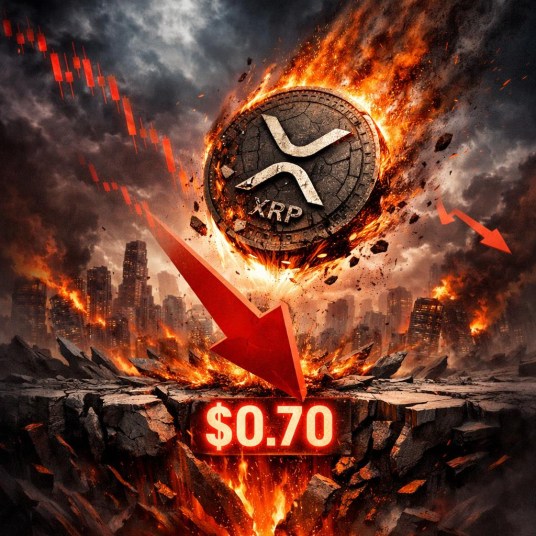
    Adding to the concerns, some chart analysts referenced in Daodu’s report suggest that if the current risk-off trend persists, XRP could experience an additional 40% drop, bringing its price down to approximately $0.70.

    On-Chain Data Paints a Contrasting Picture

    Despite the bearish technical signals, on-chain data presents a more optimistic narrative. The number of XRP wallets holding at least 10,000 tokens reached a record high of 332,230 in May and has continued to grow throughout the recent downturns. Furthermore, wallets holding one million or more XRP have seen a net increase of 42 new addresses since January, marking the first growth in “millionaire” wallets since September 2025.

    Whale activity also suggests a tightening of supply. Holders of 10 million or more XRP now control 45.83 billion tokens, representing 68.5% of the circulating supply – the highest concentration observed since May 2018. Additionally, whale outflow dominance on Binance recently surged to 91.4%, a level not seen since 2024. Historical data indicates that when Binance outflow dominance last reached similar peaks in October 2024, XRP subsequently rallied from around $0.50 to over $3 in the following months.

    A longer-cycle technical indicator also offers a glimmer of hope. XRP’s monthly Relative Strength Index (RSI) has entered the oversold reset zone for only the fourth time in 13 years. Each previous instance of this RSI reset preceded a significant reversal in XRP’s price direction, and Daodu suggests this fourth occurrence is now forming as XRP hovers around $1.09.

    Policy and Market Dynamics as Potential Catalysts

    While whale accumulation and long-term technical signals point towards a potential rebound, near-term catalysts are largely expected to stem from policy developments. Daodu identifies the CLARITY Act’s floor vote as a potential turning point for XRP’s outlook. The bill has advanced through the Senate Banking Committee and is now on the Senate Legislative Calendar, with a full Senate floor vote being the next crucial step.

    Standard Chartered has forecast that if the CLARITY Act is passed and the broader macroeconomic environment stabilizes, XRP could reach $2.80, with a bullish scenario projecting a rise to $8. Conversely, if the bill is delayed beyond the current legislative session, the bank suggests prices could retreat to around $0.53.

    Regarding the possibility of XRP falling below $1, Daodu’s assessment is conditional. He anticipates that the altcoin may test the $1 level before the current sell-off concludes, with the outcome dependent on two key factors.

    Firstly, the ability of Bitcoin (BTC) to reclaim and hold above $60,000 is critical. Daodu suggests that a slide in BTC towards $55,000 would likely drag XRP down, irrespective of its own fundamentals.

    Secondly, the CLARITY Act must receive a Senate floor vote before the August recess. If this vote occurs and the bill is approved, it could create sufficient upside potential to attract institutional investment, potentially triggering a rally from the downturn’s low point.

  • Hyperliquid Strategies Profitable Amidst Bitmine’s $10 Billion Losses

    Hyperliquid Strategies Profitable Amidst Bitmine’s $10 Billion Losses

    Crypto Markets Face Broad Sell-Off, Treasury Holdings Under Pressure

    Cryptocurrency markets experienced renewed pressure this week as a significant sell-off extended to some of the industry’s largest digital asset treasuries. By Friday, Bitcoin (BTC) had fallen back below the $60,000 mark for the first time this year, while Ethereum (ETH) traded around $1,550, and Hyperliquid (HYPE) hovered near $57.

    While these declines impacted the broader market, the effects were most pronounced among companies heavily invested in BTC and ETH, notably MicroStrategy (MSTR) and Bitmine (BMNR). In contrast, Hyperliquid Strategies (PURR) has continued to register gains on an unrealized basis, underscoring its performance resilience against major market benchmarks.

    Hyperliquid Strategies Posts $1.2 Billion in Gains Amid Market Downturn

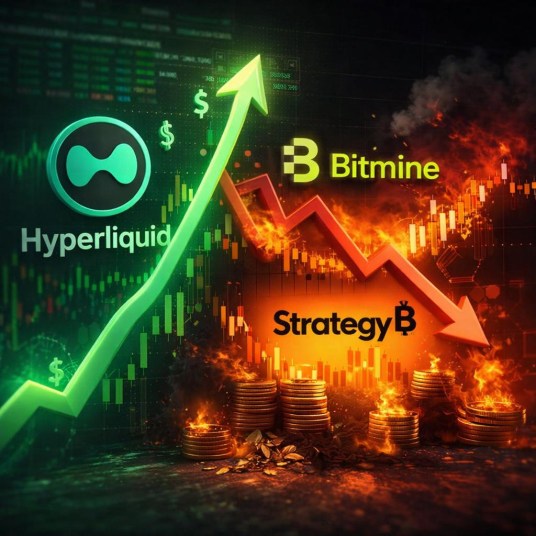
    Data from Artemis reveals that MicroStrategy and Bitmine are currently holding substantial unrealized losses, estimated at approximately $12.8 billion and $10.3 billion, respectively. Hyperliquid Strategies, however, presents a different financial picture.

    Artemis data further indicates that Hyperliquid Strategies stands as the sole major digital asset treasury company in the sector to remain in positive territory, boasting roughly $1.2 billion in unrealized gains, as illustrated in the accompanying chart.

    This divergence means that the financial strain observed across most crypto-linked balance sheets has not affected Hyperliquid to the same degree, even as prices experienced sharp contractions elsewhere. The market weakness has also impacted other significant public holders beyond the two leading companies. Lookonchain data shows that the recent retracement has widened, with SharpLink down $1.59 billion on ETH holdings and Metaplanet down $1.38 billion on BTC.

    The pattern is consistent: as BTC and ETH retrace, companies with concentrated holdings in these assets typically reflect the decline in their mark-to-market or unrealized reporting.

    Weekly BTC, ETH Pullback Hits MSTR, BMNR Stocks

    Bitcoin’s price action has been particularly noteworthy on a weekly basis. The cryptocurrency recorded a significant 20% retracement over the past week, a broader decline that has subsequently filtered down to equities and crypto proxies.

    MicroStrategy’s stock, MSTR, saw a 14% drop on Friday alone, trading around $115 per share. Bitmine’s stock, BMNR, also experienced double-digit losses on Friday, falling 12% to approximately $15.76 per share, adding to investor concerns.

    Hyperliquid’s native token, HYPE, also experienced a sharp decline during the same period, dropping 14%. Despite this pullback, Hyperliquid Strategies’ PURR token showed comparatively modest movement, with only a 1.2% retracement to $8.3 in the current trading session.

    These contrasting performances highlight a clear divergence: while MicroStrategy and Bitmine directly reflect the drawdown in BTC and ETH through substantial unrealized losses, Hyperliquid Strategies has maintained a comparative resilience, preserving positive unrealized performance even as the broader market experiences a sell-off.

  • ChatGPT’s Latest Prediction Disappoints XRP Holders

    ChatGPT’s Latest Prediction Disappoints XRP Holders

    The cryptocurrency market has experienced a dramatic downturn in recent weeks, far exceeding expectations from mid-May. Bitcoin (BTC) has fallen below the $60,000 mark for the first time since November 2024, while Ethereum (ETH) has plunged to a 14-month low. XRP has also succumbed to the selling pressure, dropping below critical support levels and reaching a 19-month low of under $1.10 on Friday.

    The immediate concern for XRP investors is whether the current support above the crucial psychological threshold of $1.00 will hold, or if the cross-border payment token is destined for a significant decline into the sub-dollar range.

    According to a new analysis from a prominent AI solution, the most probable initial bearish target for XRP, should it breach $1.00, is $0.90. This scenario appears increasingly likely given the prevailing market conditions. For context, Bitcoin’s recent dip below $60,000 marked its lowest point since before the U.S. elections in late 2024.

    Similarly, XRP has retreated to its lowest levels since that period in November 2024, currently trading below $1.10. Having broken through its last significant support at $1.00, this level is now under intense scrutiny, with a further downward move potentially testing it imminently.

    The AI model suggests that a drop to $0.90 would represent an additional 18%-20% decline for XRP and would likely be accompanied by continued weakness across the broader cryptocurrency market.

    However, the AI also outlined even more pessimistic scenarios should bullish sentiment completely evaporate. In a more extreme bearish outlook, XRP could fall to the $0.75-$0.80 range.

    A full capitulation scenario, while considered a “low-probability outcome,” envisions XRP dropping to $0.60. The AI platform noted that such a drastic decline would likely require a confluence of factors, including macroeconomic instability, a widespread crypto bear market, and the erosion of key positive narratives like ETF optimism and institutional adoption.

    Conversely, the AI also presented a more optimistic perspective, suggesting that XRP might be “approaching a point where conditions become favorable for a relief rally.” Drawing on historical data, particularly for previous Junes in U.S. midterm election years, the AI highlighted that “pessimism often preceded major recoveries.”

    Based on this, the AI outlined a potential for a swift rebound to $1.25 and even $1.40, contingent on buyers successfully defending the $1.05-$1.10 support region. The coming days, or even hours, will be crucial in determining whether this support holds.

  • XRP Price Plunge Risk: What Happens If $1 Support Fails?

    XRP Price Plunge Risk: What Happens If $1 Support Fails?

    XRP Begins June With Steepest Decline in Three Months

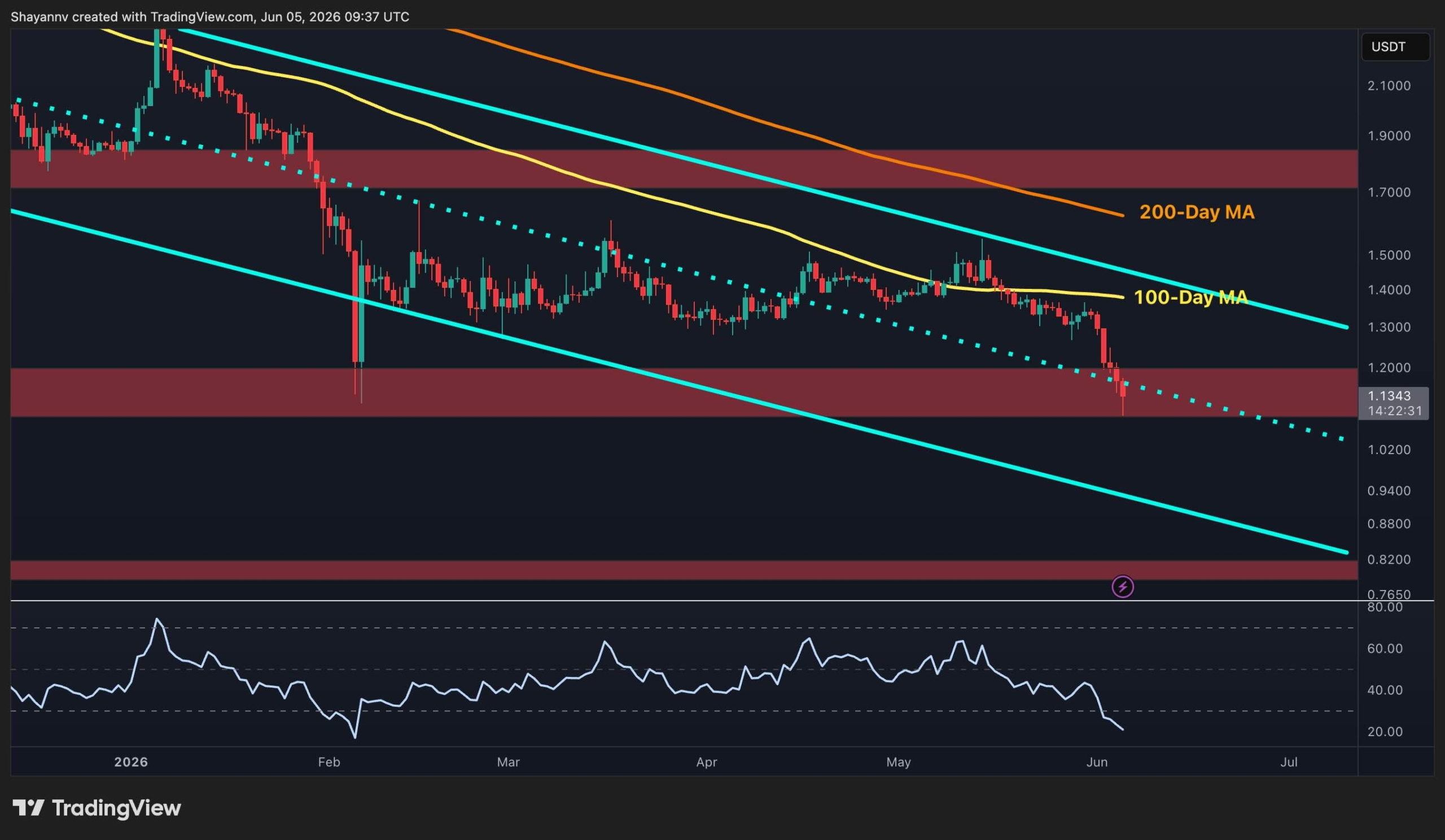
    XRP has opened June with its most significant price drop in the past three months, as the critical $1.20 support level, which had acted as a firm floor for months, is now being breached. The cryptocurrency is currently trading at $1.11. The Relative Strength Index (RSI) is also registering its lowest point since the capitulation seen in February, with the next significant support level appearing to be approximately $0.30 lower. Analysts suggest this is not merely a pullback from resistance but rather a breakdown of XRP’s last line of defense.

    On the USDT chart, the $1.20 support band, which proved resilient during the February market crash and had remained untouched since, is now on the verge of collapse. The RSI has similarly plummeted to around 20-25, nearing the oversold territory observed during the February capitulation low. This reading alone is noteworthy, as historically, RSI levels at this extreme have preceded at least a sharp relief bounce, even within a broader downtrend.

    However, an oversold RSI does not automatically signal that a bottom has been established. The $1.20 level is now likely to transition into resistance. For the current breakdown to be considered reversed rather than merely paused, any subsequent bounce would need to reclaim this level on a sustained closing basis.

    Below the current trading price, the next key structural reference point is the $0.80 demand zone. This area also aligns with the lower boundary of a descending channel, presenting a significant confluence of support, albeit at a considerably lower valuation. With the 100-day moving average at $1.35 and the 200-day moving average at $1.60 now both acting as substantial overhead resistance, the USDT-paired chart shows XRP facing considerable selling pressure above and limited structural support below.

    XRP/BTC Pair Shows Greater Resilience

    In contrast, the BTC pair is presenting a more robust picture. XRP/BTC is currently trading at 1,800 satoshis, holding above recent lows of 1,740 satoshis. The RSI, which had surged to 70 at the end of May, suggesting a potential shift in momentum, has since retreated to 50. This indicates that the brief period of strength has not translated into sustained buying pressure.

    The price is trading below the short-term resistance of 1,850 satoshis, having been rejected at this level once again. The declining 100-day moving average, situated around 1,900 satoshis, is acting as immediate dynamic overhead resistance. The fact that the XRP/BTC ratio has held its ground while the USDT pair has weakened suggests that XRP’s dollar-denominated weakness is partly attributable to broader altcoin selling pressure rather than a specific deterioration of XRP’s standing against Bitcoin.

    A confirmed close below 1,740 satoshis on the BTC pair, especially if it occurs concurrently with continued weakness in the USDT pair, would signify a definitive breakdown across both pairings. Such a scenario would expose the 1,500 satoshis area as the next significant level of support.

  • XRP Sentiment Sours: Divine Ray ICO’s Live Product Outshines Waiting

    XRP Price Faces Stagnation Amidst Institutional Accumulation and Shifting Crowd Sentiment

    XRP’s price saw a 3% dip last week, now trading within the $1.30 to $1.40 range, a situation that has proven frustrating for many holders. However, beneath the surface of this price stagnation, significant activity is unfolding. Institutions are reportedly making daily purchases, and Exchange Traded Fund (ETF) inflows continue to pour in. Concurrently, crowd sentiment has once again turned sharply negative.

    Divine Ray ICO Surpasses $100,000 on Launch Day

    In contrast, a cryptocurrency presale known as Divine Ray ($DCR) has achieved a notable milestone, raising over $100,000 on its opening day. Divine Ray distinguishes itself with a live social media application and its own proprietary blockchain.

    While XRP holders await a delayed breakout, Divine Ray presents a functional product and a $5 million valuation, a combination that analysts suggest is compelling.

    Analyst Predicts Bold XRP Targets Amidst Accumulation

    Crypto analyst Patel recently shared an updated XRP chart on a four-day timeframe. The analysis places XRP’s current trading price at $1.3607, situated firmly within a multi-year accumulation zone that spans roughly from $0.50 to $1.80.

    Patel has outlined ambitious long-term price targets for XRP, indicating potential upside levels of $5, $10, and even $15 per token. He attributes this optimistic outlook to sustained institutional buying, noting that these entities are not selling but are instead quietly increasing their holdings daily.

    Data supports this observation, with total net ETF inflows for XRP reaching $1.41 billion since their inception. Over the past 15 trading days alone, there have been $116.48 million in direct inflows. Outflow days have been infrequent, occurring on only 13 out of 193 days, meaning over 90% of trading days have seen net inflows. This suggests substantial capital accumulation by large investors while retail interest appears subdued. Patel characterizes this period as “the calm before the storm,” advising potential buyers to consider accumulating during significant market downturns within the $1 to $0.70 range.

    Crowd Sentiment Dips into “FUD Zone”

    Santiment’s latest data on XRP crowd sentiment reveals a significant shift, with the ratio of positive to negative commentary dropping to a mere 1.1 bullish comments for every bearish comment. This marks the highest level of crowd fear, uncertainty, and doubt (FUD) observed in three weeks. The sentiment ratio chart indicates a sharp decline into the “FUD Zone,” a region historically associated with price stabilization and subsequent bounces, as seen in late April and early May.

    Historically, such widespread fear and skepticism have served as a contrarian indicator for XRP’s price. When social media sentiment becomes excessively fearful, it often signifies that many less committed investors have already exited the market, thereby reducing selling pressure and creating conditions conducive to a rebound. Conversely, periods of extreme optimism, where the sentiment ratio enters the “FOMO Zone,” have often coincided with local price peaks due to widespread bullish positioning. Currently, the market’s position within the fear zone suggests a potentially opportune time for buying.

    XRP Price Prediction and Divine Ray’s Value Proposition

    Based on this data, an XRP price prediction suggests a potential bounce towards the $1.50 to $1.60 range in the coming weeks. Continued ETF inflows and sustained institutional demand could propel XRP above $1.60, potentially opening the path to $2.00 and beyond. However, even the most optimistic long-term targets of $5 to $15 per XRP, representing a 3x to 10x return over multiple years, are considered respectable but not necessarily life-changing for smaller investment portfolios.

    Divine Ray, on the other hand, offers a tangible product with its fully functional mobile social media application, available on both the Apple App Store and Google Play. This approach, launching a product before its token, is a rarity in the cryptocurrency space. Users can download the app, create an account, and begin using it immediately.

    The project is built on its own blockchain infrastructure, developed using the Cosmos SDK and integrated with the IBC network, granting Divine Ray complete control over its technology, scalability, and future ecosystem development. Divine Ray Coin ($DCR) is already trading on the Osmosis decentralized exchange, providing immediate liquidity and market validation from the presale’s inception.

    Divine Ray targets the expanding global consciousness and wellness economy, a sector encompassing meditation, yoga, retreats, spiritual content, and conscious communities. The platform aims to connect creators, retreat centers, events, and communities within a unified ecosystem. The $DCR token possesses multiple utilities, including memberships, advertising, NFT minting, creator rewards, and community growth incentives, each contributing to demand drivers within the platform’s social economy.

    The project’s initial valuation of approximately $5 million during Phase 1 of its ICO is considered exceptionally low compared to industry norms, where many projects launch with websites alone at valuations of $50 million or $100 million. Divine Ray’s existing live app, functional blockchain, and DEX listing present a significant valuation gap, offering potential for substantial returns.

    The $DCR presale is structured in four phases, with prices increasing incrementally. Phase 1 offers 400 billion DRC at $0.0000015 per token, with subsequent phases moving to $0.000002, $0.0000025, and $0.0000035. Phase 1 remains open, but its momentum, evidenced by exceeding $100,000 on day one, suggests it may not last. Divine Ray is positioned as a presale to watch this summer.