Tag: Negative

  • Recurring Cross-Chain Bridge Exploits Highlight Persistent Risks, Allbridge Core Latest Victim

    Recurring Cross-Chain Bridge Exploits Highlight Persistent Risks, Allbridge Core Latest Victim

    The recent security exploit on Allbridge Core, resulting in the loss of approximately $1.65 million in stablecoins, underscores a persistent and significant risk within the decentralized finance (DeFi) ecosystem: the vulnerability of cross-chain bridges. This incident is not an isolated event but rather the latest in a series of high-value exploits that have consistently targeted the infrastructure enabling asset transfer between different blockchains.

    Why This Matters

    The materials describe a narrow update: An attacker exploited Allbridge Core by manipulating stablecoin pool ratios through rapid USDC and USDT swaps, after obtaining a flash loan. The exact amount of funds returned by those who profited from arbitrage.

    Broader Context

    Source materials place the factual news in this context: Allbridge Core, suffered a security exploit that resulted in losses of approximately $1.65 million, according to blockchain security firm PeckShield.

    Allbridge Core Exploit: A Case Study

    According to blockchain security firm PeckShield, the attacker exploited Allbridge Core by manipulating stablecoin pool ratios through rapid USDC and USDT swaps. This was facilitated by a flash loan of $1.12 million in USDC obtained from Kamino on Solana. The attacker reportedly used these rapid swaps to distort the pool ratios, allowing them to withdraw liquidity at unfavorable rates before repaying the flash loan within the same transaction. Following the exploit, the stolen assets were moved through privacy protocols for mixing, according to Onchain Labs.

    In response to the security incident, Allbridge reported the exploit and paused its protocol as a precautionary measure while investigations were underway. The project also advised users with liquidity in affected pools to withdraw their funds immediately. Allbridge noted that the exploit created a temporary positive arbitrage opportunity due to the imbalance in the affected liquidity pools and requested that anyone who profited from this opportunity voluntarily return the funds, which would then be used to compensate liquidity providers.

    A History of Bridge Vulnerabilities

    The Allbridge Core exploit adds to a growing list of security breaches targeting cross-chain bridges, a critical component of the DeFi landscape. In April 2023, Allbridge itself experienced a similar incident on its BNB Chain protocol, resulting in a loss of approximately $573,000. In that exploit, attackers manipulated token swap prices, stealing about $289,900 in BUSD and $290,900 in USDT.

    These incidents are part of a broader trend. In April 2023, Syndicate Labs lost about $330,000 worth of SYND tokens due to a leaked private key that allowed an attacker to control its bridge contracts. The following month, the Verus-Ethereum bridge was exploited for over $11 million due to a contract failing to validate transactions properly, though most of the funds were later returned. In June 2023, attackers stole $1.7 million from one of Taiko’s bridge protocols.

    Underlying Risks and Future Outlook

    These recurring exploits highlight the inherent technical challenges and vulnerabilities associated with cross-chain bridge technology. The complexity of maintaining secure communication and asset custody across disparate blockchain networks presents a constant target for malicious actors. While the exact vulnerability in Allbridge Core’s smart contract is still under investigation, the pattern suggests systemic risks that require ongoing attention from developers and users alike.

    It remains uncertain whether the funds stolen from Allbridge Core will be recovered or if the attacker will be apprehended. The situation also leaves open questions about the specific amount of funds returned by those who profited from the arbitrage opportunity created by the exploit. The DeFi community continues to grapple with the implications of these persistent security failures, emphasizing the need for robust security audits, improved smart contract design, and increased user awareness regarding the risks associated with cross-chain interactions.

  • CLARITY Act Faces Senate Hurdles, Odds of Passage Drop Significantly

    CLARITY Act Faces Senate Hurdles, Odds of Passage Drop Significantly

    The CLARITY Act, a key piece of legislation designed to structure the cryptocurrency market, is currently stalled in the U.S. Senate, causing its perceived odds of passing to drop significantly. Prediction markets now place the bill’s chances at approximately 31%, a notable decrease from around 40% earlier this week and over 70% in May.

    The bill, which passed the House of Representatives a year ago with bipartisan support (294-134) and subsequently cleared the Senate Banking Committee in May, faces critical disagreements that are hindering its progress toward a full Senate vote. The CLARITY Act is currently listed as №423 on the Senate legislative calendar, but it requires at least 60 votes to pass.

    Key obstacles include demands from Senate Democrats for stricter language to prevent senior government officials from profiting from crypto businesses. Additionally, traditional banks have raised concerns regarding crypto platforms offering interest-like payments on stablecoin balances, fearing it could divert deposits from conventional lenders. White House meetings intended to resolve these disputes between banks and crypto representatives have so far failed to yield a breakthrough, despite a reported compromise in May. Even a recent meeting involving Donald Trump did not result in significant progress.

    The legislative path forward is complex. Senate leaders must first agree to bring the bill to the floor, and negotiators need to secure sufficient Democratic commitments to overcome the 60-vote threshold. Furthermore, the bill must reconcile language from both the Senate Banking Committee (overseeing the SEC) and the Senate Agriculture Committee (overseeing the CFTC) into a single package before it can be considered for a vote.

    The timing of these legislative efforts is also a factor. Supporters aim for the bill to pass before the Senate’s August recess. However, the upcoming November midterm elections loom large, potentially leading to significant shifts in congressional control, which could impact the bill’s future prospects. While passage in 2026 remains theoretically possible, current indicators suggest a challenging road ahead.

    Washington analysts suggest that the odds of the CLARITY Act passing may be even lower than the 31% indicated by prediction markets. The bill’s current status highlights the ongoing political and industry disputes that continue to shape the regulatory landscape for the cryptocurrency sector.

    Why This Matters

    The materials describe a narrow update: Despite passing the Senate Banking Committee and receiving support from some Democrats, the CLARITY Act is stalled in the Senate due to disagreements over restrictions on senior officials profiting from crypto and concerns from banks regarding stablecoin interest payments. Whether Senate leaders will agree to bring the bill to the floor.

    Broader Context

    Source materials place the factual news in this context: Donald Trump’s 2024 presidential campaign had a strong focus on the cryptocurrency industry.

  • ECB Flags Stablecoin Risk to Deposits, Outlines Digital Euro Safeguards

    ECB Flags Stablecoin Risk to Deposits, Outlines Digital Euro Safeguards

    The European Central Bank (ECB) has warned that the increasing adoption of stablecoins could lead to a significant drain of retail deposits from traditional European banks. Piero Cipollone, an ECB executive board member, stated that stablecoins, which allow users to hold and move money outside the banking system, pose a risk by potentially drawing away these crucial deposits. This concern follows a trend where mobile payment apps have already eroded bank revenues from fees and transaction data.

    Mobile payments have become increasingly prevalent, now exceeding one in ten point-of-sale transactions in Ireland, the Netherlands, and Finland. When customers use these services, banks often incur higher fees and lose valuable transaction data, impacting their revenue streams and business intelligence. Stablecoins, described as privately issued crypto tokens pegged 1:1 to a fiat currency, offer users a way to manage funds entirely outside of conventional banking infrastructure.

    The ECB’s proposed solution to this potential deposit drain is a digital euro. This digital currency is designed to be distributed through commercial banks, rather than replacing them. Safeguards are planned, including the digital euro paying no interest to discourage large holdings and implementing holding limits to cap the amount individuals can possess. The ECB’s financial stability analysis suggests this design poses no material risk to bank liquidity.

    Despite the ECB’s warnings and proposed measures, the stablecoin market continues to grow, with its global value estimated at approximately $300 billion. Critics remain unconvinced about the potential impact of a risk-free, government-backed digital wallet on bank deposits, suggesting it could drain them similarly to stablecoins. Legislative negotiations on the digital euro are currently underway, with a target deal anticipated by the end of 2026. A 12-month pilot program involving 36 payment providers is slated to begin in the second half of 2027, with the first issuance of the digital euro eyed for 2029.

    The potential loss of retail deposits could have significant consequences, particularly for smaller cooperative banks that rely on these deposits for lending to local businesses and homebuyers. For these institutions, a substantial reduction in deposits could present an existential challenge, rather than a mere accounting issue. The ECB’s efforts to navigate the evolving digital payment landscape aim to balance innovation with financial stability, though uncertainties remain regarding the ultimate impact of stablecoins and the effectiveness of the proposed digital euro.

    Why This Matters

    The materials describe a narrow update: An ECB executive board member, Piero Cipollone, stated that stablecoins, which allow users to hold and move money outside the banking system, pose a risk to banks by potentially drawing away retail deposits. The extent to which stablecoins will actually drain retail deposits from European banks.

    Broader Context

    Source materials place the factual news in this context: European banks are losing the payments war in installments.

  • Kimi K3 Sparks DeepSeek Stock Market Fears

    Kimi K3 Sparks DeepSeek Stock Market Fears

    China’s AI Leap Sparks Market Jitters

    Chinese artificial intelligence lab Moonshot AI has once again sent shockwaves through global markets with the late-night launch of its Kimi K3 model. The development triggered a significant sell-off in semiconductor and AI stocks on Friday, as investors reacted to what they perceive as China closing the technological gap.

    Market Sell-Off Across Sectors

    The impact was felt broadly, with Taiwan’s benchmark stock index plummeting over 6% and Japan’s market closing down 4%. In the United States, the Nasdaq Composite slid 1.5%, marking its worst trading session of the week.

    This reaction echoes the market’s response to DeepSeek’s R1 model release in January 2025. At that time, the assumption that cutting-edge AI required exorbitant spending and corresponding chip orders was challenged, leading to a dramatic drop in Nvidia’s market capitalization, which shed approximately $590 billion in a single trading session. This latest development, however, has seen the damage spread more widely across the entire sector.

    The VanEck Semiconductor ETF (SMH) fell below its exponential moving average (EMA) support band for the first time since April. This decline extends a rout that has pushed the ETF more than 20% below its record high reached in late June.

    Kimi K3 Performance and Accessibility

    On the Artificial Analysis Intelligence Index, a composite benchmark that evaluates model performance across reasoning, knowledge, mathematics, and coding, Kimi K3 achieved a score of 57. This places it ahead of Claude Opus 4.8 and GPT-5.5, and on par with Claude Fable 5 and OpenAI’s GPT-5.6 Sol. Notably, K3 outperformed these models in specific benchmarks while operating at a fraction of the cost.

    Further amplifying its impact, the full weights for K3 are scheduled for release on July 27 under a Modified MIT license. This open-source approach means the model will be available for free to smaller research labs.

    Analyst Perspectives

    Wall Street analysts largely anticipated this trend. Robin Zhu of Bernstein described the release as “confirmatory,” viewing it as another data point supporting a trend that has been building throughout the year. Gary Yu, an analyst at Morgan Stanley, characterized K3 as the product of steady, compounding progress rather than a sudden breakthrough. “K3 has received positive feedback globally, signaling an all-round catch-up of Chinese LLMs with U.S. leaders in model size, performance, and pricing,” Yu wrote.

    Bernstein’s Zhu echoed this sentiment, stating, “At a high level, K3 feels confirmatory of our views that (1) AI [state of the art] continues to evolve rapidly; and (2) China AI can continue to keep pace with global [state of the art], and take some share over time.”

    Moonshot AI’s Backing and Reach

    Moonshot AI is backed by Alibaba, which invested $1 billion in the company in 2024 at a valuation of $2.5 billion. The startup’s current valuation is estimated to be around $31.5 billion.

    As previously reported, Moonshot AI already has a more significant presence in U.S. developer communities than is widely recognized. Cursor’s Composer 2 was found to be running on Kimi K2.5 without disclosure, a fact later acknowledged by the Cursor team, which confirmed the use of the open-source base.

  • UK Men Jailed for Impersonating Police in $5.3 Million Cryptocurrency Fraud

    UK Men Jailed for Impersonating Police in $5.3 Million Cryptocurrency Fraud

    Three men have been sentenced in the UK for a sophisticated cryptocurrency fraud scheme, stealing approximately £4 million (over $5.3 million) from eight victims by impersonating police officers. The sentences were handed down on Thursday at Southwark Crown Court.

    The group operated by contacting victims, falsely claiming to be police officers investigating compromised cryptocurrency accounts. They persuaded individuals to transfer their digital assets to what they believed were secure police-controlled accounts. These were, in fact, fake accounts controlled by the fraudsters, who then laundered the stolen funds through a complex network.

    Anthony Ikenwe and Kevin Nwamma each received six-year sentences for conspiracy to commit fraud and five-year sentences for money laundering, to run concurrently. Hamza Bashir was sentenced to three years and nine months for fraud and three years for laundering, also to run concurrently.

    Victims began coming forward in January 2025, leading to arrests in November after officers raided seven addresses across London and Essex. The Metropolitan Police’s Cryptocurrency Team investigated the case using a data-driven approach. By piecing together blockchain transactions, exchange records, communications, financial records, and internet service provider data, investigators linked what initially appeared to be separate crimes into a single organized network operating across multiple platforms and jurisdictions.

    Detectives discovered the men were living lifestyles far exceeding their declared incomes. For instance, one individual had a recorded annual income of just £444, yet the group purchased a car worth nearly £60,000 with cryptocurrency. They also kept around £500,000 in cash in a safety deposit box in Dubai and funded holidays to destinations including Thailand, Japan, Paris, Mykonos, the Maldives, and the Seychelles. Purchases at luxury retailers such as Harrods, Hermès, and Louis Vuitton were also noted, with crypto routinely converted into prepaid payment cards, according to the Met.

    Officers linked more than £1 million in cryptocurrency to wallets controlled by Ikenwe and traced stolen funds flowing into bank accounts associated with Nwamma’s luxury chauffeur business. Recovered luxury goods were valued at over £26,000.

    Ikenwe and Nwamma pleaded guilty in April, while Bashir changed his plea to guilty on the eighth day of his trial. The Metropolitan Police stated that they are continuing to work with UK and international partners to identify other individuals linked to the conspiracy and to recover assets for the victims. Around £1 million in crypto linked to victims has been recovered so far.

    This case highlights a recurring trend in cryptocurrency crime where criminals impersonate law enforcement. Similar scams have been reported, including one last year where a scammer posing as UK police stole $2.8 million in Bitcoin. In the US, fraudsters have posed as Denver police, and in France, robbers dressed as police carried out a $1 million Bitcoin robbery. In Ukraine, men posing as police were arrested for extorting $250,000 in Tether.

    “Criminals should be under no illusion that policing is evolving alongside technology,” said Detective Inspector Geoff Donoghue. The Metropolitan Police’s investigation demonstrates their adaptation to combating complex financial crimes through sophisticated data analysis. However, uncertainties remain regarding the full extent of the laundering network and the total value of assets that can ultimately be recovered for the victims.

    Why This Matters

    This case underscores the evolving tactics of cybercriminals who impersonate law enforcement to defraud victims of digital assets. The Metropolitan Police’s data-driven investigation demonstrates their adaptation to combating complex financial crimes, highlighting the ongoing technological race between criminals and law enforcement. The approximately £4 million ($5.3 million) stolen from eight victims represents a significant financial impact, emphasizing the need for public vigilance against sophisticated impersonation scams.

    Broader Context

    Impersonating police has become a recurring thread in crypto crime, with similar incidents reported globally. This case is part of a broader trend where criminals leverage the authority of law enforcement to exploit individuals’ trust in digital asset security.

  • XRP Momentum Falters, Sub-$1 Drop Looms

    XRP Momentum Falters, Sub-$1 Drop Looms

    XRP Faces Persistent Selling Pressure, With Bitcoin Pair Showing Significant Weakness

    XRP is currently under pressure across both its USDT and BTC trading pairs, with the broader market structure continuing to favor sellers. While the token has managed to find some stability above immediate support on its dollar chart, its Bitcoin counterpart is consistently printing lower highs and lower lows, underscoring its ongoing relative weakness.

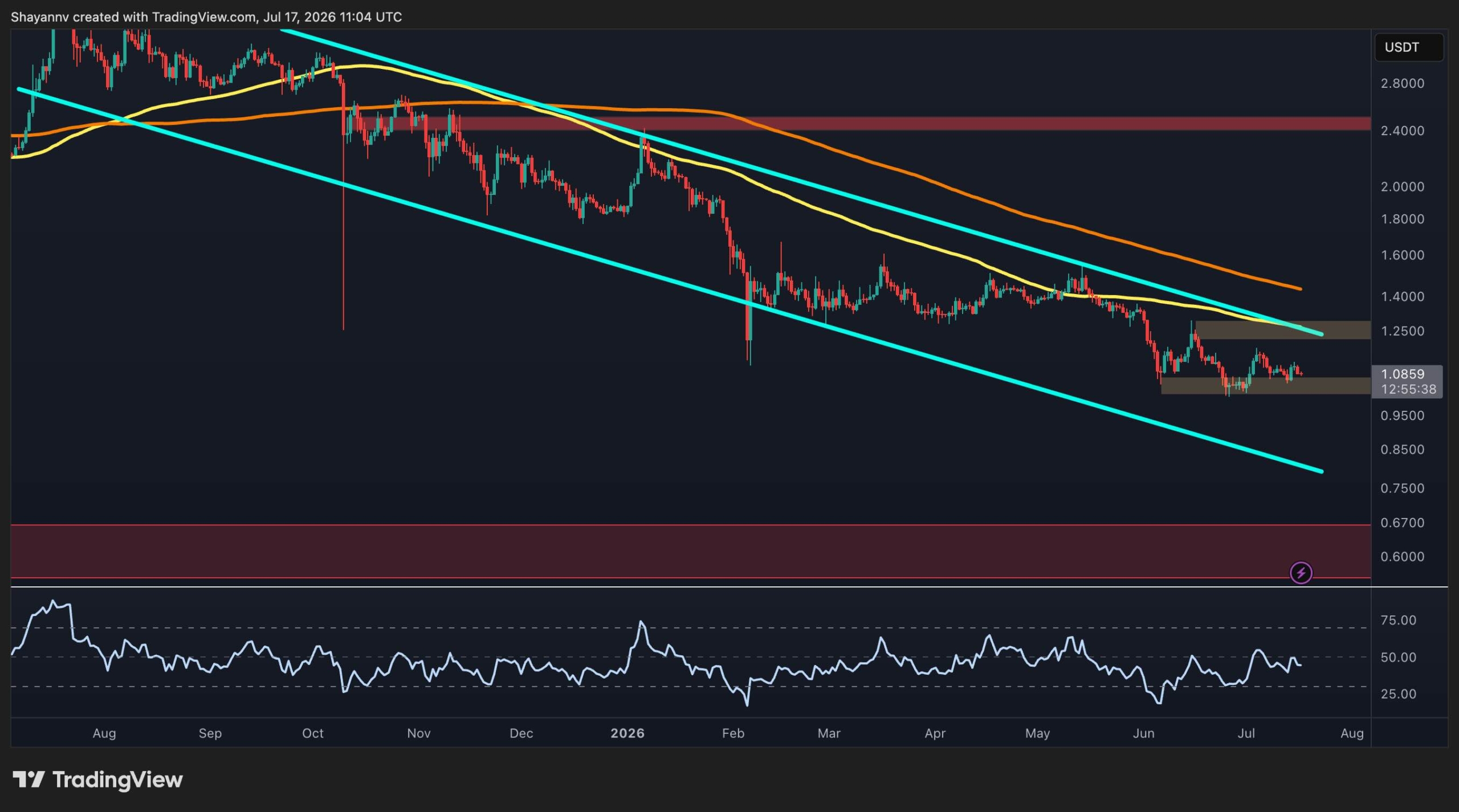
    On the daily chart, XRP is trading around $1.08 following an extended decline within a clearly defined descending channel. Although the asset has recently moved sideways rather than continuing its downward trajectory, the overall trend remains bearish. XRP is trading below both its 100-day and 200-day moving averages, both of which are also sloping downwards, reinforcing the prevailing negative momentum.

    Since a significant breakdown in June, XRP has established a consolidation range between the $1 support zone and the $1.25 resistance area. Buyers have repeatedly defended the lower boundary, but every attempt at recovery has been rejected before reclaiming the declining 100-day moving average or breaking above the channel’s upper boundary. This indicates that bullish momentum remains constrained.

    A breakout above the $1.25 resistance would be the first indication that buyers are regaining control and could open the path towards the descending channel’s upper boundary, which represents the next major hurdle. Until then, the broader structure continues to suggest further downside, with a loss of the $1 support potentially leading to significantly lower demand zones.

    The Relative Strength Index (RSI) is hovering near the neutral 50 level, reflecting a current balance between buyers and sellers after weeks of intense selling pressure. However, without a decisive bullish breakout, the indicator does not yet signal a meaningful shift in the trend.

    XRP/BTC Pair Shows Deeper Weakness

    The XRP/BTC daily chart presents an even more concerning picture. The pair has been confined within a long-term descending channel for nearly a year, consistently trading below both the 100-day and 200-day moving averages, highlighting sustained underperformance against Bitcoin.

    Following several unsuccessful recovery attempts in May and June, XRP/BTC has now fallen below the crucial horizontal support level of approximately 1,720 satoshis. This level had previously attracted buyers multiple times over recent months, but each rebound has resulted in another lower high, signaling that selling pressure continues to dominate.

    On the upside, the next significant resistance is located around the 1,850 satoshis region, where previous support has now transitioned into resistance. A move above this area would improve the short-term outlook, but the descending channel and the 200-day moving average, currently near 2,000 satoshis, remain the primary obstacles to a broader trend reversal.

    Meanwhile, the RSI remains below the midpoint, suggesting that momentum still favors sellers. Unless XRP/BTC can reclaim key resistance levels and break its long-standing bearish structure, the pair appears vulnerable to another test of the channel’s lower boundary, which is now situated around 1,500 satoshis.

  • XRP ETF Inflows Plummet Amidst Declining Institutional Demand and On-Chain Activity

    XRP ETF Inflows Plummet Amidst Declining Institutional Demand and On-Chain Activity

    XRP ETF Inflows Plummet as Institutional Demand and On-Chain Activity Decline

    U.S. spot Ripple XRP exchange-traded funds (ETFs) recorded a meager $107,000 in inflows on July 10, a figure that pales in comparison to the over $100 million absorbed by the product complex just two months prior.

    The total assets under management (AUM) for the seven XRP funds have now dipped below $1 billion, settling around $996 million. This marks the end of what had appeared to be a sustained period of institutional accumulation within the current cryptocurrency ETF cycle.

    The stark data raises a critical question: has institutional appetite for XRP cooled, or is this the beginning of a more significant withdrawal? The answer holds direct implications for XRP’s price, which has managed to remain above $1 despite a simultaneous drying up of both retail and institutional demand.

    The decline in crypto ETF flows for Ripple XRP has been remarkably swift. In May, the product complex saw inflows exceeding $100 million for the entire month, with consistent weekly additions. July, however, presents a starkly different picture. Several days this month have registered zero inflows, and July 8 alone saw net outflows of $7.29 million, one of the largest single-day losses since March.

    While the pace of accumulation has decelerated from a steady climb to a near standstill in just six weeks, the concentration of July’s outflows within a single issuer suggests this may be driven by fund-specific redemption pressures rather than a broad, coordinated institutional exit. This distinction is crucial as July’s flow data continues to develop.

    Meanwhile, Ripple’s RLUSD stablecoin is already facilitating approximately $2.5 billion in volume on the XRP Ledger, and around $4 billion in tokenized real-world assets are now active on the network. The ledger’s upcoming major upgrade will introduce native lending capabilities, and an Ethereum-compatible sidechain is already operational. If these use cases can generate sustained on-chain demand, measured by active addresses and new wallet growth rather than just volume figures, the network activity landscape could shift, potentially drawing ETF demand back into an accumulation phase.

    However, if these catalysts fail to gain traction, XRP may continue to drift sideways, supported by its large-holder base as institutional allocators await clearer signals before increasing their positions. The bearish scenario for XRP’s price is not a sudden collapse, but rather a prolonged period of stagnation where the support from cold storage gradually erodes if persistent ETF outflows signal a fundamental shift in institutional conviction rather than a temporary pause.

    The broader cryptocurrency ETF flow environment also plays a role. A reacceleration of Bitcoin ETF inflows and an improvement in macro risk appetite could lead to renewed inflows for XRP ETFs as institutional capital rotates back into the market.

    The July data serves as a significant warning sign, but it is one data point within a product complex that has cumulatively attracted nearly $1.5 billion in inflows since its launch. Institutional patience has been evident, but whether it can withstand another month of sub-$1.10 prices and dormant on-chain metrics remains to be seen as July’s remaining flow data unfolds.

  • Bybit Alpha: Token Delisting – July 16, 2026

    Bybit Alpha: Token Delisting – July 16, 2026

    Bybit to Delist OPG Token, Offering Users Conversion Options

    Bybit announced that it will be delisting the OPG token from its Bybit Alpha platform, with the cryptocurrency no longer supported moving forward.

    Delisting Details

    The delisted asset is OPG, with the contract address 0x45db70e1c808dae42f9c4dfea74ba5e6a113bdc1.

    Sell/Convert Period

    Holders of OPG tokens will have until July 23, 2026, at 8:00 AM UTC, to sell their holdings. During this period, users can also convert their OPG into supported settlement currencies, including USDT, USDC, SOL, or bbSOL, through Bybit Alpha.

    Automatic Liquidation

    After July 30, 2026, at 8:00 AM UTC, any remaining OPG holdings will be automatically liquidated. The assets will be sold in the following order of priority: USDT, USDC, SOL, and then bbSOL. The execution time and final settlement price will be contingent on on-chain liquidity, and a 0.5% liquidation fee will be applied.

    Important Considerations

    Assets acquired on Bybit Alpha are not eligible for withdrawal and can only be sold into the specified supported settlement currencies. To mitigate potential losses stemming from liquidity or price volatility, Bybit strongly advises users to sell their affected assets before the established deadline. Following automatic liquidation, any proceeds will be credited to users’ Unified Trading Accounts.

    Risk Disclosure

    Trading cryptocurrencies carries substantial risk and may lead to the loss of invested capital. Users are urged to ensure they fully comprehend the inherent risks, consider their experience level and investment objectives, and seek independent financial advice if necessary. Bybit disclaims any liability or responsibility for losses incurred through trading on its platform.

  • DeFi Suffers $18M Loss in Ostium Oracle Attack

    DeFi Suffers $18M Loss in Ostium Oracle Attack

    Ostium, a decentralized perpetuals exchange built on Arbitrum, suffered an estimated $18 million loss on Wednesday after attackers compromised an oracle signer key. The exploit allowed malicious actors to manipulate the platform’s price feed, generating fake trading profits and draining funds from Ostium’s liquidity vault.

    Attack Details

    Blockchain security firm Blockaid reported that the attacker utilized a registered PriceUpKeep forwarder and future-dated authorized oracle reports to create artificial trading profits. This manipulation triggered a multi-million dollar payout in the form of USDC, a stablecoin issued by Circle, from Ostium’s liquidity pool.

    Ostium acknowledged the issue on X, stating, “We are aware of the issue with the OLP vault. We have paused all trading. The team is investigating.”

    Ostium Protocol and Impact

    Ostium offers perpetual futures tied to real-world assets, including stocks, commodities, foreign exchange markets, and indices. Operating as a decentralized exchange (DEX), it allows users to maintain control over their funds and typically does not require personally identifiable information. At the time of the attack, the protocol held approximately $63 million in total value locked. The exploit effectively drained nearly one-third of its liquidity.

    Broader DeFi Security Concerns

    This incident occurs amidst a challenging year for decentralized finance (DeFi) exploits. DeFi refers to financial applications built on blockchain networks that operate without traditional intermediaries like banks. In the first five months of 2026 alone, over $840 million was stolen from DeFi protocols. Notable incidents include $292 million stolen from KelpDAO and $285 million from Drift Protocol. Resolv Labs also fell victim in June, with hackers stealing over $25 million.

    AI’s Role in Exploits

    Security experts are increasingly warning that advancements in artificial intelligence are accelerating the discovery of vulnerabilities. Danny Jenkins, CEO and co-founder of ThreatLocker, previously told Decrypt that AI systems are significantly more adept at reviewing code and identifying potential flaws than many human analysts. He noted that current AI is already speeding up vulnerability discovery, and newer models like Mythos could dramatically enhance these capabilities, posing a significant future challenge.

    “It will be only a matter of time until someone bad gets access to it,” Jenkins stated.

    The increasing effectiveness of frontier AI models in identifying complex software flaws was underscored in May when security researcher Taylor Hornby used Anthropic’s Claude Opus 4.8 to uncover a four-year-old counterfeiting vulnerability in Zcash.

  • Ogle Warns of Meme Coin Collapse Risk: Concentrated Ownership and Low Liquidity Highlighted

    Ogle Warns of Meme Coin Collapse Risk: Concentrated Ownership and Low Liquidity Highlighted

    A crypto veteran, identified as Ogle, has issued a warning regarding the inherent volatility and potential for rapid collapse in small meme coins, particularly those with low liquidity. According to Ogle, concentrated ownership and the possibility of a few large holders selling off their stakes can lead to swift and dramatic price drops. Ogle explained on July 13 that “paper gains can disappear really fast when leverage, thin markets, and concentrated ownership collide.” He elaborated that if even a small number of significant holders decide to sell, especially in coins with limited trading volume, the price can plummet quickly. “If even two or three of these traders were to sell, it would trigger a major price drop, especially for smaller meme coins,” he stated.

    The meme coin CASHCAT, built on the Robinhood Chain, serves as a recent illustration of this phenomenon. Data indicates that CASHCAT experienced a surge of over 3,200% in the past week, reaching an all-time high (ATH) of $0.2288 and a market cap of approximately $226 million about a day ago. During this period, one trader reportedly turned an initial investment of around $838 into over $1 million in profit.

    However, the situation for CASHCAT took a sharp turn following the launch of a perpetual contract on Hyperliquid. Shortly after reaching its ATH, the coin’s value crashed by approximately 60%. This downturn coincided with the liquidation of about 90% of long positions. At the time of writing, CASHCAT was trading below $0.16, representing an over 18% dip in 24 hours and more than 30% below its ATH.

    Ogle, who is an advisor for World Liberty Financial, noted that while meme coins can offer quick returns, his own trading experience has yielded the most significant gains from utility-focused assets such as Solana, BNB, Ethereum, Litecoin, and Bitcoin. He described these as “slower plays that require patience,” suggesting that many traders may lose interest before these assets can deliver larger returns.

    The risk associated with meme coins is amplified when they are listed on perpetual futures exchanges. These platforms allow traders to use leverage, borrowing funds to place larger bets. When a price decline occurs, especially in a low-liquidity market, these leveraged positions can be rapidly liquidated, further accelerating the sell-off and price crash.

    Ogle’s warning highlights the critical interplay of concentrated ownership, low liquidity, and leverage in the meme coin market. While the allure of rapid gains is strong, the potential for equally rapid and substantial losses remains a significant concern for investors in this highly speculative sector. The CASHCAT incident underscores the fragility of such assets and the importance of understanding these underlying market mechanics.

    Why This Matters

    The materials describe a narrow update: A crypto trader named Ogle issued a warning about the inherent volatility and risk of collapse in small meme coins. The exact number of large holders who sold CASHCAT.

    Broader Context

    Source materials place the factual news in this context: The article is from CryptoPotato.