Tag: Negative

  • Senate’s CLARITY Act Faces Diminishing Odds as August Deadline Looms

    Senate’s CLARITY Act Faces Diminishing Odds as August Deadline Looms

    CLARITY Act Faces Diminishing Odds as Senate Deadline Looms

    New York, NY – The path for the CLARITY Act, the landmark cryptocurrency regulation bill before Congress, is narrowing significantly in the Senate, according to a Monday warning from Jefferies analyst Andrew Moss and his team. Their assessment, based on Polymarket odds, suggests the probability of the bill’s passage by the end of 2026 has fallen to 48%, a sharp decline from 70% in mid-May.

    Jefferies is now flagging increased near-term volatility for both cryptocurrency tokens and blockchain-related equities, as the legislative outcome appears to be crystallizing into a binary event.

    The dip in prediction market confidence stems from three converging pressures: unresolved ethical provisions, ongoing disputes over language concerning illicit finance, and a Senate calendar that offers approximately 20 legislative days before the August recess.

    Legislative Hurdles Mount

    “Missing this window means the market structure bill doesn’t simply get rescheduled; it gets repriced entirely,” Moss and his colleagues stated in their note. “Failure to pass Clarity before the August recess could push the bill out to next year, or even later, if Democrats flip the Senate in November.”

    Jefferies specifically identified Coinbase (COIN), Circle (CRCL), and Bullish (BLSH) as the crypto-linked equities most susceptible to legislative-driven market swings, in addition to certain digital tokens.

    The CLARITY Act did clear the Senate Banking Committee on May 14 with a bipartisan 15-9 vote, including all Republican members and two Democrats, signaling initial momentum. However, the subsequent procedural hurdles present a more formidable challenge.

    Before a full Senate vote can occur, lawmakers must reconcile two distinct committee-passed versions: the Banking Committee’s bill and the Senate Agriculture Committee’s Digital Commodity Intermediaries Act. This merged text then needs to be aligned with the House-passed H.R. 3633 (which was approved 294-134 in July 2025) and subsequently clear a 60-vote cloture threshold to overcome a potential filibuster.

    These four distinct procedural gates are compressed into roughly 20 legislative working days before the recess. The Banking and Agriculture versions, for instance, contain substantively different approaches to the Commodity Futures Trading Commission’s (CFTC) jurisdiction over digital commodities, and no merged text has been publicly released as of late June.

    Contentious Provisions and Shifting Political Landscape

    Adding to the complexity, ethics provisions attached during committee markup have not yet achieved consensus. Some senators advocate for their removal, while others consider them non-negotiable. Furthermore, law enforcement agencies have voiced objections to specific language regarding decentralized finance (DeFi) exemptions, introducing another variable that could impede floor scheduling.

    JPMorgan issued a similar warning earlier in June, cautioning that the crypto market structure bill might have a limited window for passage this year due to the tightening congressional calendar ahead of the midterm elections.

    The debate surrounding stablecoin yields, which Standard Chartered estimates could redirect up to $500 billion in deposits if resolved favorably, remains an open issue complicating any rushed compromise. Should the bill extend beyond August, it would re-enter a Senate environment potentially reshaped by the November elections. A Democratic majority in the Senate could significantly alter the calculus for securing the necessary 60 votes.

    Equity Exposure and Long-Term Clarity

    While not the first sell-side warning regarding the timeline, the 22-point drop in Polymarket odds since mid-May provides stronger backing for Jefferies’ assessment than previous analyst commentary. Alex Thorn of Galaxy Digital had previously lowered his firm’s passage probability from 60% to 50% on June 26, citing calendar compression as the primary driver. Jefferies’ current position below that level suggests a growing consensus on the street for sub-50% odds as the base case.

    The Jefferies note distinguishes itself by offering equity-specific granularity. For Coinbase, the exposure is direct, as its product suite, including staking, lending, and rewards on USDC holdings, operates within regulatory gray areas that the CLARITY Act would either legitimize or restrict. A delay preserves current ambiguity but also maintains enforcement risk, particularly given the Securities and Exchange Commission’s (SEC) demonstrated willingness to act on custody and yield products.

    For Circle, the situation presents a more nuanced picture. The current bill text reportedly aims to close a loophole that allows third parties like Coinbase to offer rewards on USDC, potentially impacting USDC’s growth metrics. However, a delay would grant Circle more time to diversify its revenue streams beyond stablecoin reserve income before such a provision takes effect.

    A critical detail often overlooked is the asymmetry in the delay scenario. Recent guidance from the SEC, CFTC, and OCC has improved the near-term operating environment for institutional crypto participants. However, Jefferies emphasizes that agency guidance is reversible. A future administration could revoke no-action letters and staff bulletins without legislative action. The CLARITY Act, conversely, would establish durable statutory clarity that agencies cannot unilaterally dismantle, a distinction that makes the bill significant beyond a single news cycle.


  • Goliath Ventures CEO Admits to $250M Crypto Ponzi Scheme

    Goliath Ventures CEO Admits to $250M Crypto Ponzi Scheme

    Crypto Firm CEO Pleads Guilty to Fraud, Spent Millions on Mansions and Supercars

    The president and CEO of cryptocurrency firm Goliath Ventures has pleaded guilty to fraud, admitting to defrauding investors of hundreds of millions of dollars and using the funds for a lavish personal lifestyle, including the purchase of luxury homes and high-end vehicles.

    Christopher Alexander Delgado, 34, entered his guilty plea on Tuesday to charges of conspiracy to commit wire fraud, wire fraud, and money laundering. The U.S. Attorney’s Office for the Middle District of Florida announced the development in a statement.

    A Ponzi Scheme Unraveled

    Prosecutors allege that from at least January 2023 through January 2026, Delgado and his associates operated Goliath Ventures, previously known as Gen-Z Venture Firm, as a Ponzi scheme. The firm allegedly enticed investors with false promises of substantial monthly returns derived from cryptocurrency “liquidity pools.”

    Instead of making legitimate investments, the funds from new investors were reportedly used to pay off earlier investors. A significant portion of the money also financed Delgado’s extravagant lifestyle, including “extravagant business gatherings, holiday parties, luxury travel accommodations,” and personal expenditures.

    Extravagant Spending Revealed

    According to the plea agreement, Delgado used investor funds to acquire at least six properties valued between $1.15 million and $8.5 million each. His purchases also included Lamborghinis, Rolls-Royces, Rolex watches, numerous Louis Vuitton bags, and custom Tiffany jewelry. A related civil forfeiture action has identified at least $400 million paid in by investors, with Delgado admitting to causing a minimum of $250 million in losses.

    “Delgado provided fraudulent information to solicit investor funds and then spent his ill-gotten gains on his extravagant lifestyle,” U.S. Attorney Gregory W. Kehoe stated.

    Forfeiture and Sentencing

    Delgado has agreed to forfeit eight properties, 11 vehicles, 30 watches, over 50 luxury bags and wallets, and at least 29 pieces of jewelry, in addition to seized bank and cryptocurrency accounts. He faces a maximum of 20 years in prison for each fraud count and 10 years for money laundering. Sentencing is scheduled for October 8. The investigation was conducted by IRS Criminal Investigation and Homeland Security Investigations.

    Delgado was initially arrested in February in a case initially valued at $328 million. Investigators found that only approximately $1.5 million of investor money had reached a decentralized exchange, Uniswap. The fallout from the scheme has continued to draw in other parties. In March, a victim filed a lawsuit against JPMorgan Chase, alleging the bank failed to uphold its “know your customer” obligations by allowing Goliath to maintain an account. The complaint notably referenced comments made by JPMorgan CEO Jamie Dimon, who previously described Bitcoin as “a decentralized Ponzi scheme.”

  • Bitfinex Analysts: Bitcoin May Drop to $40,000 Before Reaching Bottom

    Bitfinex Analysts: Bitcoin May Drop to $40,000 Before Reaching Bottom

    Bitcoin May Plunge to $40,000s Before Hitting Bottom, Bitfinex Analysts Say

    Bitcoin (BTC) has further to fall before reaching its trough in the current bear cycle, according to an analysis of on-chain indicators by researchers at the crypto exchange Bitfinex.

    The latest Bitfinex Alpha report suggests that the leading digital asset could see further declines into the $40,000 range by the end of the year as more investors exit the spot market.

    Historically, BTC has experienced declines of at least 70% from its all-time highs (ATHs) before finding a bottom and beginning to recover. During the 2022 bear market, BTC dropped 78% from its peak of $69,000, and in 2018, it plummeted 86% from cycle highs near $20,000.

    Based on these historical drawdown patterns and the typical timeframes between market peaks and troughs, analysts anticipate BTC’s current decline could extend into the $40,000s. The asset is currently down 53.9% from its ATH of $126,000. A drop into the $40,000s would represent a decline of at least 68%. Furthermore, if cycle estimates incorporate price movements relative to moving averages, analysts believe BTC could reach its bear-cycle bottom in the fourth quarter of 2026.

    Despite the asset’s floor giving way over the weekend, analysts maintain that BTC’s structural levels remain unchanged. At the time of reporting, with the coin trading near $60,000, it is positioned below the True Market Mean of $77,000, which represents the average cost basis for active investors. This level also acts as a dividing line between bullish and bearish market conditions, indicating that bitcoin’s price action will likely continue to be dictated by a structural bear market environment.

    Last week, after breaking below the $61,500 support level and hitting a new bear cycle low of $58,136, the key support level to monitor is now $53,400. The move towards $58,000 signals weakening spot demand, evidenced by selling from short-term holders, outflows from exchange-traded funds (ETFs), the collapse of the digital asset treasury channel, and negative gamma pressure.

    Notably, unlike previous downturns, bitcoin’s fall below $60,000 last week did not involve large-scale liquidations or significant fluctuations in open interest. This suggests the decline was a structural exodus from spot markets rather than a forced deleveraging event. With the market’s primary demand driver absent, bitcoin’s price is expected to remain weak and continue its downward trend in the coming weeks.

    “The market awaits a resurgence of spot demand to establish a floor and potentially turn higher,” the analysts explained.

  • BIP-110 Critics Warn of Self-Custody Risks, Fund Exposure

    BIP-110 Critics Warn of Self-Custody Risks, Fund Exposure

    Critics Warn Bitcoin Upgrade Could Render Funds Unspendable

    A contentious debate surrounding Bitcoin’s proposed BIP-110 soft fork has escalated, with critics arguing that the upgrade could destabilize certain wallets and potentially render some users’ Bitcoin permanently inaccessible if implemented.

    The concerns were raised by crypto investment advisor Farside Investors, who challenged assertions made by BIP-110 proponent Fred Krueger in a recent social media post. Krueger had claimed that BIP-110 would preserve Bitcoin’s core monetary properties, leaving its 21 million coin supply, proof-of-work consensus, Lightning Network functionality, multisig wallets, self-custody capabilities, and address formats unchanged.

    “The primary effect is that large arbitrary data used by Ordinals, Runes, and similar protocols would no longer be valid,” Krueger stated.

    Farside Investors, however, disputed this assessment. They contend that BIP-110 would effectively ban several Taproot scripting features, including the OP_IF opcode, which is utilized by Miniscript. According to Farside’s explanation, following the fork, wallets supporting Miniscript would still permit users to create and send funds to addresses constructed using these now-prohibited scripts. While such transactions would appear valid under BIP-110’s own rules, the Bitcoin sent to these addresses would become unspendable, as the necessary conditions for spending would no longer be recognized under the new consensus rules.

    Ironically, the latest version of Bitcoin Knots, a node implementation that supports BIP-110, could itself generate these incompatible addresses, Farside pointed out.

    Furthermore, Farside highlighted that BIP-110 would also prohibit the creation of new pay-to-public-key (P2PK) outputs. This script type was widely used in Bitcoin’s early days and currently holds over 1.7 million BTC. While spending existing P2PK outputs would remain permissible, Farside noted that under certain circumstances, the proposal could lead to temporary fund freezes or expose users to theft risks, despite incorporating safeguards like grandfathering older outputs and limiting enforcement to approximately one year.

    The proposal is set to activate if 55% of miners signal their support during a difficulty adjustment period. Alternatively, if this threshold is not met, activation could occur through a mandatory signaling process commencing at block 961,632, which is anticipated in August 2026.

    The dispute over BIP-110 is emblematic of a broader disagreement regarding network congestion on Bitcoin. Krueger and his supporters argue that inscriptions, BRC-20 tokens, and similar applications have created unnecessary bloat on the network, and BIP-110 offers a method to discourage such transactions without altering Bitcoin’s fundamental monetary policy.

    Conversely, other voices, including the Block Runner podcast account, have rejected this rationale. They emphasize that the 126.7 million inscriptions on Bitcoin represent a mere 1.267 BTC in value, a negligible amount they likened to a coin lost at sea. According to this perspective, miners who profit from this activity, such as AntPool, ViaBTC, SpiderPool, F2Pool, and Luxor, are actually contributing to offsetting Bitcoin’s diminishing security budget. They also point out that BIP-110 itself has garnered only limited support from miners and nodes.

    Despite the ongoing debate, network activity has remained robust, largely unaffected by price fluctuations. Recent data from CryptoQuant indicates that usage levels have been near record highs, even as Bitcoin’s price dipped below $60,000, suggesting that demand for blockspace, regardless of the controversy, is unlikely to wane in the near future.

  • British Investors Sue Binance, Changpeng Zhao for $200M

    British Investors Sue Binance, Changpeng Zhao for $200M

    Binance Faces $200 Million Lawsuit in U.K. Over Alleged Unregulated Products

    Global cryptocurrency exchange Binance and its founder, Changpeng “CZ” Zhao, are facing a lawsuit in the United Kingdom seeking approximately $200 million (£150 million), according to a Reuters report.

    The legal action alleges that Binance offered complex and high-risk financial instruments, such as leveraged trading products, without the necessary regulatory approval. The lawsuit reportedly involves close to 1,700 claimants, some of whom allegedly lost tens of thousands of dollars when these products were available in late 2019.

    “Binance remains committed to its obligations to users and to operating in accordance with applicable law,” a spokesperson for the firm told Reuters, adding that the company intends to defend itself against the suit. A representative for the exchange did not immediately respond to a request for comment.

    While claimants had access to these derivative products in late 2019, the U.K. Financial Conduct Authority (FCA) announced a ban on crypto derivatives for retail customers in October 2020, deeming such advanced trading products “ill-suited” for this demographic. This ban took effect in January 2021.

    A recent overview of the regulator’s crypto policy, published on Tuesday, indicated that the FCA has lifted its ban on retail access to certain exchange-traded notes (ETNs) but is continuing to review its stance on retail access to derivatives. The regulator reiterated that “Cryptoassets are high risk investments and will remain high risk under our regime.”

    Meanwhile, Binance, the world’s largest crypto exchange by trading volume, is also navigating regulatory challenges in Europe. Last week, the company formally withdrew its Markets in Crypto Assets (MiCA) application from Greece, a week after Reuters reported that the application was likely to be denied.

    A MiCA license is crucial for firms seeking to offer crypto services across European Union member states starting July 1. Without such a license, Binance will be unable to operate its services in the region. Following its withdrawal from Greece, Binance stated its intention to apply for a license in another EU member nation, though it has not yet specified which country.

  • Michigan Bans Kalshi Sports Markets

    Michigan Bans Kalshi Sports Markets

    Kalshi Blocks Michigan Users from Sports Wagers After Court Ruling

    Kalshi has blocked all users in Michigan from accessing sports-related wagers, following a significant ruling against the prediction market platform in state court.

    On Monday, a circuit court judge in Ingham County issued a temporary restraining order, prohibiting Kalshi from offering sports markets in the state for 14 days. The ban, requested by state regulators, comes as Kalshi and Michigan continue to clash over the regulatory status of prediction markets. State regulators nationwide contend these platforms constitute illegal gambling operations, while the platforms, supported by the Trump administration, argue they are financial instruments regulated at the federal level by the Commodity Futures Trading Commission (CFTC).

    To grant Michigan’s motion for a temporary restraining order, Judge Rosemarie Aquilina determined that the state would suffer irreparable harm if Kalshi were permitted to continue offering sports-related prediction markets while the case proceeded. She ultimately found this to be the case.

    “Michigan and its most vulnerable citizens are suffering and will continue to suffer immediate and irreparable harm absent relief from being exploited by Kalshi’s sports betting operation masquerading as an investment opportunity,” Aquilina ruled.

    She further stated that the company, by offering prediction markets to customers as young as 18, risked inflicting “profound” levels of “irreparable harm on Michigan’s youth,” and “takes advantage of serious mental health issues” without providing the safeguards required of licensed gambling operations.

    As of Tuesday afternoon, Michigan users reported on social media being unable to access sports wagers on the Kalshi app.

    “It’s no surprise that we disagree with the state’s decision and will fight it in court,” a Kalshi spokesperson said in a statement shared with Decrypt. “In the meantime, we’re implementing restrictions.”

    Michigan Attorney General Dana Nessel celebrated the restraining order, pledging to continue the fight against Kalshi and all other prediction market platforms operating in the state.

    “We remain committed to enforcing a level playing field for all gambling platforms in Michigan and ensuring that companies cannot evade accountability or exploit consumers under the guise of a prediction market,” she said in a statement.

    Kalshi has previously faced similar temporary bans in Nevada and Massachusetts. The ongoing legal battle over prediction market regulation is unfolding across state and federal courts nationwide, and is likely to ultimately be decided by the U.S. Supreme Court.

  • Dutch Prosecutors Move to Bankrupt Crypto Firm Knaken

    Dutch Prosecutors Move to Bankrupt Crypto Firm Knaken

    Prosecutors Seek Bankruptcy for Collapsed Crypto Platform to Safeguard Customers

    Dutch prosecutors are pursuing bankruptcy proceedings against a defunct cryptocurrency platform in an effort to protect tens of thousands of customers who have been locked out of their funds.

    The Public Prosecution Service has formally requested a court in Rotterdam to declare Knaken Cryptohandel and its associated entity, Stichting Knaken Payments, bankrupt. Prosecutors described the move as being “in the public interest.” Knaken has been inaccessible since early June, leaving an estimated 30,000 users unable to access their digital assets.

    The platform facilitated the exchange of euros for cryptocurrencies such as Bitcoin and Ethereum, alongside trading and storage of digital assets. These activities require a license from the Dutch financial markets regulator, the AFM, under European Union crypto regulations. Knaken had not obtained such authorization.

    While the company claims to have ceased operations and is in the process of winding down, prosecutors have expressed “grave concern” that the process is not being managed in an orderly fashion. Knaken has reportedly stopped processing customer payouts and has advised users against filing damage claims.

    Acting on alerts from the AFM, prosecutors have invoked their civil authority to petition for the company’s bankruptcy in the public interest. Should the court grant the request, a court-appointed administrator would assume control of Knaken’s assets and determine the distribution to customers and other creditors. The prosecution service has clarified that it will not be involved in the administrator’s handling of this process.

    In parallel, the Fiscal Information and Investigation Service (FIOD) is conducting a criminal investigation into potential offenses. This probe was initiated following signals from the AFM and a formal complaint lodged by the regulator. On Monday, investigators executed searches, seized electronic devices including laptops and phones, and confiscated company assets. No arrests have been made to date. Prosecutors emphasized that the civil and criminal investigations are being handled by separate teams.

    This development occurs as Europe’s comprehensive crypto licensing framework, MiCA, is being implemented. A transitional period allowing firms to operate under existing national rules is set to expire on July 1. After this date, platforms lacking proper authorization will no longer be legally permitted to serve EU customers. Analysts anticipate this regulatory tightening will significantly reduce the number of market participants, with only approximately 200 firms having secured full licenses thus far. The Netherlands concluded its own grace period a year ago.

    Knaken had previously sought to establish a mainstream presence through sponsorships of Dutch football clubs, including Ajax, Feyenoord, and Sparta Rotterdam. However, these associations deteriorated well before the platform’s collapse. Ajax terminated its sponsorship after just two months, and Feyenoord ended its partnership last year. According to Dutch public broadcaster NOS, Knaken described itself as “financially vulnerable” in its 2024 annual accounts.

  • Ripple (XRP) Price Watchlist This Week

    Ripple (XRP) Price Watchlist This Week

    XRP Faces Steep Decline: Key Support Levels Tested Amidst Bearish Trend

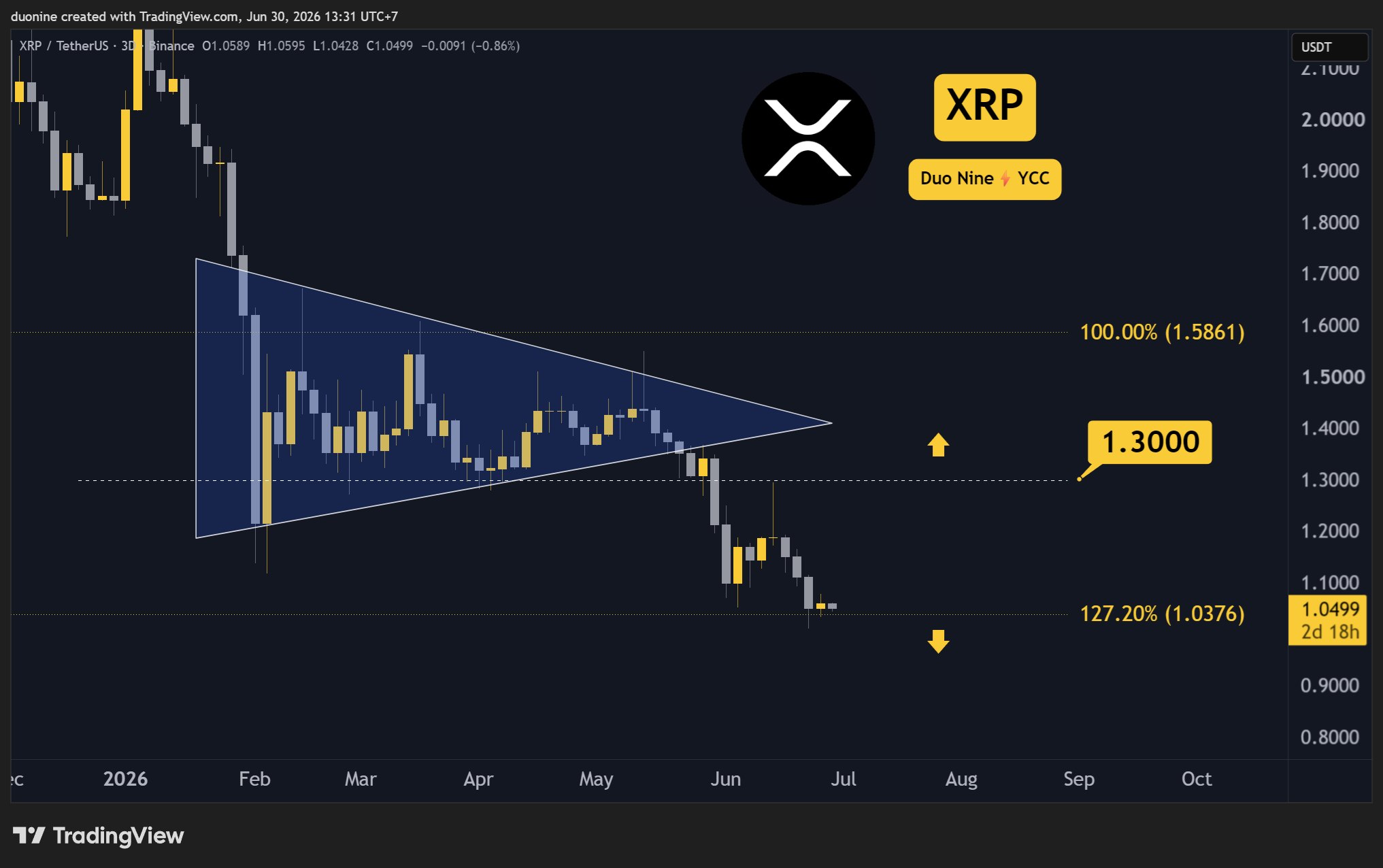
    XRP has experienced a significant downturn, shedding 6% over the past week and testing the crucial $1 support level for the third time in two weeks. This repeated failure by buyers to push the price away from this key threshold signals a potentially bearish outlook.

    Support and Resistance

    Key support levels for XRP are identified at $1, with the next significant floor at approximately 80 cents. Resistance levels to watch are $1.3, $1.6, and $2.

    Bearish Trend Intensifies

    The cryptocurrency is currently entrenched in a bearish trend, characterized by consistently lower highs and lower lows. Analysts suggest that if selling pressure continues to mount, the $1 support could break, potentially flipping into resistance. In such a scenario, buyers might be forced to retreat to the 80-cent mark for the next major support. The current price action indicates a strong possibility of further declines in the coming weeks, with $1 likely to become a resistance zone.

    Momentum Indicators Signal Caution

    Momentum indicators further reinforce the bearish sentiment. The 3-day Relative Strength Index (RSI) is hovering near the 30-point mark, a common indicator of a bearish trend. As long as the RSI remains below 50, bears are expected to maintain control of the market.

    MACD Suggests Deeper Downturn

    Adding to the concerns, the weekly Moving Average Convergence Divergence (MACD) is showing signs of a bearish cross. If confirmed, this would be the first such occurrence in 2026 and could signal a prolonged period of recovery challenges for XRP.

    Outlook for the Remainder of the Year

    The outlook for XRP in the latter half of the year appears negative, with the potential for further price drops. Investors are advised to await confirmation of a market bottom before considering new entries into XRP.

  • Coinbase Plunges 62% After Jim Cramer’s PARC Basket Recommendation

    Coinbase Plunges 62% After Jim Cramer’s PARC Basket Recommendation

    Cramer’s “PARC” Basket Falters as Key Stocks Plummet

    Nearly a year after CNBC’s “Mad Money” host Jim Cramer christened a group of four stocks – Palantir (PLTR), Applovin (APP), Robinhood (HOOD), and Coinbase (COIN) – as the “PARC” basket, three of the quartet have seen significant declines or stagnation.

    The initial grouping, coined on July 14, 2025, led many in the financial industry to interpret Cramer’s move as a bullish signal for the cryptocurrency sector. However, the stock most intrinsically linked to crypto has now experienced the steepest fall. Cramer had described the PARC stocks as those retail investors had “anointed and taken up without any real bounds,” framing the market at the time as bifurcated between the S&P 500 and these momentum-driven names.

    Coinbase Leads the Decline

    New performance data, shared on X by market commentator Heisenberg on June 29, 2026, reveals that Coinbase has been the worst performer since Cramer’s announcement, shedding 62% of its value.

    Yahoo Finance data indicates that over the past 52 weeks, Coinbase’s stock has fluctuated between $139 and $444. It is currently trading near the lower end of this range, around $149, a stark contrast to the strong investor conviction that accompanied its inclusion in Cramer’s basket. Notably, Donald Trump’s financial disclosure in May showed that the former president purchased Coinbase shares between January and March of this year, though these transactions were managed by third-party financial institutions.

    Palantir and Robinhood Lag

    Palantir has also struggled, declining approximately 25% since the “PARC” acronym was introduced, and has fallen about 40% in 2026 alone. Its 52-week high was around $207, and it was trading near $113 at the time of this report.

    Robinhood, meanwhile, has remained largely flat. This performance could be considered a relative success given the steep drops experienced by other members of the group. Earlier this month, Robinhood expanded into the Canadian crypto market with its $180 million acquisition of WonderFi, now boasting over 1 million international funded customers. However, this expansion has not significantly boosted its stock price.

    Applovin Stands Out

    Applovin is the sole outlier in the PARC basket, having genuinely delivered positive returns with a 34% increase since the group was named. Despite this gain, its current price of around $477 remains well below its one-year high of $745. Nevertheless, compared to its PARC counterparts, Applovin’s performance is a clear exception.

    A “CRAP” Forecast?

    In 2025, Cramer had considered two similar acronyms: PARC and CARP (Coinbase, Applovin, Robinhood, Palantir). However, some observers humorously proposed a third: CRAP. A year later, this alternative acronym appears to have been a more accurate predictor of the stocks’ performance.

    Analyst Shanaka Anslem Perera commented on this development via X, stating, “The acronym arrived at the precise moment conviction in these names ran hottest, and the year that followed turned a throwaway joke into a price chart. CRAP was never an insult. It was the forecast, written a year early.”

  • XRP Faces Crucial Decision as Calm Precedes Potential Volatility

    XRP Faces Crucial Decision as Calm Precedes Potential Volatility

    XRP Faces Intense Selling Pressure Amidst Broader Crypto Downturn

    XRP is currently experiencing significant selling pressure, a trend that mirrors the broader cryptocurrency market. Both its trading pairs against Tether (USDT) and Bitcoin (BTC) are entrenched in clear downtrend structures. While the dollar-denominated pair is testing a critical demand zone, the BTC pair is hovering just above a key support level, placing the market at a pivotal juncture.

    XRP/USD Analysis

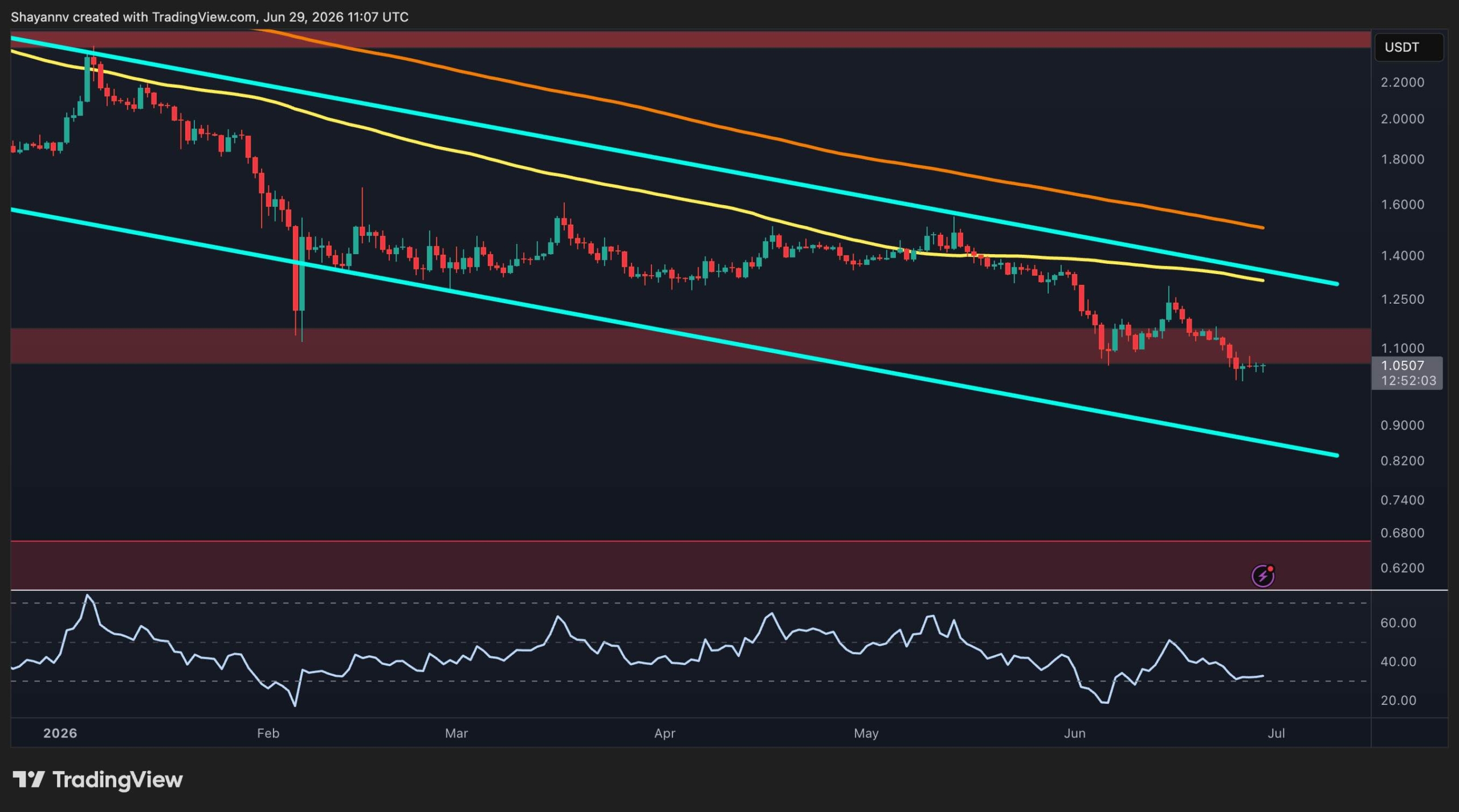
    On the daily chart, XRP continues to exhibit its established bearish structure, remaining confined within a long-term descending channel. The digital asset is presently trading around the $1.05 mark, having failed to establish higher lows in recent weeks, a clear indication of sustained seller dominance on higher timeframes.

    The most significant support for XRP/USD is now situated between $1.00 and $1.10, an area where the price is attempting to find stability. This zone has historically attracted buying interest and could potentially trigger a relief bounce if buyers successfully defend it. However, the overarching trend remains bearish, with XRP trading below both its 100-day and 200-day moving averages. These averages are both sloping downwards, serving as dynamic resistance levels.

    Any attempt at a recovery is likely to encounter its initial hurdle around the 100-day moving average, which is positioned near the $1.30 level and aligns with the upper boundary of the descending channel. A decisive break above both this channel resistance and the moving average would be necessary to signal a meaningful shift in the market’s structure.

    Conversely, a failure to hold the current support area could expose XRP to the lower boundary of the descending channel, located near the $0.80 region. This makes the current support zone particularly crucial for the medium-term outlook.

    XRP/BTC Analysis

    Against Bitcoin, XRP continues to underperform, with the XRP/BTC pair firmly entrenched within its own descending channel. The pair is currently trading at approximately 1,750 satoshis, sitting directly above a horizontal support level that has repeatedly halted deeper declines since May.

    Despite this support holding on multiple occasions, none of the subsequent rebounds have resulted in a clear bullish breakout, underscoring persistent selling pressure and a lack of sustained upward momentum. Repeated rejections near the 100-day moving average further reinforce the bearish structure.

    On the upside, the first major horizontal resistance is observed around 1,850 satoshis, which converges with the declining 100-day moving average. Above this, stronger resistance emerges near 2,000 satoshis, followed by the descending 200-day moving average and the upper channel resistance. As long as XRP remains below these resistance clusters, the trend against Bitcoin suggests continued relative weakness.

    On the downside, a confirmed breakdown below the 1,700 satoshis support region would likely invalidate the current consolidation pattern and pave the way for another downward leg towards the psychological support level around 1,500 satoshis, and potentially lower. This positions XRP at a critical decision point on both its USDT and BTC charts, as buyers and sellers vie for dominance over the prevailing trend.