Tag: Negative

  • Trump’s Crypto Pledge Triggers Market Plunge

    Trump’s Crypto Pledge Triggers Market Plunge

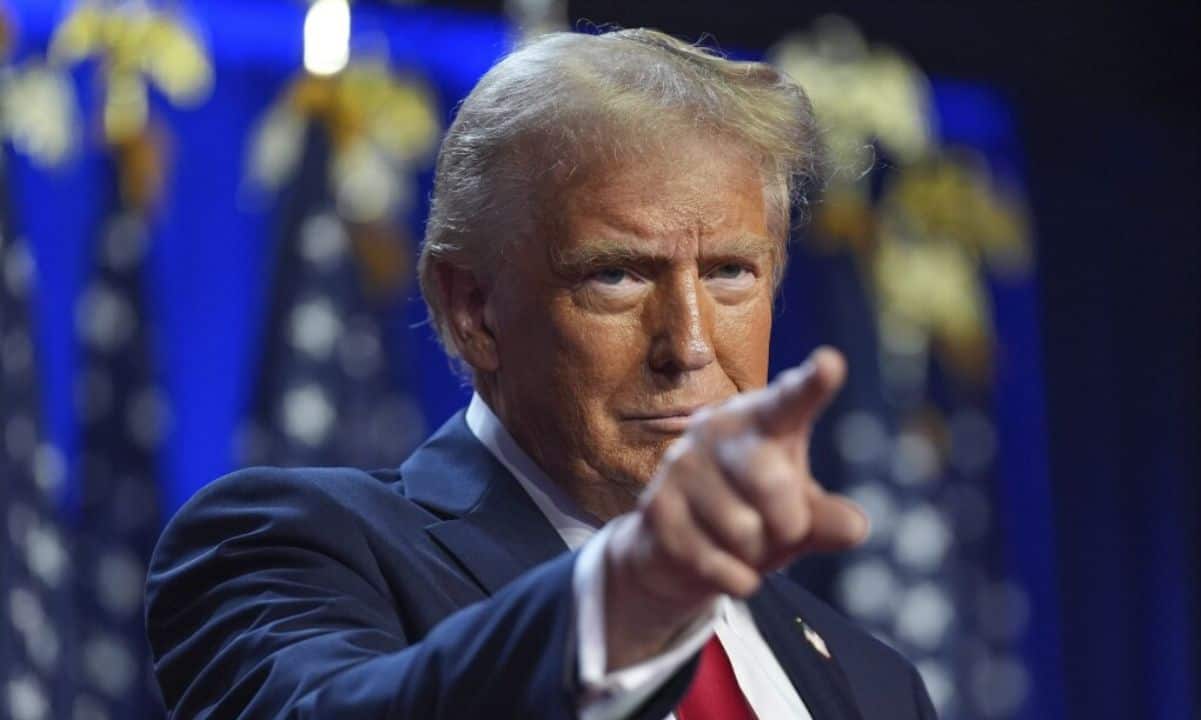
    Former U.S. President Donald Trump claimed on Wednesday that he had “saved” the American crypto industry, alleging that former SEC Chair Gary Gensler and an “anti-crypto army” had nearly destroyed it by driving Bitcoin, crypto perpetuals, and innovation offshore. Trump made the statement on Truth Social.

    “America is now the crypto capital of the world, and builders and entrepreneurs are coming back to the United States where they belong,” he added. “Under my leadership, we will codify a future-proof digital asset market structure that cannot be undone by the crypto haters. The new frontier of finance is being built in America, and Trump will never let crypto down!”

    In a separate post, he stated, “where we are currently the crypto capital of the world, other countries are trying diligently to replace us in that capacity, but we won’t let that happen. It is a major industry, and we must protect it.”

    Market Reaction

    Despite such pronouncements from a world leader typically causing market gains, the crypto market experienced a sharp downturn. The market fell nearly 3%, wiping out over $80 billion.

    Over the past 24 hours, approximately 165,000 traders were liquidated, with total liquidations reaching $928 million, 93% of which were long positions, according to Coinglass.

    Bitcoin dropped 3.2%, falling to $72,800, its lowest level since mid-April. The asset has now lost 8% over the past two weeks and is approaching the $60,000 zone.

    Bitcoin and Ethereum Performance

    Bitcoin experienced a significant drop, falling below $73,000 in a 60-minute period. Over $480 million in long positions were liquidated.

    Ethereum also fell below the $2,000 psychological level, declining more than 4.4% to $1,975, its lowest level since the end of March. Altcoins broadly declined as the bear market intensified.

    “Retail has erupted with ‘buy the dip’ calls toward ETH as a result of this drop below a key psychological support level,” reported Santiment. “This typically means the price may have a bit further to fall, due to the crowd (which usually gets calls wrong) being too optimistic.”

    Geopolitical Factors

    Market pressures were further exacerbated by a new wave of U.S. military strikes on Iran late Wednesday.

    The strikes targeted an Iranian military site, and the U.S. shot down four Iranian drones near the Strait of Hormuz, according to Reuters.

    “These actions were measured, purely defensive, and intended to maintain the ceasefire,” an official told the outlet. Iran retaliated by attacking a U.S. base in Kuwait.
  • XRP Plummets Amidst Surging Sell-Off

    XRP Plummets Amidst Surging Sell-Off

    XRP Price Dips Below $1.30

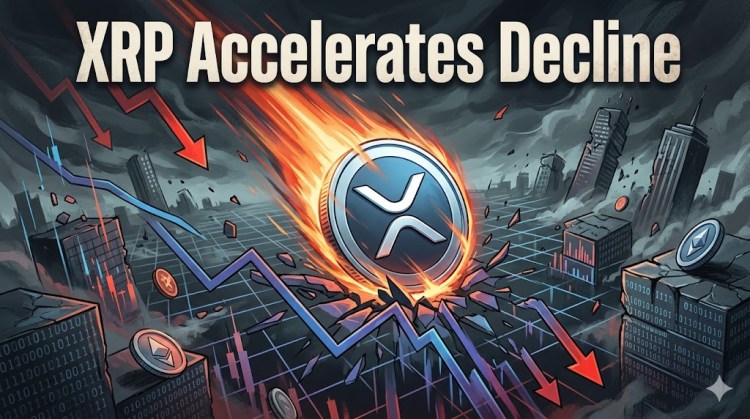
    The price of XRP has continued its downward trend, trading below $1.30. The cryptocurrency is currently consolidating losses and facing resistance levels near $1.30 and $1.340.

    XRP began another decline, falling below the $1.30 mark. It is now trading below this level and the 100-hourly Simple Moving Average. A bearish trend line is forming, with resistance at $1.340 on the hourly chart of the XRP/USD pair, according to data from Kraken. The pair could continue to decline if it remains below $1.340.

    XRP failed to maintain its position above $1.340 and extended its decline, mirroring the trends of Bitcoin and Ethereum. The price dropped below $1.3250 and $1.3120, entering a short-term bearish zone. Losses extended below $1.30, with a low of $1.2677 recorded. The price is currently consolidating losses well below the 23.6% Fibonacci retracement level of the downward movement from the $1.3638 swing high to the $1.2677 low. XRP is trading below $1.30 and the 100-hourly Simple Moving Average.

    Potential Resistance Levels

    If a recovery occurs, the price may encounter resistance near $1.290. The first major resistance level is near $1.30. The primary resistance could be at $1.3150, which aligns with the 50% Fibonacci retracement level of the downward move from the $1.3638 swing high to the $1.2677 low. A close above $1.3150 could potentially push the price towards $1.3275. The next hurdle is at $1.340, where a bearish trend line also presents resistance on the hourly chart of the XRP/USD pair. A decisive move above the $1.340 resistance could drive the price towards the $1.3550 resistance level. Further gains might lead to a test of the $1.3750 resistance.

    Potential for Further Losses

    If XRP fails to surpass the $1.3150 resistance zone, a fresh decline could be initiated. Initial support on the downside is near $1.2675. The next significant support level is near $1.2550. A break below $1.2550 could see the price continue to decline towards $1.2320. The subsequent major support is near the $1.220 zone, below which the price could fall further to $1.20.

    Technical Indicators

    • Hourly MACD: The Moving Average Convergence Divergence (MACD) for XRP/USD is gaining momentum in the bearish zone.
    • Hourly RSI: The Relative Strength Index (RSI) for XRP/USD is currently below the 50 level.

    Key Levels

    • Major Support Levels: $1.2675 and $1.2550
    • Major Resistance Levels: $1.3150 and $1.3400
  • David Hoffman Explains Ethereum’s Exit Strategy

    David Hoffman Explains Ethereum’s Exit Strategy

    Bankless co-founder David Hoffman has sold his Ether holdings, citing his belief that the “ETH is money” thesis has largely played out. Despite this move, Hoffman maintains a strong bullish outlook on Ethereum as a network.

    Rationale for the Sale

    Hoffman, who has built his career and community around Ethereum, stated that the decision was not made lightly. In a recent tweet, he explained that the “ETH is money” thesis hinged on Ethereum’s success across various coordination layers, including decentralized leadership, governance, Layer 2 ecosystems, roadmap execution, and technological development.

    Hoffman contrasted Ethereum with Bitcoin, noting that Bitcoin prioritized simplifying its blockchain to maximize the value of BTC, while Ethereum pursued a more ambitious path by expanding utility across decentralized applications, finance, tokenization, and infrastructure. He acknowledged that Ethereum has achieved part of its vision and earned its current market capitalization, but suggested that the opportunity for ETH to be significantly revalued higher by the market is diminishing.

    Broader Crypto Market Dynamics

    The Bankless co-founder also pointed to the broader crypto market, noting that the “strong version” of crypto, which focused on decentralized finance, NFTs, DAOs, and crypto-native systems, failed to maintain long-term mainstream support outside the 2020-2022 period. He attributed this to crypto’s association with scams, grifts, and speculative behavior, which weakened the social belief system necessary for ETH to function as global money.

    Hoffman further stated that Ether’s utility increasingly benefits other forms of money, particularly stablecoins and tokenized dollars, rather than ETH itself. He described Ethereum as a “giver, not a taker,” emphasizing that the network provides secure blockspace, tokenization infrastructure, and DeFi support at minimal cost, rather than maximizing value for ETH holders. He believes Ethereum’s architecture prioritizes applications, rollups, and ecosystem growth over ETH itself, making it challenging for the underlying crypto asset to fully achieve global money status without overwhelming market dominance.

    Market Sentiment and Uncertainty

    Hoffman’s decision comes amid intensifying bearish sentiment surrounding Ethereum. A recent report by Santiment found that social media discussions have shifted from optimism to frustration and concerns about further downside.

    The analytics firm noted that traders increasingly view ETH as “dead money” compared to better-performing crypto assets in 2024, with weakening ETF flows, declining on-chain activity, and growing competition from ecosystems like Solana and BNB Chain adding pressure on sentiment.

    Rumors of prominent Ethereum figures reducing or exiting ETH positions, including discussions surrounding Hoffman, have also contributed to rising market uncertainty, particularly as traders worry about insiders losing confidence in the asset.

  • Crypto Markets Plunge Amid Bearish Sentiment

    Crypto Markets Plunge Amid Bearish Sentiment

    Tuesday saw a significant downturn in the cryptocurrency market, with a broad sell-off impacting various altcoins. Zcash (ZEC) led the decline, dropping 11%, followed by World Liberty Financial’s WLFI, which fell 8%, and Ondo Finance (ONDO), down 7%.

    Bearish Sentiment Rises

    The losses occurred amid growing bearish sentiment among investors. Blockchain analytics firm Santiment noted that such sentiment has historically preceded price rebounds. Santiment highlighted the declines of Ondo, Zcash, WLFI, and DeXe, among others, in a post on X.

    Ondo Finance Faces Setback

    Ondo Finance’s drop came shortly after the death of its 32-year-old founder and CEO, Nathan Allman. The company announced that Ian De Bode, the longtime president, will take over as CEO. The token is currently trading near $0.41, representing a gain of approximately 9% over the past seven days.

    Zcash and WLFI Performance

    Zcash’s 11% single-day drop was the steepest among the mentioned assets. However, the decline was approximately 7.5% over the last 24 hours, with ZEC trading around $570. The asset is up 60% over the past month and nearly 970% over the past year. WLFI’s 8% dip added to the token’s recent struggles, having reached a new all-time low in late April after a 16% single-day crash. The token has also faced a controversial lock-up proposal, a lawsuit from Tron’s Justin Sun, and ongoing scrutiny over its ties to the Trump family.

    Other Tokens Show Gains

    Despite the losses, some tokens showed positive performance over the week. NEAR was up more than 55% over seven days, trading around $2.50, although it declined nearly 8% on Tuesday. Hyperliquid’s HYPE token also saw gains, increasing 25% according to Santiment’s data. RAIN was the week’s standout performer, reaching an all-time high of around $0.012 on Tuesday, with a weekly increase of almost 55% and a 24-hour increase of over 44%.

    Market Outlook

    Santiment’s data indicated that bearish expectations have been building for about 10 days. The firm noted that this collective caution has historically preceded price recoveries, as markets often move against the prevailing sentiment. However, traders will be watching to see if this pattern holds, especially with Bitcoin remaining below $77,000 and struggling to break above its 200-day moving average near $80,000.

  • XRP Slides Toward $1.20 Support Amid Bearish Pressure

    XRP Slides Toward $1.20 Support Amid Bearish Pressure

    XRP Slides Toward Critical $1.20 Support as Bears Stay in Control

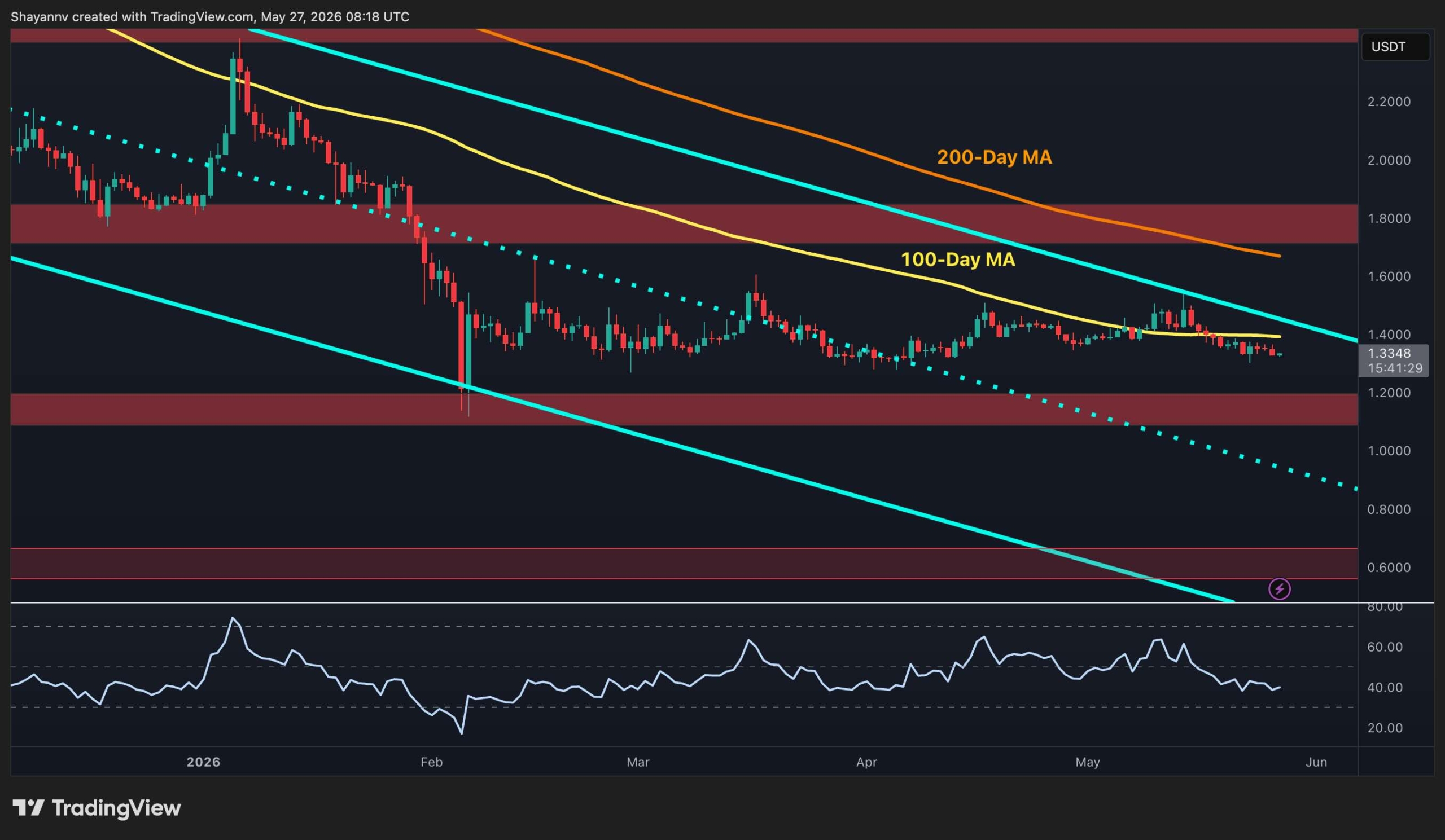
    XRP is trading at $1.33 as May concludes, steadily declining to its lowest levels since March without any specific trigger. This downward trend has characterized the altcoin’s performance throughout the latter half of the month.

    Key Support Levels Tested

    The $1.20 support level is the closest it has been in weeks, and the 100-day moving average has been breached again. The XRP/BTC pair is also testing its recent low, appearing increasingly vulnerable.

    Against USDT, the cryptocurrency is just below the upper boundary of a descending channel. The 100-day moving average, around $1.40, now acts as overhead resistance after being surpassed during May. The 200-day moving average continues to decline, currently around $1.60.

    The Relative Strength Index (RSI) is hovering around 40, indicating weak momentum with no signs of a bottom forming.

    Potential Breakdown Looms

    The $1.20 demand zone is now within reach, making the next few daily closes crucial. A potential breakdown below $1.20 would be the first breach of that level since February, potentially leading to a further decline towards the $0.60 zone. Conversely, any recovery attempt would need to reclaim $1.40 and the 100-day moving average to suggest a genuine recovery is underway.

    XRP/BTC Pair Analysis

    The XRP/BTC pair is trading at 1,760 sats and is testing the pink horizontal support level, which marks the recent low near 1,730 sats.

    The price has struggled to sustain a modest recovery above 1,800 sats. The RSI has been oscillating between 30 and 60 throughout May, without any sustained directional movement, reflecting a pair in a state of equilibrium rather than clear directional momentum.

    The 100-day moving average, around 1,900 sats, and the 200-day moving average, near 2,050 sats, remain the dynamic recovery targets on either side of the critical 2,000 supply zone.

    Below, the lower channel boundary and the demand area near 1,500 sats are the next potential targets if the recent low breaks down. XRP is expected to continue underperforming against BTC, as market sentiment remains largely pessimistic regarding Ripple.

  • South Korea Arrests in First DEX Rug Pull Case

    South Korea Arrests in First DEX Rug Pull Case

    South Korea Makes First DEX Rug Pull Arrest in Catfi Case

    The Seoul Southern District Prosecutors’ Office in South Korea has arrested and indicted the operators behind Catfi, marking the country’s first prosecution related to a rug pull on a decentralized exchange (DEX).

    The case, brought under the Virtual Asset User Protection Act, accuses the group of market manipulation after 256 investors lost 900 million won ($586,000) when liquidity was drained following an artificial price surge.

    According to Digital Asset, South Korean prosecutors charged a criminal group accused of manipulating the price of the Solana-based meme coin CATFI and generating approximately 400 million won (~$260,000) in illegal profits.

    The scheme began on Pump.fun in early 2025. The main suspect, identified by the surname Park and operating online as the influencer ‘Eth Father,’ created Catfi before listing it on a decentralized exchange. Park allegedly posed as an unrelated third party to recommend purchases, inflated follower counts, managed project social accounts, and spread tokens across multiple wallets while using circular trading to obscure issuer control.

    Catfi’s price surged 1,001-fold within 26 hours of issuance, attracting 6,000 investors before the liquidity vanished. The group used approximately 10 million won in criminal funds and profited 400 million won, or $260,000.

    Regulatory Shift

    Until the Catfi case, South Korea’s virtual asset enforcement primarily focused on centralized exchanges. DEX fraud existed in a legally ambiguous area due to non-custodial design, pseudonymous wallet operators, and the absence of a regulated intermediary, making it difficult to assign criminal liability under frameworks designed for traditional finance or even centralized exchange (CEX) abuse.

    The Virtual Asset User Protection Act, which took effect in July 2024, provided prosecutors with a statutory basis, covering “the use of fraudulent means, plans, or techniques” and false statements about material facts in digital asset trading, regardless of venue.

    The Catfi prosecution is only the second known case under the Act, following the January 2025 ACE token manipulation case on Bithumb, but the first to target a DEX environment.

    The Seoul Southern District prosecutors explicitly stated their enforcement mandate, declaring the office would “resolutely deal with acts that disrupt the digital asset market and undermine public trust.”

    DeFi regulation in South Korea has shifted from exchange oversight to on-chain conduct, and operators who believed decentralization offered immunity are now taking note.

    Investigative Template

    The Catfi case illustrates the investigative methods that make on-chain forensics increasingly dangerous for rug pull operators. Prosecutors identified circular trading patterns and coordinated wash trades across wallets controlled by the issuing group, which created artificial volume and masked insider ownership concentration.

    The off-ramp, where criminal proceeds are converted into fiat or stablecoins, typically exposes the operators. This process often involves centralized exchanges with Know Your Customer (KYC) obligations, revealing the identities of pseudonymous operators.

    South Korea’s enforcement bodies have developed this pattern across prior cases. The 149-arrest USDT laundering ring announced earlier this year demonstrated prosecutors’ ability to map complex multi-wallet schemes at scale. The Catfi group’s use of approximately 10 million won in traceable criminal funds suggests the on-chain trail was coherent enough to support the indictment.

    Two suspects were arrested and indicted for market manipulation; one was indicted without detention; two others were charged for assisting the main suspect’s flight. Similar reconstruction methods were used in the Squid protocol exploit, where on-chain tracing helped identify the flow of drained funds across multiple transactions.

  • XRP Faces Renewed Price Pressure, Potential Weekly Breakdown Looms

    XRP Faces Renewed Price Pressure, Potential Weekly Breakdown Looms

    XRP Price Faces Downward Correction

    The price of XRP has begun a downward correction, falling below the $1.350 mark. Currently exhibiting bearish signals, the cryptocurrency may decline further, potentially dropping below $1.3120.

    Technical Analysis

    XRP’s price initiated a downward correction after failing to sustain its position above $1.350. It is now trading below $1.340 and the 100-hourly Simple Moving Average. A bearish trend line is forming, with resistance at $1.3580 on the hourly chart for the XRP/USD pair, according to data from Kraken. The pair could continue its downward trajectory if it remains below $1.3550.

    Price Dips Below Support

    XRP struggled to maintain its position above $1.3650, triggering a fresh decline mirroring movements in Bitcoin and Ethereum. The price dipped below the $1.3550 and $1.3500 levels, subsequently falling below $1.340. This move included a clear break below the 61.8% Fibonacci retracement level, calculated from the upward movement between the $1.30 swing low and the $1.3740 high. A bearish trend line is also forming, with resistance at $1.3580 on the hourly chart for the XRP/USD pair. The price is currently trading below $1.340 and the 100-hourly Simple Moving Average.

    If the price attempts an upward move, it may encounter resistance near $1.3340. Initial major resistance is near $1.340, above which the price could rise to test $1.350. A decisive move above the $1.350 resistance could push the price towards the $1.3580 resistance and the trend line. Further gains might lead to a test of the $1.3650 resistance, with the next significant challenge for bulls potentially near $1.3740.

    Potential for Further Decline

    If XRP fails to surpass the $1.340 resistance zone, a fresh decline could be initiated. Initial support on the downside is near $1.3175. The next major support levels are near $1.3125 and the 83.2% Fibonacci retracement level, calculated from the upward movement between the $1.30 swing low and the $1.3740 high. A break and close below $1.3125 could lead to a continued decline towards $1.3020. Further support is expected near the $1.30 zone, with a potential for further losses towards $1.2920. Additional losses might lead to a test of $1.2880.

    Technical Indicators

    The Hourly MACD for XRP/USD is currently gaining momentum in the bearish zone. The Hourly RSI (Relative Strength Index) for XRP/USD is now below the 50 level.

    Major Support Levels: $1.3175 and $1.3125.

    Major Resistance Levels: $1.3400 and $1.3580.

  • Ethereum Price Stalls Amid Record Staking, Analyst Says

    Ethereum Price Stalls Amid Record Staking, Analyst Says

    Ethereum has fallen below the $2,100 level as selling pressure intensifies, overshadowing a recovery that has struggled to find solid support since mid-May. While the decline is concerning, an analysis by CryptoOnchain has identified a contradiction within the network data, suggesting the current price weakness is more complex than a simple bearish outlook implies.

    The Contradiction in Data

    The contradiction lies between two data points that should not be moving in opposite directions simultaneously. The ETH 2.0 staking rate has reached a new all-time high of 32.18%, representing the largest portion of Ethereum’s total supply ever committed to the network’s validator infrastructure. This indicates that more ETH is locked in long-term staking contracts than ever before, reflecting strong conviction in Ethereum’s long-term value among a significant group of holders.

    However, the network’s organic activity tells a different story. Median token transfer size and transaction fees have plummeted by 80% to 90% compared to the 90-day average. The daily utility that drives genuine demand for block space, including transactions, DeFi activity, NFT volume, and protocol interactions, has nearly vanished. CryptoOnchain describes the current state of the Ethereum blockchain as an “on-chain ghost town.”

    This presents a paradox: record conviction on one hand, and near-zero organic activity on the other, both occurring simultaneously within the same network at the same price. The analysis examines what is holding the structure together, and the answer is the most alarming element revealed by the data.

    Record Staking and Empty Network

    The CryptoOnchain analysis poses a critical question: if organic network activity has collapsed and US institutional spot demand has disappeared, why isn’t Ethereum’s price reflecting these twin absences more severely?

    The Coinbase Premium has dropped to -0.12, confirming that American institutional spot buyers, who fueled the most significant phases of Ethereum’s previous recoveries, have reduced their active accumulation. On-chain activity metrics confirm that retail and protocol users are also largely absent. The two categories of participants whose genuine demand has historically supported Ethereum price levels are both missing simultaneously.

    The Phantom Network: Binance Leverage vs. On-Chain Ghost Town

    The analysis suggests that offshore derivatives are the key factor. Binance Funding Rates have surged 688% above the 90-day baseline, remaining positive at +0.01. Speculative leveraged positioning on the world’s largest derivatives exchange is currently sustaining Ethereum’s price in the absence of spot demand and network utility, which would typically provide that foundation.

    The structural assessment is direct. Peak staking creates a genuine supply floor, as 32.18% of total ETH locked in validators represents a meaningful reduction in immediately available sell-side supply, thus limiting downside in a structural sense. However, a price sustained by derivatives leverage rather than spot demand or network utility is vulnerable. Leverage flushes do not occur gradually. When funding rates at 688% above baseline encounter a catalyst that forces deleveraging, the adjustment happens rapidly, and the supply floor provided by staking cannot absorb the speed of that kind of unwind.

    Technical Outlook

    Ethereum continues to trade near the critical $2,100 level after weeks of sustained selling pressure. The daily chart shows ETH trapped below the major resistance region between $2,280 and $2,380, an area that repeatedly rejected bullish momentum throughout May. Technically, Ethereum remains below the 200-day moving average, which continues trending downward, reinforcing the broader bearish market structure.

    Despite the weakness, bulls are still defending the $2,050–$2,100 support region aggressively. A decisive breakdown below this area would likely expose Ethereum to a deeper move toward the broader demand region around $1,800–$1,900. Volume has gradually declined during the recent consolidation, reflecting market indecision. For bulls to regain momentum, Ethereum likely needs to reclaim the $2,200 level and then break decisively above the $2,300–$2,400 resistance cluster.

  • Scammers Steal $400K via Fake Uniswap Site

    Scammers Steal $400K via Fake Uniswap Site

    Fake Uniswap Site Steals Crypto Funds

    A fraudulent website masquerading as Uniswap is currently siphoning funds from multiple cryptocurrency wallets, according to on-chain analyst “b-block.” The analyst estimates that the scammers have already amassed at least $400,000 in stolen assets.

    Users are advised to only use official links and to verify protocols through DefiLlama.

    Rise in Malicious Google Ads

    This warning follows a report from the security group SEAL, which detailed a significant increase in malicious Google Ads targeting cryptocurrency users. SEAL found that attackers were impersonating popular decentralized finance (DeFi) platforms, wallets, and trading applications to steal funds.

    SEAL reported blocking over 356 malicious Google ad URLs linked to crypto scams. These ads targeted platforms including Uniswap, Morpho Finance, PancakeSwap, Hyperliquid, CoW Swap, and 1inch.

    The attackers utilized compromised or fraudulently obtained Google advertiser accounts and employed cloaking, fingerprinting, and nested iframe delivery systems to circumvent Google’s automated review processes. Many of the fake ads leveraged trusted Google services like sites.google.com and docs.google.com to appear legitimate in search results.

    SEAL identified crypto drainer families, including Inferno Drainer and Vanilla Drainer, as the primary malware used in these campaigns. These tools trick users into signing malicious wallet transactions or entering recovery seed phrases on cloned websites, enabling attackers to seize control of wallet assets.

    SEAL also noted that the sophisticated infrastructure used in these attacks, including Cloudflare Workers, Arweave-hosted payloads, traffic redirection systems, and proxy layers, allows for the interception of Ethereum RPC requests and real-time monitoring of user activity.

    Uniswap was the most impersonated platform, accounting for 41% of the malicious sites tracked. Between March 13 and March 30, confirmed and unattributed losses linked to these campaigns exceeded $1.27 million, though SEAL believes the actual figure is likely much higher.

    Other Recent Phishing Campaigns

    While the recent Uniswap-related scams primarily involved fake websites and malicious Google Ads, a separate phishing campaign earlier this year targeted Ledger users via fraudulent emails. This attack followed a data breach at Ledger’s third-party e-commerce partner, Global-e, which exposed customer contact and order information.

    The scammers falsely claimed that Ledger and Trezor had merged and urged users to migrate their wallets through fake websites that requested 24-word recovery phrases. The phishing pages closely mimicked the companies’ official branding and messaging.

    More recently, Ripple CTO David Schwartz warned of a phishing campaign that sent fake security alerts appearing to originate from Robinhood’s official email system. These emails passed authentication checks because attackers exploited Robinhood’s account creation process, making the messages appear legitimate.

    The phishing emails claimed a new login from an “iPhone 17 Pro” and prompted users to review suspicious activity via a “Review Activity Now” button, which then led to credential theft. Robinhood later confirmed the issue, stating that no systems were breached and no funds were affected.

  • CLARITY Act Passage in 2026 Less Likely, Says TD Cowen

    CLARITY Act Passage in 2026 Less Likely, Says TD Cowen

    The prospects of the CLARITY Act becoming law this year are diminishing, according to TD Cowen, despite the bill’s passage through key Senate committees. While the measure successfully cleared the Senate Agriculture Committee and the Senate Banking Committee, a full Senate vote—and the final approval needed to enact the bill—appears increasingly unlikely before the end of the year.

    CLARITY Act Momentum Stalls

    Jaret Seiberg, a managing director at TD Cowen’s Washington Research Group, wrote in a Tuesday note that his team remains pessimistic about the CLARITY Act’s enactment this year. He attributes the main challenge to political hurdles, specifically whether Democrats can support the bill if it includes provisions addressing presidential conflicts of interest.

    Seiberg also cautioned that Republicans could become more hesitant to advance the legislation if it requires them to vote against amendments targeting or responding to Trump-related concerns. He noted that the progress in the Senate Banking Committee earlier this month does not necessarily indicate broad bipartisan agreement. He characterized the committee’s advancement of the bill, despite objections from Democrats and banks, as shifting the debate to the full Senate rather than resolving underlying disputes.

    Rising Washington Tensions

    Seiberg also pointed to several Trump-related developments that he believes are complicating the political environment for the CLARITY Act. One factor is a resolved legal case involving the Internal Revenue Service (IRS). The dispute led to the creation of a $1.776 billion anti-weaponization fund and permanently prohibits the IRS from auditing past tax returns for Trump, his family, and related companies. Seiberg believes the fallout from this dispute will likely heighten tensions in Washington, making it more difficult to reach a consensus on legislation like the already delayed CLARITY Act.

    Seiberg also cited a recent New York Times investigative report alleging that prediction markets and crypto-related interests may have influenced efforts aimed at the Commodity Futures Trading Commission (CFTC). He emphasized that these claims remain unconfirmed. However, he noted a response from CFTC Chair Michael Selig, who told the New York Times that the agency is focused on major wrongdoing and is not “playing favorites.”

    Another factor cited in the TD Cowen note involves government financial disclosures released earlier this month. These reports indicated that approximately 3,600 stock trades were executed on Trump’s behalf during the first three months of 2026. Seiberg argued that the surrounding controversy makes it more likely that lawmakers will choose to delay action, especially as the midterm election approaches and the political calendar narrows the window for further postponements.