Tag: Negative

  • Bitcoin Short-Term Holders Transfer 107,760 BTC

    Bitcoin Short-Term Holders Transfer 107,760 BTC

    Historical data suggests that Bitcoin has never recorded three consecutive months of positive performance during a bear market year. This trend appears poised to continue in 2024, with May likely to close in the red for BTC, following positive performances in March and April, as well as the beginning of this month. Recent on-chain data indicates that short-term investors may be capitulating amidst Bitcoin’s recent price struggles.

    Are BTC’s Short-Term Investors Losing Conviction?

    In a Quicktake post on the CryptoQuant platform, market analyst RugaResearch reported a significant movement of Bitcoin by a specific group of investors within the past day. This group, known as short-term holders, is often considered the most reactive segment of the market. Specifically, RugaResearch noted that 107,760 BTC within the 1-month to 3-month Spent Output Age Band moved in a single day, representing the largest on-chain movement within this age band in over seven months. The Spent Output Age Bands is an on-chain indicator that categorizes spent transaction outputs into age brackets, illustrating the proportion of total coins moved and their period of inactivity.

    The 1- to 3-month Spent Output Age Band tracks Bitcoin purchased between late February and late April, coinciding with the initial stages of BTC’s recovery, up to approximately $80,000 last month. RugaResearch explained that a significant movement within this age band, such as the one recently observed, suggests that recent investors are reacting rather than accumulating. The analyst highlighted that the movement of these 107,760 BTC, while the Bitcoin price is below $74,000, implies that a substantial portion of the 1-month to 3-month Spent Output Age Band is either out of the money or near breakeven.

    While the exact reason for this movement remains unclear, this shift does not suggest strong conviction among the most reactive investors. RugaResearch stated that exchange inflows can indicate whether these coins are being sold. If they are deposited on exchanges, the sell-off could continue. Conversely, if they are moved to cold storage or over-the-counter desks, it may indicate redistribution under pressure. Therefore, data from centralized exchanges will be crucial in the coming days to understand the purpose of this movement.

    Bitcoin Price Momentum Stays Negative For Eight Days

    Simultaneously, RugaResearch revealed a concerning trend with the Bitcoin Price Momentum indicator, which has remained negative since May 22nd. After reaching a nearly one-year high of +20.5% on May 5th, the on-chain metric declined by 12.9 percentage points approximately ten days later. Having turned negative just over a week ago, the Bitcoin Price Momentum currently stands at -4.07%. “When 1m-3m spent output spikes 6.7x overnight while momentum bleeds for 8 straight days, the positioning game shifts,” the market analyst concluded.

    As of the time of writing, the price of BTC is approximately $73,410, reflecting a minor 0.4% decrease in the past 24 hours.

  • South Korea Acts on Crypto Fraud: First Case Under New Law

    South Korea Acts on Crypto Fraud: First Case Under New Law

    South Korean prosecutors have charged a group of individuals connected to CatFi, a Solana-based meme coin project, alleging they orchestrated a rug pull scheme after attracting investor funds.

    Charges and Suspects

    The Seoul Southern District Prosecutors’ Office announced Wednesday that five individuals face charges related to the case. Two primary suspects are in custody, while the other three have been indicted without detention.

    Alleged Scheme

    Investigators say the group launched CatFi in early 2025 using the Solana meme coin platform Pump.fun. The project quickly gained investor interest, but the creators abandoned it after accumulating sufficient funds. Prosecutors emphasized the legal significance of the case, as it marks the first time the country’s Virtual Asset User Protection Act has been used to prosecute a rug pull under fraudulent and unfair trading provisions. It is also the first known prosecution involving a crypto crime carried out through a decentralized exchange, which had previously been largely unregulated.

    Deceptive Practices

    According to the findings, the suspects employed misleading promotional tactics to generate interest. One of the accused allegedly posed as an independent crypto influencer, promoting CatFi to attract investment. Another individual managed project communications, artificially inflating follower counts and posting announcements about fake token lock-up arrangements to create an illusion of stability.

    Market Manipulation

    Authorities further allege the group circulated tokens across multiple wallets and engaged in wash trading to conceal their control over the supply and simulate genuine market demand. Following the launch, CatFi’s price reportedly surged dramatically, increasing by approximately 1,001 times within 26 hours. During this period, around 6,000 investors purchased the token.

    Investor Losses and Profits

    Prosecutors stated that 256 investors reported total losses of approximately 900 million Korean won, equivalent to around $600,000. The suspects are believed to have secured profits exceeding 400 million won. The scheme initially drew attention from online blockchain analysts who traced wallet activity and identified those involved. However, police initially closed the case after the suspects claimed they had been hacked.

    Investigation and Arrests

    The Financial Services Commission later referred the matter to prosecutors, leading to a joint investigation involving a dedicated crypto crime unit and financial and tax authorities. The investigation led to the apprehension of the suspects, including one individual who evaded capture for three months using disguises. Arrests of two suspects occurred on May 11, with the remaining three detained later on Wednesday.

    Scrutiny of Pump.fun

    Pump.fun has faced scrutiny for enabling large-scale speculative token activity on Solana, where many newly created meme coins are linked to scams like rug pulls and pump-and-dump schemes. The platform’s ease of token creation and low transaction costs facilitated rapid trading. Despite this, the meme coin launchpad was one of the top revenue-generating applications in the Solana ecosystem in 2025, earning over $100 million in revenue.

  • XRP’s Value Questioned Amidst Price Slump

    XRP’s Value Questioned Amidst Price Slump

    The cryptocurrency market appears to be reverting to a bearish trend as the second quarter of the year progresses, with large-cap assets experiencing the most significant losses in recent weeks. Amidst this challenging market environment, the XRP token has declined by nearly 10% in the last two weeks. Interestingly, despite its recent performance, the altcoin is being flagged as potentially overvalued by the market. According to recent on-chain data, XRP could undergo a price correction in the coming weeks.

    NVT Ratio Climbs 20% In A Single Week

    In a Quicktake post on the CryptoQuant platform, CryptoOnchain suggested that XRP has entered “overvalued” territory. The market analyst noted an increasing divergence between the altcoin’s network market valuation and its fundamental utility.

    This assessment is based on significant changes in the Network Value to Transactions (NVT) ratio, which compares an asset’s network value (market capitalization) to the daily transaction volume on the network. This on-chain indicator provides insight into XRP’s valuation.

    According to CryptoQuant data, the XRP NVT ratio has risen steadily over the past week, increasing by 20.3% compared to its three-month baseline. “This structural rise in NVT occurs while the price attempts to consolidate near the $1.33 level,” CryptoOnchain wrote in the Quicktake post. A rising NVT ratio typically suggests that the market is pricing the digital asset higher than the actual value of the assets being transferred on the network, indicating overvaluation.

    However, CryptoOnchain also noted that the rising NVT indicator doesn’t provide a complete picture. Examining XRP’s exchange activity reveals a lack of spot market participation. For example, CryptoQuant data shows that Binance inflows and outflows have both decreased by approximately 98% compared to their three-month averages. Meanwhile, active deposit addresses on the world’s largest crypto exchange have declined by 94%.

    According to CryptoOnchain, the combination of the rising NVT metric and the decline in spot market participation suggests that the XRP price lacks fundamental support from active investors or network usage. This situation puts the altcoin in a precarious position, potentially leading to a price decrease as it seeks its fair value.

    XRP Price At A Glance

    As of this writing, the price of XRP is approximately $1.32, with no significant movement in the past 24 hours.

  • UK Sanctions Crypto Firms Linked to Russia’s War Effort

    UK Sanctions Crypto Firms Linked to Russia’s War Effort

    The UK has imposed sanctions on 18 cryptocurrency platforms, banks, and financial networks accused of enabling the Kremlin-backed “A7” payment network to circumvent international economic restrictions.

    Sanctions Target $90 Billion in Transactions

    The sanctioned entities are alleged to have processed over $90 billion in 2025 to support Russia’s invasion of Ukraine.

    A report by TRM Labs identified several targeted exchanges, including Huobi, Exmo Exchange, Bitpapa, and Rapira Group. Huobi alone reportedly facilitated over $4.9 billion in on-chain transactions to UK-sanctioned entities and the A7 network since 2021. Furthermore, $1.13 billion of these transactions occurred in the 14 months following the March 2025 shutdown of the Russian crypto exchange Garantex, with $838 million specifically directed to the A7 network last year.

    Crypto Activity Shifted After Garantex Closure

    TRM’s findings indicate that Russian-linked crypto activity did not diminish after the closure of Garantex. Instead, it migrated to successor exchanges and payment platforms such as Rapira, Aifory Pro, Grinex.io, and ABCex. Exmo Exchange is reported to have directly transacted over $19.5 million with sanctioned entities like Garantex and Chatex, while BitPapa also transferred millions to these actors.

    The report highlights that Rapira moved over $543 million, including $375.6 million tied to Grinex.io. Aifory Pro transferred over $189 million, with $175.2 million attributed to ABCex. ABCex itself recorded $355 million in transactions across the restricted firms, sending $175.2 million to Aifory Pro, $133.4 million to Garantex, and $38.1 million to Rapira.

    UK Adds Entities to Consolidated List

    The UK government has added all 18 sanctioned entities to the UK Consolidated List. Businesses operating in the country are now required to freeze any assets connected to these entities and block transactions involving the listed companies.

    “If the Kremlin thinks it can evade our sanctions by hiding behind crypto networks and shadow financial systems, it is gravely mistaken,” stated Foreign Secretary Yvette Cooper. She added that the restrictions aim to cut off the financial flows supporting Putin’s war in Ukraine.

    Sanctions Extend to Individuals

    The new measures also target individuals linked to the A7 network. The government’s report indicates that the group is backed by a Kyrgyz bank suspected of processing payments within the system, along with a major global crypto exchange believed to have transferred over $1.5 billion back into Kremlin-linked financial channels.

    Illicit Crypto Activity Increased

    A separate analysis by TRM Labs revealed a sharp increase in illicit crypto activity last year, with most of it related to Russian-linked trades. The A7 network’s A7A5 token contributed $72 billion worth of trades, while the group’s own wallets accounted for another $39 billion. Most of this money reportedly flowed through Garantex and Grinex.

  • DxSale Exploit Hits Liquidity Providers for $7.3 Million

    DxSale Exploit Hits Liquidity Providers for $7.3 Million

    More than 1,400 liquidity pools associated with outdated DxSale contracts on BNB Chain were exploited in a $7.3 million attack, according to blockchain security firms on May 29.

    Growing Threat

    The attack contributes to a rising number of DeFi breaches this month, prompting security experts to caution that older smart contracts and inadequate access controls are leaving protocols vulnerable.

    Attack Details

    According to the on-chain security account PeckShieldAlert, a user identified as “Tahax” first discovered the exploit. Their report indicates that attackers targeted at least 1,400 old DxSale liquidity pool contracts on BNB Chain, extracting approximately $7.3 million worth of cryptocurrency. The stolen funds were then routed through AnySwap in an attempt to conceal the transaction trail.

    PeckShield further noted that an address identified as “0xC457…FA69” transferred 2,958 BNB from the hack, valued at $1.87 million, into two primary wallets. These wallets subsequently moved the funds through several deposit addresses on Binance.

    DxSale is a launchpad platform that allows crypto projects to create tokens and liquidity pools without developing their own infrastructure. The platform was popular about five years ago, with many projects launching tokens on BNB Chain locking their liquidity pools with the protocol.

    According to Tahax, the locker still held liquidity pools from projects that had been untouched for years, with founders and holders believing they were secure. However, nearly nine months ago, the DxSale deployer transferred ownership of the locker to a new wallet without any public announcement or migration notice. The on-chain investigator claims that the locker contract was unverified and likely contained a backdoor, which the attacker exploited.

    Two days prior, 0xC457…FA69, a new wallet funded from Bybit and possibly routed through AnySwap, reportedly took ownership of the locker and, within hours, began draining the liquidity pools.

    DxSale has yet to release a statement regarding the exploit.

    Broader Context

    The DxSale hack is part of a larger trend. The crypto sector lost at least $650 million in April due to similar incidents. May has also seen its share of attacks, including one last week where an individual stole over $11 million from the Verus bridge by exploiting a flaw in its payment verification process. Security researchers reported that the attacker submitted a small transaction that passed verification while still unlocking large withdrawals from the bridge’s reserves.

    Earlier in the month, liquidity provider TrustedVolumes was also hit for approximately $5.9 million after a hacker exploited weaknesses in its custom settlement system. Analysts pointed out that the exploit succeeded because the protocol checked authorization against one address while pulling funds from another.

    THORChain was also affected, with on-chain sleuth ZachXBT stating it may have lost over $10 million, causing its RUNE token to plummet 15% within minutes.

    This ongoing series of exploits has prompted a reaction, with OpenZeppelin co-founder Manuel Aráoz declaring “all of DeFi unsafe,” arguing that AI-assisted attackers are discovering vulnerabilities faster than security teams can fix them.

  • Uniswap Price Dips Amid Binance Token Absorption

    Uniswap Price Dips Amid Binance Token Absorption

    Uniswap Faces Downward Pressure Amidst Significant Exchange Inflows

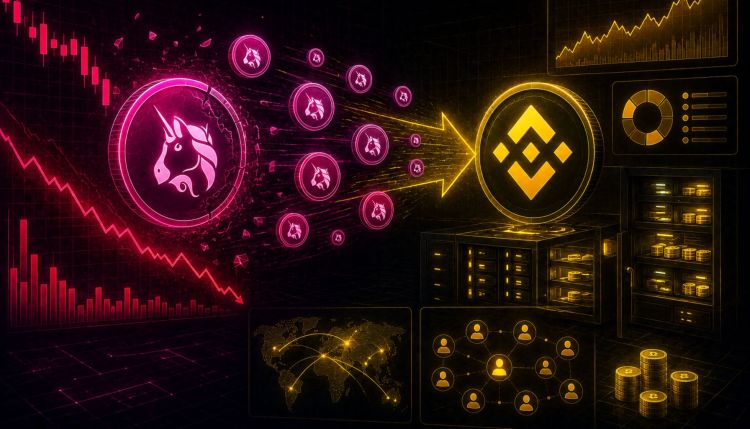
    Uniswap is struggling to regain higher price levels as selling pressure continues to push the price down from levels that briefly offered hope of a sustained recovery. While the weakness is evident, and the direction appears clear, an analysis by CryptoQuant tracking Binance exchange flows has identified a dramatic shift in UNI’s flow dynamics. This shift warrants attention regardless of one’s perspective on the market’s direction.

    Extreme Inflow Acceleration on Binance

    The seven-day average Binance netflow for UNI has turned sharply positive, reaching +145,829 UNI. This represents a 6,019% deviation above the three-month baseline. This is not a moderate increase in exchange deposits, but one of the most extreme inflow accelerations recorded in UNI’s recent on-chain history. This has been concentrated in a period where the price is already declining.

    The scale becomes more pronounced at the individual session level. On May 25, Binance received a single-day inflow spike of 1.8 million UNI. On May 27, this figure exceeded 3.1 million UNI in a single session. In just two days, nearly five million UNI arrived on the world’s largest exchange while the price fell from above $4.20 to around $3.10.

    This inflow surge is not driven by retail activity. Total inflow volume rose 183% above the three-month average, while the average transaction size per inflow jumped 285%. This indicates that larger holders are making deliberate, large-scale decisions to move UNI onto Binance.

    Implications of the Inflow Surge

    The CryptoQuant analysis highlights the supply dynamic. When exchange inflows accelerate while prices decline simultaneously, it suggests that holders are positioning tokens for potential sale rather than moving assets into self-custody for long-term holding. The intent behind these deposits differs from the accumulation behavior seen during constructive market phases. The scale of the current inflow acceleration leaves little doubt about the intentions of the largest UNI holders.

    While Binance has absorbed the bulk of the incoming supply, its USD-denominated reserve has decreased by 4.95% despite the token inflows. The falling price is partially offsetting the volume of tokens arriving, meaning the exchange holds more UNI but less dollar value. This dynamic suggests that supply is arriving faster than the price can stabilize to reflect it.

    Ecosystem Activity Remains Intact

    Network data provides additional context, preventing a purely bearish interpretation. Active addresses are running 3% above the three-month baseline, indicating that Uniswap’s ecosystem activity remains intact despite the price weakness and the exchange inflow surge. The protocol is still being used. The selling pressure is not a reflection of fundamental deterioration.

    The next few sessions will determine the outcome. Traders monitoring this setup should watch whether the deposited UNI converts into aggressive selling or reverses into outflows as buyers absorb the supply before drawing conclusions about UNI’s next directional move.

    Technical Analysis: Price Tests Critical Support

    UNI remains under significant selling pressure, currently trading near $3.02 after losing the short-term support that held throughout most of April and May. The daily chart shows a clear bearish structure, characterized by lower highs and lower lows since the November peak above $10.00. Despite several recovery attempts during the first quarter of 2024, bulls have been unable to reclaim any major resistance level, allowing sellers to maintain control of the broader trend.

    The recent rejection from the $4.00-$4.20 region proved particularly significant. That rally briefly pushed UNI above its short-term moving averages and generated optimism for a larger recovery, but buyers failed to sustain momentum. Since then, the price has declined sharply and broken below the 50-day and 100-day moving averages, which now act as dynamic resistance around the $3.30-$3.50 region.

    Volume has increased during the latest decline, suggesting that the move is supported by active selling. The current area around $3.00 represents a critical support zone, as it marks the lowest levels reached since the February capitulation event. If bulls fail to defend this region, UNI could enter price discovery towards lower support levels. To regain momentum, buyers would first need to reclaim the $3.50 area and establish a higher low structure above it.

  • Mashinsky Seeks to Overturn Crypto Fraud Sentence

    Mashinsky Seeks to Overturn Crypto Fraud Sentence

    Alex Mashinsky, the founder and former CEO of the now-defunct crypto lending platform Celsius, is seeking to overturn his 12-year prison sentence, according to a new motion filed in the District Court for the Southern District of New York.

    Grounds for Appeal

    The motion, handwritten by Mashinsky, cites ineffective counsel and the “fruit of a poisonous tree” doctrine as grounds for vacating the sentence.

    Mashinsky, who pleaded guilty to charges of commodities and securities fraud, included additional materials to support his claims, stating that his counsel’s ineffectiveness stemmed in part from “financial duress resulting in unavoidable and absolute conflict of interest with client.”

    “The root of counsel’s deficiencies lay in the undisclosed financial distress of the firm Mukasey & Young LLP,” Mashinsky’s motion for habeas corpus relief states. “This distress created a conflict of interest that permeated every strategic decision made by counsel since the outset of the petitioner’s representation.”

    Alleged Conflict of Interest

    This conflict of interest arose from the firm’s engagement with FTX founder and former CEO Sam Bankman-Fried, also known as SBF. Mashinsky claims this created an “unwaivable conflict since it was market manipulation of the CEL token and StETH by SBF” that harmed Celsius. Celsius subsequently paused withdrawals, leaving customers unable to access billions of dollars in deposits.

    Shortly after halting withdrawals, Celsius was forced to file for bankruptcy in an attempt to stabilize its business. A year later, Mashinsky was arrested and charged by the SEC, CFTC, and FTC. Some charges alleged he defrauded customers of $42 million.

    He later pleaded guilty, reportedly stating in court, “I know what I did was wrong, and I want to try to do whatever I can to make it right.”

    Despite some creditors seeking harsher penalties, Mashinsky was sentenced to 12 years in prison. He is now seeking to have that sentence vacated.

    Recent Settlement

    Last month, Mashinsky was formally banned from the cryptocurrency industry as part of a $10 million settlement with the FTC. The regulator initially secured a $4.7 billion judgment against him, though the majority of the judgment has been suspended, requiring only the $10 million payment.

  • XRP’s Future: Expert Warns of Time Running Out

    XRP’s Future: Expert Warns of Time Running Out

    XRP Price Faces Potential Dip Before Possible Recovery

    XRP has been trading sideways for most of 2026, resembling a coiling spring, but the anticipated upward surge may not be imminent. The cryptocurrency’s four-month consolidation has kept its price below a significant resistance level of $1.65. According to crypto analyst CasiTrades, time is running out, as XRP could be headed for a further decline to lower macro support levels before any substantial recovery can begin.

    Four Months of Resistance at $1.65

    CasiTrades’ analysis is based on XRP’s failure to break above the upper boundary of its consolidation pattern on the 4-hour candlestick chart. As the chart illustrates, XRP has been trading within a range with lower highs for several months, creating a compression pattern. The next decisive move could be crucial for the broader trend.

    The $1.65 level is the most critical in this analysis, as it has acted as the ceiling of the current structure since February. Each rejection from this area has weakened the immediate bullish outlook. CasiTrades suggests that the longer XRP fails to reclaim $1.65, the more likely it is to experience a final drop to lower macro supports. The analyst has outlined XRP’s price action since early 2026 within an Elliott Wave triangle structure with sub-impulse waves.

    Lower Macro Support Levels for XRP

    CasiTrades has specified the downside levels she is watching: $1.10 and $0.87 on Coinbase. The $1.10 area corresponds with the 0.786 Fibonacci retracement at approximately $1.0854, while the $0.87 price target aligns with the 0.854 retracement near $0.8621.

    The next confirmed support lies between $1.26 and $1.30. A break below this range could push XRP to its year-to-date low around $1.11, bringing the deeper targets closer. Both price targets are derived from the broader macro downtrend that has shaped XRP’s structure over the past several months.

    The projected move would also complete the corrective sub-impulse wave 5, which began in February 2026, as well as the larger corrective wave 2 that started in late 2025. However, this does not necessarily invalidate a bullish structure. In fact, the analyst predicts that a move to macro support could be the final decline before a stronger recovery. The chart indicates a significant rebound from the lower support zone, with XRP potentially pushing back through $1.65 and exceeding $2 if sufficient bullish momentum emerges.

    At the time of writing, XRP is trading at $1.32 and is open to either direction. The first sign of a bullish shift would be XRP reclaiming $1.65 and establishing it as support.

  • Sui Network Suffers Second Day of Outage, Token Value Plummets.

    Sui Network Suffers Second Day of Outage, Token Value Plummets.

    The native token of the Sui blockchain, SUI, has fallen 20% this week following a “network stall” that caused downtime on the layer-1 blockchain for the second consecutive day.

    Price Performance

    Recently trading at $0.89, SUI has dropped an additional 2% in the last 24 hours and is now more than 83% below its January 2025 all-time high of $5.35. According to CoinGecko data, its weekly decline has placed it among the five worst-performing assets in the top 100 cryptocurrencies by market capitalization.

    Network Outage

    “Sui mainnet is currently experiencing a network stall. Network activity may be paused at this time,” the network’s team posted on X on Friday morning.

    Sui developers shared the same message on Thursday when the layer-1 blockchain was down for over five hours before a patch was deployed to validators, temporarily restoring the network.

    “Activity on Sui mainnet has resumed after a halt due to a crash bug in the gas charging logic introduced by the 1.72 release. A full incident review will be shared in the coming days,” the network announced.

    Investigation and Response

    While a comprehensive postmortem of the incident is pending, the network indicated that Thursday’s outage was caused by a bug introduced in its latest release.

    It remains unclear whether Friday’s outage is related to Thursday’s incident or the subsequent patch. Representatives for the network and Mysten Labs, the core team behind it, did not immediately respond to requests for comment.

    Previous Issues

    These outages follow a similar network stall in January, which resulted in six hours of downtime for the layer-1 blockchain’s mainnet.

    Background

    Hailed as a “Solana-killer,” the network has faced some of the same challenges as the high-speed layer-1 network, which has also experienced major outages in the past.

    Sui was launched in 2023 by Mysten Labs, which raised $300 million in a Series B funding round in 2022, valuing the company at approximately $2 billion at the time. Despite the recent decline, the network’s token currently trades with a market capitalization of around $3.6 billion.

  • Crypto Prices Fall Amid ETF Outflows, Macro Concerns

    Crypto Prices Fall Amid ETF Outflows, Macro Concerns

    Crypto Market Downturn

    Cryptocurrency markets experienced a downturn over the past week, with Bitcoin leading the decline as investors moved away from riskier assets. Bitcoin began the week trading near the $77,000-$78,000 range but steadily lost momentum, falling to approximately $73,000 by Friday.

    This decline reflects a combination of macroeconomic pressures, renewed outflows from exchange-traded funds (ETFs), and reduced liquidity, rather than a single industry-specific event.

    The primary factor contributing to the downturn was the waning institutional demand. U.S. spot Bitcoin ETFs saw significant redemptions, with over a billion dollars leaving in a single day. Simultaneously, activity among large holders increased, with whale outflows reaching their highest level since February, raising concerns that some investors are preparing to sell during the market weakness.

    Macroeconomic factors also played a role. Geopolitical tensions between the U.S. and Iran diminished hopes for near-term interest rate cuts, negatively impacting speculative assets. Furthermore, analysts reported that central banks are increasing their gold reserves at an unprecedented rate, signaling a broader risk-off market sentiment.

    Altcoins followed Bitcoin’s downward trend, with Ethereum trading near $2,000. Overall risk appetite remains cautious.

    The week highlighted the crypto market’s sensitivity to ETF flows and macroeconomic risks. Bitcoin’s inability to maintain its price around the mid-$70,000 level suggests a defensive market outlook heading into the following week.

    Market Cap: $2.54T | 24H Vol: $83B | BTC Dominance: 57.7%
    BTC: $73,158 (-5.4%) | ETH: $1,995 (-5.9%) | XRP: $1.33 (-3.4%)

    SpaceX Pre-IPO Market Flash Crash

    The pre-IPO market for SpaceX on Hyperliquid, powered by Ventuals, experienced a sudden flash crash. The price plummeted by 45% before recovering, leading to mass liquidations. Ventuals has stated that affected traders will be compensated.

    Google Engineer Charged with Insider Trading

    U.S. prosecutors have charged a Google software engineer with allegedly using confidential information to profit from betting on Polymarket. He allegedly made $1.2 million by using proprietary search data.

    Hyperliquid Expands with Macro Prediction Markets

    Hyperliquid has expanded the range of outcome markets available on its platform. Initially, only fixed bets on Bitcoin’s daily price were available, but users can now trade on macro events such as monthly CPI prints and other economic indicators.

    Coinbase CEO on Financial System Evolution

    Brian Armstrong, CEO of Coinbase, stated that the financial system still requires significant upgrades. He emphasized that substantial technological innovation and policy work are needed to achieve these advancements.

    Galaxy Digital and BitGo Legal Battle Continues

    BitGo and Galaxy Digital are continuing their legal dispute over the failed $1.2 billion acquisition agreement, which was once expected to be the largest merger in the industry.

    Sui Network Experiences Another Outage

    The Sui Network experienced another period of downtime. The blockchain was offline for nearly six hours on Thursday. This is not the first time the network has experienced such an outage.