Tag: Negative

  • US Treasury Sanctions Iranian Crypto Exchanges for Terrorist Financing

    US Treasury Sanctions Iranian Crypto Exchanges for Terrorist Financing

    Treasury Sanctions Iranian Crypto Exchanges for Terrorist Financing and Sanctions Evasion

    The U.S. Treasury Department’s Office of Foreign Assets Control (OFAC) has designated Nobitex, Iran’s largest digital asset exchange, along with three other Iranian cryptocurrency platforms, alleging they facilitated terrorist financing and sanctions evasion.

    According to the Treasury Department, Nobitex processed over half of all digital asset inflows into Iran in 2025 and was instrumental in payments linked to Iran’s terrorist activities, efforts to circumvent sanctions, and transactions involving entities affiliated with the Islamic Revolutionary Guard Corps (IRGC), including IRGC-linked ransomware operators. The exchange also allegedly assisted the Central Bank of Iran in accessing hundreds of millions of dollars in stablecoins, which were used to support the depreciating value of the Iranian rial, the Treasury stated in its sanctions announcement.

    Wallex, identified as Iran’s second-largest digital asset exchange by volume, handled 12% of Iranian digital asset inflows in 2025. Bitpin, responsible for 10% of these inflows, was sanctioned due to investors reportedly connected to Iranian sanctions evasion schemes. Ramzinex, a Tehran-based digital asset exchange established in 2018, reportedly processed more than $2.45 billion in transactions.

    In addition to the exchanges, the Treasury Department also sanctioned four individuals associated with Nobitex. These include chairman and co-founder Amir Hossein Rad, who was involved in re-establishing operations after a significant hack in June 2025 that resulted in a $90 million loss. Two co-founders, Seyed Mohammad Ali Aghamir and Seyed Mohammad Aghamir Mohammad Ali, are reportedly members of the Kharrazi family, a group with close ties to Supreme Leader Khamenei’s inner circle. The current CEO of Nobitex, Seyed Ali Khoee, who previously held the position of director of product and marketing, was also designated.

    These sanctions, announced on Monday, represent the latest action in the Treasury’s ongoing campaign targeting Iranian cryptocurrency assets. Treasury Secretary Scott Bessent stated last week that his department has seized approximately $1 billion in cryptocurrency from Iranian exchanges and wallets since the commencement of its enforcement efforts against Iran. In April, Tether froze $344.2 million in stablecoins held in two wallets attributed to the Central Bank of Iran.

    “As promised, Treasury will continue to follow the money in support of Economic Fury, whether it is through the banking system or through digital assets, to prevent the regime from developing a nuclear weapon,” Bessent said in the Treasury statement.

  • Strategy Shares Drop Again as Bitcoin Giant Sells $56 Billion

    Strategy Shares Drop Again as Bitcoin Giant Sells $56 Billion

    Shares of Bitcoin-focused software company MicroStrategy (MSTR) tumbled more than 9% on Tuesday, extending a recent decline following the firm’s disclosure of a $2.5 million Bitcoin sale on Monday.

    The company’s stock closed at $136.08, marking a nearly 15% drop over the past five trading days and a more than 23% fall for the month.

    This sharp downturn in MicroStrategy’s stock price coincides with a significant slump in Bitcoin’s value. The cryptocurrency has fallen approximately 5.8% in the last 24 hours, recently trading around $67,288. This represents a more than 46% decrease from its all-time high of $126,080.

    Although MicroStrategy CEO Michael Saylor had previously signaled the company’s intention to sell Bitcoin, the amount—32 BTC, valued at roughly $2.5 million—represented a small fraction of its extensive Bitcoin holdings, which exceed $56 billion. Despite this, shareholders have reacted negatively to the sale.

    Analysts at TD Cowen, however, remain optimistic, maintaining a $400 price target for MSTR shares. This target suggests a potential gain of nearly 200% from the current trading level. MicroStrategy’s stock has not reached such heights since August of last year, shortly before Bitcoin’s most recent all-time high.

    Currently, MicroStrategy’s stock is trading more than 70% below its 52-week high of $457.22.

    The pressure on MicroStrategy’s stock is not an isolated incident within the crypto-related equities market as major digital assets experience a downturn.

    Shares of leading U.S. cryptocurrency exchange Coinbase (COIN) also declined, falling more than 4.5% on Tuesday to close at $173.99. Coinbase’s stock has faced challenges this year, mirroring the broader crypto market’s struggles and dropping over 23% year-to-date.

    Coinbase is now trading nearly 61% below its 52-week high. Analysts at Compass Point have set an even lower price target, reiterating a forecast of $140 this week, which implies a further 19% drop from its current trading price.

    Other publicly traded companies with significant exposure to the cryptocurrency market have also seen their stock prices fall in recent trading sessions. Bitmine Immersion Technologies (BMNR) and Sharplink (SBET), firms involved with Ethereum treasuries, saw their shares drop 4.62% and 6.14% respectively on Tuesday. BMNR closed at $17.98, while SBET finished the day at $5.81.

    Additional notable decliners among crypto-related stocks on Tuesday included Bitcoin miner CleanSpark (CLSK) and BTC services firm Fold (FLD). CleanSpark lost 6.5% to close at $17.58, while Fold dropped 8.4% to end the day at $0.87.

  • XRP Price Dips as Bears Reassert Dominance

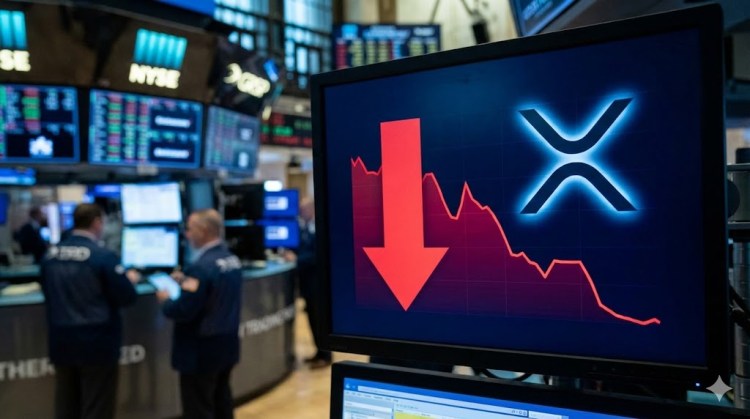
    XRP Price Dips as Bears Reassert Dominance

    XRP Price Slides Below Key Support Levels, Bears in Control

    The price of XRP has extended its losses, trading below the $1.320 mark. The cryptocurrency is currently consolidating its decline, facing immediate hurdles at $1.2880 and $1.30. XRP’s downward trajectory continued as it fell below the $1.280 zone, and is now trading beneath both this level and its 100-hourly Simple Moving Average. A bearish trend line has formed on the hourly chart for the XRP/USD pair, with resistance noted at $1.3150, according to data from Kraken. Should XRP remain below $1.30, further downward movement is anticipated.

    XRP Price Dips Below $1.280

    XRP failed to sustain its position above $1.320, mirroring declines seen in Bitcoin and Ethereum. The cryptocurrency’s price dropped below $1.3050 and $1.30, entering a short-term bearish territory. Losses deepened further, with the price falling below $1.2880. A low of $1.2752 was established, and XRP is now consolidating its losses significantly below the 23.6% Fibonacci retracement level of the move from the $1.3642 swing high to the $1.2752 low.

    Currently trading below $1.2880 and the 100-hourly Simple Moving Average, any attempt at a recovery would likely encounter resistance near the $1.2920 level. The first significant resistance is positioned around $1.2960. The primary resistance zone could be $1.3150, or the 50% Fibonacci retracement level of the decline from the $1.3638 swing high to the $1.2677 low, which sits at $1.320. A decisive close above $1.320 could propel the price towards $1.3275, with the next hurdle at $1.340. A bearish trend line also forms with resistance at $1.340 on the hourly chart. A clear break above this $1.340 resistance might see XRP advance towards the $1.3550 resistance, with further gains potentially pushing it towards $1.3750.

    More Losses on the Horizon?

    If XRP is unable to overcome the $1.3150 resistance zone, a fresh decline could be initiated. Initial support on the downside is observed near the $1.2750 level. The next major support is located around $1.2550. A downside break and a close below $1.2550 could lead to a continued decline towards $1.2320. The subsequent major support is situated near the $1.220 zone, below which the price could extend its losses towards $1.20.

    Technical Indicators

    Hourly MACD: The MACD for XRP/USD is currently gaining momentum in the bearish zone.
    Hourly RSI (Relative Strength Index): The RSI for XRP/USD is trading below the 50 level.

    Major Support Levels: $1.2750 and $1.2550.
    Major Resistance Levels: $1.3000 and $1.3150.

  • Polymarket Accused of $500K Scam Over MicroStrategy Bitcoin Sale

    Polymarket Accused of $500K Scam Over MicroStrategy Bitcoin Sale

    Trader Alleges Polymarket Mishandled $500,000 Bet on MicroStrategy Bitcoin Sale

    A user of the prediction market platform Polymarket has accused the company of unfairly resolving a market tied to MicroStrategy’s first Bitcoin sale in years, leading to a significant financial loss for the trader.

    The user claims to have lost approximately $500,000 after betting that MicroStrategy (now rebranded as Strategy) would sell Bitcoin before a May 31 deadline. This sale was later officially confirmed by the company in a Securities and Exchange Commission (SEC) filing on June 1.

    The dispute centers on a Polymarket event that posed the question: “Will MicroStrategy sell any of its Bitcoin by May 31?” The market’s rules stipulated that it would resolve to “Yes” if the company sold any BTC by 11:59 PM ET on May 31. The designated sources for resolution included on-chain data, official disclosures, and credible news reports.

    On June 1, Strategy filed an 8-K form with the SEC. As previously reported, the company disclosed that it had sold 32 BTC, valued at roughly $2.5 million, between May 26 and May 31 – a period clearly within Polymarket’s resolution timeframe.

    However, the SEC filing occurred one day after the May 31 market deadline, creating the core of the controversy. The central question is whether the market should have been judged based on the date of the sale itself or the date of its public confirmation.

    According to the aggrieved trader, he began purchasing “Yes” shares after observing that Strategy had deposited approximately $30 million worth of BTC into Coinbase Prime a week prior. This move fueled speculation that the company was preparing to sell. The trader stated that he had reviewed on-chain data, examined past wallet activity, and concluded that Strategy had likely sold Bitcoin before the deadline.

    After the company confirmed the sale on June 1 through its SEC filing, the trader increased his position. He argued that the market was still open and that the rules only required the sale to occur within the specified timeframe, not the confirmation.

    The trader alleges that Polymarket subsequently added a clarification, stating that confirmation achieved outside the market’s timeframe would not qualify. He contends that this clarification was introduced after the fact.

    A tweet from user @willo2_Poly on June 2, 2026, included a screenshot of Polymarket’s updated resolution criteria: “No information from MSTR, on-chain data, or consensus of credible reporting confirmed that MicroStrategy sold Bitcoin within the market’s timeframe. Confirmation achieved outside of the market’s time frame does not qualify.”

    The trader asserts that this constituted a new rule and argues that the market should have either resolved to “Yes” or been closed on May 31 if post-deadline confirmation was not permissible.

    At the time of this report, the market has been resolved to “No.”

    Other traders on Polymarket have raised concerns that the platform’s dispute resolution mechanism, which involves UMA token holders voting on resolutions after a bond is posted, can be susceptible to manipulation. They argue that “UMA whales” can influence outcomes during debate periods, and that Polymarket has not adequately addressed this issue.

  • BitGo CEO Predicts Stablecoin Crisis as MiCA Deadline Nears

    BitGo CEO Predicts Stablecoin Crisis as MiCA Deadline Nears

    Stablecoin Crisis Warning

    BitGo CEO Mike Belshe is cautioning that the European Union’s Markets in Crypto-Assets (MiCA) framework could trigger a “massive stablecoin crisis” if major USD-backed crypto issuers fail to meet the bloc’s compliance requirements before the July 1, 2026, enforcement deadline.

    This warning comes as exchanges operating in the EU are already assessing which tokens will survive the regulatory changes.

    Concerns Regarding Non-Compliant Stablecoins

    Belshe’s concern centers on the potential consequences of non-compliant stablecoins, particularly Tether’s USDT, facing mass delisting across EU platforms simultaneously. He argues that this would not result in an orderly market transition but rather a liquidity crisis.

    The MiCA regulation, which came into effect on June 29, 2023, with its stablecoin provisions (Titles III and IV) applying from June 30, 2024, will see full enforcement, including the delisting of non-compliant tokens, by July 2026.

    Under MiCA, any stablecoin pegged to a single official currency, such as the US dollar, is classified as an e-money token, which brings with it banking-grade obligations. Issuers of e-money tokens must be licensed as EU credit institutions or e-money institutions, hold backing assets in segregated, highly liquid instruments, and guarantee par-value redemption at any time.

    For Tether, which has largely operated outside EU regulatory frameworks, this represents a significant structural overhaul.

    Structural Gaps and Systemic Risk

    Belshe highlights that the EU lacks a robust safety net for stablecoin issuers. EU deposit insurance is capped at €100,000 per depositor, offering the same protection to a stablecoin issuer holding billions in reserves as a retail savings account.

    Tether CEO Paolo Ardoino has previously stated that the requirement to hold a significant portion of reserves in EU-regulated banks creates its own systemic risk, potentially leading to the very bank-run exposure that MiCA aims to prevent.

    The regulation also empowers the European Banking Authority (EBA) to impose transaction caps on tokens deemed “significant,” with potential thresholds around €200 million in daily EU transaction value. For USDT, which accounts for over 90% of global stablecoin trading volume, this cap would be quickly reached, potentially disrupting EU operations.

    Contrasting Regulatory Approaches

    The stablecoin regulation in Europe contrasts sharply with the more permissive approach emerging in the United States, where discussions have leaned towards lighter-touch frameworks.

    Belshe’s primary argument is not that MiCA’s goals are misguided but that the transition timeline creates a “cliff edge.” If USDT loses its listings on EU exchanges before compliant alternatives are readily available, traders could face illiquid trading pairs with no equivalent dollar-liquidity pool to absorb the volume. This could lead to wider slippage, price discrepancies between EU and global markets, and impaired arbitrage opportunities.

    Circle’s Position and Market Depth

    Circle, the issuer of USDC, has positioned itself as a primary beneficiary of this shift. Circle holds EU e-money institution licensing and has structured both USDC and its euro-denominated EURC to meet MiCA’s reserve and custody requirements. Circle France has also received approval to offer crypto-asset services in the EU, enabling MiCA-compliant custody and transfer services for USDC and EURC across the European Economic Area.

    However, Belshe warns that USDC and EURC may not yet possess the market depth to replace USDT liquidity overnight without causing the very turmoil MiCA seeks to prevent.

    Liquidity Crisis Concerns

    The EU crypto market is substantial. A forced migration of billions in stablecoin volume into thinner compliant pools would not be a smooth transition but rather a liquidity crisis, compressed into a regulatory deadline.

    If Tether fails to secure MiCA-compliant licensing before the July 2026 deadline, EU-regulated exchanges will face a binary choice: delist USDT or risk regulatory sanctions. Several major platforms, including Coinbase’s EU operation, have already begun restricting USDT access for European users ahead of the deadline.

    If exchanges delist USDT across EU jurisdictions simultaneously, the liquidity shock will be concentrated within a narrow timeframe. Traders holding USDT-denominated positions in EU accounts would need to migrate into compliant assets, such as USDC, EURC, or fiat, under time pressure and into shallower order books.

    Belshe’s warning centers on this potential forced liquidation event driven by the regulatory calendar, rather than market fundamentals.

    The critical factor is not whether MiCA enforcement will occur, as it is expected to. Instead, the key variables are whether Tether will move towards compliance and whether regulators will provide any transitional relief for existing large stablecoins during the adjustment period, neither of which is currently guaranteed.

  • Lummis: Delaying Crypto Bill Means No Regulation Until 2030

    Lummis: Delaying Crypto Bill Means No Regulation Until 2030

    Senator Lummis Warns of Crypto Regulation Delay

    Senator Cynthia Lummis has issued a stark warning: failure to pass the CLARITY Act now will effectively delay comprehensive U.S. crypto regulation until 2030.

    The rationale is straightforward: if the bill fails to pass the Senate in the current legislative session, the 2026 election cycle will severely limit available floor time. The next realistic opportunity for a comprehensive market-structure framework would then be at the earliest in the subsequent Congress.

    For institutional investors, this timeline is not merely a political consideration. It represents an operational constraint that compliance teams at major asset managers and trading desks are already factoring into their investment decisions, increasingly favoring jurisdictions with established regulatory frameworks.

    If the United States does not establish the global standard for digital asset regulation, other nations will. China is actively developing its own regulatory approach. The CLARITY Act is seen as a means for the U.S. to lead and prevent adversaries from shaping the rules of the next financial era.

    The U.S. has primarily regulated digital assets through enforcement actions, utilizing SEC litigation, CFTC actions, and agency guidance rather than statutes to define permissible activities in the crypto market.

    The SEC’s enforcement actions have functioned as de facto rulemaking since at least 2017, from the DAO Report to ICO crackdowns and the Ripple and Coinbase litigation.

    This enforcement-based approach creates uncertainty: firms learn about penalties after the fact but lack clarity on what is permitted beforehand.

    While this asymmetry may be tolerable for crypto-native firms, it is unacceptable for compliance departments at institutions like BlackRock, Fidelity, or JPMorgan.

    A four-to-five-year extension of this regulatory regime, effectively a 2030 deadline, would not only delay U.S. institutional adoption but also establish rival jurisdictions as the default for compliant tokenization, stablecoin issuance, and institutional DeFi infrastructure during the critical period of market development.

    Capital Migration and Regulatory Freeze

    The mechanism by which regulatory inaction leads to capital migration is clear. Without a statutory framework resolving the jurisdictional split between the SEC and CFTC, compliance teams cannot approve crypto trading operations under existing bank-grade internal policies.

    Without approved trading desks, custody arrangements cannot be structured to meet fiduciary standards. Without compliant custody, institutional liquidity, which drives market movements and narrows spreads, does not flow into U.S. spot venues.

    This liquidity will go elsewhere. The EU’s MiCA (Markets in Crypto-Assets) regulation, adopted in 2023 and fully implemented in 2024, with application to crypto-asset service providers and stablecoin issuers completed by 2025, provides a passporting framework across all 27 EU member states. This offers a single licensing path, providing institutional desks with the certainty that U.S. law currently lacks.

    Singapore’s MAS regime, operating under the 2019 Payment Services Act, has already attracted tokenization pilots with JPMorgan, DBS, and Temasek through Project Guardian, drawing institutional liquidity into Asia.

    Dubai’s VARA regime has attracted Binance, OKX, and Bybit as these exchanges scaled back or restructured their U.S. operations due to enforcement pressure.

    Polymarket and similar prediction platforms estimate a mid-50s to high-50s percentage probability that a federal market-structure bill like the CLARITY Act will become law by the end of 2026. This coin-flip probability is actively hedged by macro funds via CME bitcoin and ether futures and offshore perpetuals, shifting liquidity from U.S. spot venues to derivatives venues in Europe and Asia.

    The CLARITY Act’s impact on liquidity markets is already being priced in, even before the bill has passed.

    Key Provisions of the CLARITY Act

    The CLARITY Act’s core structure addresses the ambiguity that has made U.S. crypto compliance untenable for institutional actors.

    The bill establishes a jurisdictional division between the SEC and CFTC based on whether a digital asset functions as a security or a commodity. It also creates a decentralization certification pathway allowing assets to transition from securities treatment as their networks mature and includes consumer protection provisions governing asset segregation in the event of exchange insolvency.

    The bill cleared committee with a 15-9 vote, indicating significant opposition but sufficient support to advance.

    Senator Lummis warns that the committee’s outcome is irrelevant if floor time is unavailable. Without these statutory provisions, the question of whether a token is a security remains resolved only through litigation, forcing institutional actors to either accept legal risk or abstain. Most choose to abstain.

    Jamie Dimon has publicly advocated for bank-like capital and AML standards for stablecoin issuers, warning that lighter treatment creates regulatory arbitrage with the banking system.

    This concern is valid regardless of one’s stance on the CLARITY Act, but it underscores that even traditional finance actors who desire stricter rules need a statutory framework to work from.

    The Financial Stability Board finalized global crypto policy recommendations in 2023, which the EU and Asian regulators are implementing. The U.S. Congress has yet to provide the equivalent foundation.


  • Bitcoin Price: Three Factors to Watch This Week

    Bitcoin Price: Three Factors to Watch This Week

    Crypto markets remained stagnant over the weekend, following significant losses last week. Bitcoin and Ether continue to struggle, lacking any immediate factors to trigger a recovery.

    Economic Data in Focus

    This week, investors will be closely watching new labor market data and updated figures on manufacturing and services activity.

    “We also await further details about a potential US-Iran deal, which appears to be dragging on again,” stated The Kobeissi Letter.

    The May ISM Manufacturing PMI report, due on Monday, will provide insights into the US manufacturing sector. This will be followed by April’s JOLTS Job Openings data on Tuesday and the May ISM Non-Manufacturing PMI data on Wednesday. Initial Jobless Claims data is scheduled for Thursday, and the crucial May Jobs Report will be released on Friday.

    The labor market data is particularly important, as it is one of the Federal Reserve’s two mandates for monetary policy decisions. The outlook is currently mixed, with hiring exceeding expectations in April and May, though experts hold differing views. Some economists believe the labor market is strengthening after a slow year in 2025, while others suggest the growth reflects increased demand for healthcare workers due to an aging population, rather than broader economic expansion.

    Key Events This Week:

    1. May ISM Manufacturing PMI data – Monday
    2. April JOLTS Job Openings data – Tuesday
    3. May ISM Non-Manufacturing PMI data – Wednesday
    4. Initial Jobless Claims data – Thursday
    5. May Jobs Report – Friday
    6. Total of 7 Fed Speaker Events This Week…

    The major stock indexes concluded a month of gains at record highs last week, fueled by enthusiasm for tech stocks and declining oil prices, while the crypto market remained in a bearish trend.

    Bitcoin ended May with a 3.6% loss, following two months of gains. It reached a weekend high of $74,000 but failed to sustain the momentum, falling back towards $73,000 during Monday morning trading. The asset has lost 5% over the past week and is approaching the lower end of its four-month-long range-bound channel.

    Ether fell below the $2,000 level again on Monday morning after trading just above it for most of the weekend.

    “Several meaningful catalysts are converging in June that could prove significant for Bitcoin’s near-term trajectory,” reported 10x Research on Monday. “The headwinds are real and visible: ETF outflows, stablecoin contraction, and trading volumes at historic lows all point to near-zero conviction, but that is precisely the environment we anticipated for a major cycle bottom.”

  • XRP Price Slides Amidst Growing Bearish Sentiment

    XRP Price Slides Amidst Growing Bearish Sentiment

    XRP Price Faces Downward Correction

    The price of XRP has begun a downward correction, falling below the $1.3420 mark. Currently exhibiting bearish signals, the cryptocurrency may decline further, potentially dropping below $1.3150.

    Technical Analysis

    XRP’s price initiated a downward correction after failing to sustain its position above $1.3450. The price is currently trading above $1.3150 and the 100-hourly Simple Moving Average. A declining channel is forming, with resistance at $1.3380 on the hourly chart for the XRP/USD pair, according to data from Kraken. The pair could continue its downward trajectory if it remains below $1.3420.

    Price Dips Below Support

    XRP struggled to maintain its position above $1.3520 and subsequently began a fresh decline, mirroring the trends of Bitcoin and Ethereum. The price dipped below the $1.350 and $1.3450 levels, eventually falling below $1.3420. This move included a clear break below the 38.2% Fibonacci retracement level, calculated from the upward movement between the $1.2658 swing low and the $1.3642 high.

    A declining channel is forming, with resistance at $1.3380 on the hourly chart for the XRP/USD pair. The price is currently trading above $1.3150 and the 100-hourly Simple Moving Average.

    If the price initiates a fresh upward movement, it may encounter resistance near the $1.3380 level. The initial major resistance is near $1.3420, above which the price could potentially rise to test $1.350. A decisive move above the $1.350 resistance could push the price towards the $1.3580 resistance and the trend line. Further gains might lead to a test of the $1.3650 resistance. The next significant challenge for bulls could be near $1.3740.

    Potential for Further Decline

    If XRP fails to surpass the $1.3380 resistance zone, a fresh decline could be triggered. Initial support on the downside is near the $1.320 level. The next major support levels are near $1.3150 and the 50% Fibonacci retracement level, calculated from the upward movement between the $1.2658 swing low and the $1.3642 high. A break and close below $1.3150 could see the price continue its descent towards $1.3120. The subsequent major support level is near the $1.3050 zone, below which the price could continue lower towards $1.2920. Further losses might lead to a test of $1.2880.

    Technical Indicators

    • Hourly MACD: The Moving Average Convergence Divergence (MACD) for XRP/USD is currently gaining momentum in the bearish zone.
    • Hourly RSI: The Relative Strength Index (RSI) for XRP/USD is currently below the 50 level.

    Key Levels

    • Major Support Levels: $1.3200 and $1.3150.
    • Major Resistance Levels: $1.3380 and $1.3500.
  • Cardano May Breach Key Support Level

    Cardano May Breach Key Support Level

    Cardano Price Faces Potential Steep Decline

    The price of Cardano (ADA) has been on a downward trajectory since peaking last August, reaching lows not seen since 2024. Despite early optimism for an “altseason” in May, the ADA token has reversed its gains from the beginning of the month. Current price patterns suggest the altcoin could face further declines in the coming months if it closes below a key support level in May.

    Potential for 78% Price Drop

    Crypto analyst Ali Martinez, in a May 30th post on the X platform, noted that Cardano’s price has been fluctuating near a critical level in recent weeks. The monthly chart indicates a risk of ADA closing May below a significant historical support level.

    As the chart illustrates, Cardano has been trading within a multi-year channel since 2021. After reaching the channel’s upper boundary at $1.195 in early 2025, the cryptocurrency has steadily declined, losing a key support level around $0.544 last November. Martinez identifies the next significant support level for Cardano at approximately $0.247, a level that previously fueled a rally that saw ADA reach $1.195.

    However, the Cardano price has recently dipped below this support, falling to as low as $0.232. With May’s end approaching, the market is watching to see if the ADA candlestick will close below the $0.247 threshold.

    Martinez stated on X that maintaining a position below $0.247 as the monthly close nears “alters the immediate market structure, suggesting a deeper valuation phase is underway.” According to Martinez, if Cardano closes below this support, the next “high-conviction macro targets for long-term accumulation” are around $0.113 and $0.051. This could translate to a price drop of nearly 78% from its current level if ADA remains below $0.247. However, the altcoin could potentially rebound to around $0.544 if the channel support holds and demand returns.

    Current Price Overview

    As of this writing, the price of ADA is approximately $0.237, reflecting a more than 2% increase in the past 24 hours.

  • Gravity Bridge Hit in $5.4 Million Exploit

    Gravity Bridge Hit in $5.4 Million Exploit

    Gravity Bridge Suffers $5.4 Million Exploit in Key Compromise Attack

    Gravity Bridge, a cross-chain protocol native to the Cosmos ecosystem, was targeted in a compromised-key attack over the weekend, resulting in the theft of approximately $5.4 million. This latest security breach adds to the escalating number of exploits plaguing the decentralized finance (DeFi) space in 2026.

    Attack Traced to Signing Key Compromise

    On Saturday, May 31st, blockchain investigator Specter reported that Gravity Bridge may have been exploited through a signing key compromise. A signing key compromise involves the unauthorized disclosure or theft of a cryptographic key, enabling an attacker to decrypt sensitive information, forge digital signatures, or gain unauthorized access to systems and funds.

    The stolen assets included approximately $4.3 million in USDC, 274 wrapped Ether valued at roughly $553,000, $434,000 in USDT, and 14.16 PAXG tokens, worth about $64,000. According to security firm PeckShield, the attacker has laundered a portion of the stolen funds through the ChangeNOW and Binance exchanges but still holds over 2,100 Ether, valued at approximately $4.23 million.

    The Gravity Bridge team confirmed the attack on Saturday, advising validators and orchestrators to halt operations while investigating the exploit. “Thanks to the swift action of validators, the bridge is currently halted while investigations continue,” the protocol announced on social media.

    Gravity Bridge functions by locking tokens on the Ethereum network and creating replicas of the crypto assets on the Cosmos network, relying on validator signatures to authorize each transfer. If a bad actor obtains the appropriate signing keys, the protocol would treat even forged transactions as legitimate.

    Crypto Bridge Vulnerabilities Highlighted

    If confirmed as a key compromise, the Gravity Bridge incident aligns with the trend of crypto bridge attacks, where breaches often stem from access control vulnerabilities rather than flaws in the underlying smart contract code. This pattern is evident in most recent exploits, including the $292 million Kelp DAO attack.

    DeFi Sector Faces Mounting Security Challenges

    The $5.4 million Gravity Bridge hack contributes to the growing list of attacks impacting the crypto industry, particularly the DeFi sector, in 2026. Bridges have proven to be a frequent target for attackers during this period. A TRM Labs report identified April 2026 as the most heavily targeted month, with the highest number of incidents in crypto history. These attacks included the aforementioned Kelp DAO hack and the $285 million loss suffered by Drift Protocol.