Tag: Neutral

  • Crypto Firms Dispute Warren’s Criticism of Bank Charter Approvals

    Crypto Firms Dispute Warren’s Criticism of Bank Charter Approvals

    Days after Senator Elizabeth Warren questioned the legality of the Treasury Department’s recent approval of bank charters for cryptocurrency firms, industry leaders are strongly contesting her assessment.

    Industry Group Defends Charters

    On Tuesday, the Digital Chamber, a leading crypto industry trade group, urged the Trump Treasury Department to uphold its recent decision to grant national trust bank charters to crypto firms for the first time.

    “We strongly encourage the OCC to defend these charter approvals and continue developing clear supervisory expectations for trust banks,” the group stated in a letter to Jonathan Gould, head of the Office of the Comptroller of the Currency (OCC).

    Over the past year, the OCC has granted national trust bank charters to several companies to facilitate crypto-related activities, including Coinbase, Circle, Ripple, Paxos, BitGo, Fidelity, Crypto.com, Stripe, and Protego.

    Warren’s Criticism

    Last week, Senator Warren (D-MA) criticized the approvals, arguing they violated U.S. banking laws and allowed the Trump administration to permit crypto firms to use restrictive trust charters to perform a wide range of banking functions. She contended that this policy shift posed systemic risks to the U.S. banking system.

    National trust companies, which are subject to less stringent regulation than traditional banks, typically offer fiduciary services, such as managing assets on behalf of others, but do not accept customer deposits. The crypto firms that have received national trust bank charter approval aim to facilitate the issuance, redemption, and custody of stablecoins and the funds backing these tokens. The issuance of stablecoins, cryptocurrencies typically pegged to the U.S. dollar, was legalized with the passage of the GENIUS Act last year.

    Digital Chamber’s Response

    In Tuesday’s letter, the Digital Chamber argued that Congress’s decision to pass the GENIUS Act granted the OCC the authority to expand banking privileges to stablecoin businesses.

    “It would be deeply incongruous for Congress, on an overwhelmingly bipartisan basis, to establish a new category of federally regulated stablecoin issuer while the OCC stood by and declined to exercise its chartering authority,” wrote Cody Carbone, CEO of the Digital Chamber.

    The trade group also refuted arguments that stablecoin payment and lending activities fall outside the scope of a national trust company, emphasizing that approved companies like Coinbase and Ripple do not accept deposits insured by the FDIC.

    The debate over whether stablecoin-related activities should be treated and regulated like traditional banking has been a central issue in Washington’s crypto discussions this year. For months, the banking lobby has urged lawmakers to limit the ability of stablecoin-related companies to offer incentives that compete with traditional bank savings accounts, arguing that such firms do not comply with rigorous banking regulations. Ultimately, lawmakers sided with the crypto industry’s position.

  • XRP Struggles to Recover as RLUSD Surpasses $1.7 Billion.

    XRP Struggles to Recover as RLUSD Surpasses $1.7 Billion.

    Ripple’s RLUSD stablecoin has surpassed a $1.7 billion market capitalization, achieving one of the fastest ascents for a stablecoin since its launch in December 2024, even as the price of XRP remains stagnant.

    RLUSD Adoption and XRP’s Stagnation

    The growing use of RLUSD in settlement activity on the XRP Ledger indicates genuine adoption beyond its initial users. However, analysts confirm that the stablecoin’s growth has had little impact on the buying pressure for XRP. The contrasting trajectories of the stablecoin and XRP suggest they are, for now, separate trends.

    XRP’s Technical Outlook

    With compressed volatility, a symmetrical triangle pattern tightening on the daily chart, and a crucial resistance zone approaching, XRP is nearing a critical juncture.

    The price of XRP is currently confined within a multi-week consolidation range, compressing price action into a tighter band. The symmetrical triangle formation on the daily timeframe reflects a balance between buyers and sellers.

    Immediate resistance is clustered between $1.38 and $1.42, with a stronger ceiling at $1.45, where the 100-day moving average converges with the upper boundary of a long-term descending channel. This confluence makes the $1.40–$1.45 zone the most significant technical level on XRP’s chart at present.

    Support is equally well-defined. The $1.30–$1.32 range has held as a floor through multiple tests, but a decisive break below this level could lead to a drop to $1.20, which would shift the structure to a bearish outlook.

    Analysts monitoring the consolidation note that low-volatility environments like this often precede significant price movements.

    Opportunity Cost for XRP Holders

    XRP’s stagnation at current levels raises concerns for holders: how much further upside is possible for an asset with an $80 billion-plus market cap that has yet to break above $1.45? Waiting for a breakout, which may take weeks, carries a real opportunity cost, especially as early-stage assets are rapidly raising capital.

    Maxi Doge Presale

    Maxi Doge ($MAXI) is one presale attracting attention in the current cycle. Built on Ethereum (ERC-20), it is positioned as a meme token for the high-leverage trading mindset, embodying the relentless drive of bull market culture.

    The project is priced at $0.000282, with over $4.7 million raised to date. It also offers 65% APY staking, holder-only trading competitions with leaderboard rewards, and a Maxi Fund treasury for liquidity and partnerships.

    Meme-focused marketing with a focus on viral energy completes the community strategy.

  • Analyst: Dogecoin Needs to Hold to Avoid $0.088 Dip

    Analyst: Dogecoin Needs to Hold to Avoid $0.088 Dip

    Dogecoin Faces Critical Support Level, Analyst Says

    Crypto analyst Ali Martinez has identified a crucial support level for Dogecoin, warning that the meme coin must hold above $0.1020 to avoid a potential retest of the lower boundary of a parallel channel.

    In a recent post on X, Martinez discussed the support region Dogecoin is currently testing. This region is defined by two key elements: the 50-day simple moving average (SMA) of the daily spot price and the middle level of a parallel channel.

    Understanding Parallel Channels

    A parallel channel is a technical analysis pattern that emerges when an asset trades between two parallel trendlines. In this context, the relevant type of channel is one that runs parallel to the time axis. The upper trendline typically acts as a resistance level, while the lower trendline serves as a support level. Price movements within these channels often indicate sideways trading. A breakout above the resistance level can signal a bullish trend, while a drop below the support level can be a bearish indicator.

    Dogecoin’s Current Position

    According to the chart shared by Martinez, Dogecoin has been trading within a parallel channel for several months. Earlier this month, the cryptocurrency tested the upper level of this channel and faced rejection. Subsequently, the price has retraced to the middle level of the channel, currently hovering around $0.1020. This level could act as a significant support for DOGE.

    Notably, the 50-day SMA of Dogecoin’s spot price also intersects at this $0.1020 level. “This alignment makes $0.1020 a prime level to watch,” Martinez stated.

    Potential Outcomes

    The analyst outlined two potential scenarios based on Dogecoin’s performance at this critical juncture. If buyers successfully defend the $0.1020 level, a rebound towards the channel’s upper boundary at $0.1156 could be expected. However, if Dogecoin falls below this level, potentially triggering a flush of leveraged positions, Martinez anticipates a test of the channel’s lower boundary at $0.0883. The upper level of $0.1156 is currently 13% above the DOGE spot price, while the support boundary of $0.0883 is 13% below.

    Dogecoin is currently trading around $0.1022.

  • Ethereum Price Outlook for 2026: Bull, Base, and Bear Cases

    Ethereum Price Outlook for 2026: Bull, Base, and Bear Cases

    Ethereum (ETH) has faced headwinds in the first quarter of the year and the beginning of the second, but it has managed to maintain a critical level near $2,000. A new report from market analyst Sam Daodu outlines three potential scenarios for ETH for the remainder of 2026, each tied to catalysts that could propel the network’s leading altcoin back above $4,000.

    Bullish Pathway For Ethereum

    Daodu’s analysis begins with the price action. He notes that Ethereum has been trending downward since the start of the year, with only a brief recovery. ETH began 2026 around $3,100, subsequently dropping to a low of $1,743 in February—its weakest point since early 2023. Following this, the token has largely traded sideways between approximately $2,000 and $2,400, indicating consolidation rather than a clear rebound.

    A key driver in the report is the upcoming Glamsterdam upgrade, which Daodu believes could be the deciding factor in whether ETH revisits the $4,000 level during 2026. In his bullish scenario, Glamsterdam is assumed to launch on schedule in June. The upgrade is expected to reduce gas fees by 78.6% and increase throughput to as many as 10,000 transactions per second. Simultaneously, news surrounding the upgrade is anticipated to accelerate Ethereum exchange-traded fund (ETF) inflows, and the report also assumes Bitcoin (BTC) breaks above $90,000. With these conditions in place, Daodu suggests ETH could surpass $4,000 in the third quarter and finish the year between $5,000 and $7,500.

    ETH Could Retest The February 2026 Low

    In the base case scenario, the outlook is more moderate. Daodu expects Glamsterdam to launch, but without a strong immediate market reaction. ETF inflows remain positive but slow, and Bitcoin is assumed to rise above $85,000 without triggering a decisive breakout that would significantly reignite risk appetite. Under this scenario, Ethereum is still projected to clear $3,000 in the third quarter, then test $4,000 in the final months of 2026. However, the year-end outcome is more restrained: ETH would close between $3,000 and $4,200.

    The bearish scenario is based on delays and macroeconomic pressures. Daodu assumes Glamsterdam is either delayed until the final quarter of the year or launches with deployment issues. He also incorporates a more risk-averse environment by projecting that Bitcoin could fall below $70,000, driven by inflation data or renewed hawkishness from the Federal Reserve (Fed), along with a return of ETF outflows. If these assumptions materialize, ETH would likely fail to maintain its current support and fall below $2,085. From there, the report suggests Ethereum could retest the February 2026 low near $1,743, and then end the year at or below its current price. In this bearish scenario, the possibility of Ethereum exceeding $4,000 would likely shift into a 2027 discussion rather than remaining a 2026 target.

    Currently, the leading altcoin is trading at $2,134.

  • XRP Price Plunges Amid ETF Surge: Recovery Ahead?

    XRP Price Plunges Amid ETF Surge: Recovery Ahead?

    Ripple (XRP) has experienced a price decline over the past month. While the cryptocurrency briefly surpassed $1.50 on a few occasions, these gains were short-lived, as selling pressure quickly reemerged. During this period, XRP lost nearly 6% of its value.

    Sentiment Shifts to Negative

    As the crypto asset struggles near $1.34, it appears to have entered a “FUD zone,” indicating a sharp shift towards negative sentiment surrounding XRP.

    Santiment data reveals that the ratio of bullish to bearish commentary has fallen to just 1.1 positive comments for every negative comment across social media platforms.

    Historically, according to the analytics platform, similar periods of fear and skepticism have served as contrarian indicators for XRP’s price. When traders become overly fearful, weaker holders may sell their positions, reducing selling pressure and potentially setting the stage for a rebound.

    Santiment noted that previous entries into the “FUD zone” were often followed by price stabilization or short-term gains. Conversely, the opposite pattern tends to occur during periods of extreme hype and optimism.

    When the positive-to-negative sentiment ratio moves into the “FOMO zone,” traders often become overly confident and aggressively buy due to fear of missing out, a condition that has historically appeared near local market peaks.

    Technical Analysis and ETF Performance

    Meanwhile, XRP is trading within a long-term parallel channel, according to analyst Ali Martinez. Martinez suggests that if the pattern holds, the mid-range near $0.73 could become a crucial accumulation zone during deeper pullbacks.

    Despite the underlying asset’s struggles, US-based spot XRP ETFs continue to outperform their Bitcoin and Ethereum counterparts. Last week, spot XRP ETFs attracted $22.04 million in inflows, bringing May’s total inflows to over $116 million.

    During the same period, Bitcoin funds recorded $1 billion in outflows, while Ethereum funds lost nearly $300 million.

  • Bitcoin’s Next Move Hinges on Key Levels, Analyst Says

    Bitcoin’s Next Move Hinges on Key Levels, Analyst Says

    Bitcoin (BTC) is recovering from a recent dip below the $75,000 support level, prompting market analysts to identify key price levels that will dictate the cryptocurrency’s next major move.

    Crucial Levels for Bitcoin

    Over the weekend, Bitcoin experienced a roughly 4.5% decline amid geopolitical tensions, reaching a one-month low of $74,289 before rebounding. On Monday, the leading cryptocurrency surged another 1.6%, surpassing $77,000.

    Analyst Ali Martinez has identified two crucial price levels that will determine whether BTC “launches into its next major expansion phase, or if it extends its current value reset to offer a premier buying opportunity.” He noted that Bitcoin has been consolidating since the February crash, trading within a channel during this structural reset, allowing the market to build liquidity “before its next definitive move.”

    BTC is currently near the upper boundary of its channel after being rejected at the $82,500 resistance level. Martinez observed that buyer conviction is increasing as the price tests this level, with derivatives traders heavily positioning for a breakout. Funding rates recently hit 0.4%, the highest level in over two months. According to Martinez, such high funding rates indicate that the derivatives market is “completely dominated by aggressive buyers,” and “traders are willing to pay a hefty premium just to maintain their long positions” as the market leans towards an upcoming expansion.

    On-chain data reveals that some of the largest whales have been using this tight range to “rebalance their portfolios,” redistributing over 18,447 Bitcoin, worth approximately $1.42 billion. Martinez stated, “This supply consolidation has placed BTC between resistance at $78,258 and support at $75,733.” Reclaiming the resistance could trigger a rally to $84,569, while losing the key support could send Bitcoin to $66,898.

    Potential for Further Decline

    Other market observers have also highlighted the $75,000 and $78,000 levels as critical in the short and mid-term. Daan Crypto Trades emphasized that the Bitcoin bull market support band is currently between these levels. Since BTC has failed to hold the upper boundary of this band as support for two consecutive weeks, Daan stated that bulls “need to keep holding (…) to keep this short/mid timeframe momentum in their favor.” He previously warned that a drop below the $75,000-$76,000 area, with weekly closes below it, would suggest that the April-May recovery rally was “just a big deviation/dead cat bounce.”

    Meanwhile, Merlijn The Trader noted that Bitcoin has been rejected from the 200-Day Moving Average (MA). He pointed out that this is the same level that capped the 2022 bull trap, which led to a 40% correction from that area. Like other analysts, he affirmed that losing the $75,000–76,000 zone would accelerate the move to new lows, with an initial target of $67,000, where a CME Gap is located.

    The trader also noted that Bitcoin’s tops tend to end the same way: three bumps on the 21-week SMA followed by market lows. After reaching its $69,000 cycle peak in 2021, Bitcoin retested the 21-week SMA on three occasions during its correction before reaching its bear market bottom. This time, BTC has retested this key indicator twice, suggesting that another drop to the “real bottom,” near $50,000, could follow in the coming months, if history repeats.

  • Analyst: Crypto Market Resembles Nvidia Before AI Boom

    Analyst: Crypto Market Resembles Nvidia Before AI Boom

    Jeff Park has drawn a parallel between the current state of the cryptocurrency market and the pre-mainstream artificial intelligence era of Nvidia, arguing that the technological shift is apparent to early adopters but not yet widely recognized. In a Sunday post on X, Park defended the ideological foundations of crypto, characterizing the industry as being in a challenging “middle game” before on-chain capital markets become self-evident infrastructure.

    Nvidia Comparison

    Park’s comparison centers on Nvidia CEO Jensen Huang and Elon Musk’s first public appearance together at GTC 2015, a moment he described as occurring within a narrow window before AI became a mainstream consumer or institutional priority. By that time, Huang had spent decades supporting parallel graphics processing and had backed CUDA since 2006, while Musk had already had what Park called his “Hassabis moment” in 2012. OpenAI, he noted, had not yet been founded. “This is that narrow window where a revolution is visible to some but not others,” Park wrote, “in which both of these geniuses had early inklings of recognizing AI’s pervasive potential, but the broad public was not yet made aware. It would take another 10 years for it reach mainstream applications of course.”

    Crypto’s Current Position

    Park sees crypto in a similar position today. Before GPUs became central to the AI boom, the technology was supported by gamers, hobbyists, and researchers who pushed its capabilities without necessarily knowing they were helping subsidize a much larger computing transition. In his analogy, early DeFi played a comparable role for crypto by subsidizing the development path toward institutional tokenization. “Gamers subsidized AI’s development, just like early DeFi subsidized the institutional tokenization development,” he wrote.

    The core of Park’s argument is that crypto’s most difficult phase is not the early ideological phase or the eventual mature phase, but the transitional stage between them. He referenced Elon Musk’s remarks about autonomous driving at GTC 2015, where Musk said the simplest parts were very low-speed driving, where a vehicle can stop, and high-speed driving, where rules are more structured. The hardest part, in Park’s telling, is the 10-to-50 mph zone: urban environments with bikes, children, cones, manholes, and edge cases requiring both precision and speed.

    Park applied that framework to crypto infrastructure. The “0-10 mph” phase was permissionless money, a use case he said people could understand from a practical standpoint. The “50 mph+” phase, in his view, will be on-chain capital markets becoming obvious because of self-custody, capital efficiency, money velocity, and settlement optimization. The difficult part is what sits in between. “But its the 10-50 thats hard, where money in a pre-internet financial infrastructure is hitting AML/KYC, offshore capital conduits, discretionary bank risk models, lagging reporting regimes create all kinds of need of need for precision and speed that institutional infrastructure today needs to develop further,” Park wrote. “Its fundamentally solvable, but this is the most challenging portion of fulfilling the dreams of onchain capital markets.”

    Bitcoin vs. Crypto

    Park also distinguished between Bitcoin and the wider crypto sector, while rejecting the idea that support for one must exclude the other. He said Bitcoin and crypto are not trying to solve identical problems, even if both originate from a similar ideological impulse around open access. “I love bitcoin. But contrary to some opinion, I believe its possible to love crypto too, because bitcoin is a monetary experiment enabled by the evolution of technology, while most of crypto is the inverse: a technology experiment enabled by the evolution of money,” he wrote. “They are fundamentally solving different problems, though rooted in one ideal: to make its access as much of a public good as possible.”

    The Future of Crypto

    Park’s broader thesis is that the ideology behind crypto is not fading but changing shape. He described the “winning ideology” as “technological financialization,” a form of hyperfinancialization with decentralizing elements that exports sovereign finance, agentic rails, and self-determination as public goods. That framing matters because much of the industry’s current debate is focused on whether crypto’s institutionalization weakens its original purpose. Park’s answer is that the ideological layer remains essential, but the practical expression of that ideology is now moving through financial infrastructure, tokenized markets, and systems that need to interact with existing compliance and banking regimes. “This ‘middle game’ period will be remembered as the most critical juncture for the industry,” Park wrote, adding that the future belongs to “those who recognized it was always ideological.”

    At press time, the total crypto market cap stood at $2.55 trillion.

  • Perplexity Launches Malware Detection Tool.

    Perplexity Launches Malware Detection Tool.

    Imagine you suspect someone poisoned a bottle of water in your house. To check, you drink from every bottle. That’s roughly how most security scanners work.

    Perplexity has open-sourced a new tool called Bumblebee that takes a different approach. It scans developer computers for infected software packages, malicious browser extensions, and compromised AI tool configurations without ever executing the code it finds. It reads the code, examining the ingredient label instead of consuming the food.

    The Problem: Supply Chain Attacks

    On May 11, a hacking group known as TeamPCP injected malicious code into over 160 software packages used by millions of developers worldwide, including packages from Mistral AI, UiPath, and a widely used React tool with 12 million weekly downloads. The attack spread automatically as developers installed those packages. Perplexity’s Bumblebee could have prevented this, the company claims.

    Software packages, particularly in the JavaScript ecosystem, can execute hidden scripts upon installation. This is precisely how the May 11 attack spread so rapidly. The malicious code activated automatically upon installation, before anyone detected any issues.

    A scanner that invokes the package manager to check for infections can trigger those same scripts. In essence, the act of searching for the malicious code can inadvertently activate it. Bumblebee avoids this by never calling any package manager. Instead, it reads raw metadata files—the records that describe what’s installed—without interacting with the software itself.

    Protecting AI Tool Configurations

    A novel feature of Bumblebee is its ability to scan MCP configuration files—the local files that instruct AI assistants like Claude or Cursor on which external services they are permitted to access.

    MCP connectors grant AI tools access to emails, databases, calendars, and code. If an attacker introduces a malicious connector into that configuration, the AI assistant could potentially leak credentials or execute unauthorized commands in the background. Most existing security tools do not currently check for this.

    Beyond MCP, Bumblebee covers browser extensions on Chrome, Edge, Brave, Arc, and Firefox, as well as editor plugins in VS Code and its forks. The entire scan is completed in a single pass, producing a clean, structured list of findings, and never modifying anything on the machine.

    Internal Use and Open Source Release

    Perplexity has been using Bumblebee internally to protect the systems behind its search product, its Comet browser, and its Computer AI agent. When a new threat emerges, Perplexity Computer drafts a catalog entry for it, a human reviews and approves it, and Bumblebee runs across all developer machines to check for matches.

    Bumblebee originated as an internal tool.

    According to Perplexity, securing its products for users begins with protecting the developer systems used to build them.

    Teams can create their own catalogs in the same manner. The tool includes a built-in threat directory populated with information from recent supply-chain attacks, including the May 11 campaign. The group behind that attack, tracked by Google under the alias UNC6780, has been conducting coordinated software poisoning campaigns since at least March 2026.

    Bumblebee is available free at github.com/perplexityai/bumblebee under the Apache 2.0 license, allowing users to run, modify, improve, and fork the tool without legal restrictions.

  • Cardano Dispute Intensifies as Hoskinson Intervenes

    Cardano Dispute Intensifies as Hoskinson Intervenes

    Cardano Governance Under Scrutiny Amidst Price Consolidation

    Cardano’s governance structure is facing challenges, with its native cryptocurrency, ADA, currently trading between $0.24 and $0.26, indicating a period of consolidation. The next 30 days could significantly impact its price trajectory.

    Founder Charles Hoskinson is leading a governance review, analyzing over 11,000 decentralized autonomous organizations (DAOs) to reshape Cardano’s model ahead of its 2027 governance cycle. A funding proposal for quantum-security research is likely to be rejected, with approximately 87% of Delegated Representatives opposed.

    Hoskinson has criticized the Cardano Foundation’s structure as “undemocratic” and is advocating for a membership overhaul. This governance uncertainty is increasingly influencing ADA’s market narrative as crucial votes approach.

    Market Analysis and Technical Outlook

    ADA is currently trading in the $0.23–$0.26 range, consolidating after a brief spike driven by governance-related headlines. Support is holding in the low $0.24s, a level that has absorbed selling pressure across multiple sessions.

    Resistance is situated in the $0.27–$0.29 zone, a band that has capped three prior rally attempts in recent weeks. Trading volume remains subdued, suggesting neither buyers nor sellers are ready to commit at current prices.

    Technically, momentum indicators are neutral-to-cautious. The price is fluctuating between key moving averages, with no clear directional conviction. Analyst commentary across social and trading platforms frames ADA as a governance story first, and a technical setup second.

    Potential Scenarios

    Three potential scenarios are emerging:

    • Bull Case: If the IOG treasury proposal is modified, or a Pentad summit produces a credible coordination signal, ADA could clear $0.30 and target the mid-$0.30s on renewed sentiment.
    • Base Case: Governance uncertainty persists through June, and ADA trades sideways between $0.24–$0.26, awaiting a catalyst.
    • Bear/Invalidation: If the $0.24 support level breaks due to heavy selling, a retest of the $0.20 zone becomes the path of least resistance. The June 8 vote is a key event to watch.

    Broader market conditions, particularly trends in Bitcoin (BTC) and Ethereum (ETH), are also influencing large-cap cryptocurrencies, leaving ADA with limited room to decouple based on its fundamentals alone.

    Cardano’s upside potential, even in a bullish scenario, is capped by its multi-billion-dollar market capitalization and the ongoing governance crisis.

    Alternative Investment Opportunities

    Traders seeking higher returns are exploring earlier-stage projects, where price discovery has yet to occur. This appetite is driving interest in early-stage presales.

    Maxi Doge ($MAXI), a meme token built on Ethereum (ERC-20), is one such project. The presale has raised $4,784,513.50 at a current price of $0.000282. The project features staking rewards distributed daily via smart contract at a dynamic APY.

    Standout features include holder-only trading competitions with leaderboard rewards, a Maxi Fund treasury allocated to liquidity and partnerships, and a pipeline for futures platform integration.

    Disclaimer: Cryptocurrency investments are highly volatile. Always conduct your own research before making any investment decisions.

  • PI Network Price Forecast for the Week

    PI Network Price Forecast for the Week

    Support at $0.15 Tested for Pi Network

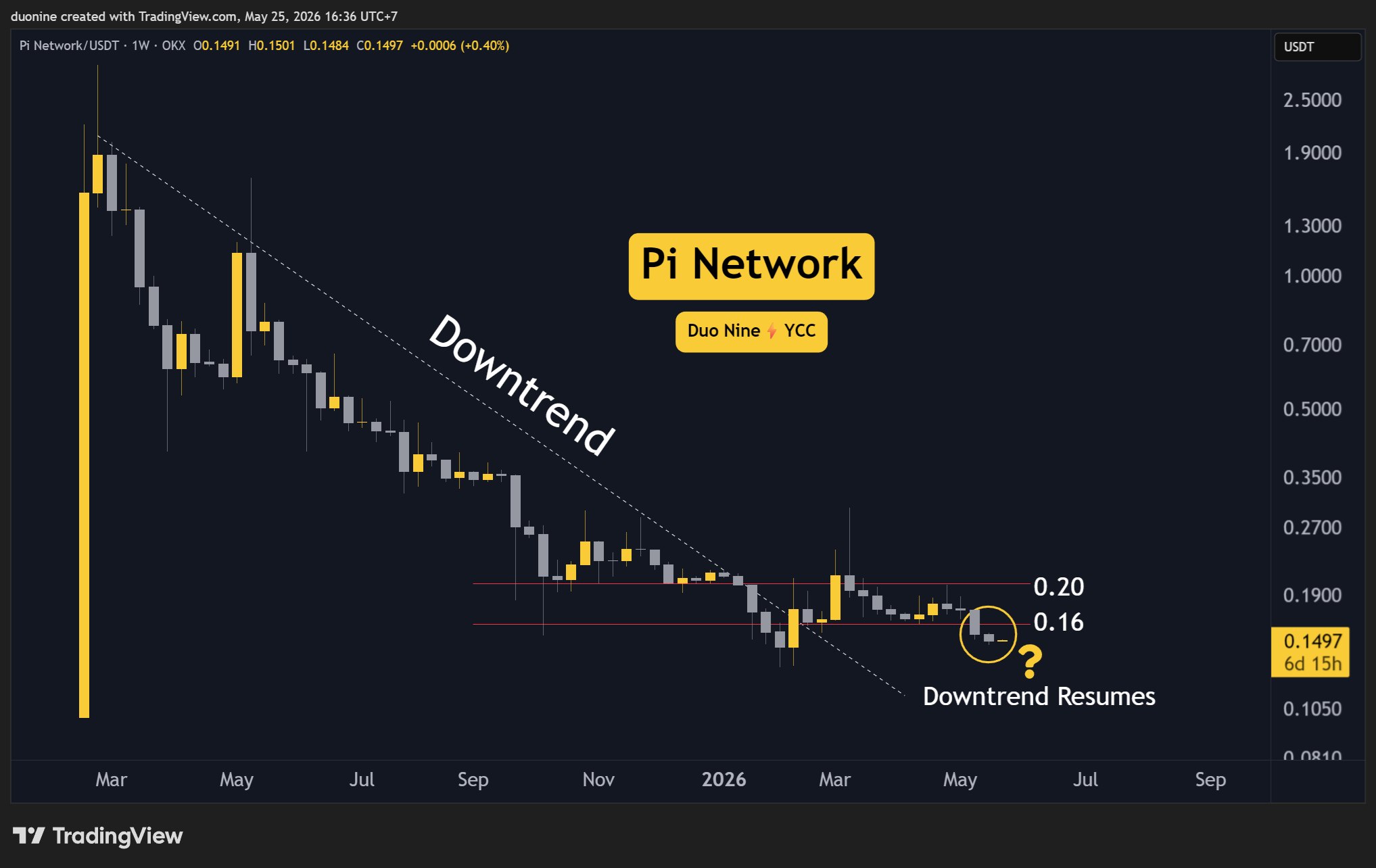
    Key Support Levels: $0.15, $0.13
    Key Resistance Levels: $0.16, $0.20

    Following the loss of support at $0.16, the price of Pi Network (PI) quickly fell to $0.15, where some buying interest has emerged. However, it remains uncertain whether this support level will hold. A stronger support level is seen at $0.13, which has previously prevented further declines.

    With this recent breakdown, sellers have regained control, potentially driving PI lower, even as buyers attempt to halt the downtrend. This is notable given that PI has already corrected by 96% from its all-time high.

    Despite the current advantage for sellers, their trading volume remains low, creating lower highs. This suggests a lack of strong conviction or limited interest in pushing PI’s price significantly lower.

    If the $0.15 support level holds, buyers could attempt to reclaim $0.16 and regain momentum, potentially reversing the recent losses since the price action turned bearish.

    The 3-day Moving Average Convergence Divergence (MACD) continues to fall to new lows, as indicated by its histogram. While this is bearish, it is occurring with decreasing sell volume. This could be interpreted as a bullish divergence, suggesting a potential reversal.

    If the MACD histogram flattens this week, it would signal that sellers are losing control of the price, potentially leading to a relief rally.