Tag: Neutral

  • Hyperliquid’s RWA Trading Volume Surpasses Crypto for First Time

    Hyperliquid’s RWA Trading Volume Surpasses Crypto for First Time

    For the week of July 13-19, 2026, trading volume from tokenized traditional financial instruments, known as Real-World Assets (RWAs), on the Hyperliquid platform surpassed that of cryptocurrencies for the first time. RWAs accounted for 52% of Hyperliquid’s total weekly trading volume, according to data reported by Blockworks.

    Lorenzo Valente, director of digital assets research at ARK Invest, announced this milestone on the social media platform X. During the specified week, RWAs generated $25.1 billion in trading volume, making up 52% of Hyperliquid’s total weekly volume of $48.2 billion. Valente also noted a running figure where RWA trading volume stood at 54%, totaling $26 billion.

    This development occurred within a broader market context where total perpetual Decentralized Exchange (DEX) volume across the industry reached $79 billion last week. Hyperliquid processed a significant portion of this, handling $50 billion. Notably, the $26 billion in RWA trading on Hyperliquid alone was larger than the combined crypto perpetual volume of all other decentralized exchanges combined.

    HIP-3 Framework Fuels RWA Growth

    The mechanism enabling this growth is HIP-3, a framework launched by Hyperliquid in October 2025. This framework allows external teams to build their own perpetual markets using Hyperliquid’s infrastructure, requiring builders to stake 500,000 HYPE tokens, valued at approximately $30 million.

    Since June, single stocks have become the dominant type of RWA traded within the HIP-3 system, now comprising 61% of all RWA trading. The HIP-3 platform has previously hosted pre-IPO markets for companies such as SpaceX, Anthropic, and OpenAI, with SK Hynix being the most-traded stock on Hyperliquid.

    Shifting Market Focus

    Valente has expressed a shift in his perspective on market aggregation, stating he is no longer convinced that RWA trading will naturally converge on the same venues as crypto. He predicts the emergence of dedicated category leaders within the RWA space and suggests that a platform’s dominance in Bitcoin and Ethereum flow may be less critical than previously assumed. Valente added that traders solely focused on crypto tokens might be concentrating on the wrong market.

    This trend has drawn attention from institutional players. In September 2025, ARK Invest CEO Cathie Wood compared Hyperliquid to Solana in its early days on the Master Investor podcast, highlighting its potential as a “new kid on the block.” ARK Invest has not reported any subsequent positions in the platform.

    Despite the significant RWA volume, uncertainties remain. It is not yet reported whether RWA trading will indeed aggregate on separate venues from crypto, and ARK Invest has not disclosed any further investment actions since Wood’s podcast remarks. The data indicates a notable shift in trading activity on Hyperliquid, suggesting a potential evolution in the focus of decentralized finance.

    Why This Matters

    The materials describe a narrow update: For the week of July 13-19, 2026, trading volume from tokenized traditional financial instruments (RWAs) on Hyperliquid surpassed crypto trading volume. ARK has not reported any position in Hyperliquid since Cathie Wood’s podcast statement.

  • Foundation Secures $52.5M for Altman’s ‘Proof of Human’ ID

    Foundation Secures $52.5M for Altman’s ‘Proof of Human’ ID

    World Foundation Secures $52.5 Million for “Proof of Human” System Amidst AI Surge

    The World Foundation announced Friday it has raised $52.5 million to expand World ID, a “proof of human” system developed by Sam Altman’s World. The nonprofit’s move signals a growing conviction that verifying human identity will become increasingly crucial as artificial intelligence agents proliferate across the internet.

    Key Investors Backing World ID Expansion

    The initial token sale was spearheaded by Pantera Capital and included participation from Bain Capital Crypto, Nasdaq-listed Eightco Holdings, Selini Capital, and Susquehanna Crypto. All Worldcoin (WLD) tokens sold in this round are subject to a 12-month lock-up period. The funds are earmarked for deploying World ID to organizations, consumers, and their AI agents, according to the Foundation. Cosmo Jiang, a general partner at Pantera, emphasized the “acutely clear” need for proof of human identity as AI development accelerates.

    World ID: Verifying Humanity Through Iris Scans

    World ID enables individuals to confirm their unique human status without disclosing personal identity. This is achieved through a one-time iris scan conducted via a spherical device known as the Orb. The scan generates an ID that is then stored on the user’s smartphone. World, which rebranded from Worldcoin in 2024, was co-founded by OpenAI CEO Sam Altman with the aim of establishing a global “proof of personhood” system. The Foundation stated that the technology is slated for integration this year with platforms such as Zoom, Docusign, Okta, Vercel, and Tinder. Additionally, a new enterprise-ready version, World ID 4.0, will empower external developers to incorporate their own credentials into the system.

    Project Milestones and Growth

    The fundraising effort coincides with the project’s third anniversary. The World Foundation reported that over 39 million people have joined the network, with 18 million having undergone verification by an Orb. The system has processed a total of 475 million ID proofs to date.

    Regulatory Scrutiny and Global Challenges

    Despite the expansion, World’s iris-scanning model has faced significant regulatory challenges in various countries concerning its handling of biometric data. In 2024, Hong Kong ordered the project to cease operations. A Kenyan court mandated the deletion of users’ biometric data, and Brazil prohibited payments for iris scans. Spain moved to halt its data collection activities, and South Korea imposed a $830,000 fine on the project for privacy violations.

    Persistent Institutional Interest

    Nevertheless, institutional interest in World ID has continued to grow. Eightco, a participant in the recent funding round, established the first corporate WLD treasury last year. This week, Grayscale filed for the first U.S. ETF linked to the Worldcoin token.

  • Farage Backer’s Polymarket Account Received $9M in Crypto from Unknown Sources: FT

    Farage Backer’s Polymarket Account Received $9M in Crypto from Unknown Sources: FT

    Polymarket Account Linked to Convicted Fraudster Received Millions in Crypto for Trump Election Bets

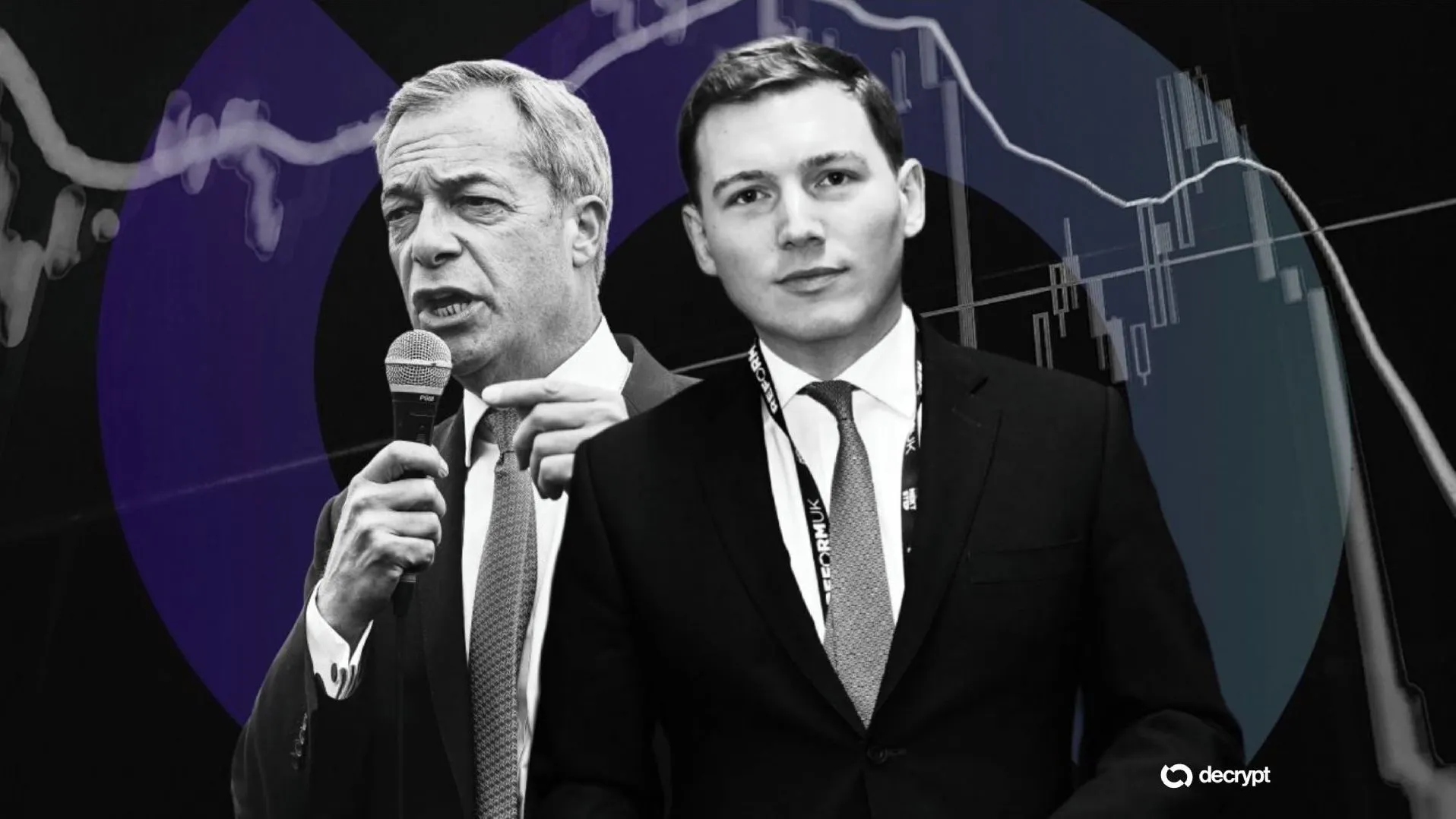
    A Polymarket account registered under the name “GCottrell93,” believed to belong to convicted fraudster George Cottrell, received $8.8 million in cryptocurrency from unidentified sources in 2024 and was used to place bets on Donald Trump’s election victory, according to a report by the Financial Times.

    Crypto Transactions and Betting Activity

    The account was funded in late October 2024 through two cryptocurrency exchanges: $7 million from OKX, transferred in five installments, and $1.83 million routed via ChangeNOW, the Financial Times reported, citing public blockchain data. Immediately upon receipt, these funds were staked on a Trump win. Following Trump’s victory, the account reportedly yielded a profit of $4.46 million. Subsequently, almost all the funds were moved out to other digital wallets. The identities of both the money providers and the recipients of the winnings remain undisclosed.

    Blockchain Investigator’s Assessment and Cottrell’s Silence

    While the Polymarket account has not been formally linked to Cottrell, blockchain investigator ZachXBT stated he has “high confidence” it belongs to him. ZachXBT had previously flagged the account earlier this year in relation to a $550,000 loss on a bet concerning U.S. strikes on Iran. Cottrell’s legal representatives declined to comment on his financial matters or specific transactions, emphasizing that their silence did not constitute an acceptance of the Financial Times’ findings. Reform UK did not provide a response to the newspaper.

    Cottrell’s Financial Support for Nigel Farage

    A separate investigation by The Sunday Times earlier this month revealed that Cottrell had financed Nigel Farage’s operations, covering expenses such as staff, private security, transportation, and accommodation, in the year leading up to Farage’s election to Parliament. These benefits were not declared by the Reform UK leader. Under the MPs’ code of conduct, members are required to disclose gifts, benefits, and hospitality that could reasonably be perceived by others as influencing their actions or words. The Sunday Times also reported that Cottrell had provided security for Farage for several months and had recruited and paid three staff members to manage his social media presence.

    Allegations of Unlicensed Betting and Property Use

    The Sunday Times investigation also connected Cottrell to a cryptocurrency gambling platform allegedly involved in “potentially illegal” unlicensed betting operations in the UK. Since the election, Cottrell has reportedly allowed Farage to reside in a five-story house he rents near Buckingham Palace, a short distance from Reform UK’s headquarters. Cottrell’s lawyer stated that as a “close friend,” Cottrell “did, and does, allow Mr Farage to stay in” the property.

    Unanswered Questions on Funding and Ownership

    Both The Sunday Times and the Financial Times have raised questions about whether funds from unidentified sources were used to subsidize benefits for Farage or Reform UK. Cottrell has declined to answer these inquiries, including questions about the beneficial ownership of the Polymarket wallet.

    Cottrell’s Background and Legal History

    George Cottrell, 32, comes from an aristocratic background. In 2016, U.S. prosecutors charged him with 21 counts related to an alleged “dark web” money laundering scheme. He pleaded guilty to a single count of wire fraud as part of a plea agreement that saw the remaining charges dropped, and he served eight months in prison. The Sunday Times reported that he has since applied for a U.S. presidential pardon.

    Increased Scrutiny of Farage’s Crypto Ties

    This report emerges amid heightened scrutiny of Farage’s connections to cryptocurrency. Earlier this month, it was disclosed that bankers had filed a suspicious activity report concerning a £5 million ($6.7 million) gift to Farage from billionaire Tether investor Christopher Harborne. Farage was also reportedly referred to the UK’s standards watchdog over alleged crypto lobbying activities.

    Farage’s Resignation and By-Election

    Farage resigned his parliamentary seat in Clacton on July 8, triggering a by-election which he framed as a “people versus establishment” contest. He has denied any wrongdoing following weeks of scrutiny regarding his finances. The major political parties—Labour, the Conservatives, the Liberal Democrats, and the Greens—declined to field candidates, characterizing the contest as a publicity stunt.

    Unusual By-Election Challenger

    In the August 13 by-election, Farage faces a record field of 34 contenders. His most notable challenger is satirical candidate Count Binface, who describes himself as an “intergalactic space warrior” from the planet Sigma IX and campaigns with a metal dustbin on his head.

  • BOBBOBUSDT Perpetual Contract Delisted

    BOBBOBUSDT Perpetual Contract Delisted

    Bybit to Delist BOBBOBUSDT Perpetual Contract

    Cryptocurrency exchange Bybit announced that it will delist the BOBBOBUSDT Perpetual Contract on July 27, 2026, at 9:00 AM UTC.

    Following the delisting, trading for the BOBBOBUSDT Perpetual Contract will cease. All active and conditional orders associated with this contract will be automatically canceled.

    Furthermore, any open positions in the BOBBOBUSDT Perpetual Contract will be automatically closed. The settlement price for these positions will be determined by the average index price recorded in the 30 minutes leading up to the delisting.

    The BOBBOBUSDT Perpetual Contract will also be removed from Bybit’s Trading Bots service and will no longer be supported. In the realm of Copy Trading, all unfilled orders for the BOBBOBUSDT Perpetual Contract will be canceled automatically.

  • Cardano (ADA) Whale Accumulation Continues Amidst Uncertain Price Outlook

    Cardano (ADA) Whale Accumulation Continues Amidst Uncertain Price Outlook

    Cardano (ADA) has seen significant accumulation by large holders over the past week, a trend that briefly elevated its market capitalization above Stellar and into the top 15 cryptocurrencies. This accumulation has reached its highest balance in approximately three and a half years, though future price movements remain subject to diverse predictions and prevailing market sentiment.

    According to Santiment data, over the last seven days, large Cardano wallets have added more than 30 million ADA to their holdings, bringing the total balance for these wallets to 5.69 billion ADA. Wallets holding between 100,000 and 100 million ADA now collectively possess 25.6 billion ADA, the highest recorded balance for this cohort in roughly three and a half years. This sustained buying interest from significant investors is a key development.

    Currently trading around $0.165, ADA is testing support at this level. The immediate resistance is noted at $0.172, with a potential upward movement towards $0.180 if buying volume increases. However, a more cautious outlook suggests stronger support could emerge near $0.148 should market sentiment weaken.

    While the accumulation is notable, its direct impact on future price performance remains uncertain. Charles Hoskinson, a prominent figure in the Cardano ecosystem, has expressed optimism, believing ADA could re-enter the top 10 cryptocurrencies by market cap before the year’s end. Such a feat would require a substantial rally from current levels.

    Market analysis indicates that ADA’s recent price action has been largely influenced by broader sentiment across the altcoin market, rather than specific Cardano-centric catalysts. Consequently, ADA remains highly sensitive to overall cryptocurrency market flows. A return of risk appetite to the broader market could potentially turn the current dip into another accumulation zone.

    Forecasting models present mixed outlooks. Some anticipate a modest recovery in the coming weeks, while others maintain a more cautious stance, highlighting the $0.148 support level. Three potential scenarios are being closely monitored: a bullish case where ADA defends $0.165 support and rebounds towards $0.172 and $0.180; a base case involving consolidation between $0.165 and $0.172 amidst continued whale accumulation; and a bearish scenario where ADA revisits the $0.148 support if market sentiment deteriorates.

    The ongoing accumulation trend by large holders may signal positioning for future price movements. However, whether this represents a strategic move for a significant rally or opportunistic buying at lower prices remains a key question. Traders are closely observing the $0.165 support level, with many likely awaiting technical confirmation before anticipating a sustained recovery. ADA’s current price action underscores its sensitivity to overall market conditions, and any significant upward movement will likely require improved buying volume and a positive shift in broader crypto market sentiment.

    Why This Matters

    The accumulation of over 30 million ADA by large holders in the past week, reaching the highest balance in three and a half years, is a notable development. However, the ultimate impact on ADA’s price direction is uncertain and depends on broader market sentiment and technical factors.

    Broader Context

    Cardano price is trading around $0.165, testing support at this level. Large holders have accumulated more than 30 million ADA over the past week, a trend that briefly pushed ADA into the top 15 by market cap. The future price trajectory remains subject to various predictions and market conditions.

  • XRP Falters on Cup and Handle as Ripple Unveils Mint to Address RLUSD

    XRP Falters on Cup and Handle as Ripple Unveils Mint to Address RLUSD

    XRP Caught Between Technical Promise and Price Resistance

    XRP is currently navigating a challenging market, caught between a technically promising setup and persistent overhead price resistance. This stalemate is testing the patience of bullish investors. A widely tracked cup-and-handle pattern, which traders have been observing for weeks, now faces the risk of invalidation. XRP is trading around $1.11, significantly below the former breakout zone of $2.68 to $2.77 that was anticipated in earlier bullish forecasts.

    Ripple’s Mint Function and RLUSD

    Ripple has introduced a dedicated “Mint” function designed to streamline the issuance of its stablecoin, RLUSD. This update aims to address minting delays and enhance the predictability of settlements. The move strengthens Ripple’s enterprise infrastructure and could potentially increase RLUSD’s appeal to institutional investors. However, the direct benefit of this development is seen as favoring stablecoin adoption rather than immediately boosting demand for spot XRP.

    Regulatory Clarity and Infrastructure

    The broader issue of regulatory clarity across Ripple’s product suite remains a significant variable influencing XRP’s price. Nevertheless, ongoing infrastructure upgrades could foster long-term confidence, particularly if institutional adoption continues to expand. Until then, traders will require stronger demand to push XRP back towards higher resistance levels.

    Macroeconomic Headwinds

    The current macroeconomic backdrop presents additional challenges. Major U.S. stock indexes have faced pressure from megacap technology stocks amid renewed concerns about artificial intelligence spending. Furthermore, headlines regarding tariffs have contributed to a risk-off sentiment across financial markets. Historically, when equities decline, altcoins rarely escape the ensuing selling pressure.

    Technical Outlook for XRP

    XRP is trading near $1.11, positioned just below a key resistance zone that many analysts continue to monitor closely. The measured move target, estimated around $5.18, remains contingent on a sustained breakout above previous swing highs. In the interim, the 50-day and 200-day exponential moving averages (EMAs) are trading below the current price, suggesting a constructive long-term trend.

    A clear breakout trigger would involve a daily close above nearby resistance, supported by strong trading volume. Such a move could pave the way for a rally towards the next resistance zone, situated between $1.30 and $1.40. Until this occurs, XRP may continue to trade within its recent range, potentially frustrating both optimistic and pessimistic traders.

    On the downside, a loss of support around the $1.08 to $1.10 range could lead to further testing of lower price levels. Some wave analysts have cautioned that a more significant correction is possible if momentum continues to wane. However, these bearish projections are currently conditional and not yet confirmed.

    Long-term price targets, such as $33 to $67 or even $60, are still being discussed by prominent XRP analysts. It is important to note that these are multi-cycle projections rather than immediate expectations. For the present, the primary question remains whether XRP can reclaim higher resistance levels and build sufficient momentum for a sustained breakout.

    The Challenge of Late-Cycle Positioning

    XRP’s current cup-and-handle setup highlights a common frustration in late-cycle market positioning: even a technically sound pattern for an asset with a $70 billion market capitalization requires a significant capital event to drive substantial price movement. Traders are increasingly shifting their focus from stalled large-cap assets to early-stage infrastructure projects where the entry price still reflects discovery rather than inflated expectations.

    Emerging Projects Gaining Traction

    One project attracting attention is LiquidChain, a Layer 3 protocol that aims to consolidate liquidity from Bitcoin, Ethereum, and Solana into a unified execution environment. It features a Unified Liquidity Layer with Single-Step Execution and Verifiable Settlement, enabling developers to deploy applications once and access all three ecosystems without the complexities of bridging.

    The project’s presale is currently priced at $0.01483, having raised $920,000 to date. LiquidChain is approaching the $1 million milestone, a point that has historically marked an inflection in presale momentum.

  • Hoskinson: Cardano’s Slow Pace Proves Effective

    Hoskinson: Cardano’s Slow Pace Proves Effective

    Cardano’s Development Strategy Mirrors AI Pioneer’s Rise, Says Hoskinson

    Charles Hoskinson, the founder of Cardano, has drawn a parallel between the blockchain’s development trajectory and that of artificial intelligence firm Anthropic, suggesting that a disciplined, security-focused approach is proving more effective than rapid market entry.

    In a recent interview, Hoskinson highlighted Anthropic’s success in the AI landscape, noting that despite entering the market later than established players like Google and OpenAI, the company has emerged as a leader. He attributed this to Anthropic’s adoption of a disciplined development philosophy from its inception, prioritizing robust practices over sheer speed. Hoskinson believes Cardano is now experiencing a similar shift in perception, as developers and investors increasingly value security and governance over “speed to market.”

    “Google initially had the big lead and then OpenAI had the big lead and then somehow this Anthropic thing came out and they were able to leapfrog everybody,” Hoskinson stated in an interview with CoinDesk. “They hadn’t fundamentally changed, they just had the right mindset.”

    He posited that this principle could ultimately benefit Cardano. “People are starting to wake up, especially in the age of AI hacking, where everything is getting broken, where speed to market is not the most desirable way,” he added.

    Exploits Underscore Risks of Prioritizing Innovation Over Resilience

    Hoskinson specifically cited the recent Kelp DAO exploit and its ripple effects on Aave as examples of the risks associated with prioritizing innovation over resilience. In April, Kelp DAO suffered a significant exploit resulting in the loss of $292 million after attackers exploited a misconfigured LayerZero bridge to forge cross-chain messages and withdraw unbacked rsETH.

    While Aave’s smart contracts remained uncompromised, the attacker used the fraudulent rsETH as collateral to borrow real assets. This left the lending protocol with substantial exposure to bad debt and triggered billions of dollars in total value locked (TVL) outflows before recovery measures were implemented.

    For Hoskinson, this incident demonstrated how vulnerabilities in one protocol can rapidly propagate through the broader decentralized finance (DeFi) ecosystem, leading to massive outflows and reputational damage. “The recent AAVE thing and Kelp thing shows you how quickly you can lose your TVL (total value locked) and how quickly you can lose your customer base,” he explained. “So, it works until it doesn’t, and when it doesn’t, it’s catastrophic for the ecosystem.”

    He argued that lasting stability requires more than technically sound code. “People want stability and it only comes from having a clear governance system, a clear software development system, and really good ideas on how to develop a roadmap in a sustainable way,” Hoskinson asserted.

    Addressing Criticisms and Future Outlook

    Hoskinson’s comments come amid ongoing criticism from segments of the crypto community regarding Cardano’s perceived prioritization of academic research, a key differentiator, at the expense of ecosystem growth.

    Cardano remains a significant protocol by market capitalization, currently valued at $6.2 billion and ranking as the 20th largest project. However, this is a considerable decline from its previous standing and aspirations. ADA has been one of the worst performers over the past year, down 80% in the last 365 days. In contrast, Ethereum, a platform Hoskinson frequently compares Cardano to, has seen a 48% decline, while Bitcoin, the industry benchmark, is down 44%.

    Hoskinson acknowledged that the decision-making process has not been without its flaws. “It took us a long time to get here. A lot of mistakes were made, and I own the lion’s share of them as the leader,” he admitted.

    Despite past challenges, he expressed confidence in Cardano’s current positioning. “Ultimately, I’m very happy with where we sit, and I think we will grow very strongly over the next 12 to 24 months,” Hoskinson stated.

    The broader argument reflects an ongoing industry debate about whether future crypto adoption will be driven by protocols that prioritize rapid development or those that focus on security, governance, and long-term sustainability. The question remains whether these approaches are mutually exclusive.

  • Bitcoin Market Cycles: Debate Continues on Macroeconomic Factors vs. Halving Theories

    Bitcoin Market Cycles: Debate Continues on Macroeconomic Factors vs. Halving Theories

    The cryptocurrency market is currently engaged in a significant debate regarding the potential bottoming of Bitcoin’s bear market. Analysts and firms are divided, with some adhering to traditional four-year cycle theories tied to halving events, while others contend that broader macroeconomic factors are now the primary influence on price movements. There is uncertainty about whether Bitcoin’s bear market has already bottomed or will decline further, and the exact timing of Bitcoin’s market bottom remains unclear.

    Grayscale’s Macroeconomic Perspective

    Grayscale, a prominent digital asset manager, posits that Bitcoin has matured and is increasingly influenced by macroeconomic forces, similar to other major financial assets. According to Grayscale, historical bear markets have often coincided with periods of slowing economic growth and rising real interest rates. This year’s downturn has unfolded alongside shifts in expectations for U.S. Federal Reserve policy and increased real interest rates. Grayscale suggests that if the Federal Reserve refrains from further rate hikes and economic growth remains resilient, Bitcoin’s price may have already found its low, potentially negating the need for further declines predicted by traditional cycle models.

    Historical Cycles vs. Current Deviations

    Historically, Bitcoin has tended to reach its market bottom approximately one year after a cyclical peak and about two and a half years after a halving event, with cumulative declines averaging around 80%. Previous bear markets typically took roughly 365 days to reach their final trough. However, the current cycle’s duration to a potential bottom is estimated at around 260 days. This deviation from historical timing prompts questions about the continued applicability of the four-year cycle theory, and whether cycle lengths for Bitcoin can change.

    Crypto trader Killa noted that Bitcoin’s market structure, including sweeping the “dead cat base low” and completing a five-wave corrective structure, suggests a potential bottom. However, Killa remains uncertain, acknowledging the unusual timing compared to previous cycles and maintaining a “50/50” outlook. Killa explained that while cycle lengths can change, the current timing deviates from historical norms, though the trader believes Bitcoin is more likely to form higher lows than make significant new lows.

    Technical and On-Chain Signals

    Further analysis comes from crypto analyst Ali Martinez, who observed technical signals on the monthly chart resembling those seen at the end of previous bear markets in 2015, 2019, and 2022. Ali Martinez acknowledged that on-chain metrics such as MVRV and CVDD still leave room for a decline toward the $40,000-$50,000 range, but the current technical setup historically points to a dominant accumulation zone with a favorable risk-to-reward profile for spot Bitcoin buyers.

    Crypto analyst Doctor Profit also warned that investors strictly adhering to the traditional four-year cycle and waiting for a bottom in September or October might miss the market’s next upward move. Doctor Profit suggested that Bitcoin could potentially revisit the $54,000 area but does not anticipate a drop below $50,000, believing that gradual accumulation already presents an attractive risk-reward profile.

    Navigating Uncertainty

    The ongoing debate highlights a fundamental uncertainty: whether Bitcoin’s price behavior is still primarily dictated by its internal halving cycles or if it has transitioned to being more closely aligned with broader macroeconomic conditions. The future direction of U.S. Federal Reserve policy and the resilience of global economic growth are key factors that could influence which of these theories ultimately suggests more accurate. Investors face the challenge of navigating this evolving landscape, where historical patterns may offer less reliable guidance than in the past.

    Why This Matters

    The materials describe a narrow update: Analysts and firms are debating the end of Bitcoin’s bear market, with some predicting a further drop based on historical four-year cycles and others suggesting the bottom may have already occurred due to macroeconomic shifts and technical indicators. Whether Bitcoin’s bear market has already bottomed or will decline further.

    Broader Context

    Source materials place the market analysis in this context: Bitcoin’s bear market.

  • Shiba Inu Supply Concentration Creates Market Uncertainty Amidst Mixed Signals

    Shiba Inu Supply Concentration Creates Market Uncertainty Amidst Mixed Signals

    Shiba Inu (SHIB) presents a complex market dynamic, characterized by a vast number of holders juxtaposed with an extreme concentration of its supply within a small group of ‘whale’ wallets. This dichotomy is occurring as the token navigates price volatility and conflicting analyst outlooks.

    As of recent data, Shiba Inu boasts approximately 1,678,502 holders. However, a closer examination reveals that just 703 ‘whale’ wallets, each holding over $100,000 worth of SHIB, control a significant 94.5% of the total supply. This level of concentration means that theoretically, a small cohort of investors could exert considerable influence over the market through coordinated actions, such as large sell-offs or accumulation.

    In terms of price performance, Shiba Inu has experienced a notable decline, with its price down 72% on a yearly scale. The token’s current price hovers around $0.000004235 as of press time. This downturn occurs despite a recent surge in holder numbers, with the total number of SHIB addresses reaching an all-time high of 1,676,535 earlier this month, including an increase of 75,000 new holders in a single day.

    Conflicting Market Outlooks

    Amidst this price volatility, market analysts are divided on Shiba Inu’s future trajectory. Some analysts point to consolidation below a five-year downtrend as a potential precursor to a significant price increase. They argue that the longer the consolidation period, the larger the potential notable move. This bullish scenario is further supported by a decrease in SHIB reserves held on centralized exchanges, with approximately 86.2 trillion SHIB currently held on these platforms. A reduction in exchange reserves is often interpreted as a sign of decreased immediate selling pressure.

    Conversely, other analysts are issuing warnings, citing a 91% match between SHIB’s recent performance and a bearish pattern observed in 2023. This historical correlation suggests a potential for a 20% price drop, potentially bringing the price down to the $0.0000032–$0.0000033 range. The presence of such contrasting interpretations highlights the inherent uncertainty surrounding Shiba Inu’s market.

    Navigating Uncertainty

    The supply concentration in whale wallets, coupled with these mixed market signals, creates a scenario where significant price movements are theoretically possible. However, the exact direction and timing of any such movements remain uncertain. The potential impact of coordinated actions by whale investors adds another layer of unpredictability.

    It is important to note that Shiba Inu has not officially endorsed any specific investment strategy, and its price movements are not guaranteed. Investors are advised to consider the significant supply concentration and the conflicting market signals when evaluating Shiba Inu’s potential.

    Why This Matters

    The materials describe a narrow update: Shiba Inu has approximately 1. Whether a rebound or a price crash will occur.

    Broader Context

    Source materials place the factual news in this context: Shiba Inu is referred to as the ‘self-proclaimed Dogecoin killer’.

  • Cardano Price Outlook: Bullish vs. Bearish Signals

    Cardano Price Outlook: Bullish vs. Bearish Signals

    Cardano’s native token, ADA, has emerged as one of the top-performing cryptocurrencies among the top 100 by market capitalization over the past week, with its price climbing 8% to approximately $0.17.

    Two significant developments suggest this upward trend may be in its nascent stages, though another factor indicates a potential correction is equally plausible.

    Earlier this month, large ADA investors, commonly referred to as “whales” in the crypto community, increased their total holdings to 25.6 billion coins. This accumulation represents nearly 70% of the token’s circulating supply and marks the highest level seen since February 2023. Concurrently, retail investors have scaled back their exposure to ADA. According to data analytics firm Santiment, this divergence in investor behavior could establish a favorable foundation for the asset.

    More recently, prominent analyst Ali Martinez reported that whales have acquired 30 million ADA units, valued at over $5 million at current market rates, within the last month. This renewed activity from this influential investor group signals their strategic positioning for a potential future price surge. In the cryptocurrency sphere, a prevailing theory posits that whales possess privileged information regarding events or news that could influence an asset’s valuation, and that their investment decisions are rarely driven by mere speculation. Their actions, therefore, could potentially incentivize smaller investors to enter the ecosystem and inject fresh capital.

    The second bullish indicator for ADA is its Relative Strength Index (RSI). This technical analysis tool gauges the speed and magnitude of recent price changes to determine if a token is due for a trend reversal. Readings below 30 typically signal oversold conditions, suggesting a potential rally, while levels above 70 serve as a warning of an impending correction. Currently, ADA’s RSI hovers around 28.

    However, a bearish factor also warrants consideration. In recent times, exchange inflows have outpaced outflows, indicating that investors are moving their assets from self-custody to centralized platforms. This trend can heighten immediate selling pressure.

    Several analysts on the social media platform X have commented on ADA’s rebound, anticipating a more substantial upward movement in the short term. “Master of Crypto” suggested that if the positive momentum persists, the price could reach $0.219.

    Other analysts, such as JAVON MARKS, express even greater optimism, forecasting significant price increases that appear ambitious from the current vantage point. This analyst believes ADA is approaching a “key converging/breaking point” that could pave the way for a rise as high as $2.90. Celal Kucuker also recently weighed in, predicting a major ascent to $5.