Tag: Neutral

  • Bybit TradFi Lists 10 Stock CFDs

    Bybit TradFi Lists 10 Stock CFDs

    New Stock CFDs Now Available

    Ten new stock Contracts for Difference (CFDs) have been introduced, offering traders the opportunity to engage with their preferred stocks and explore emerging market prospects.

    CFD Specifications

    Liquidity Notice: Traders should be aware that CFD quotes may experience reduced liquidity outside of United States trading hours.

    For comprehensive details on all available TradFi trading pairs, please consult the Help Center.

  • Bitcoin Price Action Divides Analysts Amid Shifting ETF Flows

    Bitcoin Price Action Divides Analysts Amid Shifting ETF Flows

    Bitcoin’s valuation has rebounded to hover around $65,000, a notable recovery from its dip below $58,000 in late June. This price movement has triggered a divergence of opinions among market analysts regarding whether the current surge indicates a sustainable uptrend or a potential precursor to a significant downturn.

    Bearish Outlooks and Historical Parallels

    Some analysts express caution, drawing parallels to past market events. X user BATMAN noted that the current price increase mirrors a bullish pump observed in autumn 2022, which was subsequently followed by a substantial price drop to approximately $16,000. BATMAN stated, “Side by side, this level looks concerning. It mirrors a similar bullish pump from 2022 that coincided with nothing afterward. History might not repeat itself, but it sure does rhyme.”

    Echoing this cautious sentiment, X user Kabuki views the latest price setup as a potential bull trap. Kabuki suggests that Bitcoin could decline to as low as $47,000 by August before potentially initiating a major uptrend that could lead to over $200,000 by the start of next year. These perspectives highlight a concern that the current rally might be a deceptive move before a more significant price correction.

    Bullish Undercurrents and Institutional Interest

    Conversely, other market participants point to renewed institutional interest as a positive indicator. Inflows into spot Bitcoin Exchange-Traded Funds (ETFs) have surpassed outflows for seven consecutive days, a trend not seen since April. This development suggests increasing exposure to Bitcoin by institutional investors, including pension funds and hedge funds. This contrasts with the situation at the end of June, when spot BTC ETFs experienced a weekly outflow of approximately $1.8 billion.

    Technical Indicators and Key Levels

    Technical analysis also informs the ongoing discussion. X user Ted emphasized the importance of Bitcoin maintaining its value above certain levels, suggesting that a price of $67,500 to $68,000 could be achievable if the cryptocurrency stays above key support. Meanwhile, Bitfinex’s analysts have identified a critical reaction zone between $67,900 and $68,300. This area is significant as it aligns with the short-term holder realized price and the opening level for the second quarter. According to Bitfinex’s analysts, a decisive move either above or below this range could significantly influence Bitcoin’s short-term direction.

    Navigating Market Uncertainty

    The prevailing sentiment in the market remains one of uncertainty. While recent ETF inflows offer a glimmer of optimism and suggest renewed institutional confidence, historical price patterns and key technical levels present cautionary signals. The market is left to weigh these divergent views, with the potential for both a continued uptrend and a significant price correction remaining possibilities. The future trajectory of Bitcoin’s price is currently unclear.

    Why This Matters

    The materials describe a narrow update: Bitcoin’s valuation has recently risen to around $65,000 after a dip below $58,000 in late June. Whether the current Bitcoin rally marks the start of a new bull run or will end in a major collapse.

    Broader Context

    Source materials place the market analysis in this context: The primary cryptocurrency has staged a minor resurgence over the past week, with its valuation briefly rising to nearly $67,000 and now hovering around $65,000.

  • XRP Recovery: A Trap Until This Key Event

    XRP Recovery: A Trap Until This Key Event

    XRP Faces Key Resistance as Recovery Stalls

    Ripple’s XRP is currently struggling to break through a significant technical resistance level, despite a recent recovery from its late June lows. While the uptick has boosted short-term sentiment, the cryptocurrency is approaching a critical juncture where buyers must overcome substantial overhead supply to signal a broader trend reversal.

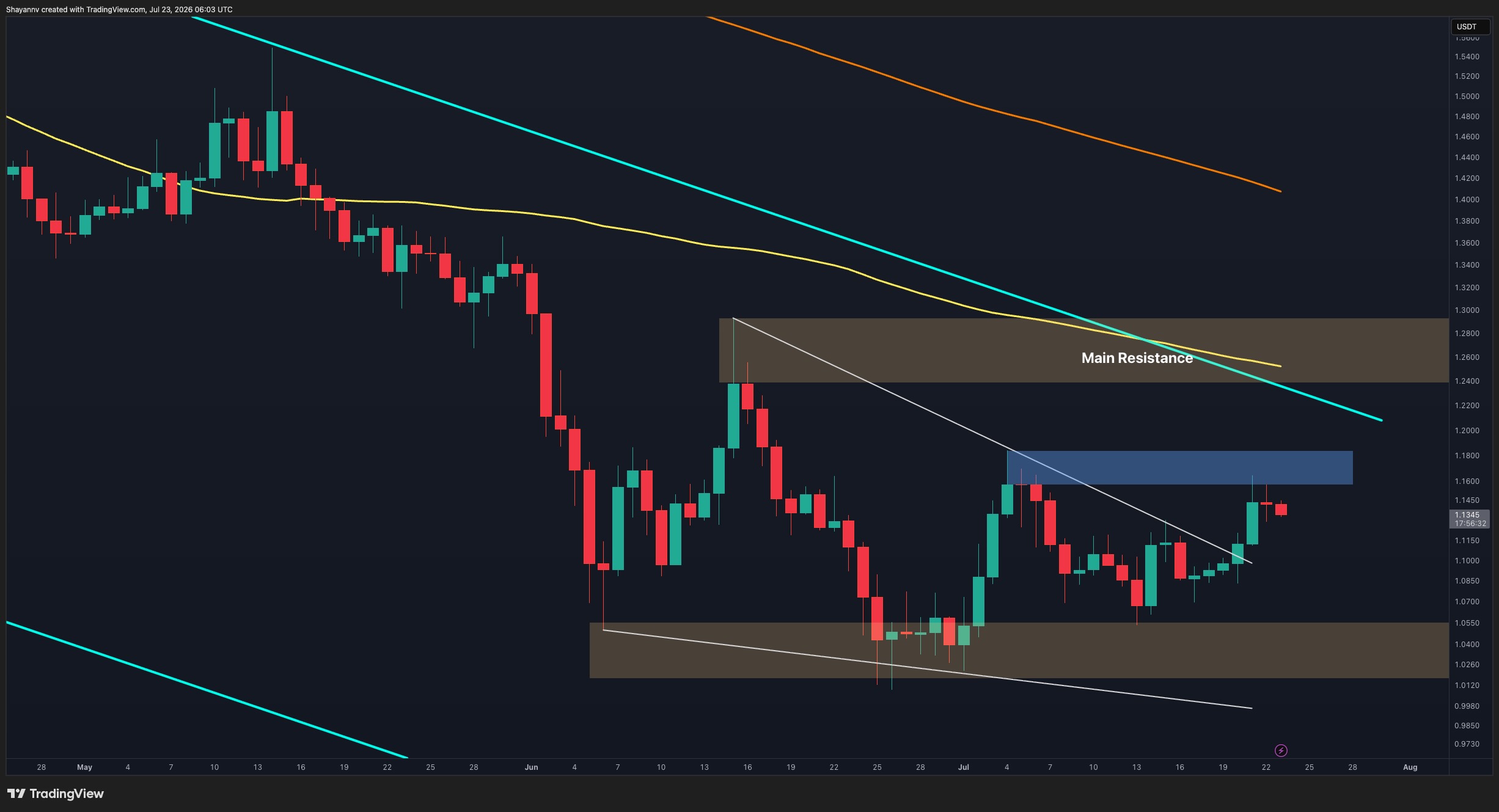
    On the daily chart, XRP continues to trade within a clearly defined long-term descending channel. Although the recent rebound has pushed the asset away from the $1.02 to $1.05 demand zone, the overall structure still favors sellers as long as XRP remains below the channel’s upper boundary and key moving averages.

    The immediate obstacle lies within the $1.24 to $1.29 resistance area, where the upper channel boundary intersects with the 100-day moving average. This confluence of technical indicators makes this zone particularly crucial; a rejection here would serve to reinforce the prevailing downtrend. A successful breach of this region would then bring the 200-day moving average into focus, but buyers must first establish a foothold above the current resistance cluster for a more positive outlook to emerge.

    On the downside, the $1.02 to $1.05 demand zone remains the primary support level. A failure to hold this area could see momentum shift back towards the broader bearish trend.

    Short-Term Outlook Offers Glimmer of Hope

    The 4-hour chart presents a more constructive short-term scenario. XRP has successfully reclaimed a descending trendline that had capped its price action throughout July and is now consolidating just below the $1.16 to $1.18 supply zone. This resistance has repeatedly thwarted bullish attempts in recent weeks, making it a pivotal level to watch. A decisive move above $1.18 could potentially propel the price towards the daily resistance zone of $1.24 to $1.29. Conversely, another rejection at this level would likely lead to a retest of the broken trendline as initial support.

    As long as XRP maintains its position above the reclaimed trendline, buyers hold a modest short-term advantage. However, the broader trend is expected to remain neutral to bearish until the price can establish acceptance above the overhead resistance cluster.

  • Dogecoin’s Technical Buy Signals Face Price Stagnation Amid Market Uncertainty

    Dogecoin’s Technical Buy Signals Face Price Stagnation Amid Market Uncertainty

    Dogecoin (DOGE) is currently exhibiting a notable divergence between its technical indicators and its actual price action. Despite the appearance of consecutive weekly TD Sequential buy signals—a pattern historically associated with potential rallies—Dogecoin’s price has remained largely stagnant, trading below the $0.073 mark over the past 24 hours. This disconnect highlights a period of market uncertainty for the popular meme coin.

    Analyst Ali Martinez has noted that the consecutive weekly TD Sequential buy signals are a rare occurrence and have historically preceded significant directional moves. However, in Dogecoin’s case, this bullish technical setup has not yet translated into upward price momentum. The meme coin is consolidating in a tight range, with short-term forecasts suggesting limited movement within a narrow band for the current week.

    Several factors contribute to this price stagnation. While the weekly buy signal offers a potential bullish outlook, other technical indicators present a mixed picture. The 50-day moving average for Dogecoin continues to slope lower, reflecting the recent downtrend. Furthermore, whale activity and derivatives data remain inconclusive, with open interest easing slightly and spot taker CVD momentum fading. The broader cryptocurrency market has also offered little support, with Bitcoin failing to hold above $66,500, which has kept risk appetite in check across major altcoins.

    Navigating Support and Resistance

    For Dogecoin to potentially see a shift from its current consolidation, bulls need to defend key support levels and attract stronger trading volume. Support is identified around $0.0722, followed by $0.0712, with a more significant floor near $0.0705. On the resistance side, levels to watch include $0.0740, $0.0746, and $0.0757. A decisive close above $0.0754 could potentially open the door towards $0.0793, according to some analyses. However, without a significant increase in trading volume, any projected upside remains modest.

    Dogecoin also remains below the $0.088 area, a level that previously acted as important support. Until this zone is reclaimed, analysts suggest that bulls still have work to do. The current trading dynamic, with a $1 billion open interest overhang at the $0.074 price point, is described by some as a trade rather than a long-term position, with limited upside potential in spot trading. A successful squeeze to $0.076, for instance, represents only about a 4% upside, which is more meaningful on leverage but limited for spot investors.

    Broader Market Context and Speculative Assets

    In related news, Maxi Doge ($MAXI), an ERC-20 meme token, has seen its presale raise close to $5 million at a current price of $0.000283. The project emphasizes community mechanics and meme-first marketing. However, this speculative asset operates independently of Dogecoin’s core technical analysis and market dynamics.

    Ultimately, Dogecoin’s current situation is characterized by uncertainty. While technical buy signals are present and rare, they have not yet overcome mixed market conditions, resistance levels, and a general lack of trading momentum. Investors are advised to monitor key levels and volume, recognizing that technical signals are not guarantees of future price movement. The possibility of a major bull rally remains uncertain, contingent on multiple factors aligning.

    Why This Matters

    The materials describe a narrow update: Dogecoin is showing technical buy signals on its weekly chart, but its price has not yet moved significantly. Whether the weekly TD Sequential buy signal will suggest a major bull rally remains uncertain.

  • WLFI Surges Double Digits as Bitcoin Dips Below $66K

    WLFI Surges Double Digits as Bitcoin Dips Below $66K

    Bitcoin’s recent price surge has stalled, with the cryptocurrency dipping back toward the $65,000 mark, where it has found some support.

    Bitcoin’s Volatility Continues

    The digital asset experienced a notable rally earlier in the week, reaching a high of $67,000 on Tuesday morning, its highest point in over a month. This surge followed favorable US Consumer Price Index (CPI) data for June, which had initially propelled Bitcoin to $65,600. However, the upward momentum proved unsustainable.

    By Friday, the price had retreated to $62,500 as sellers exerted pressure. Despite this dip, the cryptocurrency recovered over the weekend, climbing back to $64,000. Bitcoin briefly challenged the $65,000 level again on Monday morning before experiencing a more modest retracement to $63,750.

    Bulls stepped in at that point, driving Bitcoin upwards once more. However, the cryptocurrency failed to maintain its peak above $67,000, subsequently falling to $65,600 on Wednesday and $65,300 earlier today. The latter price point has provided a floor, and Bitcoin is currently trading just below $66,000.

    Bitcoin’s market capitalization has stabilized below $1.320 trillion, with its dominance over altcoins decreasing to 56.5% on CoinGecko.

    Altcoin Market Performance

    The broader altcoin market has shown mixed performance. While most larger-cap altcoins have traded sideways over the past 24 hours, WLFI has emerged as a significant gainer, experiencing a double-digit increase.

    Blockchain Capital’s BCAP has seen a dramatic surge of over 360% in the last 24 hours, reaching $106. CoinGecko reports zero trading volume for BCAP, though its market cap is approaching $1 billion.

    Among more established altcoins, WLFI has led the gains, jumping over 11% to $0.063. STABEL has followed suit, while HBAR and UNI have each risen by approximately 4%. Other larger-cap altcoins, including XMR, have seen gains of up to 2%. Conversely, BCH, XLM, CC, and TRX are trading slightly in the red.

    The total cryptocurrency market capitalization has remained relatively flat, hovering just above $2.3 trillion on CoinGecko.

  • XRP Surges Past Resistance Amidst ETF Caution

    XRP Surges Past Resistance Amidst ETF Caution

    XRP Price Faces Key Resistance Despite Bullish Technicals

    XRP’s price saw a modest increase over the past week, climbing from approximately $1.11 to $1.14. While it briefly tested resistance around the $1.16 mark, the cryptocurrency has since pulled back. Despite a constructive upward move, buyers are now confronting a significant ceiling. A decisive breach above recent highs could pave the way for a move towards $1.32. Conversely, the rally risks losing momentum as short-term traders begin to secure their profits.

    Inflows Show Slowing Demand

    This latest advance follows nine consecutive weeks of net inflows into XRP investment products, which collectively amounted to about $17.2 million. However, the pace of new inflows has decelerated. The most recent weekly figure dropped to roughly $12 million, indicating that while institutional demand remains positive, it is no longer accelerating.

    Fund Flows and Price Dynamics

    While price action can sometimes lead fund flows, this relationship becomes less reliable when inflows begin to cool. Consequently, traders looking to capitalize on strength should monitor whether demand keeps pace. If it falters, momentum could wane even if the technical indicators still appear favorable.

    Regulatory Outlook Remains Crucial

    The CLARITY Act and the broader U.S. regulatory landscape continue to be significant catalysts for XRP. A clearer regulatory framework could bolster institutional confidence and support further price appreciation. Conversely, any delays or less-than-expected progress on this front might prompt investors to adopt a cautious stance, despite the recent price recovery.

    Technical Chart Patterns and Support Levels

    XRP is currently navigating a potential cup-and-handle pattern that has been forming since early July. The neckline for this pattern is now situated closer to the $1.16 to $1.17 range. The consolidation observed since July 21 continues to resemble the handle formation, provided that buyers successfully defend the current support levels. Notably, lighter selling volume during the pullback suggests profit-taking rather than aggressive distribution by major holders.

    Support is concentrated between $1.12 and $1.13, where recent lows have attracted buyers. A more robust floor is located near $1.05 should selling pressure intensify. On the upside, immediate resistance lies between $1.16 and $1.18, followed by a more significant hurdle at $1.32. A breakout above this level could expose the next resistance point near $1.46.

    The earlier breakout from the $1.14 area was accompanied by a notable surge in trading volume, establishing a benchmark for meaningful market participation. As such, traders will likely be looking for another significant volume spike before considering any breakout to be sustainable.

    Bullish and Bearish Scenarios

    The bullish outlook anticipates XRP reclaiming and holding above $1.18 on a daily closing basis. If buying momentum strengthens, the price could retest $1.32 before challenging $1.46. The base case scenario projects XRP trading within the $1.12 to $1.18 range as traders await fresh regulatory or macroeconomic catalysts.

    The bearish prediction would materialize if XRP’s price closes below $1.12 on increasing volume. Such a move would undermine the handle pattern and elevate the risk of a decline towards $1.05. MVRV data also presents an intriguing aspect, with negative 30-day and 365-day MVRV readings suggesting that a substantial number of holders are currently at a loss. Some contrarian investors view this condition as a potential opportunity rather than a warning sign.

    LiquidChain Unveils Layer 3 Infrastructure

    LiquidChain ($LIQUID), a Layer 3 infrastructure project, is positioning itself as a unified execution environment designed to integrate liquidity from Bitcoin, Ethereum, and Solana into a single settlement layer. Its architecture incorporates features such as a Unified Liquidity Layer, Single-Step Execution, Verifiable Settlement, and a Deploy-Once Architecture, aiming to address the fragmentation issues that drive up operational costs in multi-chain DeFi. The current presale price is $0.01482, with a total of $915,000 raised to date. Investors are advised to conduct their own thorough research into the LiquidChain presale details.

  • Binance Announces Service Suspensions and Trading Pair Delistings

    Binance Announces Service Suspensions and Trading Pair Delistings

    Binance, the world’s largest cryptocurrency exchange, is implementing several operational adjustments, including temporary suspensions for Tron (TRX) and Zcash (ZEC) deposits and withdrawals, alongside the delisting of numerous trading pairs. These changes are scheduled to take effect on July 23 and July 24, respectively.

    Service Suspensions for Network Operations

    On July 23, Binance will temporarily halt TRX deposits and withdrawals for approximately one hour to conduct wallet maintenance on the Tron Network. Trading for TRX will continue uninterrupted. This measure follows a recent, similar maintenance period for Bitcoin deposits and withdrawals.

    Furthermore, Binance will suspend ZEC deposits and withdrawals to accommodate an upcoming Zcash hard fork. This network upgrade is anticipated around block height 3,428,143, approximately July 28, 2026, at 13:00 UTC. ZEC trading will not be affected during this period. Binance has a history of supporting network upgrades for various cryptocurrencies, including Ethereum and Cardano, through such temporary service adjustments.

    Trading Pair Delistings for Market Quality

    Effective July 24, Binance will delist several spot and margin trading pairs. The affected spot trading pairs are ACX/USDC, ALGO/BTC, CVC/USDC, LPT/USDC, ONG/BTC, RVN/USDC, and XRP/BNB. Additionally, the exchange will delist cross margin pairs CYBER/USDC, DOLO/USDC, PIXEL/USDC, and STEEM/USDC, as well as isolated margin pairs DOLO/USDC, PIXEL/USDC, and STEEM/USDC.

    Binance stated that these delistings are part of its continuous review process for listed assets, aimed at protecting users and maintaining a high-quality trading market. The exchange evaluates assets based on criteria such as team commitment, development activity, trading volume, liquidity, and network stability. In recent months, Binance has delisted other assets, including Alchemix (ALCX), Ardor (ARDR), NFPrompt Token (NFP), Marlin (POND), Contentos (COS), Dar Open Network (D), Highstreet (HIGH), and MOBOX (MBOX).

    Binance emphasized that such operational adjustments are common and typically have minimal impact on clients. While recent announcements have not demonstrably affected the prices of the involved cryptocurrencies, there remains uncertainty regarding the precise impact of these specific trading pair delistings, particularly in light of past instances where delistings of other assets coincided with significant price declines. The exact duration of the ZEC deposit and withdrawal suspension beyond the hard fork event is also not explicitly detailed.

    The exchange assured users that it would manage all technical requirements associated with these service suspensions and delistings.

    Why This Matters

    Binance’s proactive approach to maintaining network stability and market quality through service suspensions and trading pair delistings is a key aspect of its operational strategy. As the world’s largest cryptocurrency exchange, these actions, while routine, affect multiple digital assets and underscore the platform’s commitment to user protection and adherence to industry standards. The historical context of similar events suggests minimal disruption, yet the specific impact of these delistings remains an area of observation for market participants.

    Broader Context

    Source materials place the factual news in this context: The world’s largest cryptocurrency exchange will temporarily suspend certain services later this month.

  • HTX’s Wallet Rotation Strategy Creates Tracking Challenges Amidst UK Sanctions, Uncertainty Remains

    HTX’s Wallet Rotation Strategy Creates Tracking Challenges Amidst UK Sanctions, Uncertainty Remains

    Crypto exchange HTX is rapidly rotating its on-chain deposit and hot wallets across multiple blockchains, a strategy that presents significant challenges for blockchain intelligence firms like TRM Labs in tracking its transactions. This operational adaptation follows the UK’s imposition of sanctions on May 26, 2024, targeting Huobi Global S.A., the entity behind HTX.

    The UK government has flagged HTX as a major global cryptocurrency exchange suspected of channeling over $1.5 billion to the Kremlin. The sanctions package also targeted the ‘A7 network,’ which British authorities stated was used by Russia to evade existing restrictions and fund its invasion of Ukraine. This action marked the first time the UK applied such measures against a crypto exchange of HTX’s scale.

    Operational Adaptations and Tracking Difficulties

    According to TRM Labs, HTX has been rotating its wallets across TRON, Ethereum, BNB Smart Chain, and Solana. This strategy involves retiring hot wallets and funding addresses within hours and shifting activity to fresh ones. TRM Labs stated that this rapid cycling makes address-list screening difficult, with blocklists becoming outdated within hours. The firm has framed this response as a pattern observed across well-resourced sanctioned entities, which they note rarely disappear and tend to adapt. TRM Labs compared HTX’s wallet rotation tactics to those previously employed by the Russian exchange Garantex after its own designation and urged others to treat HTX as an “elevated sanctions-evasion risk.”

    HTX’s Defense

    In response, an HTX spokesperson told Decrypt that the activities flagged by TRM Labs are routine and security-driven platform operations common across the industry. The spokesperson stated, “We categorically reject any characterization implying otherwise and have no further comment.”

    Sanctions Scope and Regulatory Landscape

    HTX, owned and advised by Justin Sun, has previously stated that the entity sanctioned by the UK, Huobi Global S.A., is distinct from the online HTX exchange. Following the May designation, HTX informed Decrypt that user funds were safe and global operations unaffected. However, the UK’s Office of Financial Sanctions Implementation (OFSI) emphasized that it considers HTX subject to UK financial sanctions due to its ownership by Huobi.

    The US Treasury’s Office of Foreign Assets Control (OFAC) and the European Union have not designated HTX. This may indicate that freeze obligations primarily fall on UK-regulated firms. Separately, the UK’s Financial Conduct Authority (FCA) had launched enforcement action against HTX earlier this year over illegal promotions to British customers.

    Implications and Remaining Uncertainties

    HTX reported a trading volume exceeding $3 trillion in 2025. The operational strategy employed by HTX in response to the UK sanctions presents a significant challenge for regulatory oversight and blockchain surveillance. Uncertainty remains regarding the extent to which HTX’s wallet rotation is a deliberate sanctions evasion tactic versus routine security operations. The situation highlights the adaptive nature of some crypto entities and the ongoing challenges in enforcing sanctions in the digital asset space.

    Why This Matters

    The materials describe a narrow update: Following UK sanctions on May 26, 2024, crypto exchange HTX has implemented a strategy of rapidly rotating its on-chain deposit and hot wallets across multiple blockchains. The extent to which HTX’s wallet rotation is a deliberate sanctions evasion tactic versus routine security operations.

    Broader Context

    Source materials place the factual news in this context: The UK applied sanctions to HTX on May 26, 2024, marking the first time the UK used this measure against a crypto exchange of that size.

  • Block Launches Buzz, Open-Source Platform for Human-AI Collaboration

    Block Launches Buzz, Open-Source Platform for Human-AI Collaboration

    Jack Dorsey’s Block has introduced Buzz, a new free, open-source group chat platform designed to foster collaboration between human employees and AI agents. The platform aims to offer an alternative to established tools like Slack and GitHub, integrating features such as channels, threads, direct messages, voice, media sharing, code repositories, and automated workflows into a unified interface.

    Buzz is characterized as model-agnostic and decentralized, employing Nostr for identity management. This approach allows both AI agents and human users to possess their own cryptographic identities and permissions, ensuring that an agent’s identity, history, and reputation can be portable across any Nostr-compatible system. According to Block, this addresses a fundamental challenge in multi-agent work: identity. Each interaction, from messages and reactions to workflow steps and code reviews, is recorded as a signed event in a single log, creating a verifiable audit trail.

    Available under an Apache 2.0 license, Buzz allows teams to self-host or utilize Block’s managed version. Currently in early development and shipping as version 0.4.21, Buzz provides desktop builds for macOS, Windows, and Linux, though mobile clients remain unfinished. While framed as decentralized, each workspace operates on a single relay, which the project’s repository identifies as its “single source of truth.”

    Internal Development and AI Integration

    Block employees have been testing Buzz internally for months, with the platform itself reportedly developed using AI agents. This internal development process, including the interface, was described as being “more sculpted over time than designed up front.” The objective, according to Bradley Axen, Block’s head of AI capabilities, is to create a space where “humans and agents work together,” questioning whether such a platform would be proprietary or open.

    Buzz supports agents powered by various large language models (LLMs) and harnesses, including Anthropic’s Claude Code, OpenAI’s Codex, and goose, an open-source agent framework previously released by Block. Agents within Buzz can perform user-level actions via CLI commands, create their own channels, and update their memories, with users able to set specific rules for each agent within channels or threads. Experimentation with features like AI-generated shared whiteboards for threads aims to improve context handoffs.

    Broader Context and Future Outlook

    The launch of Buzz aligns with Jack Dorsey’s ongoing commitment to open-source and decentralized technologies since his departure from Twitter. He has supported various tools built on Nostr, a protocol he personally funds, including Bitchat and OtherStuff. This move into collaboration tools for AI agents also comes in the context of Block’s recent restructuring, which included significant job cuts in February, with Dorsey noting at the time that AI “fundamentally changes what it means to build and run a company.”

    While Buzz aims to reduce dependency on existing tools like Slack and GitHub, its early stage of development (v0.4.21) and the reliance on a single relay per workspace are points to note. The platform’s success will likely depend on its ability to integrate seamlessly into existing workflows and demonstrate tangible benefits for human-AI collaboration, potentially reshaping how teams operate.

    Why This Matters

    The materials describe a narrow update: Block launched Buzz, a free, open-source group chat platform designed for collaboration between human employees and AI agents. The exact date of the Block job cuts and stablecoin announcement (implied to be 2026 based on context).

  • XRP Faces Volatility This Month: Ripple’s Stakes Revealed

    XRP Faces Volatility This Month: Ripple’s Stakes Revealed

    XRP Price Faces Critical Juncture as Senate Deadline Looms

    XRP is currently trading around $1.13, marking a modest 2% gain over the past 24 hours. However, these seemingly small gains mask a significant binary risk on the horizon. A looming Senate deadline could be the deciding factor in whether XRP achieves the regulatory clarity sought by many institutional investors or loses its most substantial legislative catalyst for the foreseeable future. This critical possibility appears to be currently undervalued by the market, leaving traders in a state of anticipation.

    Market Signals Mixed Amidst Consolidation

    The broader cryptocurrency market is exhibiting mixed signals. Bitcoin and Ethereum have traded sideways for the past two days, a trend that large-cap altcoins, including XRP, have largely mirrored. XRP has fluctuated between $1.12 and $1.16 in the last day, indicating a period of consolidation without a clear directional trend.

    Clarity Act Faces Tight Timeline

    The Clarity Act has just 14 working days remaining before it can become law. The bill is expected to reach the Senate floor next week, prior to the August recess, with unresolved ethics provisions. An in-depth analysis of this development is slated for publication on Substack today or tomorrow.

    Regulatory Headlines Drive XRP’s Legal-Centric Trade

    Despite the current price stability, the underlying risk has not dissipated. XRP’s trading has become increasingly driven by legal developments, with market sentiment closely following every regulatory announcement. Any court filing, rumor of a settlement, or signal from lawmakers before Thursday could trigger a significant repricing event.

    The crucial question is the direction of such a move. A favorable outcome could bolster confidence and attract new institutional investment. Conversely, another delay or an unfavorable development might confine XRP to its current trading range or even incite another wave of selling as traders divest their positions.

    Technical Analysis: Key Levels to Watch

    XRP has been consolidating within the $1.08 to $1.15 range over the past week. The $1.10 mark continues to serve as a short-term pivot point, with support identified near $1.05, a level that has successfully absorbed several recent pullbacks. Meanwhile, sellers have consistently defended the $1.15 to $1.20 zone.

    Recent trading volumes have offered little conviction, despite the observed rebound. The current price action appears to be more indicative of traders adjusting their positions rather than chasing a new trend. This behavior is common in the lead-up to major news events, as market participants often prefer to wait on the sidelines rather than making aggressive bets.

    Bullish Scenario: Potential Upside Targets

    The bullish scenario is straightforward. Should Senate legislation progress or Ripple secure positive legal news, XRP could break above $1.20 with substantial volume. This would then expose the next resistance levels around $1.30 to $1.40, where sellers might attempt to curb the rally.

    Base Case: Continued Range-Bound Trading

    The base case scenario assumes no significant updates emerge. In this situation, XRP could remain confined between $1.08 and $1.15 as traders await the next catalyst. XRP’s price action is likely to remain volatile until fresh news shifts market sentiment.

    Bearish Scenario: Potential Downside Targets

    The bearish case comes into play if legislation stalls or regulatory pressure intensifies. A decisive break below $1.05 could initially send XRP towards the $1.00 level. Should this support fail, the next significant buying zone is anticipated to be around $0.90 to $0.95.

    Technically, XRP appears to be in a compressed state, a condition that rarely persists indefinitely. Once a catalyst emerges, the price movement could be rapid in either direction. Careful position sizing ahead of Thursday is paramount, as this setup is unlikely to remain dormant for long.

    XRP as a Known Asset with Defined Risk

    At its current price of $1.13, XRP represents a known asset with a market capitalization in the hundreds of millions and a legal binary that caps its near-term upside within a defined range. Even an optimistic target of $1.50 would represent approximately a 30% move from current levels. While respectable, this does not offer the kind of asymmetric returns theoretically possible with early-stage investments.

    Emerging Presale Opportunities

    Traders closely monitoring the XRP situation and seeking a different risk-reward profile have been directing their attention towards early-stage presale opportunities.

    Maxi Doge ($MAXI), currently priced at $0.000283 per token, has already raised $4.8 million. This figure suggests significant community engagement without the dilution risks associated with a fully saturated market capitalization.

    Built on Ethereum as an ERC-20 token, the Maxi Doge project is centered around a “leverage king” trading culture. It features holder-exclusive competitions with leaderboard rewards, a Maxi Fund treasury for liquidity and partnerships, and meme-driven marketing spearheaded by a mascot embodying a high-risk, high-reward trading mentality.

    The project’s staking program utilizes a dynamic APY structure. Its tagline, “never skip leg-day, never skip a pump,” underscores its commitment to its theme. As with any presale, the token’s value post-launch is speculative, and the risk of capital loss is a genuine possibility. Investors are advised to conduct thorough research on Maxi Doge before committing any capital.