Tag: Neutral

  • Bitcoin Price Predictions Vary Widely Amidst Market Uncertainty and Mixed Signals

    Bitcoin Price Predictions Vary Widely Amidst Market Uncertainty and Mixed Signals

    Bitcoin’s future price is subject to a wide range of predictions, with AI models and financial institutions offering forecasts that span from a potential $100,000 by the end of 2026 to a bearish target of $42,000. These divergent outlooks are occurring against a backdrop of mixed market signals, including recent ETF flows, investor sentiment indicators, and technical chart patterns, underscoring significant uncertainty in the cryptocurrency’s trajectory. The exact timing and impact of the FOMC meeting on July 28-29 remain uncertain, as do the ability of buyers to reclaim key resistance levels and the realization of bearish technical patterns.

    According to Claude Fable 5, an AI model, the bull case price target for Bitcoin is $100,000 by the close of 2026. Standard Chartered also carries a $100,000 year-end target and views current price dips as a potential buying opportunity. However, other analyses present a more cautious or bearish outlook. Citi recently revised its 12-month target for Bitcoin downwards, from $112,000 to $82,000, and now anticipates zero new ETF inflows for a full year. Furthermore, a head and shoulders pattern identified on the 3-day chart suggests a potential measured move towards $42,000 if the Fibonacci neckline at $55,298 is breached.

    Market sentiment, as measured by the Fear and Greed index, currently stands at 23, indicating ‘Extreme Fear.’ This level of fear has historically been interpreted by some as an entry point for conviction. Despite this, June saw significant outflows from Bitcoin ETFs, totaling $4.5 billion, marking it as the worst ETF month on record. This contrasts with a positive inflow of $221 million reported on July 2, which was the first positive inflow in ten sessions. At the time of reporting, Bitcoin was priced at $62,155, down 2.49% on the day, with a session high of $64,385 and a low of $61,750. Spot ETFs currently hold approximately $80 billion in Bitcoin.

    Technical indicators suggest fading momentum. The Relative Strength Index (RSI) is reading near 42, with its signal line around 46. This pattern, where momentum fades beneath its average and bounces are sold, is interpreted by some analysts as exhaustion rather than capitulation. For Bitcoin to reach the $100,000 target, buyers would need to reclaim the $68,000 resistance level and maintain support at $59,500.

    Macroeconomic factors also play a crucial role in shaping the outlook. The upcoming FOMC meeting on July 28-29 is seen as a potential catalyst. A dovish pivot from the Federal Open Market Committee could weaken the U.S. dollar, compress yields, and potentially drive institutional capital back into risk assets like cryptocurrencies.

    PlanB and Glassnode have flagged Q4 2026 as the likeliest window for a Bitcoin bottom. Historical price action indicates that Bitcoin topped near $126,000 in October 2025 and has since formed lower highs. A significant structural break was observed in February when the price dropped through $84,000, followed by a failed rally to approximately $82,000 in May.

    The inherent uncertainties surrounding Bitcoin’s future price remain substantial. The potential impact of the FOMC meeting, the ability of buyers to overcome key resistance levels, and the realization of bearish technical patterns all contribute to a complex and unpredictable market environment. The long-term impact of ETF ownership on Bitcoin’s traditional four-year cycles is also a subject of ongoing debate, with some analysts suggesting the cycle may be lengthening and becoming shallower.

    Why This Matters

    The materials describe a narrow update: Various AI models and financial institutions have issued price predictions for Bitcoin, ranging from bullish targets of $100,000 to bearish targets of $42,000, with differing analyses on ETF flows, market sentiment, and technical patterns. The exact timing and impact of the FOMC meeting on July 28-29.

    Broader Context

    Source materials place the factual news in this context: The article discusses predictions for Bitcoin’s price by various AI models and financial institutions.


  • XRP Tests Key Support Level Amid Divergent Analyst Views and Institutional Selling

    XRP Tests Key Support Level Amid Divergent Analyst Views and Institutional Selling

    XRP is currently trading around the $1.07 mark, testing a critical support level, a situation met with sharply divergent outlooks from market analysts. Institutional investors have also recently begun reducing their exposure to the cryptocurrency, adding to the prevailing uncertainty.

    XRP at a Crossroads
    The cryptocurrency space is closely watching XRP’s price action as it hovers near a significant support level. As of press time, XRP is valued at approximately $1.07, reflecting a 5% decrease over the past week. Whether XRP will continue to fall or rebound to new highs remains uncertain.

    Divergent Analyst Outlooks
    Analysts are divided on XRP’s future trajectory. Some foresee a potential move below the $1 mark, with some market observers suggesting a possible decline toward the $0.90-$0.93 liquidity zone, potentially extending to a macro support level around $0.87. These views suggest that the current market structure may favor sellers and could lead to further downward price movement.

    Conversely, other market participants remain optimistic, pointing to historical patterns that have previously preceded significant rallies. Some analysts believe XRP could be repeating a macro pattern that has coincided with substantial gains in the past, with projections of a return to new all-time highs. Speculation exists regarding a potential price of $7 by year-end, though such targets are considered ambitious by some.

    Institutional Investor Behavior Shift
    Recent weeks have seen a shift in institutional investor behavior. Up until the beginning of July, inflows into spot XRP Exchange-Traded Products (ETPs) consistently surpassed outflows. However, this trend has reversed, with pension funds, hedge funds, and other conservative investors reportedly reducing their exposure. This has reportedly forced entities such as Bitwise, Canary Capital, Franklin Templeton, 21Shares, and Grayscale to sell XRP to maintain the proper backing of their shares.

    Navigating Uncertainty
    This institutional selling pressure adds a layer of complexity to the market analysis. While positive online sentiment regarding XRP has surged recently, the actions of these larger investors suggest a more cautious approach. The waning interest in spot XRP ETPs in recent weeks contrasts with the persistent loyalty often associated with the XRP community.

    The divergence in analyst opinions highlights the inherent uncertainty in the cryptocurrency market. While some foresee a continuation of the bear market for XRP, others anticipate a potential rebound. The possibility of XRP reaching new all-time highs, potentially above $9, is discussed, though the required market capitalization for such a surge, exceeding $350 billion, is viewed by some as a significant hurdle.

    Navigating this period of uncertainty requires careful consideration of all available signals. The current price action at a key support level, coupled with the contrasting views of market analysts and the recent actions of institutional investors, underscores the speculative nature of XRP and the broader crypto space. The future direction of XRP remains a subject of considerable debate, with no clear consensus emerging from the current market data.

    Why This Matters

    The materials describe a narrow update: XRP is currently trading around $1. Whether XRP will continue to fall or rebound to new highs.

    Broader Context

    Source materials place the market analysis in this context: Ripple’s cross-border token remains one of the most talked-about topics in the crypto space.

  • Perplexity AI Forecasts XRP Price Surge by End of 2026

    Perplexity AI Forecasts XRP Price Surge by End of 2026

    Perplexity AI has projected a bullish future for XRP, forecasting a price range of $3 to $5 by 2026, a significant leap from its current trading price of $1.06. This prediction suggests a potential near fivefold increase for a cryptocurrency that has experienced a year-long decline.

    The Bull Case for XRP

    The optimistic outlook for XRP hinges on its transition from a speculative trading asset to a functional utility token. Perplexity AI highlights several key factors: sustained institutional demand, consistent ETF inflows, and increasing transaction volume on Ripple’s payment network.

    These elements, when combined, could create a “supply shock” amplified by a narrative repricing, a combination historically known to drive substantial price appreciation. The stability of ETF investments is particularly noteworthy, as they are less prone to rapid divestment during market downturns compared to “hot money.” If Ripple’s payment network continues to absorb XRP from speculative markets, a shrinking supply coupled with growing interest could fuel significant price gains.

    Achieving a $3 price target from $1.06 does not require extraordinary market events, but rather a single quarter where the narrative surrounding XRP aligns with actual transaction flows.

    The Bear Case for XRP

    Conversely, the bearish outlook for XRP is currently more strongly supported by market data. Perplexity AI identifies a scenario where inflows diminish, adoption lags behind expectations, and overall cryptocurrency market risk appetite weakens.

    In such a climate, XRP could become trapped between $1 and $1.50, despite ongoing optimistic pronouncements. This price range has largely defined XRP’s trajectory since February, and recent market activity offers little indication that this consolidation will break to the upside.

    XRP is currently in a pronounced downtrend, having peaked near $3.66 in August 2025 and consistently printing lower highs each month since. Significant structural breaks occurred with the decline through $2.40 in October and the sharp drop below $1.20 in February. Since February, XRP has traded within a range of approximately $1.30 to $1.60 before breaking lower in June. This pattern suggests a descending channel, with continuation of this trend being the most probable scenario until evidence to the contrary emerges.

    As of the latest close, XRP was trading at $1.06696, down 1.70% for the session. Immediate support is identified at $1.05, with psychological support at $1.00. Resistance levels are situated at $1.20, $1.40, and the February high of $1.60.

    The Relative Strength Index (RSI) stands at approximately 41, with its signal line near 45, indicating negative momentum as the indicator continues to trend below its average. This suggests a gradual decline rather than an imminent bottom.

    For Perplexity AI’s bullish price prediction to materialize, XRP must first reclaim the $1.20 resistance level and then break through $1.60. Until then, the $1 to $1.50 range remains the most likely forecast based on current chart patterns.

    The Search for the Next Catalyst

    Major cryptocurrencies like Bitcoin, Ethereum, and XRP have been testing similar resistance levels for weeks. The catalyst for the next significant upward movement is often perceived to be just one data release away. Institutional inflows are consistently anticipated for the following quarter, and traders awaiting a breakout are essentially waiting for decisions made on other entities’ balance sheets.

    Early-Stage Infrastructure Plays

    In contrast, early-stage infrastructure projects operate under different dynamics. Capital that might be negligible at Bitcoin’s scale can significantly impact smaller, undiscovered projects. The potential for asymmetric returns lies in the discrepancy between a project’s intrinsic value and its current market valuation, a gap that exists because the project has yet to gain widespread recognition. Once discovered, this gap tends to close.

    Addressing Cross-Chain Fragmentation

    Cross-chain fragmentation has been a persistent issue in decentralized finance (DeFi) since the advent of blockchain bridges. Major networks like Bitcoin, Ethereum, and Solana were designed as independent systems with no inherent interoperability. Transactions between these networks incur costs in the form of fees, slippage, and execution failures. Bridges, intended as solutions, have instead become mechanisms for extracting value.

    LiquidChain aims to eliminate these fees by operating three networks within a single execution layer, allowing for unified deployment and interaction without a “cross-chain tax.” Perplexity AI has identified LiquidChain as a project worth monitoring. Its presale is currently priced at $0.01454, with over $860,000 raised.

    However, LiquidChain’s execution remains unproven, and its adoption is uncertain. Established assets offer predictable returns with clearly defined upside limits. LiquidChain, on the other hand, represents an entry point that may disappear once it gains market traction.

  • Cat Meme Coin Surges 2,000% in a Week: The Driving Force

    Cat Meme Coin Surges 2,000% in a Week: The Driving Force

    Viral Cat-Themed Meme Coin Explodes by 2,000% in a Week: What’s Behind the Madness?

    The broader cryptocurrency market has endured a persistent bearish phase in recent months, with countless leading digital assets, including Bitcoin (BTC), Ethereum (ETH), Ripple (XRP), Solana (SOL), and Cardano (ADA), experiencing significant declines.

    However, the sector, comprising thousands of tokens, has seen a few outliers defy the ongoing carnage by charting substantial gains. Cash Cat (CASHCAT) stands out as one of the most notable examples, with its price skyrocketing by 2,000% over the last week. Below is a detailed breakdown of its performance and what may lie ahead.

    At the start of July, the cat-themed meme coin was trading well below $0.01 with a market capitalization of around $3 million. Over the past few days, however, there has been a remarkable uptick, and CASHCAT now stands at approximately $0.17, with a capitalization of just under $200 million. This positions it as the 176th-largest cryptocurrency.

    Perhaps the most evident reason for the price explosion is the meme coin’s affiliation with the official Robinhood platform, which recently launched its own blockchain. Following this development, CASHCAT dominated the network with massive transaction volume, thousands of traders, and high liquidity.

    Another significant factor is the backing from Binance. The world’s largest crypto exchange added the token to its perpetual services, allowing traders to utilize up to 10x leverage.

    Investor interest is also notably high. The analytics platform Lookonchain revealed that an anonymous market participant spent 519 ETH (over $920,000) to purchase 6.12 million CASHCAT coins. Prior to this, the entity disclosed that another investor had successfully cashed out $1 million in the meme coin after an initial investment of less than $1,000, naturally triggering speculation of potential inside information.

    In a separate instance, an individual who sold too early made “only” a 10x return on their initial $69 investment. Had they held on longer, they could have amassed a fortune, Lookonchain noted.

    CASHCAT is indeed experiencing a surge, with many analysts predicting further gains in the near future. Some even suggest that Coinbase could be the next major exchange to support the token, potentially adding more fuel to the rally.

    Despite the overall enthusiasm, traders and investors must exercise extreme caution when dealing with such meme coins, as they are often driven purely by hype. Once that momentum fades, the price typically follows suit.

    The crypto community is well aware of other tokens of this nature that recently charted substantial gains only to collapse by double digits within minutes. One such example is MemeCore (M), whose price hovered around $3 in late June before nosediving to approximately $0.50 following allegations of manipulation.

    Siren (SIREN) also warrants mention. Last month, the token experienced a dramatic crash from around $1.30 to $0.05 after its controller reportedly sold approximately 94% of the supply.

  • Ripple XRP Surges on SWIFT Blockchain News

    Ripple XRP Surges on SWIFT Blockchain News

    SWIFT Launches Blockchain-Based Ledger for 24/7 Tokenized Cross-Border Payments

    SWIFT has officially moved its blockchain-based shared ledger into live operational use, enlisting 17 pioneer banks to facilitate round-the-clock tokenized cross-border payments. The financial messaging giant’s payments framework also lists over 30 institutions with existing ties to Ripple XRP.

    This development marks a significant shift, with banks increasingly embracing blockchain technology rather than opposing it. SWIFT’s new ledger, built on Hyperledger Besu and Chainlink CCIP, is currently being tested by 17 banks for 24/7 tokenized cross-border payment capabilities.

    From Pilot to Production: A Nine-Month Evolution

    The SWIFT pilot program has been in development for nine months, representing a decisive transition from a prototype to a production-ready system. The 17 participating banks are now live on a blockchain-based shared ledger that manages tokenized bank deposits, not public cryptocurrencies. This enables real-time settlement capabilities for the institutions involved.

    SWIFT’s native ledger settles transactions using tokenized bank deposits, distinct from XRP. The token itself is not integrated into the standard payment flow and is not a requirement for SWIFT’s native ledger or payment processes.

    Indirect Ties to Ripple and XRP

    However, an indirect connection exists through Ripple’s On-Demand Liquidity (ODL) product, which utilizes XRP as a bridge asset for instant settlement. The extent to which this route is utilized depends on how individual banks implement Ripple’s liquidity services.

    The move by SWIFT confirms a broader trend within the financial industry, aligning with Ripple’s long-term vision of always-on, programmable settlement that aims to eliminate the need for pre-funded nostro accounts in various destination currencies.

    Broader Framework and Ripple Relationships

    The more than 30 banks listed within SWIFT’s wider payments framework, which have existing relationships with Ripple, represent a group separate from the 17 live pilot participants. The degree of overlap between these groups has not been specified. Inclusion in SWIFT’s framework does not automatically signify that these institutions have activated ODL or routed liquidity through XRP.

    Many of these banks currently leverage RippleNet solely for messaging purposes, without engaging with the token. The potential for an upgrade path from messaging to liquidity provisioning, where actual XRP demand could materialize, remains at the discretion of each bank.

    Ripple has continued its pause on programmatic XRP sales, concentrating on over-the-counter sales to provide increased XRP liquidity to customers utilizing RippleNet’s ODL service, branded as “Ripple Payments.” This enhanced liquidity is considered crucial as ODL evolves and expands into new markets.

    SWIFT’s Future Ambitions and Ripple’s Institutional Growth

    SWIFT has also articulated its future strategy, aiming to become a platform for programmable money and agentic commerce. The organization envisions a future where payments execute automatically upon meeting predefined conditions, without requiring manual authorization for each transaction.

    In parallel, Ripple has strengthened its institutional positioning. The company joined SWIFT earlier in 2026, facilitating direct global bank access and unified management of both fiat and cryptocurrency flows. Ripple has also partnered with Kyobo Life Insurance for real-time tokenized government bond settlement.

    Ripple’s institutional credibility has been bolstered by its engagement with European regulators, a key prerequisite for the institutional adoption that the SWIFT partnership represents.

    SWIFT’s Development: A Credibility Boost, Not Immediate XRP Demand

    The SWIFT development is viewed as a significant credibility event for Ripple’s ecosystem, rather than an immediate driver of XRP demand. The token’s potential upside is contingent on banks actively utilizing XRP-enabled On-Demand Liquidity routes in live payment corridors, thereby creating genuine settlement demand. Without this, the SWIFT-Ripple connection remains a structural alignment rather than a direct adoption of the token.

    In the near term, the success of XRP hinges on institutions moving beyond messaging to incorporate XRP-enabled liquidity for tokenized cross-border payments. Ripple’s ongoing institutional build-out, including its involvement in the UK’s wholesale digital markets taskforce, suggests a regulatory environment that is becoming more conducive to such decisions.

    The performance of XRP is also influenced by the strength of Bitcoin and broader altcoin sentiment. A sustained increase in Bitcoin’s market dominance above 59% could exert pressure on XRP and other altcoins. The SWIFT narrative signifies genuine structural progress for Ripple, but this progress does not yet mandate XRP demand in the same way that direct token adoption would.

  • XRP Tests Demand Zone Between $1.02 and $1.08; Price Direction Remains Uncertain

    XRP Tests Demand Zone Between $1.02 and $1.08; Price Direction Remains Uncertain

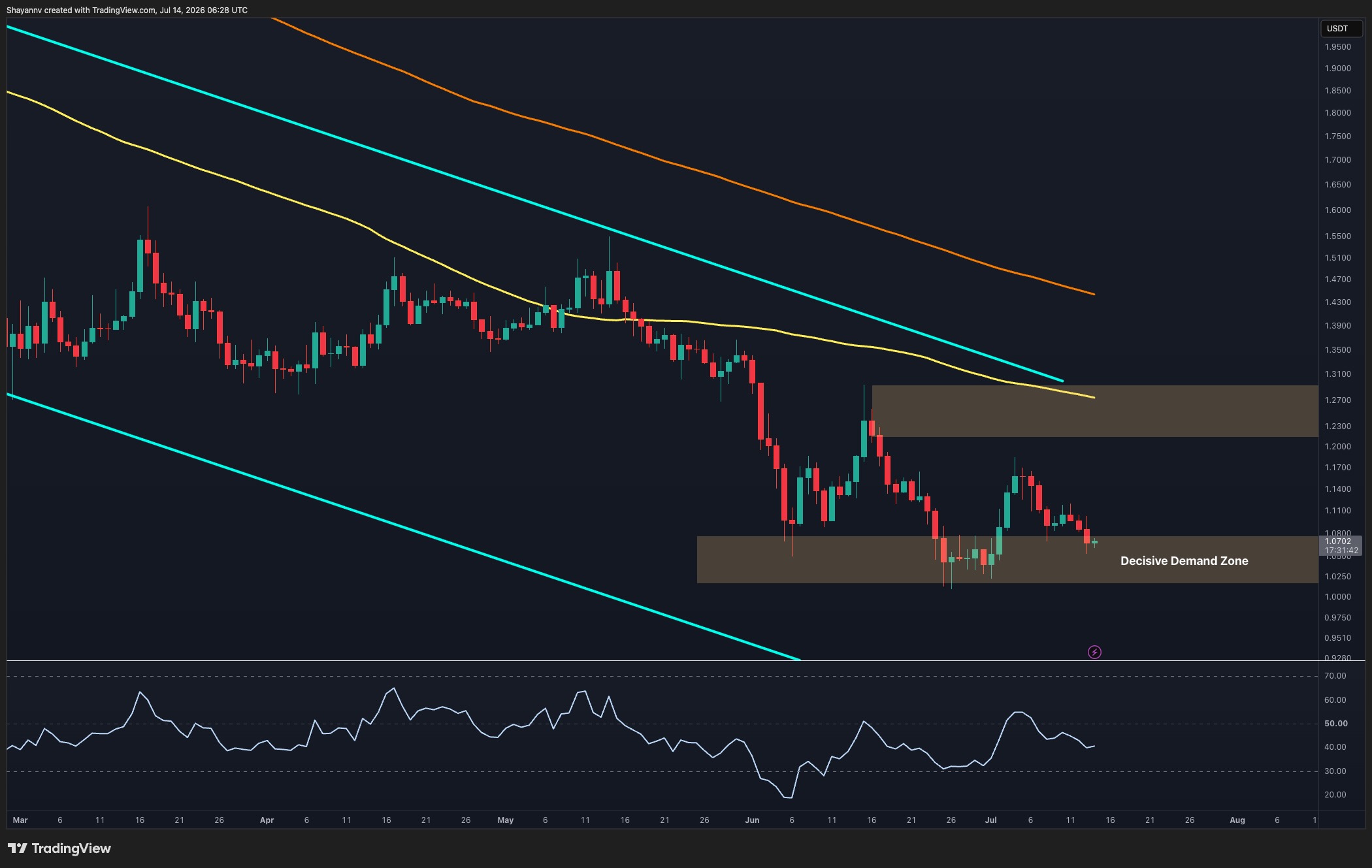
    XRP is currently testing a demand zone between $1.02 and $1.08, a level that technical analysis suggests could influence whether the asset stabilizes or faces further downward pressure. It remains uncertain whether XRP will stabilize or extend its decline from this point.

    Technical Landscape: Descending Channel and Resistance

    On the daily timeframe, XRP has been trading within a large descending channel that has contained its price action since the beginning of the year. The asset recently experienced a rejection from the upper resistance region, specifically around the $1.22 to $1.29 area. According to the analysis, this supply zone has repeatedly capped bullish advances throughout the downtrend. The rejection occurred near the confluence of the descending channel’s upper boundary and the 100-day moving average, reinforcing the significance of this resistance area.

    The Demand Zone: Support and Potential Outcomes

    Following this rejection, XRP has retraced towards the key demand zone located between $1.02 and $1.08. As per the source, this area has attracted buyers and represents a support level on the daily chart. As long as the price remains above this zone, the market could continue consolidating within the lower portion of the channel.

    Short-Term Signals and Uncertainty

    The 4-hour chart offers a closer look at recent price weakness. XRP experienced a rally from the lower demand zone but failed to sustain momentum after reaching resistance at the descending trendline and the overhead supply region around $1.22-$1.29. Since then, the asset has produced a series of lower highs and lower lows, reflecting short-term bearish pressure, the article states.

    The market has now returned to the demand zone around $1.03-$1.08 on the 4-hour chart. This area has acted as the foundation for rebounds since late June, according to the analysis. This zone remains a level to monitor.

    Potential Scenarios

    Two primary signals emerge from this price action. Firstly, a move below the $1.02-$1.08 demand zone could lead to a decline for XRP. This scenario would likely invalidate the current stabilization attempt and expose the lower boundary of the descending channel, potentially opening the door for further downside.

    Secondly, a defense of the $1.02-$1.08 demand zone could trigger a relief rally. Such a move might see XRP test the descending trendline and the $1.22-$1.29 resistance zone again. This outcome would keep XRP within its broader consolidation structure, preserving the possibility of a larger move later, though it is uncertain if such a move will occur.

    Conversely, a loss of the demand zone would represent a structural deterioration and likely shift momentum in favor of sellers. For now, the token remains positioned at a support area. While the broader trend continues to favor caution below the major moving averages and descending channel resistance, the $1.02-$1.08 demand zone remains a key level to defend to prevent another leg lower, according to the article.

    Broader Context

    Source materials place the market analysis in this context: Ripple’s XRP remains trapped within a broader bearish market structure despite several recovery attempts over the past few weeks.

  • XRP Market Analysis: Divergent Price and Sentiment Signals

    XRP Market Analysis: Divergent Price and Sentiment Signals

    XRP is currently trading around $1.07, having experienced a decline of over 7% in the past week. This price action occurs against a backdrop of significantly elevated social sentiment, with Santiment data indicating a ratio of 3.02 bullish comments for every bearish one over the last five weeks. This divergence between price and sentiment is often interpreted as a contrarian signal, suggesting that current optimism may not align with underlying price trends, a situation that introduces uncertainty regarding XRP’s immediate future.

    The broader cryptocurrency market has seen some recovery, with the total market value rising to approximately $2.13 trillion. Centralized exchange spot trading volumes also increased in June by 15.3% to $1.11 trillion, suggesting improving market participation. However, XRP’s recovery momentum has not matched that of other major cryptocurrencies like Ethereum, which has reclaimed the $1,800 mark. This suggests that buyers may be exercising selectivity in the current market, contributing to the ambiguity surrounding XRP’s independent trajectory.

    Analysts point to persistent seller pressure near key resistance levels for XRP, particularly around the $1.35 mark. Each attempt to breach this level has attracted fewer buyers, reinforcing it as a significant ceiling rather than a launchpad for further gains. The market has also experienced substantial liquidations, with over $160 million in leveraged positions being cleared, including approximately $108 million in short positions, underscoring ongoing volatility and trader activity.

    Analyzing Potential Market Scenarios

    Looking ahead, market observers suggest the most likely scenario involves XRP trading within a range of $1.00 to $1.20 as sentiment gradually cools. This period of consolidation could potentially build a more stable foundation for future price movements. However, uncertainties persist. A bearish scenario could emerge if support just above the $1.00 level fails, especially during a wider market selloff, potentially leading XRP to revisit the high $0.90s. This area is considered by some analysts as the next meaningful support level.

    For XRP to shift its trend convincingly, it would need to reclaim the $1.30 to $1.35 zone with expanding trading volume. While a bounce driven by Bitcoin’s strength would be encouraging, analysts suggest XRP needs to demonstrate independent momentum to solidify any recovery. The current setup for XRP, and many mid-to-large-cap altcoins, presents asymmetric downside risk with capped upside, particularly with a crowd that appears to be already positioned for gains.

    Alternative Investment Landscape

    In this environment, a rotation into earlier-stage infrastructure projects where price discovery is ongoing has been noted. For instance, LiquidChain, a Layer 3 infrastructure project focused on cross-chain liquidity, is currently in its presale phase, priced at $0.01479, having raised $900,000 to date. This project aims to fuse liquidity from Bitcoin, Ethereum, and Solana into a single execution environment.

    Ultimately, XRP’s current market position is characterized by ambiguity. While social sentiment is high, price action and technical resistance suggest caution. Investors should monitor buying pressure, resistance levels, and broader market conditions to navigate the potential outcomes for XRP, acknowledging that the extent of future buying pressure and the possibility of a wider market selloff remain key uncertainties.

    Why This Matters

    The materials describe a narrow update: XRP is trading around $1. Whether XRP can overcome seller pressure and resistance levels.

    Broader Context

    Source materials place the market analysis in this context: XRP prediction chatter is heating up even as the price slips, which is usually when markets like to play tricks.

  • June CPI Shows Monthly Drop, But Core Inflation and Fed Policy Uncertainty Remain

    June CPI Shows Monthly Drop, But Core Inflation and Fed Policy Uncertainty Remain

    The June Consumer Price Index (CPI) report indicated a notable monthly decrease, with the headline figure falling 0.4% month-over-month, marking the largest such drop since April 2020. This brought the annual inflation rate to 3.5%, falling below the Dow Jones consensus estimate of 3.8%. Following the announcement, Bitcoin prices experienced an increase.

    However, Federal Reserve policy considerations continue to center on core CPI, which excludes volatile food and energy prices. Core CPI remained flat month-over-month in June, holding an annual rate of 2.6%, which was below the forecast of 2.9%. This distinction is significant, as policymakers often view core and services inflation as more reliable indicators of longer-term inflationary trends. The energy index was a primary driver of the headline drop, slumping 5.7% in June, with gasoline and fuel oil prices falling more than 9%. Services ex-energy were flat, while shelter costs rose 0.1% and transportation services declined 0.3%.

    Despite the headline CPI beat, the Federal Reserve is widely expected to hold interest rates steady at its upcoming July FOMC meeting. Looking ahead, a 25 basis point rate hike in September is still anticipated by the market, which would bring the overnight rate to a range of 3.5%–3.75%. Fed Governor Christopher Waller has indicated that it would require several months of positive inflation readings to convince him that inflation is consistently returning to the Fed’s 2% target.

    Market participants are navigating this data divergence. While the softer headline inflation could theoretically influence rate-cut expectations, the Federal Reserve’s focus on core metrics suggests a continued cautious stance. This creates an environment of uncertainty for asset prices, including Bitcoin. Traders are monitoring key technical levels for Bitcoin, with nearby resistance around $64,000 and a downside reference point at $62,000, followed by prior support around $60,000. ETH is also facing resistance around $1,800.

    Some analysts suggest that while the headline print may appear constructive for cryptocurrencies in the short term, the underlying inflationary pressures, as indicated by core CPI, mean that market positioning could be vulnerable. The potential for a rapid unwinding of bullish positions exists if macroeconomic expectations reprice based on the Federal Reserve’s persistent focus on bringing inflation back to target. The path forward for inflation and the Federal Reserve’s response remain key uncertainties for investors and traders.

    Why This Matters

    The June CPI report showed a significant monthly drop in headline inflation, but the Federal Reserve’s continued focus on core inflation and the expectation of a September rate hike introduce persistent uncertainty for market participants, including Bitcoin. The distinction between headline and core inflation is crucial, as policymakers view core and services inflation as more reliable indicators of longer-term trends. While the headline beat might offer short-term optimism for risk assets, the underlying inflationary pressures indicated by core CPI suggest that market volatility and uncertainty are likely to persist.

    Broader Context

    Source materials indicate that the June CPI data showed a 0.4% month-over-month decrease, the largest since April 2020, bringing the annual inflation rate to 3.5%, below the Dow Jones consensus of 3.8%. Bitcoin prices rose following this announcement. However, core CPI, excluding food and energy, remained flat month-over-month at a 2.6% annual rate, a figure more closely watched by the Federal Reserve. Despite the headline figure, the Fed is widely expected to hike rates by 25 basis points in September. Fed Governor Christopher Waller has stated that several months of positive readings are needed to suggest inflation’s return to the 2% target.

  • U.S. Government Transfers Seized Crypto to Coinbase Prime Amid Unexplained Ambiguity

    U.S. Government Transfers Seized Crypto to Coinbase Prime Amid Unexplained Ambiguity

    The U.S. government has transferred approximately $288 million worth of seized Bitcoin and Ethereum to Coinbase Prime, according to on-chain tracker Arkham. The exact purpose of this transfer remains officially unexplained, leading to market speculation.

    The transaction, which occurred on Monday, July 13, 2026, involved roughly 3,800 BTC valued at $235 million and about 30,000 ETH valued at $53 million. The Bitcoin originated from funds seized in criminal cases linked to Ryan Farace, known as “Xanaxman,” and the defunct exchange BTC-e. These assets were routed through intermediary wallets before reaching Coinbase Prime. The Ethereum was tied to a money-laundering case involving Oracle employee Brian Krewson and was sent directly to a deposit address.

    Coinbase Prime was selected by the U.S. Marshals Service in 2024 to custody and trade forfeited digital assets. This established relationship suggests the transfers could represent the government moving assets into managed custody. However, the absence of a public explanation for these specific transfers has led some market observers to interpret them as a potential signal for a sell-off.

    “It’s not yet clear whether these inflows are in preparation for a sale or simply for the consolidation and custody of seized assets,” said Tim Sun, Senior Researcher at crypto exchange HashKey. He noted that large holders typically keep coins in cold storage, making such movements a subject of scrutiny.

    The context of these transfers is influenced by recent government initiatives. U.S. President Donald Trump’s executive order in March 2025 established a Strategic Bitcoin Reserve, stipulating that Bitcoin deposited into it “shall not be sold.” Crucially, the coins moved on Monday originated from active criminal cases and are handled separately from this reserve. Only Bitcoin that has “completed the final forfeiture process” is eligible for the reserve, with court-directed exceptions for law enforcement or victim restitution.

    Ethereum, unlike Bitcoin, is not subject to the Strategic Bitcoin Reserve’s rules. It falls under a separate Digital Asset Stockpile managed by the Treasury Department, which grants the government “greater freedom of disposal,” according to Sun.

    Adding to the complexity, the Strategic Bitcoin Reserve itself faces administrative and legislative uncertainty. Bills aimed at codifying the reserve with a 20-year holding rule have stalled in Congress, and the Treasury and Commerce departments are reportedly contesting control over these assets. Arkham continues to track U.S. government wallets holding approximately $20.6 billion in crypto, including 324,552 BTC, indicating that the $288 million transfer represents a relatively small portion of the total government holdings.

    Market participants are advised to distinguish between Bitcoin held within the reserve and the broader balance-sheet holdings of the U.S. government. The current transfers stem from active criminal cases and are not directly linked to the reserve’s non-sale policy. The lack of official explanation and ongoing administrative disputes contribute to the ambiguity surrounding the government’s intentions with these seized digital assets.

    Why This Matters

    The materials describe a narrow update: The U. Whether the government intends to sell the transferred crypto.

    Broader Context

    Source materials place the factual news in this context: The U.S. government transferred $288 million in seized Bitcoin and Ethereum to Coinbase Prime on Monday, on-chain tracker Arkham showed, reviving speculation that Washington could be preparing to sell crypto it has pledged to hold.

  • Ripple Labs Joins UK Treasury Taskforce on Tokenized Wholesale Finance

    Ripple Labs Joins UK Treasury Taskforce on Tokenized Wholesale Finance

    Ripple Labs has become a member of the UK HM Treasury’s Wholesale Digital Markets taskforce, a 54-firm initiative focused on exploring the potential of tokenized wholesale finance. The taskforce estimates that tokenized wholesale finance could contribute up to £33 billion to the UK’s annual economic output by 2035. Ripple’s participation is as a taskforce member, not an advisory lead or designated pilot operator, providing it a voice in shaping tokenization standards for UK wholesale markets.

    The taskforce is currently accepting industry feedback on its priorities and timelines until September 4, with its pilot program slated to launch in spring 2027. This move highlights the UK’s strategic push to innovate within financial markets through tokenization.

    The taskforce’s composition, featuring major financial institutions, signals a focus on institutional finance rather than crypto-native advocacy. Ripple’s strategic involvement aims to influence a market projected to scale significantly by mid-decade, especially if UK and US tokenization standards converge. Such convergence, particularly for cross-border repo and collateral settlement, could enhance the applicability of existing institutional infrastructure for cross-border payments.

    In parallel, Ripple has shared further details about the pressures it faced following the U.S. Securities and Exchange Commission’s (SEC) lawsuit filed in December 2020. CEO Brad Garlinghouse reported that company leadership considered shutting down Ripple within days of the SEC’s filing. Chief Technology Officer David Schwartz stated that external legal counsel advised that the business could not be saved and recommended executives seek a deal for their own protection. Garlinghouse later disclosed that Ripple incurred approximately $150 million in legal fees throughout the four-year legal battle. Schwartz subsequently clarified that some reports misinterpreted his comments, emphasizing that he never suggested Ripple was on the verge of shutting down.

    These disclosures offer retrospective context, framing the legal risk premium that influenced XRP’s pricing from 2020 until the case’s resolution. Regarding market performance, XRP is currently holding above a support band between $1.04 and $1.11. While recent price action shows three-wave structures, a reported bullish pattern has not yet emerged. A sustained hold above this support could lead toward $1.19 and then $1.25, whereas a break below would reinforce the broader downtrend. Year-to-date in 2026, XRP has increased by 3.89%, continuing a trend of positive annual returns: 47.6% in 2023, 31.2% in 2024, and 35% in 2025.

    Ripple’s participation in the UK taskforce adds a concrete regulatory and institutional data point to its positioning, though it is not expected to alter near-term XRP technicals. A more durable question remains whether Ripple’s early involvement in this government-backed tokenization program, alongside institutions managing trillions in assets, will translate into protocol-level adoption when the pilot program goes live in spring 2027. The UK’s established capital markets and credible regulatory system are considered foundational for its potential to become a global leader in tokenized wholesale finance.

    Why This Matters

    The article details Ripple Labs’ membership in the UK HM Treasury’s Wholesale Digital Markets taskforce, a 54-firm initiative exploring the potential of tokenized wholesale finance. It also provides retrospective context on past legal challenges faced by Ripple and their financial implications, framing past pricing pressures. The long-term question of whether Ripple’s early presence in the government-backed tokenization program will translate into protocol-level adoption remains uncertain.

    Broader Context

    Ripple Labs has joined the UK HM Treasury’s Wholesale Digital Markets taskforce, a 54-firm initiative that estimates tokenized wholesale finance could add up to £33 billion to UK annual economic output by 2035. Ripple’s participation is as a taskforce member, not an advisory lead or designated pilot operator.