Tag: Neutral

  • Binance Futures Soar 80% in June Amid Spot Market Slump

    Binance Futures Soar 80% in June Amid Spot Market Slump

    Binance reportedly experienced a substantial surge in futures trading volume last month, with figures indicating an 80% jump from May’s activity and reaching a yearly high. This increase occurred as cryptocurrency spot markets languished at their weakest pace in two years.

    According to commentary from CryptoQuant analysts, the surge in futures trading comes at a time when Bitcoin’s price has remained relatively stable, and a significant portion of the market holds a bearish outlook. The sharp monthly increase in futures volume, contrasted with a stagnant spot market, suggests a deliberate shift in trader positioning.

    The June futures figures propelled Binance ahead of its closest derivatives competitors. While OKX and Bybit also reported increases in futures volume from May to June, neither matched Binance’s growth or overall scale. Data indicates that Binance’s futures volume significantly surpassed those of OKX and Bybit.

    The last time these exchanges approached similar volume levels was in early 2026. June marked a return to, and in Binance’s case, an surpassing of that benchmark. However, the centralized exchange (CEX) futures market remained under pressure throughout the second quarter.

    Binance’s June futures volume increase occurred against a deteriorating quarterly backdrop. Total CEX futures volume across the market declined in Q2 2026 compared to Q1, continuing a downward trend. While the pace of decline slowed relative to earlier quarters, the downward direction persisted.

    Spot markets faced even deeper challenges. CEX spot volume dropped to a two-year low in Q2, with Binance remaining the largest spot venue but experiencing a slight decrease in market share. Binance, however, maintained a steady share of the futures market for the quarter.

    The widening gap between futures and spot markets underscores a structural shift in trading behavior. Derivatives-driven price action has characterized much of the 2026 market, with leverage washouts, basis trades, and hedging activity remaining robust while directional spot buying stalls. The June Binance data aligns with and amplifies this pattern.

    It remains unclear whether the futures surge reflects genuine directional conviction or primarily hedging and arbitrage flows—strategies that generate volume without necessarily indicating bullish or bearish bets. This distinction is crucial for interpreting the implications of the volume spike.

    Binance’s futures volume surge occurred just before Europe’s Markets in Crypto-Assets (MiCA) regulatory framework entered a new enforcement phase on July 1. Binance withdrew its application for a Greek license in late June, raising questions about European market access and potential impacts on derivatives volumes.

    Early data from July suggests the regulatory transition has not materially disrupted Binance’s futures activity. Binance recorded substantial futures volume in the first 10 days of July, indicating continued trading momentum. However, the limited data period means future regulatory actions could still affect volumes.

    The MiCA transition is significant as Europe is considered an important market for derivatives volumes on major centralized exchanges. Market patterns in July will clarify the extent to which June’s volume reflected front-running of regulatory deadlines versus durable shifts in demand.

    In summary, Binance’s June volume increase is a notable data point signaling a concentration of trading activity in derivatives on dominant venues amidst weaker spot volumes. Whether this concentration persists into the third quarter and how MiCA affects European-sourced volume will become clearer with forthcoming data.


  • BYDFi Connects with Web3 Community at Peru Blockchain Conference 2026

    BYDFi Connects with Web3 Community at Peru Blockchain Conference 2026

    BYDFi, a global crypto trading platform, established a presence at the Peru Blockchain Conference 2026, held July 10-11 in Lima. The event, hosted at the JW Marriott Larcomar in Miraflores, marked its fifth edition and convened approximately 4000 attendees, 100 speakers, and 50 sponsors, establishing itself as a significant forum for blockchain, crypto, and trading discussions in Peru.

    During the conference, BYDFi operated a booth, facilitating interactions with attendees to discuss trading experiences and distribute branded merchandise, including football-themed items. The conference program addressed key areas within the digital finance landscape, such as Crypto & Digital Assets, Blockchain & Web3, Trading and Financial Markets, Artificial Intelligence, Fintechs and Startups, Regulatory Frameworks for Peru & LATAM, Asset Management, and Financial Education.

    Founded in 2020, BYDFi currently serves over 1,000,000 users across more than 190 countries and regions. The platform holds partnerships, including being Newcastle United’s Exclusive Official Crypto Exchange Partner, and has been recognized by Forbes Advisor Canada as one of the best crypto exchanges in Canada for 2026. Michael Hung serves as the Co-Founder & CEO of BYDFi.

    The conference provided BYDFi an opportunity to engage with the Latin American Web3 community, exploring topics like market access, trading tools, and user experience, alongside the evolving relationship between crypto and traditional finance. This engagement aligns with BYDFi’s overarching theme, “Built for Reliability,” which underscores the company’s commitment to developing stable and trustworthy trading experiences as digital finance adoption grows globally.

    Why This Matters

    The materials describe a narrow update: BYDFi, a global crypto trading platform, had a booth at the Peru Blockchain Conference 2026, interacting with attendees, discussing trading experiences, and distributing branded merchandise. The agenda offered BYDFi a clear view of the conversations shaping user expectations around access, usability, trust, and long-term participation in digital finance.

    Broader Context

    Source materials place the factual news in this context: The conference covered themes including Crypto & Digital Assets, Blockchain & Web3, Trading and Financial Markets, Artificial Intelligence, Fintechs and Startups, Regulatory Framework Peru & LATAM, Asset Management, and Financial Education.

  • Binance to Accept SKHYB Tokenized Securities as Collateral

    Binance to Accept SKHYB Tokenized Securities as Collateral

    Binance announced today that SK Hynix (SKHYB) bStocks tokens will be added as eligible collateral assets for its Cross Margin, Portfolio Margin, and Portfolio Margin Pro services. The integration is scheduled to take effect on July 13, 2026, at 13:30 UTC.

    New Collateral Options for Margin Trading

    With this update, eligible users will be able to utilize SK Hynix bStocks tokens as collateral within Binance’s margin trading products. This expansion aims to provide users with a broader range of collateral options, thereby enhancing their margin trading capabilities. Corresponding bStocks trading pairs will also become available for margin trading.

    Eligibility and Restrictions

    This new feature is exclusively available to users with VIP 3 status and above, and only within permitted jurisdictions. Users in restricted regions will not have access to this functionality.

    Risk Management and Further Information

    Binance advises users to implement robust risk management strategies and to consistently monitor their margin levels when using bStocks as collateral. For detailed information on the index price methodology for bStocks as collateral assets, users are directed to consult the “bStocks Tokenized Securities Collateral Index Price Methodology.”

    Further details regarding marginable assets and related information can be found in the “Margin Data” section.

    Binance reserves the right to amend or cancel this announcement at any time and for any reason without prior notice.

    It is important to note that information concerning Tokenized Securities is not intended as an offer, solicitation, promotion, recommendation, or invitation to buy or sell securities in any jurisdiction. Tokenized Securities are not offered, sold, distributed, made available, or accessible in the United States or to U.S. persons. These securities have not been registered under the U.S. Securities Act of 1933 or any U.S. state securities laws, and a public offering will not be conducted in the United States or any other jurisdiction, with the exception of the ADGM. By accessing this product, users represent and warrant that they are not a U.S. person, are not located in the United States, are not acting for the account or benefit of a U.S. person, and will not access, purchase, sell, transfer, redeem, or otherwise transact in Tokenized Securities from within the United States.

  • Legend Awakes Concludes Teaser Campaign, Unveils Alberich Token as ‘Musical Meme Coin’

    Legend Awakes Concludes Teaser Campaign, Unveils Alberich Token as ‘Musical Meme Coin’

    Legend Awakes has concluded its multi-week mystery-driven teaser campaign with a cinematic reveal video, introducing the Alberich Token. The project is described as the world’s first “Musical Meme Coin,” integrating mythology, music, artificial intelligence, and blockchain technology through a narrative-first approach.

    The reveal video, which premiered on July 13th, 2026, marks the culmination of a campaign that employed cinematic visuals, cryptic messages, and hidden clues across platforms like X. According to Legend Awakes, this campaign garnered over 300 million views across its content, sparking significant community discussion. The video reportedly synthesizes the campaign’s various elements while introducing the Alberich Token.

    Inspired by Alberich, a figure from Richard Wagner’s “The Ring of the Nibelung,” the Alberich Token project aims to reinterpret this epic legend for the Web3 era. Legend Awakes states that the project merges mythology, culture, and innovation to create a distinctive digital asset ecosystem. Developed under the Nibelungen Foundation, the initiative is presented as a story-driven endeavor.

    Instead of a conventional token launch, Legend Awakes emphasizes a story-first strategy, encouraging audiences to engage with the project’s unfolding narrative before exploring its underlying technology. This approach is designed to foster a community around the project’s lore and themes.

    Further details and continued engagement with the project’s narrative are available on the official website, LegendAwakes.com. The cinematic reveal video can also be viewed via the official Legend Awakes account on X.

    Why This Matters

    The materials describe a narrow update: Legend Awakes released a cinematic reveal video, ending a multi-week teaser campaign on X. The campaign used cinematic visuals, cryptic messages, and hidden clues to introduce the world behind Legend Awakes.

    Broader Context

    Source materials place the announcement in this context: The campaign used cinematic visuals, cryptic messages, and hidden clues to introduce the world behind Legend Awakes, generating more than 300 million views across campaign content and prompting thousands of comments, reposts, and community discussions.

  • Binance Adjusts KORUUSDT Perpetual Contract Size

    Binance Adjusts KORUUSDT Perpetual Contract Size

    Binance Futures to Adjust KORUUSDT Contract Size Following Stock Dividend

    Binance Futures is set to adjust the contract size for its USDⓈ-Margined KORUUSDT Perpetual Contract on July 15, 2026, commencing at 00:15 UTC. This adjustment is necessitated by forward share splits of the underlying asset issuer’s issued and outstanding shares, structured as a stock dividend. The adjustment process is anticipated to conclude by 13:30 UTC on the same day, with a subsequent “cancel-only” phase that could last up to five minutes.

    Underlying Asset and Split Details

    The underlying asset for the KORUUSDT Perpetual Contract is the Direxion Daily South Korea Bull 3X ETF (NYSE Arca: KORU). The issuer has announced a 20-for-1 forward share split, implemented as a stock dividend. This means the adjustment scale factor will be 20.

    Impact on Open Positions and Trading

    During the adjustment period, all strategy bots, including Grid, DCA, and Snowball, linked to the KORUUSDT perpetual contract will be terminated and their positions automatically closed at 00:05 UTC on July 15, 2026. These positions will not be reinstated after the adjustment.

    Users with open positions will see their positions closed first, with unrealized profits and losses settled and credited to their Cross Margin Futures Account. For users in isolated margin mode, realized profits and all margin balances will be transferred to their Cross Margin Futures Account. Following the adjustment, new positions can be opened, with margin balances transferred to the Isolated Margin Futures Account based on the leverage level selected prior to the adjustment.

    The “cancel-only” phase will permit users to submit, modify, or cancel Post-Only orders. The duration of this phase will be determined by Binance, depending on market liquidity, and may extend up to five minutes.

    Chart and Data Continuity

    The continuous candlestick chart for the KORUUSDT perpetual contract will be retained and updated with the newly adjusted price. For time intervals of 12 hours and below, price charts prior to 00:00 UTC on July 15, 2026, will be corrected within the first week post-adjustment. For daily and longer time intervals, price chart corrections will be completed before the seventh day of the following calendar month.

    Trading Status and Timeline

    Binance Futures will provide real-time updates on the trading status of the contract. Users can check the latest information via API or the designated webpage.

    • Before July 15, 2026, 00:15 UTC: Continuous Trading Session State (TRADING)
    • July 15, 2026, 00:15 UTC to July 15, 2026, 13:30 UTC: Contract Size Adjustment process begins, with a Halt Session State (TRADING_HALT).
    • July 15, 2026, 13:30 UTC to July 15, 2026, 13:35 UTC: Cancel-only phase after adjustment completion, with a Cancel Only Session State (TRADINGCANCELONLY).
    • After July 15, 2026, 13:35 UTC: Trading functions resume under Continuous Trading Session State (TRADING).

    This announcement is made in accordance with relevant exchange and clearing rules. It is important to note that TradFi Perps are not affiliated with, sponsored, endorsed, or approved by the issuer of the underlying shares or the exchange where they are listed.

  • XRP Dips to 10-Day Low Amid Fading Whale Demand and ETF Outflows

    XRP Dips to 10-Day Low Amid Fading Whale Demand and ETF Outflows

    Crypto Market Dips Amid Middle East Tensions, XRP Faces Headwinds

    The cryptocurrency market has experienced another downturn, a move largely anticipated in the wake of escalating tensions in the Middle East. Ripple’s cross-border token, XRP, has not been immune to this broader market correction.

    While the immediate outlook for XRP appears challenging, on-chain data offers glimmers of optimism on a larger, macroeconomic scale.

    Price Volatility and Recent Slump

    At the beginning of the month, XRP’s price fell to $1.01, a level not seen in nearly two years, amidst a widespread market crash. The token saw a swift rebound in the subsequent days, even testing the $1.20 resistance. However, it was pushed back down, dipping below $1.10 within days.

    The past week has been relatively subdued, with XRP trading sideways between $1.09 and $1.12. This stability was disrupted on Monday morning as the market reacted to renewed attacks between the United States and Iran. XRP subsequently slipped to just under $1.07, its lowest point since the earlier monthly low.

    Factors Contributing to XRP’s Retreat

    Beyond the general market weakness, a potential contributor to XRP’s recent decline is activity surrounding Exchange-Traded Funds (ETFs). After nine consecutive weeks of net inflows, this trend was broken last week, with over $7 million exiting these funds.

    Further analysis from on-chain data providers Santiment and Ali Martinez indicates a significant cooling in whale activity on the XRP Ledger. The number of large transactions, exceeding $1 million, has plummeted from 70 to a mere 2 within approximately a week.

    Santiment had previously observed that XRP Ledger activity had become “unusually quiet,” with the creation of new wallets reaching its lowest point in nearly two years.

    Analyst Perspectives on XRP’s Future

    CRYPTOWZRD commented on XRP’s recent price movements, noting that the token closed “indecisively.” The analyst anticipates potential “further upside” if XRP can regain traction against Bitcoin, a scenario that has not materialized for an extended period.

    In contrast, EGRAG CRYPTO maintains a strongly bullish long-term outlook for XRP. In a recent post on X, EGRAG suggested that historical patterns may be repeating for XRP, citing several indicators that point to a potential macro bottom.

    “The macro bottom may already be behind us,” EGRAG stated. “Now we need a bounce toward the 50-MA (about $1.60), a healthy rejection, a retest of the 618 (0.5 Fibonacci zone), and that retest will become the make-or-break accumulation zone before the next impulsive move higher. In my view, this would complete a double-bottom lower low and set the foundation for the next macro rally for XRP.”

    EGRAG outlined ambitious targets for this potential long-term rally, with some extreme projections reaching as high as $31. More conservative estimates include targets of $15, $9, and a range of $5-$6.50.

  • Bitcoin Sees Early July Price Recovery Amidst Seasonality, but Market Uncertainty Remains

    Bitcoin Sees Early July Price Recovery Amidst Seasonality, but Market Uncertainty Remains

    Bitcoin (BTC) has experienced a price recovery in early July, moving from a recent low of $57,700 to approximately $64,000. This represents an 11% increase from its lows. Analysts attribute this movement to historical July seasonality and indications of recovering demand. However, broader market conditions remain predominantly bearish, as highlighted by key on-chain metrics.

    Historically, July has often been a favorable month for Bitcoin. Analysts noted that during previous bear cycles, such as in 2018 and 2022, Bitcoin concluded the month with significant surges of 20% and 17%, respectively. This historical pattern suggests that July’s positive seasonality could be contributing to the current recovery, potentially providing a tailwind even within a generally bearish market.

    Further supporting the recovery narrative are indications of improving demand. According to CryptoQuant, total Bitcoin demand has been recovering and is climbing back towards neutral levels after a sharp contraction in early June, when 30-day total demand metrics fell to -650,000 BTC. Speculative futures demand has turned slightly positive, while spot apparent demand is contracting at its slowest pace since mid-May. Analysts explained that a move back into positive territory for these metrics would suggest that the demand engine is re-igniting, though it has not yet reported a sustained shift.

    Investor demand in the United States also appears to be stabilizing. The Coinbase Premium Index, a measure of U.S. investor demand, has recovered from deeply negative readings to -0.062. This recovery is seen as a signal that selling pressure on U.S. trading platforms is easing and institutional appetite is stabilizing, aiding Bitcoin’s rebound from the $57,700 level.

    Despite these developments, the overall market sentiment remains bearish. The CryptoQuant Bull Score Index is currently hovering at 20, which is considered within the bearish zone. Analysts noted that for a sustainable rally to occur, this index needs to rise above 60. Until then, any price rebounds are likely to be treated as bear-market recoveries rather than definitive trend reversals.

    The current situation presents a mixed picture for Bitcoin. While seasonal trends and recovering demand metrics offer some optimism for the short term, the persistent bearish sentiment indicated by on-chain data suggests that caution is warranted. Whether the current demand engine will re-ignite into positive territory and if this recovery represents a trend reversal remains uncertain, contingent on sustained demand and a shift in broader market sentiment.

    Why This Matters

    The materials describe a narrow update: Bitcoin (BTC) has risen from a low of $57,700 to $64,000 in early July. Whether the current demand engine will re-ignite into positive territory.

    Broader Context

    Source materials place the factual news in this context: Analysts have predicted for July based on historical data.

  • Ethereum’s Path Uncertain as It Tests Key Resistance Zone

    Ethereum’s Path Uncertain as It Tests Key Resistance Zone

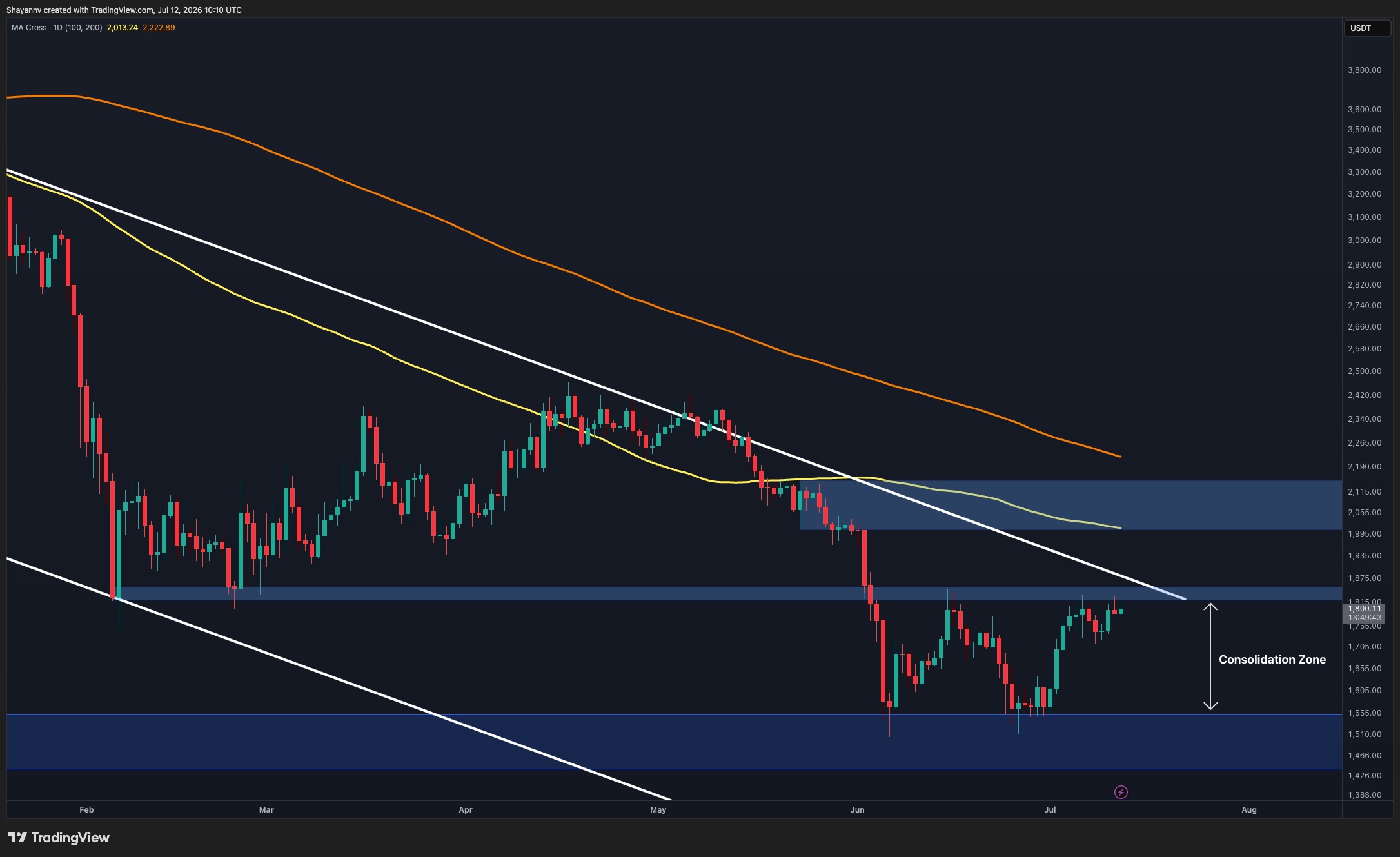
    Ethereum is currently testing a critical technical resistance zone between $1.80K and $1.85K. This area is significant as it aligns with a descending trendline that has capped price action since May, and also represents a former horizontal support level that has now turned into resistance. The current price action is occurring below both the 100-day and 200-day moving averages, which are both trending downwards, indicating a broader bearish market structure.

    The 4-hour chart, however, shows an ascending structure that has been developing since the late-June low. Within this structure, Ethereum has respected the rising channel boundaries, forming higher highs and higher lows, which suggests improving short-term momentum. Key demand zones around $1.62K-$1.64K and $1.72K-$1.74K have been reclaimed and established, respectively, providing support during recent pullbacks.

    Despite this short-term constructive price action, the rally is now approaching the upper boundary of this ascending channel and the major resistance band around $1.80K-$1.85K. This confluence of factors creates a natural area where profit-taking and seller activity could emerge. As long as Ethereum remains below this descending trendline and the $1.80K-$1.85K resistance zone, the current upward movement can still be interpreted as a recovery rally within a larger downtrend.

    Further complicating the outlook is the alignment of technical resistance with liquidity levels. A liquidation heatmap indicates a significant concentration of short-side liquidity situated above the current market price, particularly within the $1.95K-$2.1K region. This area also coincides with the 100-day moving average, which is positioned around $2K-$2.1K, and a broader supply area visible on higher timeframes. Conversely, substantial liquidity pools are noted below the market, around the $1.45K-$1.55K region, which aligns with a major daily demand zone.

    The interplay between the liquidation map and the technical structure suggests that the market may first be drawn towards the overhead liquidity cluster in the $1.95K-$2.1K range. A move into this area would effectively sweep a large concentration of short liquidations while simultaneously testing a significant resistance zone.

    The reaction at the $2K-$2.1K region is expected to be pivotal in determining the next major directional move for Ethereum. If buyers manage to break through and establish acceptance above this resistance area, the recovery could potentially evolve into a broader bullish trend reversal. However, if this liquidity sweep is followed by strong selling pressure and rejection from resistance, Ethereum could enter another notable decline. In such a scenario, the price might target the large liquidity pools resting beneath the market around the $1.45K-$1.55K support zone.

    Ultimately, the path forward for Ethereum remains uncertain. While short-term momentum has shown improvement, the asset is still contending with significant long-term resistance and the potential for liquidity-driven price discovery. A decisive move above the $1.80K-$1.85K zone would shift focus toward the $2K-$2.1K resistance, but rejection could signal a continuation of the broader downtrend.

    Why This Matters

    The current situation presents an uncertain outlook for Ethereum. Whether a larger trend reversal is underway or another corrective leg lower remains ahead, with the market’s next major directional move likely to be determined by the reaction at the $2K-$2.1K region.

    Broader Context

    Ethereum has continued its recovery from the June lows and is now approaching a major technical inflection point. The asset is testing a key resistance region around $1.80K-$1.85K, which coincides with a descending trendline and previous horizontal support turned resistance. The outcome of this test remains uncertain.

  • Senate Democrats Voice Concerns Over Trump’s Crypto Ties Amid Legislative Deliberations

    Senate Democrats Voice Concerns Over Trump’s Crypto Ties Amid Legislative Deliberations

    Top Senate Democrats have voiced criticism regarding President Donald Trump’s increasing engagement with the cryptocurrency industry, citing potential conflicts of interest as Congress deliberates on digital asset legislation. These concerns stem from reported financial interests in crypto assets, which lawmakers believe warrant close examination.

    Five senior Senate Democrats have publicly expressed their reservations. According to Senate Democrats, these disclosures are particularly relevant as lawmakers are currently negotiating key pieces of crypto legislation. Separately, Rep. James Comer has warned that Democrats would pursue investigations into Trump if they regain control of the House.

    Market participants are observing these developments closely. Traders are watching whether policy headlines begin to outweigh macro drivers in influencing market sentiment. While daily crypto trading volume remains healthy, hovering around $80 billion, and Bitcoin dominance is holding above 58%, suggesting a preference for established assets, the political climate introduces a layer of uncertainty.

    Bitcoin has seen some price movement this week, climbing more than 6% and briefly trading around the $63,000 to $64,000 range before easing slightly. The cryptocurrency is currently trading between $62,000 and $63,000. Meanwhile, Ethereum has outperformed on the week, while Solana continues to trade sideways.

    Markets have largely priced in expectations for regulatory progress, with investors continuing to watch for stablecoin legislation and a clearer market structure framework, both viewed as long-term positives for the industry. However, the path forward for digital asset legislation is fraught with uncertainty. The final text of the broader market structure bill has yet to be released, and several policy issues remain unresolved. Disagreements over unrelated measures in the House have also slowed legislative momentum, making the legislative timetable uncertain.

    The bullish case for Bitcoin, according to market analysis, is straightforward: tangible progress on digital asset legislation could see Bitcoin challenge the $65,000 region. However, the base case suggests political wrangling could drag on without derailing the legislation, potentially leaving Bitcoin trading between roughly $61,000 and $65,000 for the next few weeks. The bearish scenario hinges on politics rather than charts; a loss of the support area around $61,000 to $62,000 could lead to a significant downturn. Traders positioned in large-cap assets at current levels are essentially buying a policy lottery ticket, with meaningful upside if the bill clears but limited near-term edge if it stalls.

    For traders seeking asymmetric setups, the early-stage presale market is also being explored. The presale for Maxi Doge ($MAXI) is currently priced at $0.0002828, with $4.8 million raised to date. This project is described as a meme token built on Ethereum, focusing on a meme-first marketing engine and dynamic APY staking.

    Why This Matters

    The materials describe a narrow update: Five senior Senate Democrats have publicly criticized President Trump’s increasing involvement with the crypto industry, expressing concerns about potential conflicts of interest due to his reported financial interests in crypto. The final text of the broader market structure bill has yet to be released.

    Broader Context

    Source materials place the factual news in this context: Bitcoin price remains constructive as it trades around $62,000 to $63,000, while Trump and crypto legislation continue to shape market expectations.

  • MicroStrategy Sells Bitcoin Amidst Potential Strategic Shift

    MicroStrategy Sells Bitcoin Amidst Potential Strategic Shift

    MicroStrategy has sold 3,588 Bitcoin for approximately $216 million, reducing its total holdings to 843,775 BTC. This transaction marks a notable deviation from the company’s long-standing strategy of consistent Bitcoin accumulation.

    The sale followed a social media post by Michael Saylor on X, where he shared the message “Bitcoin Is Digital Energy” alongside a graphic of MicroStrategy’s Bitcoin holdings. Historically, such posts often preceded significant Bitcoin acquisitions. However, this instance resulted in a sale, prompting analysts to consider a potential shift in MicroStrategy’s treasury management approach.

    Market Reaction and Analyst Perspectives

    According to Bitget Wallet analysts and commentary from Bitfinex, the market’s reaction to the sale has been relatively muted, with Bitcoin’s price remaining above $60,000. This resilience, despite a substantial sale from a major corporate holder, suggests potential supply absorption. However, market observers consider the precedent set by this sale to be significant.

    Analysts suggest MicroStrategy may be transitioning from a purely accumulative strategy to one incorporating more dynamic liquidity management. This implies a willingness to sell Bitcoin when liquidity needs arise, a departure from its previous one-way accumulation approach. This shift could influence how the market prices MicroStrategy’s stock (MSTR) and the demand profile for Bitcoin going forward.

    Broader Market Context

    The context of the broader Bitcoin market provides a backdrop to this event. On July 1, long-term holder loss realization had climbed to 43% of realized value, and daily Bitcoin losses had peaked at $280 million, the highest since December 2022. While these figures indicate market stress, MicroStrategy’s sale was disclosed in advance and was relatively small compared to its total holdings, with ETF demand reportedly absorbing the supply on the same day.

    Strategic Implications and Uncertainty

    Despite the sale, the case for optimism in the near term holds, particularly as MicroStrategy’s shares saw an increase following the news disclosure. However, uncertainty remains regarding the exact nature and timing of future MicroStrategy Bitcoin transactions. It is not certain whether the company has permanently ceased buying Bitcoin or will exclusively sell in the future. The company had previously announced a new framework in recent weeks, which analysts believe may address a liquidity gap related to its preferred stock dividends.

    This strategic pivot, from a consistent accumulator to a company willing to sell Bitcoin for liquidity, represents a significant development. While the immediate dollar figure of the sale may be considered trivial in the broader market context, the precedent it establishes warrants close observation for its potential impact on corporate treasury strategies and Bitcoin demand dynamics.

    Why This Matters

    The materials describe a narrow update: MicroStrategy sold 3,588 BTC for $216 million, reducing their holdings to 843,775 BTC. Whether the community’s current hope for reaccumulation by MicroStrategy is a misleading conclusion.