Tag: Neutral

  • Paradigm Secures $1.2B Fund as Crypto VC Eyes AI

    Paradigm Secures $1.2B Fund as Crypto VC Eyes AI

    Paradigm Raises $1.2 Billion Fund, Expanding Beyond Crypto into AI

    Venture capital firm Paradigm has announced the closure of a $1.2 billion fund, signaling a significant expansion of its investment focus beyond its traditional cryptocurrency stronghold into artificial intelligence (AI) and robotics.

    Founded in 2018 by Matt Huang and Coinbase co-founder Fred Ehrsam, Paradigm established itself as a prominent backer of the crypto industry. This latest move marks a notable broadening of its investment scope. The firm has already allocated capital to companies outside the crypto space, including drone-delivery firm Zipline, valued at $7.6 billion, and space-defense startup True Anomaly, valued at $2.2 billion.

    The shift is not entirely unexpected. AI startups captured approximately 70% of global venture funding in the last quarter, while cryptocurrency deal volumes have seen a sharp decline, with Bitcoin down about 30% year-to-date. Managing partner Alana Palmedo described the move as capitalizing on opportunity rather than a retreat from crypto, telling Bloomberg that while crypto remains an “exciting frontier,” there is “so much else happening right now that’s pretty hard to ignore.”

    Paradigm maintains that it is not abandoning its crypto investments. The firm recently co-led Morpho’s $175 million funding round in June and led a seed round for a tokenized-Treasuries startup this month. It also holds stakes in prediction-market firms like Kalshi. Huang has long advocated that crypto and AI are not mutually exclusive, and Paradigm is evaluating AI deals with its existing technical team, rather than establishing a separate division. Nevertheless, the distinction between crypto and AI is increasingly blurring at the investor level.

    BNB Chain Unveils New Layer-1 Blockchain for AI Agents

    BNB Chain has revealed its roadmap for the second half of 2026, which centers on the development of a new Layer-1 blockchain specifically designed for “agentic trading.” This technology aims to support autonomous AI agents capable of executing trades, managing portfolios, and providing liquidity independently.

    The proposed blockchain is engineered to handle over 100,000 transactions per second, with preconfirmation times under 50 milliseconds and finality under one second. The goal is to achieve the speed of centralized exchanges while maintaining self-custody capabilities. This new network would be the fourth in the BNB ecosystem, joining BNB Smart Chain, opBNB, and Greenfield. A testnet is slated for late 2026, with the mainnet expected in early 2027.

    The infrastructure is being built with machines, rather than humans, as the primary users. To accommodate the millisecond execution needs of AI agents, the chain will eliminate the public mempool—the shared waiting area for pending transactions—and replace it with a private flow to prevent front-running and sandwich attacks. The roadmap also incorporates native privacy features, account abstraction, AI-powered security, and research into post-quantum cryptography. This hybrid approach will layer quantum-resistant protection over current cryptography without requiring users to migrate their addresses.

    BNB Chain enters a competitive landscape of high-throughput blockchain solutions, which already includes Solana’s Firedancer, Monad, and MegaETH. The venture is based on a market that is still nascent, with autonomous agents having settled only $73 million across 176 million blockchain transactions in the past year. However, the trajectory suggests significant future growth, as major companies like Google, Coinbase, and Visa are developing agentic payment systems, and McKinsey projects that retail agentic commerce could reach $5 trillion by the end of the decade. The feasibility of BNB Chain delivering an ambitious new Layer-1 on schedule remains an open question, but the project represents a significant undertaking.
  • Sony Bank’s Stablecoin Plan Advances with Conditional OCC Charter

    Sony Bank’s Stablecoin Plan Advances with Conditional OCC Charter

    Sony Bank has received conditional approval from the U.S. Office of the Comptroller of the Currency (OCC) to establish a national trust bank, a step toward its plan to issue a dollar-backed stablecoin. The approval, reported on July 6, allows its subsidiary, Connectia Trust, to prepare for operations expected in 2027, pending the fulfillment of remaining regulatory conditions.

    Connectia Trust, a wholly owned subsidiary, is slated for establishment this month with $40 million in capital. This entity will manage the issuance and reserves for a dollar-denominated stablecoin. Sony Bank stated the trust aims to create a “medium- to long-term business foundation” for its digital asset ventures. The bank previously indicated to Nikkei its intention for U.S. customers to use the token for digital content purchases across Sony’s ecosystem, potentially lowering transaction fees.

    The U.S. market for this stablecoin initiative is enabled by the GENIUS Act, federal legislation passed last year that outlines reserve and disclosure rules for dollar-pegged tokens. This aligns with Sony’s broader digital asset strategy, including the launch of its Ethereum layer-2 network, Soneium, in early 2025. Sony’s blockchain partner, Startale, introduced a separate dollar stablecoin on Soneium last year. For its own token, Sony Bank has engaged infrastructure firm Bastion for issuance, reserve management, and custody.

    Sony Bank’s application follows similar moves by other crypto and payment firms seeking federal trust status. In December, the OCC conditionally approved Circle, Ripple, BitGo, Fidelity Digital Assets, and Paxos. A national trust charter allows firms to custody assets, manage reserves, and issue stablecoins under federal supervision, but prohibits them from accepting cash deposits or making loans.

    Despite the conditional approval, Sony’s initiative faces opposition. The Independent Community Bankers of America urged the OCC to reject the Connectia Trust application in November, arguing it would permit Sony to issue deposit-like stablecoins while circumventing the insurance and regulations governing traditional banks. Senator Elizabeth Warren (D-MA) has also contended that the OCC has improperly granted charters to firms not qualifying under the National Bank Act. Cody Carbone, CEO of the Digital Chamber, countered in May that these criticisms “misread both the statute and the OCC’s longstanding charter authority.” A U.S. banking lobby has also considered legal action regarding these charters.

    Connectia Trust currently exists as a plan. The conditional nod requires Sony Bank to satisfy all outstanding OCC conditions before its stablecoin can launch, a process anticipated to conclude in 2027. The global stablecoin market cap is currently over $308 billion.

    Broader Context

    Source materials place the factual news in this context: Sony Bank has secured conditional approval from the U.S. Office of the Comptroller of the Currency to establish a national trust bank, moving Japan’s Sony Financial Group closer to issuing its own dollar-backed stablecoin.

    Why This Matters

    This development signifies Sony Bank’s strategic move into the stablecoin market, aiming to integrate digital assets into its existing ecosystem and potentially reduce transaction costs for consumers. The initiative is supported by the GENIUS Act, which provides a regulatory framework for such tokens in the U.S., and aligns with Sony’s broader digital asset strategy, including its Ethereum layer-2 network, Soneium. However, the path forward involves meeting remaining regulatory conditions and navigating opposition from traditional banking groups and political figures concerned about the implications of national trust charters for stablecoin issuers.

  • Delisting of KORUUSDT Perpetual Contract

    Delisting of KORUUSDT Perpetual Contract

    Bybit to Delist KORUUSDT Perpetual Contract

    Cryptocurrency exchange Bybit has announced the upcoming delisting of its KORUUSDT Perpetual Contract, effective July 13, 2026, at 10:00 AM UTC.

    Following the delisting, trading for the KORUUSDT Perpetual Contract will no longer be supported. The exchange has outlined the following procedures for the transition:

    • Order Cancellation: All active and conditional orders for the KORUUSDT Perpetual Contract will be automatically canceled.
    • Position Liquidation: Any open positions in the contract will be closed automatically. The final settlement price will be determined by the average index price recorded during the 30-minute window preceding the delisting.
    • Trading Bots and Copy Trading: The KORUUSDT Perpetual Contract will be removed from all Trading Bot services. Additionally, all unfilled orders associated with the contract within the Copy Trading platform will be automatically canceled.

    Bybit has advised users to manage their positions accordingly ahead of the scheduled delisting.

  • XRPL v3.2.0 Upgrade: High Validator Adoption, Slower Node Uptake

    XRPL v3.2.0 Upgrade: High Validator Adoption, Slower Node Uptake

    Ripple released a new software update, v3.2.0, for the XRP Ledger (XRPL) over three weeks ago. While a substantial portion of the Unique Node List (UNL) validators have adopted the new version, the overall adoption rate among general validator nodes remains notably lower.

    Data from XRPScan indicates that as of the reporting date, only 43% of XRPL nodes, equating to 357 out of 828 total nodes, have upgraded to v3.2.0. In contrast, 51% of nodes, or 426 out of 828, are still running on the previous version, v3.1.3. This disparity highlights a gap in the network’s immediate uptake of the latest software.

    Network Activation Amidst Adoption Gap

    Despite the lower adoption among general nodes, the XRPL network considers upgrades activated once a sufficient percentage of UNL validators have upgraded. Currently, 89% of the UNL validators are running on the new v3.2.0 software. The XRPL protocol requires 80% of the UNL to activate network upgrades, a threshold that has been met. Specifically, 31 out of 35 UNL validators have cleared the necessary threshold for v3.2.0 activation.

    The v3.2.0 upgrade introduces several changes, including the rebranding of the core server software from ‘rippled’ to ‘xrpld’. It also aims to reduce operating costs and memory usage by an estimated 30% to 40%, which could optimize institutional usage and improve network efficiency.

    Amendment Voting Faces Deficit

    However, an aspect of the v3.2.0 rollout is the ongoing voting process for an amendment titled ‘fixCleanup320′. This amendment is intended to deploy fixes for various components, including single-asset vaults, lending protocols, multi-purpose tokens, permissioned domains, and permissioned decentralized exchanges. To be approved, the amendment requires 28 out of the 35 UNL votes. As of the reporting date, only 17 UNL votes have been received for fixCleanup320, representing approximately 48.57% of the trusted validators having voted so far. This indicates a deficit in the votes needed for the amendment’s approval.

    The timeline for the remaining nodes to upgrade to v3.2.0 remains uncertain. Similarly, the outcome of the vote for the fixCleanup320 amendment is yet to be determined. The exact release date of the v3.2.0 upgrade is also not precisely specified, beyond being over three weeks ago.

    While the network technically considers the v3.2.0 upgrade active due to high UNL validator adoption, the slow uptake by general nodes and the current voting deficit for the fixCleanup320 amendment present ongoing points of observation for the XRPL network’s progression and security.

    Why This Matters

    The materials describe an update: Ripple released software update v3. The timeline for the remaining nodes to upgrade to v3.2.0.

    Broader Context

    Source materials place the factual news in this context: The latest infrastructure upgrade introduces several new features to the XRPL.

  • SpaceXAI’s Grok 4.5: A Strategic Play on Cost and Efficiency for Coders

    SpaceXAI’s Grok 4.5: A Strategic Play on Cost and Efficiency for Coders

    SpaceXAI has launched Grok 4.5, a new AI model strategically positioned as a cost-effective and efficient solution for coders and knowledge workers. Released on Wednesday, the model prioritizes speed and efficiency over achieving top-tier raw performance, entering a competitive AI market alongside established players like Anthropic and OpenAI.

    Grok 4.5 is priced at $2 per million input tokens and $6 per million output tokens, offering a significant cost advantage. For comparison, Anthropic’s Claude Opus 4.8 is priced at $5 per million input tokens and $25 per million output tokens, while OpenAI’s GPT 5.6 Sol, also released on Wednesday, costs $5 per million input tokens and $30 per million output tokens. Elon Musk, associated with SpaceXAI, described Grok 4.5 as “roughly comparable to Opus 4.7, but much faster,” emphasizing a deliberate tradeoff between speed, cost, and raw capability.

    Benchmark results for Grok 4.5 present a mixed performance profile. On the DeepSWE 1.1 benchmark, which measures AI models’ ability to fix software bugs, Grok 4.5 achieved a 53% success rate. This score trails behind Claude Opus 4.8 (59%), GPT 5.5 (67%), and Claude Fable 5 (70%). Similarly, on the SWE Bench Pro, a benchmark assessing resolution rates for software engineering problems, Grok 4.5 posted a 64.7% resolution rate. While this surpasses GPT 5.5’s 58.6%, it falls short of Opus 4.8’s 69.2% and Claude Fable 5’s 80.4%.

    SpaceXAI highlights Grok 4.5’s efficiency as a key advantage. The model averaged 15,954 output tokens per job on SWE Bench Pro tasks, significantly less than Opus 4.8’s 67,020 tokens for equivalent work. SpaceXAI suggests this token efficiency, combined with a speed of 80 tokens per second, translates into substantial cost savings for high-volume AI users. For developers engaged in such tasks, the cost per input token is approximately 60% less than that of Opus 4.7, offering comparable capability at a lower price point.

    The model was trained using developer session data from Cursor, incorporating debugging traces and real code edits. This training utilized tens of thousands of Nvidia GB300 GPUs within the Colossus supercomputer, a facility with a total capacity exceeding 200,000 GPUs. SpaceXAI notes that competitors with higher benchmark scores do not possess comparable hardware infrastructure.

    Despite the substantial compute resources, SpaceXAI’s models have consistently achieved competitive, though not leading, benchmark scores. The company’s strategy appears focused on delivering a capable model at a significantly lower cost and with greater efficiency, particularly for high-volume coding tasks.

    Grok 4.5 is accessible via API, on Hermes, and within the Grok build, featuring a context window of half a million tokens (approximately 400,000 words). European users can expect availability in mid-July.

    It is noteworthy that SpaceXAI’s benchmark comparisons were made against GPT 5.5, not the GPT 5.6 Sol model that also launched on Wednesday. A preliminary test of Grok build on Hermes yielded underwhelming results for creative writing but was deemed acceptable for a simple coding task. As Elon Musk has acknowledged in court, xAI’s training practices have faced scrutiny in the past, and the current training pipeline involves a platform SpaceX is in the process of acquiring.

    This release underscores a strategic shift in the AI market, where cost-effectiveness and efficiency are becoming as crucial as raw performance for specific user segments. Grok 4.5’s positioning highlights the growing importance of accessible AI tools for developers and knowledge workers, reflecting a broader trend of specialized AI solutions catering to distinct market needs.

    Why This Matters

    The materials describe a narrow update: SpaceXAI released Grok 4. The exact capabilities of GPT 5.6 Sol, as benchmarks were compared against GPT 5.5.

    Broader Context

    Source materials place the factual news in this context: SpaceXAI released Grok 4.5 on Wednesday, its first public model since the SpaceX-xAI merger closed in February and SpaceX’s pending $60 billion deal to acquire Cursor.

  • Bitcoin and Ethereum Face Conflicting Signals Amidst Market Downturn

    Bitcoin and Ethereum Face Conflicting Signals Amidst Market Downturn

    The cryptocurrency market is navigating a complex period in early July, with both Bitcoin and Ethereum experiencing significant price downturns. While technical indicators are flashing bearish signals, a confluence of historical patterns, contrarian sentiment indicators, and evolving market structures introduces considerable uncertainty about the potential for a market bottom.

    Bearish Technicals Signal Continued Downturn

    The prevailing mood in the crypto market is one of caution, bordering on fear. Bitcoin has recently touched 21-month lows, briefly dipping below $58,000. As of this week, it is trading around $61,749, down approximately 2.89% for the week. The $64,000–$65,000 range has proven to be a significant resistance ceiling since early June, a level Bitcoin has struggled to overcome. Prediction markets, such as Myriad, reflect this bearish sentiment, with traders placing nearly 73% odds that Bitcoin may reach $55,000 before it hits $84,000. This sentiment flipped from bullish to bearish around June 2.

    Technically, Bitcoin’s Average Directional Index (ADX) stands at 30.7, indicating a strong existing trend with bearish directionality reported. The Relative Strength Index (RSI) is at 36.8, suggesting the asset is approaching oversold conditions, though not yet there. While Bitcoin’s 50-week exponential moving average (EMA) remains above its 200-week EMA, forming a technical golden cross, this pattern is narrowing, raising concerns about a potential future death cross, which historically precedes deeper declines.

    Ethereum is also under pressure, trading below $1,750 and down around 4% on the day, with a year-to-date decrease exceeding 30%. The most significant bearish development for Ethereum is the confirmation of a weekly death cross, where its 50-week EMA has fallen below its 200-week EMA. This pattern, which has been present on Ethereum’s daily chart since November 2025, signifies a prolonged structural deterioration and tends to define entire market phases rather than short-term moves. Traders on Myriad are pricing in a 72% chance that Ethereum may reach $1,500 before $3,000. Ethereum’s ADX is at 26.5 with bearish directionality, and its RSI is at 36.9, mirroring Bitcoin’s bearish but not yet oversold status.

    Potential Bottoming Signals and Evolving Market Dynamics

    Despite these bearish technicals, several factors introduce a degree of uncertainty and potential for a market bottom. The Fear & Greed Index currently sits at 23, indicating “extreme fear,” a level that has historically served as a contrarian signal, often preceding market reversals.

    Furthermore, Spot Bitcoin ETFs have recently seen a significant inflow of $221.7 million on July 2, snapping a 10-day, $2.7 billion outflow streak. Since then, these ETFs have attracted approximately $510 million. Similarly, ETH spot ETFs experienced positive inflows of $29.1 million on July 2.

    On-chain data from Glassnode suggests that long-term Bitcoin holders are returning to accumulation. Historically, major Bitcoin bear cycles have concluded with periods of extreme fear and flush-out events, often followed by a pre-halving compression phase before the next upward trend. With the next Bitcoin halving roughly 21 months away, some analysts suggest that accumulation phases may be becoming relevant.

    However, the current market environment differs from previous cycles due to increased institutional involvement. The presence of spot Bitcoin ETFs, formal accounting standards, and a developing legislative framework for digital assets indicate a fundamentally altered landscape. While this doesn’t eliminate volatility, it suggests that the players and dynamics within this bear market may be distinct.

    Analysts at Citi have offered cautious forecasts, downgrading their 12-month Bitcoin forecast to $82,000 with a bear case at $53,000. For Ethereum, Citi’s bear case is set at $1,094. The technical Fibonacci target for Bitcoin below current prices is $57,735, while for Ethereum, it is $1,500.

    Navigating Uncertainty

    Ultimately, the market presents a dichotomy: strong bearish technical signals for both Bitcoin and Ethereum are countered by historical contrarian indicators and the evolving institutional landscape. The confirmation of Ethereum’s weekly death cross and Bitcoin’s struggle at resistance levels point towards potential further declines. Yet, the extreme fear readings, recent ETF inflows, and the fundamental shifts in market structure introduce significant uncertainty. Whether these factors will accelerate or delay a market bottom remains an open question, with evidence suggesting that definitive conclusions cannot yet be drawn.

    Why This Matters

    The materials describe a narrow update: Bitcoin has fallen to 21-month lows and is struggling to break resistance zones, while Ethereum has reported a weekly death cross, indicating a significant bearish trend. Whether the current market players and institutional involvement will speed up or delay the market bottom.

    Broader Context

    Source materials place the market analysis in this context: The crypto market enters the second week of July in rough shape.

  • XRP Price: Critical Level to Defend Against Breakdown

    XRP Price: Critical Level to Defend Against Breakdown

    XRP Faces Persistent Selling Pressure, Key Support Level Under Scrutiny

    XRP is currently experiencing sustained downward pressure against both Tether (USDT) and Bitcoin (BTC). Despite intermittent attempts at recovery, sellers continue to dictate the prevailing trend. While the USDT chart indicates buyers are actively defending a crucial support zone, the XRP/BTC pair is trading near multi-month lows, underscoring XRP’s ongoing relative weakness compared to the market leader.

    Technical Outlook for XRP/USDT

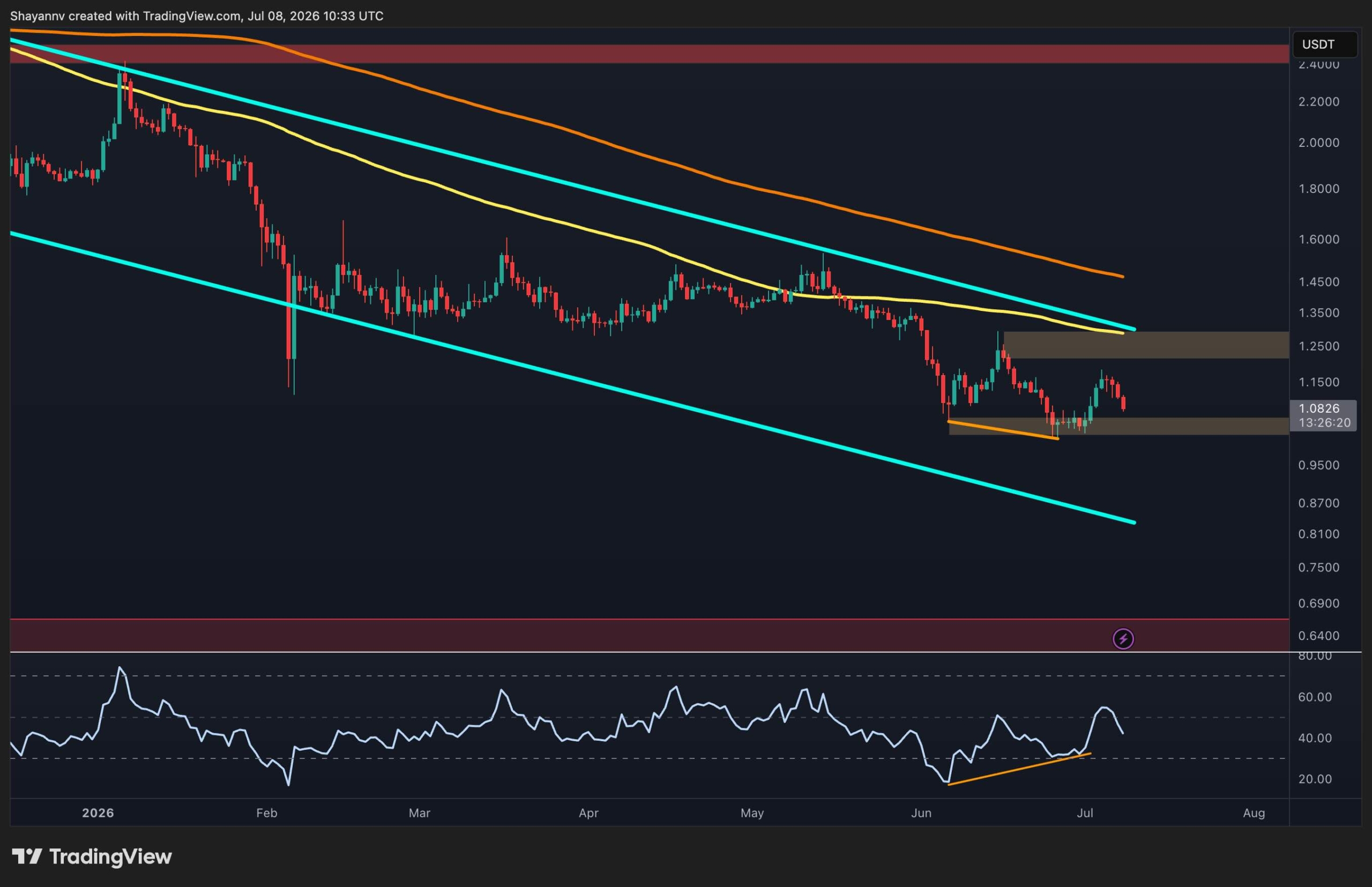
    On the daily chart, XRP remains confined within a clearly defined descending channel, signaling a firmly bearish market structure. The cryptocurrency is trading below both its 100-day and 200-day moving averages, which are both trending downwards and acting as dynamic resistance points above $1.25. This technical alignment suggests that seller momentum is still dominant, and a significant trend reversal would be required to shift the balance.

    Following the loss of the $1.25 level in early June, XRP found demand around the critical $1 mark. This region has repeatedly seen buyers step in to halt further declines and has now emerged as the most important support level to monitor. As long as this $1 support holds, the market may continue to establish a short-term base.

    On the upside, the immediate significant resistance is located around $1.25. This area coincides with the descending 100-day moving average and the upper boundary of the channel, presenting a substantial obstacle for any sustained recovery. A successful breach above this level would then target the 200-day moving average near $1.45. Conversely, a failure to hold the $1 support could trigger another downward move, potentially testing the channel’s lower trendline around $0.80.

    Meanwhile, the Relative Strength Index (RSI) has been printing higher lows, even as the price has made lower lows near $1. This developing bullish divergence suggests that bearish momentum may be waning, and buyers could initiate another recovery attempt if resistance levels begin to falter.

    XRP/BTC Pair Shows Continued Weakness

    Against Bitcoin, XRP’s technical picture remains weaker. The pair is trading below both major moving averages, which are continuing their downward trajectory and reinforcing the long-term bearish structure.

    After several weeks of range-bound trading, XRP/BTC is once again testing key horizontal support at approximately 1,700 satoshis. This level has served as the floor for recent consolidation, and another breakdown attempt is currently underway. A confirmed daily close below 1,700 satoshis would likely invalidate the current trading range and increase the likelihood of a decline toward the next significant demand zone, situated between 1,450 and 1,500 satoshis.

    To regain bullish momentum, buyers must first reclaim the 1,850 satoshis resistance area, which also aligns closely with the declining 100-day moving average. Until this resistance is overcome, rallies are likely to be viewed as corrective within the broader downtrend, potentially leading to further depreciation of XRP against Bitcoin.

  • Payward Secures $22 Million Arbitration Award Against Former Auditor Mazars USA

    Payward Secures $22 Million Arbitration Award Against Former Auditor Mazars USA

    Payward, the parent company of cryptocurrency exchange Kraken, has been awarded $22 million in arbitration against its former auditor, Mazars USA, following the auditor’s abandonment of a nearly completed audit. Payward is seeking to have this award entered as a final judgment by the Delaware Court of Chancery.

    According to Arjun Sethi, co-CEO of Kraken, the auditor’s withdrawal occurred during a period Payward claims was associated with reputational harm and financial losses, particularly during what critics describe as ‘Operation Choke Point 2.0’—a campaign to pressure banks into cutting off the crypto industry. Sethi stated that when an auditor walks away without findings, the client is left to repair reputational damage at a significant cost.

    Mazars USA had audited Kraken’s financials for three years, delivering two clean opinions. However, the firm quit the third audit in December 2023, days before its completion. Mazars reported in writing that it had no disagreement with management, no concerns about integrity, and found no fraud before withdrawing. The firm cited legal uncertainty, including an SEC complaint filed against Kraken weeks prior, as a reason for its withdrawal.

    This dispute unfolded against a backdrop of increased regulatory scrutiny on the crypto industry. In December 2022, Mazars Group had already halted its proof-of-reserves work for the crypto sector. In January 2023, regulators including the Federal Reserve, FDIC, and OCC issued a joint statement warning banks about crypto risks. Around the same time, the FDIC sent approximately 25 ‘pause letters’ to 24 banks, which advocates say instructed lenders to halt or reconsider crypto-related activities.

    The SEC had filed a complaint against Kraken weeks before Mazars abandoned its audit. This suit was later dismissed with prejudice in March 2025, with no penalties or admission of wrongdoing by Kraken, noted as part of a broader shift in regulatory approach.

    In a related development, Kraken co-founder and former CEO Jesse Powell’s home was raided by federal agents in March 2023. The investigation was reportedly closed about two years later with no charges filed.

    Sethi has pointed to these events as a reason to support legislative efforts like the Clarity Act, a bill aimed at dividing oversight of digital assets between the SEC and the CFTC. The Clarity Act cleared the Senate Banking Committee in May with a 15-9 vote, after passing the House in the previous year, but has faced hurdles and requires further votes to become law.

    Payward’s claim in arbitration centered on the reputational and financial damage was associated with by Mazars’ abrupt departure from the audit. Sethi argued that proving a lawful crypto business deserves ordinary banking and professional services should not require winning a legal fight.

    Uncertainties remain regarding the exact date of the arbitration award announcement and the specific years the Clarity Act passed the House and cleared the Senate Banking Committee. The full extent of legal uncertainty cited by Mazars and whether the firm acted independently or under pressure are also points of ambiguity. The precise reasons for the SEC’s initial complaint against Kraken and the full impact of ‘Operation Choke Point 2.0’ on the broader crypto industry are also not fully detailed.

    Why This Matters

    The materials describe a narrow update: Payward, the parent company of Kraken, received a $22 million arbitration award from its former auditor, Mazars USA. The exact date of the Tuesday announcement.

    Broader Context

    Source materials place the factual news in this context: Operation Choke Point 2.0 is a widely used term for what critics describe as the Biden administration’s unofficial campaign to pressure banks into cutting off the crypto industry after the collapse of FTX.

  • Hedge Funds Bet Heavily Against Yen; XRP Eyes $2.00 Amid Japan Shift

    Hedge Funds Bet Heavily Against Yen; XRP Eyes $2.00 Amid Japan Shift

    XRP Trades Near $1.07 Amid Yen Weakness and Japanese Investor Interest

    XRP is currently trading around $1.07, marking a roughly 3% decline over the past 24 hours. Despite this dip, the digital asset maintains a weekly gain of 6-7%, suggesting its broader upward trend remains intact.

    The key question for traders is whether sustained demand from Japan, driven by the weakening yen, will fuel further gains, or if the current consolidation signals a pause before a more significant correction. Hedge funds have adopted their most bearish stance on the yen since 2007, with short positions reaching nearly 138,000 contracts as of June 30, according to Commodity Futures Trading Commission (CFTC) data.

    This significant shift in currency markets represents a structural foreign exchange dislocation that historically prompts Japanese retail investors to seek refuge in hard assets and cryptocurrencies. In contrast, Bitcoin is consolidating in the mid-$60,000 range, down approximately 0.6% on the day but up over 6% for the week. Bitcoin has shown resilience against macroeconomic pressures that have significantly impacted Korean equities, with the Kospi index shedding about 20% from its recent peak.

    The current volatility across foreign exchange and equity markets is palpable. XRP, with its established positioning in cross-border payments, stands to benefit directly should the yen’s slide accelerate and Japanese exchange volumes surge in response.

    XRP’s Technical Landscape

    At $1.07, XRP occupies a technically challenging position. It hovers above the psychologically significant $1.00 level, which short-term traders view as strong support, but remains well below the previous resistance band near $2.00 that capped its last major rally.

    The 3% single-day drop is noteworthy, indicating active selling pressure at current price levels rather than a mere absence of buyers. Volume data suggests strategic positioning rather than panic-driven liquidations.

    The Bull Case: Japanese Retail Re-engagement

    The optimistic outlook for XRP hinges on renewed engagement from Japanese retail investors. XRP has historically enjoyed substantial popularity on Japanese exchanges. The current multi-decade lows for the yen provide domestic holders with a compelling incentive to reallocate funds into crypto-denominated assets.

    This catalyst could accelerate if the Bank of Japan signals further tolerance for yen weakness or delays intervention. On-chain data already indicates growing institutional interest. The base scenario anticipates a period of range-bound trading between $1.00 and $1.50 as macroeconomic conditions evolve.

    The Bear Case: Potential Breakdown

    The bearish argument is more straightforward. A decisive break below $2.03 could trigger a move towards $1.91 on any subsequent recovery attempt, marking a point where the near-term bullish thesis would be invalidated.

    Analysis based on the Market Value to Realized Value (MVRV) ratio suggests XRP is not yet in overheated territory. While this limits the potential for panic selling, it does not guarantee that current support levels will hold. Should the $1.00 floor falter, the next significant support level lies considerably lower.

    Market participants are advised to monitor the Bank of Japan’s policy decisions and the flow of partnerships from Ripple. While the underlying conditions for a potential rally are present, definitive confirmation is still pending.

    Infrastructure Plays: LiquidChain

    While XRP’s appeal is linked to foreign exchange dynamics, its current price point positions it as a recovery trade rather than an early-entry opportunity for those seeking asymmetric exposure to cross-border liquidity trends. Investors looking for such opportunities at a different risk profile are exploring infrastructure projects.

    LiquidChain is one such project gaining traction among analysts tracking Layer 3 development. The project aims to create an execution environment that unifies liquidity from Bitcoin, Ethereum, and Solana into a single layer. It promises unified liquidity, single-step execution, and a deploy-once architecture designed to address the fragmentation issues that developers find problematic.

    The LiquidChain presale has reportedly raised $889,886.53, with the current token price at $0.01477. This represents significant traction for a pre-launch infrastructure token.

    Key differentiators for LiquidChain include its Unified Liquidity Layer and Verifiable Settlement features. If the cross-chain thesis proves successful, the project’s value accrual potential is substantial.

    However, presale tokens inherently carry execution risk, and the absence of a live mainnet means proof of concept is yet to be demonstrated. Investors interested in the infrastructure angle are encouraged to research LiquidChain before its next price tier concludes.

  • Bankers Flag Farage’s £5M Gift From Crypto Billionaire

    Bankers Flag Farage’s £5M Gift From Crypto Billionaire

    Bankers Flagged £5 Million Gift to Nigel Farage to UK Crime Agency

    Bankers flagged a £5 million donation to Nigel Farage from billionaire Tether investor Christopher Harborne to the UK’s National Crime Agency (NCA), according to a report by The Guardian.

    The financial institution filed a suspicious activity report (SAR) with the agency on May 16, 2024, The Guardian reported, noting that the bankers were unable to trace the ultimate origin of the funds. A SAR is not an accusation of wrongdoing but rather a notification prompting the agency to review a transaction for potential further investigation.

    Harborne, a British businessman based in Thailand, who owns a 12% stake in USDT issuer Tether and ranks sixth on The Sunday Times Rich List, has also made substantial donations to the Reform UK party.

    Banks are particularly vigilant with transactions involving “politically exposed persons” (PEPs), who are considered to be at a higher risk of bribery or corruption. Financial Conduct Authority (FCA) guidance mandates that firms adopt a “risk-based and proportionate approach to PEPs when considering money laundering risks.” Harborne’s cryptocurrency holdings further elevated this risk from a banking perspective, The Guardian stated, due to the inherent difficulty in tracing funds moving in and out of digital assets.

    Farage told The Guardian that he was unaware of the SAR and had “no reason to doubt the ultimate source of the money.” He asserted that the information had been “illegally obtained” by the newspaper and claimed he had no knowledge of any discussions with the NCA concerning transactions involving him.

    The NCA declined to confirm or deny to The Guardian whether it had received any report, citing the confidentiality of SARs and the potential for breaching this confidentiality to constitute a “tipping off” offense under the Proceeds of Crime Act.

    Discrepancies in Donation Timeline Emerge

    Harborne’s lawyers informed The Guardian that Farage received the funds on April 5, 2024. However, financial industry sources cited by the newspaper indicated that at least a portion of the £5 million arrived after May 23, 2024, the date Farage announced his decision not to stand in that year’s general election, citing it was “not the right time for me.” He later reversed this decision days later to contest the Clacton seat.

    This timeline appears to conflict with an account in a new book, “The Farage Factor” by Conservative peer Michael Ashcroft. The book suggests that Reform UK was already preparing to launch Farage’s candidacy by mid-May, having enlisted a GB News producer to assist with promoting a planned announcement event.

    Farage has characterized the donation as an “unconditional gift” and has provided various explanations for its purpose, including security funding, a reward for his Brexit advocacy, and as “nobody’s business,” stating he could use it for luxury items like Ferraris.

    Scrutiny Over Declaration and Potential By-Election

    Farage has argued that he was not obligated to declare the gift as he was not a politician at the time of receipt. According to The Guardian’s reporting, he became a “person of significant control” of Reform’s corporate entity on May 1, 2024, and served as the party’s honorary president from March 2021 to June 2024.

    Parliament’s standards commissioner is already investigating whether the failure to declare the funds breached parliamentary rules. The Labour party has accused him of evading scrutiny over the gift.

    Hours before The Guardian’s latest report, Farage stated his intention to force a by-election in his Clacton seat. However, this move appeared to backfire on Tuesday night as the Conservatives, Labour, the Greens, the Liberal Democrats, and Restore Britain all announced they would not field candidates, dismissing the contest as a “circus.”

    Should Farage be re-elected, he would still face the ongoing standards inquiry and any subsequent reprimand.

    Separately, George Cottrell, a convicted fraudster with connections to an offshore crypto casino, has called for an investigation into Farage’s “failure to declare financial support.” The Reform UK leader has denied that the benefits required declaration, and Cottrell denies having expected any reciprocal benefit.