Tag: Positive

  • XRP Price May Surge as Institutional Investment Grows

    XRP Price May Surge as Institutional Investment Grows

    XRP Price Dips Amidst Institutional Interest

    The price of XRP has fallen by 2% to below its $1.40 support level, but institutional investment activity remains robust. Citadel Advisors has reportedly increased its exposure to XRP through various products, and a confirmed $500 million funding round for Ripple further strengthens its infrastructure.

    Ripple Secures $500 Million in Strategic Funding, Valued at $40 Billion

    Ripple’s recent investment round highlights strong institutional confidence in its blockchain payment infrastructure. The $40 billion valuation positions Ripple as a major player in the crypto finance sector.

    Reports suggest that Citadel Advisors has built $1.7 million in exposure to XRP through ETFs and trusts, including Bitwise, Canary, Franklin, and Grayscale XRP Trust calls. However, official 13F filings have yet to confirm these specific positions.

    Citadel Securities and Fortress Investment Group co-led a $500 million strategic funding round in Ripple on November 5, 2025, valuing the company at $40 billion. This capital injection is earmarked for custody, stablecoins, and prime brokerage infrastructure. If the ETF filings are confirmed, Citadel appears to be making two distinct but related investments.

    Market Dynamics and Regulatory Factors

    XRP investment products saw approximately $81.59 million in net inflows during April, with spot ETFs experiencing consecutive days of significant inflows in mid-May. The Securities and Exchange Commission’s (SEC) ongoing review of NYSE Arca’s crypto ETF proposals, which include XRP alongside Bitcoin, Ethereum, and Solana, also presents a potential regulatory catalyst.

    XRP is currently consolidating within the $1.37–$1.41 range, a zone that has withstood multiple tests without a decisive breakdown. Support is near the $1.35 area, and this level appears increasingly well-defended as net inflows remain positive week-over-week.

    Technical Outlook and Potential Upside

    Derivatives and technical analysis desks have identified a potential 12% upside breakout setup, with short-term targets around a low-double-digit percentage increase from current levels, potentially reaching $1.55. Institutional desks cited in ETF-flow coverage suggest that sustained net inflows exceeding tens of millions per week would significantly strengthen the case for a breakout.

    Three scenarios are worth monitoring:

    Momentum is leaning constructively, but XRP has previously experienced false breakouts. The Citadel disclosure, regardless of confirmation, is less critical than the ETF inflow trends.

    XRP price consolidation is a familiar pattern: a strong institutional narrative and positive inflow data, but near-term upside is limited by a market capitalization already exceeding $85 billion. This limits the potential for significant gains. For traders seeking early-stage exposure, the infrastructure layer supporting the next cycle of cross-chain activity is attracting attention.

    LiquidChain: A Layer 3 Solution

    LiquidChain ($LIQUID) is a Layer 3 execution environment that integrates Bitcoin, Ethereum, and Solana liquidity into a unified layer. It addresses the fragmentation issues prevalent in multi-chain DeFi.

    The project’s Unified Liquidity Layer enables single-step execution and verifiable settlement across all three ecosystems, allowing developers to deploy once and access all. The presale is currently priced at $0.0146, with $770K raised to date and a 1400% APY staking bonus for early buyers.


  • Dogecoin: Timing the Bottom and Predicting $2

    Dogecoin: Timing the Bottom and Predicting $2

    Dogecoin’s future trajectory may hinge less on speculative fervor and more on market fatigue, according to a new technical analysis. Crypto analyst Cryptollica suggests the leading meme coin is currently trading within another cycle-bottom zone. The weekly chart displays the same Relative Strength Index (RSI) washout and prolonged price compression that preceded previous significant Dogecoin rallies.

    Dogecoin’s Fourth Cycle Bottom Appears Imminent

    Dogecoin has faced considerable skepticism over the past year. Sentiment has plummeted, prices have compressed, and the initial enthusiasm surrounding the meme coin has waned. However, a pattern that has accurately identified every major Dogecoin bottom since 2015 indicates this could be a crucial moment.

    This analysis is based on the premise that Dogecoin’s chart reflects not only price movements but also the cyclical psychology of the market. Cryptollica identifies the 2015 bottom as a period of disbelief, the 2020 bottom as one of boredom, and the 2022 bottom as one of anger. The current setup is thus considered the fourth cycle bottom, characterized by exhausted sentiment and a bullish structure resetting.

    The analyst’s weekly chart shows Dogecoin trading along a long-term rising support structure, with each major low coinciding with the weekly RSI entering or approaching oversold territory. Notably, the latest RSI reading indicates the Dogecoin price rebounding from this level in early 2026 and gradually trending upward.

    Identifying the Bottom

    Dogecoin currently appears to be establishing a bottom around $0.10. However, the analysis emphasizes that the timing of the bottom is not solely determined by price. It is determined by a combination of factors: an oversold weekly RSI, prolonged price compression, and the price holding within the cycle support zone.

    The first signal, the oversold weekly RSI, is already visible on the chart. The second signal is compression. Dogecoin has spent months consolidating within a broad range around $0.10, rather than exhibiting a clear upward trend. While this may appear weak, in cycle analysis, extended compression often indicates sellers are gradually losing control.

    The third signal is confirmation. For the bottom argument to strengthen, Dogecoin needs to maintain its current support around $0.10 and begin forming higher lows on the weekly chart. A move above the nearest major resistance zones at $0.15 and $0.2 would further validate the claim that the cycle bottom has been established. Consequently, $0.10 is now a critical level for Dogecoin’s price.

    If the fourth cycle bottom is confirmed, the focus shifts from the current price to how Dogecoin has rallied from similar structural positions in the past. Cryptollica’s analysis suggests a potential target above $2.

    At the time of writing, Dogecoin is trading at $0.104, retesting the $0.10 level after reaching an intraday high of $0.1126.

  • Hive Shares Soar on Ontario AI Gigafactory Plan

    Hive Shares Soar on Ontario AI Gigafactory Plan

    Hive Digital Technologies’ stock price surged on Monday, reaching its highest point of the year following the Bitcoin miner’s announcement of a significant data center expansion in Ontario, Canada.

    The company’s shares traded around $3.39, reflecting a 26% increase for the day, according to Yahoo Finance. Just before Monday’s opening bell, Hive’s stock price briefly hit $3.92, temporarily extending its year-to-date gains beyond 35%.

    AI Gigafactory Planned

    Hive announced that its subsidiary, Buzz High Performance Computing, intends to build an “AI Gigafactory” in the Greater Toronto Area. The facility will have approximately 320 megawatts (MW) of utility capacity, sufficient to power at least 200,000 average homes.

    The firm, which began its strategic shift away from being a pure-play Bitcoin miner in 2022, indicated that the artificial intelligence facility is expected to be one of the largest in Canada. Hive added that the site will support fully vertically integrated AI supercomputers upon completion.

    In a statement, Hive and Buzz Executive Chairman Frank Holmes described the company’s latest move as a means to accelerate Canada’s tech boom, providing “sovereign AI infrastructure that turns Canadian intelligence into Canadian dominance.”

    Buzz anticipates the Ontario facility will become operational in the second half of next year, which will likely require 800 construction workers. The total buildout is estimated to cost roughly $3.5 billion Canadian dollars ($2.55 billion), ultimately leading to the creation of highly skilled jobs.

    Water-Efficient Design

    At the same time, Hive stated that Buzz’s facility is designed to minimize water usage, incorporating closed-loop cooling systems. Across North America, local residents are increasingly voicing concerns about the proliferation of data centers, which have the potential to raise electricity rates due to their substantial power demands.

    With a capacity of 320 MW, the Ontario site would bring Hive’s total global power capacity to 850 MW. Currently, the company utilizes 450 MW to power its data centers. Hive stated that it possesses sufficient land and power resources to establish facilities supporting approximately 130,000 GPUs.

    Financial Performance and Bitcoin Holdings

    In the three months ending December 31, Hive generated $88.2 million from mining digital assets, compared to $26.6 million a year earlier. High-performance computing revenue reached $4.8 million and $2.5 million, respectively, representing a smaller portion of its overall business.

    As Hive has embraced AI, the company has reduced its Bitcoin holdings. As of December 31, the company held 481 Bitcoin on its balance sheet, recently valued at $36.7 million, with the digital asset trading around $76,300, according to CoinGecko. A year prior, Hive controlled 2,805 Bitcoin, a cache currently worth $214.5 million.

  • Early Ripple Partner Joins X Money Initiative

    Early Ripple Partner Joins X Money Initiative

    Ripple’s early push into banking partnerships may be finding renewed relevance in an unexpected arena. One of its long-standing collaborators has re-emerged at the heart of X Money, the payments initiative linked to X’s broader ambition to become a global financial super app. What once served as a bridge for Ripple’s cross-border settlement network is now part of the infrastructure aimed at scaling digital payments to a massive user base.

    How a Ripple-Linked Bank Became Part of Elon Musk’s Payment Push

    A banking partner linked to Ripple from the company’s early expansion phase has now surfaced within Elon Musk’s X Money ecosystem. RippleXity revealed on X that Cross River Bank, one of the first U.S. banks to integrate Ripple’s payment protocol back in 2014 for real-time cross-border transfers between the U.S. and Europe, is now powering part of X Money’s beta rollout through its regulated banking services.

    The same Cross River Bank that reportedly issues the Visa Debit and Flex Cards appears in X Money’s beta program. With X building its payments layer through regulated banking and card infrastructure, this places a Ripple-linked financial institution within Musk’s expanding digital payments infrastructure.

    Furthermore, the development has quickly drawn attention across the XRP community because it creates a direct historical overlap between Ripple’s early settlement technology and X Money’s regulated banking framework. While there is still no official confirmation of XRP integration within X Money, many see Cross River Bank’s role as a significant connection that is difficult to dismiss.

    Ripple Prime Revenue Surges Despite XRP Trading Below All-Time High

    Although XRP continues to trade below 50% of its all-time high, Ripple’s broader infrastructure business appears to be gaining momentum behind the scenes. A technical analyst known as ChartNerd has noted that institutional adoption across Ripple’s ecosystem is accelerating, with Ripple Prime emerging as one of the company’s strongest growth drivers.

    The platform reportedly tripled its revenue over the past 12 months, processed more than 60 million transactions, and now clears over $3 trillion annually while operating across the United States. This is just one component of a broad infrastructure stack that Ripple is building during a bear market, and the projects being built now will accelerate the next bull run.

    Ripple and XRP have been building this infrastructure for over a decade, from surviving regulatory battles and securing a major victory against the SEC to expanding XRP Ledger functionality. XRP rules as a commodity, expanding XRPFI and DeFi capabilities, strategic acquisitions, banking partnerships, and strengthening its global infrastructure through XRPL upgrades. With more than 300 institutional clients and increasing global licensing approvals, these fundamentals have never been stronger, and clarity is on the horizon.

  • UK Regulators Outline Joint Plan for Tokenization

    UK Regulators Outline Joint Plan for Tokenization

    The Financial Conduct Authority (FCA) and the Bank of England unveiled a “shared vision” for tokenization in UK wholesale financial markets on Monday, initiating a joint Call for Input to provide firms with greater regulatory and infrastructure certainty as distributed ledger technology transitions from pilot projects to full-scale implementation.

    Regulatory Clarity Sought

    In a statement, the regulators indicated they would clarify their approach in areas where firms seek greater clarity, including prudential treatment, tokenized collateral, and settlement instruments.

    Sarah Breeden, Deputy Governor for Financial Stability at the Bank of England, encouraged both the private and public sectors to build upon the “strong foundations” established by the Bank and the FCA as the crypto industry advances “from pilots to production to support financial stability and sustainable growth.”

    Simon Walls, the FCA’s Executive Director of Markets, stated that tokenization has the potential to “transform wholesale markets – reshaping how assets are issued, traded, and settled.”

    Bank of England Initiatives

    The central bank also confirmed plans to launch a live synchronization service targeted for 2028, to consult on extending RTGS and CHAPS settlement hours towards near 24/7 operation, and to support HM Treasury’s pilot issuance of a digital gilt instrument known as DIGIT.

    Industry Response

    Katie Harries, Head of Policy for Europe at Coinbase, welcomed the announcement as a “clear vision for tokenization in financial markets,” urging the BoE and FCA to embrace DeFi as an opportunity to “deliver meaningful benefits for its citizens by taking an ambitious, forward-looking approach to tokenisation.”

    Ongoing Collaboration and Guidance

    The Bank and the regulator noted that they continue to collaborate with 16 firms on the live issuance and settlement of tokenized assets through the Digital Securities Sandbox. The Prudential Regulation Authority has also published Dear CEO letters updating guidance on the prudential treatment of tokenized assets, stablecoins, and other cryptoasset exposures.

    Broader Context

    The announcement follows recent indications that the Bank of England may be considering concessions to the digital asset industry. Breeden told the Financial Times that the Bank was reviewing whether its proposed stablecoin reserve floor and retail holding caps had been “overly conservative” following industry feedback.

    Breeden’s remarks followed a statement by Sasha Mills, the Bank of England’s financial market infrastructure director, at the FT Digital Asset Summit, where she stated that the Bank of England was treating stablecoins as a “new form of money” and confirmed that it expected to accept applications from prospective systemic issuers by the end of the year.

  • Ethereum Poised to Surge to $8,000, Breaking Bear Cycle

    Ethereum Poised to Surge to $8,000, Breaking Bear Cycle

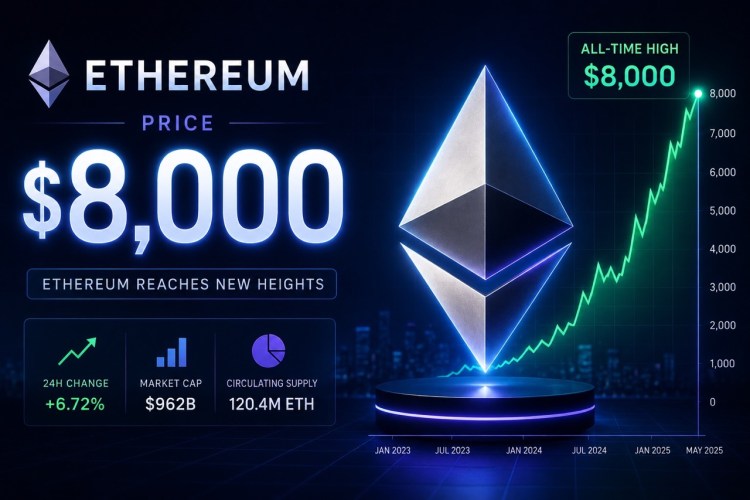
    Ethereum’s price weakness may be nearing a critical turning point, according to a new technical analysis that compares the current ETH structure with previous market cycles. The pattern that preceded the 2017 parabolic run and the 2020 breakout is re-emerging in 2026, with the long-term chart suggesting the potential start of a phase that could drive its price as high as $8,000.

    A Recurring Cycle

    Ethereum has spent the past several months building, a trend largely overlooked by the market. While the leading altcoin has underperformed compared to Bitcoin, its weekly chart is exhibiting the same structural sequence that preceded two of its most significant price rallies.

    Technical analysis indicates that ETH has followed a recognizable four-phase sequence in the previous two cycles: a prolonged downtrend, a compression phase with declining volatility, a breakout from the compression zone, and a vertical rally. In 2017, this cycle resulted in a gain of approximately 17,581%. The 2020 iteration, starting from a similar compression structure, produced a rally of about 4,348% during the 2021 bull run. The chart now presents a third instance of this structure. ETH bottomed around $1,800 in February 2026, a low that briefly breached support before a recovery brought the price back above the structure. This sequence of a fake breakdown followed by a swift recovery and the formation of a higher low mirrors the price behavior seen before the two prior cycles. The current compression is tighter than those that came before it, with buyers defending support around $2,200 and sellers capping rallies around $2,400, creating the pressure that could lead to a rally.

    Ethereum Breakout Anticipated

    The most intriguing aspect of this setup is the divergence between market sentiment and the technical structure. Currently, sentiment suggests ETH is weak. Ethereum has underperformed Bitcoin, particularly when struggling to maintain momentum above the $2,000 region. However, if the 2026 compression resolves similarly to 2017 and 2020, the projected expansion phase could yield a percentage gain smaller than those prior cycles, yet still substantial enough to push ETH well into the five-figure range.

    The prediction is that Ethereum will break out of its range below $2,400, continue this run to break out of the higher timeframe resistance around $4,900, and then reach new price highs. This could see the Ethereum price reaching at least $8,000, which, from the current trading range near $2,200, represents a gain of about 264%. Many market experts are predicting an Ethereum price rally above $10,000. Major upcoming catalysts for such a rally include the Glamsterdam upgrade, which could triple Ethereum’s Layer 1 throughput, and the expected passage of the CLARITY Act.

  • VALR Plans Expansion into Kenya

    VALR Plans Expansion into Kenya

    VALR Sponsors Kenya Blockchain & Crypto Conference

    Johannesburg, South Africa, May 18th, 2026 – VALR, a leading digital asset infrastructure provider in Africa, served as a diamond sponsor of the Kenya Blockchain & Crypto Conference held in Nairobi on May 14th and 15th, 2026.

    Peter Mwangi, VALR’s newly appointed Country Manager for Kenya, delivered a keynote address outlining his vision for Kenya as a burgeoning digital asset hub on the African continent. He drew parallels between the country’s early adoption of mobile money and the opportunities in digital asset payments, financial inclusion, and infrastructure. Shelley Havemann, VALR’s Head of Payments, participated in a panel discussion on stablecoins, the future of payments, and VALR’s role in transforming finance.

    VALR also hosted a meetup in Nairobi for financial business leaders to explore partnership opportunities. These activities highlight VALR’s strategic focus on Kenya and its support for the country’s emerging digital asset ecosystem.

    Kenya’s Digital Finance Leadership and Regulatory Advancements

    Kenya is recognized for its early adoption of mobile money, which has driven significant advancements in financial inclusion, payments, and broader economic participation across the continent. Recent regulatory developments have strengthened this foundation. The Virtual Asset Service Providers (VASP) Act was enacted in October 2025 and came into force in November 2025. The finalization of the supporting 2026 VASP Regulations under the Capital Markets Authority establishes a clear licensing and oversight framework. This framework aligns Kenya with international standards, promotes investor protection and responsible innovation, and creates a solid base for digital asset growth. These steps reinforce the vision outlined in Mwangi’s keynote and position Kenya as an increasingly important digital asset market in Africa.

    VALR’s Scale, Infrastructure, and Innovation

    Founded in Johannesburg in 2018, VALR quickly became South Africa’s largest crypto exchange by trading volume and has since developed into Africa’s leading digital asset infrastructure provider. VALR processes more than $15 billion in stablecoin volumes annually and consistently ranks among the top 10 global minters of USDC. The platform serves over 1.8 million registered users and more than 2,000 corporate and institutional clients, including companies listed on the JSE and Nasdaq.

    VALR offers institutional-grade infrastructure, including API integration, multi-account management, governance controls, an OTC desk, staking, lending, borrowing, VALR Pay, and crypto-as-a-service solutions. The company also recently launched its AI Service, which features a chat assistant for market analysis, account insights, and support, together with open API support for autonomous AI agents under the open Agent Skills Standard.

    Through its conference participation and Nairobi meetup, VALR is bringing its expertise and infrastructure directly to Kenyan institutions and the wider African market. VALR welcomes discussions with Kenyan financial institutions and businesses interested in partnership opportunities.

    About VALR

    Founded in 2018 and headquartered in Johannesburg, VALR is a global crypto exchange and the leading digital asset infrastructure provider on the African continent. It is backed by investors including Pantera Capital, Coinbase Ventures, and Fidelity’s F-Prime Capital. VALR offers a comprehensive suite of products, including Spot Trading, Spot Margin, Perpetual Futures, Staking, Lending, Borrowing, OTC services, VALR Invest, Crypto Bundles, and VALR Pay. Licensed by South Africa’s FSCA, with regulatory approval in Europe, VALR serves over 1.8 million registered users and 2,000 corporate and institutional clients worldwide. The exchange is dedicated to advancing a just financial future that upholds human dignity and the unity of mankind.

  • Hyperliquid Thrives Amid Market Uncertainty, Anticipating Major IPOs

    Hyperliquid Thrives Amid Market Uncertainty, Anticipating Major IPOs

    Hyperliquid’s HYPE Token Outperforms Crypto Market Amid Pre-IPO Futures Momentum

    Hyperliquid’s native token, HYPE, is bucking the broader cryptocurrency market downturn as its pre-IPO perpetual futures ecosystem gains traction ahead of a wave of technology listings.

    According to CoinGecko data, HYPE was trading at $45.17 on Monday, up approximately 5% in the last 24 hours and 69% over the past year.

    This divergence is linked to Hyperliquid’s HIP-3 marketplace, where traders are speculating on pre-IPO shares of companies like SpaceX, Anthropic, and OpenAI. This represents a $120 billion volume opportunity that traditional finance currently does not offer.

    Since its launch, the HIP-3 framework, which allows third-party teams to launch their own perpetual futures markets, has processed over $120 billion in total volume, according to Dune Analytics data. On April 8, HIP-3 deployers accounted for 48.1% of Hyperliquid’s total platform volume, nearing parity with the platform’s native markets.

    This parity allows retail traders to access pre-IPO price exposure previously limited to institutional investors through secondary venues.

    TradeXYZ, a leading HIP-3 deployer, demonstrated the model’s effectiveness by pricing Cerebras perpetuals within 3% of the AI chipmaker’s Nasdaq debut, while traditional secondary platforms were 35% off.

    This discrepancy highlighted that on-chain pre-IPO markets achieved faster and more accurate price discovery than off-chain alternatives.

    “For years, retail investors often entered once companies were already public and much of the upside had already played out,” Diego Martin, CEO of Yellow Capital, told Decrypt. “This feels like the beginning of a much bigger shift in who gets to participate.”

    The next wave of test cases is already forming, with several high-profile IPOs scheduled for 2026.

    According to Reuters, SpaceX is targeting a June IPO that could raise between $75 and $80 billion, roughly double the total raised across all 2025 IPOs combined, at a valuation of up to $1.75 trillion to $2 trillion. Anthropic and OpenAI are each considering listings that could raise $60 billion at valuations exceeding $1 trillion.

    A SpaceX pre-IPO perpetual contract, SPCX, is already live on TradeXYZ with a $150 reference price, implying a valuation of approximately $1.78 trillion. The token is currently trading at $207, down roughly 10% from Monday’s $230 local peak.

    Market expectations are already factoring in the scale of these listings.

    On prediction market Myriad, owned by Decrypt’s parent company Dastan, users assign a 91% chance that SpaceX’s closing market cap will exceed $1.3 trillion and give Anthropic a 67% chance of going public before OpenAI.

    Matthew Pinnock, COO of Altura DeFi, told Decrypt that the Cerebras market demonstrated how on-chain infrastructure can outperform traditional secondary markets in price formation. “24/7 crypto rails, leveraged positioning, and global participation can create faster consensus formation around late-stage private assets, particularly for sectors like AI where demand is heavily retail-driven and information moves quickly,” he said.

    Pinnock added that the category carries significant regulatory risk and anticipates regulators will eventually scrutinize whether pre-IPO perpetual products function as unregistered securities exposure for retail traders. OpenAI and Anthropic have already cautioned investors against trading in securities tied to companies they have not authorized.

    The platform’s ambitions have garnered early attention from Wall Street: Intercontinental Exchange and CME Group have reportedly urged the CFTC to address potential market integrity risks associated with Hyperliquid’s pseudonymous trading environment. The Hyperliquid Policy Center responded, arguing that the platform’s transparency is “hostile” to insider trading.

    “Instead of being focused purely on digital assets, crypto infrastructure starts becoming a way for people to participate in broader financial opportunities,” Martin said. “That is a story a much larger audience can understand.”

  • Lock.com Launches Early Access with Secure Signing and Quantum-Resistant Design

    Lock.com Launches Early Access with Secure Signing and Quantum-Resistant Design

    FOR IMMEDIATE RELEASE – London, United Kingdom, May 18th, 2026

    Quantography Labs has announced the early-access release of Lock.com, a hardware-free crypto wallet that utilizes an isolated, air-gapped security approach.

    Key Features and Functionality

    Lock.com is now available to early-access users. The platform distinguishes itself by separating private key storage from network-connected systems, eliminating the need for dedicated hardware wallet devices.

    Hardware wallets have traditionally been the standard for safeguarding digital assets. However, they present a trade-off: users must place their trust in the device, its manufacturer, and the associated supply chain.

    Lock.com addresses this dependency by isolating the signing environment from the broadcasting environment. Private keys are stored on a fully offline signer, while transactions are created and broadcast on a connected device. This design ensures that private keys never interact with the internet. The system is intended to work with users’ existing devices, removing the need for specialized hardware.

    Motivation and Technology

    Lock.com was developed in response to concerns about current crypto security practices. The developers observed that many users continue to lose funds due to vulnerabilities in the software environment surrounding hardware wallets. Lock.com aims to structurally address this issue.

    The wallet is designed to function as an isolated crypto wallet without relying on third-party hardware manufacturers or proprietary device supply chains. Its architecture incorporates post-quantum cryptographic standards, specifically ML-DSA signatures and ML-KEM key encapsulation, alongside the isolated signing model.

    Early Access and Future Plans

    The early-access phase will focus on gathering user feedback before the general release. Early access enrollment is available at https://www.lock.com/.

    About Quantography Labs

    Quantography Labs is an investment and technology firm specializing in secure finance, digital assets, and applied research. The company develops privacy-focused, quantum-ready systems designed to advance the future of digital asset security and infrastructure. Lock.com is its first publicly released product.

    Users can find more information about Lock.com’s isolated crypto wallet architecture at https://www.lock.com/.

  • XRP Dips 5% Weekly, Analysts Forecast Surge

    XRP Dips 5% Weekly, Analysts Forecast Surge

    Ripple’s cross-border token, XRP, has experienced a downturn in recent days, reaching its lowest point this month. Despite this, several factors and indicators suggest a potential rebound, with many analysts remaining optimistic about an upcoming bull run.

    Market Downturn

    The cryptocurrency market has faced challenges in the past 24 hours, with many leading digital assets incurring significant losses amid renewed tensions between the United States and Iran. U.S. President Donald Trump issued a warning to Iran, stating that time was running out.

    XRP has not been immune to this trend. Its price fell to approximately $1.38 on May 18, according to CoinGecko, representing a 5% weekly decline and returning to levels last seen nearly three weeks prior.

    Analyst Optimism

    Despite the price drop, analysts on crypto social media platforms remain bullish on XRP’s prospects. One analyst, using the pseudonym CoinForge, described the asset’s current state as “insane,” noting it is at a critical level that previously led to a 700% increase.

    CoinForge added that the Moving Average Convergence Divergence (MACD) indicator has just completed a “golden cross,” suggesting potential for expansion. Their target price is just below $5, which would represent a 240% jump.

    JAVON MARKS and Celal Kucuker have also offered optimistic forecasts. Marks argued that XRP is still “holding broken out” against Bitcoin (BTC) and could potentially outperform by nearly 800%. Their analysis suggests that a breakout similar to previous ones could push XRP above $10.

    Celal Kucuker believes the asset is poised for a significant breakout, with a potential valuation exceeding $15.

    Positive Indicators

    The recent substantial inflows into spot XRP exchange-traded funds (ETFs) further support the optimistic outlook. Data from SoSoValue indicates that the last day with net outflows was April 30, and the past week has been the strongest since December.

    Since their launch, these financial products have generated a cumulative net inflow of almost $1.4 billion, indicating strong interest from institutional investors and potentially driving upward price momentum.

    Additionally, the declining amount of XRP tokens stored on Binance is another positive sign. According to CryptoQuant, the figure has dropped to a monthly low of around 2.75 million coins, suggesting that investors are shifting towards self-custody methods, thereby reducing immediate selling pressure.