Flare Network Integrates XRP Support
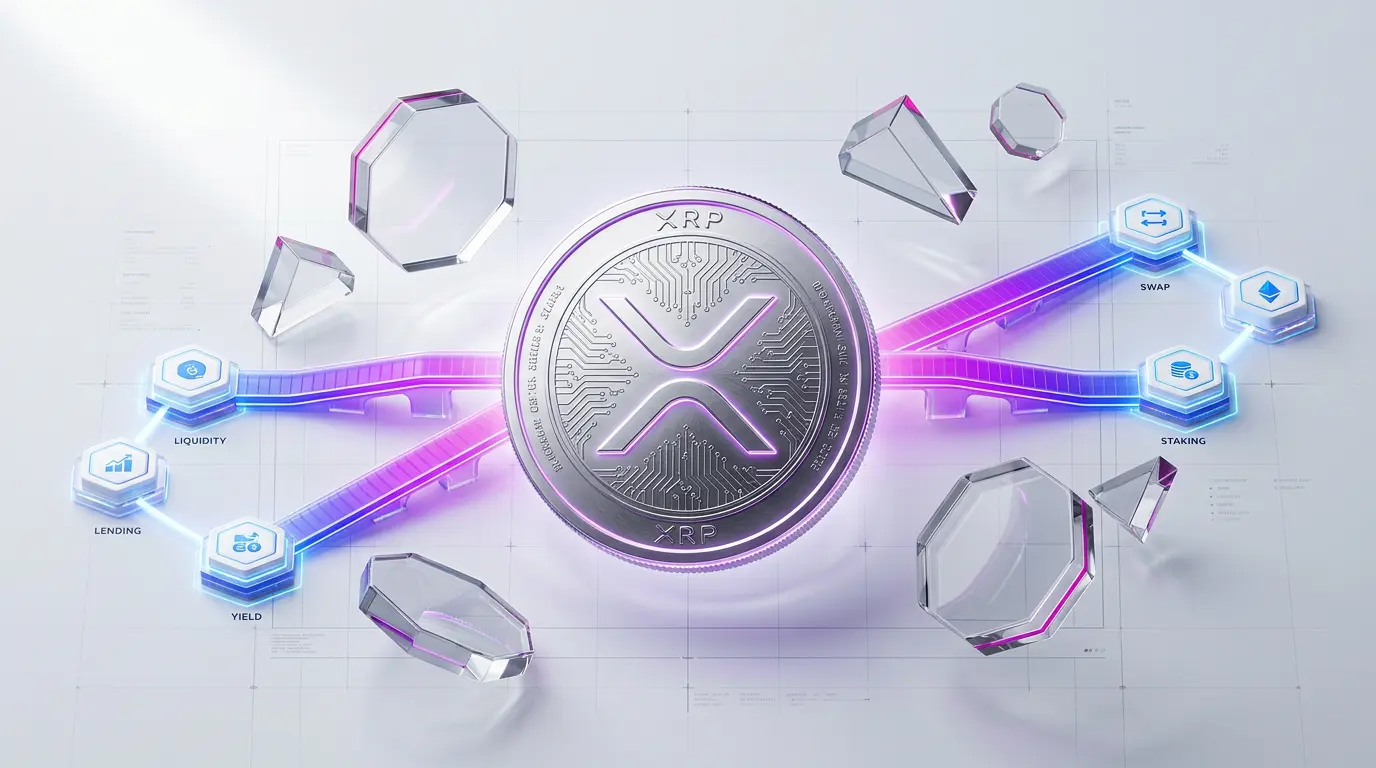
Flare Network has completed a significant infrastructure milestone by integrating native XRP support directly into its wallet architecture. This integration allows XRP holders to access a full suite of decentralized finance (DeFi) applications, including lending, borrowing, liquidity provision, and yield farming, without relying on centralized custodians or permissioned bridges.
The mechanism enabling this functionality is Flare’s FAssets protocol, which utilizes the network’s State Connector to verify transactions on the XRP Ledger. This allows XRP to be minted as FXRP on Flare in a trustless, overcollateralized format.
Flare Smart Accounts are now live in D’CENT wallets. The process involves two signatures on XRPL, followed by FXRP minting, and then access to the Monarq XRP Yield Vault. A $55,000 campaign reward pool is available for D’CENT users and early depositors.
Addressing XRP’s Utility Gap
This development directly addresses a long-standing utility gap for XRP, a token with significant liquidity and institutional reach that has historically been excluded from the smart-contract DeFi ecosystem.
On-chain data indicates a 20% increase in Flare’s Total Value Locked (TVL) following the integration announcement, with large wallets holding more than 10 million XRP as the primary drivers.
The key question is whether this initial inflow represents a sustained capital migration or opportunistic positioning in anticipation of future developments.
The Risk-Reward Trade-Off
XRP holders who move their assets from the XRP Ledger onto Flare accept smart-contract risk and bridging complexity in exchange for yield exposure that the native ledger currently cannot provide. The market is now assessing whether the yield rates justify this trade-off and if crypto liquidity will deepen quickly enough to sustain the ecosystem.
How the System Works
Flare’s State Connector protocol monitors the XRP Ledger for confirmed transactions and relays cryptographic proof of those transactions to Flare’s EVM-compatible execution layer.
When an XRP holder initiates a mint, agents on the Flare side provide overcollateralized backing, denominated in FLR, and FXRP is issued on a 1:1 basis against the locked XRP. Agents earn minting and redemption fees, and the overcollateral provides a liquidation buffer if FLR prices decline.
This structure, as outlined in Flare’s introduction to XRP DeFi, distinguishes FXRP from custodial wrapped-token approaches. There is no single bridge operator to compromise, and the collateral backstop is enforced by Flare’s proof-of-stake consensus, where 98% of the stake is community-held and no single data provider can exceed 3.3% of the total stake.
The network achieves an average block time of 1.2 seconds with single-slot finality, which is crucial for DeFi protocols where price feeds and liquidation triggers operate in near-real time.
FXRP’s DeFi Applications
Once minted, FXRP becomes a composable DeFi asset. Holders can deploy it across lending protocols, supply it to automated market maker pools on SparkDex (Flare’s native DEX), or route it into yield optimizers developed under Flare’s developer incentive program.
The Firelight protocol, currently being rolled out, further expands this functionality by introducing Economically Secured Services. FXRP stakers underwrite security for third-party applications and earn a share of the fees those applications generate.
Liquid staking tokens issued through Firelight act as receipts that can be redeployed in additional XRP DeFi strategies, creating compounding yield loops without sacrificing the base staking position.
Structural Shift in DeFi
What was previously impossible for XRP holders—accessing a full-stack DeFi environment with native collateral, decentralized price feeds via Flare’s FTSO, and programmable yield—is now accessible through a single wallet integration. This structural shift is reflected in the TVL data.
XRP Market Performance
XRP is currently trading near $1.36, consolidating after a sharp rally following the passage of the Clarity Act through the Senate Banking Committee. The token has maintained its position above the $1.30 support level for 11 consecutive sessions, a level the market views as a near-term structural floor.