Tag: Positive

  • Huang: White House AI Declaration Reshapes Industry

    Huang: White House AI Declaration Reshapes Industry

    White House Embraces Industry Self-Regulation for AI Development

    Nvidia CEO Jensen Huang secured a significant victory from Washington this past Friday, as President Trump unveiled a voluntary self-regulation accord for the artificial intelligence industry. The agreement, announced at a White House luncheon on September 29, effectively delegates oversight to the tech sector, signaling a hands-off approach from the administration.

    The gathering brought together a formidable roster of AI leaders, including Elon Musk of xAI and Tesla, Greg Brockman of OpenAI, and Google CEO Sundar Pichai. The executives convened with President Trump to deliberate on the future governance of AI in the United States. The outcome was a unified commitment to self-regulation, eschewing the imposition of prescriptive government mandates.

    President Trump drew a parallel between the transformative potential of AI and the industrial revolution. He also suggested rebranding AI technology as “super intelligence” and vowed that the U.S. would “never stifle” its advancement.

    Treasury Secretary Scott Bessent underscored the administration’s position, confirming that President Trump is “completely aligned” with Huang’s perspectives on AI policy.

    Huang has been instrumental in shaping adjustments to export rules, which have permitted the limited sale of advanced chips, such as the H200, to Chinese buyers. This arrangement, however, includes a stipulation: a 25% reduction in U.S. revenue from these transactions.

    Huang’s advocacy has consistently focused on two core principles: market-driven safety protocols and the preservation of American leadership in AI technology. Both these priorities were evident in the September 29 accord, which prioritized the pace of innovation over regulatory prudence.

    For investors, the key takeaways from the meeting—encompassing AI hardware, policy direction, exports, and regulation—suggest continued momentum for American technology companies.

    The potential downside is equally apparent. Should a significant AI safety incident occur within this self-regulatory framework, the ensuing political repercussions could be severe and swift. Companies that have structured their strategies around regulatory flexibility would face the greatest exposure.

  • Volmex Launches Bitcoin Implied Volatility Futures on Hyperliquid

    Volmex Launches Bitcoin Implied Volatility Futures on Hyperliquid

    Volmex Launches First On-Chain Bitcoin Volatility Futures on Hyperliquid

    Volmex Finance has introduced perpetual futures contracts tied to its Bitcoin Volmex Implied Volatility Index (BVIV) on the Hyperliquid exchange. This development marks the debut of an on-chain market specifically designed for trading Bitcoin’s expected volatility as a distinct asset.

    This new offering can be seen as the cryptocurrency market’s equivalent to the VIX, Wall Street’s widely recognized “fear gauge” that monitors anticipated S&P 500 volatility. Unlike the VIX, which is typically accessed through institutional brokerage accounts, the BVIV futures are available on a decentralized exchange and offer leverage of up to 5x.

    The BVIV index measures Bitcoin’s 30-day expected implied volatility by aggregating real-time options data from Deribit and OKX, two of the leading cryptocurrency options trading platforms. Recent readings for the index have hovered in the mid-to-high 30s, providing a general indication of the market’s current sentiment regarding near-term price fluctuations for Bitcoin.

    The perpetual futures contract employs a linear payout structure. For every one-point movement in the index, a trader’s profit or loss is equivalent to $1 USDC. For instance, a trader holding a long BVIV position at 35 that surges to 50 during a period of market turmoil would realize a gain of $15 per contract, without the need to understand complex options Greeks.

    These contracts are collateralized with USDC and utilize isolated margin. This means that a losing position in a volatility trade will not impact other assets held by the trader on the platform. Funding rates are calculated on an hourly basis, a departure from the more common eight-hour intervals found on most perpetual futures markets, reflecting the potentially abrupt shifts characteristic of a volatility index.

    The initial open-interest cap has been set at $2 million, a precautionary measure to allow the market to stabilize. Trading is accessible via the Markets by Kinetiq frontend under the ticker mkts:BVIV.

    Volmex CEO Cole Kennelly highlighted the launch as a significant opportunity for crypto traders and investors to engage in hedging and speculation strategies, bypassing the typical complexities associated with options trading.

    The selection of Hyperliquid as the listing venue is noteworthy. The platform has emerged as a leading decentralized perpetual futures exchange, facilitating billions in daily trading volume and achieving a valuation exceeding $90 billion. The addition of a volatility-specific product broadens the exchange’s offerings beyond simple cryptocurrency price speculation.

    However, the product is not without its inherent risks. Volatility indices can experience “gap behavior,” where the index experiences sharp jumps between calculation periods rather than smooth progression. For traders employing leverage, such gaps can lead to significant losses, potentially resulting in liquidation. While the isolated margin system helps to mitigate this risk, it does not entirely eliminate it.

  • Bitwise Launches US Spot Ether ETF After Token Surges

    Bitwise Launches US Spot Ether ETF After Token Surges

    Bitwise Launches First Spot Near ETF in U.S.

    Bitwise commenced trading its Near ETF on Tuesday, offering U.S. investors a new avenue to gain exposure to the AI-focused Near blockchain through conventional brokerage accounts. The fund, listed on NYSE Arca under the ticker NRR, carries an annual fee of 0.75%, according to Bitwise.

    The company touts the fund as the first spot Near fund in the United States. The term “spot” signifies that the ETF holds actual Near tokens, as opposed to futures contracts, which are derivatives based on anticipated price movements.

    Exchange-traded funds (ETFs) are investment vehicles that can be bought and sold like stocks. For individuals who have avoided cryptocurrency exchanges or digital wallets, this offers a simplified entry point: the underlying tokens are held within the fund, and the ETF shares appear alongside other investments in their brokerage application.

    The timing of the ETF’s launch appears opportune, particularly given Near’s recent surge in performance, with its value skyrocketing since May.

    This is not the first significant price movement for Near this year. In May, the token experienced a 28% jump within 24 hours, driven by upgrades related to privacy, artificial intelligence, and scaling. However, it subsequently retreated to around $2 over the summer. Currently, Near is trading just above $5, with a market capitalization of $6.5 billion. Despite this recent uptick, the token remains approximately 75% below its all-time high of over $20.

    Near operates as a layer-1 blockchain, serving as a foundational network upon which other applications are built, placing it in the same category as prominent networks like Ethereum and Solana. Its main network was launched in 2020.

    The connection to artificial intelligence stems from co-founder Illia Polosukhin, who is also a co-creator of the Transformer architecture, the underlying technology for models such as ChatGPT. Near established an AI research lab in May 2024, under the leadership of Polosukhin and co-founder Alex Skidanov.

    Bitwise’s investment thesis emphasizes the potential of AI agents, which are software programs designed to perform tasks on behalf of users, such as making payments or booking travel arrangements.

    “We are moving toward a world in which AI agents increasingly act on our behalf, coordinate with one another, and participate in the economy,” stated Bitwise CEO Hunter Horsley. “We believe this shift—to an agentic economy where more and more happens through AI agents—could unlock an enormous new frontier for the global economy. NEAR is building a platform for that future.”

    Bitwise also highlighted that Near Intents, a service facilitating asset swaps across different blockchains, has processed over $32 billion in volume.

    The Bitwise fund also engages in token staking. Staking involves locking up tokens to support the validation of network transactions, with participants earning rewards in return, akin to interest but paid in additional tokens. Bitwise anticipates that its internal team will stake the fund’s Near holdings to achieve average rewards of approximately 5%, which will accrue to shareholders through an increase in the fund’s per-share value.

    However, these rewards are not guaranteed. Bitwise’s disclosures indicate that reward rates are subject to change, and staking carries the risk of “slashing,” which involves penalties imposed when a validator violates network rules. Furthermore, the fund concentrates on a single asset, and Bitwise cautions that investors could potentially lose a substantial portion or all of their investment.

    Bitwise initially filed paperwork in Delaware for a Near fund in April 2025, when the token was trading at $2.61. Grayscale subsequently filed in January 2026 to convert its existing Near trust into an ETF, at a time when Near was priced around $1.54.

    The regulatory landscape for such funds became more favorable in September 2025, when the SEC approved generic listing standards. These standards allow exchanges to list qualifying crypto funds without requiring individual approval for each one. Following this, funds for Litecoin, Hedera, and Solana were introduced in October of that year, including Bitwise’s own Solana staking ETF.

    Bitwise charges an annual fee of 0.75% for the NRR ETF, which translates to $75 for every $10,000 invested.

  • Bitcoin ETFs Attract $2.95 Billion in 30 Days, Boosting Investor Profitability

    Bitcoin ETFs Attract $2.95 Billion in 30 Days, Boosting Investor Profitability

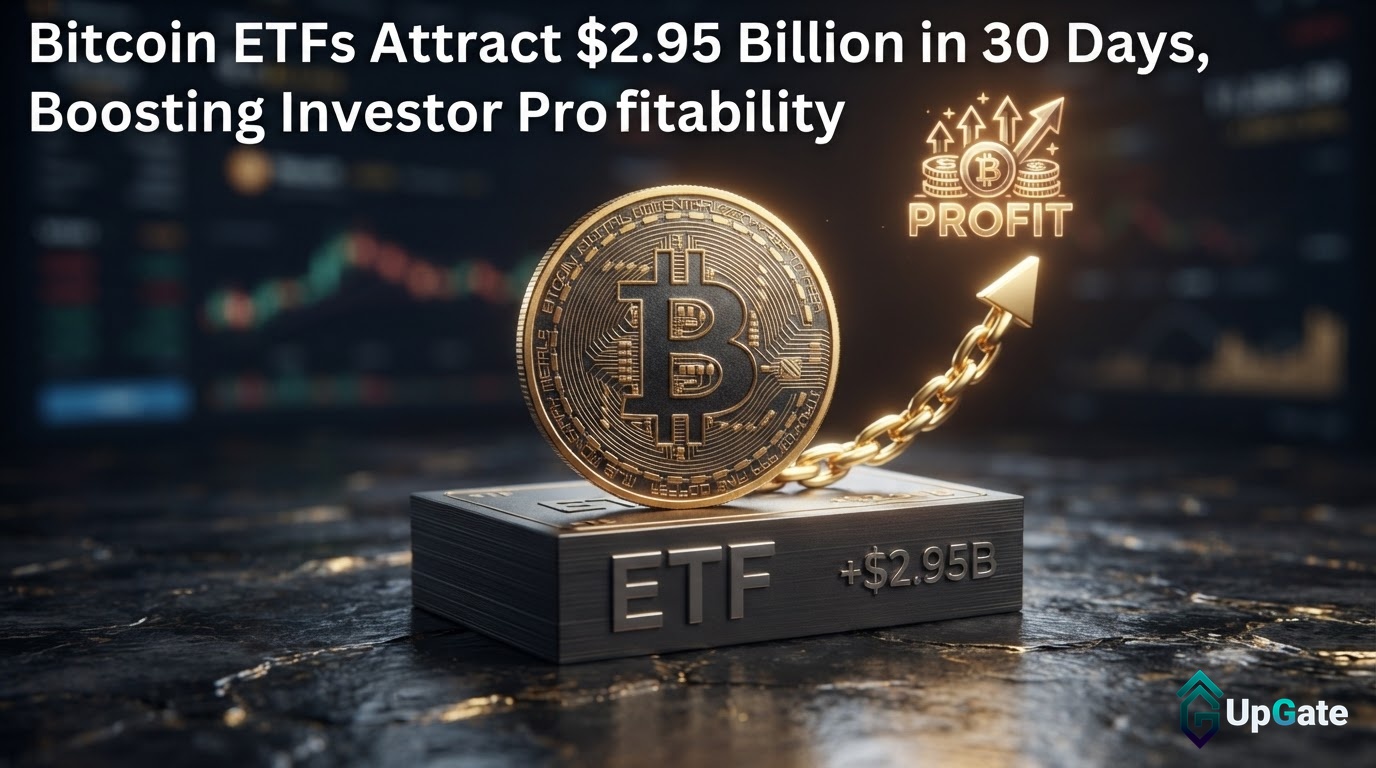
    U.S. Bitcoin ETFs have seen substantial net inflows totaling $2.95 billion over the past 30 days, extending a streak of positive daily inflows to eight consecutive trading days. This sustained investor interest has coincided with a return to profitability for the average ETF holder, whose cost basis stands at $81,722.

    While the streak has been positive, the most recent day of inflows saw a modest $31.07 million, marking the weakest day of the current run. BlackRock’s iShares Bitcoin Trust (IBIT) continued to attract investment, adding $54.84 million on Monday. However, other major funds experienced outflows, with Grayscale’s Bitcoin Trust (GBTC) losing $23.19 million and Fidelity’s FBTC shedding $10.90 million on the same day.

    This recent period of positive inflows follows a more turbulent stretch. On September 15th, Bitcoin ETFs collectively experienced an outflow of $450.4 million, the largest single-day loss since June 24th. This outflow occurred on the same day the U.S. Senate voted 49-50 against advancing the Clarity Act, a measure that required 60 votes to proceed. Ethereum ETFs also saw outflows on that day, losing $142.3 million.

    The week ending September 15th was particularly challenging for Bitcoin ETFs, with net inflows totaling just $6.2 million, the smallest weekly inflow recorded in 141 weeks. However, investor activity rebounded sharply in the subsequent days. On September 21st, Bitcoin ETFs attracted nearly $1 billion, followed by $715 million on September 22nd. While the pace moderated, inflows continued, with $347 million on September 23rd, $191 million on September 24th, and $134 million on September 25th. This resulted in a weekly total inflow of approximately $2.4 billion for the week ending September 25th, marking the largest weekly haul since October 2025.

    The positive trend in Bitcoin ETFs has also seen the cryptocurrency trading above the average ETF holder’s cost basis of $81,722, indicating that typical investors in these funds are now in profit for the first time since January. Bitcoin was trading above $84,000 on Monday.

    This broader interest in crypto investment vehicles is not limited to Bitcoin. Over the past 30 days, Ethereum ETFs have added $982.5 million, with $17.1 million in inflows on Monday, according to SoSoValue. Solana funds saw inflows of $278.2 million over the month, and XRP funds brought in $127.05 million during the same period.

    While the current streak of inflows is notable, it is not a record for the summer. An earlier nine-day run of inflows ended on August 28th, when the funds experienced $201.9 million in outflows. This occurred after comments from Federal Reserve Chair Kevin Warsh at Jackson Hole, a period where market participants often attempt to anticipate the Federal Reserve’s future monetary policy decisions.

    The current inflows suggest a renewed investor confidence in Bitcoin ETFs, driving profitability for many investors. However, the market remains subject to fluctuations, as evidenced by past outflows and the mixed performance of individual funds on a daily basis.

    Why This Matters

    The materials describe a narrow update: Bitcoin ETFs in the U. The exact date of the ‘Monday’ mentioned for the weakest inflow day and specific fund movements is not provided.

    Broader Context

    Source materials place the factual news in this context: Bitcoin ETFs are having a very good month, all things considered.

  • Grayscale: Zcash Market Cap Hits 1.5% of Bitcoin’s in One Year

    Grayscale: Zcash Market Cap Hits 1.5% of Bitcoin’s in One Year

    Zcash Surges as Demand for Financial Privacy Grows

    New York, NY – September 30, 2026 – A year ago, Zcash was a negligible player in the cryptocurrency market, its market capitalization a mere 0.1% of Bitcoin’s. However, recent research from Grayscale indicates a dramatic shift, with Zcash’s market share climbing to 1.5% by September 2026.

    The digital currency, ZEC, experienced a remarkable surge, escalating from approximately $60 to around $1,500 over twelve months. This nearly 19-fold increase propelled its market capitalization to nearly $13.74 billion by late August. For perspective, Bitcoin’s market capitalization stood at approximately $1.56 trillion during the same period.

    Grayscale’s report, released on September 29, 2026, attributes this significant rally to an increasing demand for financial privacy. The underlying thesis suggests that as blockchain transparency advances and on-chain surveillance tools become more prevalent, a growing number of users and investors are prioritizing the ability to conduct transactions privately.

    Zcash’s defining characteristic is its shielded transactions, which allow users to encrypt sensitive data such as sender, receiver, and transaction amounts, while still maintaining settlement on a public blockchain.

    By the end of September 2026, ZEC was trading around $1,400, with its market capitalization reported to be between $23 billion and $24 billion. This suggests sustained momentum following an initial price spike earlier in the summer.

    Grayscale analyzes this market opportunity in relative terms. The firm identifies Bitcoin as the dominant force in the “currencies sector” of the crypto market, commanding approximately 90-93% of that category’s total market capitalization.

    Grayscale Launches Zcash ETF, Boosting Accessibility

    A key development contributing to Zcash’s increased visibility was the launch of Grayscale’s Zcash ETF on August 25, 2026. Trading under the ticker ZCSH on NYSE Arca, the exchange-traded fund represents a conversion of Grayscale’s established Zcash Trust, which has been in operation since 2017.

    The transition from a trust to an ETF is significant because it addresses the persistent issue of premiums or discounts to net asset value that affected Grayscale’s earlier trust products. The ZCSH ETF now offers direct exposure to ZEC, incorporating an arbitrage mechanism designed to keep its market price closely aligned with the underlying asset’s value. Reports indicate that the ETF has attracted substantial inflows since its inception.

    Future Potential and Associated Risks

    Grayscale’s research also includes hypothetical scenarios illustrating ZEC’s potential price trajectory based on different levels of market-cap capture relative to Bitcoin. For instance, if Zcash were to achieve 2% of Bitcoin’s market capitalization, the implied ZEC price would be approximately $1,622. Grayscale emphasizes that these figures are purely hypothetical and not predictive forecasts.

    Zcash’s privacy features are optional, allowing users to enable or disable them as needed, utilizing shielded transactions powered by zero-knowledge proofs.

    However, Grayscale acknowledges that privacy-focused cryptocurrencies carry inherent risks. ZEC exhibits significantly higher volatility compared to Bitcoin. Furthermore, regulatory scrutiny poses a considerable challenge, with several exchanges having delisted privacy-centric tokens in recent years due to concerns over money laundering.

    Mirroring Bitcoin’s scarcity model, Zcash also features a capped supply of 21 million coins.

  • Baillie Gifford Launches Tokenized Bond Fund, BAGEY, on Ethereum and Solana

    Baillie Gifford Launches Tokenized Bond Fund, BAGEY, on Ethereum and Solana

    Baillie Gifford, an Edinburgh-based asset manager overseeing approximately $237 billion to $260 billion in assets, has launched its Enhanced Yield Fund (BAGEY) as a tokenized bond product. This fund operates natively on both the Ethereum and Solana blockchains, settling transactions in either USDC or fiat currency and targeting a yield of approximately 7%.

    Fund Mechanics and Features
    Verified facts indicate that BAGEY is an actively managed, short-duration bond portfolio with an average credit quality rating of BBB and a duration of roughly two years. Shares are minted directly on public blockchains, with Ethereum and Solana serving as the legal register of ownership, meaning there is no traditional wrapper between the investor and the token. The minimum investment is $100, though the fund is restricted to eligible professional investors.

    Infrastructure and Partners
    Custody and tokenization services for the fund are provided by BitGo Bank & Trust, BNY, Anchorage Digital, and Archax. The fund is structured to operate with daily net asset value calculations.

    Market Context and Implications
    BAGEY officially launched on June 22, 2026, through Baillie Gifford’s digital assets unit, BGDA UK. By September 29 of the same year, its availability expanded to professional investors in Switzerland, Hong Kong, and the Cayman Islands. This launch by a major asset manager into the tokenized asset space signifies a growing trend of traditional financial institutions integrating with blockchain technology. The issuance of tokenized bond funds on multiple blockchains like Ethereum and Solana suggests a potential broader adoption of distributed ledger technology for financial instruments, supported by established digital asset infrastructure providers.

    Why This Matters

    The materials describe a narrow update: Baillie Gifford launched the Enhanced Yield Fund (BAGEY), a tokenized bond product native to Ethereum and Solana, which settles in USDC or fiat and targets a 7% yield. Tokenized bond funds are being issued on multiple blockchains.

  • Bitwise Launches First US Spot NEAR ETF on NYSE Arca Amid Token Surge and AI Focus

    Bitwise Launches First US Spot NEAR ETF on NYSE Arca Amid Token Surge and AI Focus

    Bitwise has launched the first US spot exchange-traded product (ETP) tracking the NEAR token, which began trading on NYSE Arca on Tuesday under the ticker NRR. This introduction of a traditional investment vehicle for the NEAR token coincides with a significant price surge and increased activity on the NEAR blockchain’s network.

    The Bitwise NEAR ETF carries a management fee of 0.75% and will hold NEAR tokens directly, with plans to stake a substantial portion of the fund’s holdings. This launch follows Bitwise’s previous introduction of a European NEAR ETP in June 2025.

    In recent weeks, the NEAR token has experienced notable price appreciation. According to CoinGecko data, the token gained approximately 167% over the past month, trading around $4.94 on Tuesday. Over the past year, the NEAR token is up about 81%.

    This performance aligns with a broader strategic shift by the NEAR blockchain towards artificial intelligence (AI) use cases. In 2024, NEAR focused its strategy on AI, aiming to leverage its capabilities for decentralized applications and autonomous AI agents. Bitwise chief investment officer Matt Hougan told Cointelegraph that the firm views AI agents as a growing use case for NEAR, expecting this activity to increase over time.

    Central to this strategy is NEAR Intents, the network’s cross-chain transaction protocol. Activity on NEAR Intents has seen a sharp increase, with volume rising to over $32 billion from less than $1 billion a year ago, according to Bitwise. The protocol allows users and AI agents to specify desired transactions, which third-party solvers then execute across supported blockchains. Hougan noted that the design of Intents aligns with the goal-based orientation of large language models (LLMs) and shields them from complexities like bridging.

    NEAR Intents also demonstrated its utility this week by blocking over $50 million in attempted transfers linked to the Bitget hack. This incident highlighted the protocol’s role in securing transactions, although not all stolen funds were recovered.

    Major financial institutions like BlackRock have also examined the intersection of AI and digital assets. A research paper from BlackRock suggested that AI agents could increase demand for stablecoins, cryptocurrencies, and tokenized assets as machine-to-machine transactions become more common, describing AI as a potential “structural catalyst” for digital asset adoption. Programmable assets, BlackRock noted, could be well-suited for high-frequency, low-value transactions.

    The launch of the Bitwise NEAR ETF offers investors a regulated avenue to gain exposure to the NEAR token. The ETF’s structure and Bitwise’s strategy to stake NEAR tokens are key details for potential investors. The growth in NEAR’s price and network activity, particularly driven by its AI focus and the expanding utility of NEAR Intents, provides the context for this new financial product.

    Uncertainties remain regarding the exact amount of NEAR tokens Bitwise intends to stake and the precise extent to which AI agents will drive future activity on the NEAR network compared to human-driven transactions. The overall impact of AI on digital asset demand is also an evolving area of analysis.

    Why This Matters

    The materials describe a narrow update: Bitwise launched a new exchange-traded product (ETP) in the US that tracks the NEAR token. The exact amount of NEAR tokens Bitwise intends to stake in the fund.

    Broader Context

    Source materials place the factual news in this context: Bitwise is a crypto asset manager.

  • Bitwise Launches First NEAR Spot ETF for US Investors

    Bitwise Launches First NEAR Spot ETF for US Investors

    Bitwise Launches First US Spot NEAR ETF, Betting on Blockchain for AI Economy

    Bitwise has introduced the first U.S. spot exchange-traded product designed to track NEAR, broadening its suite of single-asset cryptocurrency funds. The move signals the asset manager’s conviction in the blockchain’s potential to underpin an emerging economy driven by artificial intelligence.

    The Bitwise NEAR ETF commenced trading on Tuesday on the NYSE Arca under the ticker symbol NRR. The fund features an annual management fee of 0.75% and directly holds NEAR tokens. Bitwise also intends to stake the fund’s tokens, aiming to generate additional NEAR for shareholders that will be reflected in the fund’s net asset value.

    This launch concludes a regulatory journey that began over a year ago. Bitwise submitted the fund’s S-1 registration statement to the Securities and Exchange Commission (SEC) in May 2025. NYSE Arca granted approval for the shares to be listed on September 24, with the SEC registration becoming effective on the same day.

    Bitwise is positioning NEAR as a foundational infrastructure for a future where AI agents increasingly handle payments, trade assets, and execute financial transactions on behalf of users. A key element of this strategy is NEAR Intents, the network’s cross-chain transaction system. Bitwise reported that the protocol has processed over $32 billion in volume, a significant increase from less than $1 billion a year prior. NEAR’s own data indicates more than $30 billion in lifetime volume across 35 blockchains.

    “NEAR sits at the intersection of two of the biggest trends in technology: AI and crypto,” stated Bitwise Chief Investment Officer Matt Hougan. He argued that autonomous agents will require rapid settlement infrastructure that is not dependent on a single custodian.

    In contrast to conventional spot products that merely track the underlying token, the NRR ETF plans to actively utilize its NEAR holdings through staking. Bitwise estimates average NEAR staking rewards to be around 5%, though investors will not receive this full headline rate.

    The fund’s SEC filing indicates that under normal conditions, it expects to stake substantially all of its NEAR holdings. Thirty-three percent of the additional tokens generated through staking will be allocated to staking-related expenses, with the trust retaining approximately 67% of the rewards, which are then incorporated into its net asset value. This is in addition to NRR’s 0.75% annual sponsor fee, which is levied against the fund’s NEAR holdings.

    Bitwise already provides similar NEAR exposure in Europe. Its NEAR Staking ETP began trading on Deutsche Börse Xetra in July 2025 and held approximately $52.3 million in assets under management as of September 11. The European product has an annual expense ratio of 0.85% and also includes staking rewards.

    The U.S. launch adds NEAR to Bitwise’s expanding portfolio of single-asset crypto products, which already includes Bitcoin, Ether, Solana, XRP, and Hyperliquid. This development coincides with NEAR’s strategic shift beyond its initial Layer 1 focus towards infrastructure designed for cross-chain liquidity and AI agents.

    NEAR Intents simplifies transactions across different blockchains, enabling applications and agents to execute cross-chain swaps without requiring users to manually interact with bridges or manage gas fees on each network. Bitwise’s SEC prospectus designates exposure to NEAR as the fund’s primary investment objective, with the generation of additional NEAR through staking serving as its secondary objective.

  • Altcoin Rally Ignites as Bitcoin Dominance Falls Below 59%

    Altcoin Rally Ignites as Bitcoin Dominance Falls Below 59%

    Bitcoin Dominance Wanes as Altcoins Surge, Fueling “Altseason” Speculation

    The cryptocurrency market is witnessing a significant shift as Bitcoin’s dominance begins to erode, with altcoins gaining considerable momentum. Bitcoin’s share of the total crypto market capitalization has fallen below 59%, a key psychological threshold, while trading volumes for altcoins are now approaching four times that of Bitcoin. This burgeoning activity has ignited discussions about a potential “Altseason,” a period characterized by widespread gains in alternative cryptocurrencies.

    Altcoin Trading Volume Skyrockets

    Data reveals a dramatic increase in altcoin spot trading volume, reaching its highest point since September 2025. This surge, now nearly four times Bitcoin’s volume, indicates a growing appetite among traders for assets beyond the market leader. The shift in focus is also evident in performance metrics, with 72.5% of tracked altcoins outperforming Bitcoin as of September 23, a stark contrast to the 39% seen during the August rally. This trend suggests that spot traders are increasingly allocating capital to altcoins, a move that has historically preceded local peaks for Bitcoin. While altcoin futures leverage has remained relatively stable, the increased activity in spot markets points to a more direct investor engagement with these alternative assets.

    Major Altcoins Show Strong Performance

    The upward momentum is not confined to smaller altcoins. Major cryptocurrencies are also demonstrating robust growth. U.S. spot Ethereum ETFs have recorded six consecutive days of inflows, accumulating $689.9 million in net inflows by the end of the week. Similarly, U.S. spot XRP ETFs have extended their inflow streak to 11 weeks, with cumulative inflows now exceeding $1.79 billion.

    ETH/BTC Breakout Signals Broader Altcoin Strength

    Further bolstering the “Altseason” narrative is the ETH/BTC trading pair, which has broken a nearly five-year downtrend. Ethereum is now poised to close its third consecutive green month against Bitcoin, a significant technical development. Historically, a strengthening ETH/BTC trend has often coincided with capital flowing out of Bitcoin and into other cryptocurrencies, including large- and mid-cap altcoins.

    OTHERS/BTC Follows Suit

    The OTHERS/BTC chart, representing the performance of cryptocurrencies excluding Bitcoin and Ethereum, mirrors this trend. After a four-year downtrend, this ratio has now broken above its long-term trendline and is showing upward movement following a breakout in 2026. This pattern of altcoins gaining strength after Bitcoin has been observed in previous market cycles, notably around 2017, 2021, and 2024.

  • Amaze Holdings to Acquire BullionFX for $155 Million

    Amaze Holdings to Acquire BullionFX for $155 Million

    Amaze Holdings to Acquire Gold-Backed DeFi Ecosystem BullionFX for $155 Million

    NEWPORT BEACH, California, September 29th, 2026 – Amaze Holdings, Inc. (NYSE American: AMZE) announced today it has entered into a binding Letter of Intent (LOI) to acquire the assets of BullionFX, including its core platform Alchemy, for approximately $155 million in stock. The proposed acquisition would integrate a decentralized financial ecosystem backed by physical gold into Amaze’s portfolio, expanding its reach into retail, institutional, and blockchain markets.

    The BullionFX assets encompass the technology, infrastructure, and intellectual property behind a blockchain-based financial ecosystem centered on auditable physical gold. This move signifies a strategic pivot for Amaze, extending its operations beyond creator commerce into gold-backed digital asset infrastructure. The transaction arrives amidst a notable resurgence in cryptocurrency markets, significant growth in stablecoin transaction volumes, renewed institutional interest in digital assets, and the continued strength of gold as a traditional store of value. Visa Onchain Analytics (Allium) reported that adjusted stablecoin transaction volume reached $1.79 trillion in June 2026, a 125% increase year-on-year.

    “The renewed momentum in crypto and gold’s enduring role as a store of value have created a unique opportunity for infrastructure built on both,” stated Joel Krutz, Interim Chief Executive Officer of Amaze. “Alchemy is a comprehensive, gold-backed financial ecosystem, and we believe bringing it to the public markets can generate substantial long-term value for our shareholders.”

    The acquisition will provide Amaze with the technology, infrastructure, and intellectual property for a robust decentralized finance (DeFi) ecosystem. In this system, each unit of digital value is linked to physical gold held by independent custodians. The platform’s architecture is designed to support lending and borrowing protocols, yield-generating products, cross-chain interoperability, and an Ethereum-based Layer 2 network. This network aims to bridge traditional and decentralized finance, catering to the rapidly expanding market for gold- and USD-backed stablecoins and offering users broad functionality, including access to yield opportunities.

    Following the closing of the transaction, Amaze plans to prioritize the launch of its self-custody retail wallet and yield engines. As an initial institutional application, the company intends to pursue the establishment of a listed Stable Asset Treasury (SAT) vehicle for gold and USD, subject to regulatory approvals.

    “We’ve observed traditional financial markets increasingly adopting blockchain technology and, more recently, stablecoins, driven by retail users seeking greater control, custody, and transferability of their assets,” said Stephen Moss, Founder of BullionFX. “We believe traditional finance will increasingly converge with decentralized finance to leverage the best attributes of both. Alchemy is strategically positioned to bring a range of bridged traditional and decentralized financial products to market, introducing innovative offerings at both retail and institutional levels while aiming to mitigate risks associated with conventional stablecoin models. Becoming part of a publicly listed company will provide Alchemy with the access and institutional credibility needed to accelerate our mission: a stable, transparent financial ecosystem for retail users that bridges traditional and decentralized finance.”

    Inside the Alchemy Platform

    $GOLD, Backed by Physical Gold: Alchemy’s primary token, $GOLD, is designed to be backed one-to-one by physical gold held in secure vaults, independently custodied and audited. Reserves are intended to be subject to real-time attestation through third-party, institutional-grade audit mechanisms. $GOLD is positioned as the network’s settlement asset, combining the stability of a hard asset with the speed and transparency of blockchain settlement.

    Built for the Stablecoin Industry: Alchemy is a platform for both retail and institutional clients, developed to serve the rapidly growing stablecoin industry. Its compliance-focused architecture is engineered to support gold-linked payments, yield generation, lending, borrowing, cross-chain interoperability, and open-ecosystem DeFi applications that third-party developers can build upon.

    Institutional Gold Infrastructure on Ethereum Layer 2: For institutional clients, Alchemy offers gold-based infrastructure encompassing gold as a currency, USD products collateralized by gold, and other gold-backed financial products. Operating on an Ethereum-based Layer 2 network, it aims to bring gold’s inherent stability on-chain, serving as a foundation for future industry products.

    Proprietary Yield Engines: Alchemy’s proprietary yield engines for gold and USD are designed to power institutional products targeting competitive returns by connecting traditional and decentralized markets.

    Self-Custody for Retail: A planned self-custody retail wallet is intended to provide users with direct access to gold-linked payments, yield, and DeFi applications, while maintaining full control over their assets.

    “Stablecoins have demonstrated the demand for digital money. The next critical question is what that money is anchored to,” commented Simon Rahme, Co-Founder and CTO of BullionFX | Alchemy. “We engineered Alchemy’s Layer 2 so that gold is integrated within the settlement layer itself, rather than being layered on top. This provides developers and institutions with a robust foundation for payments, lending, and yield products, with reserves designed to be verifiable on-chain.”

    Transaction Terms

    The LOI, which includes certain binding provisions, outlines the parties’ commitment to work towards definitive agreements. The transaction, if completed, will involve a significant issuance of Amaze common stock to BullionFX. The final terms are contingent upon satisfactory due diligence, regulatory review, approval from each company’s board of directors, and other customary closing conditions.

    About Amaze Holdings, Inc. (NYSE American: AMZE)

    Amaze Holdings, Inc. operates an end-to-end, creator-powered commerce platform. It provides tools for brand development, product creation, advanced e-commerce solutions, audience growth, and scalable managed services. By enabling individuals to transform their knowledge, creations, and shared content into sustainable income, Amaze empowers creators to foster deeper audience relationships and pursue more flexible paths to personal and financial well-being. Further information is available at www.amaze.co.