Tag: Positive

  • Binance Sees $618M Net Taker Volume Surge as Bitcoin Tops $85K

    Binance Sees $618M Net Taker Volume Surge as Bitcoin Tops $85K

    Aggressive Buying on Binance Fuels Bitcoin Surge, Triggers Massive Short Liquidations

    September 21, 2026 – A significant surge in buying activity on Binance, the world’s largest cryptocurrency exchange, appears to have been a key driver behind Bitcoin’s recent ascent past $85,000. In a single hour on September 21, Binance’s net taker volume, a metric reflecting aggressive market buy orders, jumped by over $618 million. This substantial increase points to a pronounced imbalance favoring buyers on the platform’s derivatives market.

    The spike in buying pressure coincided precisely with Bitcoin’s dramatic climb, with the BTC/USDT trading pair experiencing a roughly 6.7% increase within the same hour. The rapid price appreciation led to widespread liquidations of short positions across the crypto market, with over $400 million in shorts being forcibly closed.

    Net taker volume is calculated as the difference between market buy orders and market sell orders. Trades characterized by net taker volume involve participants willing to accept the current market price immediately, rather than waiting for a specific price point via a limit order. A positive net taker volume indicates strong demand from eager buyers, while a negative reading suggests sellers are capitulating.

    On-chain analytics firm CryptoQuant, which tracks Binance’s real-time order flow, reported the data. Notably, the intense trading activity was concentrated on Binance, with no similar spikes observed on other major cryptocurrency exchanges during the same period.

    This is not the first instance of Binance recording exceptionally high net taker volume figures in 2026. Earlier in the year, in January, the exchange saw a spike exceeding $500 million in a single hour. By April, cumulative net taker volume had surpassed $1 billion during a particularly volatile trading session. Both of these prior events preceded or accompanied periods of short-term bullish price action for Bitcoin and the broader cryptocurrency market.

    The January surge occurred as Bitcoin was trading in the mid-$70,000 range. The April rally, which added several thousand dollars to Bitcoin’s price over the subsequent week, was similarly accompanied by significant trading volume.

    The $400 million in short liquidations provides a mechanical explanation for the price acceleration. In perpetual futures markets, when a short position is liquidated, the exchange automatically closes the position by executing a market buy order. This influx of buying pressure can then drive prices higher, triggering further liquidations and creating a cascading effect of buying demand.

    Binance’s dominant role in this recent event highlights a persistent reality within the crypto industry: a single exchange continues to control a substantial portion of the cryptocurrency derivatives market. The absence of comparable activity on other platforms during this specific window further emphasizes Binance’s significant influence on market dynamics.


  • Bitcoin Price Surges Past $85,000, Triggering Short Squeeze and Significant Liquidations

    Bitcoin Price Surges Past $85,000, Triggering Short Squeeze and Significant Liquidations

    Bitcoin’s price surged past $85,000 over a 24-hour period, triggering a substantial short squeeze that coincided with the liquidation of approximately $918.9 million in leveraged positions. The event saw Bitcoin’s intraday highs approach $85,300, marking a roughly 5.7% increase in a single day.

    Data from Glassnode highlighted that short positions accounted for a significant majority, between 86% and 95%, of all liquidations during this period. The single largest individual liquidation recorded was approximately $11.29 million on a BTC-USDT position on Binance. While total liquidations across both long and short positions were estimated to be between $746 million and $790 million, the overwhelming majority were shorts being closed out.

    Analysts attribute the price surge to a textbook short squeeze. As Bitcoin’s price cleared key resistance levels, notably $82,000 and then $84,000, it forced short sellers to buy back Bitcoin to cover their positions. This forced buying further amplified the upward price momentum, creating a cascading effect that coincided with more liquidations. The broader $918.9 million figure is understood to encompass liquidations across various altcoin positions in addition to Bitcoin.

    Adding to the market dynamics, open interest saw a notable increase, growing by approximately 7.6% to 8% and reaching an estimated $156 billion. This growth in open interest, occurring alongside significant liquidations, suggests that traders were actively entering new positions, potentially anticipating further price movements. Trading volume also surged, estimated to be between 39% and 58% higher during the event, indicating heightened market participation.

    This price action occurred against a backdrop of favorable macroeconomic conditions. Declining oil prices and falling Treasury yields have been cited as contributing factors. Lower yields reduce the opportunity cost of holding non-yielding assets like Bitcoin, while easing inflationary pressures from cheaper energy inputs can create a more positive sentiment for risk assets.

    According to analysts, the concentration of short interest in the $83,000 to $86,000 band meant that a relatively modest initial price move could trigger a significant cascade. The fact that Bitcoin reached its highest level since January also resets the psychological framework for traders, with previous resistance levels potentially now acting as support zones.

    While the short squeeze was a primary driver, analysts also attributed some of the sustained momentum to genuine spot demand. Real buyers reportedly stepped in alongside the forced liquidation buying, helping Bitcoin to break through resistance bands rather than simply bouncing off them. The growing open interest alongside the squeeze creates a dynamic market environment, with more leveraged positions potentially storing energy that could be released in either direction.

    Why This Matters

    The recent surge in Bitcoin’s price and the subsequent short squeeze, resulting in approximately $918.9 million in liquidations, underscores the volatility inherent in leveraged cryptocurrency markets. The increase in open interest to an estimated $156 billion, despite significant liquidations, suggests continued active trading and potential for further market fluctuations. This event, occurring against a backdrop of declining oil prices and falling Treasury yields, highlights the interplay between macroeconomic factors and digital asset performance.

    Broader Context

    Source materials place the factual news in this context: Declining oil prices and falling Treasury yields created a favorable macroeconomic backdrop.

  • Securitize Stock Soars on Benchmark Buy Rating and $16 Target

    Securitize Stock Soars on Benchmark Buy Rating and $16 Target

    Securitize, the company laying the groundwork for Wall Street’s blockchain future, received a significant boost after Benchmark initiated coverage with a “Buy” rating and a $16 price target. The stock climbed on the news, which positioned the tokenization platform as the leading infrastructure provider in a market analysts predict could reach tens of trillions of dollars over the next decade.

    Infrastructure for Tokenized Assets

    Securitize provides the essential framework for issuing, managing, and trading tokenized securities, generating fees at each stage, mirroring the operations of traditional exchanges and clearinghouses. Benchmark’s analysts described this strategy using a term from the Gold Rush era: a “picks and shovels” play, highlighting Securitize’s foundational role in the burgeoning real-world asset tokenization market.

    Market Dominance and Key Partnerships

    The company commands approximately 70% of the U.S. tokenization market. Its most significant client relationship is with BlackRock’s BUIDL fund, a tokenized money market product that held around $1.7 billion in assets at the time of Benchmark’s report. Benchmark set its price target at $16 per share. In July 2026, Rosenblatt followed with its own “Buy” rating and a $14 target.

    Securitize is also pursuing a public listing on Nasdaq through a merger with Cantor Equity Partners II, aiming for the ticker symbol SECZ. Furthermore, the company has partnered with the New York Stock Exchange to develop infrastructure for trading tokenized stocks and ETFs.

    Market Potential and Competitive Landscape

    Benchmark’s report projected that the tokenization sector could attract over $30 trillion in assets within the next decade. For context, the entire U.S. stock market is currently valued at approximately $50 trillion. BlackRock CEO Larry Fink has publicly expressed his conviction that tokenization represents the next evolution of financial markets, with his firm managing over $10 trillion in assets.

    The competitive environment in tokenization is intensifying. Companies such as Ondo Finance and Franklin Templeton have introduced their own tokenized products, while established custodians like BNY Mellon are developing in-house blockchain capabilities.

    Regulatory Outlook

    The primary uncertainty remains regulatory clarity. The Securities and Exchange Commission’s stance on tokenized securities will be a critical factor in determining the pace at which institutional capital enters the space.

  • ECB Begins Preparatory Work on Tokenized Securities to Build DLT Experience

    ECB Begins Preparatory Work on Tokenized Securities to Build DLT Experience

    The European Central Bank (ECB) has initiated preparatory work to invest in tokenized securities, aiming to build practical experience with distributed ledger technology (DLT) across the investment lifecycle. This move aligns with the Eurosystem’s broader strategy to integrate digital assets into its operations.

    Preparatory work for the ECB’s investment in tokenized assets, specifically euro-denominated public-sector securities, commenced on September 21. The initiative is designed to foster institutional familiarity with DLT, covering aspects such as trade execution, settlement, and portfolio management. According to the European Central Bank, the specific size and timing of these investments will be determined by the ECB’s Executive Board, though the institution has described the allocation as “small.”

    Concurrently, the Eurosystem launched Pontes, a DLT settlement solution for wholesale tokenized asset settlements in central bank money. Pontes began with 13 market participants and four DLT operators, with full implementation targeted for 2028. This launch occurred on the same date as the ECB’s preparatory work began.

    These developments follow a series of prior explorations and decisions by the Eurosystem. In 2024, an ECB exploratory program tested DLT-based transactions totaling approximately €1.6 billion. Subsequently, in March 2026, certain DLT-based assets became eligible as collateral within the Eurosystem. A significant step was taken in July 2025 when the Eurosystem’s Governing Council decided to unify its approach to digital asset integration.

    Tokenized securities operate within the existing framework of securities law, distinct from the Markets in Crypto-Assets Regulation (MiCA), which governs crypto assets. The ECB’s direct engagement with tokenized assets could potentially accelerate the development of clearer regulatory pathways for traditional assets utilizing DLT.

    The ECB stated that the goal is to build institutional muscle memory around DLT. While the exact scale and schedule for the ECB’s investments remain uncertain, the preparatory work and the launch of Pontes signify a strategic push towards DLT integration in wholesale financial markets.

    Why This Matters

    The ECB’s direct engagement with tokenized assets, through preparatory investments and the launch of the Pontes settlement solution, signifies a concrete step in integrating distributed ledger technology into wholesale financial markets. This initiative aims to build institutional experience with DLT and could influence the development of regulatory pathways for traditional assets on DLT.

    Broader Context

    These developments are situated within the Eurosystem’s ongoing efforts to explore and integrate digital assets. Previous steps include an ECB exploratory program in 2024 that tested DLT-based transactions worth approximately €1.6 billion, and the eligibility of certain DLT-based assets as collateral within the Eurosystem since March 2026.

  • ECB to Invest Own Funds in Tokenized Securities via Pontes Service for DLT Experience

    ECB to Invest Own Funds in Tokenized Securities via Pontes Service for DLT Experience

    The European Central Bank (ECB) is preparing to invest a portion of its own funds in tokenized securities, using its new Pontes service for settlement. The initiative, announced on Monday, is designed to build institutional expertise in distributed ledger technology (DLT) and gain practical experience as an investor in tokenized markets.

    The ECB stated that initial purchases will focus on tokenized, euro-denominated securities issued by euro-area governments, public agencies, and European supranational institutions. These assets, which are conventional securities recorded on a distributed ledger, will settle in central bank money via the Pontes service. The investments will be drawn from the ECB’s own-funds portfolio.

    Pontes Service and Digital Strategy

    The Pontes service is part of a broader Eurosystem strategy to adapt central bank money for the digital age. The bank explained that Pontes will combine three tested systems into one service, enabling transactions to settle with cash tokens or through the Eurosystem’s T2 payment system. Its Hash-Link protocol is designed to synchronize asset transfers and payments, with automated processing intended to reduce manual work.

    Gaining Investment Lifecycle Experience

    By investing directly, the ECB aims to gain first-hand experience across the full investment lifecycle, including trade execution, settlement, systems, and portfolio management. The ECB said this may help market participants, including those involved in exploratory work, to enhance their services, supporting market developments while preserving the central role of central bank money.

    Market Context and Uncertainties

    However, the ECB has not disclosed the exact amount it plans to invest or when purchases will begin. The bank stated that its Executive Board will determine the operational details and timing after preparatory work is complete, considering developments in tokenized issuances and Europe’s broader tokenized financial ecosystem.

    Pontes will operate alongside Appia, an initiative developing a blueprint for a tokenized financial ecosystem in Europe. This move by the ECB occurs amidst broader market developments in tokenization. In May, JPMorgan filed for a tokenized Ethereum money-market fund, and in June, New York Life Investment Management introduced a tokenized bond fund. Earlier this month, India launched a pilot to issue and settle tokenized corporate bonds using its wholesale digital rupee.

    The ECB’s planned investment is intended to provide practical experience and build expertise in DLT within financial markets, aligning with the Eurosystem’s strategy to adapt central bank money for the digital age. The Pontes service aims to support market developments by enabling participants to enhance their services while maintaining the central role of central bank money.

    Why This Matters

    The materials describe a narrow update: The ECB will invest from its own-funds portfolio in tokenized, euro-denominated securities issued by euro-area governments, public agencies, and European supranational institutions. The exact amount the ECB plans to invest.

  • Derive Proposes V3 Upgrade to Zero-Knowledge Exchange on Ethereum Layer 1

    Derive Proposes V3 Upgrade to Zero-Knowledge Exchange on Ethereum Layer 1

    Derive, a leading platform for onchain options and perpetual contracts, has submitted a proposal for a significant V3 upgrade. This upgrade aims to transition the platform to a zero-knowledge exchange model, with verification conducted directly on Ethereum’s Layer 1. The proposed architecture will utilize a zkVM for its matching engine and sequencer, a move intended to enhance transaction volume and the capacity for cross-margined positions.

    This V3 upgrade signifies a shift away from Derive’s current Layer 2 chain, which will be phased out. According to the proposal, existing V2 positions and balances will migrate to the new V3 system. A new token, stDRV, is planned to launch on the Ethereum mainnet as part of this transition. The protocol has also indicated that its roadmap includes the integration of Real World Assets (RWAs), though specific details and the exact timeline for the V3 upgrade’s full implementation remain uncertain.

    Technical Foundation: zkVM and L1 Verification

    The V3 architecture replaces Derive’s existing L2 chain with a high-performance matching engine and sequencer operating within a zkVM. This setup is designed to theoretically handle substantial daily transaction volumes, potentially reaching hundreds of billions of dollars, and support thousands of cross-margined positions per portfolio. The approach separates computation, performed within the zkVM, from verification, which occurs on Ethereum. This allows trades to be processed quickly, with proofs confirming their correctness, and Ethereum serving as the ultimate arbiter of truth.

    Enhanced Functionality: New Features

    In addition to the core architectural changes, Derive V3 introduces several new features. ‘Risk universes’ are designed to offer a more granular approach to risk management, allowing the protocol to compartmentalize exposure across different asset types and market conditions. The platform will also feature two-sided lending across all collateral types, providing increased flexibility for both lenders and borrowers. Native vault support is also being integrated, aiming to provide structured product builders with enhanced tools.

    Market Position and Security

    Derive currently holds a dominant position in the onchain options market, reportedly accounting for approximately 95% of premium volume. The platform has historically processed over $28 billion in notional volume and generated more than $8 million in revenue, with no reported security incidents or insolvency events. The protocol currently has around $2 billion in open interest. As part of recent developments, Derive added FXRP as collateral in August 2026, and new perpetual contracts for its native DRV token and F were listed shortly after the V3 announcement.

    Security is also being addressed with the introduction of granulated session keys. These keys allow users to grant limited, time-bound permissions for interacting with the protocol, which is intended to reduce the risks associated with persistent wallet approvals.

    The migration process from V2 to V3 is expected to encompass all positions and balances, with bridge funds transferring to Ethereum L1.

    Why This Matters

    The materials describe a narrow update: Derive has submitted a proposal (DIP) for a V3 upgrade that may replace its current Layer 2 chain with a zero-knowledge exchange model verified on Ethereum’s Layer 1. The exact timeline for the V3 upgrade’s full implementation.

    Broader Context

    Source materials place the factual news in this context: Derive is the protocol formerly known as Lyra Finance.

  • ECB Launches Pontes System for Tokenized Asset Settlement Using Central Bank Money

    ECB Launches Pontes System for Tokenized Asset Settlement Using Central Bank Money

    The European Central Bank (ECB) has officially launched the Pontes system, an infrastructure designed to enable financial institutions to settle tokenized assets using central bank money on distributed ledger technology (DLT). reported on September 21, this development marks a significant step in the Eurosystem’s strategy to integrate central bank money with the evolving landscape of tokenized finance.

    Why This Matters

    The materials describe a narrow update: The ECB has launched Pontes, an infrastructure that allows financial institutions to settle tokenized assets on distributed ledger technology (DLT) using central bank money (CBM), thereby replacing stablecoins as a settlement tool and eliminating counterparty risk on the DLT settlement layer. The full scope of services and operating hours for Pontes will be gradually expanded.

    Broader Context

    Source materials place the factual news in this context: The article mentions a previous “innovation exemption” by the SEC allowing tokenized stocks on-chain, and the Korean central bank’s 24-hour Korean Won settlement.

    Replacing Stablecoins, Eliminating Risk

    The primary objective of Pontes is to provide a stable and secure settlement layer for tokenized assets, aiming to replace the reliance on privately issued stablecoins. By utilizing central bank money (CBM) directly on DLT, the system seeks to eliminate counterparty risk inherent in using stablecoins as a settlement tool. This move addresses feedback from previous testing phases conducted by the Eurosystem in 2024, where the acquisition of risk-free settlement assets was identified as a key bottleneck for the widespread adoption of tokenized finance.

    According to the ECB, Pontes brings the stability and trust of central bank money to Europe’s tokenized finance ecosystem, offering a significant advantage for its scaling. The “end-to-end” architecture of tokenization, facilitated by systems like Pontes, has the potential to significantly shorten transaction cycles and reduce operational costs compared to traditional settlement methods involving multiple intermediaries.

    Broader Eurosystem Strategy and Global Context

    Pontes is part of a broader Eurosystem initiative to explore an integrated DLT financial services ecosystem, including the Appia project, which aims to develop the ‘service layer’ complementing Pontes’ ‘settlement layer’. Both Pontes and the Appia project are targeted for full operation and blueprint proposal, respectively, in 2028. The ECB’s approach to tokenized finance is characterized as ‘regulating while promoting’, a strategy that involves careful validation and gradual expansion of participants and services.

    The rollout pace of Pontes is described as conservative, consistent with the ECB’s methodology of small-scale validation before broader implementation. While the exact scope of services and operating hours for Pontes will be expanded gradually, its launch signifies a move from testing to practical application in Europe’s efforts to advance real-world asset (RWA) tokenization.

    Europe’s approach, with the ECB directly providing the DLT settlement layer, contrasts with the current path in the United States. The US approach currently relies on SEC innovation exemptions and institution-built private or permissioned chains, with the exploration of a central bank digital currency (CBDC) still in its observational phase. Piero Cipollone stated that the ECB’s approach aims to ensure the stability and integrity of the financial system as tokenization evolves.

    Future Outlook

    While Pontes is designed to address the immediate need for a secure settlement layer, uncertainties remain regarding the full scope of its services and operating hours. Similarly, the precise nature and timeline for the Appia project’s exploration of an integrated DLT financial services ecosystem beyond its blueprint proposal are yet to be fully defined. The ECB’s strategy emphasizes a phased approach to integrating DLT into the financial infrastructure, prioritizing stability and risk mitigation.

  • Bitcoin Rally: Analyst Predicts Further Gains Beyond $88K

    Bitcoin Rally: Analyst Predicts Further Gains Beyond $88K

    Bitcoin’s Trajectory Mirrors 2022-2023 as Analyst Eyes $88,000

    Bitcoin is exhibiting a market trajectory reminiscent of the 2022-2023 period, according to recent analysis by Doctor Profit. The cryptocurrency’s recent surge above the 50-week moving average (MA50 Weekly) has set the stage for a potential breakout towards the $82,500-$83,000 range, a move that has largely materialized in the past few hours.

    The MA50 Weekly currently stands at approximately $78,700. Bitcoin recently surpassed this level and was trading near $85,000 at the time of reporting, following a significant rally on Monday. Doctor Profit indicated that a weekly close above this moving average would bolster his optimistic outlook. This assessment is informed by Bitcoin’s prior market behavior in 2022-2023, when the digital asset encountered multiple rejections around the MA50 Weekly before ultimately breaking through.

    Historically, Bitcoin has fallen below and subsequently reclaimed the MA50 Weekly on seven occasions. Five of these instances preceded bull markets, while two proved to be false signals. These exceptions occurred once in 2011, during a period of “virtually no liquidity” for BTC, and again in 2020 amidst the COVID-19 crash.

    The current market conditions are displaying a similar pattern, according to the analyst. “The recent bear trap adds another similarity to 2022-2023!” Doctor Profit stated. “Same rejections, for 3-4 weeks followed by a shakeout, then a recovery above the moving average and breakout above the MA50 Weekly, exactly of what is happening right now! Bears interpreted weakness as confirmation of another collapse, but the market reversed. I see the same broader transition!”

    This latest development shifts the focus to the potential commencement of the next bull market phase, a topic that has been a subject of recent speculation among analysts. Doctor Profit has identified $88,000 as the next price target once remaining resistance levels are overcome.

    Historical Cycles and Future Projections

    Another market commentator, Crypto Patel, suggests that Bitcoin might be repeating a historical cycle. He highlighted a 364-day interval between Bitcoin’s 2017 peak and its 2018 bottom, followed by a comparable 364-day gap between the 2021 peak and the 2022 bottom. Crypto Patel posits that the period between the projected 2025 peak and the 2026 bottom appears to be aligning with this same timing.

    Bitcoin is currently retesting long-term trendline support after losing a significant economic zone. If this historical pattern holds true, Crypto Patel indicated that the next major expansion could target $370,000. He emphasized, however, that price action must confirm this setup.

  • Strategy Adds 950 Bitcoin for $75.7 Million, Total Holdings Reach 846,000 BTC

    Strategy Adds 950 Bitcoin for $75.7 Million, Total Holdings Reach 846,000 BTC

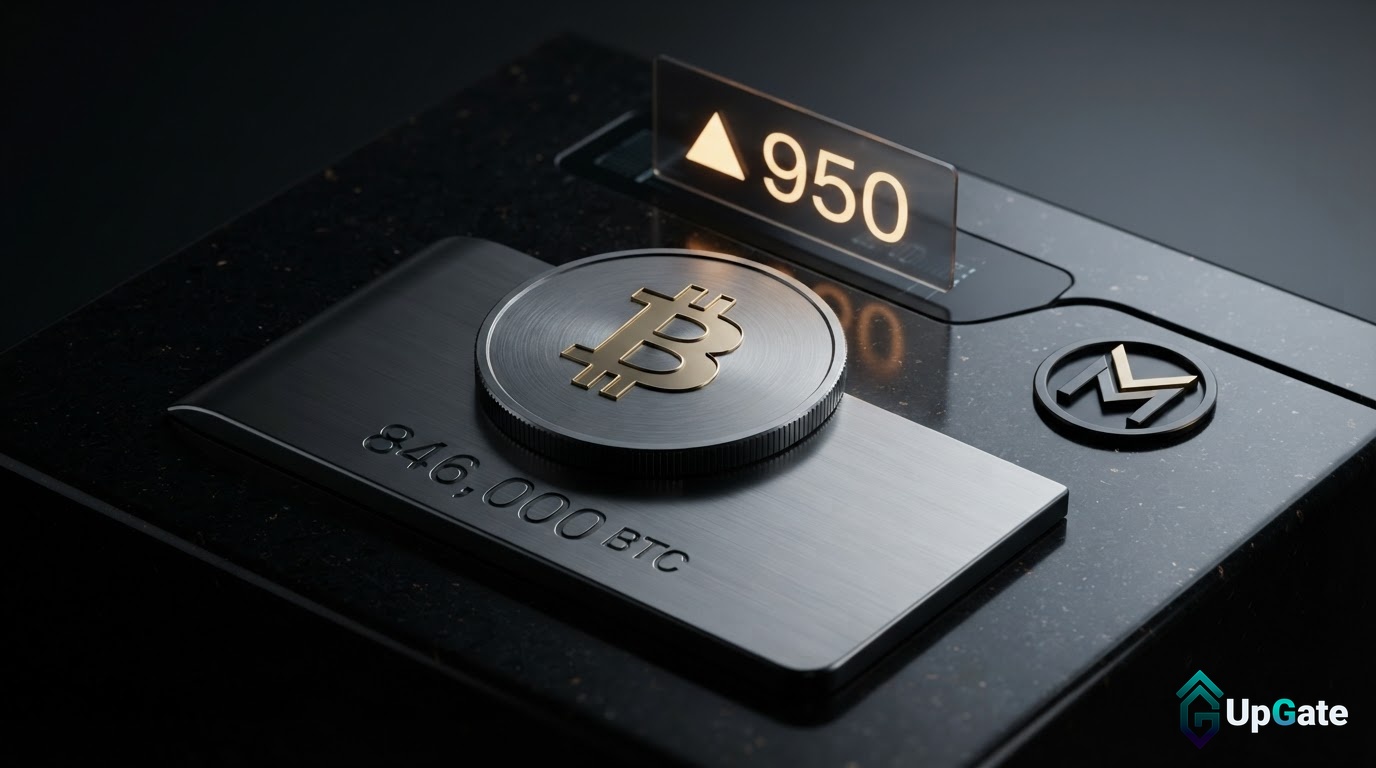
    Strategy purchased 950 Bitcoin for approximately $75.7 million between September 14 and September 20, 2024, increasing its total holdings to 846,000 BTC.

    The acquisition was funded by existing U.S. dollar cash reserves. As of September 20, Strategy reported $1.05 billion in USD cash reserves, with broader USD reserves totaling $5.04 billion. The average price for this purchase was $79,670 per Bitcoin, inclusive of fees. This is Strategy’s first Bitcoin purchase in nearly three weeks.

    With this addition, Strategy’s total Bitcoin holdings now represent over 4% of Bitcoin’s 21 million coin supply cap. The company’s total cost basis for its 846,000 BTC is approximately $63.8 billion, with an average acquisition price of around $75,416 per coin. Bitcoin was trading near $85,000 at the time of purchase. Strategy holds unrealized gains of approximately $8.1 billion on its total holdings, which are valued between $71.9 and $72 billion.

    Michael Saylor, a figure at Strategy, alluded to the purchase on X with the post “A little more orange.” The company, which rebranded from MicroStrategy to Strategy to better reflect its Bitcoin-centric mission, has been accumulating Bitcoin since 2020.

    Strategy’s recent purchase occurred during a period when other publicly traded firms also increased their Bitcoin reserves. Collectively, these firms accumulated a net 2,254 BTC during the past week, with Strategy’s 950 BTC accounting for roughly 42% of this total. The broader stablecoin market also saw an increase, with total supply rising by $56.29 million over the same stretch.

    In parallel with its Bitcoin acquisition, Strategy repurchased approximately 1.77 million shares of its preferred stock for around $174 million. The company also allocated $57.4 million towards preferred dividends and debt interest payments during the same period.

    The fact that Strategy paid an average of $79,670 per coin, below the prevailing market price near $85,000, suggests the company may have been opportunistic about timing its entries during the week. Strategy’s continued accumulation of Bitcoin underscores its ongoing corporate treasury strategy and contributes to the broader trend of institutional adoption of digital assets.

    Why This Matters

    The materials describe a narrow update: Strategy purchased 950 Bitcoin between September 14 and September 20, 2024, for about $75. The exact date of Michael Saylor’s post on X is not specified.

    Broader Context

    Source materials place the factual news in this context: Strategy, the company formerly known as MicroStrategy, purchased 950 Bitcoin between September 14 and September 20 for approximately $75.7 million.

  • Grok AI Forecasts Bitcoin at $150,000 by Q4

    Grok AI Forecasts Bitcoin at $150,000 by Q4

    Elon Musk’s Grok AI has forecast a significant surge for Bitcoin, predicting it could reach $150,000 by the end of 2026 in a robust bull market. The AI’s bullish outlook places Bitcoin’s potential range between $135,000 and $175,000, with the possibility of a late-cycle surge pushing the cryptocurrency above $200,000.

    Bitcoin’s Current Position and Historical Performance

    At its current approximate price of $82,000, a move to $150,000 would represent an increase of about 80%. Notably, Bitcoin has already undergone a substantial correction from its previous cycle’s peak. The cryptocurrency reached a high of approximately $126,200 on October 6, 2025, before experiencing a sharp decline throughout 2026. It has since recovered to trade in the $80,000s.

    Historically, Bitcoin has demonstrated its capacity for immense gains during strong market cycles. Data from previous years shows that Bitcoin saw gains of around 154% in 2023 and 110% in 2024. A potential rise from the current ~$82,000 to $150,000, while substantial at approximately 80%, is considerably less than the percentage gains observed in earlier Bitcoin bull phases.

    Technical Analysis and Key Levels

    Bitcoin has recently broken a pattern of lower highs that had been in place since May, and has reclaimed several key moving averages. Technical analysis indicates that the $71,781 level is a significant support zone, with $82,793 acting as a major resistance. Beyond this, further technical objectives are identified around $90,000 and $97,867.

    CryptoQuant’s analysis aligns with this progression, highlighting $81,700 as a critical level, coinciding with Bitcoin’s 365-day moving average. Resistance levels above this are noted at approximately $84,600 and $88,700.

    The initial major hurdle for Bitcoin is therefore the $82,000 to $84,000 region. Having now surpassed this area, a sustained breakout would clear one of the most significant technical obstacles standing between the current price and the $100,000 mark.

    The next significant milestone is projected to be around $98,000. Beyond this point, the market approaches the all-time high of $126,200, a level where market dynamics are expected to become particularly interesting.

    Once Bitcoin decisively breaks above $126,000, it enters a phase of genuine price discovery, with minimal historical resistance above that threshold. At this stage, psychological price targets such as $130,000, $140,000, and $150,000 could attract momentum traders and institutional investment.

    Historical Cycles and Future Potential

    Bitcoin’s past cycles offer context for potential future movements, especially if liquidity returns aggressively to the market. In 2020, Bitcoin surged from a March low of around $5,000 to nearly $29,000 by year-end, followed by a rise to approximately $69,000 in 2021. The subsequent bear market in 2022 saw Bitcoin fall to around $15,700 before the commencement of the current cycle.

    The recovery has been substantial, with historical data showing:

    • 2022 low: ~$15,700
    • 2023 high: ~$44,200
    • 2024 high: ~$106,100
    • 2025 high: ~$126,200
    • 2026 low: ~$58,300

    Historical annual data underscores the dramatic potential of Bitcoin’s movements during bullish cycles. Another encouraging technical development is Bitcoin’s recent formation of a 50-day/200-day golden cross, the first such signal since May 2025. While not a definitive guarantee of a bull run, this technical indicator provides additional support for the optimistic outlook, assuming a full-blown bull market materializes. An approximately 80% move from current levels remains well within Bitcoin’s historical volatility.

    External Forecasts and Market Dynamics

    External analysis from Bernstein analysts also supports a bullish outlook, with expectations of Bitcoin reaching $150,000 by mid-2027. Their accelerated bull case projects a figure of around $200,000 within the same timeframe.

    While a nearly 5% daily increase can be significant for existing positions, investors observing from the sidelines might find it a risky strategy to chase Bitcoin into resistance levels near $84,500, especially with the Grok AI prediction still unconfirmed.

    The mathematics of upside potential at a market capitalization exceeding $1.5 trillion means that gains may occur at a slower pace compared to early-stage infrastructure projects, which are currently drawing significant attention.

    Bitcoin Hyper ($HYPER) Initiative

    Bitcoin Hyper ($HYPER) is positioning itself as the first Bitcoin Layer 2 solution with full SVM integration. It offers smart contract execution designed for speed, reportedly surpassing Solana, while leveraging Bitcoin’s base-layer security for settlements. The project’s presale has raised $33.1 million, with tokens currently priced at $0.0136864. Staking rewards are advertised at a 35% APY upon launch. The initiative aims to address Bitcoin’s limitations in transaction speed, fees, and programmability without compromising its inherent trust. A Decentralized Canonical Bridge is intended to facilitate native BTC transfers.