Tag: Positive

  • Injective Eyes Wall Street with INJC Staking ETF Proposal

    Injective Eyes Wall Street with INJC Staking ETF Proposal

    Proposed ETF Could Bring Injective Token to Mainstream Brokerages

    Injective’s native token, INJ, may soon trade under a ticker symbol familiar to traditional investors: INJC. Canary Capital is behind the proposed Staked INJ Exchange-Traded Fund (ETF), having submitted an amended registration statement to the U.S. Securities and Exchange Commission (SEC) on September 24, 2026. The fund aims to provide investors with exposure to INJ without the need for a cryptocurrency wallet, with plans to stake the majority of its holdings to generate additional yield.

    Injective, a Layer 1 blockchain designed for finance and tokenization, is now part of a growing wave of digital asset-related ETF applications. The company’s CEO believes regulators might act more swiftly than the market anticipates.

    The INJC ETF would directly hold INJ tokens, offering investors spot exposure to the asset’s price fluctuations. Furthermore, the fund’s structure is designed to stake approximately 90% of its assets. Staking involves locking up tokens to support the security of a blockchain network, with participants receiving rewards in return.

    BitGo is slated to act as the custodian, responsible for holding the fund’s tokens. The ETF is intended for listing on the Cboe BZX exchange. An S-1 filing is the registration document companies or funds submit to the SEC before offering securities to the public. Amendments to these filings typically follow feedback or updates, suggesting the application process is progressing rather than stalled.

    Canary Capital is not the sole entity pursuing an INJ-related ETF. At least three such applications are currently pending with the SEC. Alongside Canary’s INJC proposal, filings from 21Shares and REX-Osprey are also in review.

    Injective CEO Eric Chen has indicated that the timeline for approval could be sooner than some expect. In an interview on October 5, 2026, he suggested that a 2027 launch for U.S. INJ-linked ETFs might be overly conservative. With multiple active applications underway, Chen posited that U.S. INJ ETFs could potentially launch before 2027.

    In early October 2026, the Injective Foundation introduced its Trench Treasury program. This initiative aims to fund smaller projects being developed on the Injective blockchain and to reward community contributors. The initial funding round is targeting projects such as Sprout and RunUp.

    The inclusion of staking within an ETF structure introduces a yield component, positioning it more as an income-generating investment rather than solely a bet on price appreciation. However, staked tokens can be less liquid, requiring a fund that stakes a significant portion of its holdings to manage redemptions carefully. Maintaining a portion of assets in an unstaked state is one method to address this.

    If approved, the INJC ETF could attract investors who might otherwise avoid setting up cryptocurrency exchange accounts. The presence of three distinct INJ ETF applications suggests that issuers perceive significant investor demand.

    Regulatory approval timelines can be subject to delays, and Chen’s projection of a pre-2027 launch remains an outlook, not a certainty. Staking also presents its own technical and liquidity considerations that traditional ETF investors may not be accustomed to evaluating.

    Key developments to monitor include further amendments to Canary’s S-1 filing, any progress on the 21Shares and REX-Osprey proposals, and signals from the SEC regarding its comfort level with staking mechanisms within an exchange-traded fund structure. On the Injective ecosystem front, the progress of Sprout, RunUp, and other Trench Treasury recipients will be indicative of whether the blockchain’s on-chain activity can align with its ambitions in the traditional financial markets.

  • Ripple Targets Traditional Stock Markets

    Ripple Targets Traditional Stock Markets

    DriveWealth Taps Ripple for Stablecoin Integration and Global Expansion

    DriveWealth, a provider of global brokerage infrastructure, has announced a strategic partnership with Ripple to integrate stablecoin settlement, cross-border payments, and digital asset custody into its existing framework. The initial phase of this collaboration will focus on settlement capabilities within Europe, with subsequent expansion planned for the United States market.

    The integration will leverage Ripple’s robust stablecoin infrastructure, including its native stablecoin, RLUSD, which operates on the XRP Ledger (XRPL). This will be complemented by Ripple’s established mint and burn functionalities. The overarching goal is to enable DriveWealth’s clients to efficiently fund and manage collateral accounts using stablecoins, with the ability to convert these assets into cash in near real-time.

    The partnership encompasses four key areas: stablecoin settlement, cross-border payments, digital asset custody, and equity financing.

    DriveWealth is implementing Ripple Payments to streamline cross-border transfers from its international partners. Concurrently, the company is working with Ripple to establish digital asset custody services in Europe, with ambitions to extend these offerings to additional markets.

    In a separate initiative, DriveWealth and Ripple Prime are exploring equity financing opportunities. This exploration will utilize Ripple Prime’s Delta One business, which specializes in providing institutional services for U.S. equities and equity derivatives.

    The companies also intend to connect DriveWealth’s treasury and custody infrastructure with Ripple’s systems. This integration aims to provide clients with a more unified platform for managing dollars, stablecoins, and cryptocurrencies.

    The current settlement cycle for U.S. equities is T+1, meaning trades settle one business day after execution. Cross-border money transfers can often take significantly longer. This disparity can lead to increased funding requirements and tie up capital when financial institutions most need it.

    The new integration is designed to assist international clients in moving funds without being solely reliant on traditional banking transfer windows and cutoff times. DriveWealth already facilitates 24/5 trading and anticipates that the enhanced funding capabilities will better synchronize money transfers with its trading services.

    “Our partnership with Ripple empowers us to extend the same funding and custody experience our clients already rely on to stablecoins and digital assets,” stated Naureen Hassan, CEO of DriveWealth.

    Jack McDonald, Ripple’s Senior Vice President of Stablecoins, commented that the partnership’s scope extends beyond cross-border settlement to encompass trading, custody, and settlement infrastructure.

    DriveWealth serves as a brokerage infrastructure provider to over 100 global partners, including fintech companies, digital wallets, and financial institutions seeking access to U.S. markets.

    In related news, Ripple has also entered into a partnership with South Korea’s Meritz Securities to explore digital asset custody and tokenization opportunities within the Korean capital markets. This agreement marks Ripple’s inaugural collaboration with a South Korean securities firm and its fourth institutional partnership in the country for 2026, following previous agreements with Kyobo Life Insurance, Kbank, and Jeonbuk Bank.

    Separately, Evernorth has selected Ripple, Kraken, Coinbase, and BitGo as partners for its XRP treasury strategy, which involves approximately $648 million in XRP holdings. These developments underscore Ripple’s growing institutional footprint across digital asset custody, tokenization, payments, and XRP-based financial services.

    Ripple and DriveWealth are scheduled to discuss their partnership during a fireside chat at the Ripple Swell event, taking place on October 28 in New York City.

  • Qivalis Secures Dutch Central Bank Authorization for Euro Stablecoin Plans

    Qivalis Secures Dutch Central Bank Authorization for Euro Stablecoin Plans

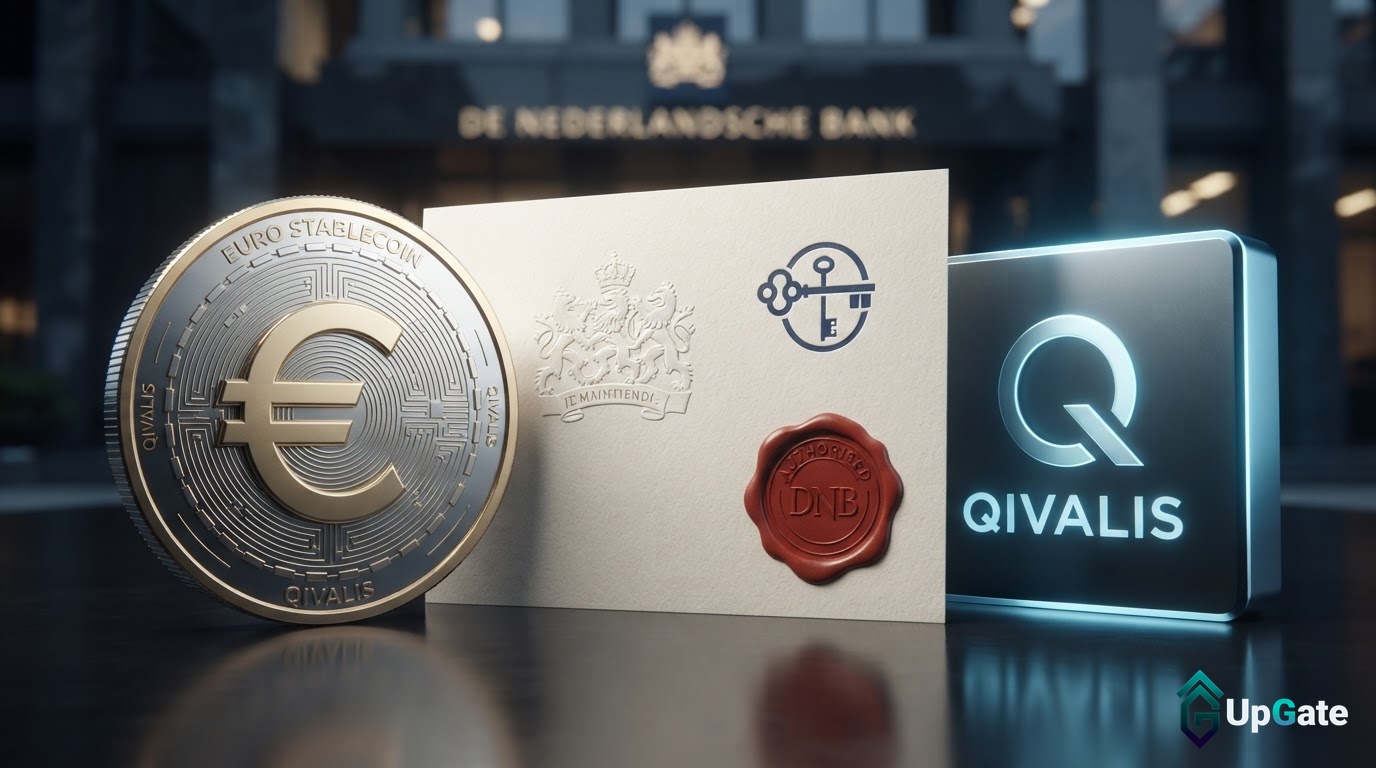
    Qivalis, a European banking consortium, has received Electronic Money Institution (EMI) authorization from De Nederlandsche Bank (DNB), the Dutch central bank. This regulatory approval is a significant step towards the company’s goal of launching a euro-denominated stablecoin.

    The authorization, announced Wednesday, permits Qivalis to issue euro-denominated electronic money tokens and subjects the consortium to ongoing supervision by the DNB. However, the actual issuance of a stablecoin is contingent upon meeting additional requirements under the Markets in Crypto-Assets Regulation (MiCA) and the publication of Qivalis’s white paper.

    Qivalis aims to introduce a stablecoin denominated in euros into a market currently dominated by US dollar-based stablecoins. According to DefiLlama, Tether USDt (USDT) holds a market capitalization of $183 billion, representing over 60% of the total stablecoin market, which is valued at $303 billion.

    “We believe Europe should have a euro-denominated on-chain settlement asset issued under European law and subject to European regulatory standards,” said Jan-Oliver Sell, CEO of Qivalis. This strategic intent aims to provide a regulated, European-law compliant alternative in the stablecoin space.

    In May, Qivalis expanded its backing, adding 25 new banks across 15 countries, bringing its total institutional support to 37 institutions. The timeline for the stablecoin’s launch remains subject to further regulatory developments and the completion of Qivalis’s internal documentation, including its white paper, with issuance anticipated in the coming months, pending these conditions. The market reception and competitive impact of this new euro-denominated stablecoin are yet to be determined.

    Why This Matters

    The materials describe a narrow update: Qivalis, a European banking consortium, received Electronic Money Institution (EMI) authorization from the Dutch central bank, De Nederlandsche Bank (DNB). Exact timing of stablecoin issuance is subject to additional MiCA requirements and white paper publication.

    Broader Context

    Source materials place the factual news in this context: Qivalis is looking to introduce a euro-denominated stablecoin into a market largely dominated by US dollar-based stablecoins.

  • Bitcoin Whales Buy Again After Months of Selling

    Bitcoin Whales Buy Again After Months of Selling

    Bitcoin Whales Resume Accumulation After Months of Selling

    Large holders of Bitcoin (BTC) have begun accumulating the cryptocurrency again after a period of selling, according to an analysis by CryptoQuant. This shift in behavior coincides with Bitcoin’s recovery from lows near $62,000 to highs around $87,000, surpassing its 365-day moving average.

    Other market and on-chain indicators also suggest an improvement in market conditions. CryptoQuant’s Bull Score Index, which aggregates ten market and on-chain metrics, has risen significantly from 20 in late July to 90 on September 26. The index currently stands at 80, a level the firm interprets as signaling the early stages of a potential bull cycle.

    Analysis of whale wallets, excluding those associated with exchanges and mining pools, reveals that these entities now hold 3.03 million BTC. This represents their highest combined balance since November 21, 2025. Furthermore, their monthly accumulation rate has accelerated to its fastest pace since February 11, 2026.

    Long-term data also indicates a notable change in whale behavior. After holdings began to contract in September 2025, the annual change in whale balances has now returned close to zero and moved above its 365-day moving average, suggesting a strengthening trend of accumulation.

    Flows into Bitcoin Exchange-Traded Funds (ETFs) offer another sign of renewed demand. U.S. spot Bitcoin ETFs have recorded net inflows of approximately 2,300 BTC year-to-date in 2026, valued at around $1.5 billion. This follows earlier outflows totaling 83,000 BTC, worth approximately $5.1 billion.

    Data from the crypto lending platform CoinRabbit further illustrates evolving activity among large holders. In September, borrowers with BTC-backed loans exceeding $10 million increased their total USDT borrowing by 83%, a reversal from a 9% decline in July. Their average loan size also saw a 33% increase, following an 8% decrease in August.

    In contrast, smaller borrowers exhibited a different pattern. Retail customers with loans under $100,000 reduced their total borrowing by 17% in September. However, their average loan size increased, highlighting distinct borrowing behaviors between large and small-scale customers.

    Collectively, these figures suggest that some large holders may be leveraging their Bitcoin holdings for liquidity through borrowing, rather than selling. While the data does not definitively confirm their intentions, these developments align with CryptoQuant’s broader assessment of improving market conditions.

  • Standard Chartered Offers Direct Bitcoin, Ether Trading to Affluent UAE Clients

    Standard Chartered Offers Direct Bitcoin, Ether Trading to Affluent UAE Clients

    Standard Chartered has launched direct trading services for Bitcoin (BTC) and Ether (ETH) for its affluent clients in the United Arab Emirates (UAE), effective October 14, 2026. The new offering enables clients to trade these cryptocurrencies directly through their existing bank accounts, utilizing a closed-loop system that keeps assets within the bank’s infrastructure.

    Regulated by Dubai’s Virtual Assets Regulatory Authority (VARA), the service aligns with the UAE’s objective to become a regulated hub for virtual assets. This initiative by Standard Chartered is viewed as a significant step in integrating digital assets into traditional banking frameworks.

    Standard Chartered describes the service as moving cryptocurrency from the periphery of a client’s financial life into the same application used for managing other banking products. The closed-loop model ensures that both fiat currency and digital assets remain within the bank’s system, supported by institutional-grade custody and settlement processes, rather than being transferred to third-party platforms.

    Clients must meet professional investor criteria to access this service. The offering includes spreads of up to 2% per trade, a factor Standard Chartered has flagged as a trade-off for the convenience and security of the integrated system. Consequently, some clients may still prefer dedicated exchanges for more active trading strategies.

    This launch marks a progression in Standard Chartered’s digital asset strategy. The bank established its digital-asset custody business in September 2024, initially serving institutional clients. In July 2025, Standard Chartered became the first Global Systemically Important Bank (G-SIB) to offer deliverable spot trading for Bitcoin and Ether in the UK. This was followed by the rollout of institutional spot trading in BTC and ETH through its Dubai International Financial Centre entity on September 3, 2026.

    The bank has flagged this latest offering for affluent clients in the UAE as a logical next step following its previous expansions into custody and institutional trading. The move aligns with the broader trend of increasing regulatory maturity in the virtual asset space, as indicated by major international banks operating under frameworks like VARA’s rules.

    While the service offers direct access to digital assets within a regulated environment, potential uncertainties remain regarding the future reach of the service beyond professional investors, the possibility of expanding to other digital assets, and broader expansion plans. The current offering focuses on Bitcoin and Ether for affluent clients, with a cost structure that includes spreads of up to 2%.

    Why This Matters

    The materials describe a narrow update: Standard Chartered has enabled affluent clients in the UAE to trade Bitcoin (BTC) and Ether (ETH) directly through their existing bank accounts, utilizing a closed-loop system that keeps assets within the bank’s infrastructure. How far beyond professional investors the service might eventually reach.

    Broader Context

    Source materials place the factual news in this context: Standard Chartered’s digital-asset custody business was established in September 2024, initially serving institutional clients.

  • Standard Chartered Launches Regulated Crypto Trading Service in UAE for Professional Investors

    Standard Chartered Launches Regulated Crypto Trading Service in UAE for Professional Investors

    Standard Chartered has launched a cryptocurrency trading service in the United Arab Emirates (UAE) for eligible Professional Investor clients, allowing them to buy and sell Bitcoin and Ethereum. The service integrates trading, custody, and settlement within the bank’s existing accounts and a closed-loop ecosystem, a move Standard Chartered says aims to reduce reliance on third-party platforms and wallets.

    The bank has secured licensing approval from Dubai’s Virtual Assets Regulatory Authority (VARA) for this offering. Standard Chartered describes the service as a global first for the bank and the first of its kind by an international bank in the UAE. The initial rollout is restricted to eligible Professional Investor clients within the UAE.

    Integrated Ecosystem and Regulatory Approval

    According to the bank’s announcement, the closed-loop structure is designed to mitigate risks associated with third-party wallets. The bank states that the offering combines institutional-grade custody, liquidity, and client access within a single digital-asset ecosystem. Samir Subberwal, Global Head of Wealth and Personal Banking at Standard Chartered, highlighted the launch as a significant milestone, integrating digital assets into the bank’s core wealth offering amid growing client interest.

    Rola Abu Manneh, the bank’s Chief Executive Officer for the UAE, Middle East and Pakistan, noted that the UAE was a strategic choice for this launch due to its progressive approach to innovation, robust regulatory environment, and increasing leadership in digital assets. Standard Chartered’s existing wealth capabilities already include cryptocurrency ETFs on its cash-equities platform and exposure through structured products and OTC derivatives.

    Client Focus and Undisclosed Details

    This launch effectively shifts access to Bitcoin and Ethereum into a regulated banking relationship. The closed-loop structure centralizes trading, custody, and settlement functions within the bank’s infrastructure, eliminating the need for clients to manage assets across both a bank and external crypto providers. The VARA regulatory approval is a key element, situating the new service within an authorized UAE framework.

    The restriction to Professional Investor clients signifies that Standard Chartered is enhancing its wealth management services with crypto trading capabilities, rather than introducing a broad consumer product at this stage. Standard Chartered plans to expand the offering to other markets over time, although specific destinations and timelines for this expansion have not yet been disclosed.

    Several details regarding the new service remain undisclosed. These include trading fees, minimum investment amounts, and transaction limits. It is also not specified whether clients can transfer purchased assets outside of the bank’s ecosystem, and the precise mechanics of execution are not described.

    Why This Matters

    The materials describe a narrow update: Standard Chartered has introduced a crypto trading service in the UAE, enabling eligible Professional Investor clients to buy and sell Bitcoin and Ethereum. Trading fees are not specified.

    Broader Context

    Source materials place the factual news in this context: Standard Chartered’s broader wealth capabilities already include cryptocurrency ETFs on its cash-equities platform and exposure through structured products and OTC derivatives.

  • ETH Surges as BTC and XRP Lag

    ETH Surges as BTC and XRP Lag

    Ethereum Captures Trader Attention as Bitcoin and XRP Face Growing Fear

    Ethereum is currently drawing the lion’s share of attention from cryptocurrency traders, while Bitcoin and XRP are experiencing increasing apprehension. Data from Santiment reveals that the world’s largest altcoin by market capitalization is seeing a ratio of 2.05 bullish comments for every bearish comment across platforms like X, Reddit, and Telegram.

    This shift in sentiment coincides with Ethereum trading above key support levels, as traders closely monitor staking demand and upcoming network upgrades.

    The same confidence is not being extended to Bitcoin, which is struggling to garner similar enthusiasm. Its bullish-to-bearish comment ratio has fallen to 0.82. Persistent rejections near the $87,000 mark, a brief dip towards $81,000, and significant long liquidations have all contributed to market concerns.

    XRP is also under pressure, with a sentiment ratio of 0.92. The token has seen a decline of over 9% in the past week, and the $1.40 level continues to prove a difficult barrier to reclaim. Santiment suggests that this divergence in sentiment could become significant if prices begin to recover. While the prevailing fear surrounding Bitcoin and XRP might present opportunities for a potential rebound, the high level of optimism for Ethereum could indicate a market that is overheating.

    Analyst Predicts Ambitious Upside for Ethereum

    Meanwhile, analyst Crypto Patel has outlined an ambitious outlook for Ethereum, setting a long-term target of $15,000 for the current bull cycle. The $1,600 to $2,000 range has been identified as a potential zone for re-accumulation, with intermediate targets projected at $3,270, $4,892, and $10,000.

    According to Crypto Patel, a confirmed breakout above $4,892 could pave the way for a more substantial rally. However, for this optimistic scenario to materialize, Ethereum will need to maintain its hold on key support levels and overcome significant resistance.

    Spot Ethereum ETFs See Inflows After Prolonged Outflows

    Spot Ethereum Exchange-Traded Funds (ETFs) finally experienced a positive inflow of capital after ten consecutive days of outflows. On October 13th, these funds recorded net inflows totaling $24.84 million, marking their only positive day in October thus far. Grayscale’s Ethereum fund led the gains with $16.3 million, while Fidelity’s FETH attracted an additional $8.11 million. Other funds reported no flows for the day.

    While this rebound is a welcome development, it has done little to offset the recent significant withdrawals. These ETFs have collectively seen net outflows of approximately $695 million in October, indicating that investor demand remains under pressure.

    A similar trend was observed in spot Bitcoin ETFs, which collectively attracted $175.6 million. XRP funds, however, saw no flows for three consecutive days.

  • Starknet Launches Shadow Accounts for Private DeFi Operations

    Starknet Launches Shadow Accounts for Private DeFi Operations

    Starknet Launches Shadow Accounts, Enabling Independent On-Chain Identities for DeFi Interactions

    Starknet, the Ethereum Layer 2 scaling solution, has introduced Shadow Accounts, a new feature designed to allow users to maintain distinct on-chain identities for each decentralized finance (DeFi) application, thereby obscuring their activity from their primary wallet. Developed by StarkWare, this functionality aims to enhance user privacy without compromising the transparency of transactions.

    According to an official announcement on X by StarkWare, Shadow Accounts generate unique and persistent addresses for every DeFi application. Users can fund these shadow accounts using shielded balances within STRK20 privacy pools. This enables them to engage in lending, trading, and other DeFi operations with a separate on-chain persona, preventing direct traceability back to their main wallet.

    In essence, activities such as trading on Uniswap, borrowing on Aave, or providing liquidity on Curve, which were previously linkable through a single main wallet address, can now be isolated. Shadow Accounts ensure that each activity is independent, breaking the chain of on-chain correlation analysis across different protocols.

    Starknet’s official technical documentation clarifies that while the balances and transactions associated with Shadow Accounts remain fully visible on-chain, the intention is not to make the transactions themselves opaque. Instead, the feature focuses on obscuring the link between the shadow account and the funding main wallet.

    For users, the process involves connecting their wallet to an integrated DeFi application, switching from public to privacy mode, depositing assets into a vault, and then allowing the shadow account to manage that position until the funds are withdrawn back to a shielded balance. This process preserves the inherent transparency of DeFi protocols while altering the picture of “who is doing what” visible to external observers.

    Currently, Shadow Accounts are being rolled out with a focus on vault scenarios. However, StarkWare has indicated plans to gradually extend this functionality to cover liquidity provision, lending, staking, derivatives trading, prediction markets, and NFT marketplaces. The underlying logic is that any scenario requiring an “on-chain identity” can be separated from the main wallet using shadow accounts, offering users more granular identity management while maintaining transparency.

    This is not StarkWare’s first foray into privacy features. In June, the company launched the STRK20 privacy framework, facilitating private transfers and shielded token balances on Starknet. Later that month, they showcased a Private KYC system, allowing users to complete verification without revealing their full identity profile. Shadow Accounts represent the next step in this roadmap, evolving from “private transfers” to “private operations.”

    On-chain privacy has been a persistent point of contention in the DeFi space. The complete transparency of on-chain data can enable activities like whale watching, MEV (Maximal Extractable Value) harvesting, and front-running attacks. Conversely, completely anonymous on-chain behavior can raise regulatory concerns. Starknet’s Shadow Accounts adopt a middle ground: transactions remain transparent and auditable, while the identity linkage of “who is doing what” is obscured through zero-knowledge (ZK) technology.

    Compared to mixers like Tornado Cash, which completely erase the origin and destination of funds (leading to significant regulatory scrutiny), Shadow Accounts’ design of “separate identities without hidden transactions” aligns more closely with a compliance framework that institutions might find acceptable. External auditors can still trace the compliance of each DeFi operation, but the complete picture of an ordinary user’s activity is no longer easily pieced together.

    Future considerations include the current limitation of Shadow Accounts to Starknet-native applications. The willingness of the broader DeFi ecosystem to integrate this feature and the speed of support from mainstream wallets such as Argent X and Braavos will determine whether Shadow Accounts become a significant shift in user habits or remain primarily a technological demonstration.

  • Ripple Partners with Meritz Securities, First Korean Securities Firm

    Ripple Partners with Meritz Securities, First Korean Securities Firm

    Ripple Partners with Meritz Securities to Expand Digital Asset Services in South Korea

    Blockchain solutions firm Ripple has announced a strategic partnership with Meritz Securities, a prominent South Korean securities firm. This collaboration marks Ripple’s inaugural partnership with a securities firm in South Korea and its fourth institutional alliance in the country this year. The agreement aims to integrate Ripple’s digital asset custody and tokenization technologies into South Korea’s capital markets.

    Meritz to Explore Ripple Custody and Tokenization

    Under the terms of the partnership, Meritz Securities will conduct a thorough study of Ripple Custody and its tokenization capabilities. The objective is to assess their suitability for integration into Meritz’s existing securities business operations. Ripple Custody is designed to offer financial institutions secure storage, transfer, and settlement solutions for digital assets, along with robust management of private keys. Leveraging Ripple’s established technology is expected to accelerate Meritz’s development of these services, potentially bypassing the significant time and cost associated with building such infrastructure in-house.

    Broader Digital Asset Exploration by Meritz

    Beyond custody solutions, Meritz Securities is actively exploring a range of digital asset services. These include the potential development of spot cryptocurrency exchange-traded funds (ETFs), security tokens, fractional investment offerings, and advanced trading platforms. The firm is also investigating the creation of South Korean won-denominated stablecoins, which could facilitate digital payments and money transfers. These initiatives suggest Meritz’s intention to utilize Ripple’s technology for a diverse array of applications, extending beyond mere cryptocurrency storage to encompass investment products and digital payment systems.

    Strategic Significance for Ripple and South Korea

    The partnership is considered a significant move for Ripple, providing it with a direct pathway into South Korea’s substantial $4.51 trillion capital markets through an established financial institution. Fiona Murray, Ripple’s Managing Director for Asia Pacific, highlighted the company’s comprehensive infrastructure, stating, “Ripple brings the full infrastructure stack across payments, custody and tokenization, backed by more than 85 licenses and a network spanning more than 60 markets globally.”

    This latest alliance follows Ripple’s previous collaborations in South Korea with Kyobo Life Insurance for tokenized government bond settlement, Kbank for digital asset wallet infrastructure, and Jeonbuk Bank for cross-border payment solutions. The timing of this partnership is particularly noteworthy, as South Korea is in the process of refining its digital asset regulations, with a comprehensive regulatory framework slated to be implemented in February 2027.

  • Fidelity ETF Clients Pour $103M into Bitcoin in One Day

    Fidelity ETF Clients Pour $103M into Bitcoin in One Day

    Fidelity Bitcoin ETF Dominates Inflows as Clients Buy Over $100 Million

    Fidelity’s spot Bitcoin exchange-traded fund experienced a remarkably strong Monday, with clients of the Fidelity Wise Origin Bitcoin Fund (FBTC) purchasing $103.06 million worth of the cryptocurrency on October 13, 2026.

    This significant inflow alone would mark a successful trading day. However, what truly set it apart was Fidelity’s dominance, capturing nearly all the capital flowing into U.S. spot Bitcoin ETFs on that particular day.

    The broader sector recorded net inflows of $109.8 million. FBTC’s substantial contribution, estimated at approximately $103.1 million according to research data, left the remaining U.S. spot Bitcoin ETFs to share a modest $6.7 million in net inflows. These inflows occurred as Bitcoin traded above the $86,000 mark.

    Firms such as SoSoValue and Farside Investors meticulously track the primary market activity for these funds, which involves the daily creation and redemption of ETF shares. These creations are crucial because a spot ETF must hold the underlying asset. When investors inject capital into FBTC, the fund is compelled to acquire actual Bitcoin to back the newly issued shares.

    October has not presented a consistent trend for ETF flows. The early part of the month saw a fluctuation between inflows and outflows. On October 1, the sector collectively registered a net inflow of $102.7 million, with BlackRock’s iShares Bitcoin Trust (IBIT) leading the charge. Later that same week, FBTC experienced outflows.

    This pattern of volatility is characteristic of Fidelity’s fund. FBTC is recognized as one of the most active products in its category, frequently experiencing substantial inflows and outflows in response to market movements.

    U.S. spot Bitcoin ETFs debuted in January 2024. Since their launch, the group of ETFs has accumulated approximately $57 billion in cumulative net inflows. Total assets across the sector have surpassed $100 billion at various points this year.

    Within this competitive landscape, FBTC typically ranks just behind IBIT in terms of both assets under management and trading volume. FBTC maintains a competitive fee structure of 0.25%, placing it among the lowest-cost major Bitcoin ETFs, comparable to IBIT. This fee has also been subject to waivers during certain periods.

    On-chain data plays a vital role in distinguishing ETF-driven activity from standard retail transactions, providing analysts with a clearer understanding of the demand channeled through these regulated investment vehicles.

    The concentration of inflows into a single fund is a noteworthy development. When one ETF captures the vast majority of the sector’s net inflow, it suggests that other products may have experienced flat trading days or minor outflows that effectively canceled each other out.

    FBTC’s own trading history serves as a reminder of the inherent volatility in the market. The same fund that attracted $103.06 million on October 13 saw significant outflows just days after the sector’s robust performance on October 1.

    The flow data compiled by SoSoValue and Farside Investors will continue to provide a daily assessment of market activity. For now, Fidelity can claim bragging rights, and its clients have demonstrably increased their Bitcoin holdings by $103 million.