Tag: Positive

  • Ripple Launches Institutional Trading Arm

    Ripple Launches Institutional Trading Arm

    Ripple Launches Institutional Trading Business to Expand Wall Street Reach

    Ripple, the company associated with the cryptocurrency XRP, has unveiled a new institutional trading business, Ripple Prime, signaling a strategic expansion beyond its digital asset origins and deeper into traditional finance.

    The initiative, announced Thursday, will enable hedge funds, asset managers, and other institutional clients to engage in Total Return Swaps (TRS) across a range of assets, including US-listed equities, indices, and digital assets.

    According to the company, the service is now operational and represents a significant move to bolster its presence in traditional financial markets. This development follows Ripple’s acquisition of prime broker Hidden Road for $1.25 billion, which was completed less than a year ago.

    Products within the Delta One category, such as TRS, are derivatives designed to mirror the performance of an underlying asset or index. A TRS allows investors to benefit from an asset’s gains and income without direct ownership, in exchange for financing costs and potential losses.

    Ripple Prime has broadened its platform’s asset offerings, now providing clients with access to equities alongside foreign exchange, fixed income, derivatives, and cryptocurrencies through a unified counterparty relationship. The company also stated that customers can cross-margin exposures across these diverse assets around the clock, potentially lowering the collateral requirements for institutions.

    Noel Kimmel, President of Ripple Prime, commented that these services are precisely what institutional market participants are seeking, and expressed pride in the company’s ability to deliver them.

    Ripple’s acquisition of Hidden Road, subsequently rebranded as Ripple Prime, was initially announced in April 2025 and finalized by year-end. This acquisition positioned Ripple as the first crypto company to own and operate a global multi-asset prime broker, handling over $3 trillion in annual clearing volume and serving more than 300 institutional clients.

    Earlier this year, Ripple Prime secured an investment-grade BBB rating from KBRA, with the agency citing its growth in clearing and intermediation within exchange-traded derivatives and fixed-income repo markets.

    In August, Ripple Prime announced an upsized $275 million private placement of senior unsecured notes, following a $200 million debt facility secured from Neuberger Specialty Finance in May. The company indicated that the new capital would fuel its ongoing expansion efforts.

  • Robinhood Chain Surges on Meme and RWA Boom

    Robinhood Chain Surges on Meme and RWA Boom

    Robinhood Chain Surges on Meme Coins and Real-World Assets

    Robinhood Chain is experiencing a significant upswing, propelled by a surge in meme coins and real-world assets (RWAs). The blockchain platform recorded its strongest day since mid-July, with approximately $443 million in decentralized exchange (DEX) volume, over 3 million transactions, and active wallets exceeding 115,000. This represents a threefold increase in volume from the early August low of around $140 million.

    The performance of associated tokens mirrored this trend. StonkBroker, Index, HMM, TENDIES, Juggernaut, and YOLO all closed in positive territory, while the newly launched Biscotti rapidly achieved a $10 million market capitalization within hours. Notably, all of the top eleven tokens by market capitalization on the chain are less than two months old.

    A substantial driver of this growth is the increasing adoption of RWAs. The total value of real-world assets on the chain has reached $41.9 million across 202 tokenized assets. On Monday, net on-chain RWA flows surged to approximately $85 million, marking the highest single-day figure since the chain’s launch. This contrasts with $12.8 million recorded in mid-July.

    Robinhood CEO Vlad Tenev acknowledged the innovative developments occurring on the chain. Speaking on The Iced Coffee Hour podcast, Tenev highlighted how developers are creating novel products that the company had not anticipated, integrating meme coins, core cryptocurrency functionalities, and stock tokens. He cited an example where users holding a meme coin could receive stock tokens as an airdrop, a feature characteristic of the Stonkbrokers ecosystem, with similar functionalities also appearing in AI-related projects. Tenev’s comments suggest he is closely monitoring the chain’s evolving landscape.

    Looking ahead, the trajectory for Robinhood Chain appears to be upward, despite the potential for a market correction after a period of parabolic growth. A key indicator to watch will be the next token listing on Robinhood, following the recent addition of Cashcat. Such a listing would not only signal continued token onboarding but also provide insights into Robinhood’s preferred sectors, whether they be memes, utility tokens, or infrastructure projects. As long as Tenev and his team continue to support the ecosystem, its potential for growth seems considerable.

  • Block Scholes Research Highlights Liquidity Dynamics of Tokenized RWA Futures on Bitget UEX

    Block Scholes Research Highlights Liquidity Dynamics of Tokenized RWA Futures on Bitget UEX

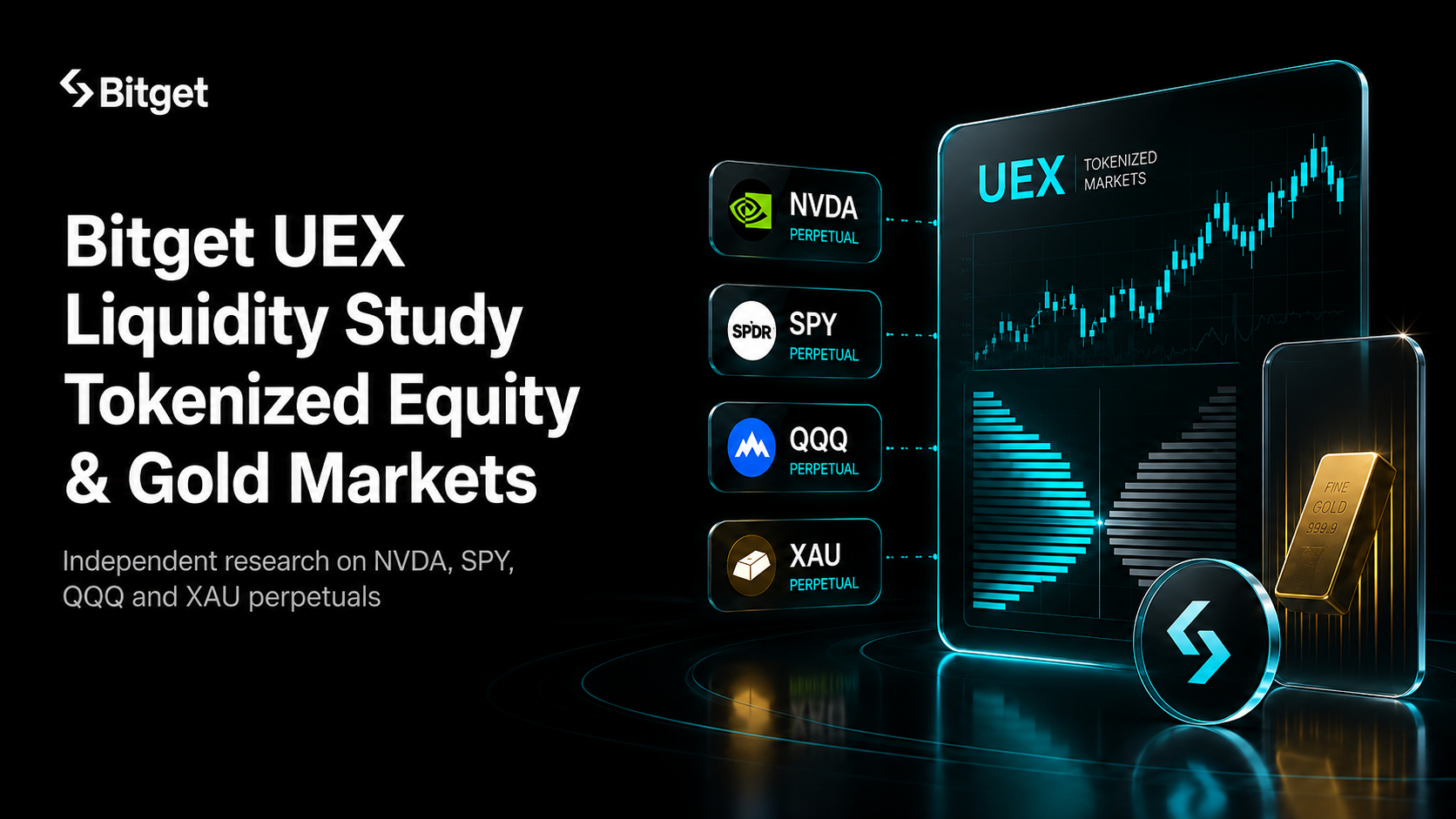
    Independent research by Block Scholes has analyzed the liquidity conditions of tokenized real-world asset (RWA) perpetual futures on Bitget UEX, offering insights into trading dynamics for these instruments. The study, which examined data up to May 2026 and events from February 2026, focused on contracts tracking gold (XAU-USDT), the SPDR S&P 500 ETF (SPY-USDT), Nvidia (NVDA-USDT), and the Invesco QQQ Nasdaq-100 ETF (QQQ-USDT).

    Key Findings on Liquidity

    According to the report, liquidity for these tokenized RWA perpetual futures generally improves within active trading sessions. Block Scholes measured order-book depth, bid-ask spreads, and slippage. By mid-May 2026, the resting liquidity on Bitget UEX’s Nvidia-tracking contract approached approximately three-quarters of the depth observed on Bitget’s BTC/USDT spot market. On May 18, 2026, top-of-book spreads were notably tight, recorded at around 0.02 basis points for gold, 0.14 basis points for both SPY and QQQ contracts, and 0.44 basis points for the NVDA contract. This indicates that less than half a basis point separated the best bid and best ask for three of the four instruments at that time.

    Intra-day analysis revealed significant improvements. For instance, SPY’s spread narrowed from 1.76 basis points at the market open on May 18, 2026, to 0.14 basis points within an hour. Similarly, slippage for a modeled $100,000 market buy order on the SPY contract decreased from 14.88 basis points at the open to 10.66 basis points an hour later. Larger orders also saw improvements, with a $500,000 order experiencing a reduction in slippage from 46.07 basis points to 24.90 basis points over the same period.

    Weekend Trading and External Event Impact

    The research also shed light on trading behavior outside traditional market hours. Block Scholes measured a substantial decrease in trading volume for these RWA perpetuals on weekends, ranging from 65% to 90% compared to weekday levels, depending on the contract. However, median bid-ask spreads remained relatively stable, staying close to weekday levels. Across the sampled week, these weekend spreads were approximately 0.02 basis points for gold, 0.8 for QQQ, 1.0 for NVDA, and 1.3 for SPY.

    Block Scholes examined the impact of external events on liquidity, noting that geopolitical developments could cause temporary disruptions. Following the announcement of U.S. strikes against Iran on February 28, 2026, spreads widened across all four contracts. For example, the NVDA contract’s spread increased from a baseline near 0.6 basis points to a peak of 3.4 basis points. However, Block Scholes found these widening effects to be brief, with NVDA’s spread returning near its pre-announcement level within minutes and QQQ’s within the hour. Order-book depth also thinned temporarily, with QQQ’s resting depth within 1% of the mid-price falling to approximately $109,000 from a typical Saturday median of about $191,000, but depth returned to its usual range within a week.

    Methodology and Context

    The research utilized data from Bitget’s API and historical order-book information spanning from September 2025 through May 2026. It is important to note that these tokenized RWA perpetuals provide synthetic price exposure to underlying assets and do not confer equity ownership, dividends, or voting rights in the referenced companies or funds. The study also considered how liquidity behaves outside the underlying assets’ regular trading hours, given the continuous trading nature of perpetual futures.

    Bitget has been publishing monthly proof-of-reserves disclosures since December 2022.

    Why This Matters

    The materials describe a narrow update: Block Scholes published research on Bitget UEX’s tokenized RWA perpetual futures (gold, SPY, Nvidia, QQQ). The exact definition of ‘resting liquidity’ used by Block Scholes beyond ‘visible resting liquidity at a point in time or over a sample period’.

    Broader Context

    Source materials place the factual news in this context: Bitget is a global cryptocurrency exchange operating as a Universal Exchange (UEX), offering crypto, tokenized stocks, gold, and other asset classes within a single account.

  • Bank of England to Get Legal Duty for Payments, Digital Money Innovation Amid Global Competition

    Bank of England to Get Legal Duty for Payments, Digital Money Innovation Amid Global Competition

    HM Treasury plans to introduce an amendment to the Financial Services and Markets Bill, establishing a statutory ‘secondary objective’ for the Bank of England focused on fostering innovation in payments and digital money. This new objective will operate under the Bank’s primary responsibility for financial stability and is expected to be presented to the House of Lords in September.

    The Bank of England will be required to report annually to parliament on its progress in fulfilling this objective. The stated aim is to support the Bank in driving innovation in payments and digital finance, thereby ensuring the UK remains a global leader in financial services.

    The move comes amid mounting global competition in the stablecoin market. Approximately 99% of stablecoins currently in circulation are dollar-denominated. In response to this landscape, the Bank of England has previously adjusted its regulatory approach. Planned caps on stablecoin ownership were dropped in favour of a £40 billion issuance limit. Furthermore, the Bank reduced the proportion of backing assets issuers must hold in zero-interest deposits, a move interpreted as an effort to enhance the commercial viability of UK-issued stablecoins against those in rival jurisdictions.

    Applications for systemic sterling stablecoin issuers are expected to open by the end of the year. This aligns with a broader international trend of regulatory framework development for digital assets. The European Union’s Markets in Crypto-Assets (MiCA) regime has applied to stablecoin issuers since June 2024, with its full framework coming into force in December 2024. The United States introduced the GENIUS Act last year.

    While the new objective is designed to encourage innovation, the Bank of England’s governor has previously flagged a potential future divergence with Washington regarding the supervision of stablecoins. Specific details concerning the Bank of England’s annual reporting mechanism and the precise nature of any future regulatory discussions with the US remain subjects of uncertainty.

    The Bank of England’s primary mandate remains financial stability. The new secondary objective is designed to operate within this existing framework, guiding its efforts in the evolving digital payments and finance sector.

    Why This Matters

    The materials describe a narrow update: HM Treasury will introduce an amendment to the Financial Services and Markets Bill to create a statutory ‘secondary objective’ for the Bank of England. The specific details of the Bank of England’s annual reporting on progress.

    Broader Context

    Source materials place the factual news in this context: The move comes amid mounting global competition on stablecoins.

  • Revolut Unveils Euro Stablecoin EURR

    Revolut Unveils Euro Stablecoin EURR

    Revolut Unveils First Euro Stablecoin, EURR, in Select Markets

    Revolut has begun the rollout of EURR, its inaugural euro-denominated stablecoin, making it available to a “select group of customers” in Denmark, Poland, and Portugal. This initial phase precedes a broader launch across the European Economic Area (EEA) expected later this year.

    The token is issued by Bridge, a stablecoin infrastructure firm acquired by Stripe for $1.1 billion in 2025. Within Revolut’s retail app, EURR functions as a “euro-denominated, on-chain rail” designed to facilitate transactions between euros and cryptocurrencies.

    Bridge Building S.A., the issuer’s Luxembourg-based entity, manages the reserves and is committed to redeeming EURR at a rate of €1.00 per token. This operation adheres to the EU’s Markets in Crypto-Assets (MiCA) framework, a regulatory regime that has already seen 14 stablecoin issuers and 39 licensed service providers register in its early stages. Bridge itself announced its electronic money institution license and MiCA authorization, covering all 27 EU member states, on July 2.

    Emil Urmanshin, Head of Crypto and New Bets at Revolut, stated that EURR “connects 80 million Revolut customers directly to on-chain finance.” He emphasized that the combination of Revolut’s scale and its licensed banking infrastructure is “unlocking real-world stablecoin utility that no traditional bank or crypto native can match.”

    The public offering commenced on August 20 on the Ethereum and Polygon blockchains, according to a company blog post. Revolut Digital Assets Europe Ltd is designated as the sole distributor, with Revolut X, the company’s standalone exchange, serving as a secondary distribution channel. Support for additional blockchains, including Solana, Arbitrum, Optimism, Avalanche, Injective, TON, and Sui, is planned.

    It is worth noting that Revolut’s token shares its ticker symbol with an existing MiCA-authorized euro stablecoin from StablR, which CoinGecko lists under the same EURR symbol.

    Revolut has indicated that other currency-denominated stablecoins are under development through separate regulatory processes. The wider EEA rollout of EURR remains contingent on regulatory approvals, operational readiness, and product development.

    Iman Olya, product owner of stablecoin at Revolut, commented on the token’s utility, stating, “Revolut initially eliminated hidden fees and friction in currency exchange. EURR completely removes the pain of moving on and off-chain, becoming a new seamless and instantaneous bridge between fiat and crypto.”

    This launch follows Revolut’s recent rollout of its UK bank, which began with a limited customer group after the Prudential Regulation Authority lifted restrictions on its banking license in March. For context, Circle’s EURC, currently the largest regulated euro stablecoin by market capitalization, held approximately €394 million in circulation as of today, according to CoinGecko data.

  • Nvidia Soars on Record $96.2 Billion Revenue

    Nvidia Soars on Record $96.2 Billion Revenue

    Nvidia Shares Rebound After Strong Earnings Beat

    Nvidia shares staged a recovery in after-hours trading Wednesday, following an initial dip in the wake of the chipmaker’s fiscal second-quarter earnings report.

    The stock had closed regular trading down 1.59% at $209.66, but rebounded to approximately $217 in after-hours activity, a gain of roughly 3.5% from its closing price.

    Nvidia reported a more than doubling of its quarterly revenue to $96.2 billion, surpassing the $92.27 billion average analyst estimate compiled by the Associated Press. Revenue from its Data Center segment surged 117% to $89 billion, while adjusted earnings per share came in at $2.22, exceeding the $2.09 estimate. Gross margins remained strong at 75%.

    AI Infrastructure Drives Growth

    Nvidia founder and CEO Jensen Huang attributed the quarter’s robust performance to escalating demand for artificial intelligence infrastructure.

    “AI has reached its inflection point. It’s doing useful work. Its tokens are productive and profitable. Now, compute is revenue, and demand is accelerating,” Huang stated. “This time last year, one lab alone was driving the buildout; today, we have a golden age of new AI labs and startups, multiple frontier labs scaling in parallel, a thriving open-model ecosystem and physical AI coming online—with strong momentum across the U.S. and around the world.”

    Significant Commitments for Future Demand

    According to Chief Financial Officer Colette Kress, Nvidia has secured $366 billion in multiyear commitments for artificial intelligence infrastructure, with $279 billion specifically allocated for supply and capacity. The company also disclosed up to $108.5 billion in phased guarantees, which represent potential future exposure rather than current liabilities or payments.

    “We’ve partnered with our extensive network of suppliers to secure the critical components needed to meet demand for the next several years,” Kress said in a statement. “Our commitments increased from $119 billion last quarter to $279 billion, primarily related to the procurement of memory.”

    Nvidia also reported $3.5 billion in maximum gross exposure under these agreements.

    Strategic Partnerships and Future Projects

    In August, Nvidia announced its agreement to support the development of SB Energy’s PORTS-Pike Technology Campus in Ohio. This facility is slated to house Nvidia infrastructure under long-term leases to OpenAI.

    “Each generation of NVIDIA infrastructure deployed at PORTS-Pike could represent approximately 1.5 million NVIDIA GPUs, or approximately $150 billion to $200 billion in NVIDIA revenue,” Kress noted. “Over 20 years, we expect the site can support multiple infrastructure upgrade cycles.”

    Including both arrangements, the maximum gross guarantee exposure stands at $108.5 billion. This figure signifies potential future exposure, not an immediate loss or payment.

    Outlook and Product Readiness

    Nvidia anticipates third-quarter revenue to be between $108 billion, with a margin of error of 2%. The company forecasts gross margins of 74%, plus or minus half a percentage point, a slight decrease from the 75% recorded in the second quarter.

    Shipments of Hopper data-center products to China accounted for less than 1% of Data Center revenue during the quarter.

    Despite the temporary dip in its stock price, Huang emphasized that Nvidia is actively preparing to meet future demand with its next-generation computing platform.

    “The AI infrastructure buildout is at full steam,” he stated. “Vera Rubin, now in full production, was built to power exactly this moment.”

  • TronBid Enhances TRON Marketplace for Energy and Bandwidth Trading, Aims to Reduce USDT Fees

    TronBid Enhances TRON Marketplace for Energy and Bandwidth Trading, Aims to Reduce USDT Fees

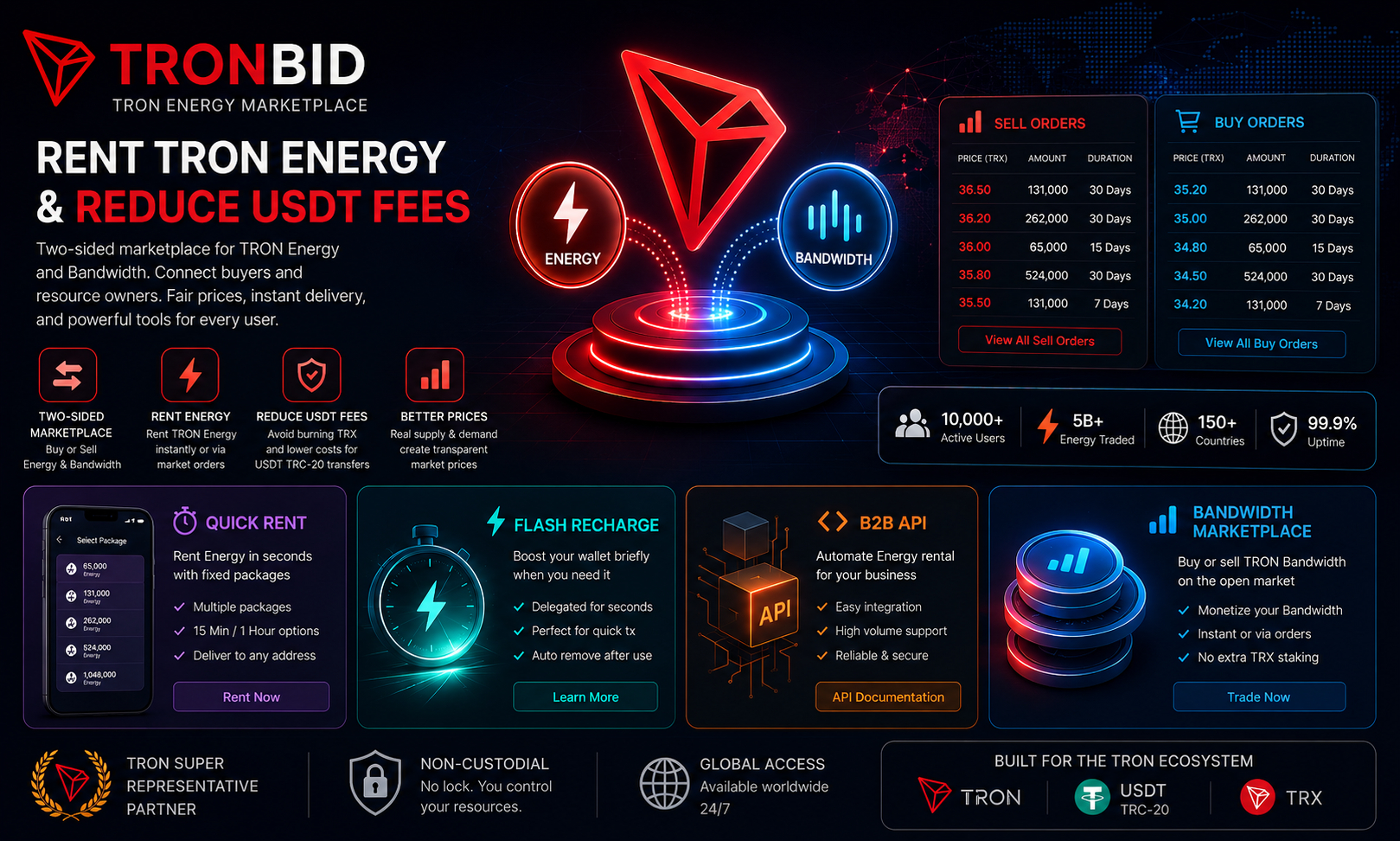
    TronBid has expanded its peer-to-peer marketplace for TRON network resources, introducing new features for renting Energy and Bandwidth, trading these resources, and reducing USDT fees for TRC-20 transactions. This expansion provides users and businesses with enhanced tools to manage their participation and costs on the TRON network.

    TRON utilizes Energy and Bandwidth as its primary network resources. Energy is required for smart contract execution, including processes such as USDT TRC-20 transfers. If a wallet lacks sufficient Energy for a transaction, the TRON network may consume TRX to cover the necessary resources. This scenario has driven demand for alternative methods of acquiring Energy, leading to platforms like TronBid.

    A Two-Sided Marketplace for Resources
    The expanded TronBid marketplace operates on a two-sided model, enabling both buyers and sellers to create orders. Buyers can specify the amount of Energy or Bandwidth they need, the desired rental duration, and their price. Sellers can post offers detailing the amount of resources they wish to rent out, their price, and the rental period. Buyers can then purchase these offers, with the option to acquire only a portion of a seller’s available resources.

    Enhanced Features for Immediate Needs and Businesses
    To address immediate resource requirements, TronBid has introduced ‘Quick Rent,’ offering predefined Energy packages for short-term rentals that can be delivered directly to any TRON address. For users who maintain their own Energy capacity but need to manage consumed resources, the platform provides ‘Flash Recharge.’

    TronBid also caters to businesses through a B2B Quick Rent API. This API allows exchanges, payment processors, wallets, and other businesses handling frequent TRON transactions to automate Energy rental. By integrating this functionality into their transaction infrastructure, companies can manage network-resource costs more efficiently, particularly for large volumes of USDT TRC-20 transfers.

    Monetizing Network Resources and SR Partnership
    Beyond Energy rental, TronBid’s marketplace supports Bandwidth trading, allowing holders of staked TRX to monetize unused network resources. By enabling both buyers and sellers to set their own terms, TronBid aims to foster more transparent price discovery based on actual supply and demand within the TRON ecosystem.

    Alongside these marketplace enhancements, TronBid has become a TRON Super Representative Partner. This development signifies a closer integration with the TRON network’s governance structure and underlying infrastructure.

    Why This Matters

    The materials describe a narrow update: TronBid has launched an expanded peer-to-peer marketplace for TRON network resources. By receiving temporary Energy delegated from another account, users can perform eligible TRON transactions without maintaining enough staked TRX for their maximum resource requirements.

    Broader Context

    Source materials place the factual news in this context: TronBid expands its two-sided TRON resource marketplace, giving users new ways to rent Energy, trade Energy and Bandwidth, and reduce USDT fees for TRC-20 transactions.

  • CoinMarketCap Secures SOC and ISO Certifications to Enhance Data Trust and Security

    CoinMarketCap Secures SOC and ISO Certifications to Enhance Data Trust and Security

    CoinMarketCap has announced the attainment of SOC 1 Type 1 and SOC 2 Type 1 attestations, alongside dual ISO certifications for information security and privacy management. These certifications, obtained on August 26th, 2026, are designed to bolster trust and assurance for its institutional clients and the broader cryptocurrency ecosystem.

    Why This Matters

    The materials describe a narrow update: CoinMarketCap has successfully completed SOC 1 Type 1 and SOC 2 Type 1 examinations, which independently assess the controls protecting its market data systems and financial reporting controls, respectively. SOC 2 is the assessment most often requested by enterprise buyers evaluating a technology vendor.

    Broader Context

    Source materials place the announcement in this context: CoinMarketCap has obtained a SOC 2 Type 1 attestation report, following an independent examination of the controls protecting the systems behind its market data.

    Independent Verification of Controls

    The company has successfully completed independent examinations of its controls, including those protecting its market data systems and financial reporting. These attestations complement the existing ISO/IEC 27001:2022 certification for information security management and ISO/IEC 27701:2019 certification for privacy information management. Both ISO certifications were awarded by the British Standards Institution in June 2026.

    Understanding the Attestations and Certifications

    SOC 2 is frequently requested by enterprise buyers when evaluating technology vendors, assessing controls against the Trust Services Criteria for Security. The SOC 1 Type 1 report, meanwhile, covers controls relevant to internal control over financial reporting. Both Type 1 reports reflect controls as at a specified date and are available to partners and clients upon request.

    The scope of these assessments encompasses critical areas of CoinMarketCap’s operations, including price tracking, market data, APIs, cloud systems, operational processes, account management, the handling of personally identifiable information (PII), and its mobile applications. This comprehensive review aims to provide verifiable assurance of the company’s security and privacy practices.

    Demonstrating Trust Through Examination

    According to CoinMarketCap, the distinction being drawn is between security that is asserted and security that has been examined. Rush, CEO of CoinMarketCap, stated, “Trust in that data should be demonstrated rather than claimed. Independent assessors have examined how we run security and privacy, and documented it in a form our partners and clients can review.”

    Meeting Institutional Demands

    These credentials are increasingly a prerequisite for institutional clients, whose own obligations require them to evidence the controls of the vendors they depend on. CoinMarketCap, which serves as a primary data source for major financial news outlets and powers a significant portion of crypto infrastructure, including wallets and trading interfaces, aims to meet these rigorous demands.

    The ISO/IEC 27701:2019 certification, an extension of ISO 27001, specifically governs how personal data is collected, processed, and protected, aligning with global privacy regulations such as GDPR. For a platform with a global user base, this alignment is crucial.

    CoinMarketCap intends to maintain and extend its assessment program over time, reinforcing its position as a foundational data provider in the crypto space. With over 1 billion monthly page views and tracking 53 million cryptocurrencies, the company plays a significant role in organizing and delivering crypto intelligence.

  • Morning Minute: LayerZero Taps ATLAS for New Settlement Engine

    Morning Minute: LayerZero Taps ATLAS for New Settlement Engine

    LayerZero Aims to Power Global Exchanges with New Settlement Engine

    LayerZero, a company that has spent six years developing infrastructure for cross-blockchain token transfers, announced Tuesday the launch of ATLAS, a trading and settlement engine designed to operate behind the scenes of exchanges rather than directly compete with them. The news sent the price of its native token, ZRO, up more than 20%, trading near $1 earlier in the session.

    ATLAS is a backend system with no user interface. Trading platforms can integrate with it, retaining their own branding and customer base while outsourcing the complexities of matching, clearing, settlement, and risk management. LayerZero argues that platforms built on existing exchanges often find themselves in direct competition with the host exchange’s own applications, a situation that deters institutions from entrusting their core operations to such systems. The company is releasing two versions of ATLAS: one tailored for cryptocurrency applications and prediction markets, and another for firms requiring custom rule enforcement on the same engine. The system is designed to support a wide range of markets, from spot and perpetual futures to stocks, bonds, commodities, and prediction markets.

    “ATLAS is the embodiment of our belief that the world’s rapidly expanding asset base needs a neutral, performant engine that underpins the venues that will build across markets spanning the globe. Any market, anywhere in the world, 24/7, with industry-leading performance, all…” LayerZero stated in a post on X (formerly Twitter) on August 25, 2026.

    The ZRO token is integral to the ATLAS ecosystem. Trading venues can stake ZRO to receive fee rebates ranging from 20% to 65%. After these rebates, 75% of the remaining fees are used to buy and burn ZRO, while the other 25% is distributed to the market creator. This mechanism positions the token as a claim on trading volume, explaining the price surge following the announcement.

    This significant development arrives at a crucial juncture for LayerZero. In April, attackers siphoned approximately $292 million from Kelp DAO, a bridge utilizing LayerZero technology. This incident was followed by a notable exodus of protocols, including BitGo’s $7.7 billion in wrapped Bitcoin and Wyoming’s state stablecoin, collectively representing around $15 billion. However, the launch of ATLAS signals a potential resurgence in momentum. LayerZero has now established the infrastructure to support prominent players in the upcoming market cycle across perpetuals, tokenized stocks, prediction markets, and broader real-world assets (RWAs). The market’s response from potential partners will be closely watched.

  • INS Loans TradFi Perpetual Contracts: Leverage Adjustments

    INS Loans TradFi Perpetual Contracts: Leverage Adjustments

    Bybit to Increase Leverage Limits for Stock Futures to Boost Institutional Trading

    Bybit is set to adjust leverage limits for eligible stock futures within its INS Loans product, aiming to better support institutional trading needs and enhance capital efficiency for TradFi Perpetual Contracts.

    Following the adjustment, these eligible stock futures will offer higher leverage levels, determined by their individual risk and liquidity profiles. The updated leverage limits will range from 10X, 15X, 20X, or 25X, depending on the specific contract. The changes are scheduled to take effect on August 26, 2026, at 10 AM UTC.

    Leverage Adjustment Details

    Symbols with Leverage Increased to 10X:
    SSPCUSDT, MVLLUSDT, INTWUSDT, AXTIUSDT, SHAZUSDT, AEHRUSDT, ZHONGJIUSDT, MINIMAXUSDT, ZHIPUUSDT, SKUUUSDT, BEUSDT, SKDDUSDT, CIFRUSDT, BOTUSDT, TSEMUSDT, ALABUSDT, QNTXUSDT, GIGADEVICEUSDT, BSPUSDT, WDCUSDT, PENGSTOCKUSDT, CRDOUSDT, FLNCUSDT, POETUSDT, COHRUSDT, APLDUSDT, ASTSUSDT, SMCIUSDT, STXXUSDT, OUSTUSDT, CLSKUSDT, FLYUSDT, TSLLUSDT, KODEX200USDT, FWDIUSDT, MARAUSDT, ARMUSDT & CXMTUSDT.
    Previous Leverage: 3X
    New Leverage: 10X

    Symbols with Leverage Increased to 15X:
    IRENUSDT, RDWUSDT, RKLBUSDT, TERUSDT, USARUSDT, SAMSUNGEMUSDT, HIMSUSDT, AMCUSDT, IONQUSDT, ONDSUSDT, GLWUSDT, NOKIAUSDT, CIENUSDT, CSOPSKHYNIX2LUSDT, AMATUSDT, BNCUSDT, NCLDUSDT, LRCXUSDT, BMNRUSDT, RIOTUSDT, MOUSDT, PURRUSDT, KLACUSDT, NETUSDT, APPSTOCKUSDT, FLEXUSDT, CSOPSAMSUNG2LUSDT, HPEUSDT, ONUSDT, NVDLUSDT, VRTUSDT, HYUNDAIUSDT, UVXYUSDT, KSTRUSDT, RDDTUSDT, REGNUSDT, SQQQUSDT, WENSTOCKUSDT, NOWUSDT, TQQQUSDT, BBXUSDT, SNOWUSDT, QCOMUSDT, SOXXUSDT, GEVUSDT, VRTXSTOCKUSDT, SPOTUSDT, GDXUSDT, SMICUSDT, CRMUSDT, DKNGUSDT, ADBEUSDT, RIVNUSDT, SOFIUSDT, AALUSDT, CATSTOCKUSDT, BIIBUSDT, MAUSDT, PANWUSDT, CRWDUSDT, TZAUSDT, AMGNUSDT, ASMLUSDT, SHOPUSDT, SMHUSDT, GMESTOCKUSDT, GILDUSDT, TXNUSDT, ZMUSDT, LYTEUSDT, POPMARTUSDT, VSTUSDT, EWTUSDT, SONYUSDT, ARKKUSDT, TTWOUSDT, MEITUANUSDT, EBAYUSDT, XLKUSDT, BXUSDT, CSCOUSDT, PYPLUSDT, LLYUSDT, UBERUSDT, XOMUSDT, GEUSDT, TENCENTUSDT, GSUSDT, KUAISHOUUSDT, XBIUSDT, BACUSDT, LGELECTRONICSUSDT, NVOUSDT, XLVUSDT, TMFUSDT, NFLXUSDT, XLFUSDT, XIAOMIUSDT, XLEUSDT, UNHUSDT, TBTUSDT, JNJUSDT, HANMIUSDT, BRKBUSDT, NAVERUSDT, BITOUSDT, VUSDT, JPMUSDT, PEPUSDT, COSTUSDT, WMTUSDT, IWMUSDT & KOUSDT.
    Previous Leverage: 3X
    New Leverage: 15X

    Symbols with Leverage Increased to 20X:
    SNXXUSDT, KORUUSDT, MUUUSDT, SOXLUSDT, SOXSUSDT, AAOIUSDT, NBISUSDT, CBRSUSDT, SKHYNIXUSDT, SKHYUSDT, SAMSUNGUSDT, DRAMUSDT, DELLUSDT, AMDSTOCKUSDT & IBMUSDT.
    Previous Leverage: 3X
    New Leverage: 20X

    Symbols with Leverage Increased to 25X:
    SPCXUSDT.
    Previous Leverage: 3X
    New Leverage: 25X

    Symbols with Leverage Increased to 10X:
    CRWVUSDT.
    Previous Leverage: 5X
    New Leverage: 10X

    Symbols with Leverage Increased to 15X:
    LITEUSDT, PLTRUSDT, TSMUSDT, BABAUSDT, AVGOUSDT & EWJUSDT.
    Previous Leverage: 5X
    New Leverage: 15X

    Symbols with Leverage Increased to 20X:
    SNDKUSDT, MUUSDT, MRVLUSDT, COINUSDT, HOODUSDT, ORCLUSDT, METAUSDT, AMZNUSDT & SPYUSDT.
    Previous Leverage: 5X
    New Leverage: 20X

    Symbols with Leverage Increased to 25X:
    INTCUSDT, CRCLUSDT, MSTRUSDT, EWYUSDT, TSLAUSDT, NVDAUSDT, GOOGLUSDT, MSFTUSDT, AAPLUSDT & QQQUSDT.
    Previous Leverage: 5X
    New Leverage: 25X

    Important Note

    This adjustment applies to stock futures currently eligible under INS Loans. Any newly listed stock futures will initially maintain the current default leverage of 3X, unless otherwise specified.

    Bybit stated that it will continue to monitor and review leverage parameters in response to market conditions, liquidity, volatility, and risk considerations.