Tag: Positive

  • Analyst Predicts Potential Altcoin Gains, Citing Historical Parallels Amid Market Uncertainty

    Analyst Predicts Potential Altcoin Gains, Citing Historical Parallels Amid Market Uncertainty

    Analyst Matthew Hyland has put forth predictions of substantial returns for altcoins, potentially ranging from 10x to 1000x, drawing comparisons between the recent market pullback and historical events such as the March 2020 market collapse. However, these forecasts are accompanied by significant uncertainty, and the extent to which past performance can reliably predict future outcomes remains a key question.

    Hyland argued that many altcoins could experience a recovery within months, a sentiment echoed by other traders who expressed bullish outlooks for Bitcoin and Ethereum. This perspective is partly based on the observed speed of previous market recoveries. According to Hyland, the June sell-off is being viewed by some as an altcoin equivalent of the March 2020 market collapse, suggesting a potential for rapid recovery. Hyland’s reasoning for altcoin recovery rests partly on the speed of previous market recoveries rather than a specific price target.

    CrediBULL Crypto claimed that the latest market move had indicated a potential macro bottom, with Bitcoin potentially heading above $100,000 and ETH above $3,500. Sykodelic stated that Bitcoin had “sliced through the 200-day Simple Moving Average (SMA) like butter” on its way toward $75,000. Sykodelic pointed to previous Bitcoin moves after similar breaks, citing gains of 124% in 2019, 724% in 2020, and 511% in 2023. Hyland noted, however, that a fall below $65,000 would weaken the argument that the bottom is in, a condition that must be met for the macro bottom to be considered.

    Current Market Snapshot

    In terms of current market performance, Bitcoin was trading above $76,000, marking an increase of nearly 9% over the preceding 24 hours and more than 19% over the past seven days. Ethereum was priced near $2,400, having gained 5% in 24 hours and 26% over the week. XRP was around $1.32, up almost 18% in one day and approximately 29% on the weekly chart. Bitcoin Cash saw an 18% gain over 24 hours, while Dogecoin rose 12% in the same period. The current market run traces back to a Wednesday rally that propelled BTC from the low $60,000s past $70,000, reaching its highest level since May.

    Influencing Factors and Lingering Uncertainties

    Several factors may be influencing the market. The US Treasury reportedly doubled the size of its liquidity-support buybacks for longer-dated government debt. Additionally, a White House meeting occurred where discussions included the CLARITY Act, with President Donald Trump reportedly pushing for its passage and floating the idea of further government Bitcoin purchases. The impact of these events on future market movements remains uncertain.

    While the historical comparisons and current price action offer a basis for optimistic predictions, it is crucial to acknowledge the inherent uncertainties. The exact timing of any predicted altcoin recovery, the definitive confirmation of a macro bottom, and the realization of specific price targets for major cryptocurrencies are all subject to market volatility and unforeseen events. Therefore, while analysts suggest potential for significant gains, these forecasts should be approached with caution, recognizing the speculative nature of the cryptocurrency market.

    Why This Matters

    Analyst Matthew Hyland predicts that altcoins could experience returns of 10x to 1000x after a recent market pullback, comparing the June sell-off to the March 2020 market collapse. The potential for such returns is contingent on various market factors and historical comparisons, with significant uncertainty surrounding the timing and magnitude of any recovery.

    Broader Context

    This market analysis places potential future returns for altcoins within the context of an analyst’s prediction, historical market events, and current price movements, highlighting the speculative nature of such forecasts.

  • Wall Street and Washington Drive Bitcoin Surge

    Wall Street and Washington Drive Bitcoin Surge

    Bitcoin Surges Past $79,000 on Renewed Institutional Interest and Shifting Regulatory Landscape

    Bitcoin’s price surged past $79,000 on Friday, propelled by a confluence of factors including renewed institutional buying, improving macroeconomic conditions, and a more favorable regulatory outlook from Washington. These developments coincided with billions of dollars in short liquidations, further fueling the rally.

    While the current week has seen a sharp ascent for Bitcoin, analysts suggest the underlying momentum began building prior to this latest breakout.

    A Convergence of Forces

    Lacie Zhang, a research analyst at Bitget Wallet, told Decrypt that Bitcoin’s recent price action appears to be driven by a convergence of three key forces. These include a more supportive macroeconomic backdrop, a reduction in regulatory risk emanating from Washington, and robust spot demand.

    Zhang highlighted the U.S. Treasury’s expanded long-dated buyback plan as a significant factor, noting that it weakened the dollar and revived the “debasement trade” for both Bitcoin and gold. Simultaneously, the Trump administration’s advocacy for cryptocurrency market structure legislation has helped to alleviate regulatory uncertainty.

    The third crucial element, spot demand, has been clearly reflected in renewed buying activity within Bitcoin exchange-traded funds (ETFs).

    ETF Inflows and Short Squeezes

    “U.S. spot Bitcoin ETFs saw roughly $517 million of net inflows on August 19 and about $606 million on August 20, while the break above $70,000 forced short covering and pulled momentum buyers back in,” Zhang explained.

    These funds had already attracted substantial capital, with $853.5 million in net inflows over five consecutive trading sessions earlier this month.

    Julio Moreno of CoinShares reported that ETFs purchased approximately 7,500 BTC in a single day, marking their highest daily acquisition level since April.

    “The catalyst was the US Treasury announcement and Trump’s remarks about the US Gov. potentially buying Bitcoin,” Moreno told Decrypt. “However, Bitcoin spot demand was already showing signs of growth days before.” He added that historically, similar periods of demand growth have been followed by a median Bitcoin gain of 23% over the subsequent two months.

    Washington Warms to Crypto

    Earlier this week, former President Donald Trump urged Congress to pass a “fair version” of the Clarity Act during a White House meeting with cryptocurrency and finance executives. This proposed legislation aims to establish a federal regulatory framework for digital assets and delineate the respective jurisdictions of the Commodity Futures Trading Commission (CFTC) and the Securities and Exchange Commission (SEC).

    However, the immediate impact of such legislation on Bitcoin itself may be limited.

    “Bitcoin already has relatively high regulatory certainty in the US. It is widely treated as a commodity, spot ETFs are established, and institutional access already exists,” Moreno observed. “The Clarity Act does not radically change Bitcoin’s investability in the same way it potentially does for many other crypto assets.”

    Zhang noted that Trump’s push for market structure legislation is also influencing how investors perceive and price regulatory risk. “The regulatory risk premium is being repriced lower after Trump again urged Congress to pass crypto market structure legislation,” Zhang stated, adding that clearer rules facilitate easier underwriting of exposure for institutions.

    The Clarity Act remains stalled in Congress, with the Senate expected to revisit the legislation in September. In parallel, CFTC Chair Michael S. Selig announced on Thursday that he has directed agency staff to explore cryptocurrency market structure rules under the commission’s existing authority.

    Shorts Get Crushed

    The shift in demand and market sentiment left traders who had bet against Bitcoin exposed as the price continued its upward trajectory.

    Zhang estimates that over $4 billion in cryptocurrency shorts were liquidated within a two-to-three-day period, including approximately $2.7 billion during one 24-hour span and an additional $1.2 billion the following day.

    “Bitcoin shorts alone were reported around $2.75 billion during the initial squeeze,” she said. “It is one of the largest forced short covering episodes in recent crypto history.”

  • US Agencies Advance Crypto Regulation Amidst Legislative Push

    US Agencies Advance Crypto Regulation Amidst Legislative Push

    U.S. government entities have taken multiple actions this week concerning cryptocurrency regulation and industry engagement, signaling a dynamic period for the sector. The Securities and Exchange Commission (SEC) unveiled its first crypto-specific rulemaking proposal, President Donald Trump met with crypto executives to advocate for the Clarity Act, and the Commodity Futures Trading Commission (CFTC) convened the inaugural meeting of its Innovation Advisory Committee.

    The SEC formally proposed “Regulation Crypto Assets” on Tuesday, a new framework for crypto fundraising. This proposal was approved via a “seriatim” process, where commissioners voted individually, following the cancellation of a previously scheduled open meeting. Reports suggest that pressure from both the White House and Wall Street contributed to the cancellation. According to Semafor, the White House was concerned that the SEC’s proposal and a separate innovation exemption for tokenization could complicate negotiations over the Clarity Act. Wall Street groups also reportedly raised legal concerns about the innovation exemption, arguing such significant changes should follow formal rulemaking.

    President Trump hosted crypto industry executives at the White House on Wednesday, emphasizing the importance of passing the Clarity Act. Discussions focused on the bill’s potential impact on U.S. jobs, economic growth, and the repatriation of crypto companies. Industry executives reportedly left the meeting optimistic about the Clarity Act’s prospects. President Trump urged Congress to pass a “fair version” of the bipartisan bill, referencing ethics provisions proposed by Sens. Thom Tillis (R-NC) and Ruben Gallego (D-AZ). The group also discussed remaining hurdles, including ethics, and how the White House could facilitate bipartisan agreement.

    On Thursday, the CFTC held the first meeting of its Innovation Advisory Committee, bringing together leaders from traditional finance, crypto, prediction markets, and AI. CFTC Chairman Mike Selig indicated that the agency would act to establish a regime for crypto asset markets if Congress fails to pass legislation. “Passing Clarity is the surest way that we can prevent another Gary Gensler from running a rogue campaign of lawfare against the individuals and companies in this room today,” Selig stated, referencing the former SEC chief under whom the agency brought 125 crypto-related enforcement actions. He added that if the Clarity Act continues to stall due to “Democratic obstruction,” the CFTC will utilize its existing authorities and has directed agency staff to begin exploring rules for crypto asset markets.

    The SEC’s proposed Regulation Crypto Assets would allow certain offerings of up to $5 million over four years or $75 million annually without full SEC registration. It also includes a conditional safe harbor for crypto assets once an issuer’s essential managerial efforts have ended and would preempt certain state securities registration requirements.

    Key industry figures, including Coinbase CEO Brian Armstrong, a16z Managing Partner Chris Dixon, Ripple CEO Brad Garlinghouse, and Kraken co-CEO Arjun Sethi, were reportedly involved in these discussions, with some meeting privately with Commerce Secretary Howard Lutnick.

    Uncertainties remain regarding the Clarity Act’s passage by Congress, the specific ethics provisions causing dispute, the exact nature of any “White House mix-up” that may have contributed to the SEC meeting cancellation, and the specific rules the CFTC might explore if legislative action is delayed.

    Why This Matters

    The materials describe a narrow update: The SEC proposed a new crypto fundraising framework, President Trump met with crypto executives to push for the Clarity Act, and the CFTC held its first Innovation Advisory Committee meeting. Whether the Clarity Act will be passed by Congress.

    Broader Context

    Source materials place the factual news in this context: Washington’s usual August lull disappeared this week.

  • Armstrong: Crypto Regulation Expected by Mid-September

    Armstrong: Crypto Regulation Expected by Mid-September

    Coinbase CEO Anticipates Crypto Regulatory Clarity by Mid-September

    Coinbase CEO Brian Armstrong anticipates a significant development in U.S. cryptocurrency regulation by mid-September, potentially arriving through a Senate vote or new rules from the Securities and Exchange Commission (SEC) and the Commodity Futures Trading Commission (CFTC).

    These expectations follow a White House meeting between Armstrong, other crypto executives, and President Donald Trump, as lawmakers prepare to re-examine the CLARITY Act.

    Armstrong shared his outlook on X (formerly Twitter) on August 21, stating that “clarity is coming either way,” and identifying September 15 and September 16 as pivotal dates. He projected that the CLARITY Act could secure over 60 votes in the Senate on September 15, or alternatively, that new regulations from the CFTC and SEC could be introduced the following day.

    His post referenced remarks from CFTC Chairman Mike Selig, who had indicated earlier that his agency would not indefinitely await congressional action if the CLARITY Act faced continued delays attributed to what Selig termed Democratic obstruction.

    In a video accompanying his post, Selig elaborated that “the CFTC will utilize its existing authorities to begin establishing a regime” for crypto markets. He suggested this plan could allow both registered and unregistered exchanges to seek a new designation that would permit leveraged and margin crypto trading under CFTC supervision. Selig also stated he had instructed staff to collaborate with developers of on-chain finance protocols to facilitate the legal offering of their products in the U.S. He cautioned that if Democrats did not support a bipartisan version of the CLARITY Act, the CFTC would proceed with its own rulemaking.

    Following the meeting with President Trump and other crypto leaders, Armstrong described the potential September 15 vote as crucial for ensuring the administration’s crypto initiatives achieve lasting impact for decades. He credited the administration for advancements such as the GENIUS Act, the concept of a strategic Bitcoin reserve, and a recent SEC proposal that would enable crypto companies to raise up to $5 million over four years or $75 million within 12 months. This capital-raising proposal offers a glimpse into what agency-driven regulations might entail if legislative efforts falter again.

    The Coinbase chief also highlighted the extensive amendments contributed by Democratic senators, countering the notion that support for the bill is strictly divided along party lines.

    Senate Majority Leader John Thune initiated a cloture filing for the CLARITY Act before the August recess, paving the way for the September 15 vote. However, the bill requires 60 votes for passage. With Republicans holding 53 seats, at least seven Democrats or independents would need to vote in favor.

    Galaxy Research recently revised its probability of the bill’s passage this year downward from 50% to 30%, citing ongoing disagreements regarding ethics provisions, illicit finance rules, and language originating from the Senate Agriculture Committee.

    In parallel, a bipartisan proposal from Republican Senator Thom Tillis and Democratic Senator Ruben Gallego, aimed at strengthening restrictions on public officials issuing their own cryptocurrencies and expanding the enforcement role of state attorneys general, has stalled due to a lack of timely response from the White House.

  • XRP Reverses Bearish Trend, Soars Higher

    XRP Reverses Bearish Trend, Soars Higher

    Crypto Market Surges, XRP Leads the Pack

    The cryptocurrency market is experiencing one of its strongest weeks in months, with XRP notably taking the lead. Bitcoin surged past $72,000 this week, propelled by a record short squeeze. This phenomenon occurs when traders who bet on falling prices are compelled to buy back at higher levels, further driving up the asset’s value. The surge was reportedly fueled by a U.S. Treasury plan to nearly double its long-bond buybacks starting September 9. As of this report, Bitcoin is trading above $77,000, having reached an intraday high of $79,000.

    Traders have dubbed this market movement “QE Lite,” as the loosening of bond markets through this mechanism mirrors past Federal Reserve stimulus strategies, albeit originating from a different government entity. This liquidity injection has boosted risk assets across the board, with XRP seeing the most significant gains.

    On Friday’s daily chart, XRP opened at $1.2681, climbed to an intraday peak of $1.4300, and was trading near $1.40 at the time of writing. This represents a 10.52% increase within that single trading candle.

    Real-time rankings indicate an even higher 24-hour gain for XRP, reaching 14.21%, and a remarkable 40.06% increase over the past week. This performance positions XRP as the top-performing asset among the ten largest cryptocurrencies by market capitalization, outperforming Bitcoin’s 7.44% and Ethereum’s 4.50% gains.

    XRP Breaks Technical Resistance

    The XRP price chart had been mired in a “death cross” pattern for months, a bearish technical signal. This occurs when the 50-day exponential moving average (EMA), a short-term trend indicator, falls below the 200-day EMA, signaling a potential downturn in momentum. Since its formation on XRP’s chart, previous attempts to rally have faltered, stalling at or just below the “cloud” formed by these two moving averages.

    Today’s trading action saw XRP’s price not only reach this resistance level but close above it, marking the first daily close above both EMAs since the death cross appeared.

    However, this does not yet signify a reversal of the death cross itself. The 50-day average remains below the 200-day average, meaning a “golden cross” – the bullish counterpart – has not yet formed. Nevertheless, the price reclaiming territory above both averages is often the initial catalyst for such a shift, with the moving averages typically following suit.

    Indicators Signal Strong Momentum

    Further technical indicators support the breakout narrative. The Relative Strength Index (RSI), a momentum gauge ranging from 0 to 100, is currently at 83.5. This deep into overbought territory suggests the rapid ascent, and a potential pause or pullback would not be unexpected.

    The Average Directional Index (ADX), which measures trend strength irrespective of direction, stands at 32.4. This comfortably exceeds the 25 level that traders use to confirm a genuine trend, with the buy-side directional line also positioned above the sell-side line. Additionally, the Squeeze Momentum Indicator, which identifies periods of low volatility preceding a breakout, has flipped to “off,” indicating that the squeeze has occurred and momentum is now building.

    Broader Market Influences and Key Levels

    This significant movement for XRP is not occurring in isolation. Its best week since the 2024 election rally is riding the coattails of Bitcoin’s short squeeze. The same Treasury liquidity news that boosted Bitcoin also coincided with a $275 million Ripple bond sale and the introduction of new SEC crypto exemption rules, which are also contributing to the market dynamics.

    Notably, Bitcoin itself has not yet closed above its own death cross levels, suggesting XRP is currently outperforming the cryptocurrency it typically follows.

    Key levels to monitor for XRP include resistance at $1.43 (Friday’s high) and $1.60, near the upper boundary of the descending channel that has capped XRP’s price since late 2025. Support is identified at $1.34, followed by a golden zone between $1.0754 and $1.0965, with a deeper floor at $0.9862. The next significant tests for the market are anticipated around September 9, when the Treasury’s expanded bond buybacks commence, and September 15, when the Senate is scheduled to revisit the Clarity Act.

  • Ethereum ETFs See Inflows Amid Price Gains, Uncertainty Remains

    Ethereum ETFs See Inflows Amid Price Gains, Uncertainty Remains

    U.S. spot Ethereum ETFs recorded net inflows exceeding $220 million on August 20, marking the fourth consecutive day of positive performance. This trend coincides with Ethereum’s price holding above the $2,300 level. These inflows represent a notable shift from the combined net outflows of over $1 billion experienced by Ethereum ETFs during May and June.

    On August 20, BlackRock’s iShares Ethereum Trust (ETHA) was the primary driver of inflows, contributing approximately $173 million. Other notable inflows included BlackRock’s ETHB ($35.9 million), Fidelity’s FETH ($5.8 million), Bitwise’s ETHW ($2.8 million), and VanEck’s ETHV ($1.7 million). The sustained positive flow suggests continued institutional interest, even as Ethereum’s price has recovered.

    The inflows on August 20 followed $189 million in net inflows on August 19. This recent period of positive flows contrasts with the substantial outflows seen earlier in the year, indicating a potential change in institutional sentiment towards Ethereum.

    Ethereum’s price action has shown movement alongside this increased institutional activity. According to CoinGecko data, ETH was trading around the $2,360 area on August 20, with its market capitalization above $270 billion. The cryptocurrency has moved above the $2,300 level and briefly traded near $2,400.

    Supporting the narrative of increasing demand is a decrease in Ethereum supply held on exchanges. Santiment data indicated that exchange-held ETH dropped from approximately 7.70 million coins on June 2 to 6.54 million coins by August 18, a reduction of about 15% over an 11-week period. This reduction in readily available ETH on exchanges, combined with ETF inflows, could influence buying pressure.

    However, uncertainties remain regarding the sustainability of this trend. It is unclear whether Ethereum can translate this ETF momentum into a sustained breakout. The $2,400 area is identified as a level to monitor for potential resistance. Whether ETH can decisively clear this level while ETF inflows remain strong is a key question for future market direction.

    For now, the consistent inflows into Ethereum ETFs suggest that institutions are increasing their exposure to ETH, even as its price has recovered from recent lows. The market is observing whether this trend will lead to sustained upward price movement for Ethereum.

    Why This Matters

    The materials describe a narrow update: Ethereum ETFs recorded substantial net inflows, with over $220 million on August 20, extending a streak of positive flows. Whether Ethereum can turn this ETF momentum into a sustained breakout.

    Broader Context

    Source materials place the factual news in this context: Ethereum is back in the spotlight after U.S. spot Ethereum ETF pulled more than $220 million in fresh capital on August 20.

  • Kalshi’s Crypto Perpetual Futures Reach Record $17.98 Million Open Interest

    Kalshi’s Crypto Perpetual Futures Reach Record $17.98 Million Open Interest

    As of June 3, 2026, Kalshi’s crypto perpetual futures recorded a daily open interest of $17.98 million, a new high for the CFTC-regulated platform. This development indicates activity in the U.S. market for regulated crypto derivatives, offering an alternative to offshore platforms.

    Perpetual futures are derivative contracts that allow traders to speculate on the price movements of an underlying asset, such as cryptocurrencies, without owning the asset itself. These contracts do not have a fixed expiration date. They enable leveraged trading, meaning traders can control larger positions with a smaller amount of capital, amplifying both potential profits and losses. According to Kalshi’s guide, positions can be liquidated if market movements deplete the required collateral.

    Kalshi claims to be the first U.S. entity to offer CFTC-regulated perpetual futures, having launched the product on May 29, 2026. The platform’s contracts utilize a funding rate mechanism, charged every eight hours, designed to align the futures price with the underlying spot market price. As of June 3, 2026, Kalshi’s guide listed 13 CFTC-approved crypto perpetual futures contracts. These include contracts for assets such as Bitcoin, with a maximum leverage of 5.9x, Ethereum at 4.5x, and Shiba Inu at 2.0x, among others.

    It is important to distinguish Kalshi’s perpetual futures from its prediction markets. While both are offered on the platform, perpetual futures are directional bets on asset prices, whereas prediction markets resolve based on the occurrence or non-occurrence of specific events. The reported $17.98 million figure specifically pertains to crypto perpetual futures open interest.

    The open interest on Kalshi, while a record for the platform, remains significantly smaller compared to major offshore perpetual futures venues. For instance, Hyperliquid reportedly saw $11.7 billion in daily open interest across its numerous pairs. This comparison underscores the difference in scale between Kalshi’s regulated U.S. offering and established global markets.

    Despite the scale difference, Kalshi’s record open interest suggests that traders are beginning to explore regulated alternatives for leveraged crypto exposure within the United States. The appeal for traders lies in the ability to take long or short positions on major crypto assets through a CFTC-regulated platform, without the need to purchase the underlying tokens directly. This regulated environment offers a distinct choice compared to both direct crypto ownership and offshore derivatives markets.

    Uncertainties remain regarding the exact date the $17.98 million open interest was achieved beyond it being a daily figure. Additionally, the specific crypto assets included in the 13 CFTC-approved contracts, beyond those explicitly mentioned, are not detailed. The maximum leverage limits for assets other than Bitcoin, Ethereum, and Shiba Inu are also not specified in the provided information.

    Why This Matters

    The materials describe a narrow update: Kalshi’s daily crypto perpetual futures open interest reached a new record of $17. The exact date of the $17.98 million open interest record beyond ‘daily’.

    Broader Context

    Source materials place the factual news in this context: Kalshi is a platform offering both perpetual futures and prediction markets.

  • XRP Price Update: August 21st

    XRP Price Update: August 21st

    XRP Surges Over 20% in 24 Hours, Signaling Potential Trend Reversal

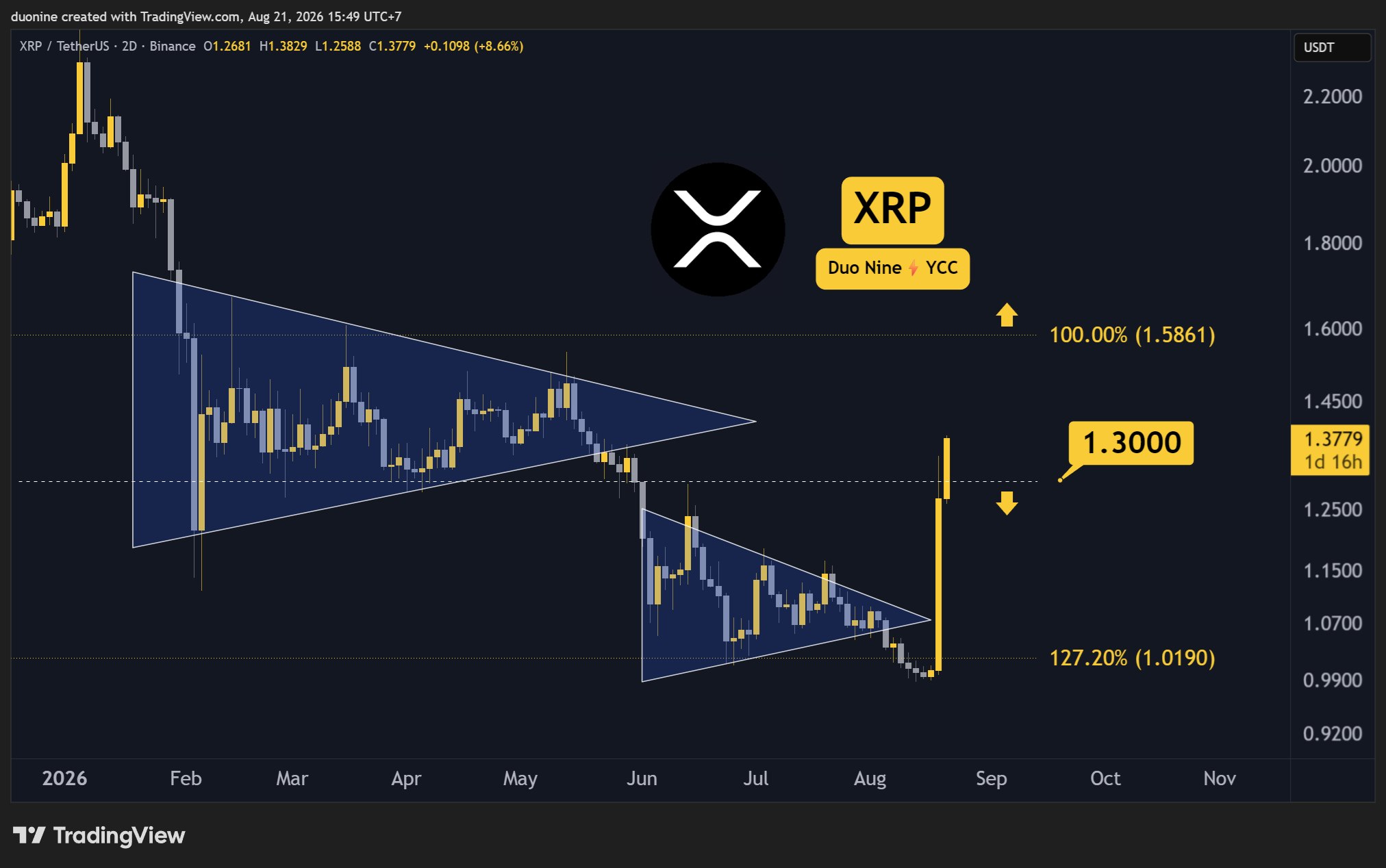
    XRP has experienced a significant surge of over 20% in the past 24 hours, showing no immediate signs of slowing down. This sharp increase follows a period where the cryptocurrency narrowly avoided falling below the critical $1 support level. The current rally appears to be part of a broader market-wide uptrend, with XRP capitalizing on the prevailing momentum.

    Key Price Levels to Watch

    Analysts are closely monitoring key support levels for XRP at $1 and $1.3. On the resistance side, immediate targets are identified at $1.6 and $2.

    At the time of reporting, XRP’s price has successfully broken through the $1.3 resistance, which is now expected to serve as a significant support zone. Should the upward momentum continue, the next major price target is projected to be $1.6.

    Buyers Re-emerge, Volume Spikes

    After months of trading within a narrow range just above the $1 mark, XRP has seen a strong return of buyer interest. Trading volume has surged to levels not observed since the market downturn in February. Crucially, the current market dynamic shows buyers in control, a stark contrast to the previous seller dominance.

    This robust rally has effectively reversed most of the losses incurred since the beginning of the year. If XRP can successfully reclaim the $1.6 level, it would mark a higher high and officially signal an end to its recent downtrend.

    Overbought Conditions and Future Outlook

    The aggressive buying activity has propelled XRP’s daily Relative Strength Index (RSI) above 80, indicating an overbought condition. This suggests a degree of caution for investors entering the market at this stage, as a significant portion of the upward move may have already occurred, even if XRP reaches the $1.6 target.

    Regardless of immediate price fluctuations, XRP’s recent performance has sent a strong message, potentially setting a bullish tone for the remainder of the year. Ideally, the cryptocurrency would now consolidate its recent gains, confirming the upward trajectory before attempting further advances.

  • XRP Surges Past $1.30: Key Drivers of Ripple’s Rally Revealed

    XRP Surges Past $1.30: Key Drivers of Ripple’s Rally Revealed

    XRP Surges Past $1.30, Fueled by Whales and Analyst Optimism

    Just days after speculation swirled around whether Ripple’s cross-border token, XRP, would breach the critical $1.00 support level, the cryptocurrency has staged an impressive recovery. Analysts had previously projected potential price drops to as low as $0.60.

    However, the market landscape shifted dramatically. A surge in Bitcoin’s price propelled the entire cryptocurrency market upward, with XRP taking center stage. The token rocketed to $1.30, its highest point in months, marking a 30% gain from its recent lows.

    Whales Drive the Rally

    The most significant factor behind XRP’s resurgence appears to be the activity of “whales” – large holders of the cryptocurrency. Reports indicate that these major players accumulated over 300 million XRP tokens within a 96-hour period, directly contributing to the substantial price increase. This followed an earlier accumulation of 72 million coins at the end of the previous week.

    Data shared by market observer Vincent Van Code on X corroborates this trend. Van Code highlighted that 53% of all significant buy orders originated from large players, with medium traders accounting for 35% and smaller investors making up just 12%.

    “Retail is not the driving force of this rally. This is great news,” Van Code concluded, suggesting that the current upward momentum is driven by more substantial market participants.

    ETF Inflows Remain Modest

    While spot XRP Exchange-Traded Funds (ETFs) saw positive performance for three consecutive days, their actual inflows remain relatively modest compared to peaks seen in November and December of the previous year. This suggests that ETFs are likely not the primary catalyst for the current recovery.

    Analysts Project Significant Upside

    The recent 30% surge has emboldened analysts to issue bullish predictions for XRP. Crypto Patel envisions XRP potentially reaching $10, a target he deems plausible. He referenced historical precedents, noting that in 2017, a $3 price was considered improbable, yet XRP achieved it the following year. Similarly, in 2023, despite widespread skepticism, XRP experienced a significant rally from $0.50 to $2.60 within a month. Patel suggested that the $1.00 dip acted as an accumulation zone, with “$10-$20 absolutely on the table.”

    Other analysts also expressed optimism. Mikybull Crypto predicted a “god candle” for XRP following a retest of the Ichimoku cloud, while CW observed that the asset has broken through a major resistance level, signaling the end of a prolonged downtrend and the commencement of a “full-fledged uptrend.”

  • Ripple’s SEC Legal Battle: A Cautionary Tale Driving US Crypto Regulation Debate

    Ripple’s SEC Legal Battle: A Cautionary Tale Driving US Crypto Regulation Debate

    The protracted legal battle between Ripple and the U.S. Securities and Exchange Commission (SEC), which concluded after more than four years and approximately $150 million in legal costs, is now being presented as a significant cautionary tale for the future of cryptocurrency regulation in the United States. The outcome, which distinguished between institutional sales and secondary market trading of XRP, is being leveraged by Ripple’s leadership to advocate for clearer legislative frameworks.

    Why This Matters

    The materials describe a narrow update: Ripple and its executives spent over four years and approximately $150 million fighting a lawsuit with the SEC over unregistered securities sales of XRP. Whether the CLARITY Act framework will move through Congress this session.

    Broader Context

    Source materials place the factual news in this context: Ripple CEO Brad Garlinghouse is using his company’s own legal bill as evidence that Washington’s approach to digital assets has a direct, measurable cost.

    The Cost of Ambiguity

    According to Ripple CEO Brad Garlinghouse, the substantial financial and operational toll of the lawsuit underscores the negative impact of regulatory ambiguity. He stated that a majority of the company’s hiring during the legal stretch occurred outside the United States, suggesting that regulatory uncertainty pushes capital and jobs offshore. This sentiment aligns with the broader industry concern that a lack of clear rules hinders innovation and drives businesses to more favorable jurisdictions.

    Case Outcome and Its Nuances

    The SEC initially sued Ripple, Garlinghouse, and co-founder Chris Larsen in December 2020, alleging that the company had raised funds through unregistered securities sales of XRP. The case navigated numerous rulings before both parties filed a joint stipulation dismissing their appeals in August 2025. Per the SEC’s own litigation release, this resolution left a civil penalty of $125,035,150 and a registration-related injunction in place.

    This outcome, however, did not categorically declare XRP exempt from securities law but rather differentiated between how it was sold to institutional investors and its trading on secondary markets. Ripple views this distinction as a template for how crypto assets should be regulated going forward, arguing for a more defined approach than the case-by-case litigation model that consumed its legal budget.

    Garlinghouse has previously called the resolution a “long overdue surrender by the SEC,” contending that the agency pursued the case to intimidate the industry rather than to police fraud. He emphasized that “America needs clear crypto rules to protect users and keep innovation at home.”

    Shifting Regulatory Signals

    Recent developments suggest a potential shift in regulatory sentiment. Around August 19, a White House innovation meeting brought together crypto executives and regulators to discuss digital-asset policy. During this meeting, CFTC Chair Michael Selig indicated a move away from an enforcement-led regulatory approach. Selig said that innovators were now being welcomed to the White House, contrasting with a previous environment where they might have been “railroaded to the big house.” He also noted that additional regulatory roadmap details would follow at the CFTC’s inaugural Innovation Advisory Committee meeting on August 20, which included digital assets and emerging financial products on its agenda.

    Selig’s comments, made with Ripple’s leadership present, are seen by some as tightening the odds that market-structure legislation will be prioritized before the next election cycle. The practical argument for such legislation, like the proposed CLARITY Act, is that it would replace the current litigation-heavy model with a defined split of jurisdiction between the SEC and the Commodity Futures Trading Commission (CFTC). This approach mirrors industry proposals for a token safe harbor, which would allow projects to raise funds and build networks without facing enforcement actions years into their operational history.

    Uncertainty Ahead

    However, uncertainties remain regarding the legislative path forward. Whether the CLARITY Act or similar frameworks will successfully move through Congress this session is an open question. Ripple’s post-litigation position and financial standing are likely to remain reference points in this ongoing debate, regardless of the legislative outcome.

    For traders, the immediate takeaway is that the SEC’s case against Ripple is closed, with the established penalty and injunction standing as final. The broader signal, however, is political: a shift in regulatory posture from a key agency, coupled with industry advocacy, may increase the impetus for legislative action to define the future of digital asset regulation in the United States.