Tag: Positive

  • Matt Hougan: Three Investor Mistakes Leading to Underestimation of Crypto’s Future Potential

    Matt Hougan: Three Investor Mistakes Leading to Underestimation of Crypto’s Future Potential

    Current investor assumptions about crypto’s future potential may be constrained by outdated metrics and a narrow view of market applicability, according to Bitwise Chief Investment Officer Matt Hougan. Hougan identified three common errors that can lead investors to underestimate the industry’s long-term prospects: misjudging the future use cases and addressable market for crypto applications, assuming traditional finance (TradFi) companies will inevitably dominate crypto-native businesses, and relying on current transaction volumes to predict future blockchain activity.

    Expanding the Horizon: Tokenization and Market Size

    One significant area where investors may be falling short is in assessing the true addressable market for crypto platforms. Hougan pointed out that platforms like Uniswap should not be valued solely against the current crypto market, which is approximately $2 trillion. As traditional assets such as stocks, bonds, and real estate are increasingly tokenized and moved onto blockchains, the potential market for these decentralized applications could expand dramatically. Tapping into these broader markets could create an opportunity roughly 100 times larger than the current crypto market alone, Hougan believes. This expansion is a key factor that investors might be overlooking when evaluating the future potential of crypto infrastructure.

    Crypto-Native vs. Traditional Finance: A Competitive Edge

    Another common pitfall, according to Hougan, is the assumption that established TradFi companies will ultimately take over crypto-native businesses. While companies like PayPal have entered the crypto space with products such as its stablecoin PYUSD, which currently holds 1% of the stablecoin market, and Fidelity launched its crypto custody service in 2019, crypto-native firms often possess distinct advantages. Hougan said these firms tend to move faster, maintain a singular focus on the crypto sector, and have already cultivated user trust within the ecosystem. Coinbase, for instance, has become the largest crypto custodian in the US, demonstrating the strength of crypto-native players.

    The Future of Activity: AI, 24/7 Markets, and Transaction Volume

    The third major error identified by Hougan involves using current transaction volumes as a reliable predictor of future blockchain activity. The current trading hours for US stocks, for example, are limited to 33 hours per week. However, as tokenized assets become more prevalent, the potential for 24/7 trading, akin to a 168-hour market, emerges. Furthermore, the integration of AI agents is expected to significantly alter transaction dynamics. Hougan suggests that the combination of round-the-clock trading and AI-driven activity could push stock transactions up to 10 times higher. He even envisions scenarios where transaction volumes could increase by 50x or 100x, particularly in areas like payments where AI agents might favor blockchain systems due to their suitability for autonomous software compared to TradFi systems that often require human authentication.

    While the exact future transaction volumes remain uncertain, Hougan emphasized that even with potential fee reductions from higher volumes, the overall growth is likely to be substantial. He anticipates agentic trading and payments to emerge within months, with AI-related activity potentially adding to, rather than competing with, existing crypto trading volumes. This suggests a significant underestimation of future activity based on current metrics.

    These insights highlight a critical need for investors to re-evaluate their assumptions about crypto’s future. By looking beyond current market sizes, established brands, and present-day transaction volumes, investors can gain a more accurate perspective on the vast potential driven by technological advancements like tokenization and AI, and the unique advantages of crypto-native innovation.

    Why This Matters

    The materials describe a narrow update: Matt Hougan outlined three key errors in crypto investment strategy: underestimating the future use cases and addressable market for crypto applications, assuming TradFi companies will dominate crypto-native businesses, and using current transaction volumes to predict future blockchain activity. The exact future addressable market size for crypto applications.

    Broader Context

    Source materials place the market analysis in this context: Bitwise Chief Investment Officer Matt Hougan’s recent post.


  • Ripple ETFs Surge to Best Week Since May on XRP Rally

    Ripple ETFs Surge to Best Week Since May on XRP Rally

    XRP ETFs Experience Strongest Week Since May Amidst Token Surge

    Cryptocurrency markets are experiencing a significant shift, a trend clearly reflected in exchange-traded funds (ETFs) that track various digital assets, including Ripple’s native token, XRP.

    While generally trading in positive territory, spot XRP ETFs had faced a prolonged period of subdued demand, particularly throughout August. However, this trend reversed dramatically last week.

    The week began sluggishly for these funds, with SoSoValue data indicating zero actual inflows on Monday. This continued a challenging streak that saw seven out of the first eleven trading days of the month with no significant investor activity. The landscape changed on August 18, when investors injected $5.81 million into the funds, marking the largest daily net inflow for August.

    Wednesday saw a more modest gain of $2.35 million for the ETFs, a day that proved pivotal for the broader crypto market. The US Treasury Department’s announcement of a significant monetary policy shift, coupled with former President Trump’s hosting of a Crypto Summit at the White House, are widely considered the primary drivers behind the market’s revival.

    XRP’s own price surge lagged slightly behind other cryptocurrencies on Wednesday, but its momentum picked up considerably in the following days. Thursday saw inflows of $13.24 million, followed by a robust $18.38 million on Friday – the highest single-day inflow since May 14. Cumulatively, the XRP ETFs garnered $39.78 million last week, their best performance since the week ending May 15.

    The total cumulative net inflows for XRP ETFs have now reached a new all-time high of $1.55 billion. Bitwise’s XRP fund continues to lead the pack, holding $542.69 million in cumulative net inflows. It is followed by Canary Capital’s XRPC with $468.12 million and Franklin’s XRPZ with $434.16 million.

    Although XRP did not experience the same explosive growth as Bitcoin and many other altcoins on Wednesday, its subsequent rally was substantial. After successfully defending the $1.00 support level, the token embarked on a rapid ascent, reaching $1.70 by Saturday morning. This represented a remarkable 70% increase in less than 72 hours.

    However, the rally faced resistance at the $1.70 mark, leading to a sharp decline to $1.42. Bulls have since stepped in, facilitating a recovery, with XRP currently trading just above $1.50. Analysts, however, emphasize that the token must reclaim the $1.65-$1.70 resistance zone to signal a sustained shift in the broader trend.

  • ACE Robotics Chairman: Robot Brains Poised for ‘ChatGPT Moment’ by 2027

    ACE Robotics Chairman: Robot Brains Poised for ‘ChatGPT Moment’ by 2027

    Robots Poised for Commercial Leap as AI Advances

    Humanoid robots have demonstrated impressive capabilities, from walking and dancing to boxing. However, enabling them to reliably perform useful tasks in the complex and unpredictable physical world remains a significant hurdle for artificial intelligence.

    Wang Xiaogang, Chairman of ACE Robotics, believes that breakthroughs in AI models and real-world training data are on the cusp of equipping robots with the intelligence necessary to transition from mere demonstrations to practical commercial applications.

    “We anticipate reaching the ‘ChatGPT moment’ for embodied intelligence by the end of next year, propelled by world models and environmental data capture,” Wang stated in a report by Reuters.

    ACE Robotics, a Chinese startup established in July 2025, is focused on developing AI models specifically for humanoid robots. The company, which has secured backing from Ant Group and SenseTime, raised over $100 million in the first half of 2026. According to Reuters, ACE Robotics is also planning to pursue an initial public offering “as early as permitted.”

    While large language models like ChatGPT and DeepSeek have seen rapid adoption, robots continue to struggle with performing a diverse range of tasks in unfamiliar settings, with a persistent lack of adequate training data posing a major obstacle.

    Embodied AI empowers robots and other physical agents to perceive their surroundings, reason about them, and translate decisions into actions through the use of sensors and actuators. Concurrently, world models assist AI in comprehending the mechanics of the physical world by learning the behavior of objects and environments. For robots, this translates to anticipating potential outcomes of movements, object manipulation, or interactions with their environment before executing an action.

    “Over the past few years, the entire industry has accumulated approximately 100,000 hours of data, which is far from sufficient to train embodied foundation models,” Wang commented.

    Similar research initiatives are underway globally. In October, researchers introduced HumanoidExo, a wearable exoskeleton designed to capture human movements for the training of humanoid robots.

    Other companies are also developing their proprietary AI models for robotic applications. In January, Boston Dynamics unveiled the production version of its Atlas humanoid robot, citing advancements in AI as a key factor bringing the robot closer to commercial deployment. In June, Alibaba launched its Qwen-RobotSuite, a collection of AI models engineered to assist robots in navigation, executing physical tasks, and simulating real-world environments.

  • Bitcoin and Ethereum ETFs See Notable Inflows; Treasury Buyback Announcement Coincides

    Bitcoin and Ethereum ETFs See Notable Inflows; Treasury Buyback Announcement Coincides

    Spot Bitcoin and Ethereum Exchange Traded Funds (ETFs) have recorded substantial net inflows over the past five business days, reaching a level not observed in approximately ten months. This period of increased investment coincided with an announcement from the US Treasury Department regarding an increase in its liquidity-support buyback operations for longer-dated government debt.

    According to the FactSheet, Bitcoin ETFs attracted nearly $1.92 billion in fresh funds during the five business days leading up to August 21. In the same timeframe, Ethereum ETFs saw net inflows of close to $700 million. The US Treasury Department announced it would double the maximum size of its liquidity-support buybacks for longer-dated government debt, raising them from $2 billion to at least $4 billion per operation. The source states this action may have influenced investor appetite for risk-on assets.

    Market movements during this period saw Bitcoin’s price increase. Before the Treasury Department’s announcement, Bitcoin traded below $65,000. By Friday, its price had risen to nearly $80,000, an increase of approximately $15,000. Ethereum’s price also experienced a notable rise, moving from $1,900 on Wednesday to over $2,500 by Saturday morning. Ethereum’s weekly gains were reported to be over 28%.

    ETF Inflow Details

    Daily figures for Bitcoin ETF inflows show $517 million on Wednesday and over $606 million on Thursday. The total net inflows for Bitcoin ETFs rose from under $51.8 billion to over $53.7 billion by August 21. This past week was reportedly the best for Bitcoin ETF net inflows since the week ending October 10, when inflows reached $2.71 billion.

    For Ethereum ETFs, daily net inflows included $30.85 million on Monday, $71.47 million on Tuesday, $189.15 million on Wednesday, and $220.77 million on Thursday, followed by $185 million on Friday. Cumulative total net inflows for Ethereum ETFs increased from $11.45 billion to $12.15 billion on August 21.

    Correlation and Uncertainties

    While the FactSheet notes these inflows and price movements occurred concurrently with the Treasury announcement, the interpretation of a direct causal link is presented with caution. One signal suggests that increased institutional demand for Bitcoin and Ethereum ETFs correlates with positive price movements for both cryptocurrencies. Another signal indicates that the US Treasury Department’s announcement may have influenced investor sentiment towards risk-on assets, citing the Treasury’s action and subsequent inflows as basis, with a medium confidence level.

    It is important to note certain uncertainties. The exact date range for the ‘past five business days’ is not explicitly stated but is inferred to be leading up to August 21. Additionally, a mention of Ethereum ETF inflows since ‘October 2025’ is likely a typographical error and may refer to a date in 2023 or a similar recent period, given the context of a 10-month high. The precise timing of a past Bitcoin crash, which reportedly coincided with over $19 billion in liquidations, is also not specified.

    The narrative planner emphasizes an evidence-based correlation analysis, focusing on verified facts regarding inflows and the Treasury announcement, followed by observed price movements. Potential correlations are to be discussed with explicit mention of limitations and uncertainties, avoiding direct causal claims or speculative language. The aim is to provide a balanced perspective, highlighting that while inflows and price changes coincided with the Treasury announcement, the extent of influence remains subject to interpretation and broader market factors.

    Why This Matters

    The materials describe a narrow update: Spot Bitcoin and Ethereum ETFs saw substantial inflows totaling $1.92 billion for Bitcoin and nearly $700 million for Ethereum over five business days. This occurred alongside a US Treasury announcement to double liquidity-support buybacks for longer-dated government debt. The exact date of the ‘past five business days’ is not specified, but inferred to be leading up to August 21.

    Broader Context

    Source materials place the factual news in this context: The week started on the right foot, with almost $300 million in net inflows on Monday and another $189.30 million on Tuesday.

  • Gemini AI: Ethereum Poised to Capture Retail’s 2026 Trade

    Gemini AI: Ethereum Poised to Capture Retail’s 2026 Trade

    Ethereum Poised for Major Upgrade, AI Predicts Significant Price Surge

    Ethereum is on the cusp of its most substantial protocol overhaul since “The Merge,” with a significant hard fork scheduled for the end of August. Google’s Gemini AI anticipates this upgrade, dubbed “Glamsterdam,” will fundamentally alter Ethereum’s trajectory, projecting a baseline price target of $3,800 to $4,500 by late 2026, with a realistic mid-case scenario of $4,150.

    Key Upgrades Driving the Transformation

    The Glamsterdam hard fork introduces three critical Ethereum Improvement Proposals (EIPs). EIP-7928 is set to implement parallel execution, dramatically increasing network throughput to an estimated 10,000 transactions per second (TPS). Complementing this, EIP-7904 addresses cost efficiency through gas repricing, aiming to reduce Layer-1 fees by approximately 78.6%. These advancements in speed and affordability are expected to enable more complex applications to run directly on the mainnet, rather than relying solely on Layer-2 rollups. The third crucial component, EIP-7732, introduces Enshrined Proposer-Builder Separation (PBS). This measure is designed to curb Miner Extractable Value (MEV) extraction by up to 70%, redirecting captured value directly to mainnet validators instead of “searchers.”

    Potential Risks and Bullish Outlook

    The primary risk identified for the upgrade is a potential delay in execution. Further technical setbacks pushing the protocol’s implementation beyond the fourth quarter of 2026 could lead to a prolonged period of market consolidation, with a potential downside risk to $2,100 support and a bear target of $1,850. However, a successful mainnet deployment is seen as the key catalyst for achieving the projected $4,150 price target.

    Recent Price Action and Technical Indicators

    Ethereum’s daily chart shows a significant breakout from a prolonged consolidation phase. After peaking near $4,950 last August, ETH experienced a sustained decline, with sharp drops in October and November, and a notable break in February that saw prices approach $1,780. The spring saw a recovery to $2,450 by May, but this was largely erased in June, with the low reaching around $1,480. July and August saw a slow base form above $1,850, with recent trading sessions pushing ETH towards $2,400.

    Currently trading around $2,398.9, up 3.13% and $72.9, the daily range has been between $2,324.2 and $2,446.8. Key support levels are identified at $2,300, $2,100, and $1,850, while resistance is anticipated at $2,450, $2,800, and $3,000. The Relative Strength Index (RSI) stands at 86.13, with its signal line at 59.55. This significant gap indicates extreme market repricing and a deeply overbought condition. While momentum is strongly bullish, such high RSI readings typically precede a period of consolidation.

    Gemini’s mid-case price prediction of $4,150 requires an additional 73% increase from current levels. The success of the upcoming hard fork is viewed as the decisive factor in determining whether this current breakout evolves into a sustained trend.

    Bitcoin Hyper: A Parallel Pursuit for Enhanced Bitcoin Functionality

    In parallel, the Bitcoin Hyper project is aiming for a similar outcome of enhanced network speed and cost efficiency for Bitcoin, albeit through a different approach. Instead of altering Bitcoin’s base layer, the project is developing an execution environment around it utilizing the Solana Virtual Machine. This initiative seeks to introduce high-speed transactions, ultra-low fees, and smart contract capabilities to an ecosystem historically constrained by Bitcoin’s slower and less programmable design.

    A Canonical Bridge is being developed to facilitate the movement of Bitcoin into this new environment, with HYPER tokens powering gas fees, staking, and governance across the network. The project’s premise is that Bitcoin’s existing substantial capital and security can be made more accessible and usable by adding a faster execution layer. The presale has already garnered over $33 million, with current investors able to stake HYPER for yields up to 36% APY, in anticipation of a planned 2026 launch.

  • XRP Surges: Breakout Confirmed, What’s Next?

    XRP Surges: Breakout Confirmed, What’s Next?

    XRP Surges in Bullish Breakout After Months of Downtrend

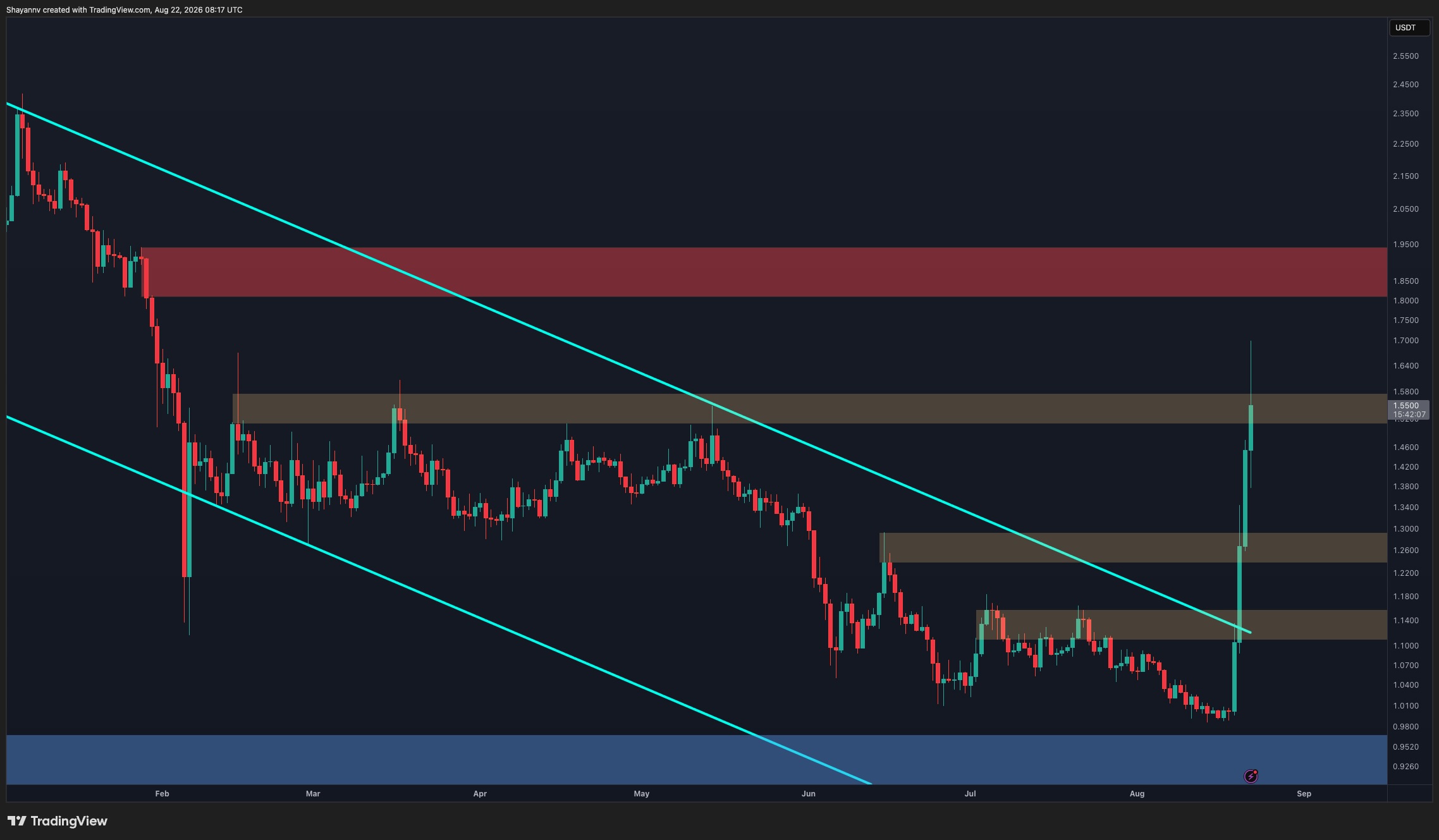
    XRP has experienced a significant bullish breakout, emerging from a prolonged period of decline. This impulsive move has markedly improved the cryptocurrency’s short-term technical structure, though it is now confronting a key resistance area after a rapid ascent.

    On the daily chart, XRP has decisively broken free from a descending channel that had dictated its price action for several months. The breakout, which originated from the support region between approximately $0.98 and $1, propelled the asset through multiple resistance levels, including the channel’s boundary and the $1.10-$1.15 zone.

    The rally has since extended towards $1.55, bringing XRP directly into the critical resistance zone of $1.50-$1.58. The long upper wick, reaching close to $1.70, indicates that sellers have already entered the market at higher price points, suggesting some short-term profit-taking following the near-vertical advance.

    Despite this, the broader structural shift is substantial. Maintaining a position above the former $1.50 region would solidify the breakout and could potentially bring the major resistance zone of $1.82-$1.94 into focus. Conversely, a failure to establish support at current levels could initiate a corrective phase, with the former resistance area between $1.22 and $1.30 serving as an important level to watch.

    Aggressive Rally and Potential Retracement

    The 4-hour timeframe underscores the aggressive nature of XRP’s recent surge. The token broke out from around the $1 mark and climbed as high as $1.70 with minimal consolidation, leaving the market susceptible to a retracement as initial momentum wanes.

    Fibonacci retracement levels highlight several potential support areas should a correction occur. The first significant zone is around the 0.5 level at $1.34, which aligns with the upper boundary of the identified support area between $1.22 and $1.34. Below this, the 0.618 retracement is situated at $1.26, followed by the 0.702 level at $1.20. A deeper pullback could bring the 0.786 level near $1.14 into play, close to another former resistance zone.

    For now, the rejection from $1.70 suggests that the market may need time to consolidate the explosive rally. As long as XRP holds the $1.22-$1.34 zone during any correction, the breakout structure appears constructive, and another attempt at the $1.70 level could follow. However, a sustained loss of this area would increase the likelihood of a deeper retracement towards $1.14-$1.10 before buyers potentially regain control.

  • Ray Dalio’s Prediction on US Debt: Uncertainty and Asset Allocation

    Ray Dalio’s Prediction on US Debt: Uncertainty and Asset Allocation

    Ray Dalio, founder of Bridgewater Associates, has presented a prediction regarding the United States’ fiscal trajectory, suggesting potential fiscal challenges within the next three to five years. Dalio’s analysis indicates that investors might consider reducing their exposure to bonds and allocating a portion of their portfolios to gold and Bitcoin as potential hedges against these uncertainties.

    The core of Dalio’s argument centers on the U.S. fiscal situation. Current data indicates the federal government is projected to collect approximately $5.5 trillion in revenue this year while anticipating spending around $7.5 trillion. This gap results in a federal deficit of roughly $2 trillion for the year, representing about 6% of GDP. Adding to these fiscal pressures, U.S. government debt has surpassed $40 trillion this week, with $10 trillion due for refinancing. The annual interest expenses on this debt are approaching $1 trillion.

    Dalio estimated that a U.S. fiscal challenge could materialize in “three years, give or take two.” He suggests that without significant fiscal policy changes, Treasury yields may need to rise substantially to attract buyers for government debt. Alternatively, policymakers might resort to monetary intervention, which could potentially weaken the U.S. dollar and fuel inflation, according to the analysis.

    In response to these potential challenges, Dalio’s recommendation is to reduce holdings in bonds. He suggests allocating between 10% and 15% of investment portfolios to gold and holding “a bit of Bitcoin” as a hedge against a severe fiscal challenge. These recommendations coincide with notable recent price increases for both assets. In the past week, Bitcoin surged from approximately $64,000 to nearly $80,000, while gold rebounded from around $4,000 to $4,600 per ounce. These market movements followed U.S. Treasury Secretary Scott Bessent’s announcement of plans to increase buybacks of long-dated government bonds, a move that initially lowered Treasury yields and weakened the dollar.

    While Dalio’s concerns are grounded in observable fiscal trends, the exact timing and severity of any potential fiscal challenge remain uncertain. The specific actions policymakers might take and the extent to which investors may continue to finance government deficits are also subject to change. Furthermore, the effectiveness of gold and Bitcoin as hedges against such a scenario is a point of consideration, as their performance can be influenced by numerous market factors beyond U.S. fiscal policy.

    Dalio has also proposed solutions for the U.S. government, including reducing the federal deficit to around 3% of GDP through a combination of spending cuts, increased tax revenue, and lower borrowing costs. The feasibility and political viability of such measures are not detailed in the provided information. The analysis suggests that assets not easily issued by governments, such as gold and Bitcoin, could offer protection in scenarios involving a weakening dollar or increased inflation.

    Why This Matters

    The materials describe a narrow update: Ray Dalio, founder of Bridgewater Associates, has advised investors to reduce exposure to bonds and allocate a portion of their portfolio to gold and bitcoin, citing concerns about an impending US debt crisis. The exact timing of the potential US debt crisis.

    Broader Context

    Source materials place the market analysis in this context: Ray Dalio, once one of the most prominent crypto critics, has made a new case for owning gold and bitcoin.

  • Ripple CEO Shares Insights After White House, CFTC Talks

    Ripple CEO Shares Insights After White House, CFTC Talks

    Ripple CEO Breaks Silence on White House and CFTC Engagements

    Ripple CEO Brad Garlinghouse has spoken for the first time following his participation in a cryptocurrency meeting at the White House earlier this week and his appointment to the CFTC’s Innovation Advisory Committee, an initiative he described as “the Olympic rules of crypto.”

    Garlinghouse highlighted a consensus among attendees, which included numerous figures from traditional finance, that existing regulations are ill-suited for the current market environment.

    Beyond significant market fluctuations in the past week, a notable development that may have contributed to the market’s revival was a gathering at the White House, organized by the Trump administration. President Trump met with executives from prominent crypto firms such as Coinbase, Ripple, and Gemini, alongside the chairs of the Securities and Exchange Commission (SEC) and the Commodity Futures Trading Commission (CFTC).

    A central focus of the discussions was the long-awaited CLARITY Act. Policymakers have been engaged in ongoing debates over this key legislation, which has struggled to gain bipartisan support. Reports indicate that President Trump urged Congress to pass a “fair version” of the bill, emphasizing its importance for maintaining U.S. leadership over China.

    The legislation successfully passed the House of Representatives in July 2025 but encountered a stalemate in the Senate due to disagreements over provisions related to ethics, stablecoin incentives, and tokenized equities. Following the event, Garlinghouse expressed his pleasure at “being back at the White House” alongside President Trump, CFTC’s Mike Selig, and SEC’s Paul Atkins.

    He underscored the clear reality that with one in four Americans owning digital assets, “crypto isn’t a fringe industry. And Washington, DC, knows the crypto voter is alive and well.”

    Garlinghouse concluded his remarks by stating, “This President’s incredible commitment to innovation and leadership around digital assets in the US has been profound. The future is bright.”

    Speaking after the CFTC meeting, Garlinghouse reiterated that all participants, including those from traditional finance, agreed that current regulatory frameworks were designed for a different era and are “aren’t good enough” for today’s landscape. He argued that these regulations are insufficient for both businesses and innovation.

    He referenced an open letter he penned in 2019, in which he called for U.S. authorities to establish clearer rules for the cryptocurrency sector. Seven years later, the industry continues to await such clarity. On a positive note, Garlinghouse believes the Trump administration, along with appointees like Selig and “a myriad of bold leaders in Congress,” are finally moving in the right direction, with the industry “never been closer” to achieving these necessary regulations.

  • Pi Network Final Planned Upgrade v27 Set for September 15, Alongside New App Pricing Model

    Pi Network Final Planned Upgrade v27 Set for September 15, Alongside New App Pricing Model

    Pi Network is preparing for its final planned protocol upgrade, version 27, scheduled for September 15. This upgrade aims to enhance the network’s smart contract capabilities and transaction authorization processes. Concurrently, a new pricing model for application creation and editing will be implemented on August 24.

    The Pi Network Core Team announced the successful deployment of version 26 on the Mainnet, continuing a series of protocol updates that began in February with version 19.6. Version 27 is designated as the last planned upgrade in this series, focusing on incorporating newer protocol features and expanding the network’s smart contract capabilities. According to the team, version 27 will introduce more flexible and secure smart contract authentication and enable more advanced ways for accounts and applications to authorize transactions.

    Recent developments supporting the network’s infrastructure include the release of Pi Node version 0.6.2 last week, which brought improvements to SoloHost, node connectivity, and the Pi Desktop user experience. Additionally, a successful initial distributed computing test was conducted with five volunteer Node operators who performed computations and returned results to a Pi coordinator, indicating progress in network scalability.

    Evolving App Development Economics

    Starting August 24, Pi Network will implement a revised pricing model for creating and editing applications. The current model charges 0.25 PI for both app creation and editing. The new model aims to reflect actual costs more closely and may vary depending on the resources required for each action. However, applications that demonstrate real utility and usage from distinct users will remain eligible for subsidized pricing. The eligibility for this subsidized pricing will be reviewed regularly, allowing developers whose apps gain traction to potentially benefit from the lower rates.

    Uncertainties remain regarding the precise criteria and frequency for reviewing eligibility for subsidized pricing, as well as the specific definition of ‘real utility and usage from distinct users.’ The Core Team has noted that the process for reviewing eligibility will be ongoing.

    The transition to version 27 marks a significant milestone in Pi Network’s development roadmap, emphasizing enhanced functionality and a strategic approach to fostering utility-driven applications within its ecosystem.

    Why This Matters

    The materials describe a narrow update: Pi Network’s Core Team announced the successful deployment of version 26 and detailed the upcoming final planned upgrade, version 27, set for September 15. The exact nature and extent of the ‘significantly higher’ costs that could be covered by the project under the current pricing model.

    Broader Context

    Source materials place the factual news in this context: The article discusses updates and upcoming changes to the Pi Network protocol and related services.

  • XRP Surges Over 65%, Outperforming Bitcoin as Altcoins Lead Market Gains

    XRP Surges Over 65%, Outperforming Bitcoin as Altcoins Lead Market Gains

    The cryptocurrency market is experiencing a notable surge in altcoin performance, with XRP leading the gains. XRP has seen a price increase of over 65% since Wednesday, surpassing BNB in market capitalization and outperforming Bitcoin and other major cryptocurrencies. This trend highlights a significant shift in recent market dynamics.

    According to CryptoPotato, XRP’s impressive rise saw it trade above $1.65, a level not seen in many months. This surge followed a period where XRP dipped below the $1.00 support level less than a week prior. The broader market’s rebound on Wednesday is credited with aiding XRP’s recovery, which initially flew to $1.40 before breaking out further.

    BNB also experienced a substantial gain, soaring by 10% today. However, XRP’s performance allowed it to overtake BNB in market capitalization. Other altcoins such as SOL, HYPE, DOGE, ADA, LINK, XLM, BCH, CC, and LTC have also posted double-digit gains. ZEC notably surged by 40% to reach $820, while ETH reclaimed the $2,500 level after a 7% increase. The official Trump (TRUMP) coin also saw a significant rise, skyrocketing by over 60% in the past day and re-entering the top 100 altcoins by market cap.

    Bitcoin has also shown resilience, rebounding from a recent dip to $76,200 and trading above $78,000. The primary cryptocurrency had previously reached near $80,000 on Friday, marking a gain of $15,000 in the preceding 48 hours. Despite this rebound, Bitcoin’s market dominance has seen a slight decrease, moving from 57.9% to 57.1%.

    The overall cryptocurrency market capitalization has experienced substantial growth, adding $100 billion in a single day and $500 billion since Wednesday, bringing the total market cap to $2.760 trillion on CoinGecko. This broad market recovery and growth across various digital assets underscore a dynamic period in the cryptocurrency space.

    Minor uncertainties remain regarding the data, including the mention of ‘CC’ as an entity with double-digit gains, which is not a commonly recognized cryptocurrency ticker, and the precise definition of the ‘Weekend Watch’ period.

    Why This Matters

    The materials describe a narrow update: Several altcoins, led by XRP which surged over 65% and surpassed BNB in market cap, experienced significant price increases. The exact duration of the ‘Weekend Watch’ period is not precisely defined.

    Broader Context

    Source materials place the factual news in this context: The cryptocurrency market is on the move again, but this time the altcoins have taken the spotlight.