Category: Uncategorized

  • Crypto Markets Face Three Key Influences This Week

    Crypto Markets Face Three Key Influences This Week

    Crypto Markets Hold Gains as Investors Eye Fed Minutes and Earnings Season

    Cryptocurrency markets concluded the past week on a positive note, consolidating recent gains and even seeing marginal improvements. The coming week, however, promises to be a pivotal one, with investors closely watching the release of the Federal Reserve’s minutes from its last meeting. These minutes are expected to offer crucial insights into the future direction of monetary policy, particularly as inflation continues its upward trajectory.

    Meanwhile, the U.S. stock market has reached a significant milestone, with its total capitalization surpassing $80 trillion, setting a new record. This figure now represents approximately 48% of the global market capitalization.

    “We expect another volatile week ahead as markets brace for earnings season,” noted The Kobeissi Letter.

    Economic Data and Fed Policy in Focus

    The economic calendar for the week is packed with key releases. On Monday, June’s S&P Global Services Purchasing Managers’ Index (PMI) data will provide a broader assessment of economic activity. This will be followed on Tuesday by the ADP Employment Change report.

    Wednesday is marked by the release of the Federal Open Market Committee (FOMC) minutes, the first under new Chairman Kevin Warsh. While the central bank previously held interest rates steady, persistent inflationary pressures, exacerbated by rising energy prices, could prompt a shift towards rate hikes.

    “I think it’s going to be interesting to see how the discussion went around the table, how incrementally hawkish are they leaning,” commented Matthew Miskin, co-chief investment strategist at Manulife John Hancock Investments. “That’s what investors and markets are going to be wondering: What is this new Fed chairman and updated (Fed policymaking body) looking for to decide the path of rates from here?”

    Further labor market data will be released on Thursday with Initial Jobless Claims. This comes after a report indicating that full-time employment dropped by 514,000 in June, reaching its lowest point since December 2024. “The weakness in the US labor market is accelerating,” stated Kobeissi.

    Key Events This Week:

    • Monday: June S&P Global Services PMI data
    • Tuesday: ADP Employment Change data
    • Wednesday: Fed Meeting Minutes
    • Thursday: Initial Jobless Claims data; June Existing Home Sales data
    • Friday: IEA Monthly Report

    Corporate and Market Developments

    In addition to economic indicators, the week will also see SpaceX (SPCX) join the Nasdaq 100 index. Furthermore, the second quarter earnings season is set to commence this month, which typically introduces a period of heightened market activity.

    Crypto Market Performance

    As of Monday morning in Asia, cryptocurrency markets are holding onto their recent gains. The total market capitalization has risen by 1.1% on the day, reaching $2.26 trillion.

    Bitcoin has led the charge, recording a 2.7% gain over the weekend to trade at $63,700 on Monday morning. This marks its highest level in two weeks, following its worst month in four years.

    Ether has shown even stronger performance, with a 14% gain over the past week, approaching the $1,800 mark in early Monday trading. Altcoins have largely traded in positive territory, with Hyperliquid and Canton demonstrating notable outperformance.


  • Bybit Lists Siacoin (SC) v2.14.1 Upgrade

    Bybit Lists Siacoin (SC) v2.14.1 Upgrade

    Bybit to Support Siacoin Network Upgrade, Trading Uninterrupted

    Cryptocurrency exchange Bybit has announced its support for the upcoming Siacoin (SC) v2.14.1 network upgrade. The upgrade is scheduled to occur on July 7, 2026, at approximately 08:00 AM UTC, or upon reaching block height 583,000.

    Service Suspensions

    To facilitate a seamless transition, Bybit will temporarily suspend Siacoin (SC) deposits and withdrawals. This suspension will commence on July 7, 2026, at 07:00 AM UTC.

    Trading Continues

    The exchange has clarified that all other trading activities involving Siacoin will remain unaffected by the network upgrade.

    Resumption Notifications

    Bybit will not issue further announcements regarding the resumption of deposit and withdrawal services. Users wishing to be notified when these services are back online are advised to visit the Deposit or Withdrawal page and activate the “Set Alert” function.

    Further details on the Siacoin network upgrade can be found in the official release notes.

  • USDⓈ-M Perpetual Futures Tick Size Updates Set for July 7-8

    USDⓈ-M Perpetual Futures Tick Size Updates Set for July 7-8

    Binance to Adjust Tick Sizes for USDⓈ-M Perpetual Futures Contracts

    Binance announced it will adjust the tick size, the minimum price fluctuation for a trading pair, on several USDⓈ-M Perpetual Futures Contracts. The changes are scheduled to take effect on specific dates in July 2026, aiming to enhance market liquidity and improve the user trading experience.

    Tick Size Adjustments

    The adjustments will be rolled out in phases. On July 7, 2026, at 06:30 UTC, the tick size for GUAUSDT and YBUSDT will change from 0.0001 to 0.00001. BIGTIMEUSDT will see its tick size decrease from 0.00001 to 0.000001, while FILUSDC will move from 0.001 to 0.0001. PUNDIXUSDT’s tick size will be adjusted from 0.0001 to 0.00001. SYNUSDT’s tick size will be adjusted from 0.00001 to 0.0001.

    The following day, July 8, 2026, will see further adjustments. At 06:30 UTC, FILUSDT’s tick size will be reduced from 0.001 to 0.0001. Later that morning, at 06:40 UTC, MANAUSDT’s tick size will be adjusted from 0.0001 to 0.00001. At 06:50 UTC, QTUMUSDT’s tick size will change from 0.001 to 0.0001. Subsequently, at 07:00 UTC, 1INCHUSDT’s tick size will be adjusted from 0.0001 to 0.00001. At 07:10 UTC, IOSTUSDT’s tick size will decrease from 0.000001 to 0.0000001. Finally, at 07:20 UTC, STORJUSDT’s tick size will be adjusted from 0.0001 to 0.00001.

    Trading Suspension for Specific Contracts

    The tick size adjustments will not impact trading operations for most USDⓈ-M Futures contracts. However, the trading function for FILUSDT, MANAUSDT, QTUMUSDT, 1INCHUSDT, IOSTUSDT, and STORJUSDT Perpetual Futures Contracts will be temporarily suspended.

    The USDⓈ-M FILUSDT Perpetual Futures Contract will be suspended from 06:30 UTC to 06:31 UTC on July 8, 2026. The USDⓈ-M MANAUSDT Perpetual Futures Contract suspension will occur from 06:40 UTC to 06:41 UTC on the same day. For the USDⓈ-M QTUMUSDT Perpetual Futures Contract, trading will be suspended from 06:50 UTC to 06:51 UTC. The USDⓈ-M 1INCHUSDT Perpetual Futures Contract will be suspended from 07:00 UTC to 07:01 UTC. The USDⓈ-M IOSTUSDT Perpetual Futures Contract suspension is scheduled from 07:10 UTC to 07:11 UTC. Lastly, the USDⓈ-M STORJUSDT Perpetual Futures Contract will be suspended from 07:20 UTC to 07:21 UTC.

    During these brief suspension periods, users will be unable to place new orders or cancel and modify existing ones for the affected contracts. The trading status of these contracts will change from “TRADING” to “PENDING_TRADING.” API users can query the latest status using the GET /fapi/v1/exchangeInfo endpoint.

    API and Order Impact

    The tick size changes will also be reflected in API data. API users can retrieve the most current tick size information via the GET /fapi/v1/exchangeInfo endpoint. Further details and updates will be available in Binance’s API Changelog.

    Crucially, these tick size updates will not affect existing orders. Orders placed before the adjustment will continue to be matched using the original tick size.

    This information is provided as a Notice under Binance Exchange Rule 17. Traders are advised to consult the Trading Parameters for comprehensive details and to adjust their trading strategies accordingly to mitigate any potential impact.

  • French Minister: 77 Crypto Kidnappings Prompt New Security Plan

    French Minister: 77 Crypto Kidnappings Prompt New Security Plan

    French Authorities Report Surge in Crypto-Related Kidnappings, Unveil New Security Strategy

    France has seen a significant rise in cryptocurrency-related criminal cases, with 77 incidents involving kidnappings, extortion, or attempted kidnappings recorded since the start of the year.

    Interior Minister Laurent Nuñez disclosed the figures on June 30 during a meeting with the Association of Digital Asset Holders (ADAN). This marks a substantial increase from the 45 cases reported in 2025.

    While acknowledging the sector’s concerns, Nuñez described the incidents as serious but highlighted the effectiveness of emergency security measures implemented a year ago. He reported that approximately 200 individuals have been arrested in connection with these crimes, either after attacks occurred or before they could be carried out.

    As a recent illustration, the minister cited the apprehension of suspects linked to an incident in the Somme region within eight hours of the crime. The victim in that case had utilized a dedicated emergency hotline established for members of the cryptocurrency sector.

    Nuñez also noted that 724 individuals within the industry are now registered on the government’s immediate identification platforms, representing an 11% increase in participation. While specific details of the government’s forthcoming actions are yet to be fully revealed, the minister indicated that all departments within the Interior Ministry have developed a new security strategy that is “more ambitious” than previous initiatives.

    Three-Pronged Security Plan Targets Intelligence, Cooperation, and Coordination

    The new security plan is structured around three core priorities. The first focuses on enhancing intelligence sharing. Nuñez emphasized the importance of robust intelligence gathering on criminal networks, particularly as perpetrators of these crimes are sometimes located outside of France.

    The second priority aims to deepen cooperation with ADAN by establishing a network of experts to bridge the gap between cryptocurrency industry participants and relevant government officials.

    The third priority centers on improving operational coordination among law enforcement agencies to more effectively disrupt criminal groups. This also includes strengthening collaboration with countries where individuals believed to be orchestrating these attacks are based.

    International Cooperation Crucial in Combating Crypto Crime

    The minister underscored the continued essential role of cooperation with foreign authorities. He pointed to the June 2025 arrest in Morocco of a Franco-Moroccan man suspected of orchestrating a series of kidnappings targeting the crypto industry. Among the victims was David Balland, co-founder of Ledger. Nuñez stated that this arrest led to the swift cessation of the attacks.

    Similar criminal activities have persisted globally. In March, a cryptocurrency holder known online as ‘Sillytuna’ reported being forced by armed assailants to surrender approximately $24 million in digital assets during a violent robbery. The victim recounted that the attackers used weapons and threatened kidnapping and sexual assault unless he transferred control of his crypto holdings.

    Blockchain investigators subsequently tracked the stolen funds as they were moved across various networks and converted into privacy coins, a tactic designed to impede tracing efforts.

  • XRP Price Surge: What’s Next After 8% Weekly Gain?

    XRP Price Surge: What’s Next After 8% Weekly Gain?

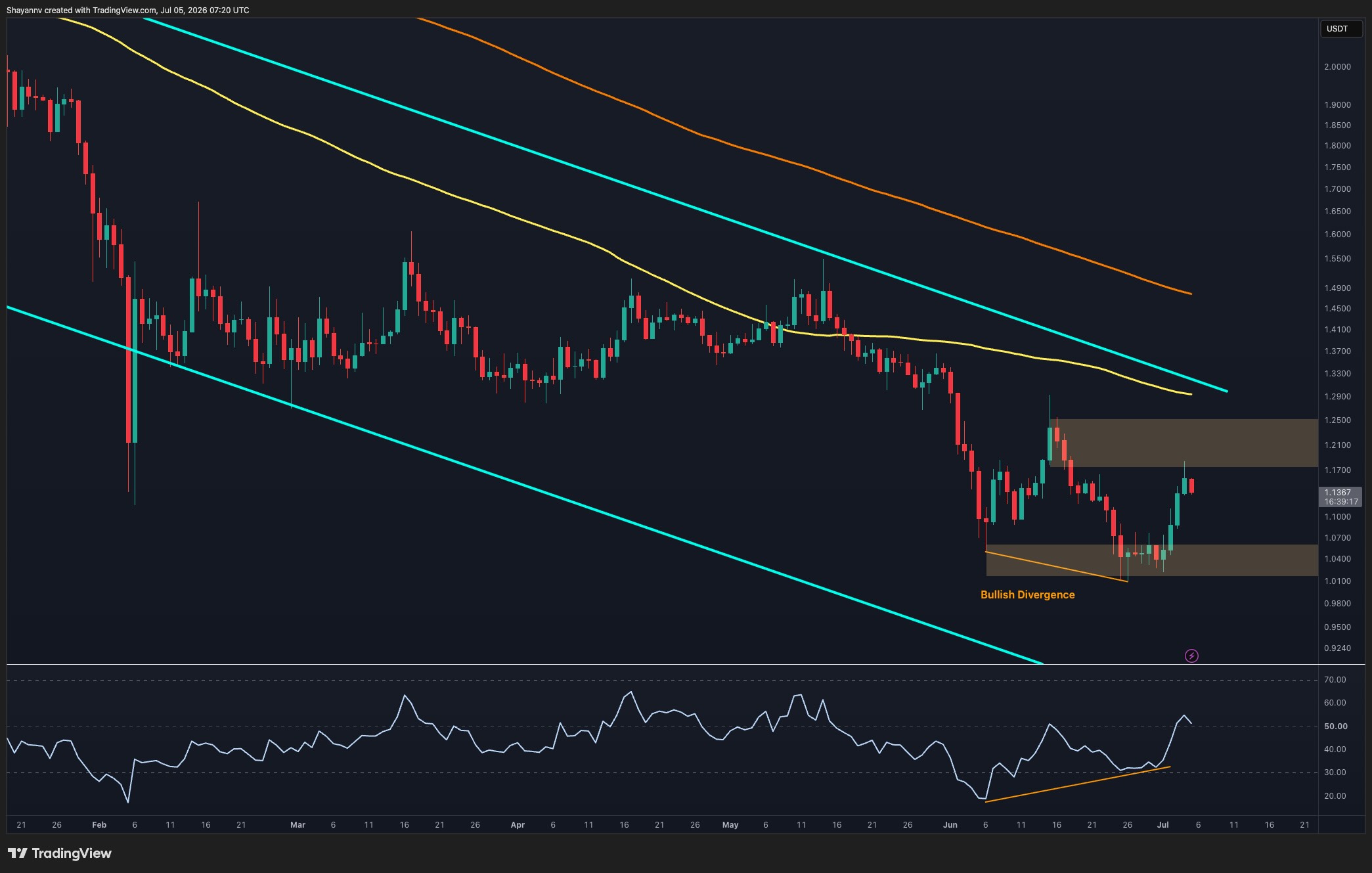
    Ripple’s XRP has staged a significant recovery from recent lows, confirming a bullish divergence that emerged near a key support level. While the broader market structure remains in a corrective phase, the latest surge has propelled XRP back toward a critical technical inflection point that could dictate its next directional move.

    Daily Chart Outlook

    On the daily timeframe, XRP continues to trade within a long-term descending channel. It remains below major moving averages and the upper boundary of this channel. Despite this overarching bearish structure, recent price action has shown considerable improvement.

    The bullish Relative Strength Index (RSI) divergence that formed around the $1.02-$1.05 support zone has played out as anticipated. During this period, XRP was making lower lows while momentum indicators were printing higher lows, signaling a waning selling pressure. Since then, XRP has experienced a sharp rebound, reclaiming the lower support region between $1.02 and $1.06.

    This recovery has now brought the price to the first significant resistance zone, situated between $1.17 and $1.24. This area previously served as support before the recent breakdown and is now acting as a supply zone. The RSI has also moved back above the midline, indicating improving momentum and bolstering the case for a continued recovery attempt.

    However, the broader trend remains bearish as long as XRP trades below the descending channel’s resistance and the overhead moving averages. A successful reclaim of the $1.17-$1.24 region would be the initial indication that the market is attempting to build a larger reversal structure.

    Four-Hour Chart Insights

    The 4-hour chart offers a clearer perspective on the recent breakout. XRP spent several days consolidating within the $1.02-$1.06 demand zone before buyers aggressively intervened, triggering a sharp rally toward the descending trendline resistance.

    This move has already seen XRP reclaim its local support area and push directly into the trendline that has capped higher highs since mid-June. XRP is now testing this dynamic resistance as it approaches the lower boundary of the broader $1.21-$1.29 supply zone.

    This presents a pivotal juncture. A confirmed breakout above the descending trendline would likely pave the way for a move into the upper resistance region, where sellers might attempt to reassert control. Such a breakout would also signify a short-term structural shift after weeks of lower highs and lower lows.

    Conversely, a failure to break through the trendline could lead to a temporary pullback toward the recently reclaimed support zone. As long as XRP remains above the $1.02-$1.06 area, the current recovery structure is expected to hold.

    For the moment, short-term momentum favors the bulls. However, the market is approaching a significant resistance cluster, and a decisive breakout will be necessary to confirm that this recovery is evolving into something more substantial than a mere relief rally.

  • XRP Sees 22% June Drop, Eyes Major July Rally

    XRP Sees 22% June Drop, Eyes Major July Rally

    XRP Suffered a Significant June Decline, But Historical Trends Point to a Potential July Rally

    XRP has not been immune to the broader market downturn, experiencing a sharp fall in June to a multi-year low of $1.00. However, this critical support level held firm against bearish pressure, allowing the digital asset to stage a swift recovery. All eyes are now on July, a month that has historically been one of XRP’s strongest performers, particularly in recent years, with each of the past four Julys delivering double-digit gains. The question on investors’ minds is what the outlook holds for July 2026.

    Data from Cryptorank reveals that XRP concluded June with a substantial 22.1% decrease. During the month, the asset dipped to $1.01 on most exchanges, influenced by widespread cryptocurrency apprehension, escalating geopolitical tensions in the Middle East, and other market-moving factors. This marked its lowest price point since late 2024 and saw it fall out of the top five cryptocurrencies by market capitalization.

    While XRP has since rebounded to $1.15 as of press time, it remains positioned below stablecoins like USDC and USDT, as well as major cryptocurrencies such as BNB, ETH, and BTC. Nevertheless, historical performance offers a glimmer of hope for XRP bulls in July. All six previous Julys have seen XRP trade in positive territory, with five of those months recording double-digit percentage increases.

    July 2020 and July 2023 were particularly strong, with XRP prices surging by 48.1% and 47.6%, respectively. The previous year saw a remarkable 35% increase, following a 31.2% jump in the year prior. More modest gains were observed in July 2022 (14.6%) and July 2021 (6.91%).

    However, a caveat exists for the current July. While XRP has already begun the month with a 9% increase, the five Julys preceding the aforementioned strong performances, specifically from 2015 to 2019, were all in negative territory. This raises the question of which historical pattern XRP will follow this time.

    Potential Catalysts for Growth

    One factor that could drive XRP higher is the ongoing inflows into spot Ripple Exchange-Traded Funds (ETFs). Reports over the weekend indicated that these funds have extended their positive streak to nine consecutive weeks of gains.

    Quarterly Performance and Historical Rebounds

    The 22.1% drop in June contributed to a similar 22.4% decline for XRP in the second quarter of 2026. This marked the first time in its history that XRP has experienced three consecutive quarters of losses, each accompanied by significant downturns. XRP saw a 35.4% decrease in Q4 2025, followed by a 27.1% drop in Q1 2026, and the aforementioned 22.4% decline in Q2 2026.

    The encouraging news for XRP supporters is that the token has historically demonstrated substantial gains following periods of negative streaks. The coming months will be crucial in determining whether history repeats itself or if the current downward trend is set to continue.

  • Mac Clipboard App Caught Stealing Passwords

    Mac Clipboard App Caught Stealing Passwords

    Fake Maccy App Targets Users with New Infostealer

    Mac users seeking the open-source clipboard manager Maccy are falling victim to a counterfeit version of the application that installs a new Rust-based infostealer dubbed PamStealer, according to cybersecurity firm Jamf Threat Labs. If successful, the malware poses a significant threat, capable of stealing users’ passwords and cryptocurrency wallet keys.

    In a report published Thursday, Jamf Threat Labs detailed how the campaign employs a deceptive website to distribute a disk image containing a malicious AppleScript file named Maccy.scpt. Upon opening, this file presents instructions to users, urging them to run it within Apple’s Script Editor while concealing the malicious code deeper within the document.

    “We are tracking this malware under the name PamStealer after one of its core behaviors: validating the victim’s login password through the macOS Pluggable Authentication Modules (PAM) before harvesting it,” Jamf Threat Labs stated.

    The malware then leverages JavaScript for Automation and native macOS APIs to download a second-stage payload. This approach avoids common shell utilities like curl or zsh, thereby reducing the number of observable processes for security tools.

    “With many stealers, we have seen attackers purchasing Google Ad space to lure users to the malicious app. We have recently observed malicious ads being hosted on X as well,” Jamf Threat Labs Director Jaron Bradley told Decrypt. “These social engineering techniques have proven to be highly successful.”

    The second stage, according to the report, is a Rust-based binary specifically designed for Apple Silicon Macs. It disguises itself as either Finder or Software Update to evade detection.

    “Rather than storing its configuration in cleartext, the dropper derives a key from a fingerprint of the host—including its CPU architecture, locale, keyboard layout, and time zone—and uses it to unlock an encrypted, integrity-checked configuration containing the payload URL and installation path,” the company explained.

    Once installed, the malware can pilfer browser credentials and Keychain data, monitor clipboard contents, establish persistence, and exfiltrate stolen information to a remote command-and-control server using encrypted communications. Crucially, it quietly self-terminates if it cannot verify it is running on its intended target.

    The malware also attempts to escalate its privileges by presenting a fake Finder alert that prompts users to grant Full Disk Access. This deceptive prompt can appear up to 40 minutes after infection, making it less likely for users to associate it with the initial download. If granted, the malware gains access to sensitive protected data, including Mail, Messages, and Time Machine backups.

    Bradley noted that Jamf has not yet observed any evidence of PamStealer being actively deployed in the wild. Nevertheless, the company has informed Apple of its findings. Apple did not immediately respond to a request for comment from Decrypt.

    Jamf also indicated that similar social engineering tactics are appearing on other platforms. Last week, the company reported on X that it was investigating a sponsored advertisement on the platform promoting DynamicLake. This ad redirected users to dynamicmacisland[.]com, where they were instructed to open Terminal and execute an installation command.

    “The advertisement was delivered through a verified X account, adding another layer of trust to the social engineering,” the firm wrote. “Analysis of the payload revealed a recent Atomic (MacSync) Stealer variant.”

    These discoveries come at a time when attackers are increasingly disguising malware as legitimate software and exploiting trusted developer platforms and advertising channels. Recent campaigns have included a fake OpenAI repository that climbed to the top of Hugging Face’s trending projects before distributing a Rust-based infostealer, a malicious Visual Studio Code extension that GitHub stated exposed approximately 3,800 internal repositories, and the Shai-Hulud software supply-chain campaign targeting development tools used by AI companies such as OpenAI and Mistral AI.

  • Cardano Surges 40% as ADA Recovers from FUD

    Cardano Surges 40% as ADA Recovers from FUD

    Cardano’s founder and a central figure in the project’s development ignited controversy in June, triggering a wave of fear, uncertainty, and doubt (FUD) that sent the native token’s price into a sharp decline.

    However, over the past week, ADA has broken away from the trend of larger-cap altcoins, staging a significant 40% surge from its multi-year low.

    The turbulence began a month ago when Charles Hoskinson announced he would be taking a break from Cardano, cautioning that several projects built on the Layer-1 blockchain could face imminent failure. The immediate impact on ADA was severe, with the token plummeting from over $0.20 to below $0.19, then $0.16, and ultimately falling below $0.14 by the end of June, marking its lowest point since 2020.

    While the broader bearish sentiment in the cryptocurrency market contributed to ADA’s collapse, its subsequent revival has been notable. In contrast to most larger-cap cryptocurrencies, which have seen gains of 5-10% in the past week to ten days, Cardano’s token has experienced a considerably more robust recovery.

    The asset has climbed more than 40% since its recent low, reaching $0.20 earlier today for the first time in a month. Analysts at Santiment Intelligence observed this divergence, suggesting that ADA has decoupled from other altcoins following “peak FUD [that] created rifts in [the] community last month.”

    Santiment further noted that the Cardano network is “showing signs of life again,” with nearly 15,000 non-empty ADA wallets added since the recent bottom.

    “Retail support has been one of ADA’s strongest traits even through ugly market stretches,” Santiment concluded. “After weeks of fear, this renewed holder growth suggests the crowd is gaining trust again after a short stretch of rapid market cap growth.”

    Another significant driver behind ADA’s impressive rebound is the anticipation surrounding the upcoming RealFi Phase 1 Testnet upgrade. Hoskinson has described it as the “largest” in the project’s history, with completion slated for July 6.

    Such upgrades typically generate excitement within the community and are often preceded by substantial price rallies for the underlying asset. However, the period following their completion can sometimes see a “buy-the-rumor, sell-the-news” event, leading to a price correction.

    For now, ADA remains among this week’s top performers, having gained 30% since last Sunday. Its market capitalization has returned to $7 billion, after recently dipping below $5 billion.

  • Bitcoin Suffers Worst Month in Four Years: Outlook for July

    Bitcoin Suffers Worst Month in Four Years: Outlook for July

    Bitcoin Suffers Worst Month in Four Years, Eyes July Recovery

    Bitcoin has endured a challenging start to 2026, with the cryptocurrency experiencing losses in four out of the past six months. June proved particularly brutal, marking the worst monthly performance in four years. However, historical data suggests July could offer a reprieve for Bitcoin, and the month has begun with promising signs. The key question now is whether the digital asset can sustain this momentum in the coming weeks.

    May’s Peak and June’s Plunge

    The narrative for Bitcoin in 2026 took a sharp turn in May. Mid-month, the price of Bitcoin surged past $82,000, leading many analysts to believe that the asset had recovered from its earlier losses and was poised for a new bull run.

    This optimism proved short-lived. The rejection at that price level reinforced the “sell in May and go away” sentiment. June saw the cryptocurrency plummet, falling below $70,000 and even dipping below $60,000 on several occasions – a level not seen since before the U.S. presidential elections in late 2024. After shedding approximately $25,000 in a matter of weeks, Bitcoin finally showed early signs of recovery and regained some footing by the end of the month. Despite this late-month rebound, Bitcoin concluded June with a 20.5% loss, its steepest monthly decline in four years.

    Historical Precedent for July

    Analysis of past performance indicates that July has historically been a more favorable month for Bitcoin. In the last 13 years, nine Julys have resulted in gains for the cryptocurrency. Crucially, every July that has followed a losing June has seen Bitcoin finish the month in positive territory.

    The current July has started on a positive note, with Bitcoin trading around $63,000 over the weekend. However, for the month to deliver a much-needed recovery, several factors need to improve in the coming weeks.

    Firstly, the sustained record net outflows from spot Bitcoin Exchange-Traded Funds (ETFs) must cease. These outflows have been a significant impediment to Bitcoin’s progress for months.

    Secondly, recent on-chain data, particularly the Coinbase Premium metric, suggests a lack of genuine demand from U.S. and even Korean investors.

    On a broader macroeconomic front, a de-escalation of tensions or a lasting peace agreement in the Middle East would be beneficial. Additionally, resolving the uncertainty surrounding the upcoming U.S. midterm elections could provide a positive catalyst.

    Despite these headwinds, Bitcoin has recently displayed some bullish signals, rebounding past the significant $60,000 level. Analysts are now closely watching for the next major breakout.

    Crypto analyst Rekt Capital also commented on Bitcoin’s July prospects, suggesting that the cryptocurrency may attempt to retest the 50-Month Exponential Moving Average (EMA), currently around $65,000, as resistance.

    “It’s Green July and history suggests Bitcoin will be looking to turn the 50-Month EMA (purple) into new resistance,” Rekt Capital posted on X (formerly Twitter) on July 4, 2026, alongside a chart illustrating the trend.

  • Altman’s AI Forecasts Major Meta Stock Jump by 2026

    Altman’s AI Forecasts Major Meta Stock Jump by 2026

    Sam Altman’s AI Predicts Significant Meta Stock Surge by 2026

    Sam Altman, through an AI model associated with ChatGPT, has identified Meta Platforms stock as presenting one of the most compelling entry points in years for a company that has historically traded well above its current valuation. The model forecasts a price range of $750 to $900 by December 2026, a target that the stock has previously reached within the current market cycle.

    The Bull Case: Advertising Powerhouse and Emerging AI Infrastructure

    The optimistic outlook for Meta hinges on its dual identity as a dominant advertising business that is simultaneously evolving into a significant player in AI infrastructure. Currently trading around $582, the core thesis begins with Meta’s established strength: its AI-driven ad recommendation engine, which has consistently driven revenue growth quarter after quarter.

    Meta’s Advantage+ advertising tools are reportedly capturing market share from competitors. Furthermore, the monetization of WhatsApp is still in its nascent stages, offering substantial room for expansion. The company is also layering new AI products onto its existing user base, creating additional avenues for growth.

    A potentially transformative development, which the AI model highlights as not yet fully priced in by most investors, is Meta’s reported exploration of commercializing its surplus AI computing capacity through a cloud business. Such a move would unlock an entirely new revenue stream beyond advertising, bolstering investor confidence that the company’s substantial AI infrastructure investments are yielding tangible long-term returns rather than simply consuming capital. If these various growth initiatives align, the AI model suggests a clear trajectory for Meta to reclaim and surpass its previous highs.

    The Bear Case: Execution Risks and Market Headwinds

    Conversely, the pessimistic scenario for Meta is rooted in significant execution risks that are difficult to overlook. The company’s annual AI capital expenditures have surged to over $100 billion. Meanwhile, its Reality Labs division continues to incur substantial losses without a clear path to profitability. Any deceleration in digital advertising demand or a failure to rapidly monetize new AI products could compress profit margins, potentially confining the stock to a range between $550 and $650 for an extended period, hindering its ability to break out to new highs.

    Technical Analysis: Consolidation and Key Levels

    On the daily chart, Meta is trading at $582.90, following a sharp decline from highs near $800 reached in the summer of 2025. This peak represented one of the stock’s most powerful rallies before encountering significant selling pressure in the latter half of the previous year.

    The stock found support around $525 in late 2025 before rebounding towards $750 in early 2026. It subsequently retreated and has largely traded within a broad, volatile range between $550 and $680 for most of the current year. The most recent downward movement in late June brought the price back towards $555, with today’s trading session seeing a bounce to $582.90, placing Meta squarely in the middle of its current consolidation range.

    Immediate resistance is observed near $630, the level that capped the most recent attempt at a relief rally. A more formidable resistance lies around $680, where the stock has faced multiple rejections throughout 2026. Beyond this, the $750 level serves as the lower bound of the bull case target and a prior high from earlier in the year, making it a critical technical checkpoint before any realistic push towards $800 or $900.

    Support remains firm near $550, a zone that has absorbed selling pressure on several occasions over the past few months. The overall technical pattern suggests a stock in an extended consolidation phase after an exceptional run, working through excess valuation rather than exhibiting structural weakness.

    Momentum indicators on the daily charts appear indecisive and choppy, lacking a clear directional trend in recent months. A sustained push above $630 and its subsequent defense could signal a continuation of the longer-term uptrend, paving the way for the bull case targets rather than an improbable surge into uncharted territory.

    Crypto Market Dynamics: Beyond Established Assets

    The broader market sentiment suggests a rotation is underway, though its full impact may only be apparent in hindsight. Large-cap cryptocurrencies like Bitcoin, Ethereum, and XRP are currently facing resistance, with their upside dependent on external catalysts that remain uncertain. The delay in anticipated macro tailwinds and institutional inflows is prompting a shift in strategy for capital that has navigated multiple market cycles. Instead of waiting at resistance levels, such capital is moving to capitalize on opportunities before they become obvious.

    Early-stage infrastructure projects operate on a different valuation model. Their smaller market capitalization means that even modest capital rotations can lead to significant price movements. This asymmetry arises because the market has not yet fully priced in the potential of these nascent ventures. The gap between their current valuation and their intrinsic worth is where substantial returns are generated.

    The fragmentation of multi-chain ecosystems incurs significant costs for decentralized finance (DeFi). Bitcoin, Ethereum, and Solana, for instance, operate with isolated liquidity systems, lacking native interoperability. Every transaction between these ecosystems results in users absorbing costs through fees, slippage, and failed transactions.

    LiquidChain aims to address this by unifying these three networks into a single execution layer, offering full ecosystem access with a single deployment and eliminating cross-chain taxes on every interaction. This innovative approach has yet to be widely recognized by the market.

    The LiquidChain presale is currently priced at $0.01454, having raised just over $820,000. This represents an early-stage opportunity, distinct from marketing claims. While execution and adoption remain unproven, and these risks are acknowledged, established assets offer a more predictable path to a visible ceiling. LiquidChain, conversely, provides an opportunity to enter at an earlier stage.