Tag: Market Trends

  • STRC Dividend Streak Hits 32 Years Amid Price Drop Below $90

    STRC Dividend Streak Hits 32 Years Amid Price Drop Below $90

    Strategy Claims 32 Years of Dividend Payments as STRC Sinks Below $90

    Strategy, the company whose treasury is heavily invested in Bitcoin, asserted on Thursday that it possesses sufficient reserves to cover its dividend obligations for the next 32 years. The company stated on X, formerly Twitter, that its Bitcoin holdings, currently valued at just under $55 billion, provide ample coverage for its $1.7 billion in dividend commitments.

    This latest claim follows a November assertion by Strategy that it had 71 years of dividend coverage, a projection that assumed a flat Bitcoin price, an assumption that has not held true. Strategy issues dividends on its Stretch product, STRC, which is designed to trade at $100 and offers an 11.5% yield.

    However, the price of STRC has recently fallen by more than 10%, a development that increases its effective yield and necessitates a greater cash outlay from the company to meet its dividend payments. On Wednesday, STRC dropped another 3%, nearing its record low and trading at $89, according to Google Finance data. BitcoinQuant reports the current effective yield for STRC stands at 12.9%.

    The company’s pronouncements have drawn scrutiny and concern from observers. Many have voiced worries on social media platforms about Strategy potentially needing to sell more Bitcoin to meet its payment obligations. This could lead to significant dilution of its common stock, MSTR, and carries the risk of accelerating the depletion of its Bitcoin reserves if further price declines occur.

    MSTR shares also experienced a downturn on Wednesday, falling an additional 5% to $116. The stock is now down 73% from its all-time high reached in July 2025.

    Skepticism Mounts Over Dividend Coverage Claims

    Prominent Bitcoin critic Peter Schiff has been particularly vocal in his opposition to Strategy and its CEO, Michael Saylor. Schiff commented on Strategy’s 32-year dividend coverage claim, outlining several critical assumptions. “That assumes you don’t raise the dividend on the preferreds, you don’t issue any more preferred shares, and the price of Bitcoin doesn’t fall,” Schiff stated. He added, “In fact, if you start selling Bitcoin to cover your obligations, the price will fall even faster, depleting your reserves much quicker.”

    This sentiment was echoed by others in the cryptocurrency community. User ‘Kaleo’ suggested, “the responsible thing you should do is cut your losses sooner rather than later and sell the Bitcoin now.” The underlying concern is that selling Bitcoin to meet obligations will inevitably depress its price. “The lower the price that you’re forced to sell, the more BTC you’ll be forced to sell to raise the same amount of cash,” one user explained. CryptoQuant analyst ‘Darkfost’ urged Strategy to “Do the math again without thinking your sales will never drag BTC price down.”

    Strategy’s recent activity has also contributed to market uncertainty. The company sold 32 BTC in late May, coinciding with a broader Bitcoin selloff. However, it has also been acquiring Bitcoin, purchasing 1,587 BTC for approximately $100 million last week and another 1,550 BTC for a similar sum in early June.

    While selling Bitcoin to cover dividend payments appears to be the company’s primary recourse, this strategy risks creating a negative feedback loop, often termed a “death spiral,” as such sales could further depress the price of Bitcoin.

    Despite these concerns, Joe Burnett, vice president at Strive, offered a different perspective. He suggested that if Strategy were to allow the market to test lower price levels and then actively buy back Bitcoin to push the price back into its target range, it could potentially bolster market confidence. “It would train the market that temporary breaks below the target range can be buying opportunities, especially if dividends continue getting paid and the price returns to the range quickly,” Burnett commented.


  • FTX’s SpaceX Stake: Billions at Play, Creditors’ Fate Uncertain

    FTX’s SpaceX Stake: Billions at Play, Creditors’ Fate Uncertain

    FTX Creditors Eye SpaceX’s Soaring Valuation for Potential Recovery

    Customers who suffered losses from the collapse of cryptocurrency exchange FTX are closely monitoring the performance of SpaceX following its initial public offering. Elon Musk’s rocket company has significantly surpassed its initial market valuation of $1.77 trillion, and its strong debut on Wall Street has bolstered hopes among those tracking FTX’s bankruptcy proceedings that creditors might recover more than initially anticipated.

    Sunil Kavuri, a British investor who lost approximately $2 million in the FTX implosion and has become a prominent advocate for other victims, told Decrypt, “It’s always great news to see good investments that could aid in the recovery and payment to FTX creditors.”

    FTX’s bankruptcy estate did not immediately respond to requests for comment.

    Months ago, Barbara Fried, mother of FTX co-founder Sam Bankman-Fried, noted in a blog post detailing her son’s story—he recently lost an appeal to overturn his 25-year prison sentence and fraud conviction—that the defunct exchange had already distributed $10.3 billion to customers.

    She referenced projections from Kyle Schmidt, a creditor advocate known as “Mr. Purple.” Schmidt estimated that final distributions could reach 171% of claims for customers with claims exceeding $50,000. This figure reflects a surplus generated from the liquidation of the estate’s assets and accrued interest.

    “Schmidt suggests that one notable investment […] is likely to yield significant proceeds this year,” Fried highlighted, referring to FTX’s investment in SpaceX through the venture firm K5 Global.

    Settlement with K5 Global Aims to Maximize Recoveries

    In January of last year, John J. Ray III, CEO of FTX’s recovery trust, announced a settlement with K5 Global. This agreement resolved a lawsuit initiated by FTX in June 2023, with both parties agreeing to collaborate on maximizing recoveries for FTX stakeholders.

    The lawsuit sought to reclaim $700 million in transfers that the defunct crypto venture allegedly made using misappropriated funds. K5 Global continues to list SpaceX in its investment portfolio.

    “It is clear that K5 is a bright spot in the FTX portfolio,” Ray stated. “The expected strong performance of their investments will be a key driver in the recovery efforts.”

    Decrypt did not receive an immediate response from K5 Global regarding comment.

    While the defunct exchange has not yet commented on SpaceX’s Wall Street debut or the potential benefits for creditors, Kavuri pointed out that the bankruptcy estate would be required to disclose any sale of stakes in K5 through court filings.

    FTX’s Exposure to SpaceX Traced to Venture Capital Investments

    Prior to his conviction, Bankman-Fried was accused of misappropriating over $8 billion in customer funds. These funds were allegedly used for political donations, real estate purchases, and venture capital investments.

    During his criminal trial, Bankman-Fried attempted to argue for leniency based on the success of his investments, which included stakes in Robinhood and Anthropic. However, the presiding judge rejected this defense, comparing the former crypto mogul to “a thief who takes his loot to Las Vegas.”

    FTX’s exposure to SpaceX originated from a relationship cultivated between Bankman-Fried and Michael Kives, described as a “super-networker” and co-owner of K5 Global alongside Bryan Baum, according to bankruptcy filings.

    The filings indicate that Alameda Research, FTX’s sister trading firm, transferred substantial sums to a K5-affiliated entity. Before FTX’s collapse in November 2022, one of K5’s funds had invested $190 million in Elon Musk’s rocket company.

    In 2022, SpaceX raised $1.73 billion at a post-money valuation of $125 billion, months before Bankman-Fried was accused of orchestrating a multibillion-dollar fraud, according to Forge.

    Although this estimate does not account for shareholder dilution, Kavuri suggested that FTX’s stake in SpaceX is likely worth several billion dollars, based on the company’s current market capitalization. On Wednesday, SpaceX’s market value surpassed $2.52 trillion, according to Yahoo Finance.

  • AI Predicts Hyperliquid Could Overtake Ripple by 2026

    AI Predicts Hyperliquid Could Overtake Ripple by 2026

    HYPE, the native token of the decentralized crypto exchange Hyperliquid, has experienced a remarkable surge, reaching a new all-time high even as the broader digital asset market continues to grapple with a prolonged downturn. The token recently outpaced Dogecoin (DOGE) to claim the 10th position among the largest cryptocurrencies by market capitalization. This development prompted an inquiry into whether HYPE could potentially surpass Ripple’s XRP within the current year, with insights sought from three prominent AI-powered chatbots.

    HYPE’s Ascent and Market Position

    Earlier this week, HYPE’s price climbed to a historic peak of approximately $77, accompanied by a market capitalization reaching around $16 billion. Despite this significant appreciation, HYPE’s valuation remains considerably lower than XRP, which currently boasts a market capitalization of roughly $74 billion.

    AI Perspectives on HYPE’s Potential to Overtake XRP

    ChatGPT assessed the likelihood of HYPE surpassing XRP as low, citing the substantial market cap disparity. However, OpenAI’s platform did identify several potential catalysts that could drive HYPE’s valuation to such levels. These include the growing popularity of Hyperliquid, its potential expansion to rival major exchanges like Binance, and endorsements from influential figures within the industry.

    The report also referenced Arthur Hayes, co-founder of BitMEX, who had a significant stake in HYPE. While Hayes reportedly sold his holdings, the blockchain analytics platform Lookonchain suggested he may have repurchased nearly 34,000 HYPE tokens for over $2 million, a claim Hayes has since denied.

    ChatGPT further suggested that institutional interest could positively impact HYPE. Data indicates that inflows into spot HYPE exchange-traded funds (ETFs) have recently outweighed outflows, accumulating approximately $180 million in net inflows. This figure, however, falls short of the $1.44 billion attracted by XRP-based ETFs since their introduction in late 2025.

    Perplexity echoed a similar sentiment, positing that a significant rise for HYPE is only conceivable within a “narrow sense.” The AI highlighted that beyond its market cap advantage, XRP benefits from a large and dedicated community, which could present a formidable obstacle to HYPE’s ascent. Perplexity elaborated, stating, “In 2026, HYPE can plausibly flip XRP on price momentum, narrative strength, or even short-term market cap at times, but XRP has a much larger base to overtake, so a full sustained flip is less likely without a major rotation in capital.”

    Google’s Gemini offered a more cautious outlook, identifying pure mathematics as the primary challenge for HYPE, rather than its utility. Gemini characterized XRP as a “highly liquid, large-cap legacy asset” with a market cap that remains in the tens of billions of dollars even during market corrections, supported by “deep institutional plumbing and international remittance use cases.” Gemini concluded, “For HYPE to flip XRP, it would need to see an astronomical influx of capital, multi-billion-dollar daily trading volumes, and massive speculative retail FOMO – all while XRP would have to severely stagnate or decline.”

  • Bitcoin Recovery Hinges on Key Support

    Bitcoin Recovery Hinges on Key Support

    Bitcoin’s recovery has stalled after hitting a significant resistance cluster, with the cryptocurrency now consolidating below a key supply zone. Current price action indicates bulls are striving to maintain upward momentum, but the market is at a pivotal juncture where the next move—either a breakout or rejection—will likely dictate the short-term trend.

    Daily Chart Dynamics

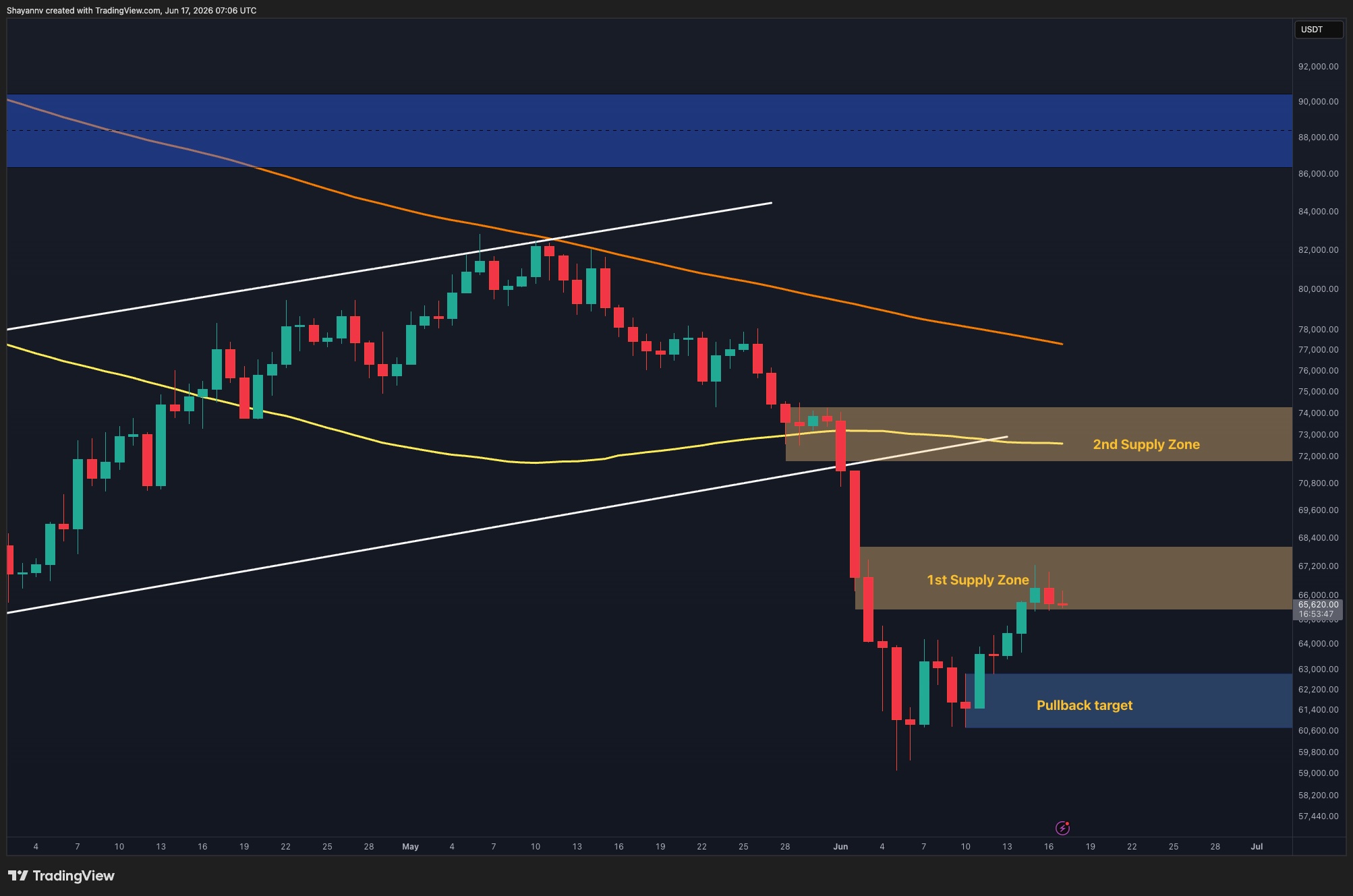
    On the daily chart, Bitcoin is trading near $65,000, having rebounded from the $60,000 support level earlier this month. This recovery has propelled the price directly into the initial major supply zone, situated between $65,000 and $67,000, where selling pressure has begun to manifest.

    Recent daily candles show consolidation within this resistance area rather than an immediate sell-off, which is generally viewed as a positive sign for buyers. However, Bitcoin remains below its 100-day moving average, which is hovering around $72,000, and its 200-day moving average, located near $77,000. This suggests that the broader upward trend has not yet fully re-established itself.

    Should buyers successfully reclaim the current supply zone, the next upward target would be the higher resistance region between $72,000 and $74,000. This area is significant as it coincides with the second supply zone, the 100-day moving average, and the lower boundary of a previously breached ascending channel, presenting the next substantial obstacle for the market.

    On the downside, the $60,000 to $62,000 range continues to serve as the critical support zone. As long as Bitcoin maintains its position above this level, the recent recovery structure is expected to remain intact.

    Four-Hour Chart Perspective

    The four-hour chart illustrates the recent rally into the $65,000-$67,000 supply zone, following a breakout from an ascending recovery channel. After reaching the upper limit of this zone near $66,800, Bitcoin has entered a phase of sideways consolidation.

    The latest price movements suggest that neither bulls nor bears currently hold dominant control. The asset is holding above the former breakout region, roughly between $64,000 and $65,000, while sellers have so far prevented a decisive breach of the supply zone.

    A breakout above $67,000 would bolster the bullish outlook and potentially pave the way toward the higher resistance area around $72,000. Conversely, a failure to hold the $64,000 support region could trigger a more significant pullback toward the demand zone between $61,000 and $62,000.

    For the immediate future, the short-term technical structure remains constructive, provided that higher lows continue to form above the recent breakout area.

    Liquidity Heatmap Analysis

    The Binance liquidation heatmap reveals a notable concentration of liquidity both above and below the current price. However, the closest and most significant cluster of liquidity is situated between $67,000 and $69,000.

    Given that Bitcoin is currently consolidating around $65,000, this overhead liquidity zone could act as a short-term magnet. A move through the current supply region might trigger liquidations of short positions, potentially accelerating momentum toward the $68,000-$69,000 area.

    Concurrently, a substantial liquidity pocket exists below the market, between $62,000 and $63,000. If Bitcoin were to lose the $64,000 support area, the market could be drawn lower to absorb this liquidity before establishing its next directional trend.

    Overall, the heatmap indicates that the market is currently positioned between two major liquidity pools. Considering the proximity of the upper cluster and Bitcoin’s ability to hold within the $65,000-$67,000 resistance zone, the short-term bias leans slightly toward an upward sweep of liquidity into the $67,000-$69,000 region before a more significant directional decision is made.

  • Coinbase Stock, Options Surge: Analyst Bullish on Evolving Exchange

    Coinbase Stock, Options Surge: Analyst Bullish on Evolving Exchange

    Coinbase Unveils Ambitious Expansion Beyond Crypto, Analyst Sees Major Upside

    Coinbase hosted an event Tuesday to unveil a suite of upcoming product additions, including tokenized equities trading and the introduction of options trading for both cryptocurrency and stocks. Prominent analysts believe these moves signal significant upside potential for the crypto exchange as it broadens its offerings well beyond traditional crypto trading.

    On Wednesday, Mark Palmer, Managing Director and Senior Research Analyst at Benchmark-StoneX, stated that the firm is maintaining its price target for Coinbase’s stock (COIN) at $270. This represents a nearly 60% increase from its closing price of over $169 on Tuesday.

    “The ambition on display was sweeping enough to put every brokerage, bank, and fintech in the country on notice,” Palmer wrote in a note to clients. “The company unveiled a suite of products spanning stocks, derivatives, artificial intelligence, and consumer finance, extending the strategy it first announced last December and pushing the platform well beyond crypto into every asset class it can reach.”

    Coinbase used its Tuesday event to reveal several new products as it aims to become an “everything exchange.” The most significant announcement was the upcoming launch of tokenized U.S. equities. Coinbase stated these will represent real shares backed 1:1, with automatic dividend payouts, distinguishing them from rival tokenized stock products which the company characterizes as derivatives.

    The company also plans to introduce options trading for both cryptocurrencies and traditional equities, and will enable users to transfer existing stock portfolios onto its platform. Additional updates include the ability to borrow against staked Solana, a Coinbase One Card travel portal offering 5% Bitcoin rewards, USDC-backed card access, and new short-term crypto price-prediction contracts.

    “In our view, the company’s update yesterday provided the clearest evidence yet that it is rapidly evolving from a cyclical crypto brokerage into a foundational infrastructure platform linking the emerging on-chain economy to the traditional one,” Palmer added.

    Coinbase’s stock (COIN) traded relatively flat on Wednesday, recently hovering just above $169, according to Yahoo Finance data. The shares have experienced a 13% decline over the past month and are down 25% year-to-date, reflecting broader declines in the cryptocurrency market.

    In May, Coinbase announced a workforce reduction of 14%, citing a strategy to enhance efficiency with a smaller team by leveraging artificial intelligence. The firm also reported its second consecutive quarterly loss, with a deficit of $394 million for the first quarter of 2026.

  • Coinbase Aims for ‘Everything Exchange’ with Stocks, Perps, and AI

    Coinbase Aims for ‘Everything Exchange’ with Stocks, Perps, and AI

    Coinbase Aims to Be the “Everything Exchange” with New Stock and Derivatives Offerings

    Coinbase unveiled a comprehensive suite of new products on Tuesday as part of its latest System Update, marking its most significant step yet toward becoming what it describes as the “everything exchange.”

    The extensive list of updates allows customers to trade U.S. stocks, ETFs, and indexes alongside cryptocurrencies, and even transfer existing stock portfolios from other brokerages. The platform is also introducing:

    The core proposition is that the traditional divide between crypto and traditional finance is dissolving, and Coinbase intends to be the singular application bridging that gap. Users can now move their equities from platforms like Schwab or Robinhood, trade options and crypto in one place, borrow against staked SOL, and utilize an AI advisor to manage their entire portfolio. This effectively positions Coinbase as a brokerage, a bank, and a robo-advisor integrated with a crypto exchange, offering users an unprecedented range of options.

    The question remains whether these advancements will significantly impact Coinbase’s market position.

    While these updates are not groundbreaking in their individual components, the overarching vision is compelling. Agentic trading is widely seen as the future, and providing the infrastructure for AI agents is a strategic move. Furthermore, tokenized stocks and perpetual futures are experiencing a surge in popularity, bolstered by the remarkable success of platforms like Hyperliquid. If the overall market for these assets continues to expand—with Standard Chartered projecting a 40-fold increase in real-world assets by 2030—Coinbase may be able to grow its business without necessarily capturing market share from competitors, simply by benefiting from broader market growth.

    SpaceX Acquires AI Coding Startup Cursor for $60 Billion

    Just days after its historic initial public offering, SpaceX is already deploying its newly acquired stock.

    Yesterday, the company announced its agreement to purchase Anysphere, the developer of the AI coding tool Cursor, for $60 billion in an all-stock transaction. Cursor will be integrated into xAI. This valuation represents nearly double the $29 billion valuation Cursor held in November.

    Cursor’s rapid growth trajectory supports this valuation increase. The company saw its annual recurring revenue climb from $100 million in 2024 to $1 billion by late 2025, and exceeded $2 billion by February. This represents the fastest scaling of any software company, with approximately 50,000 engineering teams and nearly 70% of the Fortune 1000 companies, including Nvidia and Salesforce, as clients.

    Cursor has historically relied on external AI models, incurring substantial costs for services from Anthropic and OpenAI. At one point in 2025, its estimated annual payments to Anthropic reached $650 million against revenues of roughly $500 million, a gross margin that would be unsustainable for most software companies. Compounding the issue, its primary supplier, Anthropic, is also a direct competitor through its Claude Code product, meaning Cursor was effectively subsidizing the development of a rival.

    A pivotal shift in Cursor’s business model involved ceasing its reliance on rented AI. The company’s proprietary Composer model and a more cost-effective model routing system led to slight gross-margin profitability in its enterprise segment by April. This is precisely where SpaceX’s acquisition becomes strategically advantageous. Cursor already had an agreement to utilize xAI’s Colossus supercomputer. Ownership will allow Musk to provide Cursor with low-cost computing power, shift more workload to xAI’s models, and ultimately improve margins while reducing dependence on Anthropic. Cursor had previously rejected acquisition offers from OpenAI twice to maintain its independence, making this move by Musk—using SpaceX’s public stock for his first major enterprise AI acquisition—particularly noteworthy. At a projected $6 billion run rate, the $60 billion acquisition price represents less than a 10x multiple of forward revenue, suggesting a favorable deal for SpaceX.

    Corporate Treasuries & ETFs
    Meme Coin Tracker

  • Ex-Goldman Analyst Predicts XRP Surge to $1,000

    Ex-Goldman Analyst Predicts XRP Surge to $1,000

    Ex-Goldman Sachs Analyst Predicts $1,000 XRP Price by 2030

    A former Goldman Sachs analyst has set an ambitious price target of $1,000 for XRP by the year 2030, a projection significantly higher than current market expectations. XRP is presently trading around $1.20, experiencing a 3.5% decline over the past 24 hours, mirroring a broader market downturn as investors await the Federal Open Market Committee (FOMC) meeting.

    Dom Kwok, co-founder of the Web3 education platform EasyA and a former analyst at Goldman Sachs, shared his outlook on The Rollup podcast. “I think it could go over $1,000 in the next four to five years,” Kwok stated.

    His forecast is based on the premise that mass cryptocurrency adoption will increasingly flow through XRP, rather than established players like Bitcoin or Ethereum. Kwok argues that new retail investors are often priced out of these larger-cap assets and are likely to gravitate towards more affordable and practical alternatives.

    This $1,000 target stands in stark contrast to the institutional consensus, which typically falls within the $3 to $20 range. On-chain data reveals that wallets holding at least one million XRP now control a substantial 74.1% of the total supply. These large holders have been actively accumulating, adding 1.53 billion tokens in the last six months.

    Market Dynamics and Technical Outlook

    Simultaneously, a de-escalation of tensions between the U.S. and Iran has boosted risk appetite, pushing Bitcoin towards the mid-$60,000s and consequently lifting XRP.

    Despite its current price of $1.20 and a 8% weekly gain, XRP is in a corrective phase. However, its technical structure remains robust. The Relative Strength Index (RSI) is hovering near 62, indicating a constructive, non-overbought condition. A recent three-day MACD bullish crossover remains intact, and a decade-long rising trendline has not been breached.

    Key support levels are identified in the $1.10–$1.15 zone, with mid-term resistance previously flagged at $1.43–$1.55 by various technical analyses. The asset has since surpassed these levels, establishing a new trading range.

    Should the U.S. legislative CLARITY Act progress and pass, it could accelerate XRP-linked ETF inflows. Coupled with continued whale accumulation, this would tighten supply and potentially drive the price to retest recent highs and move towards $2, aligning with Standard Chartered’s conditional $8 target.

    The $1,000 Projection: A Bold Vision

    The $1,000 price prediction necessitates a market capitalization in the tens of trillions. Such a valuation hinges on assumptions regarding the widespread adoption of global financial infrastructure, a scenario that is theoretically plausible but practically extraordinary. Kwok’s framing of this potential shift through an internet-era analogy offers an intellectually coherent perspective.

    XRP’s bullish case is heavily reliant on the maturation of financial infrastructure, with the expectation that genuine adoption will follow the development of useful applications built on accessible networks. This same thesis is currently driving early interest in other layers of the blockchain stack.

    Even within a confirmed XRP uptrend, an entry point at $1.20 means investing in an asset with a $75 billion market capitalization, compressing the potential for outsized returns. Early-stage infrastructure projects, however, still present this significant asymmetry.

    LiquidChain: A New Infrastructure Play

    LiquidChain ($LIQUID) is emerging as a Layer 3 infrastructure project, positioning itself as a cross-chain liquidity layer. It aims to fuse liquidity from Bitcoin, Ethereum, and Solana into a unified execution environment.

    The project’s architecture features a Unified Liquidity Layer, Single-Step Execution, Verifiable Settlement, and a Deploy-Once model, enabling developers to access all three ecosystems without the need for redeployment. The presale is currently priced at $0.0147, having raised $850,000 to date.

  • Analyst: 3 Altcoin Sectors Poised for Market Shakeout

    Analyst: 3 Altcoin Sectors Poised for Market Shakeout

    Analyst Identifies 3 Altcoin Sectors Positioned to Survive Market Shakeout

    The era of altcoins generating profits solely through token launches and speculative hype is drawing to a close, according to CryptoQuant CEO Ki Young Ju. He asserts that only three distinct categories of cryptocurrencies will be sustainable in the future.

    In a recent X thread, Ju clarified that “altcoins aren’t dead,” but those that relied on narrative-driven sales tactics are poised to vanish from the cryptocurrency landscape. He presented a structured argument for why selective investment in a small subset of the asset class remains viable in 2026, emphasizing projects with tangible revenue, established businesses, and alignment with the trajectory of global finance.

    The first category identified by Ju comprises “global internet companies with tokenized market layers.” He cited Binance’s BNB Coin and the TON blockchain’s rebranded GRAM token as examples. According to Ju, these tokens are backed by revenue-generating businesses, possess a substantial user base, and demonstrate a long-term commitment to operations. He suggested that for such entities, issuing a token and listing it on a crypto exchange can be a more advantageous strategy than pursuing traditional equity offerings.

    The second group highlighted by the market observer includes DeFi protocols that also generate actual revenue. Ju specifically mentioned Hyperliquid’s DEX, noting that tokens from these “high-quality” projects can still yield significant returns, particularly if their development teams are credible, they have consistent income streams, and their governance structures prioritize token holders.

    Ju’s emphasis on Hyperliquid is noteworthy, given the recent surge in its associated HYPE token. The token experienced a jump of over 31% in the past seven days and nearly 70% over the last month. This upward momentum, fueled by ETF inflows and robust trading activity linked to SpaceX-related perpetual contracts, propelled the token to a new all-time high just above $76 on June 16.

    Finally, Ju pointed to projects that are “aligned with broader financial trends.” This includes stablecoins and the tokenization of real-world assets, as well as AI agents, which he believes represent a “major growth area.”

    Ju’s perspective aligns with a broader shift in cryptocurrency markets, where speculative sectors that previously dominated are now struggling to gain traction. For instance, data from CryptoRank indicates that meme coins, which once commanded a collective market capitalization exceeding $135 billion, have seen their value diminish to just $24.5 billion over the past two years, with the sector experiencing a decline of approximately 31% this year alone.

    In contrast, the on-chain analyst observed a growing interest in stablecoins and tokenized stocks. These sectors, in his view, demonstrate blockchain technology’s capacity to support genuine business activities rather than merely facilitating speculative trading.

  • AVAX Growth Slowdown Sparks Social Media Debate

    AVAX Growth Slowdown Sparks Social Media Debate

    Avalanche Faces Scrutiny Amidst Growing Skepticism

    Avalanche (AVAX) found itself at the center of intense discussion on Monday, even as the broader cryptocurrency market experienced a rally. Growing skepticism surrounding the network’s competitive edge has ignited widespread debate on social media.

    Concerns Over Network Growth and Developer Activity

    Data from Santiment indicates that many users are questioning Avalanche’s ability to keep pace with rapidly expanding blockchains like Solana and Sui. A significant portion of the criticism centers on the perception that developer activity, user adoption, and overall ecosystem growth are shifting away from Avalanche and towards rival networks. Santiment’s sentiment analysis reveals a sharp decline in market mood surrounding AVAX, transitioning from a highly bullish phase earlier this year to one of its most bearish periods.

    However, the analytics platform also noted that extreme negative sentiment can sometimes present opportunities for market reversals. Despite the mounting criticism, Avalanche continues to foster institutional partnerships, engage in government-linked initiatives, and leverage its subnet technology, which remains a key feature of the network.

    Developer Metrics Lag Behind Competitors

    Further insights from Electric Capital’s Developer Report highlight a disparity in developer engagement. Solana leads with 795 full-time developers, defined as those contributing at least 10 days per month, while Sui boasts 202 such developers. Avalanche trails behind with 168 full-time developers. In terms of total developer counts, Solana leads with 2,555, followed by Sui at 656, and Avalanche at 484. This metric exclusively counts original code authors, excluding those involved in merged pull requests, forked commits, and automated bot activity.

    Recent Price Action and FIFA Partnership

    AVAX briefly surpassed the $7 mark this week, mirroring the broader crypto market’s recovery. The token saw a nearly 4% increase in the past 24 hours. This uptick coincides with increased attention on FIFA’s partnership with Avalanche for the ongoing 2026 World Cup. FIFA is utilizing a custom Avalanche blockchain to manage ticketing, loyalty programs, and digital collectibles for fans globally.

    The Layer 1 network, announced in May 2025, powers FIFA Collect, the organization’s official collectibles platform developed in collaboration with Modex. This initiative allows fans to use “Right-to-Ticket” collectibles to gain access to official World Cup tickets via a dedicated portal before matches. The partnership has reportedly contributed to Avalanche attracting new users.

    Long-Term Performance and Historical Context

    Despite recent gains, AVAX remains down over 26% in the past month. Furthermore, its price has fallen by more than 76% from its September 2026 high of $30.

  • Bittensor (TAO) Dips 7%, Price Surge Expected

    Bittensor (TAO) Dips 7%, Price Surge Expected

    Bittensor (TAO) Slips 7% Daily, Yet Analysts Foresee Potential Price Surge

    New York, NY – June 16, 2024 – While many leading altcoins are experiencing significant gains today, Bittensor (TAO) has bucked the broader market uptrend, registering a substantial daily decline. Despite this dip, several analysts remain optimistic, suggesting the cryptocurrency could be poised for a rebound that might propel it back to multi-month highs.

    TAO is currently trading around $268, marking a 7% drop over the past 24 hours. This downturn occurred even as Grayscale, the digital asset management firm, offered positive remarks about the project. Grayscale recently stated that centralized entities like Anthropic are more susceptible to government intervention, positioning decentralized projects such as Bittensor as a viable alternative.

    “Bittensor provides open-source, permissionless access to AI through a decentralized global network,” Grayscale posted on X.

    X user Altcoin Sherpa observed that TAO has underperformed many prominent cryptocurrencies, speculating that this weakness might be due to traders preemptively adjusting their positions or already being fully allocated. Nevertheless, the analyst expressed continued confidence in TAO, stating it “looks good” and that they remain invested.

    “This current area is a bit of a resistance spot, 200d EMA + S/R level, but if it can break here, I think the low $300s is my next area up,” the X user added.

    Ali Martinez also weighed in, suggesting that TAO is approaching the upper boundary of its descending channel. He predicted that a decisive breakout could lead to a significant price increase, potentially reaching $350 and subsequently $420.

    The asset’s recent exchange netflow data further supports the possibility of a short-term recovery. In recent weeks, outflows from exchanges have exceeded inflows, indicating that a growing number of investors are moving their assets to self-custody solutions, thereby reducing immediate selling pressure.

    Another prominent figure bullish on TAO is Michael van de Poppe. Earlier this week, he described the token’s chart as “phenomenal” and projected a potential price surge to $500. He further opined that the strongest altcoins from recent months, including TAO, could sustain their robust performance in the near term, contingent on Bitcoin (BTC) having established a bottom.

    It is worth noting that at the beginning of June, Bitcoin experienced a brief collapse to approximately $59,000, its lowest point in 19 months. While the primary cryptocurrency has since recovered to well above $65,000, following a reported peace deal between Iran and the US, some analysts believe the market may still face further downside before the current cycle concludes.