Tag: Market Trends

  • XRP’s Momentum Falters After $1.70 Rejection

    XRP’s Momentum Falters After $1.70 Rejection

    XRP Faces Critical Resistance After Sharp Recovery

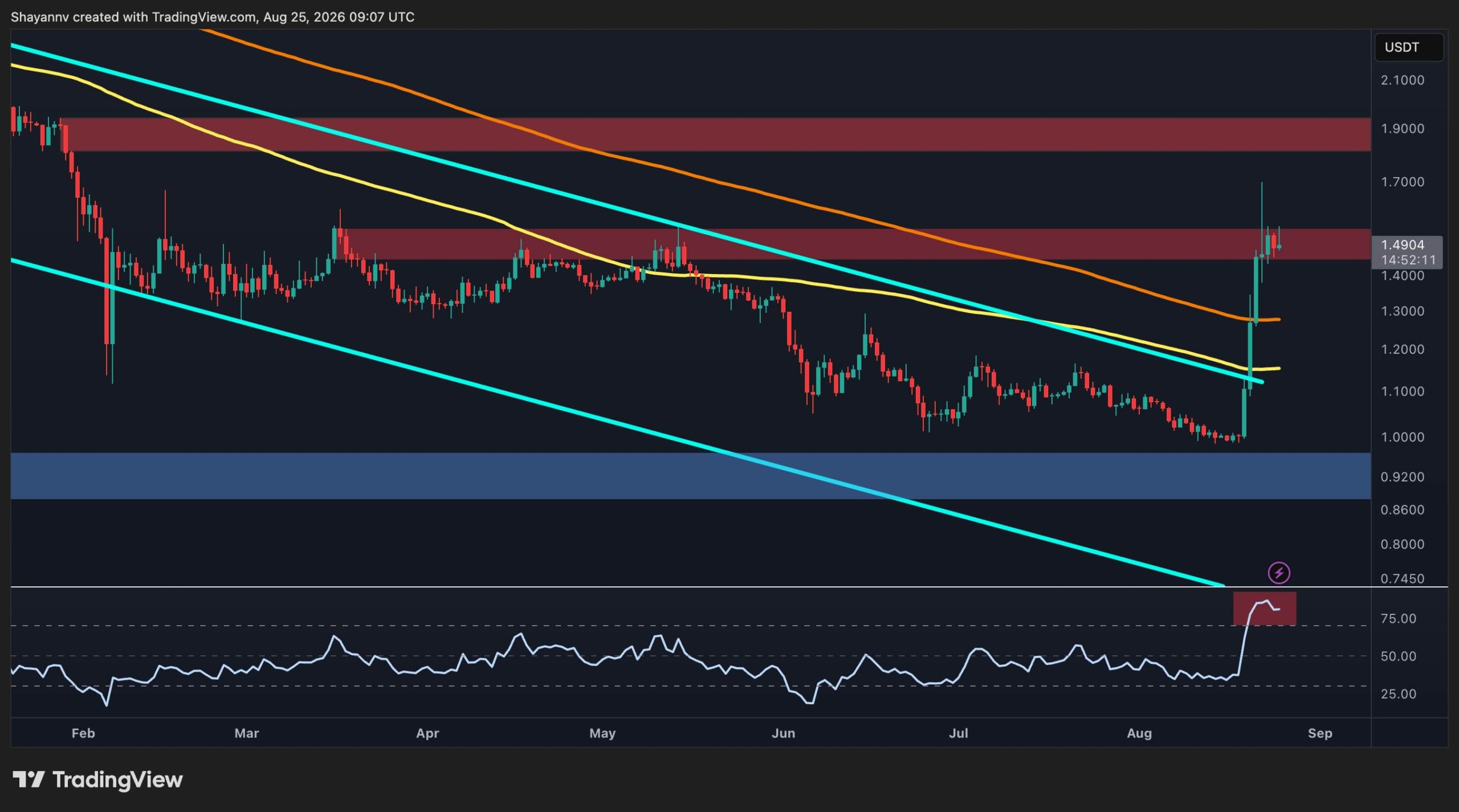
    XRP has experienced a significant rebound, climbing back from the $1.00 mark and successfully breaking through long-standing descending trendlines on both USD and BTC charts. However, the cryptocurrency’s recent rally has now encountered major resistance levels, placing current price action at a crucial juncture for determining its next directional move.

    The digital asset found support around the $1.00 level before breaching its broader descending channel. Subsequently, XRP has re-established its position above both the 100-day and 200-day moving averages, which were previously situated around $1.2 and $1.3, respectively. The move beyond $1.3 has effectively transformed these former resistance points into immediate support zones.

    Currently, XRP is testing the critical $1.50 resistance area, where price consolidation has begun. A decisive daily close above $1.50 could pave the way for a potential advance towards the $1.80-$1.90 range. Conversely, a rejection at this level, followed by a descent below $1.30, would undermine the recent breakout structure and increase the likelihood of a more substantial correction, potentially pushing prices back towards the $1.00 area.

    The Relative Strength Index (RSI) has surged past the 70 mark, remaining in overbought territory. While this indicates strong upward momentum, it also suggests the possibility of a short-term cooldown, which could lead to a retest of the 200-day moving average.

    XRP/BTC Pair Shows Mixed Signals

    On the XRP/BTC daily chart, the price has attempted to break out of its descending channel after reaching a low near 1,500 satoshis. However, unlike its USDT counterpart, this breakout has so far been unsuccessful. The pair briefly traded above the channel’s upper boundary before experiencing a significant rejection wick, indicating persistent selling pressure around this resistance level.

    XRP/BTC is now retracing towards the previously breached 200-day moving average, which is currently serving as a potential support level. The price action around this moving average will be a key determinant for the pair’s next move. If XRP/BTC can maintain its position above this average and solidify the former breakout area as support, another attempt at the 2,000 satoshis resistance zone may follow.

    A successful breach above 2,000 satoshis would bolster the relative strength outlook for XRP against Bitcoin. Conversely, a decisive failure to hold the 200-day moving average would suggest that the recent breakout attempt was a false signal, potentially exposing the pair to further downward pressure. The RSI has also pulled back after a brief stint above 70, reflecting a loss of momentum following the failed breakout and hinting at potential consolidation or correction in the coming weeks.
  • Grayscale Launches Zcash ETF Amid Privacy Concerns

    Grayscale Launches Zcash ETF Amid Privacy Concerns

    Grayscale Launches World’s First Zcash ETF Amidst Privacy Coin Scrutiny

    Grayscale’s Zcash Exchange Traded Fund (ETF) commenced trading Tuesday on NYSE Arca, introducing a nine-year-old investment product to the public markets months after developers disclosed and subsequently patched a critical vulnerability within the privacy coin’s shielded transaction system.

    Trading under the ticker ZCSH, the fund represents the world’s first exchange-traded product offering direct exposure to Zcash. This allows investors to track the price of ZEC through their existing brokerage accounts without the need to directly purchase or hold the cryptocurrency themselves.

    “Grayscale has a long history of identifying emerging technologies and investment themes early, and our nine-year history operating this fund is the clearest signal of demand,” Steve Vanourny, Grayscale’s Head of Index, told Decrypt.

    The ZCSH fund originated as the Grayscale Zcash Trust in October 2017. Grayscale filed with the Securities and Exchange Commission in November to convert the trust into an exchange-traded fund. As an ETF, shareholders do not directly own ZEC; instead, they own shares designed to mirror the value of the fund’s Zcash holdings.

    Vanourny cited Zcash’s maturity, its inherent privacy features, and growing investor interest in digital assets beyond Bitcoin and Ethereum as key factors making this the opportune moment to list the established fund.

    “Investors increasingly want exposure to digital assets beyond Bitcoin and Ether through the brokerage accounts they already use, and Zcash occupies a distinctive place in that landscape,” Vanourny explained. “With its nearly decade-long network history, monetary design derived from Bitcoin—including proof of work and a 21 million coin limit—in addition to optional privacy technology that Bitcoin does not possess.”

    Grayscale anticipates that ZCSH will primarily attract self-directed and advised investors seeking Zcash exposure via a brokerage account, according to Vanourny.

    “We view ZCSH as a focused, higher-risk satellite position within a broader digital-asset allocation that is complementary to, but not a replacement for, Bitcoin,” he stated. “It offers a distinct thesis: Bitcoin-like scarcity and proof-of-work economics, plus optional privacy, for investors who see privacy as the next major theme for the industry to address as it scales.”

    While Vanourny highlighted Zcash’s fixed supply and proof-of-work model as parallels to Bitcoin, its optional privacy features presented complexities in addressing a recent critical security flaw.

    In May, security researcher Taylor Hornby identified a four-year-old vulnerability in Zcash’s Orchard shielded pool that could have potentially enabled an attacker to generate counterfeit ZEC. Developers implemented an emergency patch on June 1. However, the network’s privacy features made it impossible to cryptographically verify whether the flaw had been exploited.

    In July, Zcash activated the Ironwood upgrade, which replaced the Orchard shielded pool with a new one. This upgrade incorporated accounting rules designed to prevent more ZEC from exiting the retired pool than entered it, thereby trapping any potential counterfeit coins.

    Looking forward, Grayscale intends to measure Zcash’s progress based on its adoption, utility, and network security, rather than solely on the token’s price.

    “On the security and infrastructure side, we will be watching the continued rollout and adoption of the Ironwood upgrade, which closed the vulnerable shielded pool from the June 2026 incident and added independently audited, formally verified supply guarantees,” Vanourny said. “Grayscale will also be monitoring exchange support and regulatory treatment of Zcash and privacy assets more broadly.”

  • Dogecoin Price Action Faces Scrutiny Amidst Divergent Market Signals

    Dogecoin Price Action Faces Scrutiny Amidst Divergent Market Signals

    Dogecoin (DOGE) has seen a 3.02% price bounce to $0.090 in the last 24 hours, yet this uptick is shadowed by conflicting indicators. Data indicates that whale wallets have been reducing their holdings, and inflows into spot Dogecoin ETFs have cooled, suggesting a complex market sentiment that warrants careful analysis.

    Whale Activity and ETF Trends

    Wallets holding between 1 million and 100 million DOGE have collectively offloaded approximately 280 million tokens since Friday. This distribution by larger holders contrasts with Dogecoin’s 34% rally last week. Concurrently, spot Dogecoin ETFs recorded inflows of $146,020 on Monday, a significant decrease from the $653,420 seen in the prior week, according to data.

    Technical Indicators and Momentum

    Technically, DOGE is trading above its 50-day EMA ($0.076) and 100-day EMA ($0.081), and has reclaimed a downtrend line near $0.070, which now acts as support. Immediate protection is noted at the $0.088 horizontal level. Analysts suggest that a sustained break above $0.094, supported by consistent ETF inflows, could potentially target $0.10 to $0.104.

    However, momentum indicators present a more cautious picture. The Relative Strength Index (RSI) is near 77, indicating overbought conditions. Furthermore, the long-to-short ratio stands at 0.93, approaching a one-month low. This positioning data suggests traders may be anticipating a pullback, even as the price holds steady. A base case scenario, according to the article, involves consolidation between $0.088 and $0.094 as overbought conditions subside. A break below $0.088 could lead to a retest of the 100-day EMA near $0.081, followed by the $0.076 level.

    Broader Market Context and Investor Focus

    The broader cryptocurrency market sentiment remains choppy, with Bitcoin’s price action heavily influencing assets like Dogecoin. Macro liquidity conditions are also a factor traders are monitoring. The current market dynamics suggest that while DOGE’s chart setup appears structurally bullish, underlying momentum and investor positioning warrant caution. Whale distribution and a long-to-short ratio below one indicate that the easier gains from the recent rally may have already been realized.

    This environment is reportedly prompting some traders to explore earlier-stage investment opportunities. For example, the Maxi Doge (MAXI) presale has raised $4,848,993.00, with tokens priced at $0.0002835. The project offers dynamic APY staking and other features.

    Uncertainties persist regarding Dogecoin’s immediate recent price action, specifically whether it can sustain momentum above $0.090 or if it may stall. The impact of macro liquidity conditions also remains a key consideration. It is not guaranteed that the current Dogecoin rally is sustainable without further support from institutional investors or large holders.

    Why This Matters

    The materials describe a narrow update: Dogecoin saw a short-term price increase, but underlying data from whale wallet activity and ETF inflows suggests a potential weakening of buying pressure. Whether DOGE price can push through $0.090 or stall into another leg down.

  • Ripple News and XRP Price Update: August 25

    Ripple News and XRP Price Update: August 25

    Ripple Ecosystem Sees Major Developments, XRP Price Surges

    The cryptocurrency landscape surrounding Ripple and its native token, XRP, has undergone a dramatic transformation in less than a week. Previously, XRP hovered around the $1.00 mark, with analysts questioning the sustainability of this support level. Now, a series of significant developments have injected new momentum into the ecosystem and propelled XRP’s price.

    FedNow Integration and Gemini’s XRP Support

    Recent reports indicate that FedNow Payments has begun facilitating payments using Ripple’s tokens, following the company’s integration with Volante. FedNow operates as an instant payment system for fiat USD, settling on central bank reserves. Volante, in turn, provides platform connectivity for domestic U.S. payments to FedNow and for cross-border services to Ripple.

    In parallel, Tyler Winklevoss, co-founder of the cryptocurrency exchange Gemini, announced “big news for the Ripple Army in Asia.” He revealed via a tweet that users of Gemini’s Singapore-based exchange can now deposit and withdraw XRP directly through the XRP Ledger network.

    Surge in XRP Ledger Activity

    The XRP Ledger (XRPL) itself has witnessed a substantial uptick in activity. Analyst Ali Martinez, citing data from Santiment, highlighted a staggering 650% increase in active addresses over the past few days. The number of active addresses surged from 47,180 to over 356,000, a spike that Martinez suggests typically signals heightened network participation and often correlates with increased price volatility.

    Institutional Interest Rekindles

    The renewed enthusiasm is also evident in institutional investment. Spot XRP Exchange-Traded Funds (ETFs), which had experienced sluggish inflows for weeks, saw a significant acceleration in demand, particularly after Wednesday. These ETFs collectively attracted nearly $40 million in net inflows last week, marking their strongest weekly performance since May. Furthermore, total cumulative inflows have reached a new all-time high of over $1.55 billion, with Bitwise’s XRP fund maintaining its position as the largest among its peers.

    Regulatory Clarity and CEO’s Outlook

    Ripple CEO Brad Garlinghouse commented on Saturday following his participation in two prominent Washington D.C. meetings: the Crypto Summit at the White House, hosted by the President, and the CFTC’s Innovation Advisory Committee. Garlinghouse stated that a consensus emerged from both gatherings, indicating that all stakeholders, including traditional finance (TradFi) institutions, are seeking clear regulatory frameworks for the crypto industry. He anticipates that such clarity may soon materialize through the anticipated CLARITY Act.

    XRP Price Rebounds Sharply

    The native token’s recent price action has been a focal point. Less than seven days ago, XRP struggled to maintain its footing above the crucial $1.00 support level, dipping below it on several occasions amid a deteriorating market sentiment.

    However, a market-wide resurgence, initially led by Bitcoin, began on Wednesday afternoon. While XRP experienced a slight delay, it eventually joined the rally with considerable force. The token surged from $1.00 to $1.70 by Saturday morning, achieving a remarkable 70% increase in under 72 hours.

    On-chain data suggests that large holders, or “whales,” played a significant role in this ascent, accumulating approximately 400 million tokens over several days. XRP’s upward trajectory was, however, capped at $1.70, and the token has since retreated to trade around $1.50. Many analysts now believe that XRP must successfully reclaim the $1.65-$1.70 resistance zone to signal a definitive return to a bull phase.

    Popular trader CasiTrades emphasized the importance of this resistance level, noting that XRP’s rally to test the “macro .618 resistance” was met with “heavy resistance and instant rejection.” CasiTrades added, “So now XRP needs to prove it can actually sustain this rally. We need [the] price to break above the macro 0.618 and then come back to successfully test that level as support. THAT is the structural shift that would signal beginning a new trend.”

  • XRP Stuck: Analyst Cites Coinbase Trading Walls

    XRP Stuck: Analyst Cites Coinbase Trading Walls

    Analyst Attributes XRP Price Stagnation to Large Coinbase Holders

    An analyst has suggested that substantial holders linked to Coinbase are manipulating XRP’s price through significant buy and sell orders on both sides of the market.

    This theory emerged as the Ripple token traded near $1.51, maintaining a narrow range following a rally that more than doubled its value from early August lows.

    A chart shared by the analyst, identified as CW, depicted XRP consolidating between approximately $1.52 and $1.53. The data indicated substantial sell orders positioned above $1.70 and $2.00, while buy orders were clustered just below $1.52.

    “It is Coinbase whales that are controlling the price of XRP,” the account stated, asserting that these order walls are not intended to drive the price up or down but rather to keep it stable. The analyst further linked this price standoff to U.S. trading desks not yet being prepared for a significant price increase.

    Later, CW provided data on futures positioning, suggesting that conditions for a rally are developing despite the lack of price movement.

    The data revealed that whale long/short ratios on Binance and OKX were both leaning bullish, with OKX’s whale position ratio at 8.16. However, sentiment among sophisticated investors remained divided: extremely bullish on OKX, extremely bearish on Bybit, and mildly bearish on Binance, which represented an improvement from a more bearish outlook the previous day. Taker volume was nearly balanced, with 48.74% of trades indicating long positions and 51.26% indicating short positions.

    In a separate post, CW noted that XRP had surpassed its point of control and a key resistance zone, with the sell wall now positioned above the current price appearing relatively small.

    Exchange-Traded Fund (ETF) flows offered another perspective, showing a net inflow of $13.82 million across XRP ETFs. This was distributed as $8.25 million into Bitwise’s fund, bringing its cumulative assets under management to $551 million; $4.01 million into Franklin’s XRPZ, reaching $438 million cumulatively; and $1.57 million into Canary’s XRPC fund.

    Combined assets under management for XRP ETFs stand at $1.441 billion, with total XRP ETF volume, including spot and other forms, exceeding $207 million for the day.

    CryptoPotato reported that XRP experienced a surge of over 65%, pushing its market capitalization above $94 billion and briefly positioning it as the fourth-largest cryptocurrency, ahead of BNB, before later falling back to fifth.

    The token saw a rapid ascent from below $1.00 to nearly $1.70 in less than 72 hours, reaching its highest level since January, before retracing. Market observers, including EGRAG CRYPTO, identified the $1.65 to $1.70 range as a critical level for determining XRP’s future trajectory.

    Diana, another active trader on X, presented a wave count analysis suggesting $1.79 as the initial target if XRP breaks through resistance between $1.53 and $1.64. Subsequent targets were projected at $2.58 and $2.89, following a potential pullback to the $1.27 to $1.30 range.

    At the time of reporting, XRP was trading around $1.51, representing a more than 50% increase over the past seven days. The token’s trading volume also rose by over 11% from Monday’s figures, reaching $5.9 billion. However, it remains approximately 59% below its all-time high of $3.65, recorded in July 2025.

  • Google Gemini AI Bitcoin Prediction for 2026: Analysis of Factors and Uncertainties

    Google Gemini AI Bitcoin Prediction for 2026: Analysis of Factors and Uncertainties

    Google Gemini AI has issued a base case prediction for Bitcoin’s price, forecasting it to reach $102,000 by Christmas 2026. The AI model also outlined a range of $95,000 to $110,000 and flagged a potential target of $105,000 before the end of 2026. However, this forecast is presented against a backdrop of significant market volatility and inherent uncertainties, underscoring the speculative nature of AI-driven financial predictions.

    Market Drivers and Recent Activity

    Recent market activity shows Bitcoin reaching $77,300, influenced by over $4 billion in short-position liquidations, a significant event since 2021. This movement occurred alongside the US Treasury’s decision to double long-dated bond buybacks to $4 billion per operation, a move that compressed yields and potentially directed capital into risk assets like Bitcoin. According to Gemini AI, these factors, along with discussions around a potential SEC framework called ‘Reg Crypto,’ are interpreted as catalysts for unlocking significant market liquidity.

    Potential Risks and Bear Case Scenario

    Despite these signals, Gemini AI also presented a bear case scenario. This outlook suggests that persistent macroeconomic headwinds or a reversal in yields could impact the current trend, potentially pushing Bitcoin’s price back towards the $68,000 support level. The AI’s analysis included a hypothetical price trajectory for 2026, detailing potential price fluctuations, such as a dip to under $60,000 in February 2026 followed by a recovery and subsequent drop to $57,500 in June 2026, before a notable move last week.

    Technical Indicators and Ecosystem Developments

    Technical indicators, such as the Relative Strength Index (RSI), are noted to be elevated, with the RSI reading 80.40 against a signal line at 58.84. The gap of approximately 22 points is described as confirming the recency of the price move, with momentum cooling without breaking, which is characterized as healthy digestion. However, the sustainability of this trend remains subject to market conditions.

    Beyond price predictions, the article touches upon Bitcoin Hyper, a project aiming to enhance Bitcoin’s utility. This project intends to integrate with the Solana Virtual Machine to offer faster execution, lower fees, and smart contract functionality without altering Bitcoin’s base layer. A Canonical Bridge is designed to facilitate the movement of BTC into this environment, with the HYPER token powering gas, staking, and governance. The presale for Bitcoin Hyper has reportedly raised over $33 million, with staking yields of up to 36% APY offered ahead of its planned 2026 launch. The value proposition of Bitcoin Hyper is presented as extending beyond Bitcoin’s direct price appreciation, potentially benefiting from increased user activity and developer engagement in a renewed Bitcoin cycle.

    Conclusion: Navigating AI Forecasts

    Navigating these predictions requires a clear understanding of the underlying assumptions and potential risks. The AI’s forecast is contingent on a complex interplay of macroeconomic factors, regulatory developments, and market sentiment. Significant uncertainties remain regarding the precise impact of regulatory frameworks like Reg Crypto, the potential for unforeseen economic shifts, and the long-term success of ecosystem developments like Bitcoin Hyper. Readers are advised to approach such AI-driven forecasts with caution, grounding their investment decisions in verifiable data and a thorough assessment of market risks.

    Why This Matters

    The materials describe a narrow update: Google Gemini AI has issued a price prediction for Bitcoin, setting a base case of $102,000 by Christmas 2026. The exact impact of Reg Crypto on market liquidity.

    Broader Context

    Source materials place the factual news in this context: The article discusses a price prediction for Bitcoin by Google Gemini AI.

  • Analyzing the Factors and Uncertainties Behind Microsoft Copilot AI’s XRP Price Prediction

    Analyzing the Factors and Uncertainties Behind Microsoft Copilot AI’s XRP Price Prediction

    Microsoft Copilot AI has issued a price prediction for Ripple’s XRP, forecasting a potential rise to between $4 and $7 by the end of 2026, with a base case scenario near $5. However, this prediction is framed by significant uncertainties and relies on a complex interplay of market factors, rather than offering a not assured outcome.

    Why This Matters

    The materials describe a narrow update: Microsoft Copilot AI has issued a price prediction for XRP, forecasting a potential rise to $4-$7 by the end of 2026, with $5 as a base case. Whether RLUSD adoption will slow.

    Broader Context

    Source materials place the factual news in this context: A rally of a few days has repriced an entire year of drift.

    Key Drivers and Market Dynamics

    The AI model’s outlook is influenced by several key developments. Recent accumulation by large holders, often referred to as ‘whales,’ has seen over 300 million XRP acquired, tightening the available supply. This was followed by a substantial short squeeze, reportedly valued at $1.25 billion, which forced liquidations and contributed to a rapid price increase. These events have shifted market dynamics, with XRP currently trading around $1.50.

    Further bolstering the bullish perspective are indicators of growing utility and institutional interest. Ripple’s RLUSD stablecoin has surpassed a $2 billion market capitalization, suggesting increased genuine usage on the XRP Ledger. Additionally, institutional investors have shown renewed interest, with ETF inflows reportedly jumping by nearly $40 million in a single week. Microsoft Copilot AI interprets these catalysts as reinforcing momentum that could sustain price expansion into 2026.

    Historical Context and Technical Indicators

    To contextualize the current situation, XRP’s price history reveals significant volatility. The asset traded above $3.40 last September, but subsequently experienced a decline, reaching a capitulation point around $1.13 in February 2026. Following this, XRP traded within a range of approximately $1.30 to $1.60 for six months before a notable move in June coincided with a price consolidation near $1.00. This $1.00 level acted as support through July and most of August, until a recent spike last week saw XRP reach $1.68 before pulling back.

    Currently, XRP closed at $1.50054, marking a 2.63% gain for the session, with trading occurring between $1.43474 and $1.55082. Technical analysis indicates resistance levels at $1.55082, the recent spike high of $1.68, and an older shelf at $1.80. Support is observed around $1.43474 and $1.30, with a structural base at $1.00.

    The Relative Strength Index (RSI) currently reads 86.45, significantly above its signal line of 51.64. This high RSI reading suggests that buyers are in strong control, but also indicates that the indicator has moved to an extreme, often demanding a period of rest or consolidation. While the current momentum is strong, its sustainability at face value is questionable without further market digestion.

    Uncertainties and Potential Risks

    Despite the positive signals, several uncertainties loom. The AI model’s bear case scenario suggests that a slowdown in RLUSD adoption or unforeseen regulatory setbacks could lead to XRP retracing towards the $1.20-$1.30 range. The long-term trajectory also depends on whether fresh demand continues to absorb supply effectively. These factors highlight that the AI’s prediction is a projection based on current trends, not a certainty.

    In conclusion, while Microsoft Copilot AI’s prediction offers a bullish outlook for XRP by the end of 2026, it is crucial to interpret this within the context of significant underlying uncertainties and market dynamics. The growth of stablecoin adoption, institutional inflows, and whale accumulation are key drivers, but potential regulatory challenges and adoption rates remain critical variables. As the market digests recent price movements, the sustainability of XRP’s upward trend will depend on these evolving factors, underscoring the importance of evidence-based analysis over speculative forecasts.

  • Trump Impeachment Odds Shift with Congress Control

    Trump Impeachment Odds Shift with Congress Control

    Polymarket Traders Price Trump Impeachment Odds Based on Congressional Control

    Prediction market Polymarket traders are currently pricing a potential impeachment of former President Donald Trump by the House of Representatives before his term concludes at approximately 68%. This stands in stark contrast to the same outcome occurring before December 31, 2026, which is priced at a mere 2%.

    The significant 33-fold difference between these two contracts, which pose a nearly identical question, highlights a crucial distinction: the market is not necessarily predicting impeachment itself, but rather pricing the calendar and congressional dynamics separately from the political sentiment.

    Polymarket’s “Will Trump be impeached before his term ends?” market resolves as “Yes” if the House of Representatives passes at least one article of impeachment by a simple majority at any point before January 20, 2029. As of its last update on August 24, 2026, this contract was trading at around 68%, with approximately $94,463 in cumulative volume since the market opened on March 19, 2026.

    A separate, shorter-dated contract asks the same question but limits the timeframe to December 31, 2026, before the newly elected House has even settled into committee assignments. This contract has traded at a premium closer to 2%, according to Polymarket pricing referenced in Washington Examiner coverage.

    The divergence in implied probability for the same event and officeholder stems from the fact that the two contracts are effectively betting on different Congresses. Republicans currently hold slim majorities in both the House and Senate. A Republican-controlled House, absent a significant internal party schism, has little institutional incentive to advance impeachment articles against a Republican president. This explains the 2% price for the shorter-dated contract, representing a bet that the current Congress will act before its term expires, a scenario with a near-zero baseline probability.

    The 68% figure, conversely, factors in a more structurally different scenario: the 2026 midterm elections. Should Democrats regain control of the House, they would acquire subpoena power, control of the Judiciary Committee, and the ability to schedule floor votes on their own terms – powers not available under the current Republican majority.

    Forecasters tracking generic ballot trends have generally indicated that Democrats are favored or competitive to flip the chamber. Polymarket’s longer-dated contract effectively represents a compounded bet: the probability of a Democratic House multiplied by the likelihood that a Democratic majority would actually bring impeachment articles to a vote within the approximately two years of runway that would follow.

    Prediction markets have increasingly become a rapid gauge for this type of time-bound political risk. A similar dynamic was observed in Kalshi’s government shutdown odds market, where prices fluctuated in tandem with the legislative calendar rather than solely with shifts in sentiment.

    The mechanism here is identical: traders are not voting on whether Trump deserves impeachment, but rather pricing the sequence of procedural hurdles that would need to be cleared. Both Polymarket contracts resolve based solely on House passage. Neither requires a Senate trial, conviction, or removal from office to settle as “Yes.” This distinction is critical for interpreting the odds and is rooted in constitutional mechanics rather than market convention.

    According to a report by the Congressional Research Service on House impeachment procedure, impeachment by the House occurs through a simple majority vote adopting articles of impeachment, which constitutes a formal accusation akin to a criminal indictment. Removal from office is a separate Senate proceeding requiring a two-thirds vote of senators present to convict, and disqualification from future office is an additional step requiring only a majority vote.

    The Congressional Research Service report notes that the House has impeached three presidents: Andrew Johnson in 1868, Bill Clinton in 1998, and Trump himself in both 2019 and 2021. In all instances, the Senate declined to convict. Therefore, a 68% price on House impeachment carries no implication for the significantly higher bar of Senate removal, which represents an entirely separate market question.

    The Trump impeachment markets illustrate how political probabilities can shift dramatically without any change in underlying views of the politician involved. Instead, the path to such an outcome changes, influenced by elections, congressional control, committee power, deadlines, and the number of procedural steps remaining.

    Platforms like Kalshi allow traders to take direct positions on these types of political outcomes. Instead of translating a House flip, impeachment vote, or government funding dispute into traditional financial markets like stocks, Bitcoin, or bonds, users can focus directly on the event and the specific conditions required for a contract to settle. This distinction is crucial when two seemingly similar questions can yield vastly different probabilities simply due to differing timeframes for resolution. For traders already considering congressional arithmetic and timing, Kalshi transforms these theses into a dedicated market.

  • Zcash (ZEC) Price Surges to 8-Year High Amid Grayscale ETF Plans; Analyst Caution Advised

    Zcash (ZEC) Price Surges to 8-Year High Amid Grayscale ETF Plans; Analyst Caution Advised

    Zcash (ZEC) has experienced a significant price surge, reaching its highest point in eight years, driven by broader market resurgence and specific corporate developments, including Grayscale’s potential ETF plans. However, some market observers and analysts are expressing caution regarding the sustainability of this rally, with uncertainties surrounding the ultimate outcome of Grayscale’s discussions.

    Over the past week, ZEC’s price increased by nearly 65%, briefly touching approximately $880 on August 23. This marks the highest valuation for ZEC since January 2018. The cryptocurrency currently trades around $848, with a market capitalization exceeding $14 billion, according to CoinGecko.

    The recent upward momentum is partly attributed to discussions surrounding Grayscale potentially contributing around 200,000 ZEC to its Zcash Trust. Plans are in motion to convert this trust product into an Exchange Traded Fund (ETF), with a scheduled launch date of August 25. This development coincides with a general resurgence in the cryptocurrency market, influenced by factors such as monetary policy changes announced by the U.S. Treasury Department.

    While ZEC has outperformed many other major cryptocurrencies like BTC, ETH, and XRP during this period, some analysts are tempering the optimism. One analyst warned of a potential significant downturn, suggesting that the current price movement might be overextended. This caution is partly based on technical indicators, with ZEC’s price noted to be well above its daily averages and the upper Bollinger Band, indicating a potentially stretched valuation. Furthermore, on-chain data reveals that ZEC exchange inflows have significantly outpaced outflows in recent days. This trend suggests that many investors are moving their assets from self-custody to centralized platforms, which can increase immediate selling pressure and is considered a bearish signal by some market participants.

    Conflicting perspectives exist among market observers. Some, like X user jussy, believe ZEC is positioned for further gains, anticipating a rise to $930 if it breaks the $850 level. Crypto Tony has expressed a more bullish outlook, suggesting $1,000 as a minimum target for the cycle. Conversely, Crypto with Harris ₿ has argued that ZEC’s “real value” lies below $500 and reminded the market of a critical vulnerability Zcash experienced earlier this year. This vulnerability previously triggered a substantial price drop, prompting figures like Arthur Hayes to divest their holdings.

    It is important to note that ZEC is distinct from Bitcoin, and its performance should be evaluated on its own merits. The recent price action, while significant, is accompanied by signals that warrant careful consideration. The outcome of Grayscale’s ETF plans and the ongoing exchange net flow data are key factors to monitor, but their precise impact on future price direction remains uncertain.

    Significant uncertainty surrounds the future trajectory of ZEC’s price. While the Grayscale ETF plans and market resurgence provide potential positive catalysts, technical indicators and historical performance, including past vulnerabilities, suggest a need for caution. Investors are advised to consider these divergent signals and the inherent uncertainties within the cryptocurrency market.

    Why This Matters

    The materials describe a narrow update: Zcash (ZEC) price increased by nearly 65% over the past week, reaching approximately $880 on August 23, its highest point since January 2018. The ultimate outcome of Grayscale’s discussions with DCG regarding ZEC contribution.

    Broader Context

    Source materials place the factual news in this context: ZEC is one of the best-performing top 100 cryptocurrencies over the past week, with its price surging by nearly 65%.

  • Hyperliquid Surges to Record High Ahead of $1.2B Token Unlock

    Hyperliquid Surges to Record High Ahead of $1.2B Token Unlock

    Hyperliquid Token Surges Amidst Record Highs, Faces Major Supply Release

    Hyperliquid, the layer-1 blockchain and perpetual futures exchange, is experiencing a significant surge, with investors in its native token, HYPE, enjoying substantial gains.

    The HYPE token reached an all-time high of $83.27 on Sunday, according to data from CoinGecko, before settling around $77.50. The token’s market capitalization is currently close to $19.5 billion. However, this upward momentum is set to encounter a substantial token supply release, identified by the tracking site Tokenomics.com as the largest of Hyperliquid’s monthly unlocks.

    Since its launch in November 2024, Hyperliquid has systematically released a portion of its 1 billion-token supply on a fixed monthly schedule. The upcoming August 29 event marks the fourth consecutive release, distributing tokens to three distinct recipient groups: the community, the foundation, and insiders. Insiders, comprising early investors, will receive the largest single share of this release at 46.6%, followed by the community (allocated for grants, rewards, airdrops, etc.) at 46.3%, and the Hyper Foundation at 7%.

    Token unlocks do not inherently cause a price collapse. They increase the number of tokens available for sale, and this new supply can exert downward pressure on the market if recipients decide to liquidate their holdings. Tokenomics.com’s historical data on price impact from previous unlocks shows a mixed performance: following the three prior monthly releases, HYPE saw a 7% decline in July, a 1% increase in June, and a significant 14.1% drop in May.

    However, unlocks directed towards investors and early contributors are closely monitored by traders. These holders, having acquired tokens at a lower cost basis, have a greater incentive to realize profits compared to community token pools.

    Hyperliquid has garnered attention beyond its token’s price performance. This month, Coinbase integrated Hyperliquid’s infrastructure to offer 50x perpetual futures on its Base app, a move that further embeds the protocol within mainstream trading channels.

    Potentially the most significant development for HYPE investors emerged mid-last week when former President Donald Trump directly mentioned Hyperliquid during a media briefing preceding a closed-door meeting with cryptocurrency executives. While the decentralized exchange for perpetual futures is currently geo-fenced and unavailable to U.S. residents, Trump informed the media that the Commodity Futures Trading Commission (CFTC) is “working to bring Hyperliquid into the United States in a fully compliant and legal fashion.”

    This development coincides with a broader shift in Washington towards a more favorable stance on the cryptocurrency sector. Trump also urged Congress to pass a “fair version” of the Clarity Act during a White House crypto summit.

    With HYPE trading near its record highs, the August 29 release is set to introduce approximately $560 million worth of insider-allocated supply into a market that has already retreated from its peak. A subsequent unlock of a similar magnitude is scheduled for September 29.