Tag: Negative

  • XRP Price Resilience Tested by Technical Warnings and Regulatory Uncertainty

    XRP Price Resilience Tested by Technical Warnings and Regulatory Uncertainty

    XRP’s notable streak of closing above the $1 mark for 635 consecutive days, a period dating back to November 2024, is now facing significant headwinds. Despite this sustained price stability, emerging technical indicators suggest a potential downturn, while an uncertain regulatory environment adds another layer of risk, according to recent analyses.

    The central tension of this story lies in the divergence between XRP’s prolonged defense of the crucial $1 psychological level and the growing cautionary signals from its technical charts. While the cryptocurrency has largely held its ground, recent price action and charting patterns indicate a shift in momentum that warrants careful examination.

    Technical Indicators Signal Weakening Trend

    Analysis of XRP’s daily chart reveals technical damage. The 50-day exponential moving average (EMA) has crossed below the 200-day EMA, a pattern traders often refer to as a ‘death cross.’ This suggests that sellers have dominated the short-to-medium-term trend for weeks. Furthermore, the daily Average Directional Index (ADX), which measures trend strength, stands at 21.8. This reading is just below the 25 threshold that traders typically use to suggest strong conviction, indicating that while the current decline is real, it may not be characterized by extreme volatility at this moment.

    On the weekly chart, the picture is more nuanced. XRP’s 50-week EMA remains above its 200-week EMA, suggesting the longer-term trend is still intact. However, the gap between these two averages has been narrowing over recent months. The weekly ADX, currently at 33.7, signals a genuinely strong trend. As reported by the source, for those holding XRP long, this strong trend is currently pointing in an unfavorable direction.

    Further technical analysis indicates that XRP has not yet reclaimed its shallowest Fibonacci retracement level at $1.0281. The ‘golden zone’ for Fibonacci retracement, situated between $1.0754 and $1.0965, represents a significant climb from current price levels. Immediate resistance is observed near $1.07–$1.09, with a potential push to $1.1264 if momentum is sustained. On the support side, this week’s low was around $0.98, with major support identified at $0.9061.

    External Pressures and Market Dynamics

    Recent events have also tested XRP’s stability. A bridge exploit resulted in the draining of approximately $200,000 through a connection between the TX Chain and the XRP Ledger. This incident was associated with XRP to briefly trade below $1 on August 11 and again on August 14. In both instances, buyers intervened before the daily close, preventing a sustained breach of the $1 level.

    The broader cryptocurrency market is also navigating a challenging period. Bitcoin has struggled to hold above $64,000, and Ethereum has faced difficulties maintaining the $1,900 level, with traders uncertain about when the current slide will end. This contrasts with Wall Street, where sectors like AI stocks have shown strength, with companies like Anthropic reportedly posting significant quarterly revenue.

    Regulatory and Legislative Uncertainty Looms

    The upcoming calendar introduces further uncertainty for the crypto market. The Senate has begun a five-week August recess without voting on the Clarity Act, a crypto market structure bill, pushing the next realistic vote to around September 15. Adding to this, the SEC abruptly postponed its own vote on new crypto-startup fundraising rules, citing scheduling issues.

    These external factors contribute to a cautious outlook. Analyst Geoff Kendrick of Standard Chartered significantly revised his 2026 XRP price target downward from $8 to $2.80 in the first quarter of 2026, reflecting a bearish sentiment among some market observers.

    Trader Positioning and Potential Risks

    Whales have reportedly purchased around 380 million XRP near the $1 level over the past week. However, this buying activity is occurring alongside approximately $1.5 billion in newly opened leveraged long positions. As reported by the source, this combination could exacerbate price drops if forced liquidations are triggered by a sustained break below $1.

    Conclusion: Navigating Uncertainty

    While XRP’s ability to hold above $1 for an extended period is notable, the confluence of weakening technical indicators, recent price volatility, and an uncertain regulatory environment presents significant risks. The market awaits further developments regarding the Clarity Act and SEC actions, with traders closely monitoring technical levels and positioning. The current situation suggests a need for caution, as XRP navigates a complex landscape where past resilience may not fully insulate it from future challenges.

    Why This Matters

    The materials describe a narrow update: XRP has maintained a streak of closing above $1 for 635 days, despite recent price dips below this level due to a bridge exploit and general market volatility. When the current crypto market slide will end.

    Broader Context

    Source materials place the factual news in this context: Crypto is grinding through what can be considered an extended bear market with no reported bottom in sight.


  • macOS Screen Sharing Vulnerability Exploited for Monero Mining, NCSC Warns

    macOS Screen Sharing Vulnerability Exploited for Monero Mining, NCSC Warns

    A critical vulnerability in Apple’s macOS Screen Sharing feature, identified as CVE-2026-65400, is being actively exploited by attackers to gain root access on Macs and deploy Monero cryptocurrency mining software. The Netherlands’ national cyber agency issued a warning this week regarding the active exploitation of this flaw.

    The Dutch National Cyber Security Center (NCSC) reported that the vulnerability allows network-based attackers to bypass authentication, enabling them to slip through without valid credentials. Exploitation has been observed on systems where port 5900, the default port for Screen Sharing, is exposed to the internet. In these instances, attackers successfully gained root access, the highest level of control over a machine, and installed Monero mining programs.

    The bug, which has a severity rating of 7.1 out of 10, is an authentication flaw stemming from faulty state management during the login process. It allows authentication attempts that should have been rejected to be accepted. Publicly available proof-of-concept code for this vulnerability is now circulating, which lowers the barrier for potential attackers.

    Monero, a privacy-focused cryptocurrency, is frequently used in cryptojacking campaigns. In such schemes, hijacked machines are used to mine cryptocurrency for the attacker, who reaps the rewards while the victim bears the costs of electricity consumption and degraded system performance. The privacy features of Monero make its transactions harder to trace compared to more transparent cryptocurrencies like Bitcoin or Ethereum.

    Apple has addressed the vulnerability by releasing patches for affected macOS versions. Updates are available for macOS Sequoia 15.7.9, Sonoma 14.8.9, and Tahoe 26.6.1. Users who have not yet updated their systems, particularly those with Screen Sharing accessible from the open internet, remain exposed to this threat.

    The NCSC advises users to apply Apple’s updates promptly and to avoid leaving Screen Sharing accessible from the internet, as this configuration provided the initial entry point for attackers.

    Why This Matters

    This incident highlights the immediate security risks posed by unpatched software and exposed network services. The exploitation of the macOS Screen Sharing vulnerability (CVE-2026-65400) for Monero mining demonstrates a persistent threat to users, underscoring the importance of timely security updates and secure network configurations. While the exact number of affected systems and the total value of Monero mined remain uncertain, the active exploitation is part of a broader trend of cyber schemes leveraging compromised devices for cryptocurrency profit.

    Broader Context

    The exploitation of the macOS Screen Sharing vulnerability for Monero mining occurs amidst a landscape of evolving cyber threats. Recent incidents include malware found in pirated software, malicious mobile apps, and compromised Python libraries, indicating a continuous effort by malicious actors to leverage compromised devices for financial gain. The use of Monero, a privacy coin, in these campaigns is driven by its features that make transactions harder to trace compared to other cryptocurrencies.

  • Dutch Prosecutors Sell Seized Knaken Crypto for $2.5 Million, Creditors Face Significant Shortfall

    Dutch Prosecutors Sell Seized Knaken Crypto for $2.5 Million, Creditors Face Significant Shortfall

    Dutch prosecutors have sold cryptocurrency seized from the bankrupt platform Knaken, generating $2.5 million (approximately €2.2 million) for creditors. This amount, however, falls significantly short of the estimated customer deposits, leaving many facing a substantial recovery shortfall.

    Knaken, which operated without a license from the Dutch markets regulator, was declared bankrupt on July 16 after prosecutors sought its winding-up in the public interest. According to court-appointed trustee Carl Hamm, the sale proceeds are currently the only funds available in the bankruptcy estate. Hamm has informed approximately 6,300 customers to temper their expectations regarding the recovery of their funds.

    Estimates suggest that customers deposited between $12 million and $14 million (approximately €10 million to €12 million) onto the platform. The considerable gap between customer deposits and the sale proceeds is attributed to Knaken’s operational structure. Customers paid fees to Knaken, which then purchased positions on an exchange. These positions belonged to Knaken, not the individual customers, leading to a misunderstanding of ownership. Many customers believed they owned the cryptocurrency outright, while in reality, they held a right to the euro equivalent.

    Further complicating recovery, Knaken appears not to have held cryptocurrency matching customer balances, with investments and running costs commingled. This operational structure has contributed to the difficulties in asset recovery.

    Questions have been raised about the prosecutors’ decision to sell the seized holdings. A lawyer representing one affected customer questioned the move, comparing it to a bankrupt garage selling a customer’s car. Prosecutors have stated they had good reasons for the sale but have declined to provide specific details. It is presumed they relied on a provision that permits the sale of seized goods liable to lose value, a decision Hamm said he understood given the unpredictable nature of cryptocurrency values.

    Knaken’s troubles began in 2020 when 23 Bitcoin (BTC) were stolen in a hack, with owner Ronald J. claiming millions in losses at the time. The bankruptcy hearing also revealed that Ronald J. had moved $2.7 million (approximately €2.3 million) from Knaken to a company he controlled, a transaction the court described as a form of conflict of interest. Ronald J. claims this transfer was for marketing work to keep functions separate and has provided records that the broadcaster Rijnmond reported showed no sign of personal enrichment. He also disputes the trustee’s investment figure, stating Knaken operated as a broker and denying that money went uninvested, though he accepts an uncovered portion existed.

    Knaken did not report its operational problems to De Nederlandsche Bank, the Dutch central bank. A spokesperson for the bank reported that its remit at the time covered money laundering and terrorist financing, but not solvency.

    Why This Matters

    The materials describe a narrow update: The Dutch Public Prosecution Service sold cryptocurrency seized from the collapsed platform Knaken, generating $2. The exact amount of customer deposits.

    Broader Context

    Source materials place the factual news in this context: Knaken let customers in the Netherlands buy, trade and store cryptocurrency through an app.

  • XRP Price Action Near $1.00: Technical Analysis Suggests Bearish Lean, Key Levels Monitored

    XRP Price Action Near $1.00: Technical Analysis Suggests Bearish Lean, Key Levels Monitored

    XRP is currently trading near the $1.00 level, with prevailing technical indicators suggesting a bearish outlook. The asset is experiencing pressure, and a potential additional weakness is possible if key support levels are breached, according to market analysis.

    Bearish Structure and Momentum Observations
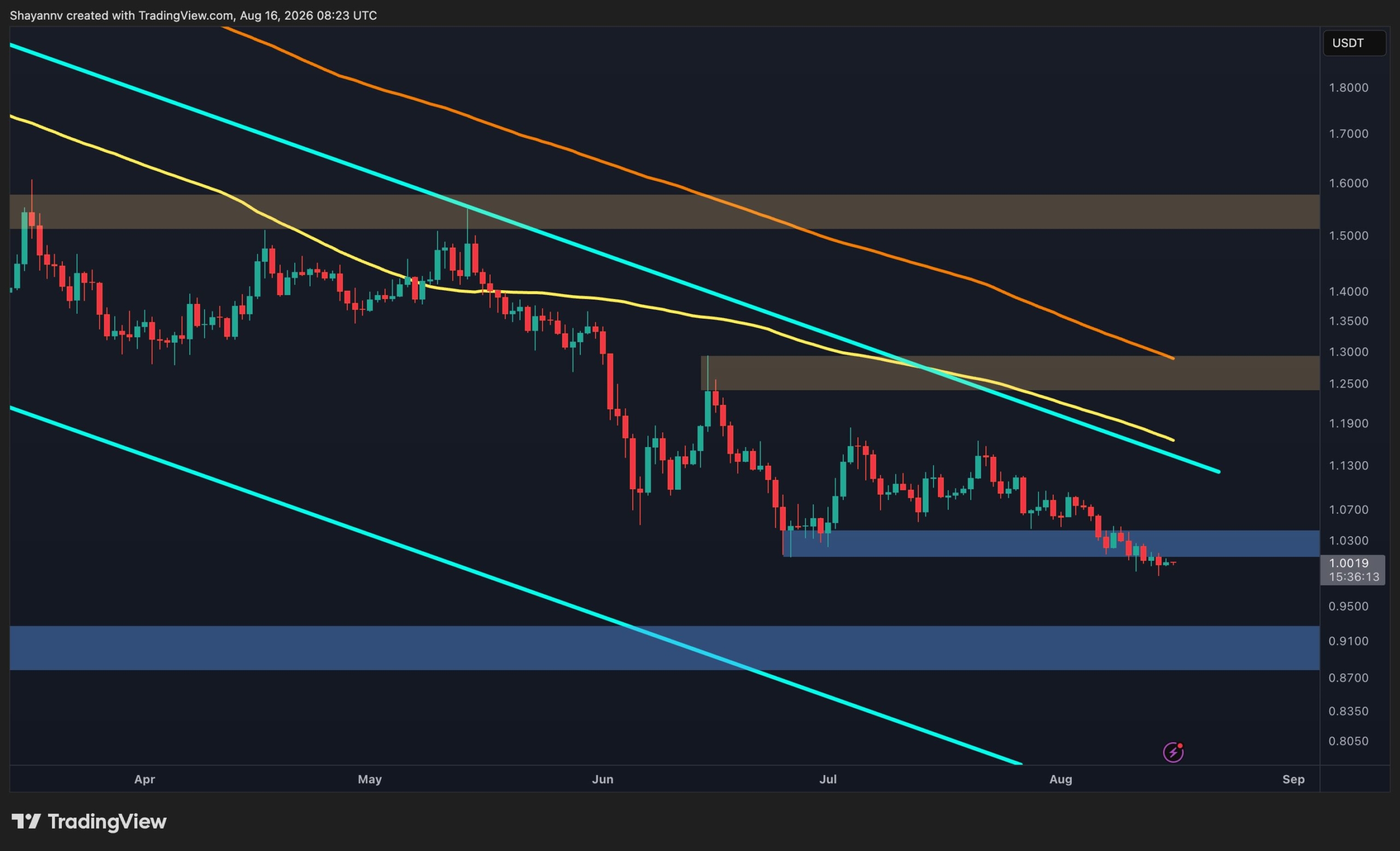
    The broader market structure appears to favor bears, with XRP trading below major moving averages on the daily timeframe. On the 4-hour chart, XRP has been forming lower highs beneath a descending trendline, reinforcing the bearish trend. This technical setup indicates that the market has lost momentum following previous declines, and a sustained recovery has yet to develop.

    Key Technical Levels: Resistance and Support
    Immediate resistance is identified in the $1.02-$1.04 area. XRP has recently moved below the $1.02-$1.03 support area on the 4-hour chart, suggesting that this former support may now act as resistance. The descending trendline overhead further reinforces the bearish structure.

    Immediate support is observed around the $1.00 level. However, if this level fails decisively, the next major downside reference is the demand zone between $0.91 and $0.97. This region represents the next significant support visible on the daily chart and could become relevant if the current consolidation resolves to the downside. A sustained move below the $1.00 area could expose this demand zone.

    Consolidation and Potential Scenarios
    The current consolidation just below $1.00 suggests that sellers have not completely lost control, although momentum is becoming compressed. The 4-hour chart presents a more immediate bearish picture, with recent rebound attempts repeatedly failing to produce a meaningful structural move. The lack of a strong bullish reversal suggests that the market may still be in a corrective phase.

    For the bearish setup to weaken, a sustained recovery above the $1.02-$1.04 resistance zone and a break above the descending trendline would be necessary to materially improve the daily structure. A stronger recovery above the $1.06-$1.08 area would provide a more convincing signal that the current downtrend is losing momentum. Until such a break occurs, the path of least resistance appears tilted to the downside, with the potential for another test of lower support levels remaining a possibility.

    Why This Matters

    The current market analysis indicates that XRP is trading below major moving averages and within a descending structure, suggesting a bearish trend. The uncertainty remains regarding whether XRP can defend the $1.00 level.

    Broader Context

    This market analysis is presented in the context of discussions surrounding XRP’s price movements. The post Ripple Price Prediction: Can XRP Defend $1 or Will $0.90 Come Into Play Next? appeared first on CryptoPotato.

  • XRP ETFs Show Gains, But Inflows Lag

    XRP ETFs Show Gains, But Inflows Lag

    XRP ETFs End Week in the Green Amidst Stagnant Inflows

    The past week saw a curious development in the spot XRP Exchange Traded Funds (ETFs) as they concluded the trading period in positive territory, despite a single day accounting for all the activity. This pattern of minimal inflows has become a recurring theme, coinciding with a continued downturn in the price of the underlying asset, which has fallen below $1.00 for the first time in nearly two years.

    The net flows into spot XRP ETFs last week offered little new insight, continuing a trend that has persisted for some time. While the five-day trading period registered positive net flows, the overall picture was less encouraging. The funds saw a modest inflow of $2.25 million, a slight increase from the previous week’s $1.01 million.

    For context, these exchange-traded funds tracking the cross-border payment token were attracting over $20 million weekly in late June and surpassed $60 million in mid-May.

    A closer examination of the daily performance reveals a more concerning trend. The entirety of the $2.25 million inflow occurred on Thursday. The remaining four trading days of the week showed no reported activity, with data from SoSoValue indicating $0.00 for each of those days. This pattern extends to August, where six out of the ten business days have mirrored this trend of zero inflows. Consequently, cumulative net inflows have remained just over $1.51 billion, with minimal movement observed in recent weeks.

    On a more positive note, several major U.S. financial institutions, including Morgan Stanley, have disclosed significant holdings in XRP through ETFs in the past week.

    However, this apparent lack of sustained institutional interest, juxtaposed with reports of Ripple “whales” accumulating XRP, has coincided with a consistent decline in the native token’s price over the past few weeks. The asset recently faced rejection at the $1.10 mark and subsequently plunged, losing the $1.05 support level. In the days that followed, XRP dipped below $1.00 on multiple occasions and is currently struggling to decisively reclaim that level.

    From a technical and on-chain perspective, the outlook for XRP is mixed. While some on-chain metrics suggest an increase in network activity, overall investor sentiment has deteriorated to a multi-month low. Simultaneously, XRP’s Open Interest has reached its highest levels since the significant market event in October 2025, potentially signaling heightened volatility in the upcoming trading sessions.

  • Bitcoin ETFs See Net Outflows, Ethereum ETFs End Five-Week Inflow Streak

    Bitcoin ETFs See Net Outflows, Ethereum ETFs End Five-Week Inflow Streak

    Last week, Bitcoin exchange-traded funds (ETFs) experienced substantial net outflows totaling nearly $390 million, marking a notable shift after a period of strong inflows. Concurrently, Ethereum ETFs, which had maintained a streak of net inflows for five consecutive weeks, also recorded modest net outflows.

    Bitcoin ETF Flows Under Pressure
    The past week saw Bitcoin ETFs bleed approximately $390 million. Monday was the most significant day for withdrawals, with $144.67 million leaving the funds. Wednesday saw outflows of $61.16 million, followed by $131.13 million on Thursday and $57.63 million on Friday. Tuesday was an exception, with Bitcoin ETFs experiencing net inflows of $4.89 million.

    Among the largest Bitcoin ETFs, BlackRock’s IBIT holds nearly $47 billion in net assets, Fidelity’s FBTC has $10.70 billion, and Grayscale’s GBTC has $8.26 billion.

    Ethereum ETF Streak Snapped
    Ethereum ETFs, after a five-week run of positive net inflows, also saw a reversal. Last week, these funds experienced net outflows totaling $2.26 million. Monday accounted for $14.59 million in outflows, and Tuesday saw $1.76 million in net outflows. However, the trend partially reversed mid-week, with $7.38 million in net inflows on Wednesday and $6.72 million on Thursday. Friday recorded no net flows, with SoSoValue showing $0.00.

    Context and Uncertainty
    The second full week of August did not provide confirmation of a sustained positive trend for crypto ETFs. The Bitcoin ETFs had previously registered their best week since April, attracting over $850 million in net inflows. The Ethereum ETFs, in contrast, had built a consistent inflow streak from the first full week of July through the first full week of August, during which their cumulative net inflows grew from under $10.90 billion to $11.46 billion.

    The recent data introduces uncertainty regarding the immediate future of investor behavior towards cryptocurrency ETFs. While the Ethereum ETFs’ outflows were significantly smaller than those of their Bitcoin counterparts, the end of their inflow streak highlights a complex market environment. The long-term trend of Bitcoin and Ethereum ETF flows remains a key point of observation.

    Why This Matters

    The materials describe a narrow update: Last week, Bitcoin ETFs experienced net outflows totaling nearly $390 million, with Monday being the most significant day for withdrawals. Whether the late Q2 ETF slumber is over and investors have finally shifted their behavior.

    Broader Context

    Source materials place the factual news in this context: The spot exchange-traded funds tracking the performance of the largest cryptocurrency by market cap turned red once again in the past five trading days, with just one day recording more net inflows than outflows.

  • Meta Patents Facial Recognition Cameras

    Meta Patents Facial Recognition Cameras

    Camera System Patent Could Identify and Log Individuals by Face

    Meta Platforms Technologies, the division responsible for Meta’s research and development and hardware intellectual property, has filed a patent for a camera system capable of identifying individuals by their faces and recording their actions.

    The patent application details how cameras would feed footage into an artificial intelligence system that tags individuals within the frame, detects their activities, and compiles this information into media clips that can be accessed on demand via a phone or headset.

    This concept is not entirely new for Meta. The company’s smart glasses, developed in partnership with EssilorLuxottica and launched in 2023, have been worn by users for years. These glasses, which have drawn criticism and are sometimes referred to as “pervert glasses” online, can record first-person video and allow wearers to query an AI about what they are seeing.

    The same Meta entity that developed these smart glasses and the Quest headsets is behind this new patent filing. The accompanying drawings depict a glasses wearer observing a room full of people. The proposed facial recognition technology would elevate the hardware’s capability from simply “recording what I point at” to “knowing and naming who is in the room.”

    The patent outlines a four-step process. First, cameras capture live or recorded footage and transmit it to the system. A facial recognition layer then analyzes the frames to identify specific individuals present, not just the presence of a person.

    A separate action detection layer operates in conjunction with facial recognition, identifying movements such as picking up an object, leaving a room, or a group gathering. Finally, the system consolidates its findings into individual media files, each tagged with the identified person, their action, or both.

    What distinguishes this system from a standard smart doorbell is its integrated assistant layer. The patent describes footage retrieval as a conversational process, where a connected device can request specific video content through a query. The system would then generate the response using the tagged clips, eliminating the need for manual scrubbing through footage. The drawings illustrate both server-side and on-device processing workflows, with a natural language understanding pipeline feeding into the clip composer.

    The most contentious aspect of this patent is its potential capability to identify and log specific individuals by face without their explicit consent. This mirrors concerns previously voiced by Democratic senators who questioned Meta about facial recognition technology in its smart glasses. As previously reported, these senators warned that real-time facial identification could increase the risk of stalking and harassment.

    Meta’s existing hardware is already at the center of this debate. Owners of the recently released Ray-Ban smart glasses from Meta have been able to record strangers in public, and contractors have reviewed private footage. A wearable camera that also identifies individuals by name would further amplify the disparity between Meta’s portrayal of its technology as a “helpful assistant” and its actual capabilities, prompting public apprehension and the development of countermeasures.

    It is important to note that this is a patent filing, not a released product. The patent is currently in the “Ready for Examination” stage, with Patentlyze assessing the likelihood of its grant as medium. Meta has previously filed patents for similar computer vision technologies for glasses, and its publication signifies that the idea is officially documented, not that the feature is under development or approved for release.

  • France Tax Data Leak Risks Bitcoin Holder Scams

    France Tax Data Leak Risks Bitcoin Holder Scams

    Hacker Offers French Tax Records for Sale, Exposing Hundreds of Thousands to Risk

    A hacker is reportedly selling a vast trove of French tax records, potentially exposing over 678,000 individuals and businesses to phishing scams, identity theft, and targeted attacks. The compromised data allegedly originates from France’s tax authority, the DGFiP, and was stolen during a breach in June.

    According to a report by French cybersecurity outlet FrenchBreaches, the hacker is seeking several thousand euros for the database. Jameson Loop, Chief Security Officer at Bitcoin security platform Casa, highlighted the severity of the breach on X, noting, “The French tax authority has been hacked, and 678K records leaked.”

    FrenchBreaches detailed that the compromised database contains records for 392,867 individuals and 285,570 professionals. Among these are 26,805 individuals with reported tax incomes of at least $116,000, 386 individuals earning over $1.16 million, and eight individuals with incomes exceeding $11.6 million. The hacker is said to be offering the complete file for several thousand dollars.

    A sample of the leaked data, as described by FrenchBreaches, includes names, birth dates, home and email addresses, phone numbers, income figures, withholding tax rates, family status, dependent information, and tax-sharing details.

    In an update, FrenchBreaches stated, “The DGFiP officially confirms the intrusion in its information system.” The firm added that stolen credentials were used in late June to access and extract taxpayer data, and the full extent of affected individuals is still under investigation.

    The attacker reportedly exploited stolen VPN credentials and an internal search tool to extract names, contact details, tax identification numbers, income figures, withholding rates, and family information before authorities could revoke access.

    FrenchBreaches warned that the availability of such sensitive tax information could enable scammers to craft highly credible fraudulent messages, far more convincing than generic phishing emails.

    This data leak occurs amidst a concerning rise in “wrench attacks,” a form of crime where perpetrators use violence or threats to extort cryptocurrency. In July, cybersecurity firm CertiK reported 52 such attacks globally in the first half of 2026, with 33 occurring in France. Earlier this month, Chainalysis reported 46 attacks through June, including 30 in France, resulting in over $30 million in stolen funds.

    Chainalysis noted that “criminals have recognized that crypto holders are high-value targets because they possess wealth in an instantly and irreversibly transferable form.”

  • Kalshi, Polymarket Face Broader Legal Scrutiny

    Kalshi, Polymarket Face Broader Legal Scrutiny

    Baltimore Sues Prediction Market Operators Over Alleged Illegal Sports Betting

    Baltimore has initiated legal action against prediction market operators Kalshi and Polymarket, accusing both companies of offering illegal sports betting within the city.

    Mayor Brandon M. Scott and the Baltimore City Council filed separate lawsuits on August 13 in the Circuit Court. The complaints allege violations of Baltimore’s Consumer Protection Ordinance and accuse the companies of misleading consumers regarding the legality and regulation of their products.

    The lawsuits claim that Kalshi and Polymarket permit Baltimore residents to wager on game outcomes, point spreads, total scores, individual player statistics, and other events typically found in licensed sportsbooks. While the companies categorize these offerings as “event contracts” or prediction market trades, city officials contend that the nomenclature does not alter the fundamental nature of the products.

    According to the filings, neither platform possesses the necessary licenses to offer sports betting in Maryland. The city argues that this allows the companies to compete with regulated sportsbooks while circumventing the oversight, taxation, responsible gambling mandates, and consumer protections applied to licensed operators.

    Concerns have also been raised about the promotional strategies employed by these companies. Baltimore alleges that Kalshi and Polymarket market their platforms in a manner that creates a false or misleading impression of legality and proper regulation. The city further asserts that this practice can increase gambling accessibility and expose vulnerable consumers, including young adults and individuals with gambling addictions, to potential financial harm.

    Baltimore is seeking civil penalties, injunctive relief, restitution for affected consumers, disgorgement of alleged illicit profits, and other remedies permitted by law.

    Both Kalshi and Polymarket are currently involved in other legal and regulatory disputes. Kalshi, for instance, recently faced a lawsuit from New York State Attorney General Letitia James, who sought to halt its operations in the state. Subsequently, the U.S. Commodity Futures Trading Commission invoked its emergency authority to mandate Kalshi’s continued operation in New York after the company requested federal intervention. The CFTC stated that this order followed the platform’s plea for assistance after the state lawsuit was filed in late July.

    Kalshi also faced a lawsuit from flight-tracking company FlightAware concerning prediction markets related to flights. FlightAware accused Kalshi of unauthorized use of its data and name to host markets on flight cancellations. However, this case was withdrawn just one day later, with Kalshi’s legal representatives stating the lawsuit was voluntarily dismissed without prejudice against all defendants.

    Polymarket has encountered its own set of challenges. JPMorgan Chase ceased providing banking services to the company late last year. Polymarket has since secured services from a different lender, though the identity of this new financial institution has not been disclosed.

    Additionally, a separate consumer protection lawsuit has been filed against Polymarket in Washington, D.C. The National Association of Consumer Advocates alleges that the company, its CEO Shayne Coplan, and Chief Marketing Officer Matthew Modabber engaged in “flagrantly deceptive” social media advertising campaigns. These campaigns allegedly promoted Polymarket to American consumers and encouraged betting on a platform that was not technically available in the U.S.

    The D.C. complaint also references reports of political influencers endorsing Polymarket’s accuracy without disclosing paid partnerships. It cites a Wall Street Journal investigation that uncovered viral videos using simulated versions of the platform to suggest creators had won bets.

  • Trezor Data Breach at Shipping Partner Highlights Broader Hardware Wallet Security Risks

    Trezor Data Breach at Shipping Partner Highlights Broader Hardware Wallet Security Risks

    A data breach at Trezor’s shipping partner, ShipMonk, has exposed the personal information of approximately 13,700 customers, prompting a re-examination of the security considerations surrounding hardware cryptocurrency wallets. The incident underscores risks associated with the physical logistics and third-party vendor involvement in hardware wallet distribution, extending security concerns beyond the management of private keys.

    Breach Details and Exposed Information
    The breach, disclosed by Trezor on August 13, involved unauthorized access to ShipMonk systems that held customer order data. The exposed information includes names, phone numbers, and home addresses of recent Trezor customers. ShipMonk first notified Trezor about the unauthorized access on Monday, August 10. Importantly, Trezor has stated that its devices themselves were not compromised in this incident.

    Re-evaluating Hardware Wallet Risks
    In the wake of the breach, Binance founder Changpeng Zhao (CZ) highlighted what he described as a “real advantage” of software self-custody wallets. CZ argued that software wallets avoid the risks tied to shipping physical devices that link a user’s identity and address to their cryptocurrency holdings. He noted that while hardware wallets have specific advantages, this incident underscores a different risk profile compared to software alternatives like the Binance Web3 Wallet or Trust Wallet, which do not involve shipping physical products.

    Broader Security Landscape and Expert Warnings
    Security experts have warned that the exposed data could be used for sophisticated phishing attacks, social engineering, or even physical threats. Nick Neuman cautioned that the data could lead to targeted social engineering and potentially wrench attacks, while NaoX Protocol stated that exposed addresses could identify crypto holders for direct targeting. Trezor has advised its customers to be vigilant against potential phishing attempts via email, phone calls, or letters, and stressed the importance of never entering wallet backups online or sharing them.

    This incident is not the first time Trezor has faced security concerns related to third-party vendors. In January 2024, a separate breach involving a Trezor third-party support vendor exposed contact details for around 66,000 users. Furthermore, the broader hardware wallet ecosystem has seen recent scrutiny. In mid-July, pseudonymous crypto investigator ZachXBT criticized hardware wallets as “complete garbage” for serious use, suggesting that a spare phone used solely for signing transactions might be a more secure alternative. Additionally, Galaxy Research has linked over $100 million in stolen Bitcoin to a firmware issue in older Coldcard devices.

    Implications for Users
    The ShipMonk breach underscores that the security of hardware wallets extends to the supply chain and data handling practices of their partners. The incident prompts a re-evaluation of the overall security model for self-custody, considering risks beyond the digital realm. Users are reminded to remain cautious and follow best practices for securing their cryptocurrency assets, regardless of the wallet type they choose.

    Broader Context

    Source materials place the factual news in this context: The incident involves a data breach at Trezor’s shipping partner, ShipMonk.